

★★★★½ 4.5/5 — A shared life costs a little impulse. Pay it on purpose.
Best for: Anyone who wants closeness and freedom at the same time, and keeps waiting for a mood or a device to settle the argument
Reading time: ~4 hrs for the Norton edition · ~12 min for this guide
Difficulty to apply: Medium — the essay is short; the guilt habit is not
Civilization and Its Discontents in one minute
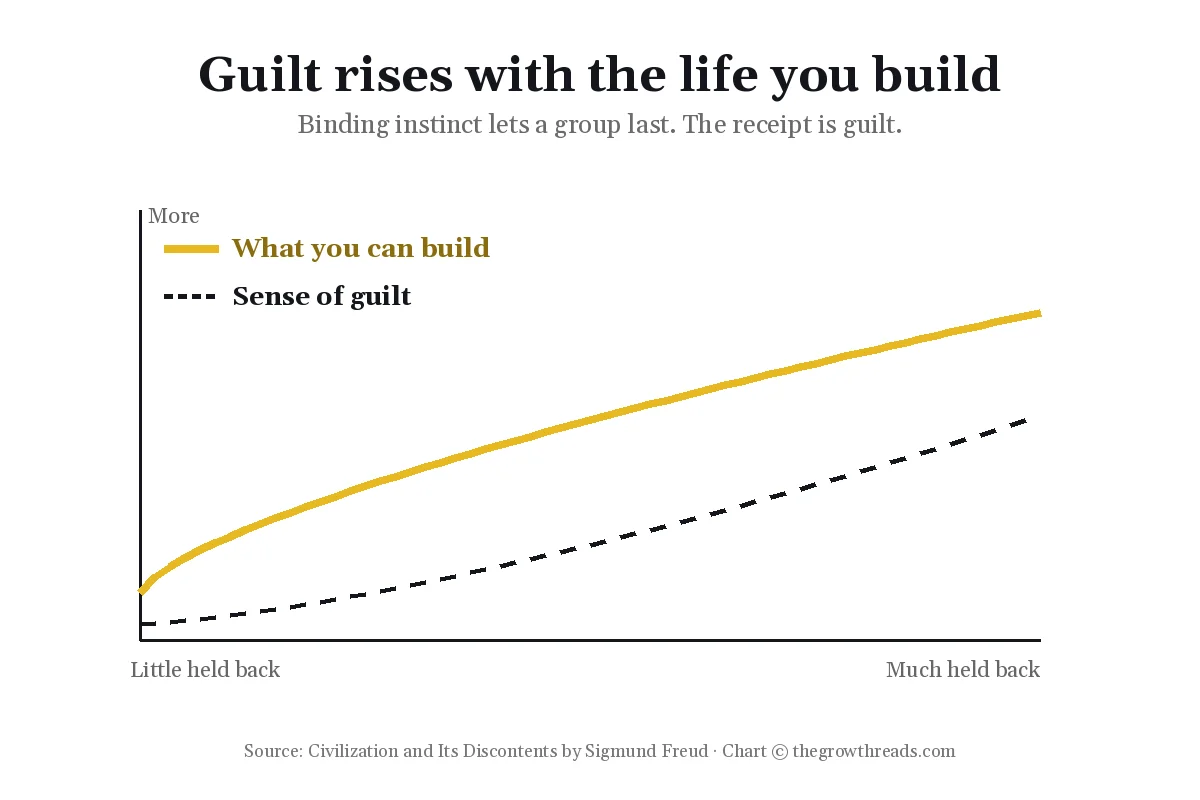
Discontent is not proof that your life failed. It is the receipt for living with other people. In 1930 Freud wrote a short essay, not a case history, about why pleasure and a shared world pull apart. The body aches. The outer world does not care. Other people are the suffering we thought we could legislate. Civilization stands on two parents he names without romance: love, and the work that necessity demands. Aggression that cannot be spent on a neighbor turns inward. Guilt is that turn. Happiness arrives as a contrast, then leaves. The steal: name the bond you are keeping and the work you are offering it.
Key takeaways
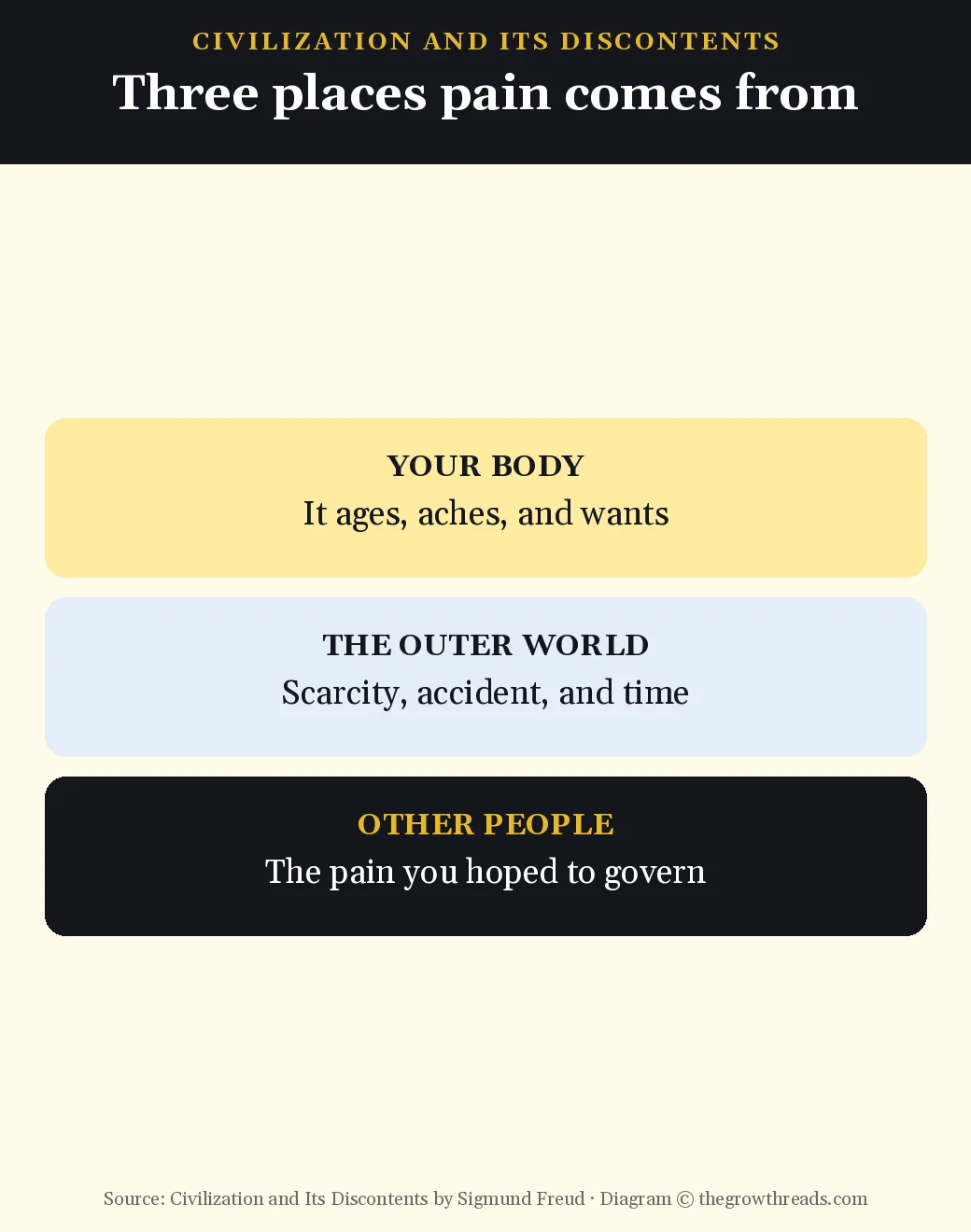
- Three sources of suffering: Your body, the outer world, and other people. The third hurts most because you expected to govern it.
- Happiness is a contrast: It spikes against a background and will not hold as a climate. Design the spike. Do not hunt a permanent high.
- The pleasure program cannot be completed: Wanting less pain and more joy is human. Expecting it as a steady state is how the week goes sour.
- Love and necessity build the shared world: Eros binds. Ananke — reality’s demand that someone do the work — keeps the binding from being only a feeling.
- Sublimation is the clean use of heat: Put restless energy into a page, a repair, a craft. The drive stays. The wreck does not have to.
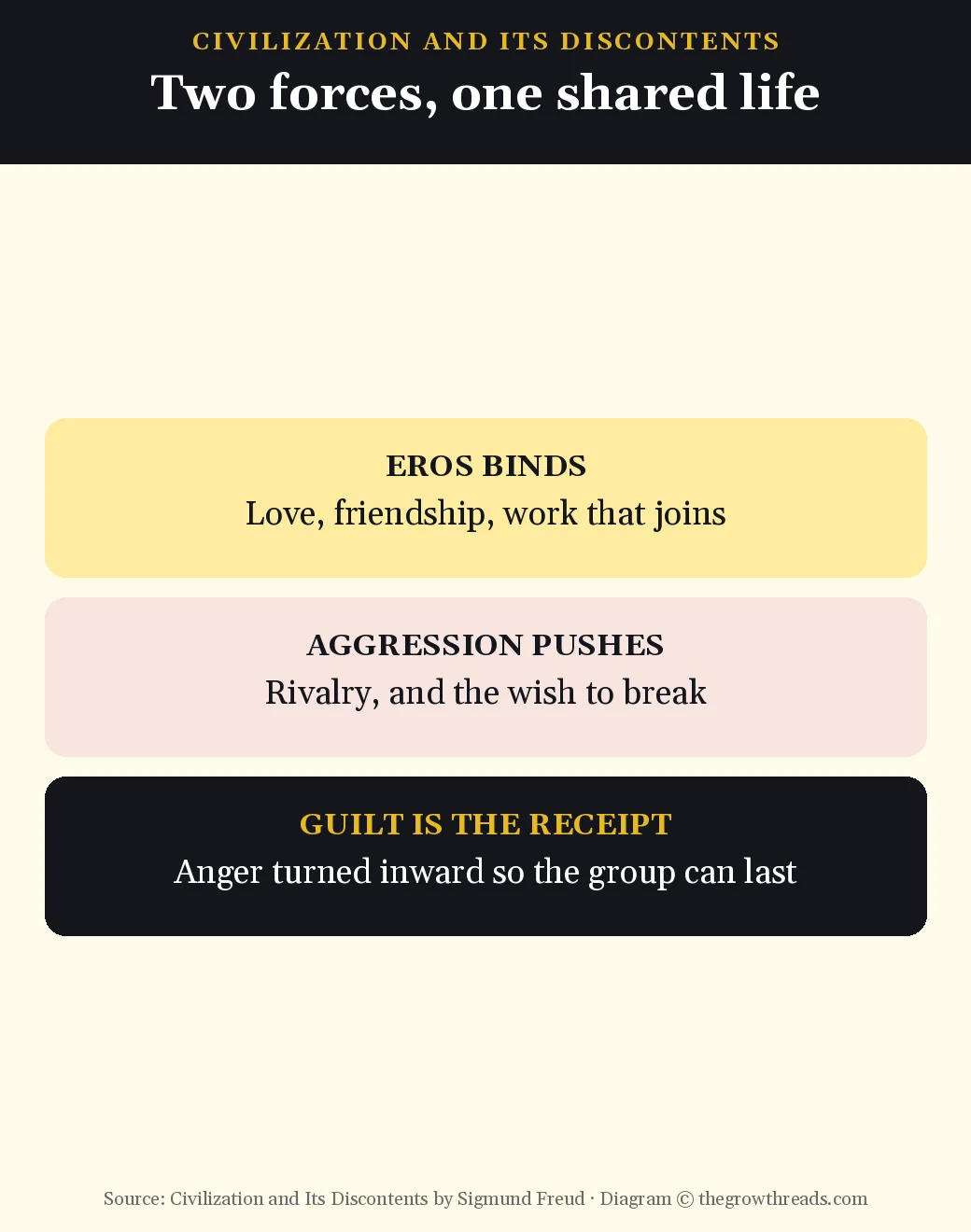
- Aggression is in the room: Rivalry and the wish to break things are not a personal glitch. A group that pretends otherwise just hides the bill.
- Guilt is aggression turned inward: The superego spends on you what you did not spend on them. That is the price of a street you can walk.
- Neighbor-love needs a limit: One specific kindness with a boundary, not a universal vow that manufactures guilt.
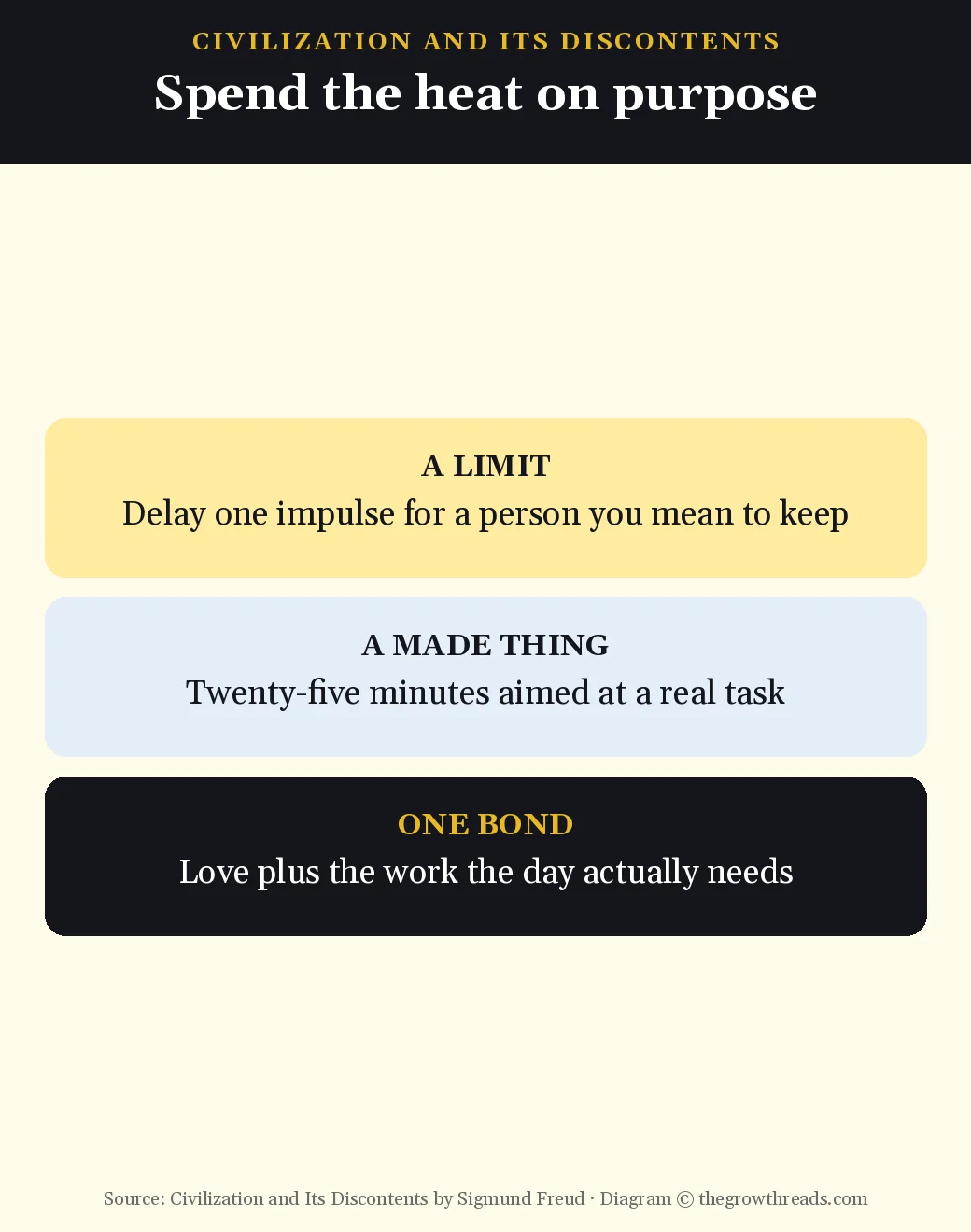
- The practical pair: One bond you will keep, and one piece of work you will offer it this week.

What is Civilization and Its Discontents about?
Civilization and Its Discontents is Freud’s 1930 essay on the price of a shared life. Love and necessary work bind people into a world, and the aggression they refuse to spend on each other returns as guilt. Happiness stays a contrast, not a climate. The use is to choose the bond and the work.
About the author
Sigmund Freud (6 May 1856 – 23 September 1939) was an Austrian neurologist who built psychoanalysis in Vienna after training with Jean-Martin Charcot in Paris. By 1930 he was already known for The Interpretation of Dreams, and he was living with the jaw cancer that shadowed his last years. This book is not a night-method. It is a late essay, written as Europe hardened, about why people who want pleasure still build families, cities, and laws that frustrate them. He had spent decades listening to private wishes. Here he asks what those wishes do when they have to share a street. He does not offer a cure for discontent. He offers a map of the ache, so a reader can spend it on a bond and on work instead of on a mood that will not stay. Explore all Sigmund Freud book summaries →
Key concepts at a glance
| Concept | What it means | Use it when |
|---|---|---|
| Pleasure principle | The push toward less pain and more joy, as soon as possible | You are treating a spike of relief as a life plan |
| Reality principle | Delay, because the world and other people do not move on your clock | A want is real and the timing would break a bond |
| Three sufferings | The body, the outer world, and relations with other people | You are blaming one realm for pain that lives in another |
| Eros | The binding instinct: love, friendship, the wish to join | You need a reason to stay in the room that is not fear |
| Aggression | The push to rival, master, or break — Freud’s late pairing with Eros | Irritation keeps leaking into people you meant to keep |
| Sublimation | Drive turned into work, art, or a craft the group can use | You have heat and nowhere honest to put it |
| Superego and guilt | Aggression turned inward so the group can last | You feel guilty and cannot name who you are angry at |
| Ananke | Necessity: the work reality demands, beside love | The feeling is warm and the task is still undone |
Part 1: The oceanic feeling is a question, not a proof
The essay opens on a letter. Romain Rolland had described an “oceanic feeling,” a sense of being joined to the whole, and called it the root of religious feeling. Freud cannot find that feeling in himself, and he will not treat his limit as a disproof. His guess is developmental. An infant has no clean line between self and world. A wide feeling may be that early state returning in prayer, music, or a crowd. He does not call religion a trick. He calls it one serious answer to helplessness.
The steal is how he holds the question. Respect the feeling, then ask what job it does on Tuesday. Awe at a coast may be contact with more than you can name, or the old wish to be held. You can feel joined to everything at dawn and still be sharp in the kitchen at eight. Name the feeling. Then return to the bond it did not repair.
TGR Note: Be Here Now stays with the wide feeling. Use it when the hour needs stillness. Use this chapter when the feeling is real and the kitchen is still unresolved. The Interpretation of Dreams is the night method. This essay is the daylight problem: what a wish does among other people.
Part 2: Happiness is a contrast with three hard limits
People want little pain and strong pleasure, and they want both to last. Freud thinks that program fails because feeling notices change. A pleasure that continues becomes the background, and the background does not feel like joy. Suffering arrives three ways. The body wants and decays. The outer world — accident, scarcity, time — does not negotiate. Other people are the source we take personally, because we believed a better rule or a better self should have prevented them.
He lists the ordinary paths without crowning one. Intoxication mutes the world and costs too much; this guide will not send you there. Withdrawal shrinks the surface others can strike. Beauty offers a milder joy that does not need their cooperation. A quieter instinctual life lowers the demand. Love is the strongest path and the most exposed, because another person’s mood becomes your weather. Work aims the same energy at something that outlasts a spike. None of these is a cure. Pick a path you can repeat.
TGR Note: Man’s Search for Meaning answers a pleasure program that cannot be completed: meaning can hold a day when joy will not. Stumbling on Happiness is the later warning that we misjudge what will still feel good once it is normal. Design a contrast, then go back to the work.
Part 3: Love and necessity build the shared world
Civilization here is whatever protects people from nature and regulates how they treat one another: tools, order, and rules that let strangers share a street. Communal life has two parents. One is compelled work. Reality requires that someone fetch, build, teach, and repair. The other is love. Eros binds partners, then families, then wider circles. Freud is for that binding. He is against the fantasy that it is free.
Every bond spends an impulse that wanted to go now. Law asks you not to take what you could take. Sublimation is the fortunate version: the drive is used, not only crushed. Someone paints, nurses, designs, or organizes. The minimum is enough for a Tuesday. Twenty-five minutes aimed at a real task is a channel. Love without necessity is a mood. Necessity without love is a shift. The essay wants both.
TGR Note: The Lucifer Effect shows what groups do with aggression when the setting licenses it. Read that when the question is what the system allowed. Read this chapter when the question is what you did with heat you were not allowed to spend. The Laws of Human Nature is a later field guide to the same rivalries.
Part 4: Aggression turned inward becomes guilt
Aggression, for Freud, is a feature of life with others, not a rare defect. A group lasts only if much of it is held back. A rule that stays outside you is easy to dodge, so conscience installs it. What cannot go outward is spent on the self. Guilt is that spend. In James Strachey’s English he writes, “The price we pay for our advance in civilization is a loss of happiness through the heightening of the sense of guilt.” Read that as a description. A lot of “I am bad” is anger that lost its address.
Neighbor-love strikes him as expensive because the neighbor may be a stranger or a rival. The command is not false. In people who already hold back, it can become a guilt machine. The usable form is smaller: one act, one person, one limit you can say aloud. Power raises what you can do, then becomes the background, and the background stops feeling like happiness. Your version of his hope is the bond you keep and the work you do while the guilt is named.
TGR Note: The Denial of Death treats culture as a hero-system against mortality. Freud’s bill is different: aggression that had to go somewhere. Read Becker when the project is immortality. Read this chapter when you were kind in public and harsh in your own head. If the guilt arrives as a picture, work it in Man and His Symbols, then give the heat a job.
Who is Civilization and Its Discontents best for — and who should read something else first?
Best for readers who feel vaguely guilty for wanting both closeness and a private will, who are disappointed that success did not feel like happiness for long, or who keep trying to love “everyone” and then snapping at one person. The Norton edition, with James Strachey’s translation, is the standard general-reader door. This guide is the steal: three sufferings, love plus necessary work, guilt as redirected aggression, one bond and one job this week.
Read something else first if you want the night method — The Interpretation of Dreams. If you want meaning where pleasure fails, Man’s Search for Meaning. If you want groups licensing harm, The Lucifer Effect. If you want the wide feeling, Be Here Now. If guilt arrives as a picture, Man and His Symbols. If guilt is crushing you, or you are unsafe, talk with a clinician and keep the week’s act small.
Questions to reflect on
- Which suffering ran yesterday — body, outer world, or another person — and which one did you blame for all of it?
- Where are you asking a pleasure to become a climate?
- What heat did you turn inward, and who would have received it?
- What bond are you keeping, and what work are you offering it?
- What kindness with a limit can you do in the next two days?
🔥 Ready to read the essay behind the guilt?
Get Civilization and Its Discontents and steal a week of love, work, and a named receipt.
How to apply Civilization and Its Discontents (7-day plan)
- Day 1 — Sort the pain. Write three lines: body, outer world, other people. One concrete fact each. Do not solve them. See which line you have been using to explain the other two.
- Day 2 — Delay one impulse for a person. Pick a bond you mean to keep. Delay one small discharge that would have landed on them: the second message, the sigh, the correction. Tell nobody. Just pay it.
- Day 3 — Give the guilt an address. When the harsh verdict shows up, write: if this were anger, who or what would it be about? One sentence. You do not have to send it.
- Day 4 — Sublimate for twenty-five minutes. Put the restless energy into one made thing: a page, a repair, a meal, a lesson plan. Stop when the timer ends. The point is a channel, not a masterpiece.
- Day 5 — Design a contrast. One real stop after effort: a walk without a feed, or twenty quiet minutes. Let pleasure be a spike, not an all-evening product.
- Day 6 — One kindness with a limit. Do one specific good for one person, and say the boundary in the same note.
- Day 7 — Write the pair. Two clauses: the bond I am keeping, the work I am offering it. Put the sentence where Monday can see it. Then do the first half-hour of the work.
Frequently asked questions
What is Civilization and Its Discontents about?
Civilization and Its Discontents is Freud’s 1930 essay on why a shared life costs happiness. People want strong pleasure and little pain, and that program cannot hold, because joy fades into the background and suffering arrives from the body, the outer world, and other people. Love and necessary work bind families and cities. Aggression that must not land on a neighbor turns inward as guilt. The steal is a pair you can keep: one bond, and one piece of work you offer it this week, without waiting for a mood to become the climate.
What does Freud mean by the “oceanic feeling”?
The “oceanic feeling” is Romain Rolland’s phrase for a sense of eternity and of being unbounded, which he took as the root of religious feeling. Freud does not find it in himself, and he will not treat that as a refutation. He guesses it may remember early life, before the ego drew a line between self and world. He takes the report seriously and still refuses to let the feeling solve other people. You can stand in awe at dawn and be sharp in the kitchen at eight. Use the feeling when it is real. Then return to the bond it did not repair.
Why does Freud say civilization creates guilt?
Freud thinks aggression is part of life with other people, not a rare defect. A group lasts only if much of that aggression is held back. A rule outside you is easy to dodge, so conscience installs it. What cannot go outward is spent on the self, and guilt is the name of that spend. He is not asking you to feel worse. He is asking you to see a harsh verdict as anger that lost its address. Name the address in one sentence you do not have to send. Then put the heat into a task or a clean limit, not into a story that you are simply bad.
What are the three sources of suffering in this book?
Freud names three. The body ages, aches, and wants, and it will not take orders from your plan. The outer world — scarcity, accident, time — does not negotiate. Other people are the third, and the most grating, because we believed this one should have been governable by love or effort. When a week feels globally wrong, write one fact under each heading. A bodily fact is often prosecuted as a relationship failure, or a real hurt is treated as a mystery of the universe. Sort first. Then spend effort on the line you can actually touch today.
Is Civilization and Its Discontents against happiness?
No. He is against the idea that happiness can be a permanent climate. We register contrasts, so a pleasure that continues stops feeling like pleasure, and the three sufferings keep interrupting any plan to feel good without a break. That is a limit, not a ban on joy. He catalogs paths people already use — love, beauty, work, a quieter instinctual life — and he prefers the ones that build something. Let a good hour be a spike against effort. Do not indict it because Thursday returned. Design one real contrast this week, then go back to the bond and the work.
How is this different from The Interpretation of Dreams?
The Interpretation of Dreams is Freud’s night book. A dream stages a wish the day refused, and the method is to follow associations from the plot. Civilization and Its Discontents barely needs a dream. It asks what wishes do in daylight, once other people, work, and conscience are in the room. Keep the dream book when you wake with a story. Keep this essay when the day itself is the problem: you got what you worked for and contentment did not stay, or you were kind in public and cruel in your own head. Same author, two scales. One reads a night. The other reads a household.
Has the “death instinct” been debated, and can you still use the book?
Yes. The speculative “death instinct” has been debated for decades, and you do not need it to use the essay. Freud is reaching for a name for aggression and for the way life undoes itself. Later clinicians have offered other accounts of anger and self-attack. The practical counsel is uncontroversial: pleasure will not stay, living together requires delay, unspent aggression often returns as guilt, and love plus real work beats a mood. If a technical term stalls you, translate it into heat, a limit, a bond, and a task. If guilt is crushing or you are not safe, talk with a clinician. Keep the week’s act small.
Related summaries
- The Interpretation of Dreams — Freud’s night method, beside this daylight essay.
- Man’s Search for Meaning — Frankl’s answer when the pleasure program cannot be completed.
- The Denial of Death — Becker on culture as a hero-system, a different bill from guilt.
- The Lucifer Effect — what groups do with aggression when the setting licenses it.
Browse the full list on our Best Psychology Books pillar.
How we analyze books: our summaries are built from a full read of the source text, cross-referenced against the author’s published essays and letters where relevant, and structured around practical application rather than critique. Read our full methodology.