

★★★★½ 4.5/5 — the most practical, no-nonsense money book for beginners. A genuine step-by-step system to automate your finances and build wealth without deprivation.
Best for: young adults and beginners who want a clear, actionable plan rather than budgeting guilt · Reading time: ~6 hours (this guide: 15 min) · Difficulty to apply: Easy — the system is simple; setting it up takes a weekend
I Will Teach You to Be Rich in one minute
You don’t need to become a budgeting monk to get rich — you need to automate a simple system and then spend guilt-free on the things you love. Ramit Sethi’s practical, irreverent guide rejects the deprivation model of personal finance (stop buying lattes, track every penny) in favor of a “conscious spending” approach: cut costs mercilessly on the things you don’t care about, so you can spend extravagantly on the few things you do. His core insight is that willpower fails, so you should build an automatic money system that pays your bills, invests, and saves for you without you having to think about it. The book is structured as a six-week program covering optimizing credit cards, opening the right bank and investment accounts, creating a conscious spending plan, automating everything, and investing simply in low-cost index funds. Rather than obsessing over trivial expenses, Sethi urges you to focus on the handful of “big wins” that actually move the needle. The result is wealth-building that runs on autopilot and a “Rich Life” defined on your own terms.
Key takeaways
- Define your Rich Life: “rich” is personal — decide what you truly want your money to give you before you optimize anything.
- Spend extravagantly on what you love, cut mercilessly on what you don’t: guilt-free spending on your priorities is the point.
- Focus on big wins: a few major decisions (automating investing, negotiating fees, salary) matter far more than skipping lattes.
- Automation beats willpower: set up your money to flow automatically so good financial behavior happens without effort.
- The conscious spending plan: allocate roughly 50–60% to fixed costs, 10% to investments, 5–10% to savings, and 20–35% to guilt-free spending.
- Use credit cards wisely: pay in full for rewards and credit history; never carry a balance.
- Open the right accounts: a no-fee checking account and a high-yield savings account are the foundation.
- Invest simply: capture any employer match, use tax-advantaged accounts, and buy low-cost index or target-date funds.
- The 85% solution: a good plan you actually start beats a perfect plan you never do.
- Time in the market matters most: start investing early and let compounding do the heavy lifting.
What is I Will Teach You to Be Rich about?
I Will Teach You to Be Rich is a personal-finance book by Ramit Sethi presenting a six-week program to automate your money and build wealth. It teaches “conscious spending” — cutting costs on what you don’t value to spend freely on what you do — along with optimizing credit cards, banking, and low-cost investing, so your finances run automatically toward your own version of a Rich Life.
About the author
Ramit Sethi is an American personal-finance expert, entrepreneur, and writer who built the popular “I Will Teach You To Be Rich” brand from a blog into a business teaching people about money, psychology, and entrepreneurship. He studied technology and psychology at Stanford, and that behavioral bent shapes his whole approach: he is less interested in spreadsheets than in how real people actually behave with money. First published in 2009 and substantially updated in a second edition in 2019, the book became a bestseller and a go-to recommendation for financial beginners, and Sethi later reached an even wider audience through his Netflix series on money. His voice is deliberately brash, funny, and opinionated, cutting through the guilt and jargon of traditional finance advice. His central conviction is that personal finance should be automated and largely ignored, freeing you to live your Rich Life rather than agonize over every purchase. Explore all Ramit Sethi book summaries →
Key concepts at a glance
| Concept | What it means | Use it when |
|---|---|---|
| Your Rich Life | Your personal definition of rich | Before optimizing anything |
| Conscious spending | Spend on what you love, cut the rest | Deciding where money goes |
| Big wins | The few high-impact decisions | Choosing what to focus on |
| Automation | Money flows without willpower | Setting up your system |
| Low-cost index funds | Simple, cheap, diversified investing | Investing for the long term |
| The 85% solution | Good enough beats perfect | You’re stalling on perfection |
Part 1: Your Rich Life and the philosophy of conscious spending
Sethi opens by rejecting the guilt-and-deprivation model that dominates personal finance. The obsessive advice to cut out small pleasures — the $3 coffee, the occasional dinner out — is, he argues, both miserable and beside the point, because those small expenses barely affect your long-term wealth. Instead, he asks you to define your own “Rich Life”: what would you actually want to do with money if you had enough? Rich might mean travel, generosity, great food, freedom to work less, or something else entirely — the definition is yours, and money is just the tool to fund it.
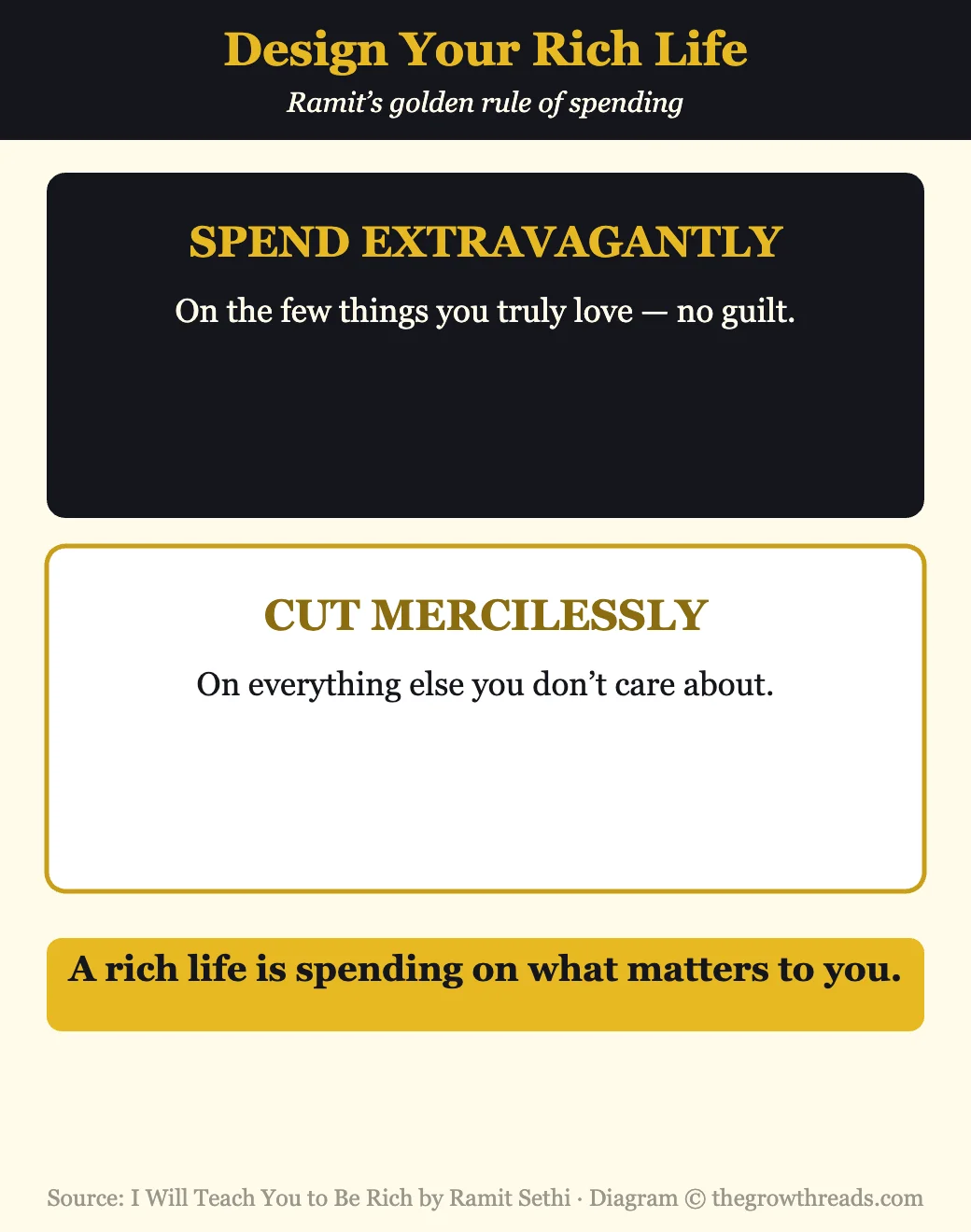
From this flows his signature principle: spend extravagantly on the things you love, and cut costs mercilessly on the things you don’t. If you love travel, spend lavishly on it without guilt — and to afford it, ruthlessly slash spending in categories you don’t actually care about. This “conscious spending” reframes budgeting from restriction into intentional prioritization. Two supporting ideas make the philosophy work. The first is to focus on big wins — the handful of high-impact financial moves like automating your investing, negotiating a lower rate or a higher salary, and choosing low-fee funds — rather than agonizing over trivial daily expenses, because a few big decisions dwarf a thousand small sacrifices. The second is the “85% solution”: getting most of the way there and actually starting beats waiting for a perfect plan you never implement. Done is better than perfect when it comes to money.
TGR Note: Where The Psychology of Money explains the behavior of wealth and Rich Dad Poor Dad lights the mindset fire, I Will Teach You to Be Rich supplies the missing mechanics — the exact accounts, automations, and steps. Read Housel and Kiyosaki for the why, and Sethi for the precise how-to.
Part 2: The plumbing — credit cards and bank accounts
The first practical weeks of the program set up the infrastructure of your financial life. Sethi is a strong advocate of using credit cards — not avoiding them — provided you pay them off in full every month. Used this way, cards build your credit history (which saves you real money on future loans), earn rewards and cash back, and offer purchase protections, all effectively for free. The cardinal rule is never to carry a balance and pay the high interest, which wipes out every benefit. He even encourages readers to call their card companies to negotiate away annual fees and late charges, and to ask for lower interest rates, showing that a five-minute phone call is a “big win” worth far more than skipping small purchases.
Next comes banking. Sethi recommends a simple two-account structure: a no-fee checking account for day-to-day cash flow, and a separate high-yield savings account (typically an online bank paying meaningfully more interest) for your emergency fund and savings goals. He is scathing about the fees and low interest of many big traditional banks and urges readers to switch to better options, again treating this as a one-time setup that pays off indefinitely. The theme throughout is optimization by design: get the accounts right once, negotiate away the parasitic fees, and then let the structure work for you rather than constantly fighting it.
Part 3: Invest simply and build your conscious spending plan
With the accounts in place, Sethi turns to investing, which he deliberately keeps simple. His recommended order of priority is clear: first, contribute to your employer-sponsored retirement account (like a 401(k)) at least up to any matching contribution, because a match is free money; next, fund a tax-advantaged individual retirement account such as a Roth IRA; and then invest additional money in ordinary accounts. Crucially, he steers beginners away from trying to pick individual stocks or beat the market and toward low-cost index funds or, even simpler, target-date funds that automatically diversify and rebalance for you. The winning strategy, he stresses, is not clever trading but consistently investing in cheap, diversified funds over a long time and letting compounding work — time in the market beats timing the market.
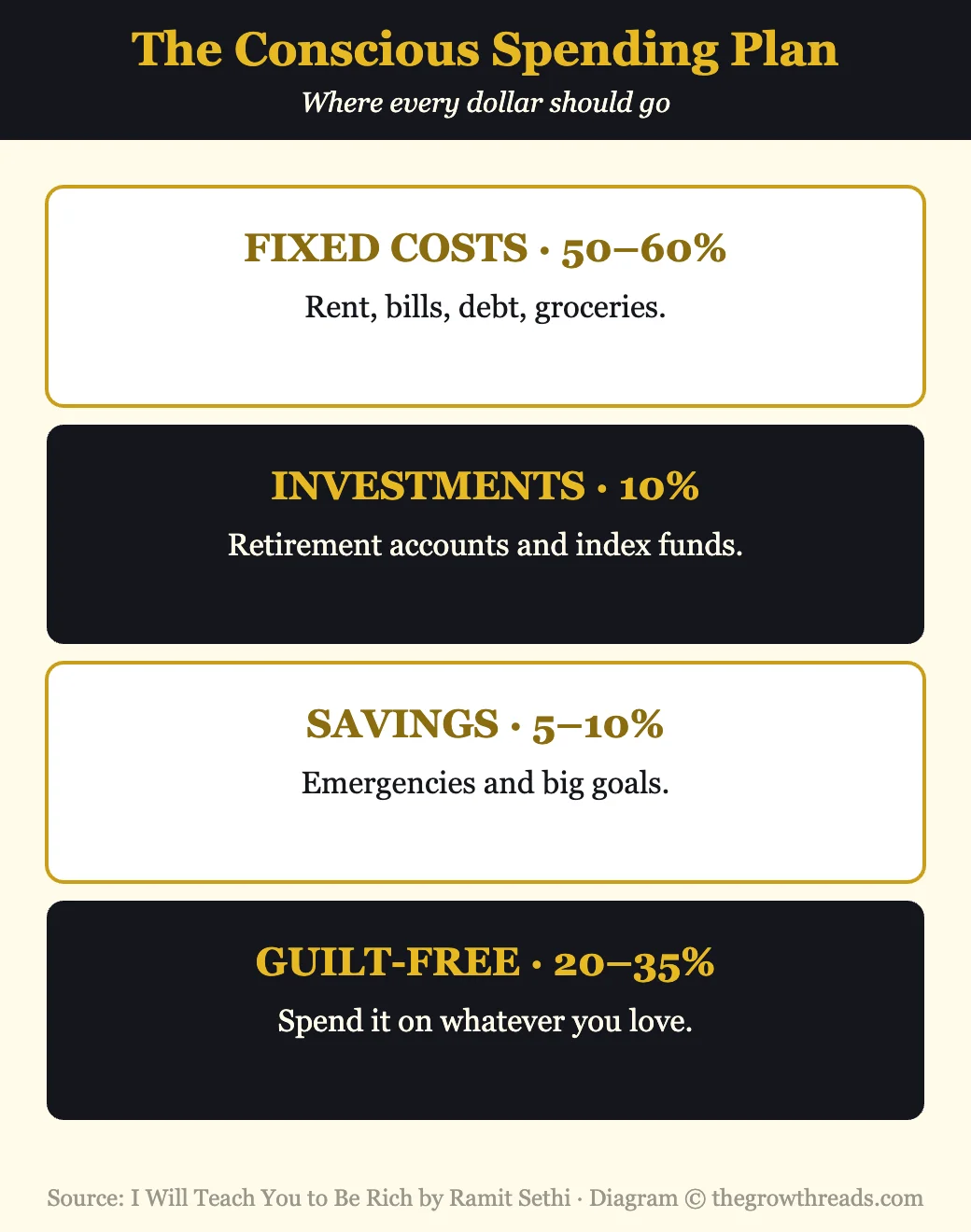
To tie spending and investing together, Sethi offers the Conscious Spending Plan, a flexible allocation of your take-home pay rather than a restrictive line-item budget. As a rough guide, he suggests directing about 50–60% to fixed costs (rent, bills, debt, groceries), around 10% to investments, 5–10% to savings goals, and the remaining 20–35% to completely guilt-free spending. The percentages are adjustable to your situation, and the point is not precision but clarity: once your investments and savings are handled automatically, whatever is left in the guilt-free bucket can be spent however you like, with zero guilt. This is conscious spending made concrete — a plan that guarantees you’re building wealth while still enjoying your money today.
Part 4: Automate everything — a Rich Life on autopilot
The linchpin that makes the whole system work is automation, which Sethi calls the most important step. Because relying on willpower and memory to move money around every month is a recipe for failure, he has you set up automatic transfers so your money flows to the right places the moment your paycheck arrives, with no ongoing effort.
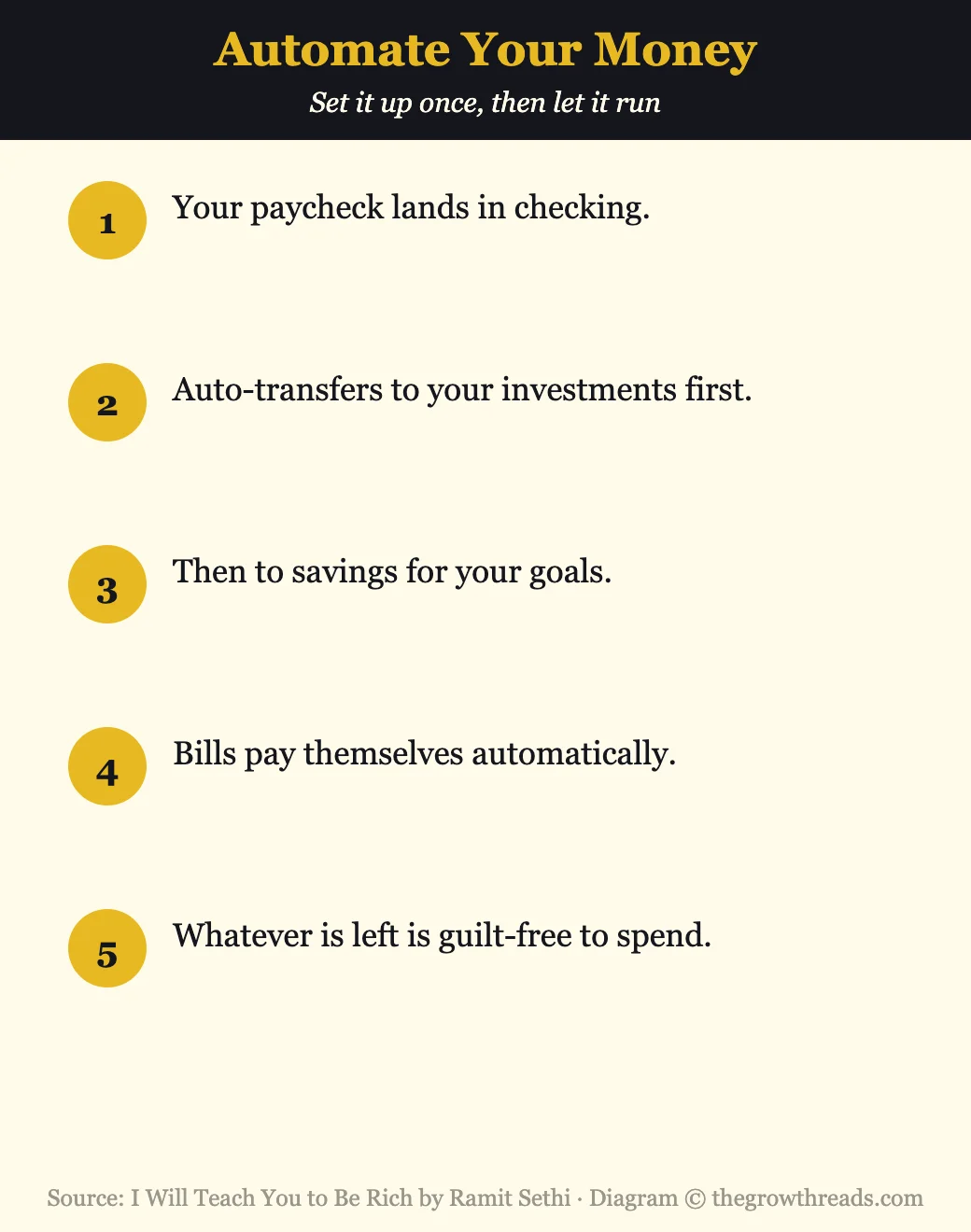
The setup works like a series of pipes: your paycheck lands in checking, and then, on schedule, automatic transfers send money to your investment accounts and savings goals first, your recurring bills pay themselves, and whatever remains is yours to spend freely. Once configured, this “money flow” runs by itself, ensuring you consistently invest and save before you have a chance to spend the money, while never having to budget in the traditional sense. This is behavioral design at its best: rather than fighting your own tendencies, you build a structure that makes good financial behavior the default and requires almost no willpower to maintain. Sethi rounds out the program with guidance on maintaining and occasionally optimizing the system, thoughts on bigger money questions (buying a house, weddings, negotiating salary), and encouragement to keep your eyes on your Rich Life. The advice is unapologetically US-centric in its specific account types and its tone is brash and occasionally repetitive, but as a genuinely actionable, psychologically smart system for beginners, few money books match it. It doesn’t just tell you to be responsible with money — it hands you the exact steps and then gets out of your way.
TGR Note: Automation is really a habit-design trick — Sethi removes willpower from the equation exactly the way Atomic Habits recommends making good behaviors effortless. And his “spend on what you love, cut the rest” is the actionable flip side of the quiet, unseen wealth documented in The Millionaire Next Door. Automate the saving, then consciously enjoy the rest.
Who is I Will Teach You to Be Rich best for — and who should read something else first?
This book is ideal for young adults, students, and anyone new to personal finance who wants a concrete, step-by-step plan rather than vague principles or budgeting guilt. Its actionable, week-by-week structure makes it arguably the best starter money book available. It is not the best fit if you are already financially sophisticated and want advanced strategies, or if you are outside the US and put off by American-specific account types (though the principles transfer). If you want the mindset and psychology of wealth to go with the mechanics, pair it with The Psychology of Money; for the data on how ordinary people build wealth, read The Millionaire Next Door.
Questions to reflect on
- What does your Rich Life actually look like — what would you spend on without guilt if money were handled?
- Which expenses are you cutting that you love, and which could you cut that you don’t care about?
- What are the two or three “big wins” you’ve been ignoring while sweating small purchases?
- Is your saving and investing automated — or does it depend on your willpower each month?
- Are you capturing every dollar of free money, like an employer retirement match?
🔥 Ready to automate your Rich Life?
This guide is the map — the book’s exact scripts and steps are what make it a system.
How to apply I Will Teach You to Be Rich (7-day plan)
- Day 1 — Define your Rich Life. Write what “rich” means to you and the few things worth spending on extravagantly.
- Day 2 — Optimize your credit card. Set autopay-in-full and call to negotiate away one fee or rate.
- Day 3 — Fix your accounts. Open a no-fee checking and a high-yield savings account if you don’t have them.
- Day 4 — Capture free money. Set your retirement contribution to at least the full employer match.
- Day 5 — Pick simple investments. Choose a low-cost index fund or target-date fund and start investing.
- Day 6 — Build your spending plan. Allocate your take-home pay across fixed costs, investments, savings, and guilt-free spending.
- Day 7 — Automate it all. Set up automatic transfers so investing, saving, and bills happen the day you’re paid.
Frequently asked questions
Is I Will Teach You to Be Rich worth reading?
Yes — it is one of the best personal-finance books for beginners, precisely because it is so actionable. Rather than vague advice, it gives you a concrete, week-by-week system to optimize your credit cards and accounts, invest simply, and automate everything, so good financial behavior happens without willpower. Its “conscious spending” philosophy — spend freely on what you love, cut the rest — is refreshingly guilt-free. The main caveats are that it is US-centric in its account specifics and its brash tone isn’t for everyone, but for getting started, few books are as practical.
What is the main idea of I Will Teach You to Be Rich?
That building wealth doesn’t require deprivation or constant budgeting — it requires setting up an automatic system and then consciously spending on what you value. Sethi argues willpower fails, so you should automate your investing, saving, and bills so they run without effort, focus on a few “big wins” instead of trivial expenses, and spend extravagantly on the things you love while cutting mercilessly on the things you don’t. The goal is your own personal “Rich Life,” funded on autopilot.
What is the conscious spending plan?
It is Sethi’s flexible alternative to a restrictive budget. Instead of tracking every line item, you allocate your take-home pay across four buckets: roughly 50–60% to fixed costs (rent, bills, debt, groceries), about 10% to investments, 5–10% to savings goals, and the remaining 20–35% to completely guilt-free spending. The percentages adjust to your situation. Once your investing and saving are handled automatically, whatever is in the guilt-free bucket can be spent however you like, with no guilt, because you know you’re already building wealth.
Does I Will Teach You to Be Rich actually help you invest?
Yes, and it keeps investing refreshingly simple. Sethi’s advice is to first capture any employer retirement match (free money), then fund a tax-advantaged account like a Roth IRA, and invest additional money after that. Crucially, he steers beginners away from picking stocks or trying to beat the market and toward low-cost index funds or target-date funds that diversify automatically. The winning approach, he stresses, is consistently investing in cheap, diversified funds over the long term and letting compounding work — time in the market rather than timing it.
Is I Will Teach You to Be Rich only for Americans?
The core principles — automate your money, spend consciously, focus on big wins, invest simply in low-cost funds, and pay off credit cards in full — are universal and apply anywhere. However, many of the specifics are US-focused, including account types like the 401(k) and Roth IRA and some references to American banks and credit cards. Readers in other countries can absolutely use the philosophy and system, but will need to substitute their own local equivalents for the specific accounts and products Sethi recommends. The framework travels well even when the details don’t.
How long does it take to read I Will Teach You to Be Rich?
The book is around 350 pages and most readers finish it in about six hours, though it is designed as a six-week action program, so implementing the steps unfolds over time. Its clear structure makes it easy to read a chapter and immediately act on it. Our summary above captures the complete system in roughly 15 minutes, which is enough to understand the plan before working through the setup week by week.
Is I Will Teach You to Be Rich good for beginners?
It is arguably the best starter money book available. It assumes no prior knowledge, avoids jargon, and walks you through exactly what to do step by step, from opening the right accounts to automating your investing. Its focus on behavior and automation is especially valuable for beginners, who often fail not from lack of information but from lack of a system. The guilt-free, “big wins” philosophy also makes managing money feel empowering rather than punishing, which helps beginners actually stick with it.
Related summaries
- The Psychology of Money Summary — the mindset behind the mechanics.
- The Millionaire Next Door Summary — how ordinary people quietly build wealth.
- Rich Dad Poor Dad Summary — the mindset shift on assets and money.
- Atomic Habits Summary — the habit design behind automation.
- Browse all our best money books.
How we analyze books: We work from the full book — reconstructing its core arguments in our own words, adding commentary that connects it to related research and other books in our library, and pressure-testing the advice against how it plays out in real life. We never reproduce the text; we synthesize it. Read our full methodology.
Disclosure: The Growth Reads is reader-supported. When you buy through links on our site we may earn an affiliate commission at no extra cost to you. We only recommend books we believe are worth your time, and our summaries and opinions are written independently. This is general information, not personalized financial advice.
Related Money Summaries
Millionaire Teacher Summary & Review: Nine Rules of Wealth
The Bogleheads’ Guide to Investing Summary & Review: The Index Fund Playbook for Building Wealth
The Latte Factor Summary & Review: Turn Daily Spending Into Lifelong Wealth
The Millionaire Next Door Summary & Review: How Wealth Is Actually Built
The One-Page Financial Plan Summary & Review: One Honest Page Beats a 40-Page Forecast