
Relationships
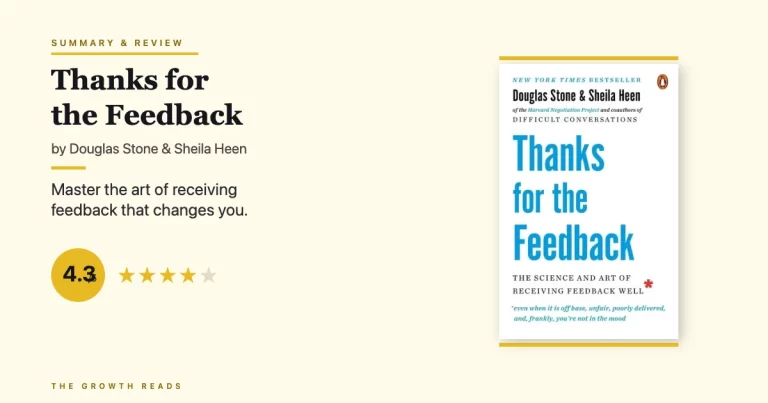
Thanks for the Feedback Summary & Review: Master the Art of Receiving
Full Thanks for the Feedback summary: three triggers, three feedback types, blind spots, 5-criteria rating, and a 7-day plan to receive feedback…
Read Summary →"The Harvard negotiator who flipped feedback from giving to receiving."
Sheila Heen is a lecturer at Harvard Law School and co-founder of Triad Consulting, specializing in negotiation and difficult conversations. Her book, Thanks for the Feedback (co-written with Douglas Stone), flips the usual feedback conversation on its head: rather than focusing on how to give feedback well, it focuses on how to receive it well, arguing that the receiver — not the giver — ultimately controls what feedback actually gets absorbed and acted on. Heen distinguishes between three distinct types of feedback — appreciation, coaching, and evaluation — and argues that much feedback friction comes from a mismatch between what kind of feedback someone is giving and what kind the receiver actually needs in that moment. Her broader argument is that receiving feedback well is a skill that can be deliberately practiced, sitting at the intersection of our drive to learn and our simultaneous need for acceptance.
Our in-depth summaries and reviews of his work
Full Thanks for the Feedback summary: three triggers, three feedback types, blind spots, 5-criteria rating, and a 7-day plan to receive feedback…
Read Summary →Heen argues that regardless of a feedback-giver's authority or intention, the receiver ultimately decides what they let in, how they interpret it, and whether they change — so building receiving skills matters more than perfecting delivery.
Heen distinguishes appreciation (motivates), coaching (builds skill), and evaluation (tells you where you stand) — arguing much feedback conflict comes from a mismatch between the type given and the type needed.
Heen frames the discomfort of receiving feedback as the natural friction between our drive to learn and grow and our simultaneous longing to be accepted as we are.
"Explicit disagreement is better than implicit misunderstanding."— Thanks for the Feedback
"Receiving feedback sits at the intersection of these two needs — our drive to learn and our longing for acceptance."— Thanks for the Feedback
"It doesn't matter how much authority or power a feedback giver has; the receivers are in control of what they do and don't let in, how they make sense of what they're hearing, and whether they choose to change."— Thanks for the Feedback
Full Thanks for the Feedback summary: three triggers, three feedback types, blind spots, 5-criteria rating, and a 7-day plan to receive feedback without shutting down.
