

★★★★☆ 4.4/5 — a campus operating system: class, energy, and one thing done excellently.
Best for: Students drowning in clubs, skipped lectures, and papers that start at midnight — and anyone whose week still looks like campus
Reading time: ~3.5 hours (208 pages) · this guide ~12 min
Difficulty to apply: Easy to start — the Sunday map is one hour; dropping a club is the hard part
How to Win at College in one minute
Treat college like a job you already accepted, not a mood you hope arrives by Thursday. Cal Newport’s How to Win at College summary in one line is that: 75 short rules from students who actually won — not the ones who looked busy. Never skip class. Sit in the front row. Start the paper the day it is assigned. Work in the library, not the dorm. Sleep. Pick one activity and become the person they call. You do not need a red-brick quad. You need a week that currently starts in panic.
Key takeaways
- School is a job: standout students run a week; they do not wait to feel motivated.
- Never skip class: the lecture is the cheapest hour you will be offered.
- Sit front: attention is a seat, not a personality.
- Sunday ritual: map every class, paper, and deadline before Monday starts.
- Start long work today: open the paper the day it is assigned — a page, not a masterpiece.
- Leave the dorm: work where nobody’s life is happening three feet away.
- Office hours: one professor who knows your name beats seven clubs on a résumé.
- Sleep is strategy: all-nighters steal the next three classes.
- Do fewer, better: one activity done excellently is the standout.
- Keep a brag file: dated proof of work you shipped, for internships and recommendations.
What is How to Win at College about?
How to Win at College is Cal Newport’s 2005 playbook of 75 short rules from standout students: treat school like a job, never skip class, start long projects the day they are assigned, and do one activity excellently — without torching sleep or a real social life.
About the author
Cal Newport wrote How to Win at College while the campus week was still his laboratory. As a Dartmouth student journalist he interviewed valedictorians, Rhodes scholars, and the quiet operators who seemed to have more hours than everyone else, then boiled what they repeated into 75 short rules. He later became a computer science professor at Georgetown and the author of Deep Work, So Good They Can’t Ignore You, Digital Minimalism, and Slow Productivity — the same thesis at adult scale: rare work needs a closed door and a calendar that tells the truth. This 2005 book is the student-shaped version. You do not need a professor title to steal the Sunday ritual. You need a week that currently starts on Monday in a panic. Explore all Cal Newport book summaries →
Key concepts at a glance
| Concept | What it means | Use it when |
|---|---|---|
| School as a job | A week you run, not a vibe you wait for | Mondays start in panic and guilt |
| Sunday ritual | One quiet hour that maps classes, papers, blocks | The calendar is a rumor until Wednesday |
| Start-the-day-assigned | Open long work while slack still exists | Every paper begins the night before |
| Front row | Attention is a seat you take on purpose | You “watch the recording later” and never do |
| Library, not dorm | Work where your life is not happening | Laptop-on-bed is your whole method |
| Office hours | One professor who can describe your work | You need a recommendation and have no name |
| One standout | Fewer activities, done in public, excellently | Seven clubs, zero craft |
| Brag file | Dated proof of work you actually shipped | Internship season and a blank memory |
Part 1: The academic job — class, a map, and a first page
Newport’s interviews keep repeating a boring sentence: the students who win treat school like a job. They go to class. They sit where looking at a phone is socially expensive — the front. They take notes they can quiz later, not a transcript they will reread at 1 a.m. Skipping a lecture to “catch up” is how catching up becomes the whole personality. The cheapest hour on campus is the one someone already prepared for you. You do not have to love the professor. You have to be in the room.
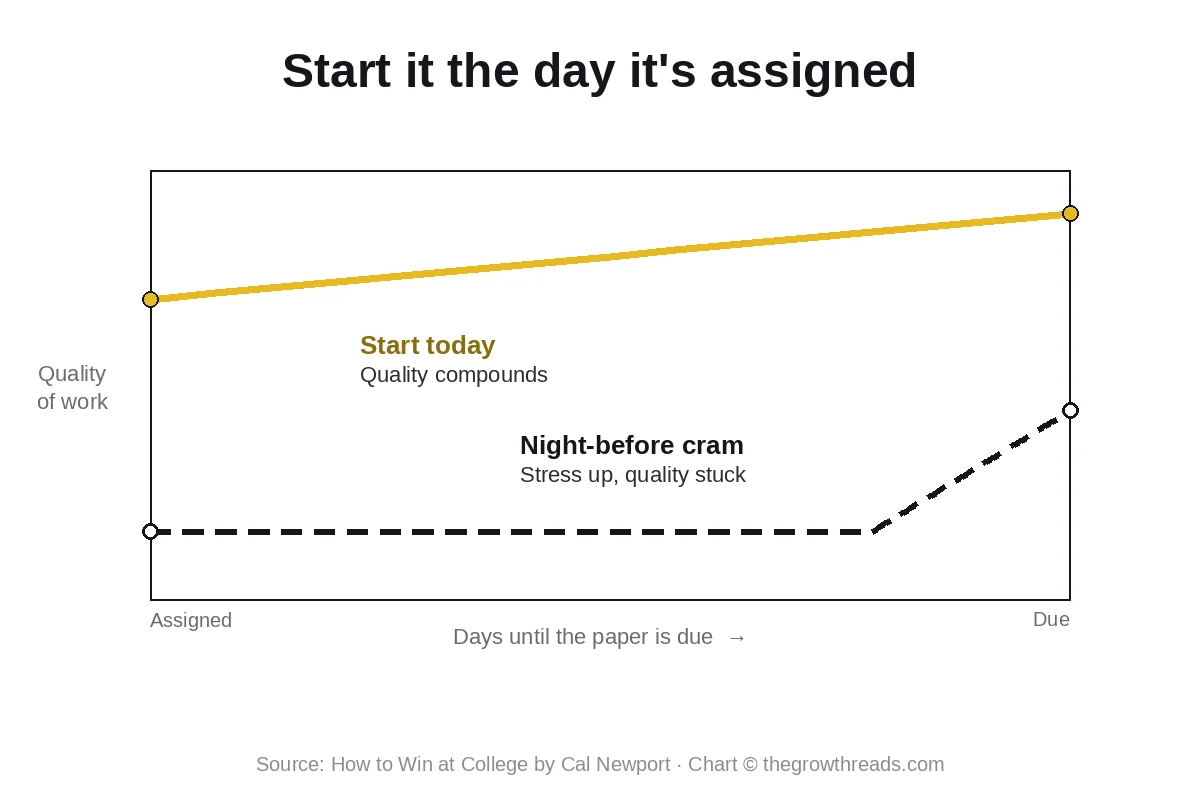
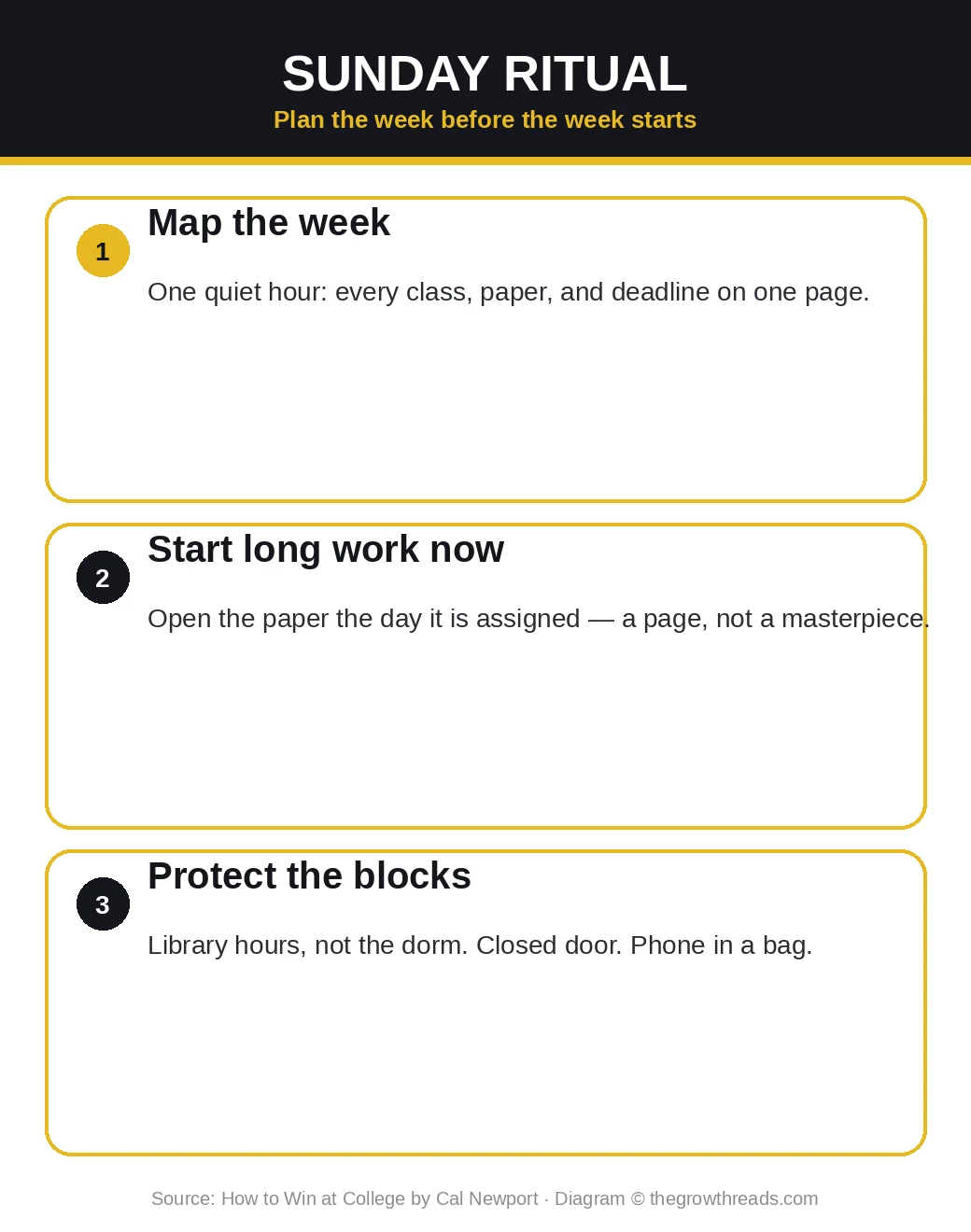
The Sunday ritual is the job’s kickoff meeting. One quiet hour: every class, lab, paper, and deadline on one page, then blocks for the long work. It is not a productivity costume. It is a map so Monday is not an ambush. Pair it with the rule the chart is built on — start long-term projects the day they are assigned. A ugly first page on day one is how quality compounds. A heroic night-before is how quality stalls while stress spikes. You are not writing the paper on Sunday. You are refusing to meet it as a stranger on Thursday.
Where you sit to do that page matters as much as when. Newport is blunt about the dorm: it is where your life happens. Work needs a closed door that is not also a bedroom — library, empty classroom, lab after hours. A bed with a laptop is still a bed. Put the phone in a bag. Write the bad page. That is the academic engine before any fancy study method shows up.
TGR Note: If the study method inside those blocks is still rereading, our How to Become a Straight-A Student summary is the clinic: five-minute planning, a closed door, notes you quiz. Do not collect both as a way to delay the first page. For memory science, Make It Stick is quiz-and-recall instead of highlight theater.
Part 2: Professors, papers, and a name they can remember
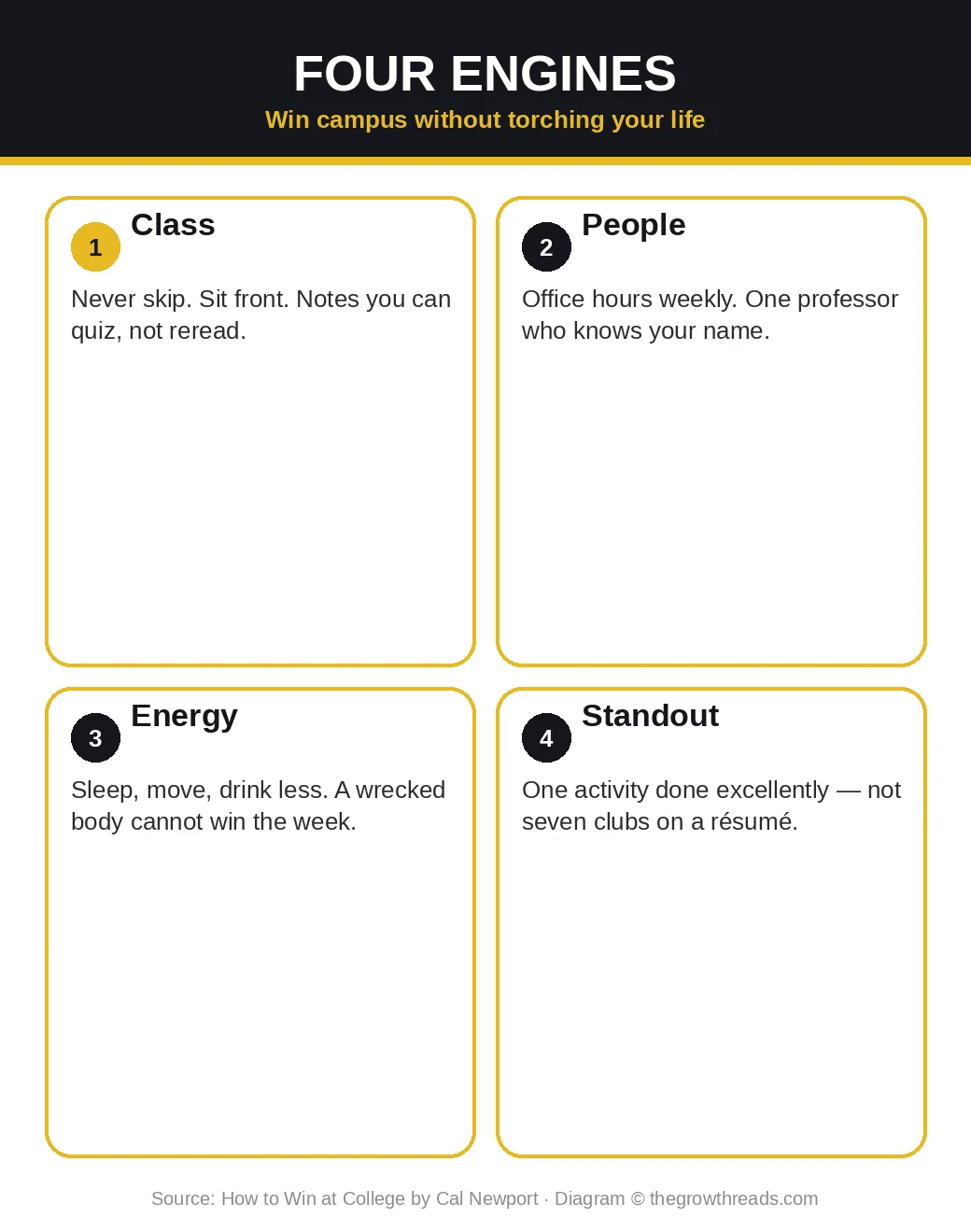
Office hours are how a professor goes from a silhouette to someone who can write a specific sentence about your work. Newport’s standout students showed up with a real question or a draft, weekly enough that their name stuck. Recommendations and internships are downstream of that sentence. Seven clubs will not write it. You do not need to be interesting. You need to be repeatable.
Papers are where the Sunday map either pays or humiliates you. Starting the day of the assignment is not perfectionism. It is refusing a 48-hour identity crisis. Outline on day one. A source on day two. A bad draft while the argument is still cheap to change. Dropping a class that is a mismatch — early, on purpose — is part of the same job. A heroic incomplete is not character. It is a calendar you would not accept at work. Writing well is a campus skill with a life after graduation; treat the paper as a product with a ship date, not a mood that arrives when the library empties.
Sit front in the classes that own those papers. Ask one question that proves you did the reading. The goal is not to become the person who talks. It is to become the person whose work the instructor can describe in March, when internships ask for a name. If you cannot imagine that sentence, you have a seating chart, not a professor.
TGR Note: If the hard part is rare work after class, our Deep Work summary is the adult closed-door block. Intensity beats a long interrupted evening. For career capital instead of a résumé of clubs, So Good They Can’t Ignore You is why skills mint options. None of them replace going to class this week.
Part 3: Energy is part of the grade — sleep, body, a real social life
All-nighters are not a work ethic. They steal the next day of class — the cheapest hour you were already told to protect. Newport’s rules here are unfashionable and kind: sleep, move, eat, clean the room, do not make drinking the social plan. A wrecked body cannot sit front or write a page that survives daylight. You cannot recover a Tuesday lecture with a Thursday adrenaline spike.
A real social life is in the system, not the prize after collapse. The book is not asking you to become a monk. It is asking you not to use chaos as a personality. Put one standing meal and one sleep target on the Sunday map the way you put a paper. Protect them like deadlines, because they are.
The dorm rule returns as energy policy. You cannot sleep where you also panic-write. Separate the rooms even if the building will not: library for work, bed for sleep, a table for friends. When the body is back, the academic job gets cheaper. When it is not, Parts 1 and 2 become a speech you give yourself at 2 a.m.
TGR Note: If the week is still a blur of urgency, our Eat That Frog! summary is the ugly-first-task cousin of start-the-day-assigned. If you left campus and the leak is now Slack, Slow Productivity is fewer things at a natural pace. Do not skip sleep to look serious. It fails in public the next morning.
Part 4: Do fewer things, in public — the standout and the brag file
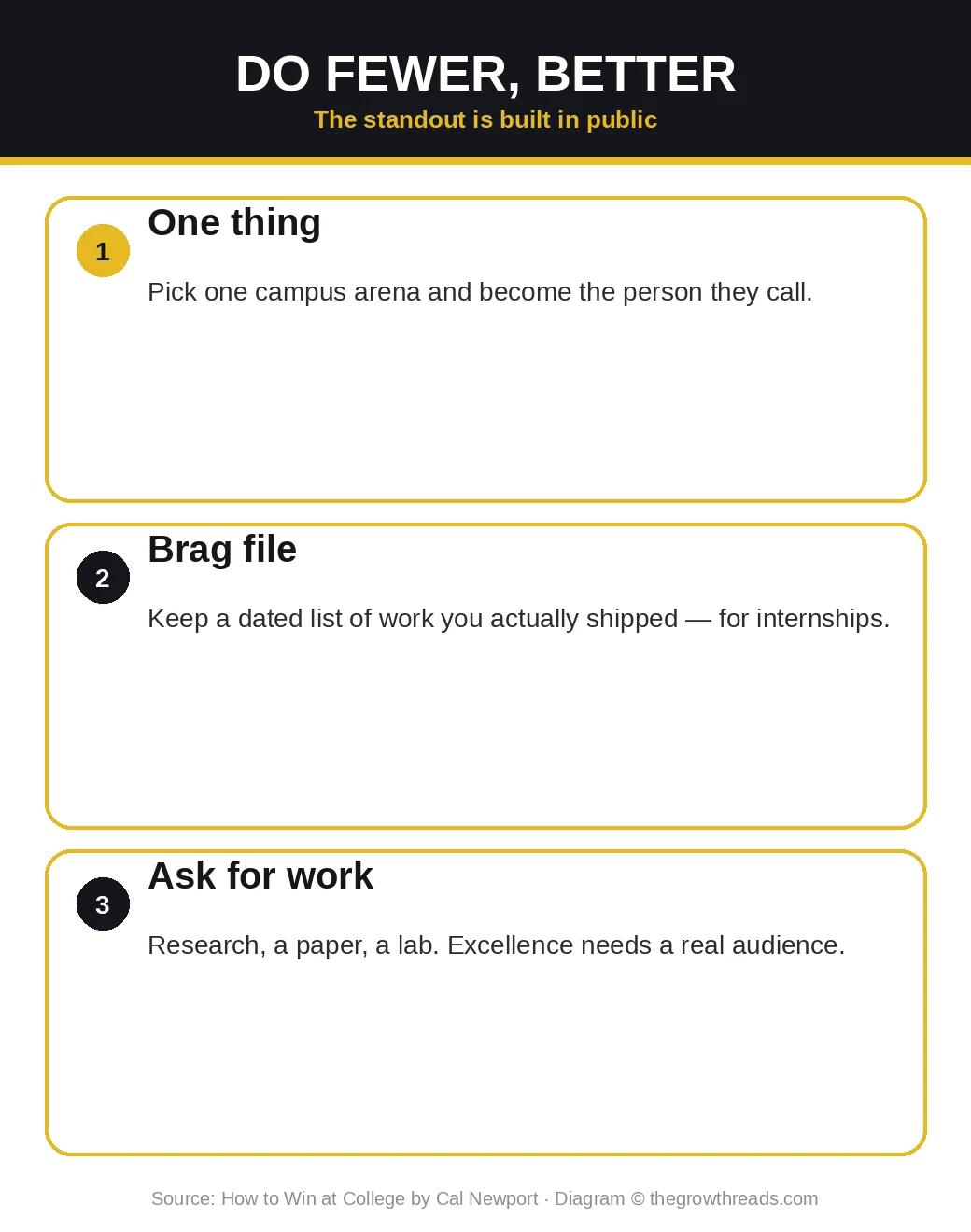
Campus rewards a spike, not a form that looks well-rounded. Newport’s standout students picked one or two arenas and became the person you call when that arena matters. Seven clubs is a costume. One editorship, lab, or role that ships in public is a story a stranger can repeat. Dropping extra clubs is how the remaining work gets an audience.
Ask for real work. A professor’s research, a lab shift, a column with a byline. Excellence needs a deadline that is not only yours. Then keep a brag file: dated notes of what you actually shipped — a paper, a talk, a dataset, a performance. Internship season will ask your memory to lie. The file tells the truth. It is also how you walk into office hours with evidence instead of vibes. You are not bragging at people. You are refusing to arrive empty when someone asks what you have done.
The long game is the same job at a longer zoom. Majors matter less than skills you can demonstrate. Internships are how the campus spike meets the outside world. Steal the cut this week on a paper you cannot postpone. Open it today. Sit front tomorrow. That is winning at college before anyone puts it on a mortarboard.
TGR Note: If you keep saying yes until the week drowns, our Essentialism summary is the adult disciplined pursuit of less. Campus clubs are a perfect Essentialism lab. For building a skill on purpose once you have picked the arena, Ultralearning and Peak are how practice gets specific. Use them after you drop the sixth club. A new practice system on top of seven commitments is how nothing ships.
Who is How to Win at College best for — and who should read something else first?
Best for people whose week already looks like campus: students, first-years, anyone still running classes, papers, and too many optional rooms. If you skip lectures, start papers at midnight, and cannot name a professor who would recommend you, this is the briefing. You need a map and a first page.
Read something else first if the calendar is already sane and the grades still come from rereading — start with How to Become a Straight-A Student. If you left school, Deep Work or Slow Productivity is the OS. If you cannot remember what you read, Make It Stick is the science.
Questions to reflect on
- What long project is already assigned that I have not opened — and what would a ugly first page look like today?
- Which class did I skip this month, and what did that “saved” hour actually buy?
- Who is the one professor who could describe my work in a sentence — and if nobody, when is office hours?
- Which activity am I doing excellently, and which three are costumes?
- Where do I work when it counts — a library table, or a bed with a laptop?
🔥 Ready to treat school like a job?
Get How to Win at College, then use the 7-day plan to map one week, open one paper, and drop one extra club.
How to apply How to Win at College (7-day plan)
- Day 1 — Steal a Sunday. Forty minutes. List every class, paper, lab, and deadline for the next seven days. Block two work sessions that are not your bed.
- Day 2 — Front row, no skips. Attend every class on the map. Sit front in the one that owns a paper. Phone in a bag.
- Day 3 — Open the long work. The paper, lab, or project already assigned. Write a ugly first page. Put the next block on the map.
- Day 4 — Leave the dorm. Both work blocks happen in a library or empty classroom. Same time tomorrow.
- Day 5 — Office hours. One professor, one real question or a draft. Write their name in the brag file.
- Day 6 — Cut one costume. Drop or pause one club/commitment that is not the standout. Tell the remaining one what you will ship.
- Day 7 — Sleep and the file. Eight hours. Date three things you actually shipped this week. Ask one friend what they would say you are excellent at.
Frequently asked questions
What is How to Win at College by Cal Newport about?
How to Win at College is Cal Newport’s 2005 field guide of 75 short rules gathered from standout students — the book people mean when they search for a How to Win at College summary. Winning campus is a job, not a mood: never skip class, sit front, start long projects the day they are assigned, work in the library instead of the dorm, and do one activity excellently instead of seven poorly. Sleep and a real social life sit inside the system, not after collapse. You do not need all 75 rules this week. You need a Sunday map and one paper opened today.
Is How to Win at College the same book as How to Become a Straight-A Student?
No. How to Win at College (2005) is the campus operating system: class, energy, people, and one standout activity, collected as 75 short rules. How to Become a Straight-A Student (2006) is the study clinic that sits inside that system — five-minute planning, a closed door, and notes you quiz instead of reread. Read Win at College if your week is a blur of clubs, skipped lectures, and papers that start the night before. Read Straight-A Student if the calendar is already sane and the grades still come from rereading. They stack. They are not duplicates.
What is the Sunday ritual in How to Win at College?
The Sunday ritual is one quiet hour before the week starts where you put every class, paper, lab, and deadline on one page and block the work. Newport’s standout students did not wait to feel ready on Monday. They treated the week like a job they had already accepted. The ritual is not a color-coded masterpiece. It is a map: what is due, when you will sit, and which long project gets a first page today. If Sunday is gone, steal forty minutes tonight. A late map beats a heroic Thursday.
Do I need to follow all 75 rules in How to Win at College?
No. The 75 rules are a menu Newport distilled from interviews, not a personality transplant. Most readers get leverage from a handful: never skip class, sit front, start long work the day it is assigned, leave the dorm to work, go to office hours, sleep, and pick one activity to do excellently. The rest is texture — clean the room, drink less, keep a brag file — that supports those few. Steal three this week. Add one next week. A binder of all 75 unread is the same failure mode as seven clubs you barely attend.
Who should read How to Win at College — and who should start elsewhere?
Read it if you are in school, about to be, or still running campus-shaped weeks: too many commitments, papers that start at midnight, professors who do not know your name. Skip it as a first book if the problem is the study method itself — start with How to Become a Straight-A Student. If you left campus years ago and the issue is a distracted job, Deep Work or Slow Productivity is the adult OS. If you cannot remember what you read, Make It Stick is the memory science. Newport’s 2005 book is how a week on campus stops being a mood.
Does How to Win at College still work in 2026 with laptops and LMS portals?
The furniture changed. The physics did not. A laptop in a noisy dorm is still a noisy dorm. An LMS deadline is still a deadline you can open the day it appears. Front-row attention still beats a recording you never watch. Office hours still mint the recommendation that internships require. Phones made the dorm rule stricter, not optional. Use the 75 rules as tests: if a habit still produces a paper, a professor, or a standout, keep it. If it is a 2005 costume — a specific computer lab — ignore the costume and keep the job.
What is the one idea to steal from How to Win at College this week?
Steal “start it the day it’s assigned,” not a new identity as a campus celebrity. Take one paper, lab, or project already on the calendar. Open a document today and write a ugly first page. Put the next block on a Sunday map. Sit front in the class that owns that paper. That is the whole argument in one job: winning is a system you run while you still have slack, not a personality you grow at 2 a.m. Add the library and one activity later. Do not collect all 75 rules as a way to delay the first page.
Related summaries
- How to Become a Straight-A Student by Cal Newport
- Deep Work by Cal Newport
- So Good They Can’t Ignore You by Cal Newport
- Slow Productivity by Cal Newport
- Best productivity books
How we analyze books: every book on The Growth Reads is read cover to cover, summarized in thousands of words of original analysis, and rated against our five-criteria rubric (lasting impact, evidence quality, practical application, writing & originality, external consensus). Read our full methodology.