

★★★★☆ 4.3/5 — The original FIRE movement bible that redefines money as life energy and lays out a clear 9-step path to financial independence.
Best for: Anyone who wants to fundamentally transform their relationship with money and achieve financial independence — regardless of income level.
Reading time: ~6 hrs (guide: 19 min)
Difficulty to apply: Moderate — the tracking is simple but requires sustained daily attention.
Your Money or Your Life in one minute
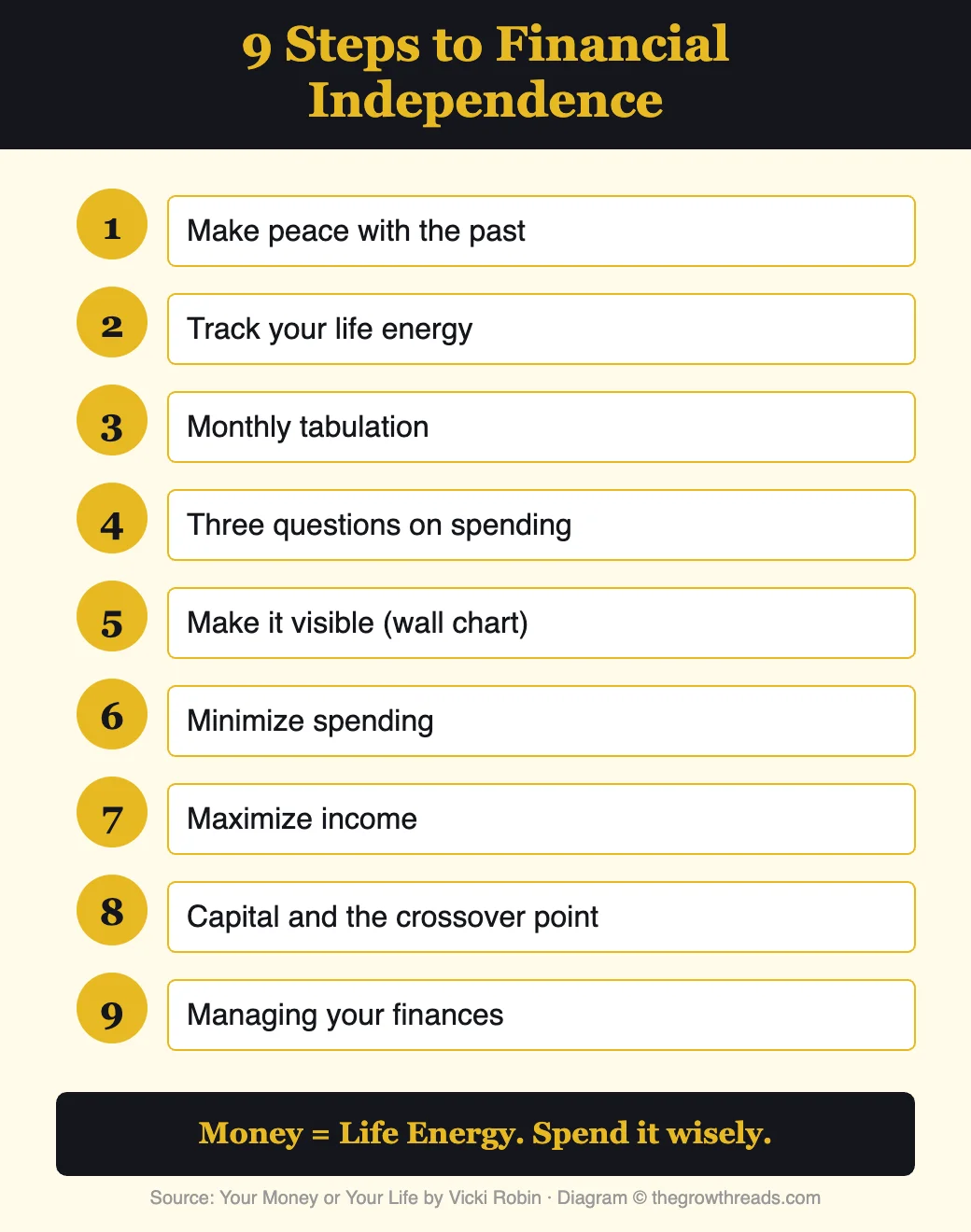
Money is something you trade your life energy for — and most people have never calculated the true cost. Vicki Robin and the late Joe Dominguez present a radical reframing: every dollar you spend represents a certain number of hours of your irreplaceable life. Once you calculate your real hourly wage (accounting for commuting, decompression, work clothes, and other hidden costs), spending decisions become life decisions. The book lays out nine concrete steps that move you from unconscious consumption to conscious financial independence — the point where your investment income covers your expenses and work becomes optional. First published in 1992, it launched the FIRE (Financial Independence, Retire Early) movement and has helped millions of people escape the earn-spend-earn treadmill.
Key takeaways
- Money equals life energy: The only universally true definition of money is that it is something you trade your finite life hours for. This reframing changes every spending decision.
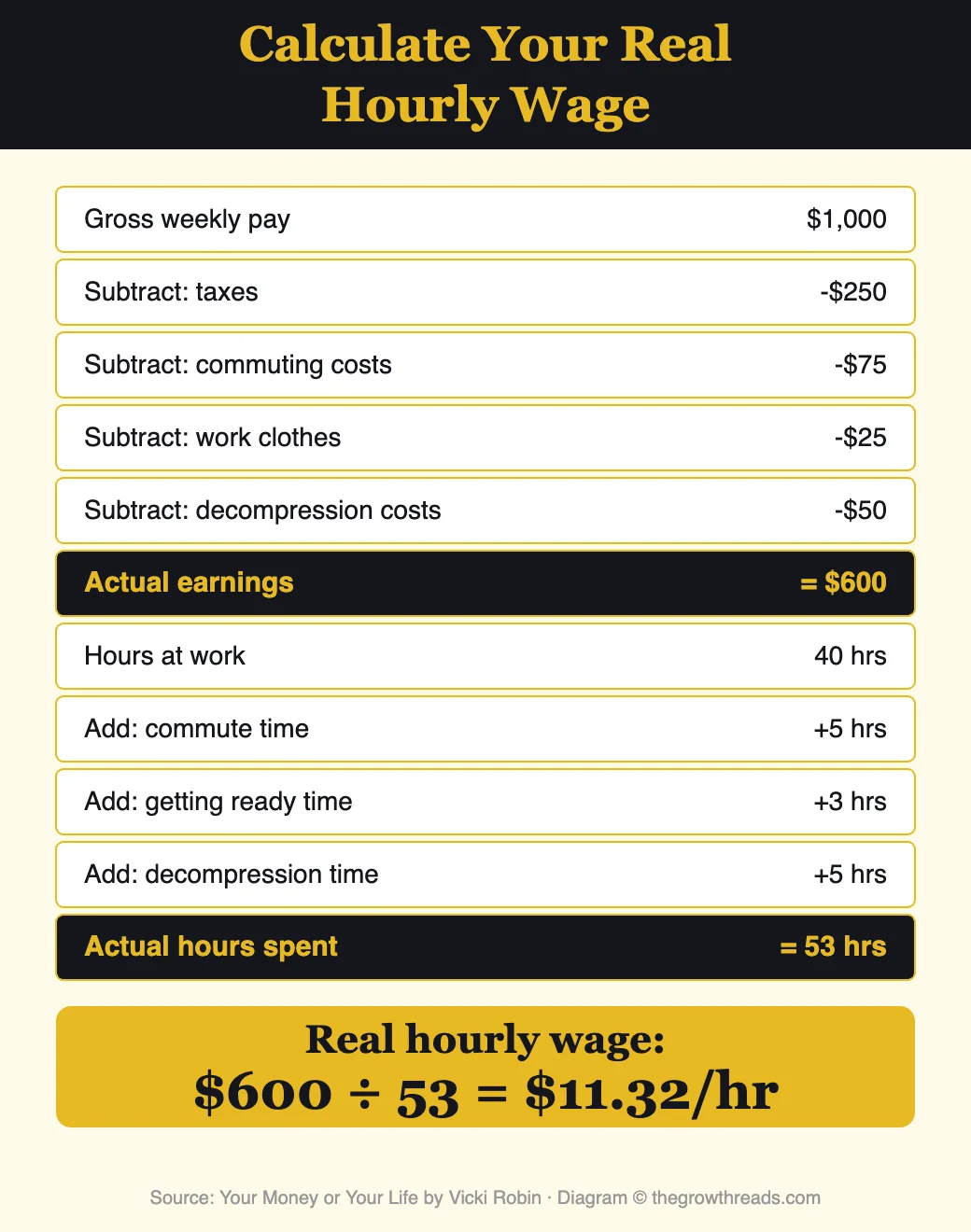
- Calculate your real hourly wage: Subtract all work-related costs (taxes, commuting, wardrobe, decompression) and add all work-related time. Your true rate is probably far lower than you think.
- Track every cent: Absolute awareness of where your money goes — every coffee, subscription, and impulse buy — is the foundation of transformation.
- Ask three questions about every expense: Did I receive fulfillment proportional to the life energy spent? Is this aligned with my values? Would I spend this if I did not have to work for money?
- The fulfillment curve peaks and declines: Spending increases fulfillment up to a point of “enough,” then additional spending actually decreases satisfaction.
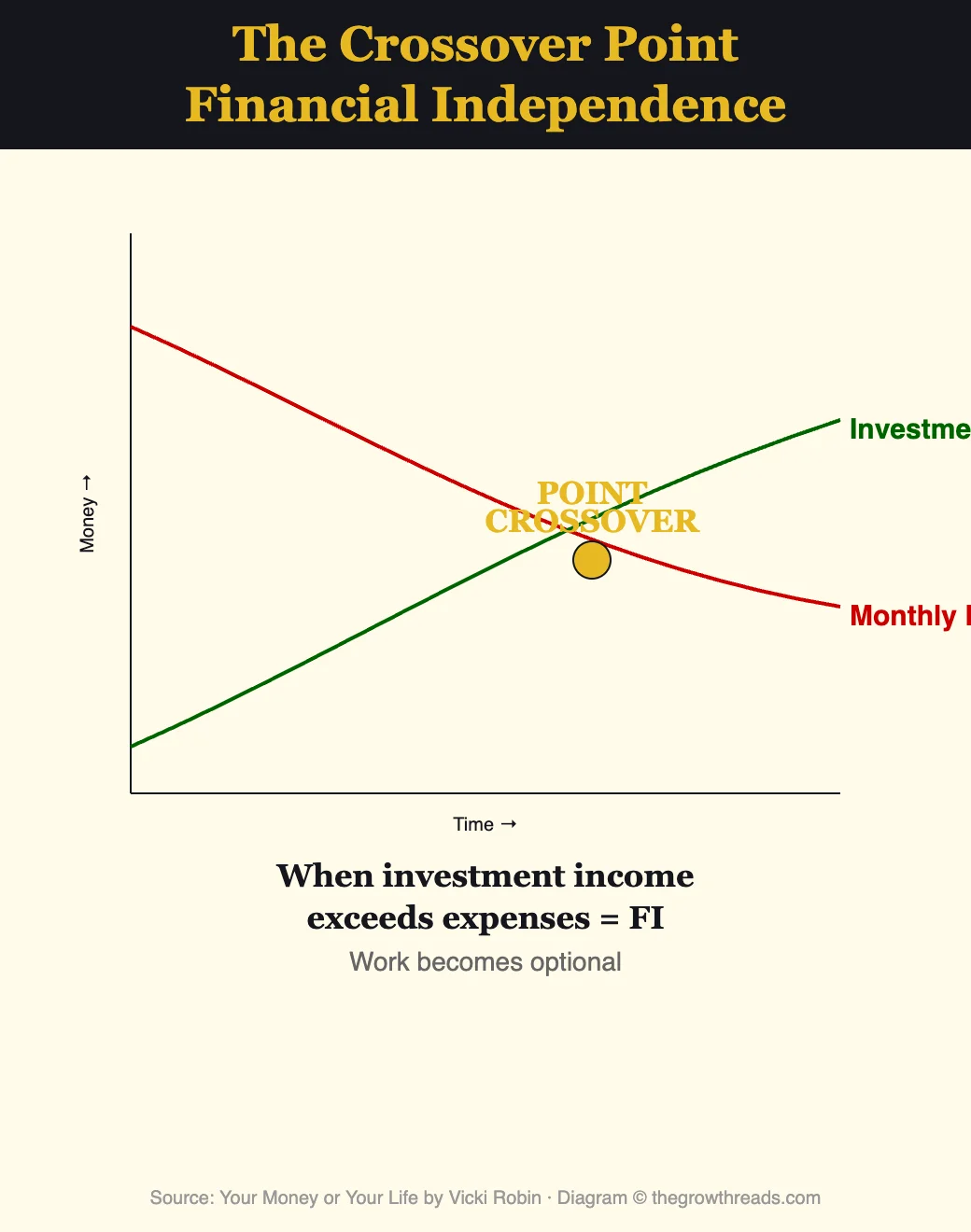
- The crossover point is freedom: When your monthly investment income exceeds your monthly expenses, you are financially independent. Work becomes a choice, not a requirement.
- Minimize spending, maximize income: Not through deprivation, but through conscious alignment of spending with values and creative approaches to earning.
- Make your progress visible: A wall chart tracking income, expenses, and investment income creates powerful visual motivation and accountability.
What is Your Money or Your Life about?
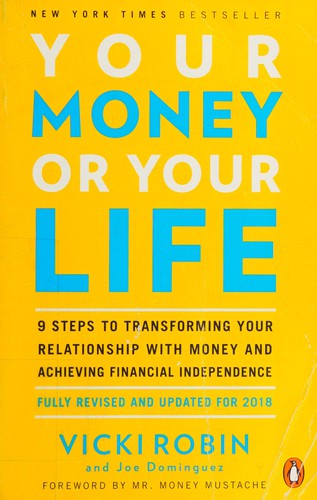
Your Money or Your Life is a personal finance book that presents a nine-step program for transforming your relationship with money by redefining it as life energy, tracking every dollar, aligning spending with values, and systematically building toward the crossover point where investment income covers all expenses.
About the author
Vicki Robin is an author, speaker, and community activist who co-authored the original 1992 edition with Joe Dominguez, a former Wall Street financial analyst who retired at age 31 and spent the rest of his life teaching others how to achieve financial independence. After Dominguez passed away in 1997, Robin continued their mission, updating the book in 2008 and again in 2018 to reflect modern financial realities including index fund investing, the gig economy, and climate-conscious consumption. Robin lives on Whidbey Island in Washington State, where she practices the principles she preaches — living richly on modest means while dedicating her time to community building and sustainability work. Explore all Vicki Robin book summaries →
Key concepts at a glance
| Concept | What it means | Use it when |
|---|---|---|
| Life Energy | Money as hours of your irreplaceable life | You want to make spending feel real |
| Real Hourly Wage | True earnings after subtracting all work-related costs and time | You want to know what your time is actually worth |
| Fulfillment Curve | The relationship between spending and happiness peaks at “enough” | You suspect more spending is not making you happier |
| The Three Questions | Fulfillment? Values-aligned? Would I still buy this if I did not work? | You want a decision filter for every purchase |
| The Wall Chart | Visual tracker of income, expenses, and investment income over time | You need motivation and accountability |
| Crossover Point | When investment income exceeds expenses — financial independence | You want a concrete, measurable FI target |
| Enough | The point of maximum fulfillment — not deprivation, not excess | You want to define your personal enough |
Part 1: Understanding your relationship with money
The book opens with a challenge: add up every dollar you have ever earned in your lifetime. Then look at what you have to show for it — your net worth. For most people, the gap between lifetime earnings and current net worth is staggering and sobering. This exercise is not designed to shame but to wake you up: where did all that life energy go?
Robin then introduces the concept that transforms the rest of the book: money is life energy. When you earn $20 per hour (after accounting for all work-related costs), a $100 dinner costs five hours of your life. A $30,000 car costs 1,500 hours. Framing purchases in life-energy terms makes abstract spending feel viscerally real.
The real hourly wage calculation is the operational heart of this reframing. Most people assume they know what they earn per hour, but they have never subtracted the hidden costs of employment: commuting (gas, wear on the car, parking), work clothes, meals out because they are too tired to cook, vacations needed to recover from burnout, childcare, and the time spent commuting, getting ready, and decompressing after work. When all of these are factored in, many people discover their true hourly wage is 30 to 50 percent lower than their nominal rate.
Part 2: The fulfillment curve and conscious spending
Robin introduces the fulfillment curve — a graph showing that spending and fulfillment are correlated up to a point (the point of “enough”), after which additional spending actually decreases satisfaction. Below the enough point, spending on basics like shelter, food, and healthcare dramatically increases quality of life. At the enough point, you have everything you need and most of what you want. Beyond it, spending creates clutter, complexity, maintenance costs, and the anxiety of protecting what you own.
The three questions applied to every expense category bring precision to this framework. First: Did I receive fulfillment, satisfaction, and value in proportion to the life energy I spent? Second: Is this expenditure of life energy in alignment with my values and life purpose? Third: How might this expenditure change if I did not have to work for a living? These questions are not rhetorical — Robin instructs readers to mark each spending category with a plus (spend more), minus (spend less), or zero (just right) based on honest answers.
Part 3: The crossover point — when work becomes optional
The most powerful visual in the book is the wall chart: a simple graph with two lines — monthly expenses (which typically decrease as you become more conscious) and monthly investment income (which increases as you save and invest). The point where the investment income line crosses above the expenses line is the crossover point — financial independence. On the day those lines cross, work becomes optional. You may continue working, but you do so by choice, not necessity.
The updated edition modernizes the investment advice. Where the original 1992 edition recommended U.S. Treasury bonds (which yielded over six percent at the time), Robin now discusses low-cost index fund investing, the four percent rule, and how to build a diversified portfolio that generates reliable passive income. She also addresses the psychological challenges of reaching FI — the identity crisis that often accompanies leaving a career, the social pressure to keep earning, and the importance of having a purpose beyond accumulation.
Who is Your Money or Your Life best for — and who should read something else first?
This book is ideal for anyone who earns money but does not feel in control of it — people living paycheck to paycheck, high earners who save nothing, and anyone who suspects their spending does not align with their values. It is also the definitive starting point for anyone interested in the FIRE movement.
If you are already financially literate and looking specifically for investment strategy, The Simple Path to Wealth or The Intelligent Investor will be more directly useful. If your challenge is more about money mindset than money mechanics, start with The Psychology of Money.
Questions to reflect on
- If you calculated your real hourly wage right now — including commuting, decompression, and work-related costs — what would the number be?
- What is the biggest spending category in your life that consistently fails the three questions test?
- How would your daily choices change if every price tag showed the number of life-hours it costs you?
- Where is your personal “enough” point — the level of spending that maximizes your fulfillment without excess?
- How many years away are you from your crossover point, and what one change would bring it closest?
🔥 Ready to transform your relationship with money?
Learn the 9-step system that has helped millions reach financial independence.
How to apply Your Money or Your Life (7-day plan)
- Day 1: Calculate your real hourly wage. Take your monthly income, subtract taxes, commuting costs, work clothes, meals out, and decompression spending. Divide by total hours spent on work (including commute and prep).
- Day 2: Start tracking every cent you spend today. Use a simple notes app or a small notebook. Do not judge — just record.
- Day 3: Calculate your lifetime earnings (rough estimate from tax records or memory). Compare to your current net worth. Sit with the gap.
- Day 4: Categorize yesterday’s and today’s spending. Apply the three questions to each category: fulfillment? values-aligned? would I still buy this without needing to work?
- Day 5: Identify your biggest “minus” category — the spending area with the lowest fulfillment-to-cost ratio. Brainstorm three ways to reduce it without feeling deprived.
- Day 6: Create a simple wall chart (or spreadsheet): monthly income, monthly expenses, and monthly investment income. Plot where you are today.
- Day 7: Calculate your crossover point. Based on your current savings rate and investment returns, estimate when your investment income will exceed your expenses. Write that date down.
Frequently asked questions
Is Your Money or Your Life about extreme frugality?
No. Robin explicitly distinguishes between frugality and deprivation. Frugality, she writes, means getting maximum fulfillment from every dollar — not spending as little as possible. The goal is alignment between your spending and your values. For some people, this means spending more on experiences they love and less on things they do not notice. The book has been adopted by people at every income level, from minimum wage workers to six-figure earners, because the principles are about consciousness, not restriction.
What is the crossover point?
The crossover point is the moment when your monthly investment income (from savings and investments) equals or exceeds your monthly living expenses. At that point, you are financially independent — you no longer need employment income to cover your costs. Work becomes optional. The speed at which you reach the crossover point depends on two factors: reducing expenses and increasing the gap between income and spending, which accelerates investment growth.
How long does it take to reach financial independence?
It varies enormously based on income, expenses, and savings rate. Someone saving 50 percent of their income can reach FI in roughly 17 years. Someone saving 70 percent can reach it in about 8 years. The key insight is that the savings rate matters far more than absolute income — a person earning $60,000 who saves 50 percent reaches FI faster than a person earning $200,000 who saves 10 percent. The wall chart makes your specific timeline visible and trackable.
Is the investment advice in the updated edition good?
The 2018 revised edition updates the investment advice significantly. Robin now recommends low-cost index funds (particularly total stock market and total bond market funds), discusses the four percent withdrawal rule, and addresses modern investment vehicles like Roth IRAs and target-date funds. While the advice is sound and well-suited for beginners, readers seeking deep investment strategy should supplement with a dedicated investing book like The Simple Path to Wealth or The Intelligent Investor.
Do I really need to track every penny?
Robin insists that total awareness is essential, at least initially. Tracking every cent is not about punishment — it is about seeing reality clearly for the first time. Most people are shocked to discover how much they spend in categories they barely think about (subscriptions, convenience purchases, impulse buys). After several months of total tracking, many people naturally develop an intuitive sense of their spending and can relax the granularity. But the initial period of complete tracking is what creates the awareness shift.
What is the fulfillment curve?
The fulfillment curve illustrates the relationship between money spent and life satisfaction. Starting from zero, spending on survival basics (food, shelter, healthcare) produces enormous fulfillment. As spending increases, fulfillment continues to rise through comforts and small luxuries. At a certain point — the peak of the curve, which Robin calls “enough” — fulfillment is maximized. Beyond that point, additional spending on bigger houses, fancier cars, and luxury goods actually decreases fulfillment because of the complexity, maintenance, and anxiety they introduce.
Is this book still relevant in 2026?
Extremely. The core principles — money as life energy, conscious spending, the crossover point — are timeless. The 2018 updated edition addresses modern concerns including student loan debt, gig economy income, sustainable investing, and climate-conscious consumption. The FIRE movement that this book launched has only grown, with millions of practitioners worldwide. If anything, the book’s message about aligning money with values resonates more strongly now than when it was first published, as more people question whether the earn-spend cycle is truly the path to a good life.
Related summaries
- The Psychology of Money Summary & Review — Morgan Housel on the behavioral side of wealth.
- The Simple Path to Wealth Summary & Review — JL Collins on simple index fund investing for FI.
- Die with Zero Summary & Review — Bill Perkins on optimizing life experiences, not just net worth.
- Best Money Books — Our complete guide to the top books on personal finance and investing.
How we analyze books: Every summary on The Growth Reads is built from a close reading of the full text, cross-referenced with the author’s published interviews, peer-reviewed research where applicable, and reader feedback from multiple platforms. We focus on extracting actionable frameworks rather than abstract theory. Read our full methodology.
Related Money Summaries
Poor Economics Summary and Review
Same as Ever Summary & Review: A Guide to What Never Changes
The Barefoot Investor Summary & Review: The Only Money Plan You Need
The Behavior Gap Summary & Review: Stop Sabotaging Your Returns
The Simple Path to Wealth Summary & Review: One Fund, Zero Complexity, Total Freedom