

★★★★½ 4.5/5 — Don’t win the decade. Win today.
Best for: people with a big goal and a thin Tuesday.
Reading time: ~4 hrs (guide: 40 min)
Difficulty to apply: Easy to start — the work is repeating the same seven moves tomorrow.
Win the Day in one minute
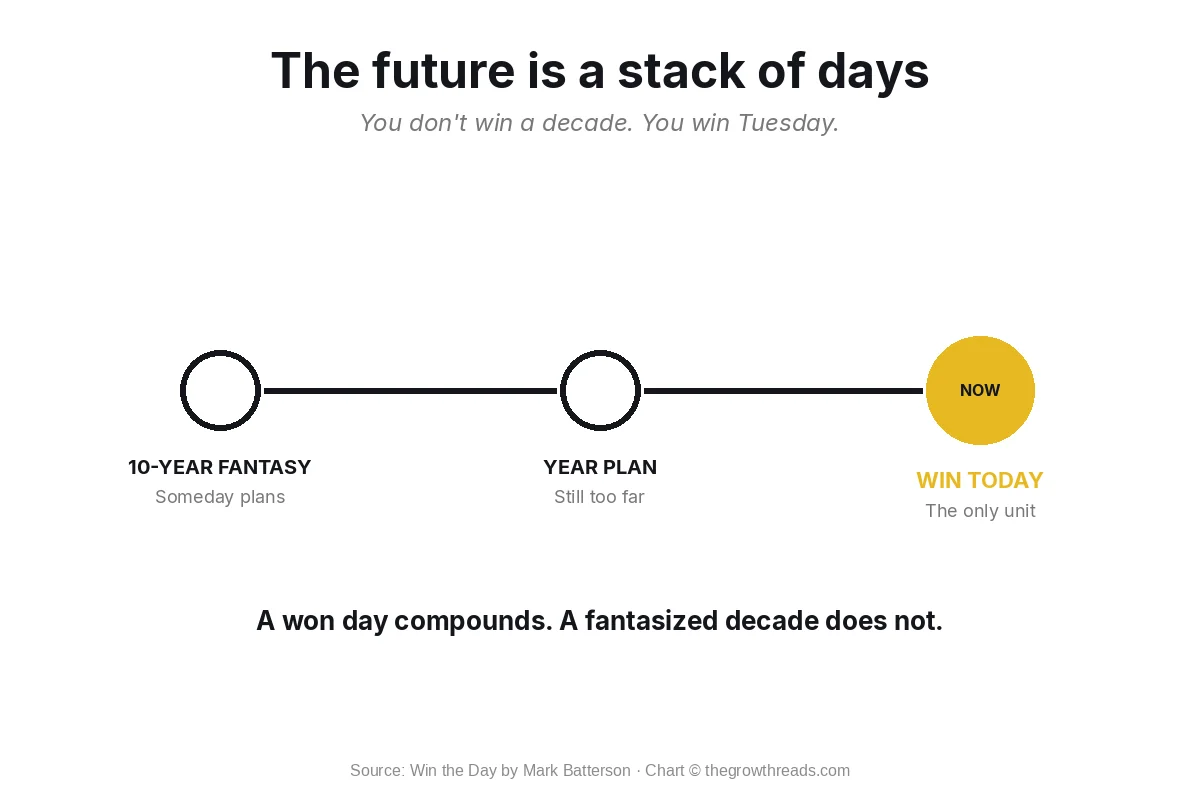
Most people try to win a decade from the couch of a wasted Tuesday. Mark Batterson, a Washington, D.C. pastor and the author of The Circle Maker, argues that tomorrow’s anxiety and yesterday’s regret are the two taxes that empty today. Win the Day is seven habits for spending the only unit you actually have: the next twenty-four hours. Rewrite the sentence. Face the wave. Do the ugly task first. Keep a small kite in the air. Cut the rope you keep calling “not yet.” Guard the hours. Plant a seed you will not harvest this week. A ten-year vision that never touches a calendar is a speech. A won Tuesday is a brick.
Key takeaways
- The unit is a day: decades are stacked Tuesdays, not a mood in 2030.
- Flip the script: the sentence you repeat at 7 a.m. runs the calendar.
- Kiss the wave: the obstacle is the work, not a delay to real life.
- Eat the frog: the ugliest important task first, while the will is cheap.
- Fly the kite: tiny excellence compounds; how you do this hour is the week.
- Cut the rope: waiting for safe is its own risk.
- Wind the clock: guard the hours that actually move the goal.
- Seed the clouds: sow today what you want standing later.
- Leave yesterday: regret is a tax — pay it once, then spend the hour.
- Shut the day: a won day ends so tomorrow’s worry does not sleep in your bed.
What is Win the Day about?
Win the Day is Mark Batterson’s seven-habit playbook for turning a ten-year vision into a Tuesday you can actually spend — rewrite the story, face the obstacle, do the hard thing first, keep a small excellence, take the next honest step, guard the hours, and plant a seed — instead of living in yesterday’s regret and tomorrow’s anxiety.
About the author
Mark Batterson is lead pastor of National Community Church in Washington, D.C., a multi-site church that began as a coffeehouse on Capitol Hill. He is a New York Times bestselling author whose earlier books — The Circle Maker, In a Pit with a Lion on a Snowy Day, Chase the Lion — mix pastoral stories with practical risk. Win the Day (Multnomah, 2020) is the daily-habit companion: less “dream huge,” more “what happens before lunch.” He writes as a pastor, not a lab scientist. The value for TGR readers is the operating system — seven named moves you can put on a weekday — not the pulpit illustrations. If a story uses scripture, keep the habit and spend the hour. Explore all Mark Batterson book summaries →
Key concepts at a glance
| Concept | What it means | Use it when |
|---|---|---|
| Win the day | The only winnable unit is the next 24 hours. | The vision is huge and Tuesday is empty. |
| Flip the script | Change the sentence that runs the morning. | You narrate failure before the work starts. |
| Kiss the wave | The obstacle is the day’s assignment. | You wait for a cleaner week that never arrives. |
| Eat the frog | Ugliest important task first. | The hard thing slides to 4 p.m. and dies. |
| Fly the kite | Tiny excellence, repeated. | You only work in heroic moods. |
| Cut the rope | Take the next honest step. | “Not yet” has lasted a year. |
| Wind the clock | Guard hours that move the goal. | The calendar is full and the work is not. |
| Seed the clouds | Sow what you want standing later. | You only plant what harvests this week. |
Part 1: Flip the script, then kiss the wave
Batterson’s first move is identity, not a timer. Flip the Script means the sentence you tell yourself before the inbox opens is already writing the day. If the line is “I’m behind,” you will spend the morning proving it. If the line is “I do the hard thing first,” the calendar has somewhere to land. This is not a mirror affirmation. It is a constraint: one sentence, written the night before, read once, then acted on. A ten-year speech at 7 a.m. is still a speech. A one-line script plus a frog is a day.
Kiss the Wave is the obstacle chapter. Batterson’s frame — borrowed in spirit from the older line that the obstacle is the way — is that the problem in front of you is not blocking the real work. It is the work. Waiting for a quieter quarter is how people lose a year. The wave is this week’s ugly email, the draft that is not ready, the conversation you keep rescheduling. You do not have to like it. You have to meet it before lunch, or it owns the afternoon.
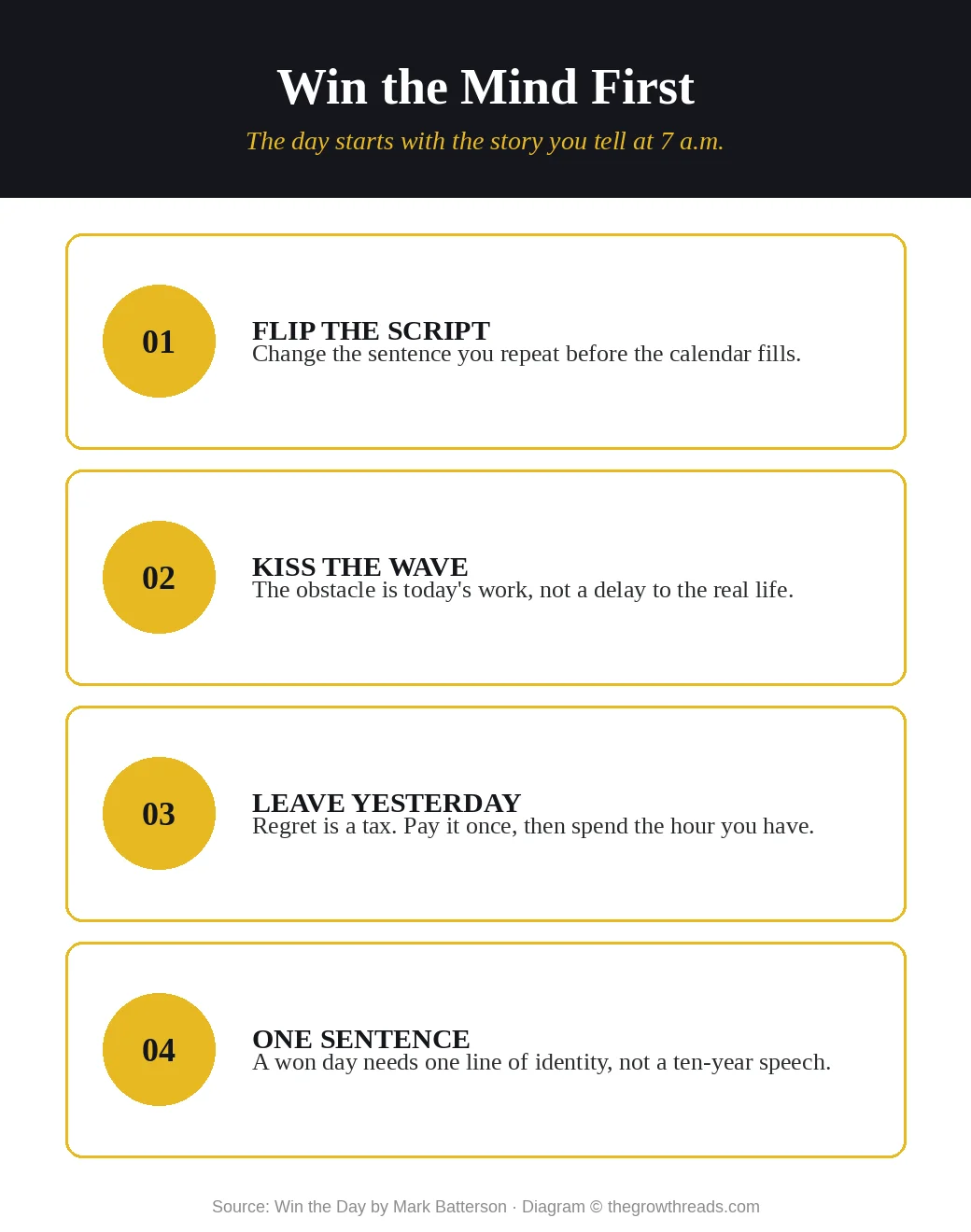
Yesterday’s regret is the other tax. Batterson’s point is blunt: you cannot spend a day you are still prosecuting. Pay the lesson once. Then spend the hour you have. If you need a lab version of “the story runs the behavior,” you will not find randomized trials here. You will find a usable morning: one sentence, one wave, no rerun of last month.
TGR Note. James Clear’s Atomic Habits summary is the identity loop after the sentence. Batterson gives you the daily script. Clear keeps the cue alive. If the first rep is still too big, Tiny Habits shrinks it so Tuesday does not need another speech.
Part 2: Eat the frog, then fly the kite
Habit three is the one most TGR readers already know by another cover. Eat the Frog — Batterson uses Brian Tracy’s name on purpose — is the ugliest important task in the first work hour, while the will is still cheap. If the frog hops to 4 p.m., it dies. The rest of the seven habits fail if this one is theatre. Put the file on the desktop. Put the call first. Do not “warm up” with mail.
Fly the Kite is the compounding chapter. Batterson’s line is the old craftsman’s warning: how you do anything is how you will do everything. A won day is not a heroic binge. It is a small kite you refuse to drop — twenty honest minutes, a closed loop, a standard you would not be ashamed to repeat tomorrow. Heroic moods are rare. Kites fly on ordinary wind. If you only work when you feel like a new person, you will wait a long time to feel like one.
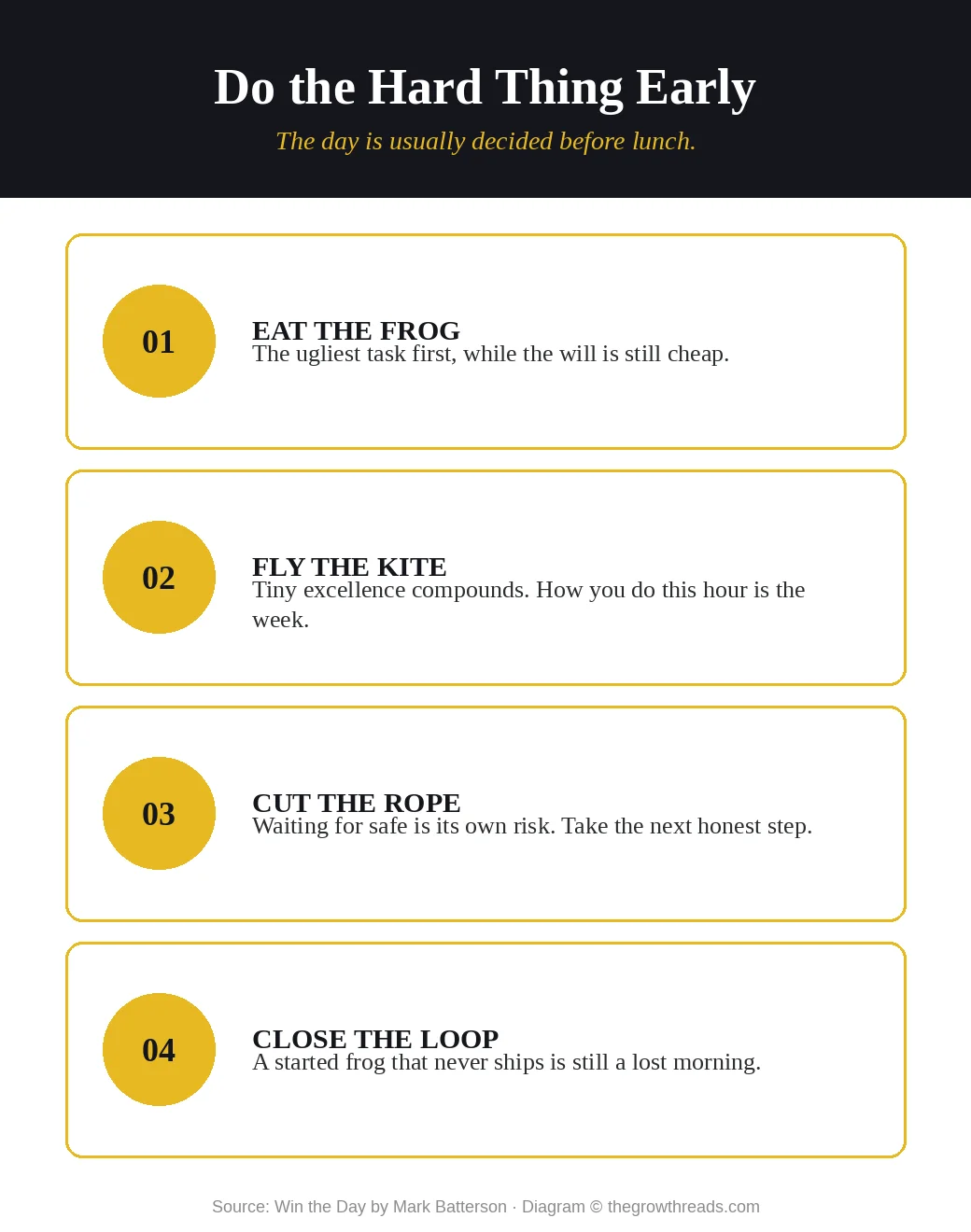
Put frog and kite on the same morning and the day has a spine. The hard thing happens. Then a small excellence keeps moving after it. If you eat the frog and then drift, you won an hour, not a day. If you fly kites and never touch the frog, you were busy. Busy is how decades vanish.
TGR Note. Brian Tracy’s Eat That Frog is the scalpel for habit three. Batterson keeps it and adds the rest of the day. For the math of tiny repeats, The Compound Effect and The Slight Edge are the longer compounding books. Fly the Kite is those books in one hour.
Part 3: Cut the rope and wind the clock
Cut the Rope is Batterson’s risk chapter. Playing it safe is not free. The bill is a life that never starts. You do not need a dramatic resignation. You need the next honest step you have labeled “not yet” for a year: send the pitch, ship the ugly draft, book the call, publish the small thing. A rope you never cut becomes a personality. The day you cut it is usually smaller than the story you told about it.
Wind the Clock is time as a limited store, not a vibe. Minutes are the clock. Moments are the life. The practical version is ugly and useful: put a real name on the hours that move the goal, and treat other people’s “got a minute?” as a request to steal the day. A full calendar is not a won day. A guarded hour that shipped the frog is. If your week is scheduled and the important work still lives in leftover scraps, the clock is wound for someone else.
Together they stop two classic stall patterns: waiting for safe, and spending every hour in other people’s meetings. Cut one rope. Guard one hour. That is a Tuesday that can carry a goal. A vision board cannot.
TGR Note. Cal Newport’s Deep Work is the longer case for guarded hours. Batterson is the daily version: wind the clock or the day leaks. If the calendar is already a mess of other people’s frogs, Essentialism is the companion for what gets a name at all.
Part 4: Seed the clouds and shut the day
Seed the Clouds is the delayed-harvest habit. Sow today what you want standing in a year: the relationship, the skill, the draft, the health hour. People who only plant what harvests this week stay hungry. A won day includes at least one action whose payoff is not this Friday — a page, a set, a note, a seed. You will not feel the rain. That is the point. The future is not a mood. It is a pile of unglamorous sowings.
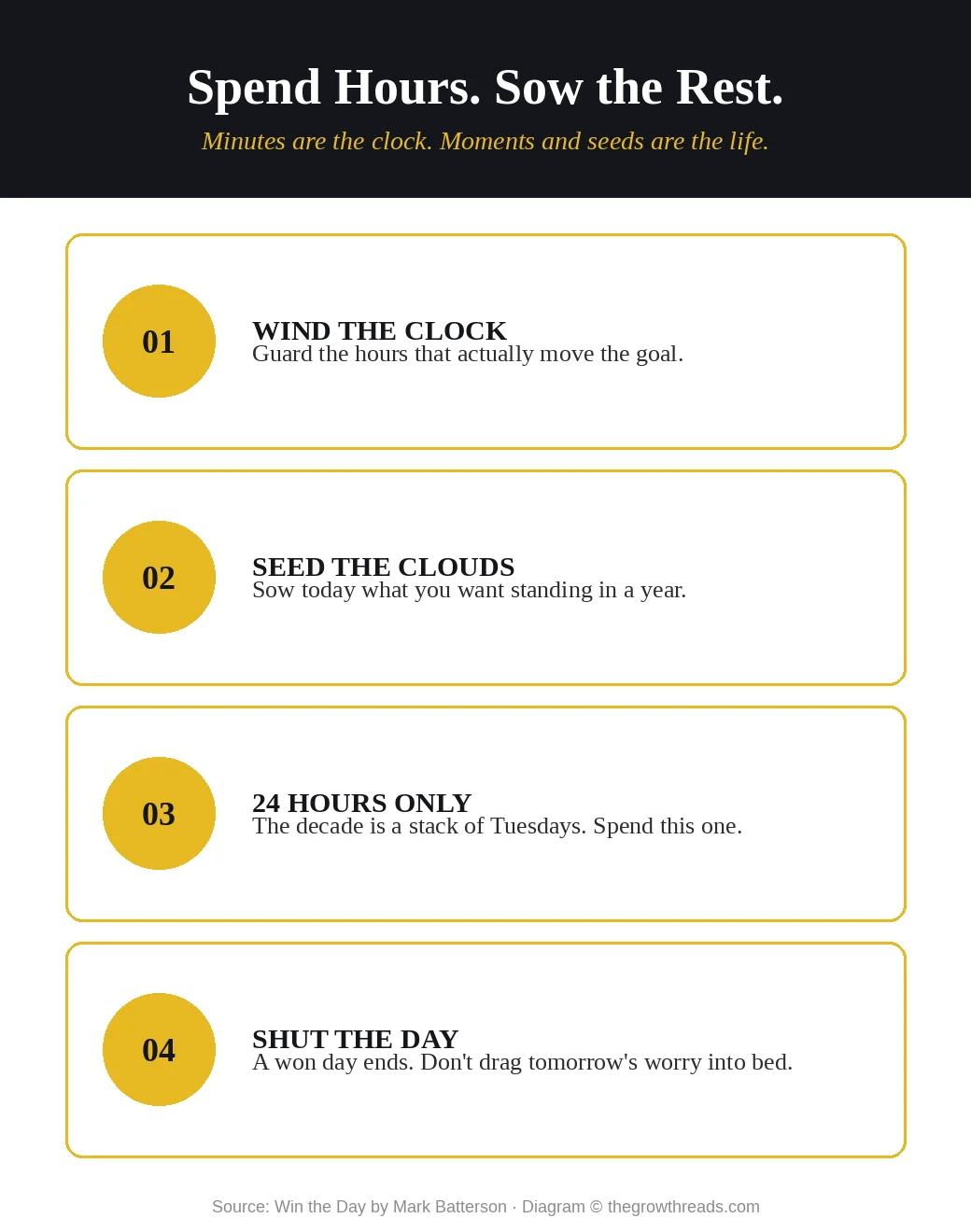
Then shut the day. Batterson’s implied last move — TGR makes it explicit — is that a won day ends. Tomorrow’s anxiety loves 11 p.m. Give it a landing: a one-line script for the morning, the frog named, the kite cue set, then sleep. You cannot win tomorrow in bed. You can only ruin tonight. Seven habits, one calendar date, a close. Repeat. That is how a decade actually gets built: not as a decade, as a stack.
TGR Note. Robin Sharma’s The 5 AM Club is a morning container; Batterson is the whole day. If the stall is a namable barrier rather than a thin Tuesday, How to Change matches the tool to the stuck point. Use Sharma or Milkman when the hour needs a box or a diagnosis. Use Batterson when the vision is already written and the day is not.
Who is Win the Day best for — and who should read something else first?
Best for people with a written goal and an unspent Tuesday — operators, students, parents, and anyone whose notes app is full of decades and whose calendar is full of other people’s hours. Also for readers who liked a faith-tinged voice as long as the habits still run secular: one sentence, one frog, one kite, one rope, one guarded hour, one seed.
Read something else first if you do not have a loop at all: start with Atomic Habits or Tiny Habits. If the only problem is the first hard task, Eat That Frog. If you need a lab diagnostic, How to Change. If the calendar is a leak, Deep Work or Essentialism. Come to Batterson when the vision is clear and the day is not.
Questions to reflect on
- What one sentence will you actually read tomorrow before the inbox, and what frog does it point at?
- Which wave are you treating as a delay to real life that is, in fact, the work?
- Where is “not yet” still a rope you could cut this week in one honest step?
- Which hour on the calendar is named for your goal, and which hours are unnamed on purpose?
- What seed can you plant today that cannot harvest this Friday — and when will you shut the day so tomorrow’s worry does not get a second shift?
🔥 Ready to stop winning a decade in your head?
Get Win the Day and spend Tuesday like it is the only unit you have — because it is.
How to apply Win the Day (7-day plan)
- Day 1 — Flip the script: Write one morning sentence that names the person who does the hard thing. Put it where the kettle is.
- Day 2 — Name the wave: Write the obstacle you have been calling a delay. Do the first five minutes of it before lunch.
- Day 3 — Eat the frog: Put the ugliest important task in the first work hour. Mail waits.
- Day 4 — Fly the kite: Attach one tiny excellence to a cue you already have. Repeat it even if the frog was messy.
- Day 5 — Cut the rope: Take one “not yet” step that is actually sendable today. Small and honest beats dramatic and imaginary.
- Day 6 — Wind the clock: Guard one named hour. Treat interruptions as requests, not commands.
- Day 7 — Seed and shut: Plant one action that cannot harvest this week. Write tomorrow’s sentence. Close the day at a real time.
Frequently asked questions
What is Win the Day about?
Win the Day is Mark Batterson’s field guide for people who live in yesterday’s regret and tomorrow’s anxiety and therefore never spend Tuesday. He offers seven daily habits: flip the script, kiss the wave, eat the frog, fly the kite, cut the rope, wind the clock, and seed the clouds. The claim is practical. A decade is a stack of ordinary days. You do not win a ten-year vision in a ten-year vision. You win the next twenty-four hours, then repeat. It is a habit book with pastoral stories, not a lab study. Use it as an operating system for one calendar date.
Who should read Win the Day?
Read it if you have a big goal and a thin Tuesday: the plan is in a notes app, the hard task keeps sliding, and the week disappears into other people’s calendars. It fits operators, students, and parents who need a daily unit, not another annual theme. Skip it as a first book if you still lack a cue-loop; start with Atomic Habits or Tiny Habits. If the only problem is the ugliest task, Eat That Frog is shorter. Come here when the vision is already written and the day is not.
What are the 7 habits in Win the Day?
Flip the Script rewrites the sentence you tell yourself before the day fills. Kiss the Wave treats the obstacle as the work. Eat the Frog puts the hardest task first. Fly the Kite is tiny excellence — how you do this hour is how you will do the week. Cut the Rope is the honest next step instead of waiting for safe. Wind the Clock guards the hours that actually move the goal. Seed the Clouds sows today what you want standing later. Seven names, one job: spend the day you are in.
How is Win the Day different from Eat That Frog?
Eat That Frog is one move: do the ugliest important task first. Win the Day keeps that move as habit three and wraps six others around it — identity, obstacles, small excellence, risk, time, and sowing. Tracy is the scalpel. Batterson is the day-long kit. If mornings already die on the first hard thing, Tracy is enough. If you eat the frog and still lose the afternoon to tomorrow-worry, you need the rest of the set. They stack. Do not treat them as rivals.
Is Win the Day a religious book?
Batterson is lead pastor of National Community Church in Washington, D.C., and the stories quote scripture. The operating system still translates if you are not in that lane: one identity sentence, one hard task, one small excellence, one honest risk, a guarded hour, a seed planted. TGR reads it as a daily productivity book. You can skip the pulpit illustrations and keep the seven moves. If you want a lab-only change book, How to Change or Tiny Habits will feel closer. If you want a day you can actually spend, this is the kit.
How long does Win the Day take to read?
The Multnomah hardcover is 256 pages — about four hours, or one focused evening if you skip the notes. Applying it is the longer job. A useful test is seven days: one habit installed per day, then a Friday review of whether Tuesday actually moved. If the calendar did not change, you summarized a pastor. You did not win a day. Reread the one chapter that names this week’s stall before you reread all seven. Twenty minutes before Monday is enough.
What is the fastest way to apply Win the Day this week?
Write one sentence that will run tomorrow morning. Put the ugliest task in the first work hour. Attach one tiny excellence to a cue you already have. Take one step you have been calling “not yet.” Guard one hour on the calendar as if it had a client name. Plant one seed you will not harvest this week. Shut the day at a real time so tomorrow’s worry does not sleep in your bed. That is the book. The rest is commentary you can reread after Tuesday happens.
Related summaries
- Eat That Frog Summary — the scalpel for the first hard task.
- Atomic Habits Summary — the cue-loop after the morning sentence.
- The Compound Effect Summary — why tiny kites beat heroic moods.
- How to Change Summary — match the barrier when Tuesday still stalls for a specific reason.
- 20 Best Productivity Books of All Time (2026) — the full Productivity pillar.
How we analyze books: we read for the operating system, test the parts you can use in a week, and write the plan we would hand a friend. Read our full methodology.