

★★★★☆ 4.4/5 — the best day at work is a day the work moved, not a day someone clapped.
Best for: managers and makers who want a better Tuesday, not a louder Friday shout-out
Reading time: ~7 hours (HBR Press hardcover, 260 pp, 2011) · this guide ~12 min
Difficulty to apply: Medium — the finding is simple; changing how you close the day is the work
The Progress Principle in one minute
Most productivity books tell you to manage the calendar. This one tells you to manage the tiny forward motion inside it. Teresa Amabile and Steven Kramer sat with 238 people on 26 project teams across seven companies and read more than 12,000 end-of-day diary entries. The pattern was not cute. The single strongest daily lift to inner work life — emotions, perceptions, motivation — was making progress in work that felt meaningful. A small win did more than a bonus speech. A setback did more damage than a win did good.
The book is a manager’s field kit and a personal one. Clear goals, enough resources, real help, and a little respect are not “nice culture.” They are the conditions under which a person can take the next step. If you lead, your job is to pull the grit out of the gears. If you do not lead, the same five-line evening check still works on your own desk.
Key takeaways
- Inner work life is the engine. Emotions, perceptions, and motivation move with the day. Performance follows them more than the other way around.
- Progress is the top daily event. In the diaries, moving the work beat recognition, incentives, and even a pleasant colleague as a lift.
- Meaningful is enough. The work has to matter to someone — a user, a patient, a teammate — not save the world.
- Small wins count. A finished test, a cleaner paragraph, a blocker that finally moved. Inches are the unit.
- Setbacks punch harder. One stall or snub lands heavier than a win lifts. Protect the next step on bad days.
- Catalysts help the project. Goals, autonomy, resources, time, help, learning from problems, idea flow. Inhibitors are those in reverse.
- Nourishers help the person. Respect, encouragement, backup, belonging. Toxins are disrespect and isolation.
- Managers guess wrong. Asked to rank motivators, they put recognition first. The diaries put progress first.
- Close the day on purpose. Five lines: progress, setback, catalyst, nourisher, meaning. Tomorrow inherits that list.
What is The Progress Principle about?
The Progress Principle is Teresa Amabile and Steven Kramer’s research-backed guide to daily motivation at work. Drawing on thousands of diary entries, it shows that progress in meaningful work is the strongest driver of inner work life — and that catalysts and nourishers make that progress more likely.
About the author
Teresa M. Amabile is the Edsel Bryant Ford Professor of Business Administration, Emerita, at Harvard Business School. She spent eighteen years on the psychology faculty at Brandeis before joining Harvard in 1995, and she is known for the componential theory of creativity: domain skill, creative-thinking skill, and intrinsic motivation have to meet. Steven Kramer, a developmental psychologist and independent researcher, is her coauthor and the other close reader of those diaries. Together they turned a multi-year field study into this 2011 HBR Press book. You listen because they did not stop at what managers hoped was true. They read what people wrote at 6 p.m. Wikipedia: Teresa Amabile. Explore all Steven Kramer book summaries →
Key concepts at a glance
| Concept | What it means | Use it when |
|---|---|---|
| Inner work life | The day’s mix of emotions, perceptions, and motivation | You are managing output and ignoring the weather underneath |
| Progress principle | Moving meaningful work is the top daily lift | You are spending the week on recognition theater |
| Meaningful work | It matters to someone, not necessarily to history | The task feels like motion without a who |
| Small win | A real inch of finished or unblocked work | You are waiting for a launch to feel anything |
| Setback principle | Stalls and snubs hit harder than wins lift | One bad hour is writing the story of the whole week |
| Catalyst / inhibitor | Supports or blocks around the project itself | The team is busy and still cannot take the next step |
| Nourisher / toxin | Supports or blocks around the person | The spec is fine and the room is cold |
| Daily check | Five lines that hand tomorrow a next step | Days end in inbox zero and no memory of progress |
Part 1: Inner work life — the hidden engine
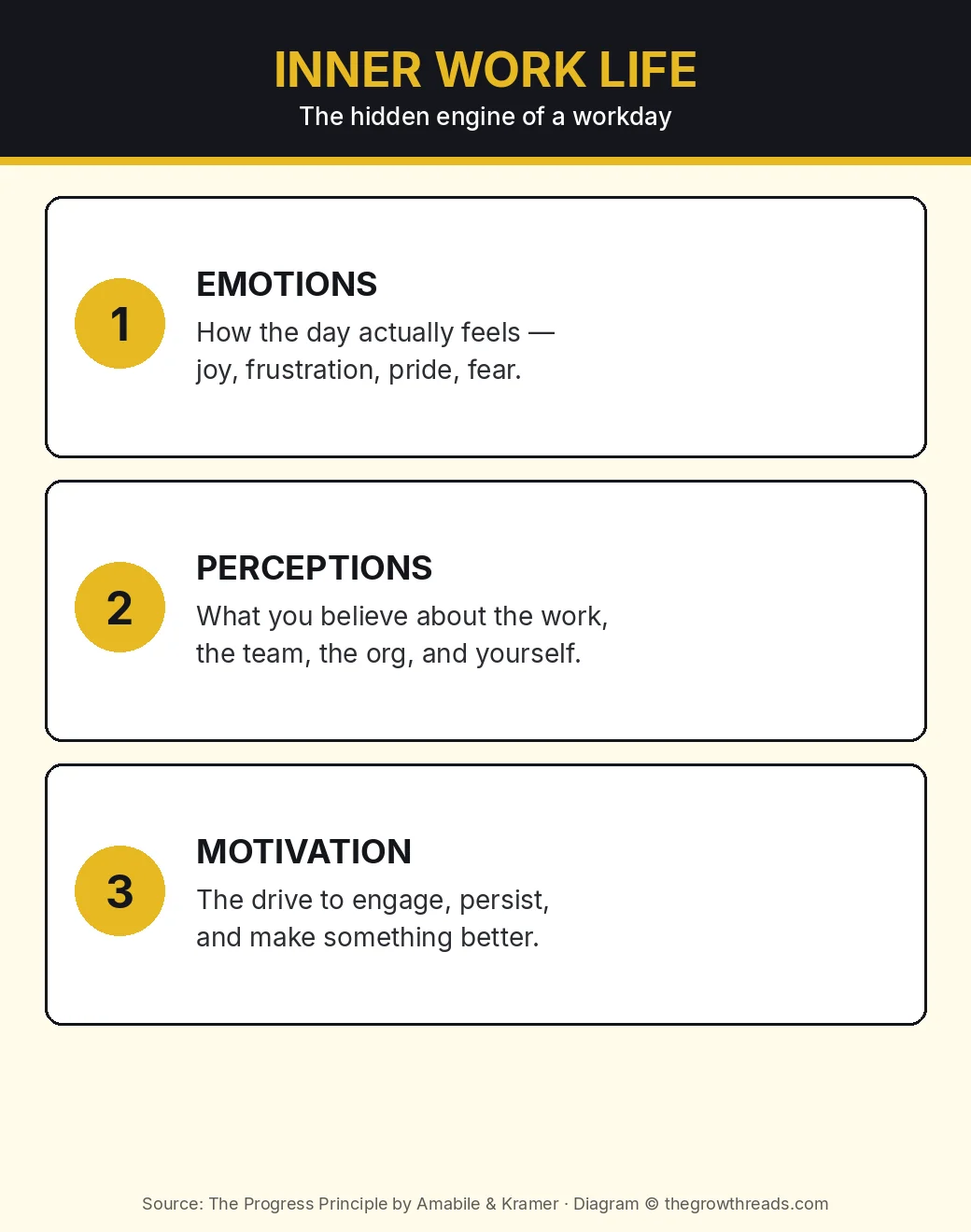
Amabile and Kramer ask you to stop treating a workday as a list of outputs. Under the list is a stream: how the day felt, what you believed about the work and the people, and whether you still wanted to engage. They call that stream inner work life. It moves when events move. A clean handoff can raise it. A silent snub can drop it. The diaries made that visible because people wrote at the end of real days, not in a lab.
Inner work life is not only a result of good performance. It is an input. When the stream is decent, people do better creative work and better grind work. When it is sour, they still attend the meeting. They just stop offering the extra thought that would have saved the project a week. If you only manage the visible calendar, you are managing the residue, not the engine. A “fine” day with no true step still sours the stream. The fix is not a pizza Friday. The fix is an event the person can point to: the work moved.
TGR Note: Pink’s Drive names autonomy, mastery, and purpose as the deep fuel. Csikszentmihalyi’s Flow names the stretch where skill meets a clear target. Amabile and Kramer add the daily weather report those theories need. You can believe in purpose and still have a Tuesday that wrecks inner work life. This book is the instrument panel, not the manifesto.
Part 2: Why small wins beat recognition
The title finding is blunt. Of all the events in the diaries, progress in meaningful work was the strongest positive. Not a bonus. Not a public thank-you. Forward motion on work that mattered to someone. Meaningful does not have to save the world. It has to be useful to a real someone — a user, a patient, a colleague, a craft.
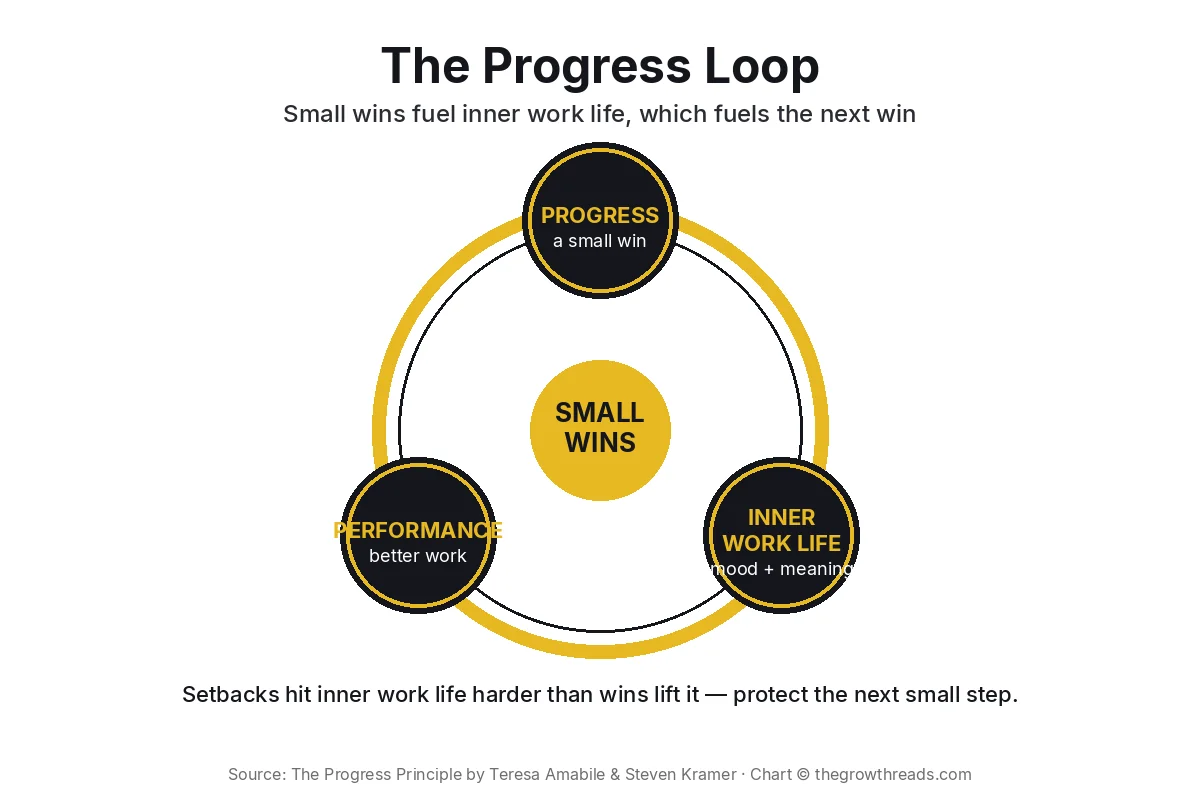
Small wins are the unit because breakthroughs are rare. A test that ran, a paragraph that landed, a blocker that moved. If you wait to feel something until the launch, you leave most weeks of inner work life to chance. The loop is ordinary: a win feeds the inner stream, the stream feeds better work, better work makes the next win cheaper.
The dark twin is the setback principle. Stalls and disrespect hit harder than wins lift. That is not an argument for padding people. It is an argument against stacking avoidable grit on a day that already stalled. Managers ranked recognition first as a motivator. Only a sliver ranked support for progress first. The diaries disagree. Recognition is lovely. It is not the engine.
TGR Note: If the stall is a missing shipping habit, Clear’s Atomic Habits still shrinks the action until it can start. If the stall is attention, Deep Work buys the hours. Amabile and Kramer sit one layer down: you can have a habit and a block of hours and still end the day with no progress event, because the goal was fog or the help never came. Pair them. Habits open the file. Progress is what you write in it.
Part 3: Catalysts that make progress possible
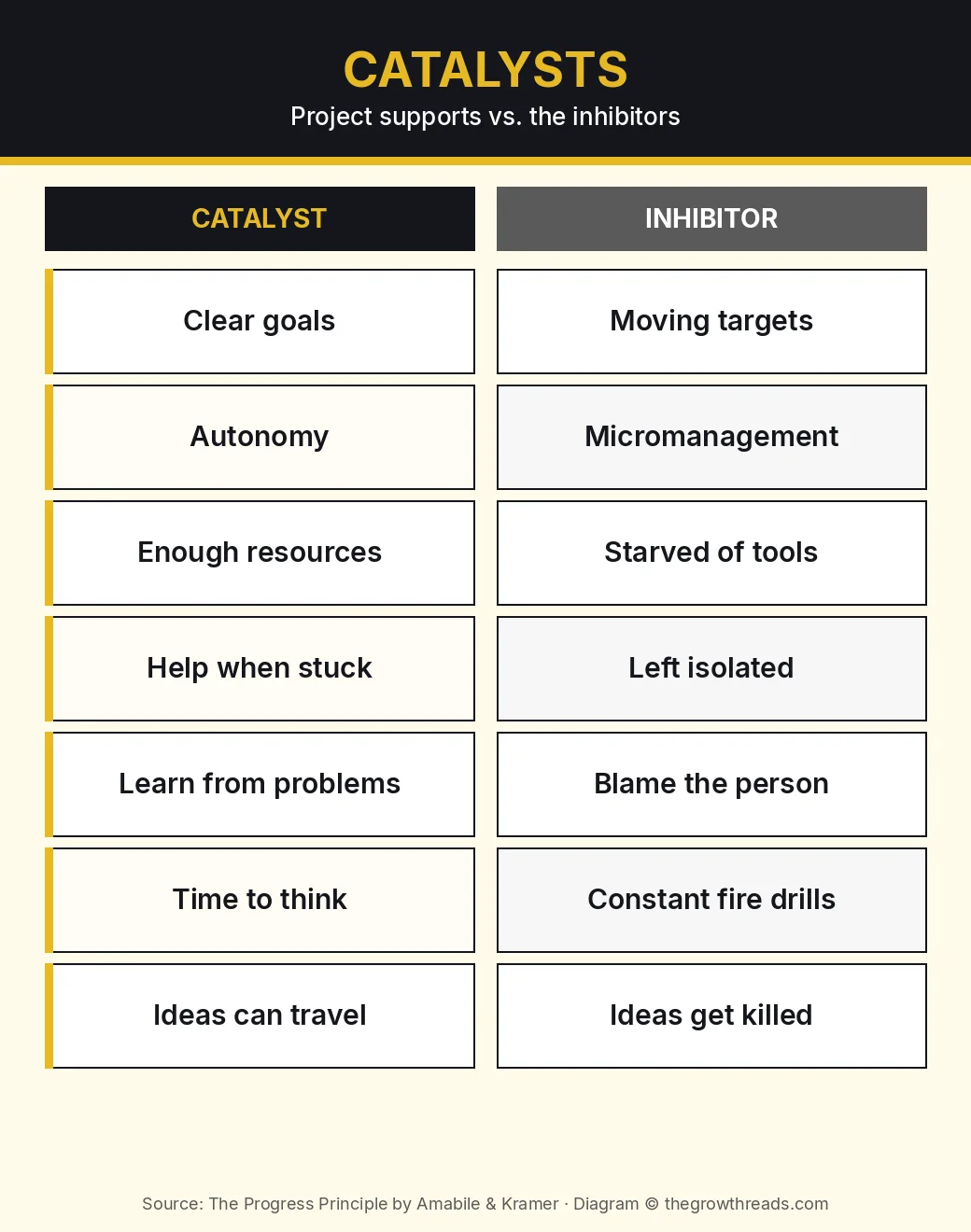
A catalyst is anything that helps the work itself move. The list is not exotic: a clear goal, autonomy over how to get there, enough resources, time to think, help when stuck, permission to learn from a problem, and an idea that is allowed to travel. An inhibitor is each of those in reverse — a moving target, a micromanaged path, starved tools, fire drills, isolation, blame, and ideas that die in the hallway.
You do not need a new values poster. You need to notice which inhibitor ate Tuesday. A team that is “busy” and still cannot name the next true step usually has a catalyst failure, not a character failure. Foggy goals are the most common. Autonomy without a target is drift. A target without help is a trap. Look at the project supports before you look at the person’s attitude.
Time is a catalyst people pretend is a personality. A calendar of reactions will not produce a progress event. You do not need a sabbatical. You need two protected hours and a goal small enough to finish inside them. If you lead, that is a gift you can give. If you do not, it is a one-sentence request: “I can ship X by Thursday if I have Wednesday morning without a fire drill.”
TGR Note: Drucker’s The Effective Executive is still the best argument that executives get paid for contribution, not for motion. Grove’s High Output Management turns that into leverage through other people. The Progress Principle tells you what those people need on a random Wednesday: a catalyst, not another status meeting. Use Drucker to pick the work. Use this book to unstick the people doing it.
Part 4: Nourishers, the daily check, and tending your own inner work life
Nourishers are interpersonal: respect, specific encouragement, backup on an ugly day, a sense that you belong. Toxins are the opposite — a rolled eye, a joke at someone’s expense, silence when help was the job. Perfect catalysts in a cold room still bleed people. A warm room with junk project supports still stalls. Project and person. Both. Every week.
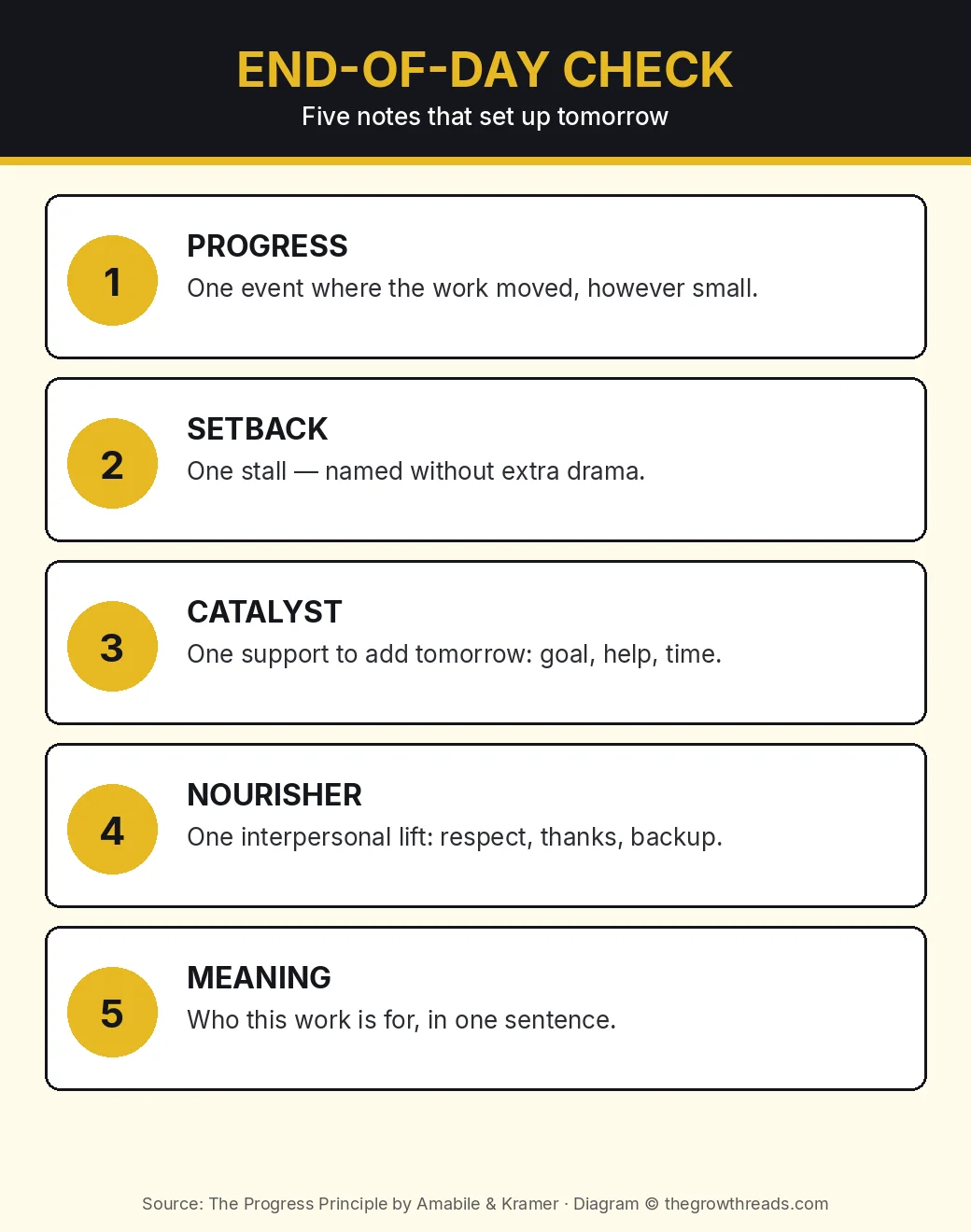
The tool is almost too small to respect, which is why it works. At the end of the day, write five notes: one progress event, one setback without a courtroom, one catalyst to add tomorrow, one nourisher to give or ask for, and one sentence of meaning. That list hands the next morning a next step. It is also how a manager sees patterns: the same inhibitor three days running is no longer an accident.
The last chapter is for you, not your org chart. Shrink the win until it is real. Ask for the catalyst by name. Ignore the story that a stalled afternoon means you are the wrong person. Setbacks are data, not identity. If you lead, your inner work life leaks. Tend yours first, then run the check with the team as a ritual of next steps, not of feelings.
TGR Note: The Power of Full Engagement manages energy in four tanks. The Happiness Advantage argues that mood is an input to performance, not a prize at the end. Amabile and Kramer give you the daily lever those books imply: a progress event. If you want the skill-building cousin, Peak and Hidden Potential are how people get better at the work. This one is how they stay well enough to do it on a random week.
Who is The Progress Principle best for — and who should read something else first?
Best for managers, tech leads, producers, and independent makers who can point at a live project and a team (even a team of one) and who suspect the week is full of motion without progress. If you already believe people want more than a gift card, and you want the research and the daily tool, start here.
Read something else first if you do not have a project yet — Getting Things Done or Making Ideas Happen will give you a next action. If the problem is a missing habit, not a missing catalyst, Atomic Habits is cleaner. If the problem is too many projects, Essentialism or The One Thing will cut the list so progress has a place to land. If you need a pep talk more than a diary method, this will feel dry. It is supposed to.
Questions to reflect on
- What was today’s actual progress event — not the busyness, the inch?
- Which inhibitor showed up more than once this week?
- Who is this work for, in one sentence you could say out loud?
- Where did you offer a toxin when a nourisher would have been cheaper?
- What is the smallest win that could be real by tomorrow at 4 p.m.?
🔥 Ready to make tomorrow’s small win inevitable?
Get The Progress Principle, then use the 7-day plan to log one inch of meaningful work each night.
How to apply The Progress Principle (7-day plan)
- Day 1 — Pick the work. One live project that matters to someone. Write the someone’s name.
- Day 2 — Name yesterday’s inch. One progress event. If you cannot find one, the goal is too foggy.
- Day 3 — Name one inhibitor. Goal, help, time, tools, or blame. Circle only one. Plan the removal.
- Day 4 — Give a nourisher. Specific respect or backup to one person on the work. Not a group emoji.
- Day 5 — Ask for a catalyst. One sentence: the win, the date, the support you need.
- Day 6 — Shrink the win. Define a Thursday-sized slice that can actually finish.
- Day 7 — Run the five-line check. Progress, setback, catalyst, nourisher, meaning. Keep the card.
Frequently asked questions
What is The Progress Principle about in one paragraph?
The Progress Principle is Teresa Amabile and Steven Kramer's research guide to daily motivation at work. They analysed more than 12,000 end-of-day diaries from 238 professionals on 26 project teams. The strongest lift to inner work life — emotions, perceptions, and motivation — was making progress in work that felt meaningful. Small wins counted. Setbacks hit harder than wins lifted. The book then shows what managers and makers can do: add catalysts around the project, add nourishers around the people, and close the day with a short check so tomorrow has a next step.
What does "inner work life" mean in The Progress Principle?
Inner work life is the mix of emotions, perceptions, and motivation that runs through an ordinary workday. It is not a personality type. It moves with events. A clear goal and a tiny finished slice can raise it. A stalled review, a snub, or a resource that never arrives can drop it. Amabile and Kramer treat it as the hidden engine of performance: people do better creative and analytic work when inner work life is decent, and they do worse when it is sour, even if the calendar looks full. Manage the events. The inner weather follows.
Why do small wins matter more than big breakthroughs?
Breakthroughs are rare. Most days the work either inches forward or it does not. In the diaries, ordinary progress events — a test that ran, a paragraph that landed, a blocker that finally moved — were enough to lift inner work life. Waiting for a launch, a promotion, or a standing ovation leaves most Tuesdays unmanaged. The progress loop is daily: a small win feeds mood and meaning, which feeds the next stretch of good work. Protect the inch. The breakthrough, if it comes, is usually a pile of inches that someone bothered to notice.
What is the difference between a catalyst and a nourisher?
A catalyst helps the work itself: a clear goal, real autonomy, enough time and tools, help when stuck, and the chance to learn from a problem instead of hiding it. An inhibitor is the opposite of those. A nourisher helps the person: respect, encouragement, emotional backup, a sense of belonging. A toxin is disrespect, dismissal, or isolation. You need both kinds. A well-loved team with no goal still stalls. A well-specified project in a cold room still bleeds people. The daily check asks for one catalyst and one nourisher on purpose so you do not only fix the spreadsheet.
Who are Teresa Amabile and Steven Kramer, and why listen to them?
Teresa Amabile is a Harvard Business School professor emerita and a psychologist of creativity and intrinsic motivation. She developed the componential theory of creativity before this field study. Steven Kramer is a developmental psychologist and independent researcher, and her coauthor on the diary project. They did not ask managers what they believed motivated people and stop there. They read what 238 working professionals wrote at the end of real days, then compared that to what 669 managers guessed. The guess was recognition. The diaries said progress. That gap is why the book exists.
Is The Progress Principle useful if I am not a manager?
Yes. The last chapter is about tending your own inner work life. You can still name a meaningful next slice, still ask for a catalyst, still protect a nourisher, and still close the day with five lines even if nobody reports to you. The manager chapters help you see what to request: a clearer goal, a blocked review, a pair of hours without a fire drill. If you do lead people, the same tools scale. If you do not, they still change how you spend the last ten minutes before you shut the laptop. The unit of change is a day, not an org chart.
How should I apply The Progress Principle this week?
Pick one live project that actually matters to someone. Each evening, write five lines: one progress event, one setback without extra story, one catalyst to add tomorrow, one nourisher to give or ask for, and one sentence of meaning. Do not wait for a retreat. Do not wait for a new tool. If you lead, spend one conversation removing an inhibitor instead of adding a pep talk. If you work alone, shrink tomorrow's win until it can finish. The 7-day plan in this summary is the whole method, scaled to a week. Repeat it. The loop only works if it runs.
Related summaries
- The Effective Executive — pick contribution first, then unstick the people doing it.
- Peak — how skill actually grows once inner work life is well enough to practice.
- High Performance Habits — daily practices that pair with the evening progress check.
- Feel-Good Productivity — mood as fuel, from a more popular lane than the diary study.
More in this silo: best productivity books.
How we analyze books: every book on The Growth Reads is read cover to cover, summarized in thousands of words of original analysis, and rated against our five-criteria rubric (lasting impact, evidence quality, practical application, writing & originality, external consensus). Read our full methodology.