

★★★★★ 4.7/5 — The field guide that treats pleasure as a good and honesty as the price of admission.
Best for: Anyone stuck in scarcity love, people considering ethical non-monogamy, and couples who need a living agreement instead of a frozen deal
Reading time: ~6–8 hrs for the Ten Speed 312-page third edition · ~14 min for this guide
Difficulty to apply: Copying the word is costume. Telling one true want, and getting a real yes, is the work.
The Ethical Slut in one minute
Love is not a pie. Easton and Hardy wrote the manual for people who are done pretending it is. First published in 1997 and updated in 2017, The Ethical Slut reclaims a slur for anyone who treats pleasure as a good and pays for that plenty with consent and honesty. It is not a hall pass. It is skills: abundance instead of slices, living agreements, jealousy as mail you open before you prosecute, and the boring kindness of safer sex and calendars. You do not have to collect partners. You do have to stop calling secrecy “protection.”
Read it when shame is still running the house, or when an opening is being discussed without a language. Skip the costume. Do the ethics.
Key takeaways
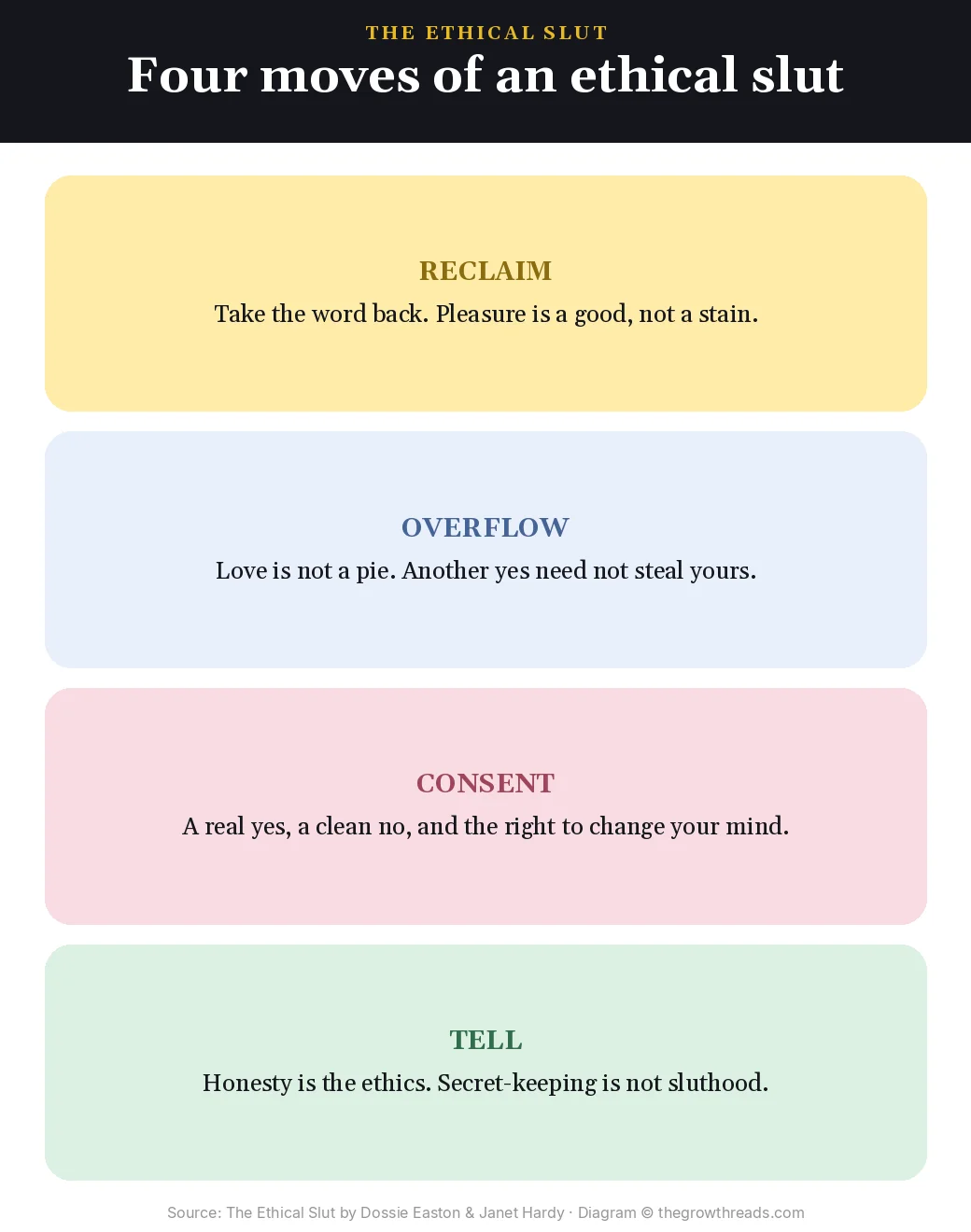
- Slut is a reclamation: a person of any gender who lives as if sex is nice and pleasure is good for you — with a real yes attached.
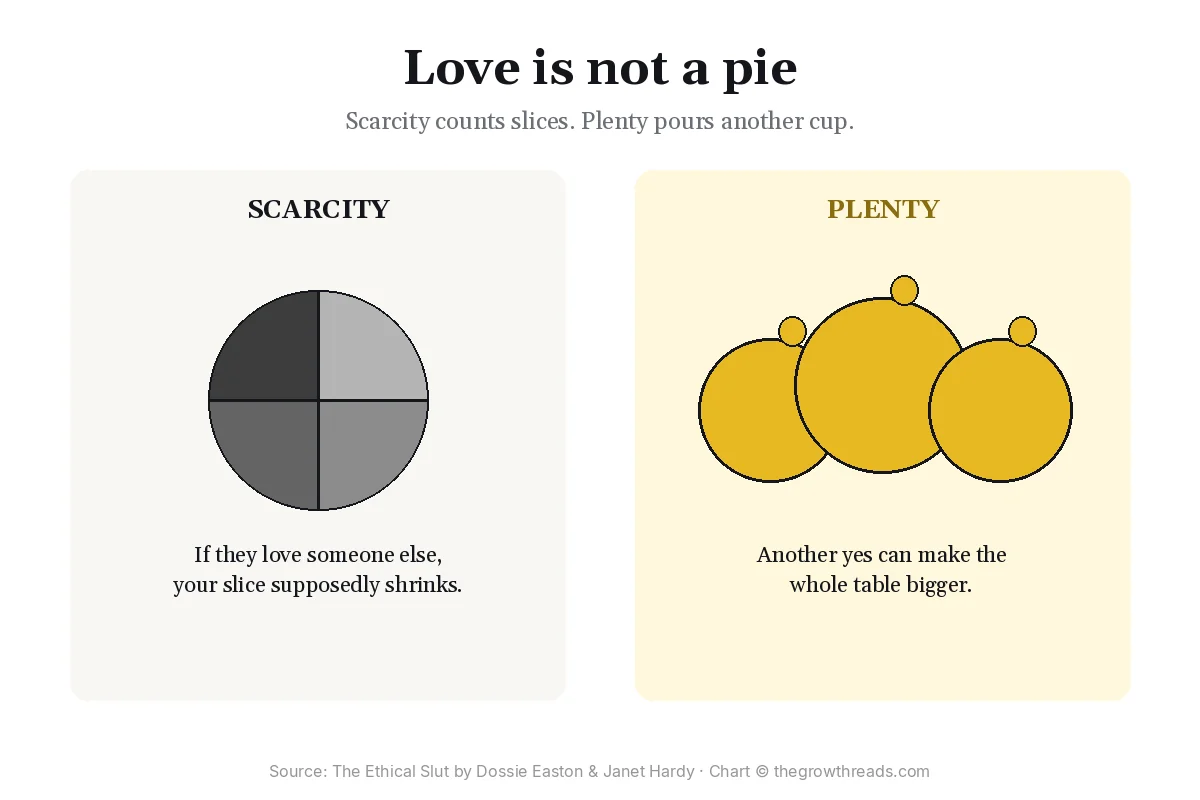
- Love is not a pie: another connection does not have to shrink your slice. Scarcity is a story you inherited, not a law of physics.
- Consent is the ethics: a real yes, a clean no, and the right to change your mind. Silence is not a yes. Pressure is not a yes.
- Honesty is the other half: secret-keeping is not sluthood. “Don’t ask, don’t tell” is often fear in a nicer coat.
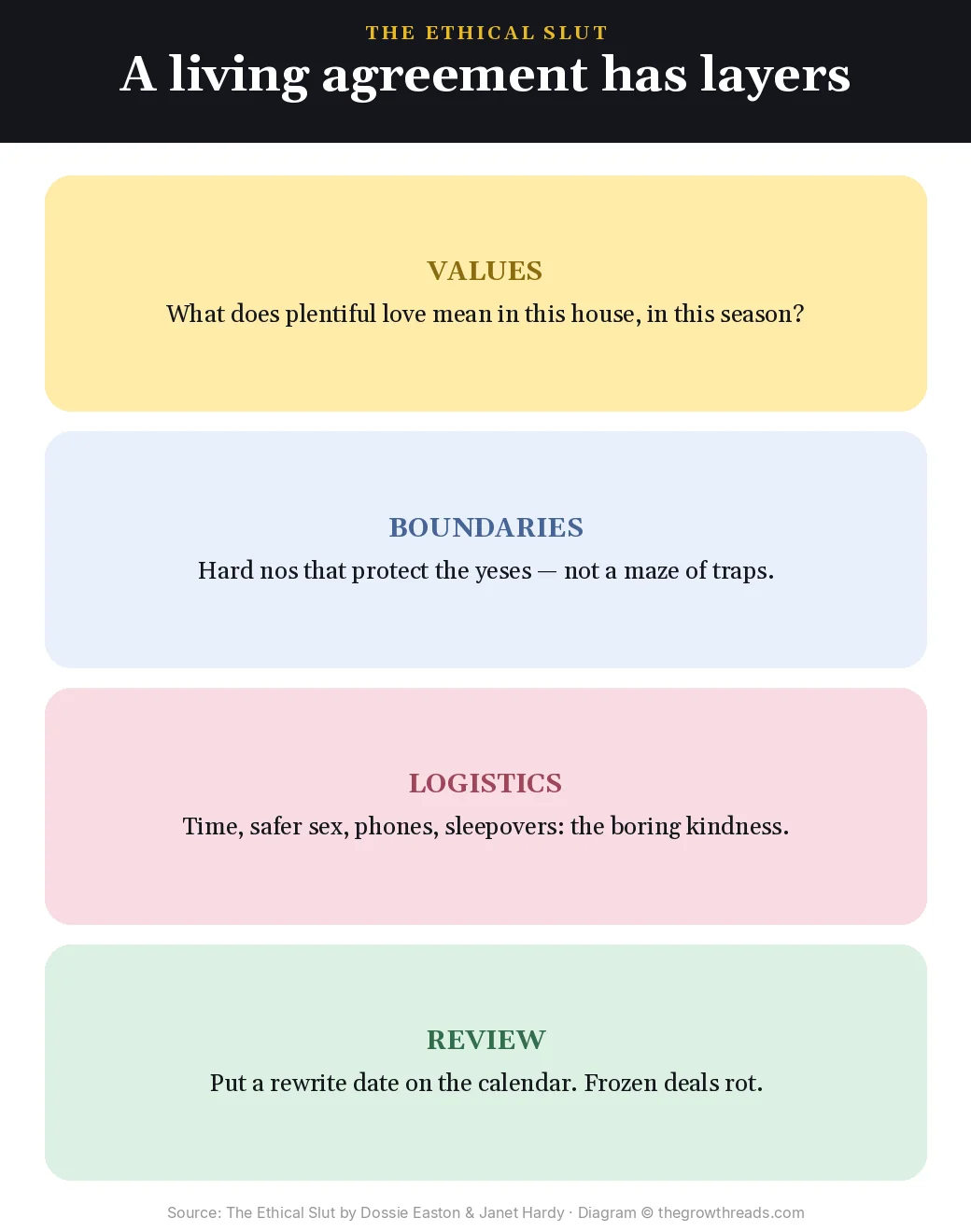
- Agreements must live: values, boundaries, logistics, and a rewrite date. Frozen deals rot and then explode.
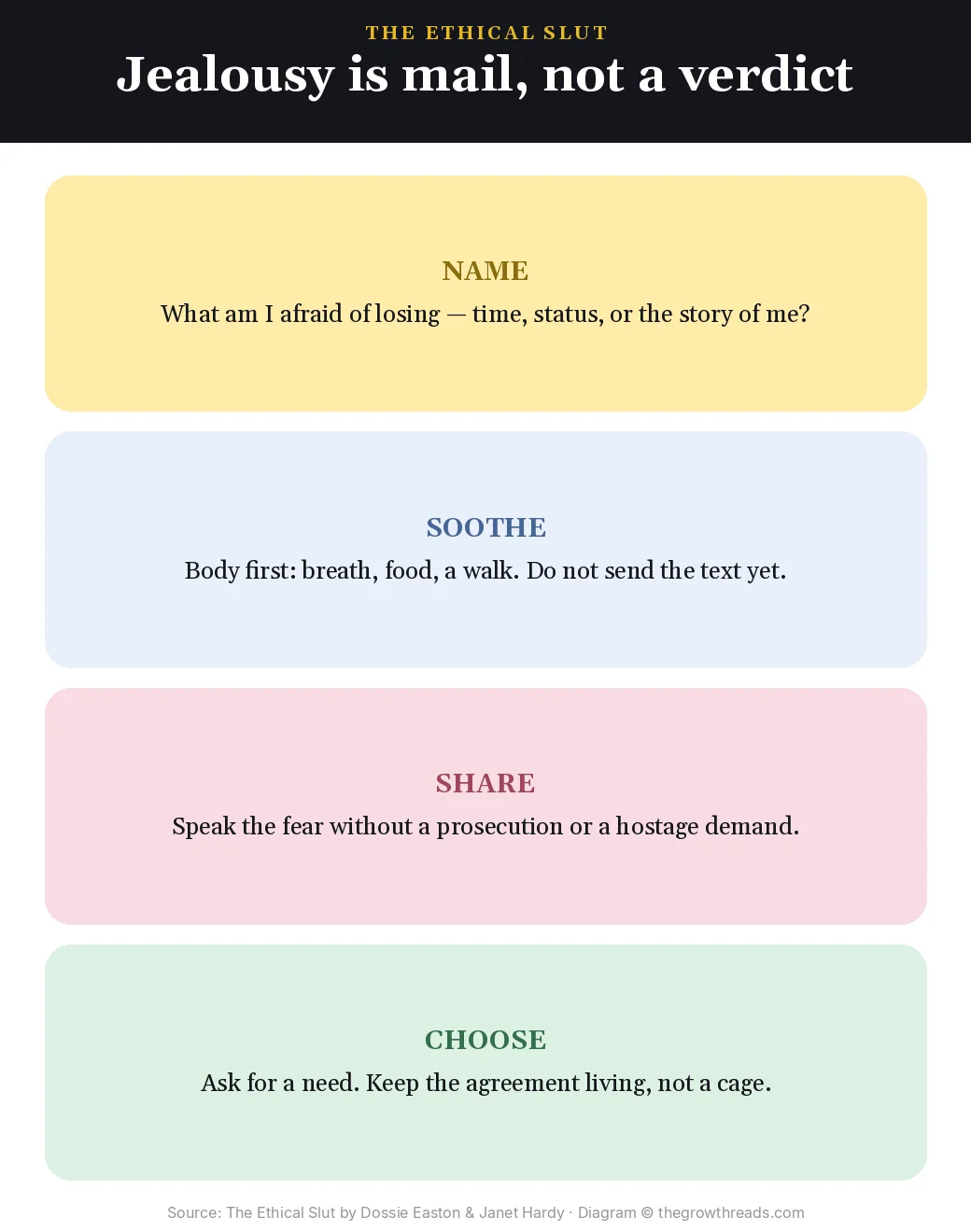
- Jealousy is mail: name it, soothe the body, share without a trial, then ask for a need — not a hostage.
- Compersion is a skill: you can grow joy in a partner’s joy. You do not have to feel bliss to stay ethical.
- Safer sex is care: tests, phones, and sleepovers are how plenty stays kind, not unromantic.
- Opening is not a patch: do not add a person to avoid a conversation you are already refusing.
What is The Ethical Slut about?
The Ethical Slut is Dossie Easton and Janet Hardy’s map for ethical non-monogamy — a 1997 self-help book, revised in 2017, that treats pleasure as a good, consent as the ethics, and jealousy as information you can work rather than a verdict that ends the night.
About the author
Dorothy “Dossie” Easton (born 1944) is a San Francisco family therapist who began teaching “unlearning jealousy” in 1973 and helped found the Society of Janus. After leaving a traumatic relationship in 1969, she built a queer, polyamorous life and a practice around consent. Janet W. Hardy founded Greenery Press in 1991 after leaving a thirteen-year marriage; she has also written as Catherine A. Liszt. They met in 1992, became co-authors, friends, and lovers, and had already written kink manuals with a small readership. The Ethical Slut (1997; Ten Speed third edition 2017) sold more than 200,000 copies because it handed people a language: plenty, agreements, and an ethic that could survive a Tuesday. Easton wanted the word back. Hardy wanted a map that did not apologize for heat. Explore all Dossie Easton book summaries →
Key concepts at a glance
| Concept | What it means | Use it when |
|---|---|---|
| Ethical slut | Pleasure is a good; consent and honesty are the price | Shame is still running the vocabulary of your desire |
| Abundance | Love is not a pie — another yes need not steal yours | You count slices every time someone is wanted elsewhere |
| Consent | A real yes, a clean no, and the right to change your mind | Silence, sulking, or “fine” is being treated as agreement |
| Living agreement | Values, boundaries, logistics, plus a rewrite date | The deal is two years old and everyone is quietly furious |
| Jealousy as mail | Fear of loss arriving in the body — information, not a verdict | You prosecute a partner instead of naming the fear |
| Compersion | Joy in a partner’s joy with someone else — a skill, not a personality | You think you have to feel bliss or you are “bad at this” |
| Couple privilege | The existing pair stacking the deck against a new person | You “open” while keeping a secret veto and a spare-room status |
| Safer sex as care | Tests, barriers, phones, sleepovers — the boring kindness | Logistics are being called unromantic so they never get said |
Part 1: Welcome — take the word back, throw out the pie
Easton and Hardy open by stealing a weapon. “Slut” has been used to police who is allowed to want. Their counter-proposition is blunt: a slut is a person of any gender who has the courage to live as if sex is nice and pleasure is good for you. Ethics are not a bonus chapter. Plenty without a real yes is just a prettier form of taking. Most of us were handed a pie chart in childhood — only so much love, attention, sex — and if they give a slice away you starve. That story shows up as monitoring, as “prove I am still the one,” as a veto dressed as hurt feelings. The first move is to name the pie as a story, not as physics.
Abundance is a working theory, not a mood: another connection can make the table bigger if the people at the table are actually fed. Tuesday night is a need you can ask for, not a slice you must police. The authors are not asking you to become them. They are asking which inherited sentences still get a vote — “good people don’t,” “if you loved me you wouldn’t.” Reclamation is practical. Take the word back so shame stops driving, then practice a cleaner yes. A costume howl with the old pie in your pocket is still the old pie.
TGR Note: If you want love defined as a practice rather than as heat, add All About Love. If the shame is a good-girl script more than a pie chart, Untamed is the sharper modern slap.
Part 2: Consent, honesty, and a living agreement
Consent here is not a checkbox. It is a continuing conversation with a body allowed to change its mind. A real yes has information — what, with whom, until when. A clean no is a gift. “Fine,” silence, and going along so the night will not get heavy are not yeses. Non-monogamy without that is cheating with better branding. Honesty is the twin. They are not asking for a sports commentary on every flicker of attraction. They are asking you not to build a second life and call the secrecy care. “Don’t ask, don’t tell” can be a chosen agreement. It can also be a way to skip your own jealousy class. You can tell which one you have by whether both people actually chose it.
The technology is a living agreement. Values: what does plentiful love mean in this house, this season? Boundaries: hard nos that protect the yeses — not tripwires designed to make the other person fail. Logistics, which the book refuses to treat as unsexy: time, overnights, phones, safer sex, what you tell friends. Last, a rewrite date. Frozen deals rot, then explode. Couple privilege belongs here: an existing pair can “open” with vetoes and spare-room status that only bind the new person. That is a pie with a nicer speech. Write the deal as if everyone at the table is a grown-up, including the person who is not in the room yet.
TGR Note: If the missing skill is a clean no, Set Boundaries, Find Peace is the plainer drill. If the conversation itself is the freeze, add Nonviolent Communication.
Part 3: Jealousy is mail — open it before you prosecute
Jealousy is the chapter people skip and then live. Easton had taught “unlearning jealousy” since 1973. The book refuses both “just be evolved” and the courtroom. Jealousy is a thought habit with a body: heat, scanning, a story that you are about to be left. Name the fear underneath — time, status, the story of being the one. Soothe the body first: food, a walk, a friend who will not help you write the indictment. Then share. “I am scared I am becoming optional” is mail. “You are selfish and this proves it” is a prosecution. Ask for a need you can actually request: a Tuesday, a check-in, a clearer agreement. A need is not a hostage. “Never see them again or I will make the house unlivable” is a hostage.
Compersion — joy in a partner’s joy with someone else — is a skill, not a personality. You may never feel fireworks. You can still want them to have a good night and mean it. You will send the text too soon. Return to the sequence instead of declaring the whole project impossible. If the jealousy is data about a broken agreement, believe that too. Mail can say “we already lied.” Open it. Ethics also bind the person having the adventure: using someone else’s jealousy as a thrill is not plenty.
TGR Note: If the heat is desire going quiet inside a committed house, Mating in Captivity is the next honest room. If the mail is about a breach that already happened, The State of Affairs thinks about infidelity without a purity play.
Part 4: Skills for a plentiful life
The last movement is unglamorous on purpose. Flirting, community, safer sex, public versus private, aging, kids in a house that does not pretend desire is a secret — this is where plenty becomes a life or stays a blog. Safer sex is ethics, not a vibe: tests, barriers, a new partner before the next overnight. That is how you do not export the experiment onto other people’s bodies. Community matters because a couple inventing this in a locked apartment will use each other as the entire forest. The 2017 edition adds gender variance, dating apps, and a longer view of who was already living this way. Update the map when the terrain changes.
Opening an existing relationship is the recipe people want. The book will not give a clean one, because the ingredients are your actual people. Do not open to save a freeze. Do not recruit a third person to carry what the two of you will not say. Write the agreement before the first date, including the rewrite. Watch couple privilege. If someone is being coerced — “open or I leave” — that is pressure with a reading list, not this book. A self that can feel a no can attach. A self that cannot can only cling or comply. Take one skill into the week: a true want, a cleaner no, a jealousy sequence, a logistics sentence. Running is using it on Tuesday.
TGR Note: If the body is the missing map, Come As You Are is the science of desire without a morality play. If you need bonding language before you change the structure, start with Attached.
Who is The Ethical Slut best for — and who should read something else first?
This book is for the person who keeps treating love like a scarce pie. It is for people considering ethical non-monogamy who want skills, not a vibe, and for monogamous couples who still need a living agreement and a jealousy conversation that is not a trial. It is for anyone who has had “slut” used as a weapon and wants the word back with a practice attached.
Read something else first if you need attachment categories this week: Attached. If you need a couples protocol, The Seven Principles for Making Marriage Work, Hold Me Tight, or Eight Dates. If someone is coercing you to open, that is not sluthood — get a boundary (Set Boundaries, Find Peace) and, if you are in danger, practical safety help (The Gift of Fear). This is education, not therapy or legal advice. A book cannot sit in the room when the yes is not real.
Questions to reflect on
- What scarcity sentence did I inherit — about love, sex, or attention — and whose voice is it in?
- Where am I calling secrecy “kindness,” and what would a true sentence sound like instead?
- What is my jealousy actually afraid of losing: time, status, or the story of being the one?
- Which part of our deal is frozen, and what rewrite date would make it a living agreement?
- If I practiced plenty this week without adding a person, what one yes or one no would change the house?
🔥 Ready to stop treating love like a pie?
Start with abundance and consent, then practice jealousy as mail and one living agreement — not as a costume howl.
How to apply The Ethical Slut (7-day plan)
- Day 1: Write the scarcity sentence you inherited in one line. Whose voice? Do not improve it yet.
- Day 2: Make a yes / no / maybe list on one topic — time, touch, or what you tell other people. A clean no counts.
- Day 3: Tell one true want to a partner or a trusted friend. Ask for a real yes. Receive a no without a prosecution.
- Day 4: When jealousy pings, run NAME then SOOTHE before you share. Ten minutes. No indictment text.
- Day 5: Draft one living agreement: one value, one boundary, one logistic, and a rewrite date on the calendar.
- Day 6: Say one logistics sentence out loud — tests, phones, sleep, or time — as care, not as a vibe killer.
- Day 7: Offer one generous act that is not a bargain. Then keep one ordinary promise so plenty does not become chaos.
Frequently asked questions
What is The Ethical Slut about?
The Ethical Slut is Dossie Easton and Janet Hardy’s field guide to ethical non-monogamy, first published in 1997 and updated in 2017. They reclaim “slut” for anyone who treats pleasure as a good and honesty as the price of admission. The map is abundance versus scarcity, consent, living agreements, jealousy as information, and the skills of safer sex and opening without hostages. It is not a hall pass to cheat. It is a practice: tell the truth, get a real yes, and stop treating love like a pie.
What does “ethical slut” mean in the book?
An “ethical slut” is not an insult and not a costume. It is someone who lives as if sex is nice and pleasure is good for you — and who pays for that plenty with consent and honesty. Ethics here is a real yes, a clean no, and the right to change your mind. Secret-keeping, coercion, and “don’t ask, don’t tell” used to dodge your own fear are not sluthood. The word is a reclamation. Use it if it fits. Keep the ethics either way.
Is The Ethical Slut only about polyamory?
No. Polyamory is one structure inside a bigger argument: love is not a pie, and plenty requires skills. The book speaks to open relationships, casual play, queer chosen family, and people who stay monogamous and still want better consent. You can read it while considering an opening, or while staying exclusive and rewriting a frozen deal. The test is not how many partners you have. The test is whether everyone actually said yes, and whether you can tell the truth when the yes gets complicated.
How does The Ethical Slut handle jealousy?
Jealousy is mail, not a verdict on your character or a veto on someone else’s life. Easton had taught “unlearning jealousy” since 1973; the book turns that class into a sequence. Name what you are afraid of losing. Soothe your body before you send the text. Share the fear without a prosecution. Then ask for a need, not a hostage. Compersion — joy in a partner’s joy with someone else — is a skill you can grow, not a personality. You do not have to feel bliss. You do have to stop using jealousy as a hostage note.
Can a monogamous couple use The Ethical Slut?
Yes, if you steal the ethics and leave the headcount. Consent, living agreements, and jealousy-as-mail work inside a closed couple. A rewrite date, a cleaner no, and a jealousy conversation that is not a trial will improve a monogamous house. Read something else first if you need attachment language (Attached) or a repair protocol (Hold Me Tight). Use this book when the fight is ownership, shame, or a secret you are calling kindness. Do not open a relationship to avoid a conversation you are already refusing.
How long does The Ethical Slut take to read?
The Ten Speed third edition runs about 312 pages. Plan six to eight hours if you read it through, less if you take one section a night — Welcome, agreements, jealousy, then skills. They wrote it as a companion with exercises, not a report to finish. A useful pace is one chapter, one TGR Note, one honest act the same week. This guide is about fourteen minutes. Speed is not the virtue. The book is doing its job when one real yes or one cleaner no happens on an ordinary Tuesday.
Who should read The Ethical Slut first?
Start here if you treat love like a scarce pie, if jealousy runs the house, or if you want language for ethical non-monogamy that is not a meme. Start here if “slut” has been used as a weapon and you want the word back with a practice. Read something else first if you need bonding science (Attached) or a couples protocol (Hold Me Tight). If someone is coercing you to open, that is not this book — get safety help and a boundary. Neither author replaces a clinician in an unsafe house.
Related summaries
- Mating in Captivity — Perel on desire inside a committed house, without a pie chart.
- Come As You Are — Nagoski’s science of wanting, for when the body is the missing map.
- Attached — bonding patterns before you change the structure.
- All About Love — hooks’s ethic: love as a verb, not as a headcount.
Browse titles on our Best Relationship Books pillar page.
How we analyze books: our summaries are built from a full read of the source text, cross-referenced against the author’s published interviews and research where relevant, and structured around practical application rather than critique. Read our full methodology.