

★★★★★ 4.5/5 — When r beats g, inherited wealth compounds faster than work. That is the whole engine.
Best for: Readers who want the long data under inequality debates, family balance sheets, and tax fights — not a first budgeting book
Reading time: ~14 hrs for the Belknap hardcover (704 pages) · ~18 min for this guide
Difficulty to apply: The household r vs g worksheet is usable this week; the global register is the long part
Capital in the Twenty-First Century in one minute
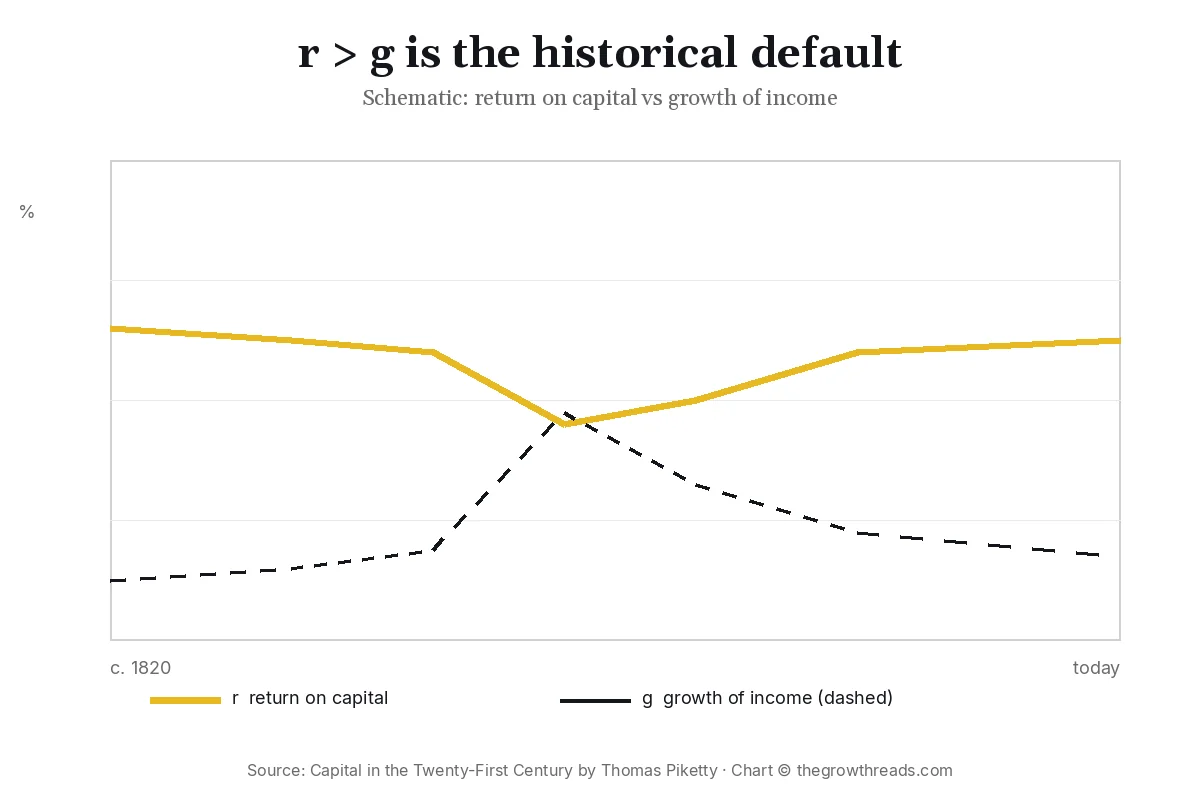
If the return on what you already own beats the growth of what you earn, inherited wealth pulls ahead of work — automatically. That is Thomas Piketty’s 2013 map, translated by Arthur Goldhammer in 2014, built from tax records and national accounts back to the eighteenth century. Wars, inflation, and progressive tax crushed private capital and created a patrimonial middle class. That pause is ending. Write your household’s r. Write its g. See which one is winning.
Key takeaways
- r > g is the default: Capital’s return has usually outrun income growth. The mid-century pause is the exception.
- The first law is accounting: Capital’s share of income equals r times the capital/income ratio.
- The second law is slow: Over decades the ratio drifts toward savings over growth (s/g). Slow growth fattens private wealth.
- The U-curve is the plot: Belle Epoque heights, a twentieth-century trough, a climb back. We are on the right arm.
- Two inequalities, not one: Labor gaps (US super-managers) and capital gaps have different engines. Do not mash them.
- Inheritance is a technology: When r beats g, a bequest grows faster than a lifetime of saving from wages.
- The patrimonial middle class was historical: Housing and pensions gave the middle a slice of capital. Not a law of nature.
- Tax is how democracies saw wealth: Progressive income and estate tax were information systems, not only revenue.
- A wealth tax is a register: Piketty wants a cadastre of who owns what, coordinated so the stock cannot hide.
- Application is local: Payroll vs portfolio, one family bequest. The 7-day plan stays at that scale.
What is Capital in the Twenty-First Century about?
Capital in the Twenty-First Century is Thomas Piketty’s history of how wealth and income have been shared in the rich world since the 1700s. When the return on capital stays above the growth of income, inherited fortunes compound faster than wages. The twentieth century compressed that gap; the twenty-first is reopening it.
About the author
Thomas Piketty (born 7 May 1971 in Clichy) is a French economist at EHESS and the Paris School of Economics, and a Centennial Professor at LSE. He took a PhD from EHESS and the LSE at 22, taught at MIT, then came home to build long-run inequality series from tax and estate records. The World Inequality Database, which he helped found, is the public cousin of that method. Le Capital au XXIe siècle appeared with Seuil in 2013; Belknap/Harvard published Goldhammer’s English in April 2014 and it became a New York Times #1 and the Financial Times/McKinsey business book of the year. Use him as a data historian of wealth, not as a market timer. Explore all Thomas Piketty book summaries →
Key concepts at a glance
| Concept | What it means | Use it when |
|---|---|---|
| r > g | Return on capital outruns income growth, so existing wealth compounds faster than pay. | A family portfolio is beating raises. |
| Capital/income ratio | How many years of income the capital stock represents. | You need one number for how heavy the wealth is. |
| First fundamental law | Capital’s share of income = r × the capital/income ratio. | Someone says labor’s slice “just is.” |
| Second fundamental law | The ratio drifts toward savings / growth (s/g). | Growth slows while saving stays high. |
| Patrimonial middle class | Housing and pensions that gave the middle a slice of capital. | You treat homeownership as a natural law. |
| Super-managers | US labor inequality driven by top pay, not only capital rents. | A slide treats all inequality as heirs. |
| Rentiers | Households living primarily off inherited capital income. | A bequest already outruns a career. |
| Global wealth tax | A progressive annual tax that also builds a public register. | The income tax cannot see unrealised fortune. |
Part 1: Income and capital — the first law
Piketty starts with definitions because the public fight is usually a vocabulary fight. National income is the flow: what a country can consume without eating its capital. Capital is the stock: housing, land, business assets, financial claims, net of debt. The capital/income ratio asks a blunt question — how many years of income is this pile of wealth. In Belle Epoque Europe the answer was six or seven years. After 1914–1945 it collapsed toward two or three. In the rich world it has been climbing back.
The first fundamental law is not a prophecy. It is an identity. Capital’s share of national income equals r times that ratio. If the stock is six years of income and r is 5 percent, capital takes about 30 percent of the flow. Labor takes the rest. You can argue about measurement. You cannot argue the arithmetic once the two numbers are on the page. Slippery definitions are how a political argument hides.
Growth, in this opening, is smaller than the postwar story told. A world that grows at 1–1.5 percent a year, with r near 4–5, is a world where the past keeps arriving as a larger claim on the present. Demographic slowdown makes it worse: fewer workers, same capital, a heavier ratio. No villain is required for the math to tilt.
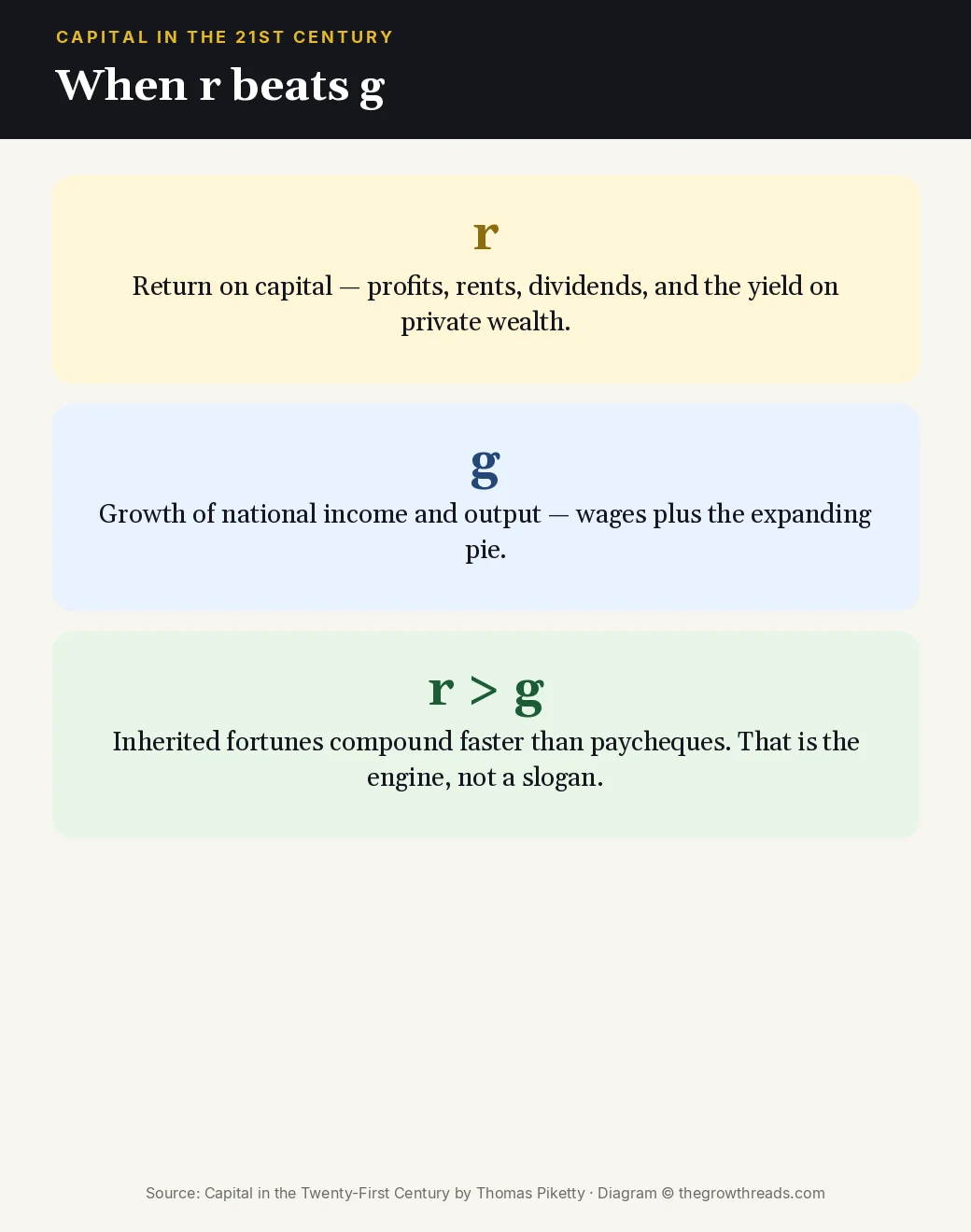
Steal one weekday move from Part 1. Write two household numbers: last year’s invested return after fees (r), and earned-income growth (g). If you cannot write them, you are living in a flow and not looking at the stock. If r is ahead, the book is describing your kitchen table, not only France in 1913.
TGR Note: The older maps sit in The Wealth of Nations and Das Kapital. Smith and Marx argue systems. Piketty argues a ratio you can put on one line: r versus g.
Part 2: The U-curve — how private capital vanished and returned
The second law is slower than the first. Over decades, if saving and growth are stable, the capital/income ratio drifts toward s/g. A society that saves 12 percent of income and grows at 2 percent is heading toward a capital stock of about six years of income. Slow growth is a wealth machine for whoever already saves. That is the quiet politics of a low-g century.
Europe’s plot is a U. On the left arm, Belle Epoque rentiers: inheritance dwarfs a lifetime of labor. On the trough, 1914–1945 — destruction, inflation that burns nominal fortunes, then a social state that taxes high incomes and estates hard enough to keep private capital from reconstituting at old scale. A patrimonial middle class appears: a house and a pension claim, not only a wage. On the right arm, from the 1970s, private capital/income ratios climb. Privatisation, recovering asset prices, slower growth, and lighter tax on capital income pull together.
The New World is a delayed chapter, not a different novel. The United States arrives with less inherited weight and, later, more labor inequality at the top. Piketty’s gift is to keep both plots on one page so you stop saying “Europe is rentiers, America is merit.” Both have capital. Both have pay. The mix shifts.
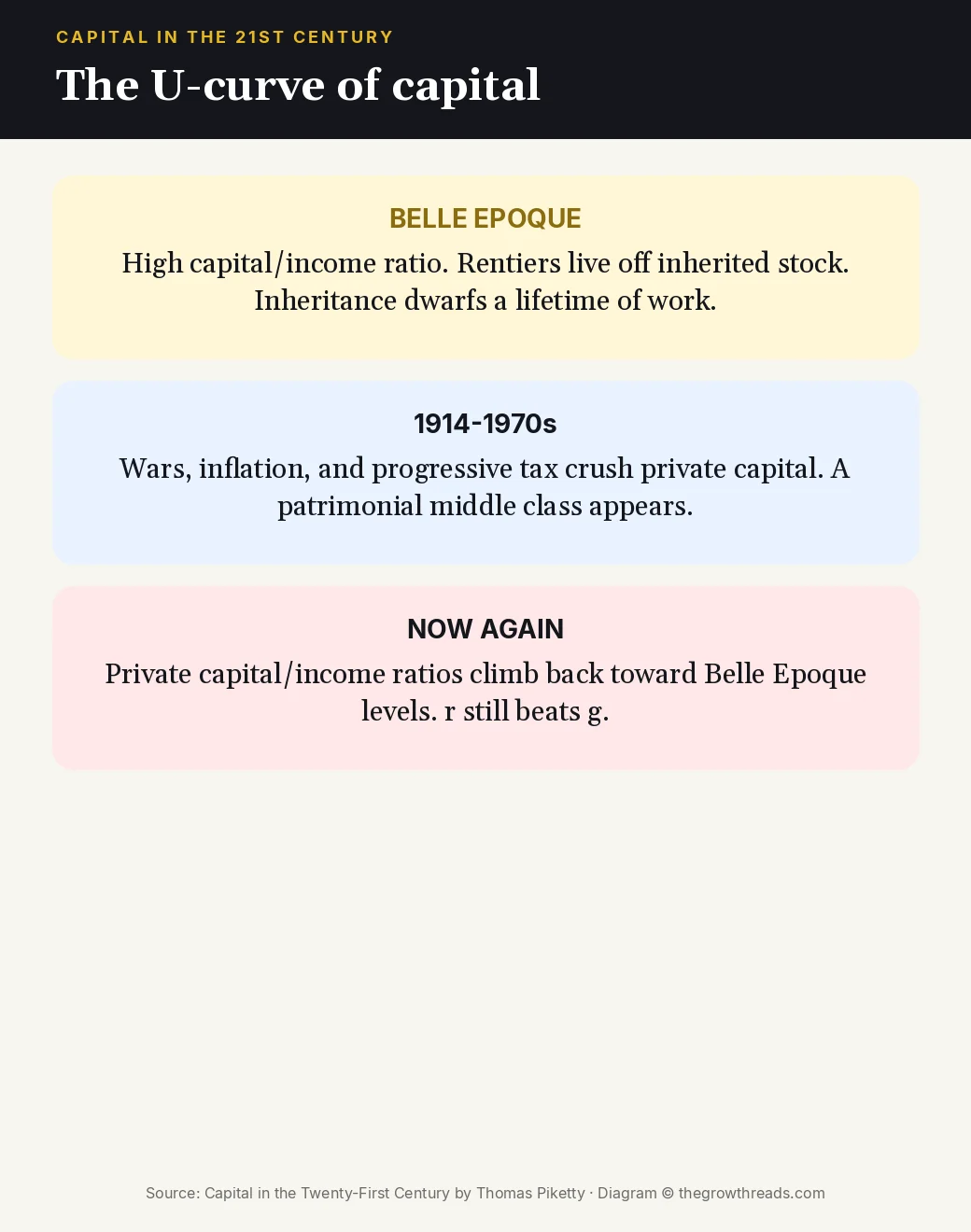
The TGR use of the U is not nostalgia for 1955. It is a warning against treating the trough as the human default. Homeownership as a middle-class wealth engine was a policy mix: credit, inflation that ate mortgages, pensions that were claims on a growing stock. If those pieces jam, the U’s right arm is a housing meeting, not an abstract chart.
TGR Note: For the machinery that decides whether surplus is shared or parked, keep Why Nations Fail on the same shelf. Acemoglu and Robinson talk rules. Piketty supplies the stock those rules act on.
Part 3: Labor, capital, inheritance — three engines
Part 3 is where people misread the book as a single rant about “the 1%.” Piketty splits the problem. Labor-income inequality is one engine. Capital ownership is another. Inheritance is the converter that turns the second into a dynasty. In the United States, much of the recent top-end story is super-manager pay. In Europe, the older rentier pattern never fully died. Mash the two and you prescribe the wrong tool.
Capital ownership is brutally concentrated even when labor income is only pretty concentrated. A small slice of households holds most of the financial and business capital. Housing is the middle’s main asset, which is why a housing boom can look like democratised wealth while the equity stock stays oligarchic. In a high-r, low-g world, the largest fortunes are reconstituted by bequest faster than a talented outsider can save them from a salary.
He is not against merit. He is against a fairy tale in which a lifetime of work routinely catches a large inherited stock when r beats g. The patrimonial middle class made the fairy tale feel true for a few decades. That is worth defending as policy. It is not worth mistaking for a law of capitalism.
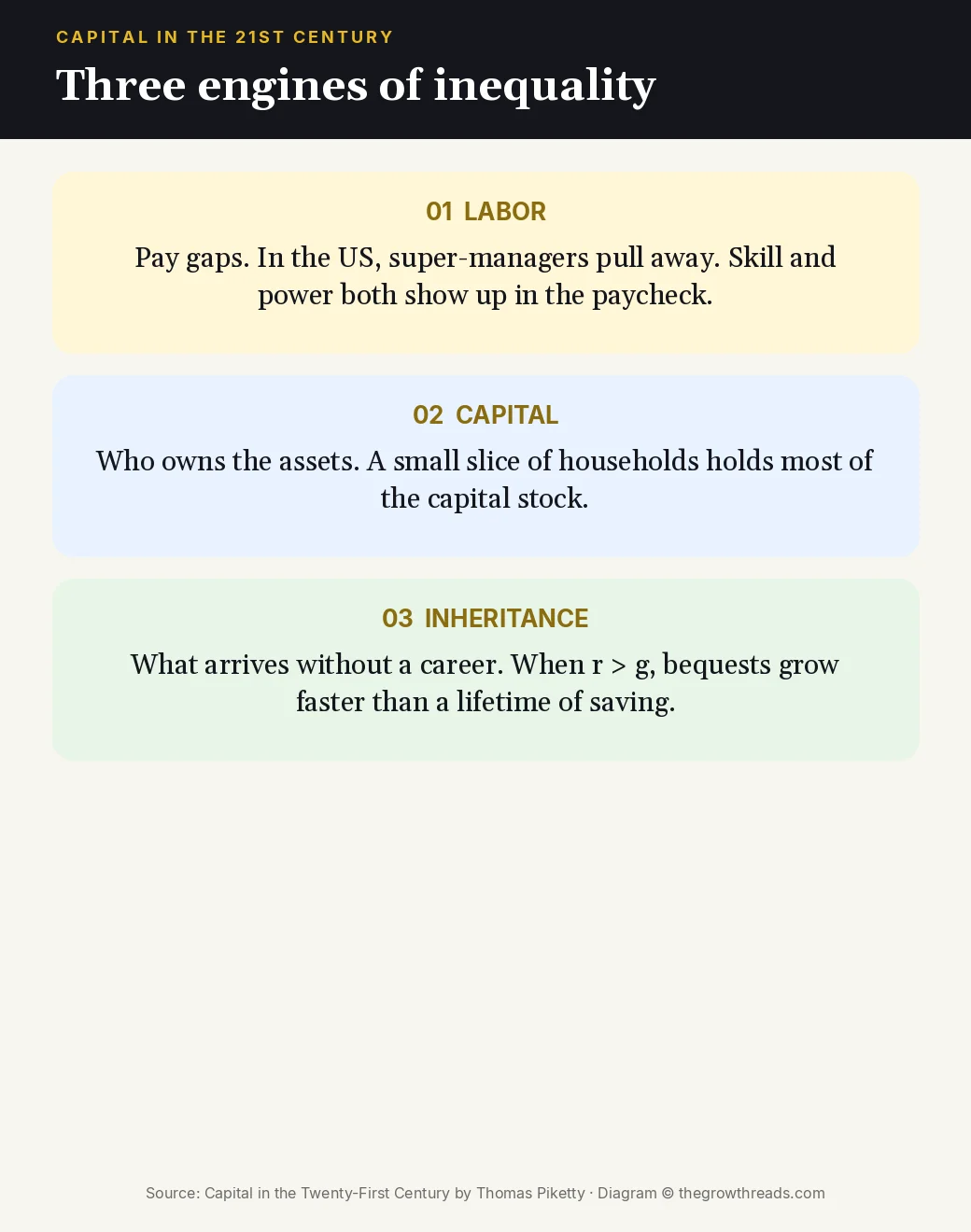
Three questions keep you honest. What part of your top-end is pay. What part is already-owned assets. What part arrived as a bequest. If a room only wants hustle, you are missing engines two and three. If it only wants to tax billionaires and ignore housing, you are missing the middle’s actual stock.
TGR Note: Michael Lewis in The Big Short watches private models that had to stay true for a trade to pay. Piketty watches a public ratio that stays true without a bet: r above g until a shock or a tax changes it.
Part 4: A social state that can see wealth
The last part is the application chapter the rest of the book earned. Piketty’s social state is a set of fiscal tools that already existed: progressive income tax, estate tax, social insurance, education. The twentieth-century compression did not fall from the sky. Inflation did some of the dirty work on nominal debts. He does not recommend inflation as a policy. He notes that it was a blunt wealth tax on whoever held cash claims.
The headline proposal is a progressive annual tax on net wealth, coordinated so the stock cannot hide by crossing a border. Critics hear “confiscation.” His actual stress is information. Without a register of who owns what, every other instrument is guessing. Income tax sees paycheques and realised gains. It is half-blind to a fortune that never sells. A wealth cadastre is how a democracy looks at the object the first three parts described.
Public debt is the closing trap. A high public debt in a low-growth world is a transfer toward whoever holds the bonds — often the same capital that already wins r > g — unless the state can tax that stock. Education and a more equal wage structure attack labor inequality without waiting for a treaty. You can use those on Monday. The treaty is the horizon. The worksheet is the job.
TGR Note: For money as a technology rather than a ratio, read The Ascent of Money. For the loan-sales file under some public debt, read Confessions of an Economic Hit Man. Neither replaces r versus g.
Who is Capital in the Twenty-First Century best for — and who should read something else first?
This book is for people who want the long data under an inequality, housing, or family-wealth argument. It is not a first personal-finance book.
If you need a first money system, start with I Will Teach You To Be Rich. If you want the inner life of a saver, read The Psychology of Money. If you want institutions without French tax tables, read Why Nations Fail. If you want the older system maps, keep The Wealth of Nations and Das Kapital. Come to Piketty when the question is why inherited capital keeps pulling away from work.
This is not financial, tax, or investment advice. It is a reading of Piketty’s framework so you can map r and g in a life you actually live.
Questions to reflect on
- What was your household’s r last year, after fees — and what was g on earned income?
- Which of your assets is housing, and which is financial or business capital?
- What share of your net worth arrived (or will arrive) as a bequest rather than as saving from pay?
- If growth in your sector halved, would the capital you already own still compound?
- What one line on a wealth register would you be unwilling to leave blank?
🔥 Ready to map r against g?
Get Capital in the Twenty-First Century and run the household worksheet on the stock you already own.
How to apply Capital in the Twenty-First Century (7-day plan)
- Day 1 — Write r and g. One year of invested return after fees. One year of earned-income growth.
- Day 2 — Split the stock. Housing versus financial/business capital versus cash. Approximate is fine.
- Day 3 — The inheritance line. What you have received, or reasonably will, next to what you saved from pay.
- Day 4 — Your capital/income ratio. Net worth divided by this year’s income. How many years of work is the pile.
- Day 5 — Name the engine. Is your top-end mostly pay, assets, or a bequest. Circle one.
- Day 6 — What the tax already sees. One flow the income tax catches and one stock it probably does not.
- Day 7 — One rule. Raise the saving rate, or have one conversation about a bequest or a housing plan.
Frequently asked questions
What is Capital in the Twenty-First Century about?
It is Thomas Piketty’s data history of wealth and income in Europe and the United States since the eighteenth century. When the return on capital (r) stays above the growth of income (g), inherited fortunes compound faster than paycheques. Wars, inflation, and progressive tax crushed private capital in the twentieth century. That pause is fading. The last third is a policy map: a progressive global tax on capital plus a register of who owns what. Read it as a field guide to r versus g, not as a stock-picking manual.
What does Piketty mean by “r > g”?
r is the average return on private capital: profits, rents, dividends, interest, and gains, net of losses. g is the growth of national income — the pie wages live on. When r stays above g for decades, a fortune that is already invested grows faster than the economy that pays the wages. You do not need a conspiracy. Compounding does the work. Piketty later said labor-income gaps have other engines too. Keep that. The usable test is still local: is your household’s r beating its g, and who already owns the r?
Is Capital in the Twenty-First Century a personal finance book?
No. It will not tell you which index fund to buy or how to pay off a card. It will tell you why a society that lets r run ahead of g quietly reweights toward heirs. That is still a money book. If you need a first system, start with I Will Teach You To Be Rich or The Psychology of Money, then come back. If you want institutions without French tax tables, read Why Nations Fail. Piketty is the long data set under those weekday books: who owns the stock, and what a tax system would have to see in order to touch it.
How long is Capital in the Twenty-First Century and do I need every chart?
The Belknap hardcover runs 704 pages. Goldhammer’s 2014 English translates the 2013 Seuil original. You do not have to memorise every country table. Steal four objects: r versus g, the capital/income ratio, the split between labor inequality and capital inequality, and the inheritance test — would a lifetime of saving catch a large bequest. The 7-day plan in this review is that steal, shrunk to a household worksheet. The charts are the evidence. Keep the worksheet. That is enough to use the book.
What is the global wealth tax Piketty proposes?
A progressive annual tax on net wealth — financial assets, housing, and business capital, minus debts — coordinated so the stock cannot hide in a neighbouring ledger. He treats it as a way to publish a cadastre of wealth, not only as a revenue tool. Without a register, every other tax is guessing. Income tax sees paycheques and realised gains; a lot of fortune never sells. You do not have to pass a treaty this week. You can still list your own net wealth on one page and notice which line is compounding.
Who should read Capital in the Twenty-First Century?
Anyone who sits near a payroll, a family balance sheet, a housing market, or a tax debate and wants the long data instead of a slogan. It is also for readers who have already done The Wealth of Nations and Das Kapital and want the twenty-country charts those books could not have. Skip it as a first money book. If you are in debt-payoff mode, start with The Total Money Makeover. Come to Piketty when the question is why inherited capital keeps pulling away from work.
Did later research overturn r > g?
No, and Piketty himself narrowed the claim. In a 2014 paper he said r > g is not the only or primary tool for labor-income inequality — US super-manager pay needs a different story. A Financial Times check of some wealth series also sparked a fight over a few country files. Treat that as a FAQ fact: huge historical datasets get revised. The residue does not require you to settle every cell. Has the capital/income ratio risen again. Does already-invested fortune still tend to outrun pay growth. Those two still organise a household conversation.
Related summaries
- Das Kapital — the older map of surplus, without the twenty-country tax files.
- The Wealth of Nations — markets and specialization as the older growth story.
- Why Nations Fail — inclusive versus extractive rules that sit around Piketty’s ratios.
- The Ascent of Money — finance as a technology, including the debt the capital stock rides on.
Browse every title in our Best Money Books pillar page.
How we analyze books: our summaries are built from a full read of the source text, cross-referenced against the author’s published interviews and research where relevant, and structured around practical application rather than critique. We disclose our editorial process and affiliate relationships in full. Read our full methodology.