

★★★★☆ 4.4/5 — very good is invisible; build the remark into the product.
Best for: Makers whose offer is competent and still ignored
Reading time: ~5.5 hours (Portfolio new edition, 224 pp) · this guide ~12 min
Difficulty to apply: Medium — the idea is simple; being the weird one at work is not
Purple Cow in one minute
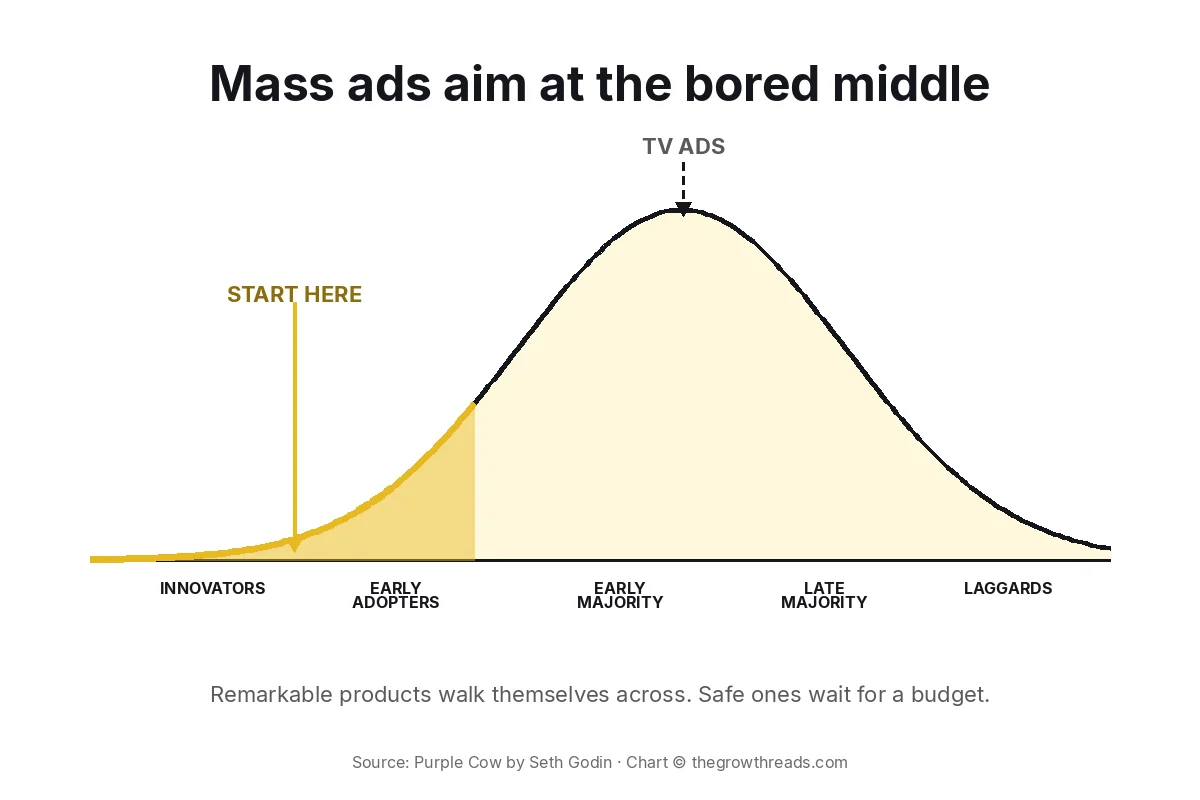
Safe is now the risky move. Seth Godin’s Purple Cow is a short, pointed brief from 2003 that still names Tuesday’s problem: you can be very good and still disappear. A field of brown cows is scenery. A purple one is a story. Godin says the TV-industrial complex — buy ads, interrupt everyone, harvest the bored middle — no longer pays. Attention is scarce, ads are wallpaper, and “pretty good” is an everyday occurrence. The work is to put the remarkability into the product itself, then show it to innovators and early adopters, the otaku who care enough to sneeze the idea. Mass marketing aims at the peak of the adoption curve. Remarkable products walk themselves across from the left edge. If nobody would tell a friend, you do not have a media problem. You have a brown cow.
Key takeaways
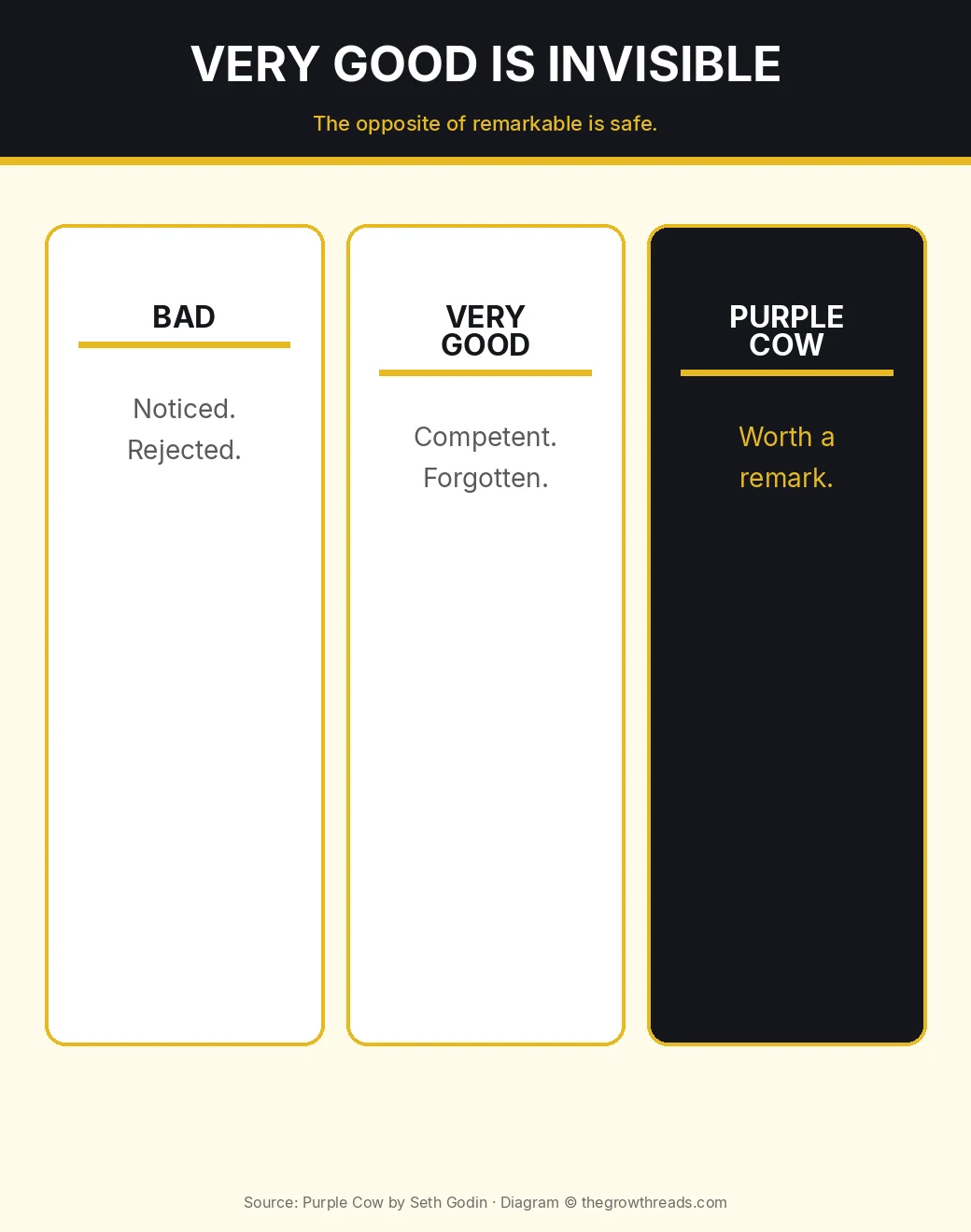
- Very good is invisible: Bad gets noticed and rejected. Competent gets forgotten. Only remarkable earns a remark.
- The TV-industrial complex is exhausted: Renting attention from a channel you do not own is a tax, not a strategy.
- Marketing is the product: Do not advertise a brown cow purple. Build the purple into the thing.
- Start at the edges: Innovators and early adopters are looking. The majority copies after they talk.
- Otaku and sneezers: Serve the people who already care. They carry the idea because it is worth carrying.
- Safe is risky: Fitting in used to be a career. In a crowded market it is how you vanish.
- A Purple Cow fades: Once copied, it is brown again. The job is the next one, not a trophy.
- One audience, one sentence: If a specific person cannot repeat why it matters, you are still driving past fields.
What is Purple Cow about?
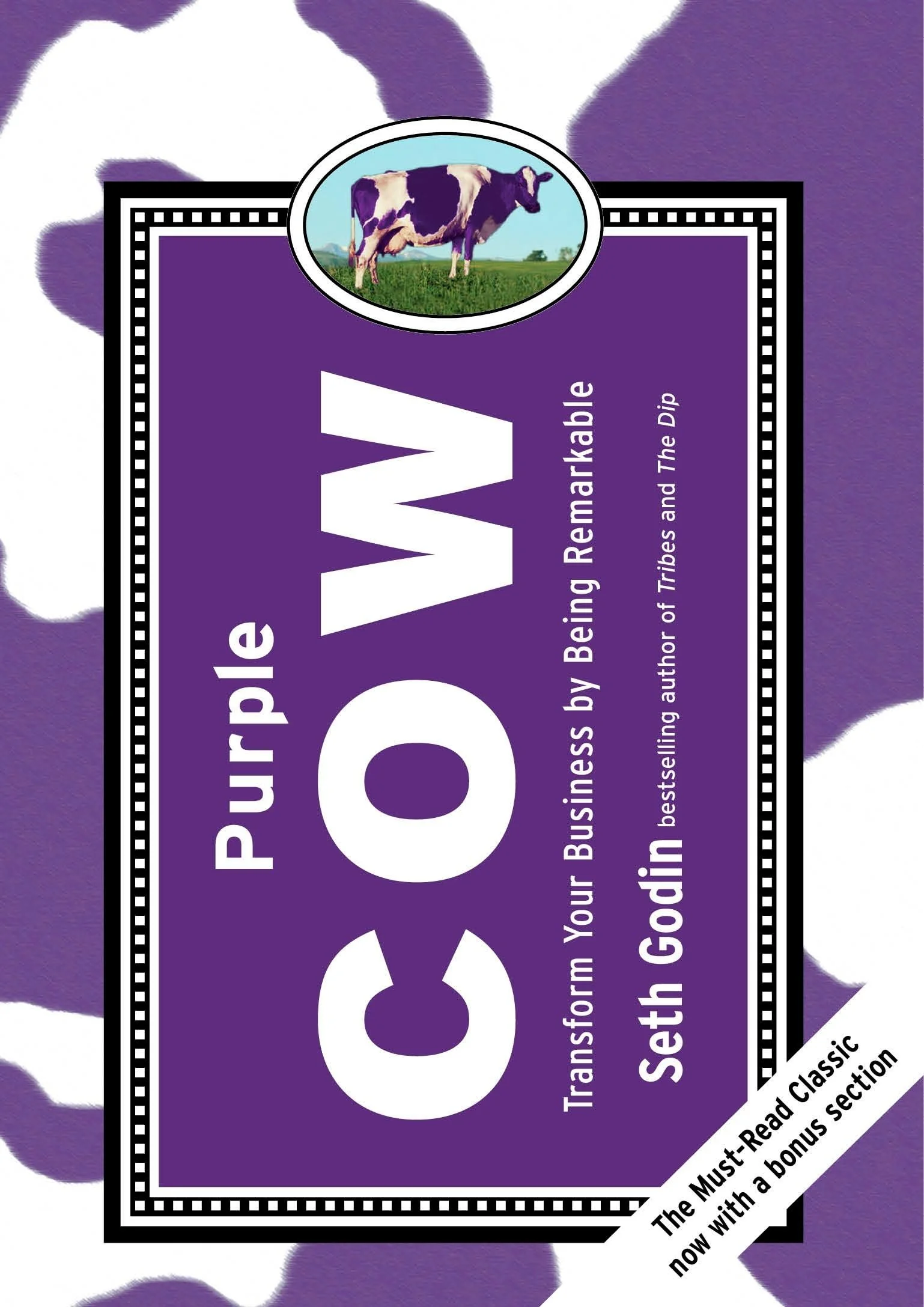
Purple Cow is Seth Godin’s argument that interruption ads no longer work, so the only reliable marketing is a product so remarkable that people talk about it. Very good is invisible. Build the difference into the thing, show it to the edges of the market first, and treat “safe” as the expensive choice.
About the author
Seth Godin is an American author, marketer, and entrepreneur, born in 1960, who has spent three decades teaching people to ship work that does not hide. He founded Yoyodyne, one of the early internet marketing firms, later sold to Yahoo, and has kept a daily blog since 2002 that is still one of the most-read marketing blogs on the web. Purple Cow (2003) is the breakthrough volume that turned “be remarkable” into a plain English brief; Linchpin, Tribes, The Dip, and The Practice extend the same spine into work, leadership, quitting, and creative discipline. He later built the altMBA and Akimbo workshops as project-based alternatives to classroom MBAs. The through-line is not a hack. It is a standard: make something worth talking about, then put it where the people who already care can find it. Explore all Seth Godin book summaries →
Key concepts at a glance
| Concept | What it means | Use it when |
|---|---|---|
| Purple Cow | Something worth making a remark about, built into the product | They nod, then forget you by lunch |
| Brown cow | Competent, familiar, easy to drive past | Your page is correct and still scenery |
| Very good | The invisible middle — not bad, not talkable | You keep polishing instead of picking a side |
| TV-industrial complex | Buy ads → interrupt → harvest the bored majority | The budget is the strategy |
| Otaku | People who already care more than the average customer | You are still pitching “everyone” |
| Sneezers | The carriers who spread an idea because it is worth spreading | You need a media plan to replace a sentence |
| Edges of the curve | Innovators and early adopters, not the fat middle | You launched to the whole TAM on day one |
| Fading cow | Remarkability has a shelf life once copied | Last year’s weird is this year’s template |
Part 1: The TV-industrial complex is over
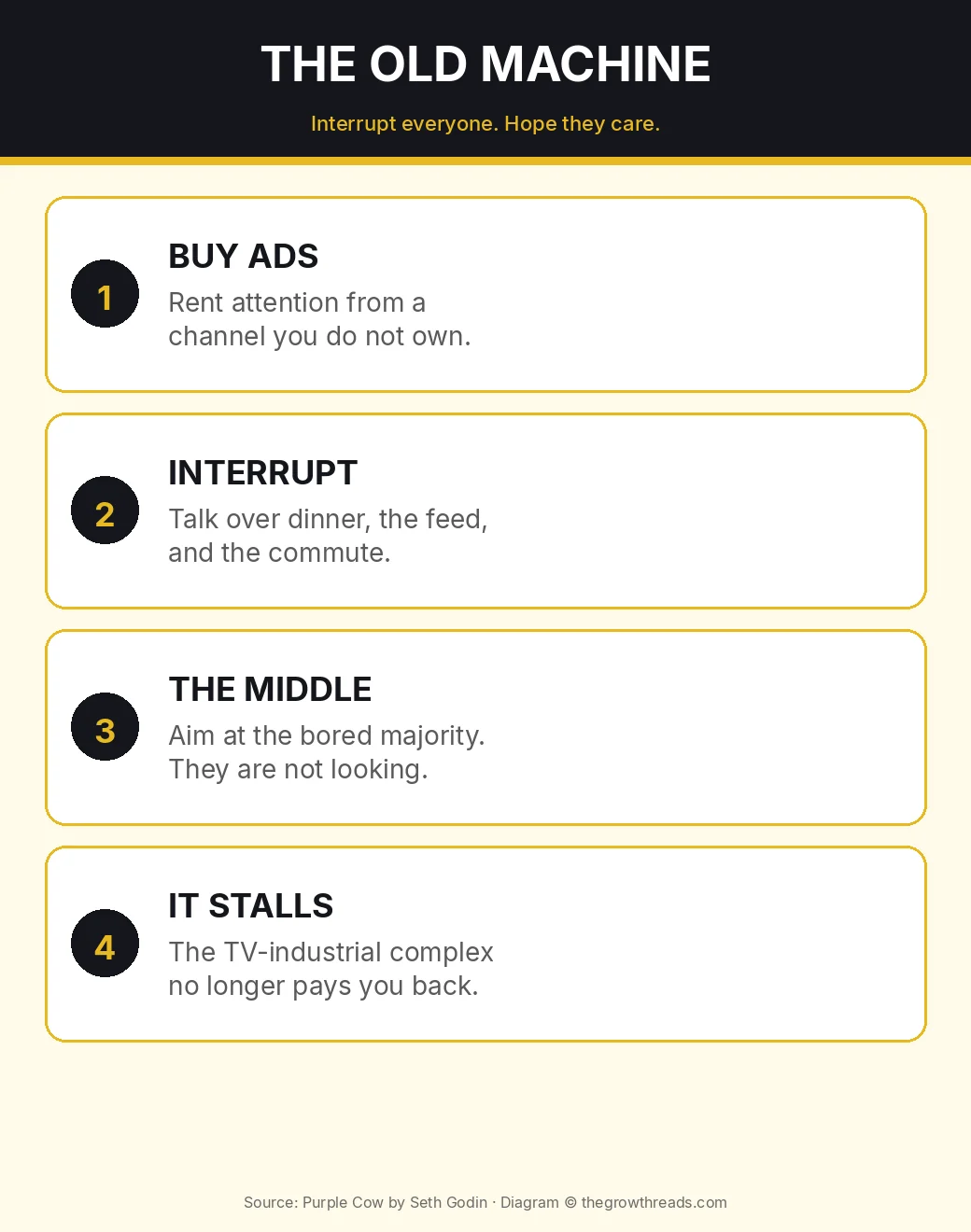
Godin opens with a drive you have already taken. Brown cows, after the third field, are not even ugly. They are nothing. A purple cow would make you tap the brakes and phone someone. That is the whole book in a picture, and it is aimed at a specific machine: the TV-industrial complex. For decades you bought interruption. You rented attention from a network, talked over dinner, and harvested the fat middle of the adoption curve — the early majority who were not looking for you. Ads paid for more ads. Average products could still win on budget.
That loop is tired. People have less slack, more noise, and better tools for skipping. Godin is not anti-advertising as a craft. He is anti the fantasy that a forgettable product plus a louder spot becomes memorable. If the thing is not worth a remark, the spot is just a more expensive way to be ignored. The practical move from this chapter is rude and useful: list the places you are still buying interruption for an offer nobody would describe to a friend. That list is not a media plan. It is a product backlog wearing a finance hat.
TGR Note: The sticky-idea lab notes sit in Made to Stick and Contagious. Godin’s addition is harsher: if the product is not worth a remark, a better SUCCESS checklist still advertises a brown cow. Fix the thing, then borrow their sentence tools.
Part 2: Start at the edges — otaku, sneezers, early adopters
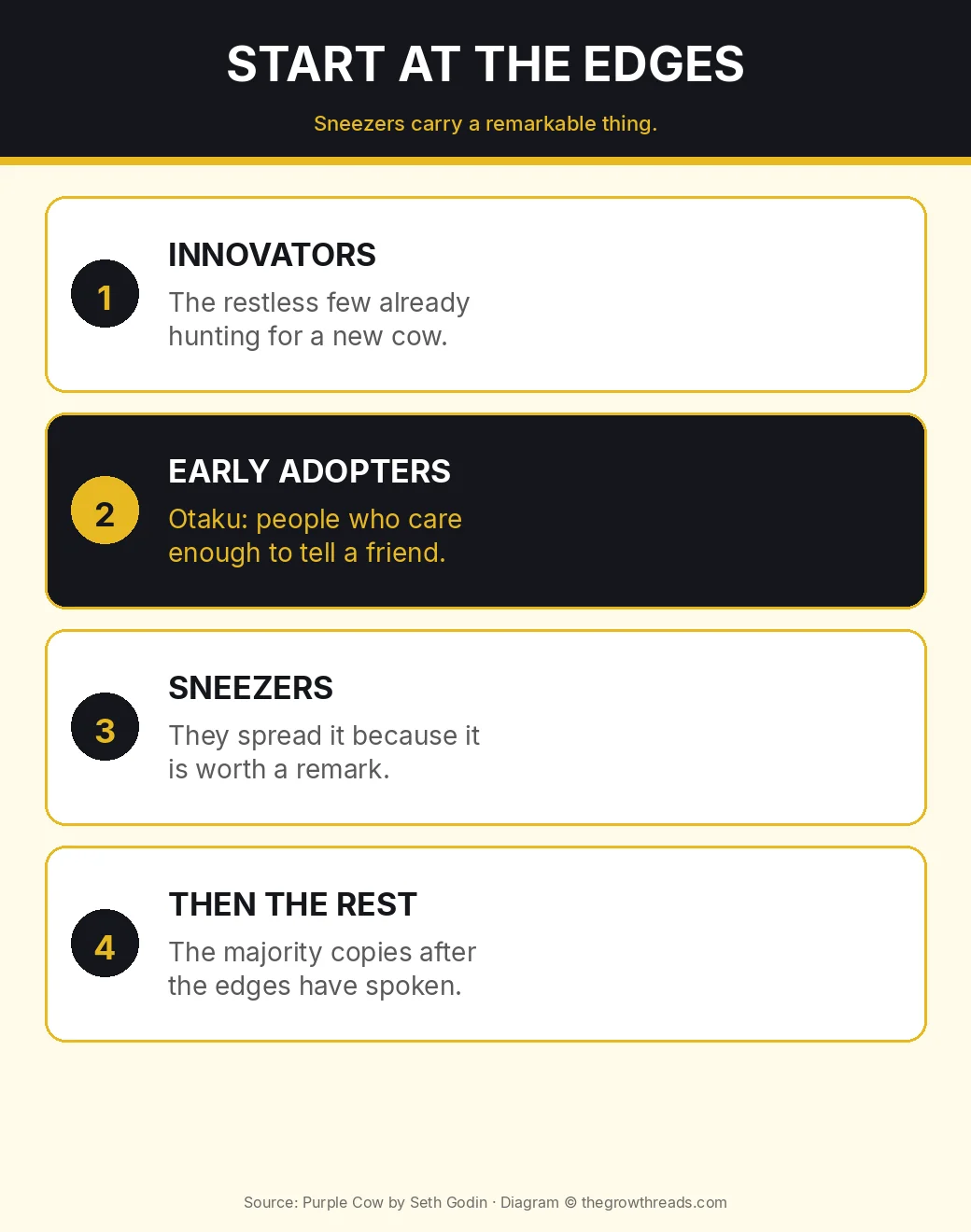
Mass marketing aims at the peak of the bell because that is where the bodies are. Godin flips the map. The people who will save you are on the left tail: innovators and early adopters who are already hunting for a new cow. He borrows otaku — the Japanese word for people who care too much — and sneezers, the carriers who spread an idea because it is worth spreading. You do not persuade the bored majority first. You make something the restless few cannot shut up about, and you accept that the majority will arrive late, if they arrive at all.
This is why “everyone” is a failed spec. A product designed for the whole TAM has to sand off the weirdness that would have given a sneezer a sentence. The smallest group that would rave is not a consolation prize. It is the only group that can move the curve. Practical test: name five people who would be angry if you made the offer more average. If you cannot name them, you do not have otaku yet. You have a press list. Show the work to those five before you buy another impression at the peak.
TGR Note: If the wound is “we have no one carrying this,” Tribes is the leadership companion: a group that wants to be connected, plus someone willing to lead. Linchpin is the personal version — you become the person who does the emotional labor the factory will not schedule. Purple Cow stays on the offer itself.
Part 3: Build the cow into the product — safe is risky
The line most teams need on the wall is simple: the opposite of remarkable is very good. Bad products get a reaction. You can fix a reaction. Very good products get a polite nod and a closed tab. Godin’s uncomfortable claim is that fitting in used to be a career and is now a way to vanish. The factory trained people to remove risk. The crowded market punishes that training. A slightly weird prototype shown to ten otaku beats a flawless average launch aimed at nobody in particular.
Marketing, in this chapter, is not a department that paints the cow after the barn is built. It is the design meeting. What would a specific person actually say? What would they demonstrate? What would they refuse to live without? Those questions belong in the spec, the onboarding, the packaging, the first five seconds of the page. If the only remarkable thing is the campaign, you will be back in the media meeting in a quarter with the same brown cow and a bigger invoice. Cut one safe feature this week. Add one proof the edges can use. Measure repeats, not reach.
TGR Note: If you freeze after you see the gap, The Practice is the shipping companion: show up, detach from the outcome, make it for someone. The Dip tells you when the hard stretch is worth beating and when you are in a cul-de-sac. Purple Cow tells you what is worth shipping in the first place.
Part 4: It fades — make the next cow
Remarkability has a shelf life. The first iPod was a purple cow. The tenth white rectangle was a brown one with a better battery. Godin does not pretend a single stunt funds a decade. Once the market copies you, you are scenery again. The factory loves that moment because it can staff a process. The maker’s job is less romantic: keep making the next thing worth a remark, on a cadence you can survive, for an audience you still know by name.
This is why a trophy launch is a trap. Teams celebrate the campaign, freeze the product, and wonder why sneezers went quiet. Quiet is data. The cow faded or you wandered back to the middle. The maintenance is a calendar, not a mood. Once a quarter, ask the five otaku what they would no longer bother mentioning. Kill that part. Put the hours into the next edge. Godin’s later books push this into a daily practice. Purple Cow is the product test those later books assume you already failed once.
TGR Note: Rework is the cousin that says ship small and ignore the theatre. Show Your Work! is how sneezers even see the next cow. Do not wait for a rebrand window. Mention the new edge while the last one is still warm.
Who is Purple Cow best for — and who should read something else first?
Best for founders, marketers, and makers whose offer is already competent and still invisible — the team that keeps buying reach for a product nobody has a sentence for. It is also a clean reset if you were trained that “very good” is the professional standard and you can feel that standard failing in the numbers.
Read something else first if the wound is fear of shipping — start with The Practice. If you are in a project that will never pay you back, The Dip is the quit/stick map. If you are replaceable at work, Linchpin is the personal brief. Come back to Purple Cow when the product exists and the silence is about the product, not your courage.
Questions to reflect on
- What would a specific customer actually say about us at dinner — not the slogan?
- Where are we still buying interruption for an offer nobody repeats?
- Who are five otaku that would be angry if we made this more average?
- Which “very good” feature exists only to please the bored middle?
- What was remarkable last year that is scenery now — and what is the next cow?
🔥 Ready to stop being a brown cow this week?
Get Purple Cow, then use the 7-day plan to name one audience and one sentence worth repeating.
How to apply Purple Cow (7-day plan)
- Day 1 — Name the brown cows. List three offers that are competent and never get mentioned unprompted. Circle one. That is the week’s cow.
- Day 2 — Write the remark. One sentence a real person would say to a friend. Not a tagline. If you would not send it as a text, rewrite it.
- Day 3 — Name five otaku. People who already care. If you cannot name five, you have been pitching the middle. Find them before you spend.
- Day 4 — Cut one safe piece. Remove or hide one average feature that exists to offend nobody. Notice what you are afraid will happen.
- Day 5 — Add one proof. A demo, a sample, a slightly weird guarantee those five can use this week. Put it in the product, not the ads.
- Day 6 — Show the edges, not the TAM. Send the remark and the proof to the five. Ask what they would actually tell someone. Record the words.
- Day 7 — Ship the next edge. Change one thing based on those words. Do not buy a campaign. Schedule the next quarterly “has this faded?” review.
Frequently asked questions
What is Purple Cow about in one paragraph?
Purple Cow is Seth Godin’s short 2003 case that interruption marketing is exhausted. A field of brown cows is scenery. A purple one is a story you tell at dinner. He argues that “very good” is the dangerous middle: competent, safe, and invisible. Build the remarkability into the product itself, then show it first to innovators and early adopters — the otaku who will sneeze the idea for you. Mass ads aimed at the bored majority are a tax you pay when the thing is not worth mentioning. The book is thin. The week’s job is to name one brown cow and make one edge worth a remark.
What does Purple Cow mean?
A Purple Cow is anything genuinely worth making a remark about, designed into the product or service rather than bolted on as an ad later. Godin’s drive-by metaphor: ordinary cows disappear after the third field; a purple one stops the car. In a crowded market the opposite of remarkable is not “bad.” Bad is noticed and rejected. Very good is forgotten. Remarkable is the only slot left for word of mouth. Use the test this afternoon: would a specific person tell a friend about this on purpose, unprompted? If the honest answer is no, you still have a brown cow, no matter how polished the deck.
Is Purple Cow still relevant after social media?
Yes, because the feed made the problem worse, not better. Interruption is cheaper than in 2003 and easier to ignore. Godin’s machine — buy ads, talk over dinner, hope the middle cares — still describes most “content calendars.” The useful half of the book is the targeting: start at the edges, serve the people who already care, and let them carry it. Algorithms reward the same behavior sneezers always did. If your offer is wallpaper, more posts will not dye it purple. Read it as a product brief, not as a nostalgia tour of TV. Then pair it with a later Godin on shipping if you stall on fear.
Who should read Purple Cow?
Makers, marketers, and founders whose thing is competent and still invisible. It is a strong fit when the wound is “they drive past us,” not “we cannot finish.” If your actual problem is shipping, start with The Practice. If the problem is quitting the wrong project, start with The Dip. If the problem is being replaceable at work, start with Linchpin. Come back to Purple Cow when the product exists and nobody has a sentence they would bother saying out loud. Designers and PMs who have been asked to “just make it pop” will recognize the trap: polish is not a remark.
How long is Purple Cow and how long does it take to read?
The Portfolio new edition is 224 pages, including the later bonus material. Most readers finish in five to six hours. Godin writes in short riffs, so you can also treat it as a desk book: one idea a morning for two weeks, with a notebook of brown cows you will not keep feeding. This guide is a twelve-minute pass so you can pick the audience and the remark before you buy. If you only have a weekend, read the TV-industrial-complex pages, the otaku/sneezer pages, and the “very good is invisible” pages, then stop and run the seven-day plan on one offer.
How do I apply Purple Cow without a huge rebrand?
Do not start with a logo. Pick one offer. Write the one sentence a real customer would say to a friend — not the slogan you wish they would say. Name the smallest group that would actually rave, and show that sentence only to them this week. Cut one safe, average feature that exists to please the bored middle. Add one slightly weird proof those five people can use. If nobody repeats the sentence by Friday, the cow is still brown; change the thing, not the media plan. A rebrand of a forgettable product is still a brown cow with nicer type.
How is Purple Cow different from Linchpin or This Is Marketing?
Purple Cow is the product brief: make something worth talking about, then start at the edges. Linchpin is the personal brief: become the person who does emotional labor and ships when the map runs out. This Is Marketing, which we have not summarized yet, is the later, broader stack — smallest viable audience, status, permission, and change. If you already know you should be remarkable and freeze, read The Practice next. If you need to lead the people who already want the idea, Tribes is the leadership companion. Start here when the offer itself is the bottleneck, not your courage and not your org chart.
Related summaries
- Linchpin — become the person who does the work a factory cannot schedule.
- The Dip — quit the cul-de-sac, stick with the one hard stretch that is worth being best at.
- The Practice — ship the cow on a schedule instead of waiting to feel ready.
- Made to Stick — once the product is worth a remark, make the remark survive the walk to the car.
More in this silo: best productivity books.
How we analyze books: every book on The Growth Reads is read cover to cover, summarized in thousands of words of original analysis, and rated against our five-criteria rubric (lasting impact, evidence quality, practical application, writing & originality, external consensus). Read our full methodology.