

★★★★★ 4.6/5 — The myth-book that still teaches you to retrieve the instinct a polite life starved.
Best for: Anyone living a finished-looking life that cannot feel a clean yes or no, readers who treat anger as a character flaw, and people who keep trading rest and appetite so the room will keep them
Reading time: ~12–16 hrs for the Ballantine 584-page paperback · ~14 min for this guide
Difficulty to apply: Copying wolf imagery is costume. Gathering one abandoned bone this week — a no, a nap, a true sentence — is the work.
Women Who Run with the Wolves in one minute
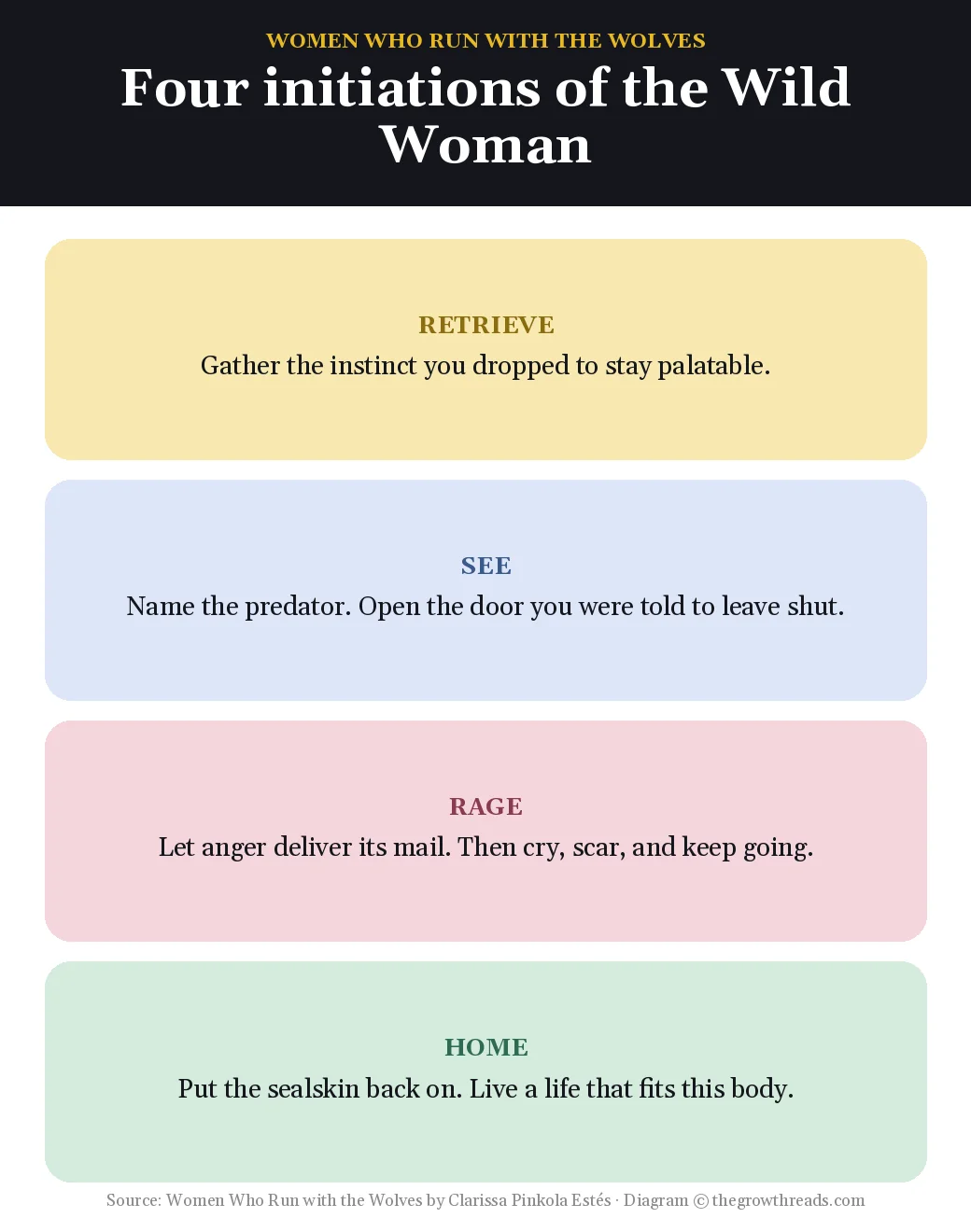
The wild woman is not a weekend. She is the instinct you starved to stay palatable, and Estés wrote a field manual for getting her back. Through La Loba, Bluebeard, the Red Shoes, and Sealskin/Soulskin, the book maps how a self goes numb in a good-looking life — and how story, tears, rage, and small acts of homing put flesh on the bones again. You do not need a forest. You need one thing you abandoned, sung over until it can run.
Read it when your manners are excellent and your body is on mute. Skip the costume-howl. Do the retrieval.
Key takeaways
- Wild means intact: not reckless, not aesthetic. The instinct that can hunt, rest, make, and say no without a committee.
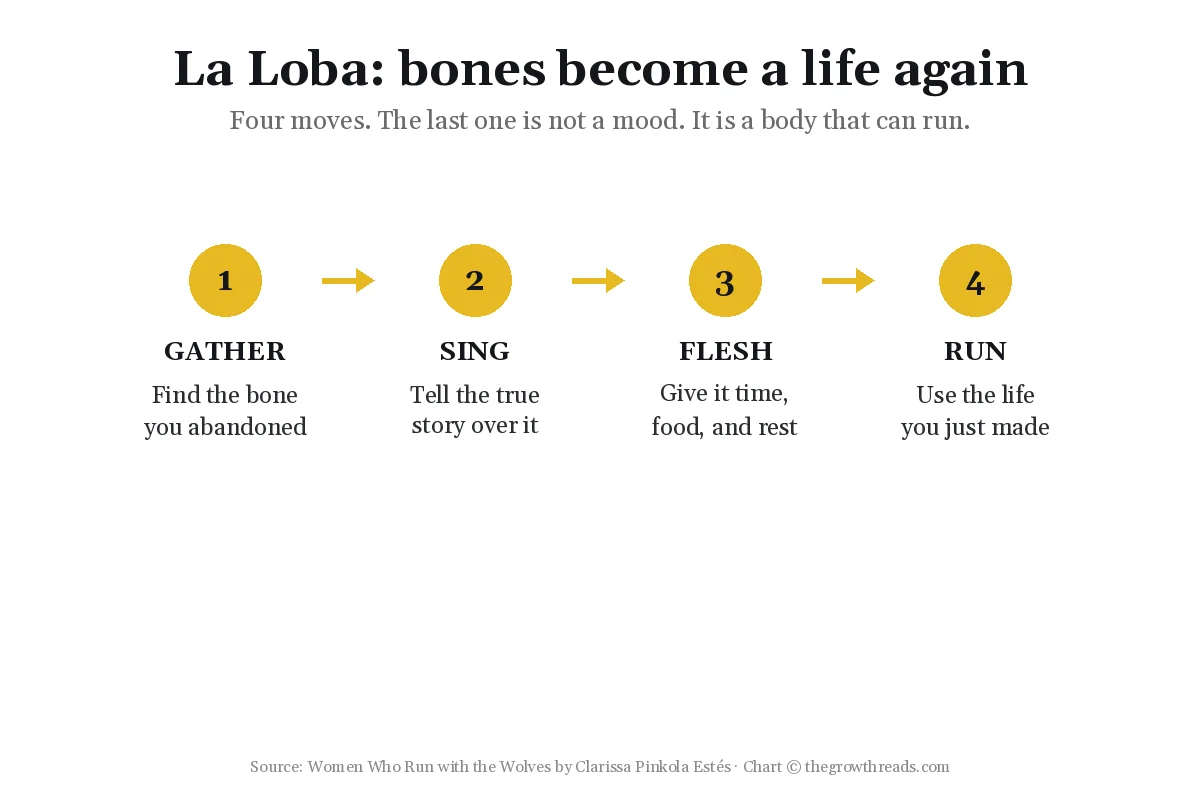
- La Loba is the whole method: gather what was discarded, sing over it, wait for flesh, then use the life.
- One bone is a cycle: appetite, anger, a craft, a nap. Waiting for the full skeleton is how nothing starts.
- Bluebeard is a charming ban: the door you were told not to open is usually the one that would save you.
- The key stays stained: you cannot unknow a predator. Niceness after seeing is not kindness.
- Rage is mail, not a personality: anger delivers data. Swallowing it is how the Red Shoes start dancing without you.
- Tears knit the scar: grief is not a failure of resilience. It is how the psyche closes a wound so you can walk.
- Sealskin is the self you traded: belonging that requires you emptied is not the sea. Put the skin back on.
- Homing is a relationship skill: a partner cannot be the forest, the mother, and the priest. Bring a self that has bones.

What is Women Who Run with the Wolves about?
Women Who Run with the Wolves is Clarissa Pinkola Estés’s 1992 map of the Wild Woman archetype — myths that teach how instinct is lost in a polite life and how it is retrieved through story, rage, grief, and coming home in a body that still fits.
About the author
Clarissa Pinkola Estés (born 1945) is a Mexican-American Jungian psychoanalyst, poet, and cantadora — a keeper of the old stories. Raised in the oral traditions of her family, she trained as a clinician and spent decades with trauma survivors, including work that sat with people the culture prefers not to hear. Publishers came to her after her story-tapes spread by hand; the book held the New York Times list for 145 weeks and made her the first Latina on that list. She writes as a doctor of the soul who still trusts a kitchen-table tale more than a slogan. The voice is not academic distance. It is a woman who has sat with bones and believes they can run again. Explore all Clarissa Pinkola Estés book summaries →
Key concepts at a glance
| Concept | What it means | Use it when |
|---|---|---|
| Wild Woman | The intact instinctive self — not a mood or a costume | You look finished and cannot feel a clean yes or no |
| La Loba | Gather discarded bones, sing, wait for flesh, then run | You want a new identity instead of retrieving a starved one |
| The predator | Charm plus a ban on looking — Bluebeard’s locked room | Dread is being renamed as your personality problem |
| The stained key | Once you see, you cannot unknow; pretending is the second injury | You keep reopening a case you already closed with your eyes |
| Rage as messenger | Anger delivers mail about a boundary or a theft | You swallow heat and call that being easy to love |
| The Red Shoes | A life that dances without you — work, care, or appetite on autopilot | Your calendar is full and you are not in any of the rooms |
| Sealskin / Soulskin | The true pelt you traded so a dry life would keep you | Belonging requires you emptied, smiling, and available |
| Homing | Returning a self with bones to love, work, and rest | You use a partner as forest, mother, and proof you exist |
Part 1: La Loba — gather the bones
Estés opens with the wolf woman who walks arroyos collecting bones. She does not buy a new animal. She does not affirm a future self. She hunts what is already hers and has been scattered — a rib of appetite, a jaw of anger, a femur of making. When the skeleton is complete she sings, not once as a performance but until the desert answers with flesh. Then the creature breathes and runs. That sequence is the book’s entire technology.
A polite life scatters bones on purpose. You drop rest to be called reliable, appetite to be called disciplined, a no so the family still sets you a plate. Those trades announce themselves as being good. La Loba’s first instruction is diagnostic: name one thing you had in your body five years ago that is not in the room now. That is the bone. You do not need the full wolf yet. Singing is repetition plus feeling — a walk, a page, a conversation that will not rebrand grief as a productivity issue. Running is using the retrieved life on an ordinary Tuesday, not posting about wolves.
TGR Note: If you want permission without the myths, Untamed is the sharper modern slap. If you need love defined as a practice rather than as a howl, add All About Love.
Part 2: Bluebeard — open the door you were told to leave shut
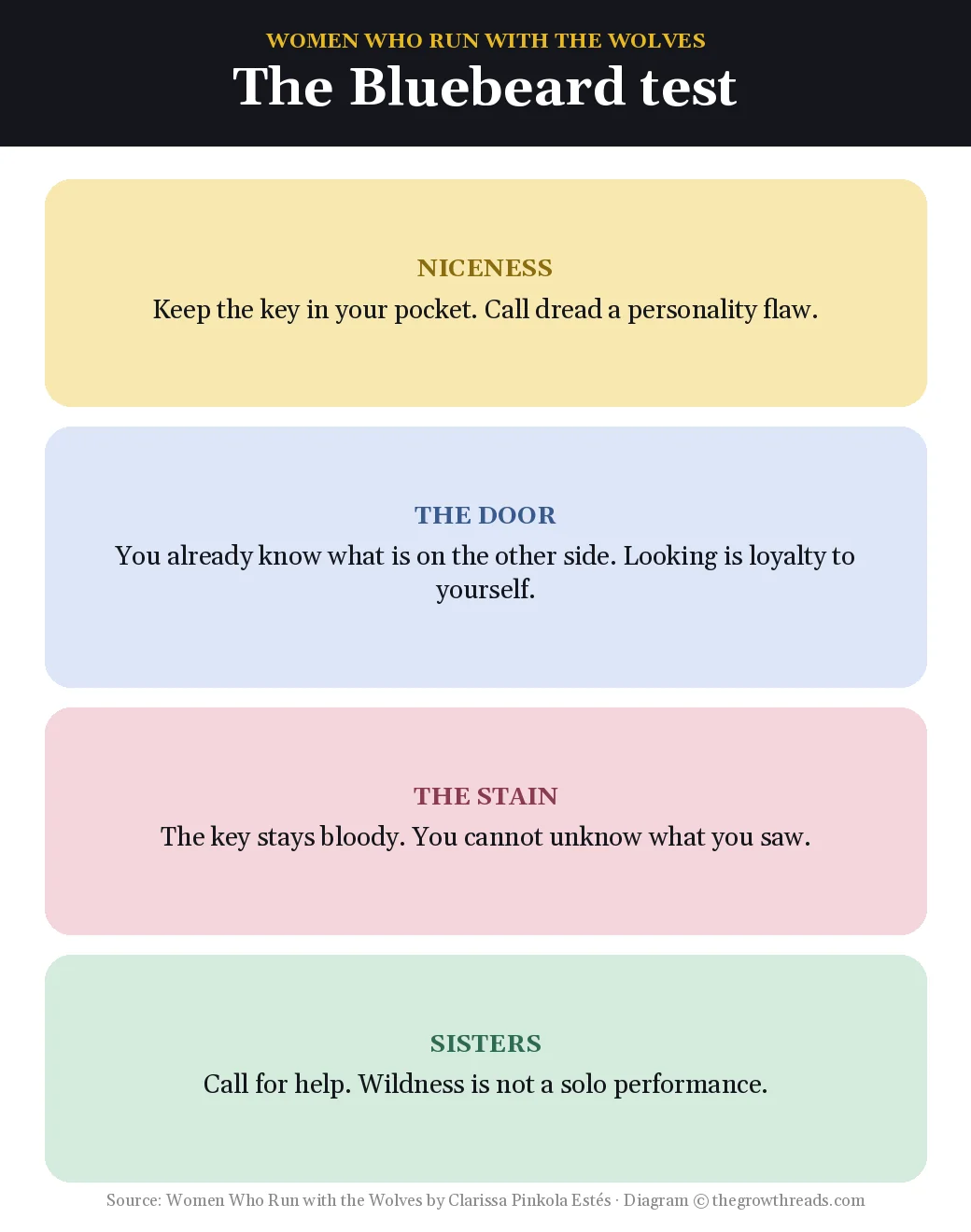
Bluebeard marries, charms, and hands over a ring of keys with one ban: not that door. The bride opens it. Behind it is the evidence of what he is. The key bleeds and will not wipe clean. Brothers or sisters arrive because looking, by itself, is not the same as getting out. Estés refuses the tidy moral that curiosity is the woman’s sin. The sin is the ban. A life that requires you not to look is already telling you what you would find.
In a relationship this is rarely a gothic castle. It is the joke you cannot question, the money you cannot see, the family story in which you are “too sensitive,” the job that praises overtime and pathologizes fatigue. Charm is not proof of safety. Dread in the body is data. You do not owe the room a better mood before you check the door. The stained key kills the rewind fantasy: once you know, pretending is a second injury. That does not mean detonating the life this afternoon. It means you stop gaslighting the part that saw, and you call a sister — a friend, a clinician, a book that will not ask you to be nicer.
TGR Note: If the locked door is a parent who never became an adult, Adult Children of Emotionally Immature Parents names the pattern without a fairy tale. If you need a clean no you can practice this week, add Boundaries.
Part 3: Rage, tears, and the scar
Several of Estés’s cycles — the Ugly Duckling, the Red Shoes, Skeleton Woman, the bear who must weep — teach the same unfashionable sequence. Something was stolen or refused. Heat arrives. If you swallow it, the heat does not vanish; it hires your legs. The Red Shoes dance the girl until she is not in the dance. Overwork, overgiving, over-explaining, and a calendar that never contains you are modern red shoes. Rage is not the shoes. Rage is the messenger that could have stopped the fitting.
Estés will not let anger be a personality. It is mail: a boundary was crossed, a gift was used, a body was ignored. Read the mail. Do not burn the house for sport, and do not return the letter unopened so you can stay “easy.” After the heat, tears. The book is stubborn about crying because tears are how the psyche knits scar tissue you can walk on. Skeleton Woman, pulled from the sea on a hook, is the love story inside the horror: he caught the whole of life, not a prize. Stay when the unpretty part comes up in the net — without turning stay into self-erasure, and without remaining in Bluebeard’s house.
TGR Note: If anger is the mail you keep returning, The Dance of Anger is the plainer map for intimate heat. If the scar is still a family script, Codependent No More is the next honest room.
Part 4: Sealskin, Soulskin — come home in this body
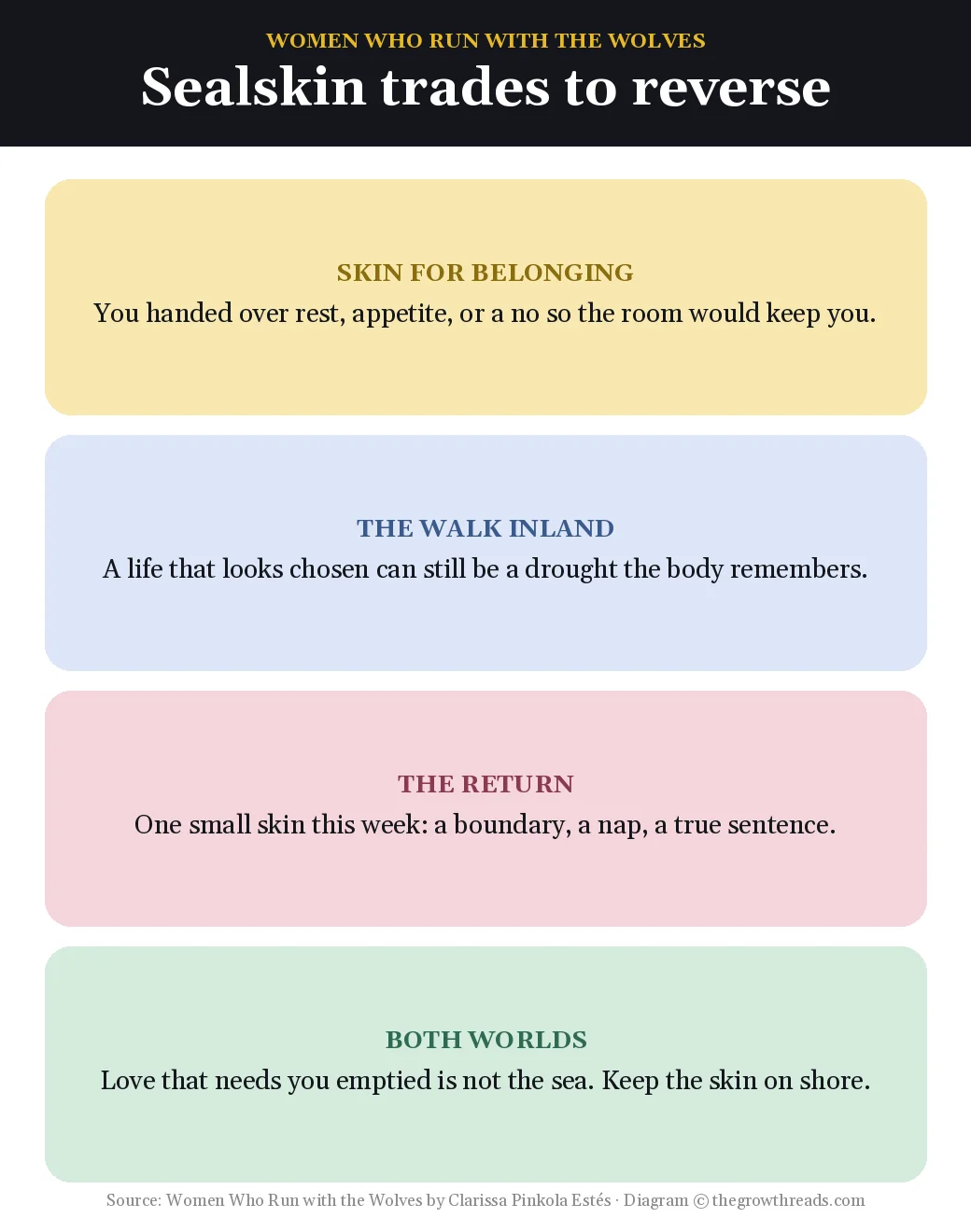
A selkie comes ashore. A man hides her sealskin. She lives a dry marriage and a dry competence until the pelt is found. Estés reads this as the soulskin: the true climate of a life. You can love people on land. You cannot let them warehouse the skin that lets you breathe. Many “good” relationships are inland droughts with excellent lighting. Homing is the application. You do not dump a partner because a myth told you to howl. You stop using them as the entire forest and return small pieces of skin — sleep, a closed door, a true sentence. Estés is not anti-love. She is anti-erasure dressed as devotion. A self with bones can attach. A self with no skin can only cling. If love is organized around remaining selectable, take back one square this week and put it on before you negotiate.
TGR Note: If homing needs a weekly practice with another adult, How to Be an Adult in Relationships is the calmer drill. If the drought is a missing yes to your own life, Eat Pray Love is the memoir version of pleasure plus devotion without the wolf coat.
Who is Women Who Run with the Wolves best for — and who should read something else first?
This book is for the competent adult whose instinct went quiet in a life that photographs well. It is for the person who apologizes for needing rest, who calls dread overthinking, who has not made anything useless in a year. It is for readers who can live with story as a teacher and do not need a worksheet on page three.
Read something else first if you need a couples protocol this week: The Seven Principles for Making Marriage Work or Hold Me Tight. For bonding science, start with Attached. For love as an ethic, All About Love. If you are in immediate danger, get practical safety help — a myth is not an exit.
Questions to reflect on
- Which bone did I put down so I would still be invited — rest, appetite, anger, making, or a no?
- What door was I told not to open, and what do I already know is behind it?
- Where are my Red Shoes this month: the calendar that dances without me?
- Who is holding a piece of my sealskin, and what one square can I wear tomorrow?
- If I sang over one discarded thing for seven days, what would “running” look like on an ordinary Tuesday?
🔥 Ready to retrieve one instinct this week?
Start with La Loba and Bluebeard, then practice Sealskin as a boundary, a nap, and a true sentence — not as a costume howl.
How to apply Women Who Run with the Wolves (7-day plan)
- Day 1: Name the bone: I used to feel ______ in my body, and I put it down in order to ______. One sentence. No essay.
- Day 2: Give that bone ten minutes — a walk, a page, a meal you taste, a closed door. Singing starts as time, not as insight.
- Day 3: Write the ban: I am not supposed to look at ______. Then write what you already know. Do not send it yet.
- Day 4: Let one anger land for five minutes without swallowing it or exploding it. Read the mail. Name the theft in eight words.
- Day 5: Cry on purpose if the heat moved anything. If tears will not come, sit with the tightness and do not improve it.
- Day 6: Return one square of sealskin: a no, a nap, a hobby that is not a couple brand. Wear it before you explain it.
- Day 7: Run: use the retrieved thing once in public view — a request, a rest, a piece of making — then do one ordinary duty without apologizing for the morning.
Frequently asked questions
What is Women Who Run with the Wolves about?
Women Who Run with the Wolves is Clarissa Pinkola Estés’s 1992 collection of myths and stories about the Wild Woman archetype — the instinctive self that knows how to hunt, rest, rage, love, and come home. La Loba gathers bones and sings flesh onto them. Bluebeard is the predator you were told not to see. Sealskin/Soulskin is the life you traded to belong. The usable work is not a cabin in the woods. It is retrieving one starved instinct this week and refusing to call that starvation maturity. A story-book with a practice, not a couples workbook.
What does Estés mean by the “wild woman”?
The “wild woman” is not a mood, a night out, or a personality type. Estés uses it for the instinctive psyche — the part that can smell a false bargain, protect a boundary, make, rest, and tell the truth without waiting for permission. Domesticated life is not the enemy; starving that instinct until you cannot feel a yes or a no is. The book’s claim is that women (and anyone living under that script) can retrieve her through story, tears, rage, and small acts of homing. Wild here means intact, not reckless.
What is the La Loba story in the book?
La Loba, the wolf woman, walks the desert gathering bones. When the skeleton is complete she sings over it until flesh returns and the creature runs. Estés treats this as the pattern of psychic retrieval: you do not invent a new self from slogans. You collect what was discarded — appetite, anger, rest, a craft, a no — and you stay with it long enough that it can move again. The singing is repetition plus feeling, not a vision board. One bone this week is a complete cycle. Waiting for the full skeleton is how the work never starts.
What does the Bluebeard story teach about relationships?
Bluebeard gives his bride every key but one and forbids the last door. She opens it. The room is filled with what he did to the women before her. The key stays stained. Estés reads this as the predator in a charming life — a partner, a family system, a job, or a story about being nice. The practice is to trust the dread you already feel, look at what you were told to leave shut, and call for help instead of managing it alone. Looking is not disloyalty. Unknowing on purpose is. This is not a license to snoop; it is a license to believe your own eyes.
Is Women Who Run with the Wolves a relationship book?
Yes, if relationship includes the one with your own instinct, your family of origin, and the partners you choose after you can feel a no. It is not a date-night script and not a Gottman skills manual. The relationship move is homing: stop trading your sealskin for belonging, stop calling a predator a communication style, and bring a self that has bones to the people you love. If you need attachment categories or repair conversations first, read Attached or Hold Me Tight, then come back. The myths still apply at a kitchen table. They do not replace therapy in an unsafe house.
How long does Women Who Run with the Wolves take to read?
The Ballantine trade paperback runs about 584 pages. Plan twelve to sixteen hours if you read every story and the commentaries, less if you take one cycle at a time — La Loba, Bluebeard, then Sealskin. Estés wrote it to be lived with, not finished like a report. A useful pace is one story, one TGR Note, one small act the same week. This guide is about fourteen minutes. The audiobook is Estés herself on many editions; her cantadora voice is part of the medicine. Do not treat speed as virtue. The book is doing its job when one bone gets sung, not when the last page is checked.
Who should read Women Who Run with the Wolves first?
Start here if you look finished and feel starved — good job, good manners, no howl. Start here if you keep calling your own warning a personality problem. Read something else first if you need a couples protocol this week (Seven Principles, Hold Me Tight) or a clean definition of love as a verb (All About Love). If you are in immediate danger, get practical safety help; myths are not an exit plan. Estés is a Jungian psychoanalyst, not a substitute for a clinician. Use the book as a retrieval practice. Use people when the door you opened is bigger than a story.
Related summaries
- Untamed — Doyle’s permission slip if the good-girl script is still wearing you.
- All About Love — hooks’s ethic: love as a verb, not as a howl.
- Adult Children of Emotionally Immature Parents — the family door Bluebeard told you not to open.
- The Dance of Anger — rage as mail you can actually read with someone you live with.
Browse titles on our Best Relationship Books pillar page.
How we analyze books: our summaries are built from a full read of the source text, cross-referenced against the author’s published interviews and research where relevant, and structured around practical application rather than critique. Read our full methodology.