

★★★★★ 4.6/5 — A due-diligence manual: if the loan only works when the hockey stick is true, you are looking at a sale.
Best for: Analysts, PMs, and citizens who bless models attached to debt, mega-projects, or “it will pay for itself” slides
Reading time: ~10–12 hrs for the Berrett-Koehler 3rd edition (384 pages) · ~18 min for this guide
Difficulty to apply: The four-question test is usable this week; the geopolitics is the long part
Confessions of an Economic Hit Man in one minute
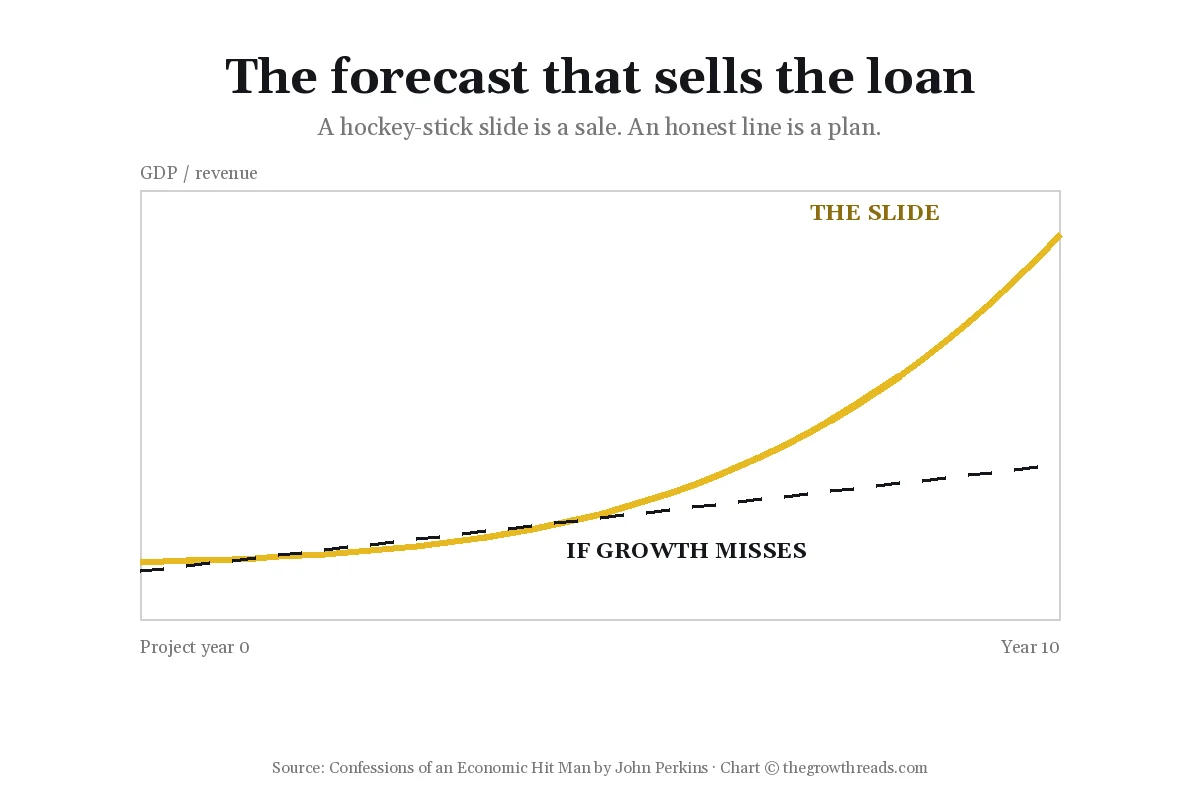
If a forecast only works when the hockey stick is destiny, you are not reading a plan. You are reading a sale. That is John Perkins’s 2004 map, updated in 2023. He says his job at a Boston engineering firm was to produce growth numbers so large they justified World Bank and USAID loans. US contractors collected the construction. The country kept the debt. You do not need his whole itinerary to use the book. Take one live model. Halve the rosy case. Ask who is paid if it still closes.
Key takeaways
- The product is the loan: The forecast is the brochure. The close is the debt.
- Hockey sticks sell; honest lines stall: If the miss-case kills the deal, the slide was doing sales work.
- Follow the contractor: Who is already lined up to pour the concrete tells you why the model exists.
- Public debt, private work: The borrower holds the miss. The builder is paid if the loan closes.
- Three layers of pressure: Salesman, jackals, soldiers. Most rooms you sit in are still layer one. Act there.
- A no has a price: Perkins’s Torrijos and Roldós files are the warning about refused scripts.
- Petrodollars recycled: Oil money in, US contracts and Treasuries out — a closed loop.
- The 3rd edition widens the map: China and climate can run the same sequence if the contractor is chosen first.
- Memoir is a case file: Some claims are disputed. The four questions still run on your deck.
- Application is local: Hiring plans and city bonds fail the same test as a hydro dam.
What is Confessions of an Economic Hit Man about?
Confessions of an Economic Hit Man is John Perkins’s memoir of producing growth forecasts that justified huge loans, routed construction to US contractors, and left the borrower holding debt if growth missed. If the salesman failed, he says jackals or soldiers finished the job. The 2023 edition applies the same test to China and climate.
About the author
John Perkins (born 1945) grew up in New Hampshire, joined the Peace Corps in Ecuador, then entered Chas. T. Main in Boston in the early 1970s. He says he was trained as an “economic hit man”: write country forecasts large enough to justify World Bank and USAID loans, with construction already flowing to US contractors. He worked files in Indonesia, Panama, Saudi Arabia, Iran, and Colombia, then left around 1980. The memoir waited until 2004 and spent more than 70 weeks on the New York Times list. The 2023 third edition adds China, climate, and a sharper citizen brief. Use the book as a field manual for reading a forecast, not as a closed court record. Explore all John Perkins book summaries →
Key concepts at a glance
| Concept | What it means | Use it when |
|---|---|---|
| Economic hit man | A forecaster whose real product is a loan, not a plan. | You are asked to “just make the model work.” |
| Hockey-stick forecast | Growth that has to explode for the debt to look cheap. | The rosy case is the only case in the deck. |
| Contractor tell | Who pours the concrete if the loan closes. | The ribbon-cutting is louder than the bid list. |
| Public miss | The borrower keeps the shortfall; the builder is already paid. | Upside is private and downside is on a public book. |
| Jackals | Perkins’s name for the quieter unit if the sale fails. | You need to know which layer of pressure you are actually in. |
| Corporatocracy | Government, banks, and contractors moving as one interest. | Three logos appear on every “development” slide. |
| Petrodollar loop | Oil money in, Treasuries and contracts out. | A “partnership” looks like a closed recycling circuit. |
| Citizen veto | One person who can still say no to the model. | The room is nodding and nobody owns the miss-case. |
Part 1: The playbook — a forecast that cannot be allowed to miss
Perkins’s first usable idea is ugly and clear. The forecast is not there to describe the country. It is there to close a loan. A hydro plant or highway on the slide is a prop. The live thing is the credit. Once the lender signs, construction can be let to firms that were in the room early. The government is left with a repayment schedule that only looks sane if the hockey stick happens.
He learned the craft at MAIN after Peace Corps years in Ecuador. The training, as he tells it, was social as much as technical: a license to put very large numbers on paper and call them economics. They had to be big enough that the loan looked obvious, and specific enough to survive a committee. That job still exists. It is the job of making a model un-killable.
The honest alternative is boring, which is why it loses meetings. Maybe the plant raises output a little; maybe it does not; here is the miss-case. That version does not move ten figures. Perkins’s version does. If deleting the top growth band kills the recommendation, it was never a forecast. It was a brochure with decimals.
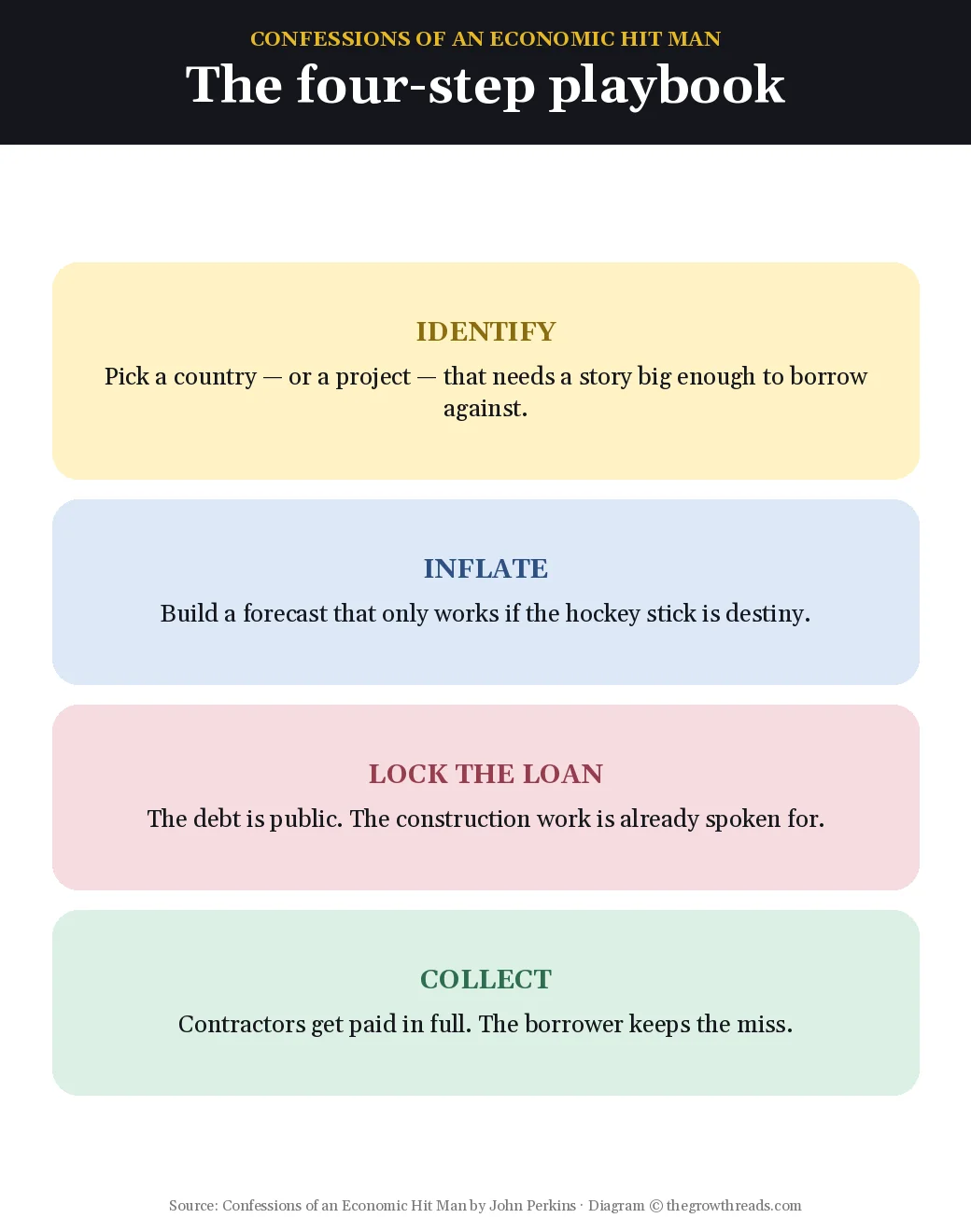
Run the playbook in four beats. Identify a place that needs a story large enough to borrow against. Inflate the growth path until the debt service looks cheap. Lock the loan while the contractor list is already warm. Collect: the builder is paid; the public book holds the miss. A city parking garage takes the same beats. Scale changes. Incentives do not.
TGR Note: The institutional twin of this playbook sits in Why Nations Fail: extractive rules park surplus for a few. Perkins supplies the operational move those rules use in a loan meeting — a forecast that cannot be allowed to miss.
Part 2: The files — Indonesia, Panama, Ecuador, Saudi Arabia
Indonesia is the apprenticeship. Perkins describes arriving to electrify a story: if the industrial forecasts were believed, the loans would follow, and the work would go to the usual firms. A young American with a model, a government that wants prestige projects, a lender that wants a bankable plan. Everyone can tell themselves they are doing development. The model is the permission slip.
Panama and Ecuador are the refusal files. Omar Torrijos and Jaime Roldós appear as presidents who would not stay inside the script. Both died in 1981 plane crashes. Perkins reads those deaths as the jackal layer. Other historians argue weather, accident, or local intrigue. The TGR use is narrower. If a leader’s refusal is treated as a system failure rather than a veto, you are no longer in a forecast meeting. You are in a pressure meeting.
Saudi Arabia is the closed loop. After the 1970s oil shocks, petrodollars had to go somewhere. Perkins describes a recycling circuit: Saudi funds into US Treasuries and US firms into Saudi infrastructure. A surplus gets steered so the contractor ecosystem stays fed. Once you have seen that loop, a lot of “partnership” language starts to look like logistics.
Iran, Colombia, and the later travelogues fill the same pattern at different temperatures. When politics broke the industrial ladder, the file did not become a seminar in humility. It became a problem for the next layer. Steal the habit: when a model fails, do you update the model, or do you update the obstacle?
TGR Note: For the older maps of surplus and markets, keep The Wealth of Nations and Das Kapital on the same shelf. Smith and Marx argue systems. Perkins argues a file: this loan, this contractor, this miss.
Part 3: Jackals, corporatocracy, and the cost of a no
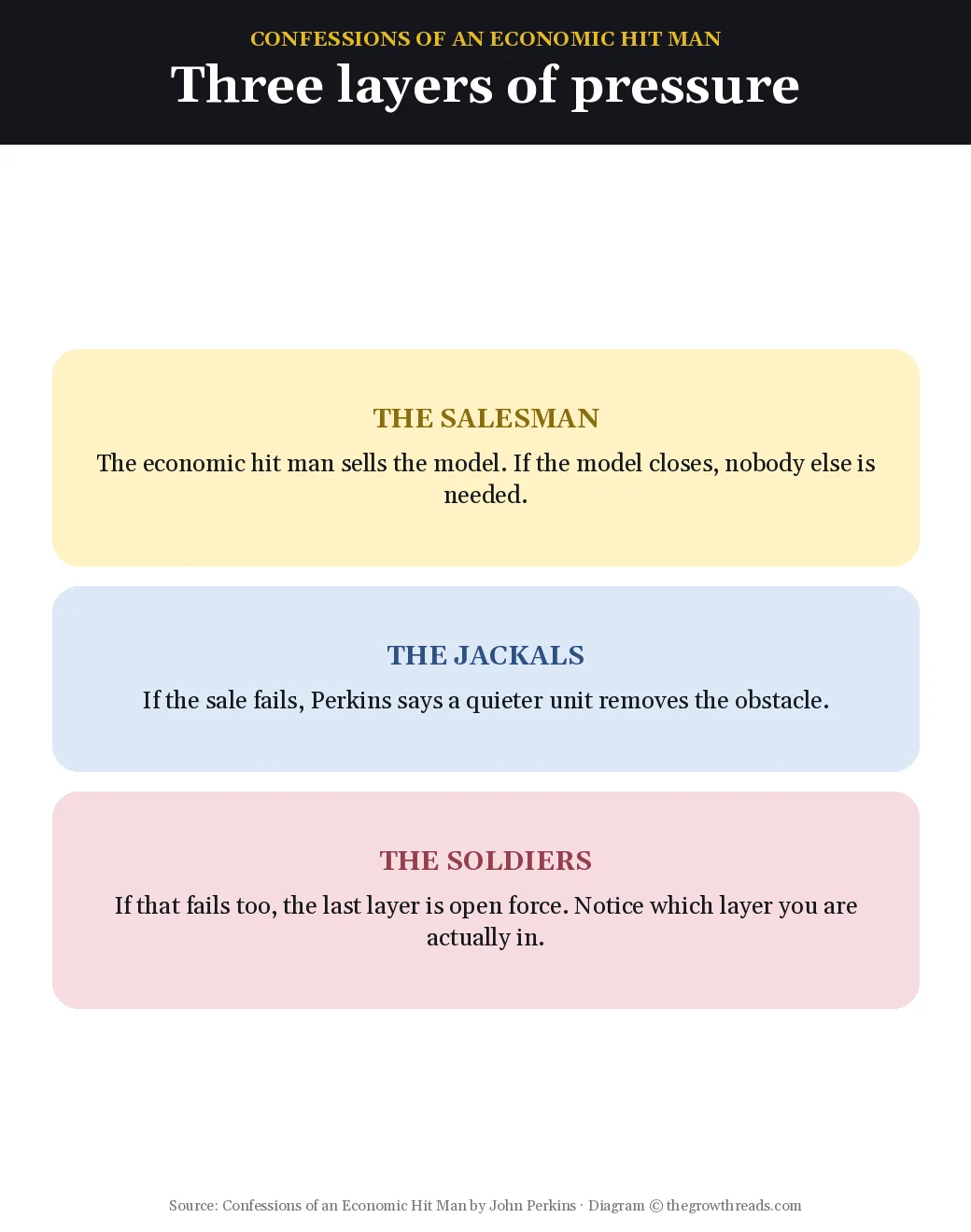
Perkins’s three-layer sketch is the part people remember and the part they misuse. Layer one is the salesman with the spreadsheet. Layer two is the covert fixer. Layer three is open force. Most readers of this site will never sit in layer two. That is not a reason to skip the diagram. It is a reason to get very good at layer one, which is where ordinary careers actually live.
If the sale closes, nobody else is needed. That sentence is the practical core. Every hour you spend making a miss-case visible is an hour the later layers do not get called: no emergency re-forecast, no quiet campaign against the person who asked an ugly question. Corporatocracy, in Perkins’s usage, is what happens when government offices, banks, and contractors stop being three checks and start being one interest with three logos.
The cost of a no is the moral load of the book. Some of those stories are contested, and memoir compresses. Organizations still punish people who kill a fee. You have watched a milder version in a quarterly review. The person who said “this only works at 40 percent growth” became “difficult.” The book’s gift is to name that pressure early, while you still have a veto.
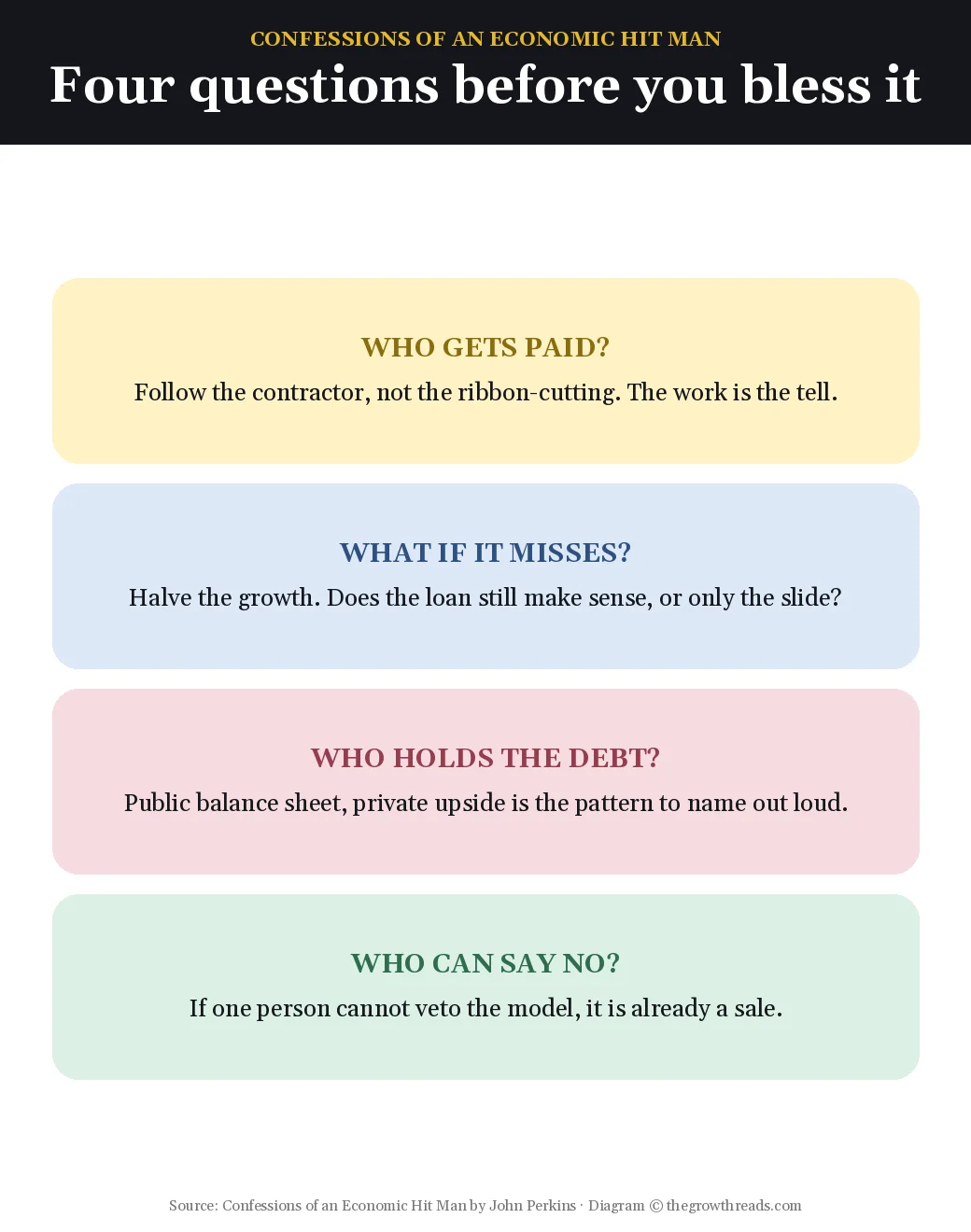
Four questions keep you in layer one on purpose. Who gets paid if this closes. What happens if growth is halved. Who holds the debt. Who can say no. If you cannot answer them on a single page, you are not ready to bless the model. If you can answer them and the deal still looks like a sale, you now have a sentence to use in the room. That is more useful than a theory of empire.
TGR Note: Michael Lewis in The Big Short watches private models that had to remain true for a trade to pay. Perkins watches public models that had to remain true for a loan to close. Same allergy to a hockey stick. Different balance sheet.
Part 4: After the confession — China, climate, and a usable test
Perkins left MAIN around 1980 and spent years trying to write the book. It appeared in 2004 and spent more than 70 weeks on the New York Times list. Millions of readers met international finance as a thriller. The TGR job is to keep the thriller and still extract a weekday tool.
The 2023 third edition is the version this review points you at. New chapters argue that China now runs a version of the sequence through infrastructure finance, and that climate spending can repeat it if the contractor is chosen before the carbon math is honest. You do not have to accept every geopolitical claim. Any new spending wave will arrive with forecasts attached. The same four questions still fire.
Perkins’s later voice is more preacher than analyst. Pair him. Use Why Nations Fail when you want rules that last longer than a memoir. Use Poor Economics when you want a field test. Use Perkins when someone puts a hockey stick on a slide and asks you to nod. The confession is the case file. The test is the inheritance.
TGR Note: If you want money-as-technology rather than money-as-confession, read The Ascent of Money. If you want a hard-money critique of the same debt machine, The Bitcoin Standard is the sharper adjacent argument. Neither replaces the four questions.
Who is Confessions of an Economic Hit Man best for — and who should read something else first?
This book is for people who sit near a model that wants a loan, a bond, a raise, or a mega-project. It is not a first personal-finance book and not a substitute for a development-economics syllabus.
If you need a first money system, start with I Will Teach You To Be Rich. If you want institutions without memoir, read Why Nations Fail. If you want field evidence on poverty programs, read Poor Economics. If you want private markets that needed a model to stay true, read The Big Short. If you want the inner life of a saver, read The Psychology of Money. Come to Perkins when the question is “what is this forecast actually selling?”
This is not financial, legal, or investment advice. It is a reading of Perkins’s framework so you can interrogate a slide.
Questions to reflect on
- Which live forecast in your world dies if you halve the growth band?
- Who is already staffed to do the work if the loan or budget closes?
- Where does the miss sit — on a public book, a customer, or a quiet reserve?
- Who in the room can still say no without becoming “difficult”?
- What sentence will you refuse to write in a model this quarter?
🔥 Ready to test the forecast?
Get Confessions of an Economic Hit Man and run the four questions on the next slide that needs a hockey stick.
How to apply Confessions of an Economic Hit Man (7-day plan)
- Day 1 — Name the slide. Pick one live forecast you currently treat as fact. Write its one-line claim.
- Day 2 — Halve it. Rebuild the miss-case at 50 percent of the rosy growth. Does the recommendation survive?
- Day 3 — Follow the contractor. Write who gets paid if the plan still closes. One name or firm, not a sector.
- Day 4 — Who holds the miss? Public book, customers, or a quiet reserve. Put the owner in a sentence.
- Day 5 — Find the veto. Identify the one person who can still kill the model. If you cannot name them, that is the finding.
- Day 6 — The sentence you will not write. Choose one number you will refuse to put in a deck without a miss-case beside it.
- Day 7 — Say it once. In a live conversation, ask one of the four questions out loud. No speech after it.
Frequently asked questions
What is Confessions of an Economic Hit Man about?
It is John Perkins’s memoir of producing growth forecasts that justified huge development loans. US contractors collected the construction work. The borrowing country kept the debt. If the salesman failed, Perkins says jackals or soldiers finished the job. The 2004 book made that sequence famous. The 2023 third edition keeps the same test and adds China, climate, and a sharper brief for citizens who bless models they did not build. Read it as a due-diligence manual for any slide that only works if the hockey stick is destiny.
What does Perkins mean by “economic hit man”?
He uses the phrase for a highly paid forecaster whose real product is a loan, not a plan. The job is to make a giant project look inevitable on paper so World Bank, USAID, or similar money can close, with the work already routed to favored contractors. The country then owes a debt that is hard to service if growth misses. Perkins says he held that job at Chas. T. Main in the 1970s. Treat the label as his operational name for a conflict of interest you can still find in ordinary decks.
Is Confessions of an Economic Hit Man a true story?
Perkins presents it as a confession of work he did. Some officials and economists have disputed parts of the record, which is a fair FAQ fact: memoir is not a court file. The useful residue does not require you to settle every episode. The playbook is testable without a verdict on every plane crash or meeting. Who gets the contract. What happens if growth is halved. Who holds the debt. Who can say no. Run those four questions on the next model you are asked to bless. Keep the contested history in the notes, not in the veto.
Who should read Confessions of an Economic Hit Man?
Analysts, product leads, public-finance staff, and anyone who signs off on a forecast attached to debt or a mega-project. It is also for citizens who want language for a ribbon-cutting that somehow always pays the same contractors. If you need a first personal-budget book, start with I Will Teach You To Be Rich instead. If you want institutions without memoir, read Why Nations Fail. If you want development evidence, read Poor Economics. This book is the forecast-and-debt lens for working models.
How is the 3rd edition different from the 2004 book?
The original 2004 memoir is the Indonesia-to-Saudi spine: how the loans were sold and what happened when leaders refused the script. The 2023 Berrett-Koehler third edition keeps that spine and adds twelve new chapters. Perkins argues that China now runs a version of the same sequence through infrastructure finance, and that climate spending can repeat the pattern if the contractor is chosen before the model is honest. The citizen test is sharper. Commerce in this review uses that updated paperback.
How do I apply this if I do not work in geopolitics?
You already sit in a smaller version of the room. A hiring plan that only works at 40 percent growth. A warehouse that only pays back if volume doubles. A city bond that only looks cheap if tax receipts follow the slide. Take one live model this week. Halve the rosy case. Write who is paid if it still closes. Write who holds the miss. Write who can veto. If the deal dies when the hockey stick dies, you found the sale. That is the whole application. No embassy required.
Where should I start if I want the economics without the memoir?
Read Why Nations Fail for inclusive versus extractive rules. Read The Wealth of Nations and Das Kapital if you want the older maps of markets and surplus. Read Poor Economics if you want field tests rather than confession. Read The Big Short if you want private models that had to be true for the trade to work. Then come back to Perkins for the specific move this book owns: a public loan whose construction work is already spoken for. The memoir is the case file. The four questions are the tool.
Related summaries
- Why Nations Fail — inclusive versus extractive rules, without the memoir.
- The Wealth of Nations — markets and specialization as the older map.
- The Big Short — private models that had to stay true for the trade to work.
- The Ascent of Money — finance as a technology, including the debt it creates.
Browse every title in our Best Money Books pillar page.
How we analyze books: our summaries are built from a full read of the source text, cross-referenced against the author’s published interviews and research where relevant, and structured around practical application rather than critique. We disclose our editorial process and affiliate relationships in full. Read our full methodology.