

★★★★½ 4.6/5 — the most useful memoir of a writing job ever put on a calendar.
Best for: Anyone who waits to feel ready before they sit down to make the thing
Reading time: ~7 hours (320 pages) · this guide ~12 min
Difficulty to apply: Easy to start — hard to keep the door closed for 2,000 words
On Writing in one minute
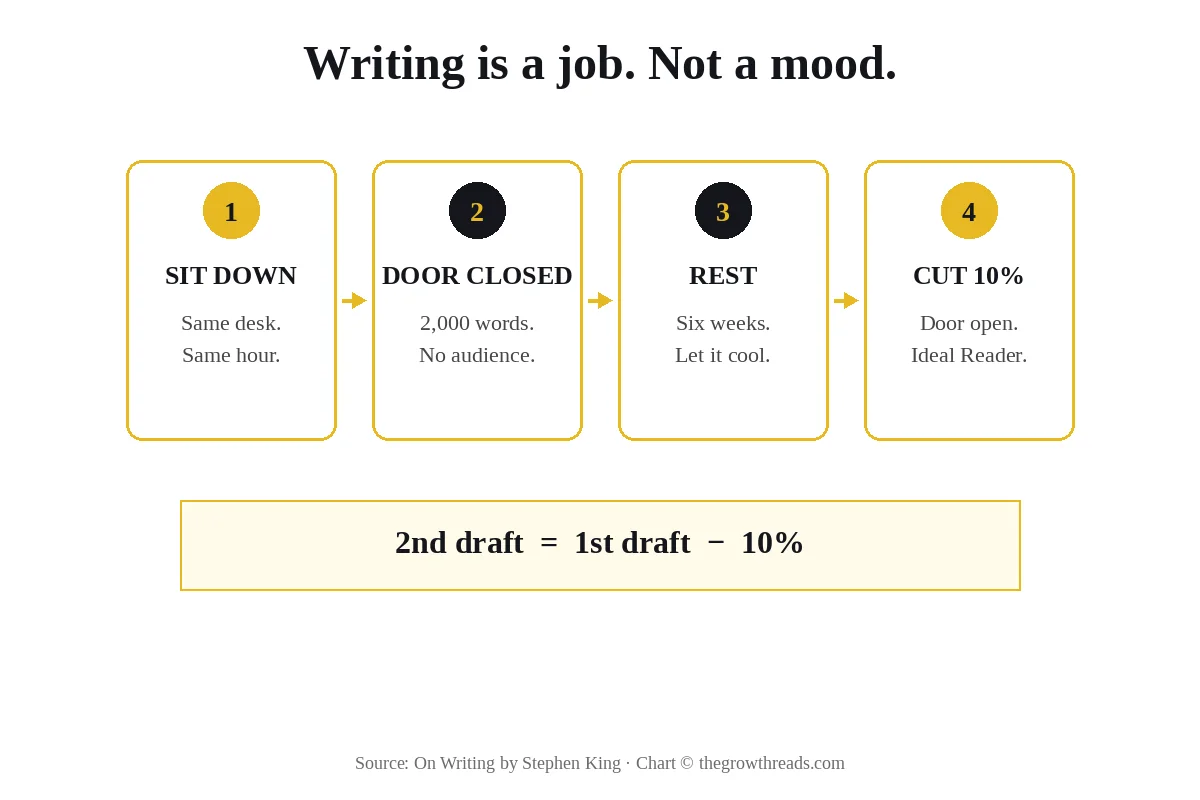
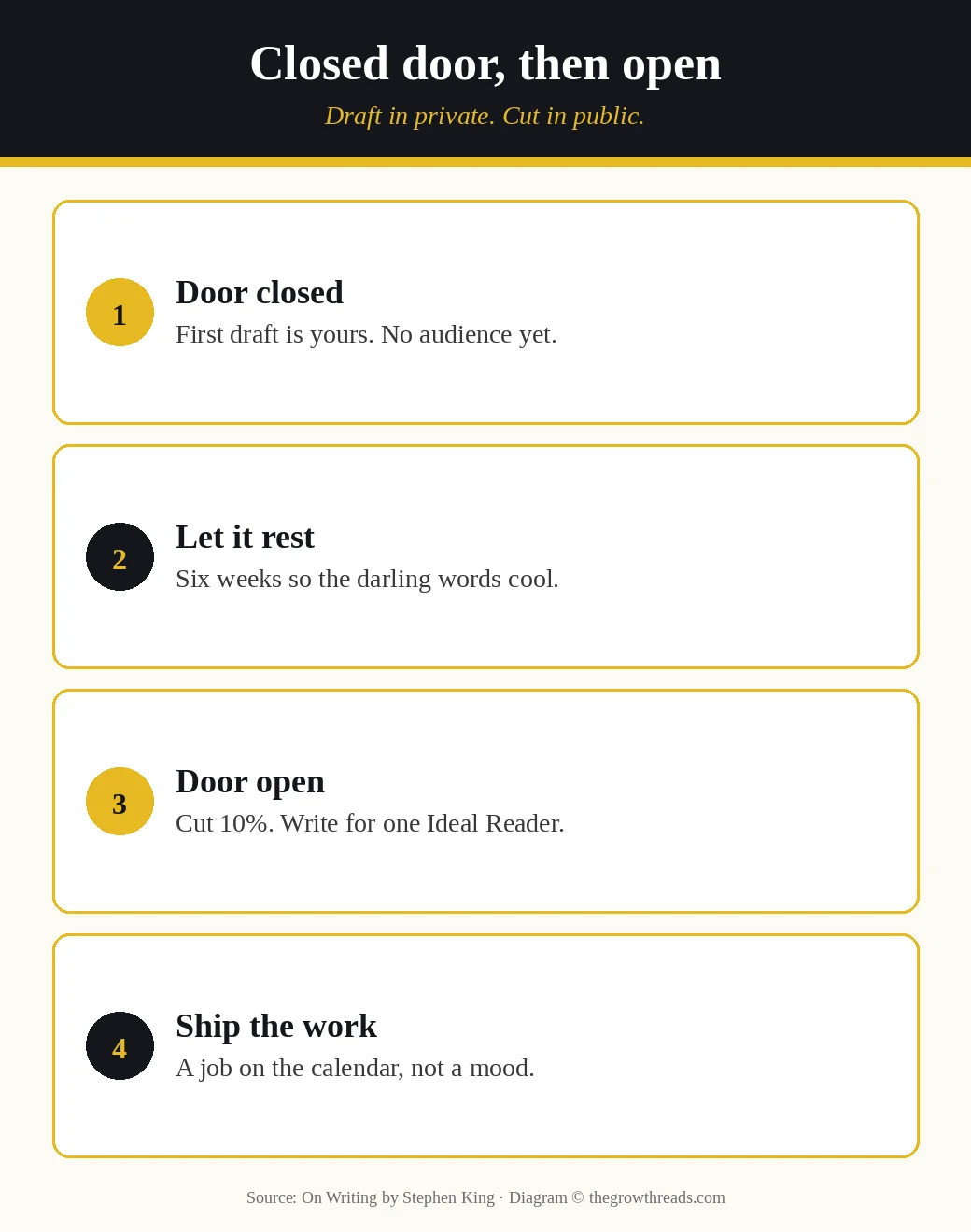
Writing is a job you show up for, not a mood that visits when the light is right. Stephen King’s On Writing: A Memoir of the Craft (Scribner, 2000) is half a working life and half a toolbox. The life is evidence: Maine, a nail of rejection slips, a first novel fished out of the trash, a van that nearly ended the job in 1999. The kit is small. Read a lot. Write a lot. Use the words you already own. Draft with the door closed. Rest. Cut about ten percent with the door open, for one Ideal Reader. This summary is the application layer — desk, quota, situation, cut — not a tour of Carrie. If you make anything on a schedule, the book is for you.
Key takeaways
- Show up like a plumber: The muse knows your hours because you are already there. Waiting is not a method.
- Read a lot, write a lot: No time to read means no tools. No daily pages means no book.
- Use your own vocabulary: The first honest word beats the dressed-up one. Don’t reach for a thesaurus to sound smarter.
- Grammar is a pole, not a costume: The story hangs on it. Adverbs and passive voice are usually extra paint.
- Situation, not plot machinery: Put people in a predicament and watch what they do. Stories are fossils you excavate, not outlines you weld.
- Door closed, then open: First draft is private. Second draft is for one Ideal Reader, and it is shorter.
- 2nd draft = 1st draft − 10%: John Gould’s newspaper rule. Cut the darling sentences that do not carry weight.
- Description to the point: Enough for the reader to see. Not a furniture catalogue.
- The job survived a van: He finished the book while learning to walk again. The habit was already there.
What is On Writing about?
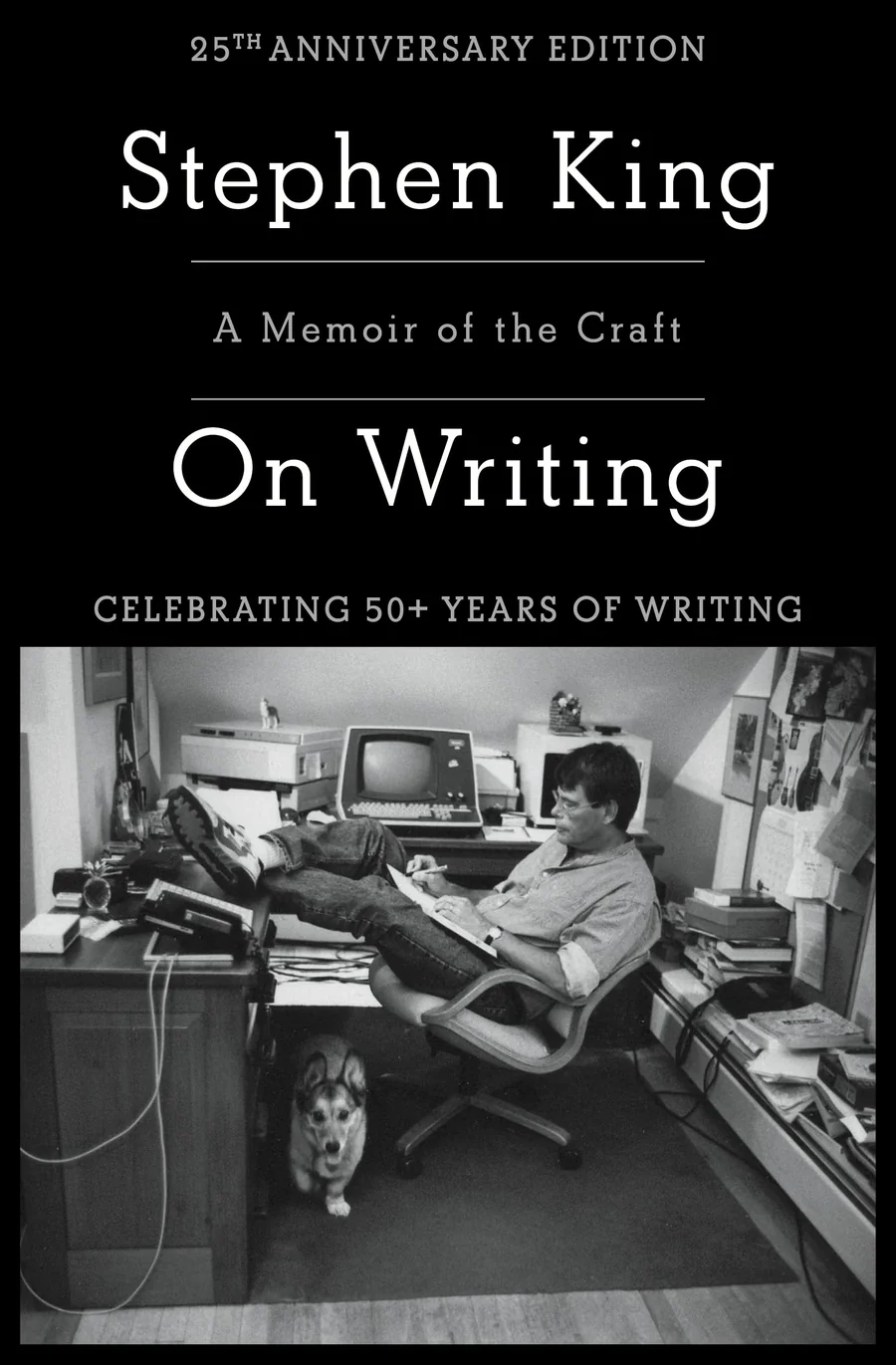
On Writing is Stephen King’s 2000 memoir of the craft: a working writer’s life, then a short kit for sitting down, filling pages, and cutting them. Talent without a daily job stays a hobby. Honest language plus a closed-door draft beats inspiration you wait for.
About the author
Stephen King was born in Portland, Maine, in 1947 and has spent most of his working life in the same state, turning a high-school English teacher’s evenings into a popular-fiction career. The early years were a trailer, a laundry, a spike of rejection slips, and a first novel his wife Tabitha pulled from the trash — Carrie, sold in 1974. On Writing is the book where he names the job instead of hiding it inside the stories. After a van struck him on a Maine road in June 1999, he finished this manuscript while learning to walk again. That is the credential that matters here: the desk that still existed when the body almost did not. Explore all Stephen King book summaries →
Key concepts at a glance
| Concept | What it means | Use it when |
|---|---|---|
| Writing as a job | Same desk, same hours, whether you feel like it | You wait for a mood before you start |
| Read a lot / write a lot | Input and output are one practice | You “have no time to read” |
| Toolbox | Vocabulary, grammar, style — used honestly | The prose is trying to sound smarter than the thought |
| Situation, not plot | A predicament plus people; the story is dug out | You outline a machine and the characters go dead |
| Door closed | First draft with no audience in the room | You edit sentence one before page two exists |
| Ideal Reader | One real person the second draft is for | You write for a vague “market” |
| Minus 10% | Second draft is first draft, shortened | Every darling sentence feels load-bearing |
| On Living | The habit has to outlast the body | A crash, a dry spell, or a scare stops the desk |
Part 1: C.V. — how a working writer is made
King calls the first movement a C.V., not a childhood scrapbook. The point is employment history. A boy who copied comics until someone told him to invent his own. A mother who paid a dollar for the next four. A mill, a classroom, a spike of rejection slips over a desk so he could see them. Carrie was not a gift. It was a draft he had thrown away, which Tabitha fished out and told him to finish. The later advance reads like a movie. The years before it read like a job with terrible pay and a stubborn calendar.
That is the application, not the nostalgia. If you are waiting to feel like a writer — or a designer, a researcher, a person who “has a book in them” — the C.V. is rude on purpose. The identity came after the hours. He wrote in a trailer, after teaching, when the pages were bad, because bad pages are how you get to the ones you can cut. Steal the method: a place, a time, a pile of work that exists whether anyone has clapped yet. The drinking years sit in the C.V. without becoming the plot. The usable line is that the pages were a daily act. When the personality wobbled, the act remained — which is why the van postscript later lands.
TGR Note: If the thing stopping you is a voice that says sit down tomorrow, our War of Art summary names that voice Resistance. King almost never uses the word. He clocks in. Read Pressfield if you need a fight. Read On Writing if you need a shift. Do not collect both as permission to delay Day 1.
Part 2: Toolbox — vocabulary, grammar, and the 10% you cut
The toolbox chapter is the part people quote and then ignore. King wants a small kit, not an MFA. Vocabulary is the words you already have, used in the order they arrive. Reaching for a fancier synonym because it sounds educated is how you write a sentence nobody would say out loud. Grammar is the pole the story hangs on — get the hang right, then stop decorating. Adverbs and the passive voice are usually a weak verb in costume. Description should be enough for the reader to build the room, then you leave. Dialogue should sound like a person, not a speech.
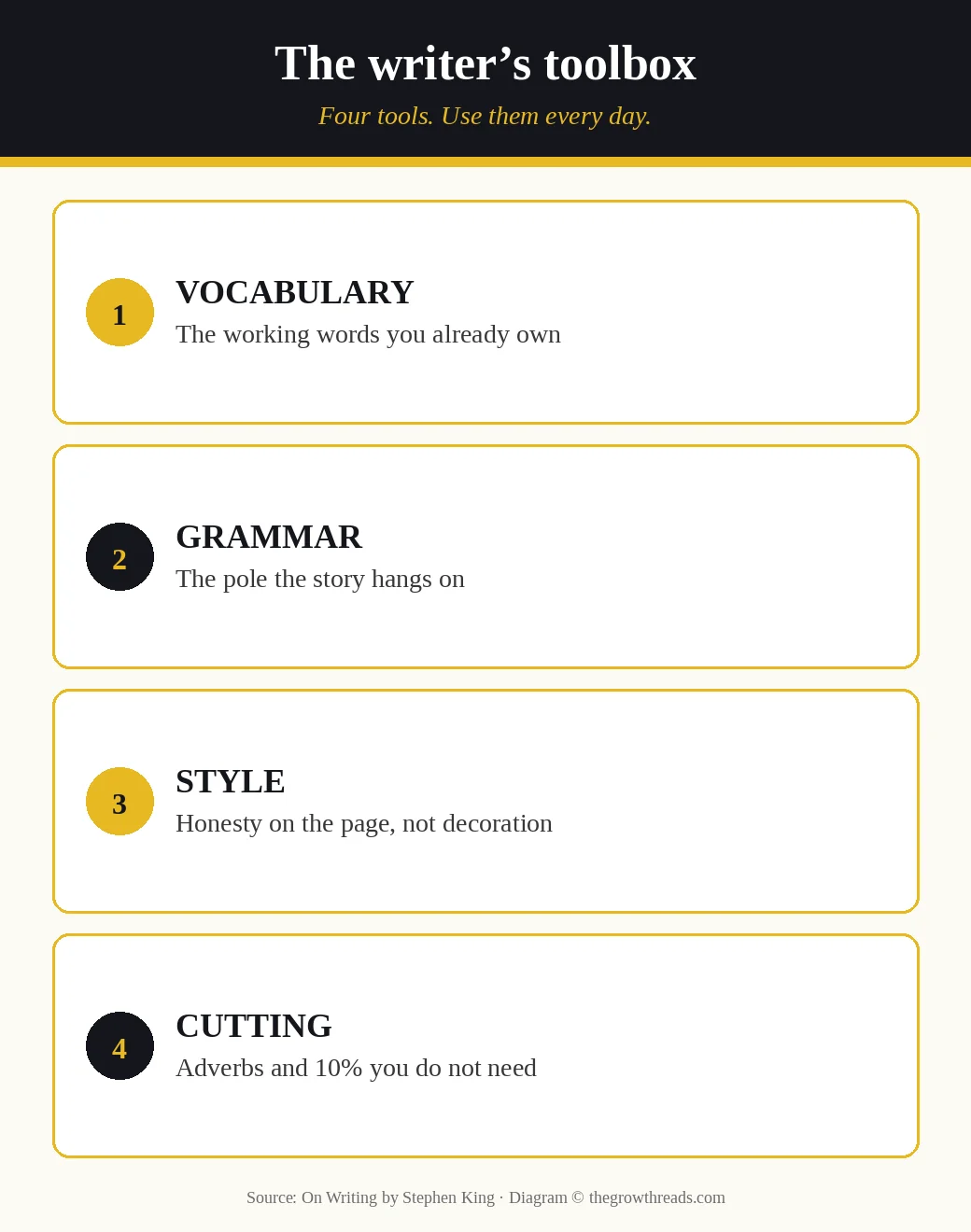
John Gould, the newspaper editor from King’s student days, is the ghost in the kit. Second draft equals first draft minus ten percent. Pass two is not where you add cleverness. It is where you remove the sentences that were you performing, explaining twice, or protecting a line you liked. Ten percent is a bias toward subtraction, not a law of physics. A memo with three openings has the same disease. Style, here, is honesty under pressure — clear beats pretty. The toolbox sits before the quota so you do not produce fog faster. Spend one session hunting adverbs in something you already wrote. Open a page. Cut.
TGR Note: Bird by Bird is the gentler sister — short assignments, shitty first drafts, the same subtraction without the newspaper bark. Steal Like an Artist is the input half of “read a lot,” aimed at people who freeze because they think originality means isolation. King assumes you are already reading. If you are not, start there before you argue with his adverb rule.
Part 3: On Writing — read, write, and leave plot alone
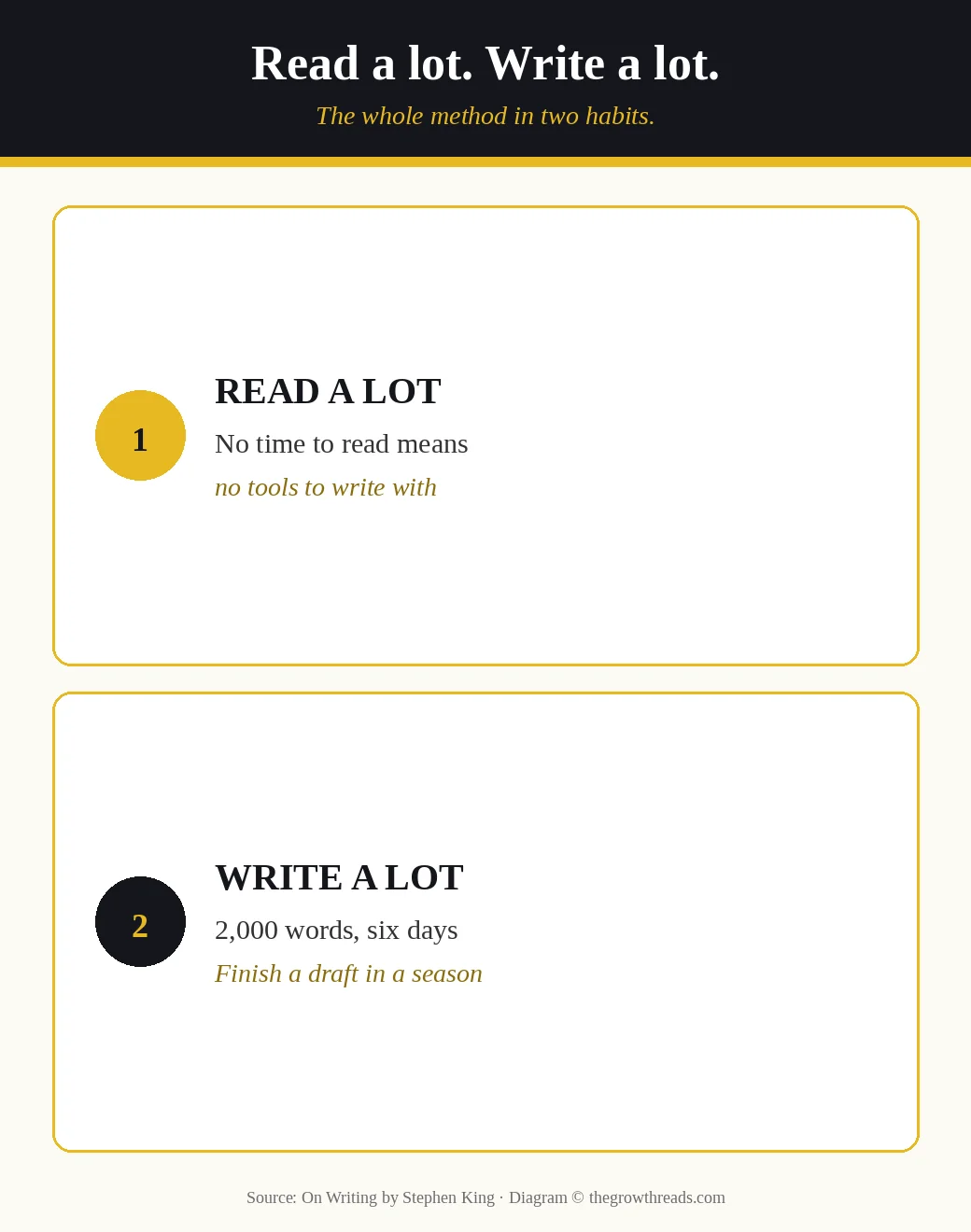
The craft section is shorter than the myth around it. Read a lot. Write a lot. Both are literal. If you have no time to read, you have no tools. If you have no daily quota, you have a wish. King’s number is famous because it is specific: about 2,000 words, six days a week, a draft in a season if you keep the streak. Steal the idea that the number exists before the mood, not necessarily his count. He writes in the morning, door shut. Nobody is invited to the first draft — not an editor, not the version of you that wants to sound literary.
Plot, as a machine you assemble in advance, is the other enemy. King prefers situation: a person in a predicament. You put the pieces in the dirt and excavate what the characters actually do. Outline-as-jackhammer smashes the fossil. For a novel, start from a what-if and follow the people. For a talk or a product narrative, start from the live problem, not the template. If the people will not do what your outline needs, the outline is wrong. Then he names the Ideal Reader — for him, Tabitha, one person whose boredom he can feel. Second draft is not “for the market.” Theme shows up after the draft exists; you go back and make it clearer. Research is a beam you hide, not a lecture on page one. The slogan without the closed door is just another mood.
TGR Note: The Artist’s Way also asks for morning pages, but Cameron’s three pages are a dump to clear the pipe. King’s pages are the job. If you need recovery from a critic in your head, start with Cameron. If you already know you want to finish a draft, King’s quota is the sterner tool. The Practice is Godin’s later cousin: ship on a schedule, skip the muse. Do not run all three programs this week. Pick the desk.
Part 4: On Living — the van, the cut, the door that stayed shut
In June 1999 a van knocked King into a ditch on a Maine road. The postscript is the test of everything before it. Sitting down hurt. The desk still worked, because it had never been a feeling. He finished On Writing while recovering. If Part 1 is how a writer is made, Part 4 is how a writer continues when the making almost stops.
Revision sits in the same movement. After the first draft, wait weeks so you can come back as a reader. Then the door opens: cut the ten percent, write toward the Ideal Reader, fix the places you explained twice. The crash is not a romance. If you have no ordinary years on the clock, a crisis will not install a desk. Install it on a boring Tuesday.
The last usable gift is permission to be readable. Tell the truth in a story people will finish. For knowledge work that is: stop decorating the memo, cut the throat-clear, send it to one real reader before the crowd. The novelist and the product manager are not doing the same art. They can still steal the same contract with the chair.
Who is On Writing best for — and who should read something else first?
Best for people who stall because they wait to feel like a writer — or anyone whose job is pages. On Writing will not give you a plot formula. It will take away the story that the next sitting is optional until the muse arrives.
Read something else first if the block is a critic you cannot get past — The Artist’s Way is recovery, not a quota. If the block is Resistance, start with The War of Art. If you need tiny assignments, Bird by Bird is kinder. If you want a habit system with no memoir, Atomic Habits or The Creative Habit. For other people’s studio hours, Daily Rituals. On Writing is the job description. Use it for that.
Questions to reflect on
- Where do you still wait for a mood before you sit down — and what would a plumber do instead?
- If you listed only days last month that had both reading and a page count, how small is the pile?
- Which sentences in your last draft were darling, and what happens if you cut ten percent of the page?
- Who is your Ideal Reader, by name — not “the market,” one person whose boredom you can feel?
- What situation (not plot) is sitting in your notes, waiting for you to put people in the room and watch?
🔥 Ready to treat the pages like a job?
Get On Writing, then run the 7-day plan on one draft you have been waiting to feel ready for — not on a muse that was never on the payroll.
How to apply On Writing (7-day plan)
- Day 1 — Name the job. One desk, one hour, one closed door (or headphones). Write the sentence: “I sit here at ___, and I do not wait.” That sentence is the employment contract.
- Day 2 — Count the reading. List what you actually read last week. If the list is thin, you found the missing tool, not a personality. Put 20 pages on tomorrow’s calendar before the quota.
- Day 3 — Closed-door pages. Thirty to ninety minutes. A number you can hit tired — 300 words is legal if 2,000 would be a lie. No audience. No tinkering with sentence one.
- Day 4 — Toolbox audit. Take yesterday’s pages. Circle adverbs, passive dodges, and any word you fetched to sound smart. Replace with the first honest word.
- Day 5 — Situation, not plot. Write one predicament in a sentence. Put two people in it. Follow what they do for a page. Do not outline the ending.
- Day 6 — Name the Ideal Reader. One real person. Read a page as if they are bored. Cut what they would skip. You are not writing for a demographic yet.
- Day 7 — Minus 10%. Take one finished page from the week and cut a tenth of the words. If it still stands, Gould’s rule is now yours. Book the same hour next week.
Frequently asked questions
What is On Writing about in one paragraph?
On Writing is Stephen King’s 2000 memoir of the craft: a working life, then a short kit for how to sit down and make pages. Writing is a job you show up for — read a lot, write a lot, draft with the door closed, rest, and cut about ten percent for one Ideal Reader. The C.V. (trailer, rejections, Carrie pulled from the trash) shows the hours came before the identity. The 1999 van accident tests whether the habit can survive the body. You do not need to write horror. You need a desk, a number, and a cut.
Is On Writing only for novelists?
No. The examples are novels because that is King’s job. Anyone who produces language on a deadline — a founder’s narrative, a paper, a weekly post, a product story — can steal the closed door, the quota, and the ten-percent cut. If you will never write fiction, skip his taste in adverbs as a personality test and keep the calendar. The situation-not-plot chapter and the Ideal Reader still pay. The book is a memoir of a job. Jobs transfer. Moods do not.
How is On Writing different from Bird by Bird or The War of Art?
Bird by Bird is a teacher’s kindness: short assignments, shitty first drafts, permission to be a person while you write. The War of Art is a fight with Resistance. On Writing is a plumber’s memo. King barely theorizes the enemy. He clocks in, names a word count, shuts the door, and later cuts. Read Lamott if the work has to be good on line one. Read Pressfield if you need the enemy named. Read King if you want the pages and still wait to feel like a writer first.
What does “second draft equals first draft minus 10%” mean?
It is a newspaper editor’s bias toward subtraction, not a sacred number. King learned it from John Gould. Pass two is not where you add cleverness. It is where you remove the sentences that were you performing, explaining twice, or protecting a line you liked. Ten percent of a messy memo might be the opening paragraph. If cutting a tenth makes the piece collapse, you cut the wrong tenth. Day 7 of the plan is the test: one page, one tenth, see if it still stands.
What is the toolbox in On Writing?
A small kit: vocabulary you already own, grammar as the pole the story hangs on, style as honesty rather than decoration, and a standing suspicion of adverbs and passive voice. Description is enough for the reader to see, then you leave. Dialogue sounds like a person. The toolbox comes before the quota so you do not produce fog faster. If your last page is trying to sound educated, the kit is the fix, not a new plot. Open something you already wrote and hunt the extra paint.
Who should read On Writing — and who should start elsewhere?
Read On Writing if you stall because you are waiting to feel ready. Skip it as a first book if you need recovery from a harsh critic — The Artist’s Way is that job. If Resistance is the name of your delay, The War of Art will meet you faster. If 2,000 words would be a lie this month, Bird by Bird’s short assignments are the kinder on-ramp. If you want a habit system with no memoir, Atomic Habits or The Creative Habit. King is the job description, not a 12-week recovery program and not a plot formula.
How do I apply On Writing this week if I am not a novelist?
Pick a pile of language you already owe: a memo, a talk, a chapter, a weekly post. Day 1 name the desk and hour. Day 2 put reading on the calendar. Day 3 write with the door closed — a number you can hit tired. Day 4 cut adverbs and doubled asks. Day 5 start from a live situation, not a template. Day 6 name one Ideal Reader. Day 7 subtract ten percent of one page. You do not need Maine or horror. You need a closed door and a cut. Book the same hour next week before the muse has an opinion.
Related summaries
- Bird by Bird — short assignments and a kinder first draft
- The War of Art — Resistance as the name of the delay
- The Artist’s Way — morning pages as recovery, not a quota
- The Creative Habit — show up before the muse, from the studio floor
- Best productivity books — the full silo list
How we analyze books: every book on The Growth Reads is read cover to cover, summarized in thousands of words of original analysis, and rated against our five-criteria rubric (lasting impact, evidence quality, practical application, writing & originality, external consensus). Read our full methodology.