

★★★★★ 4.5/5 — A field test for the rules that decide whether talent compounds or gets parked.
Best for: Readers who want a political-economy lens on wealth, not a first budgeting checklist
Reading time: ~12–16 hrs for the Currency paperback · ~16 min for this guide
Difficulty to apply: The institutions test is usable this week; the historical cases are the long part
Why Nations Fail in one minute
Nations get rich when the rules let a wide group start, own, and replace — and they stay poor when a few park the surplus. That is Daron Acemoglu and James A. Robinson’s 2012 map. Stand on the fence in Nogales: same valley, same families, a several-times income gap. Inclusive institutions — property, open entry, some chance to replace elites — sit on one side; extractive ones sat on the other for long stretches. Creative destruction is the engine. Extractive elites treat it as a threat, so they block the new machine. Extractive growth can still happen, then stall. Test the rules around your firm and city: who can enter, and who can say no to the person at the top.
Key takeaways
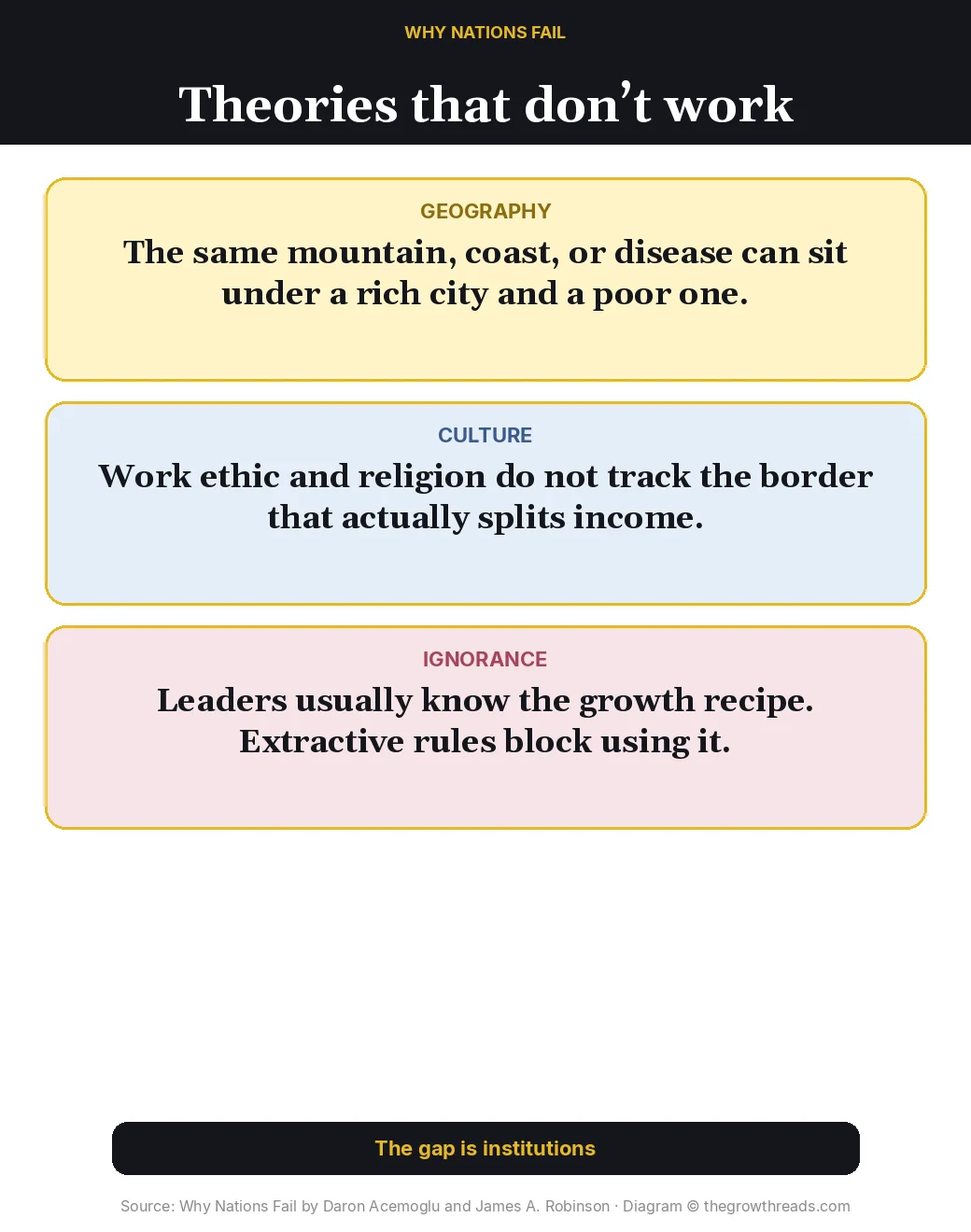
- Institutions, not the mountain: Geography, culture, and ignorance fail the border tests. The income split tracks the rules.
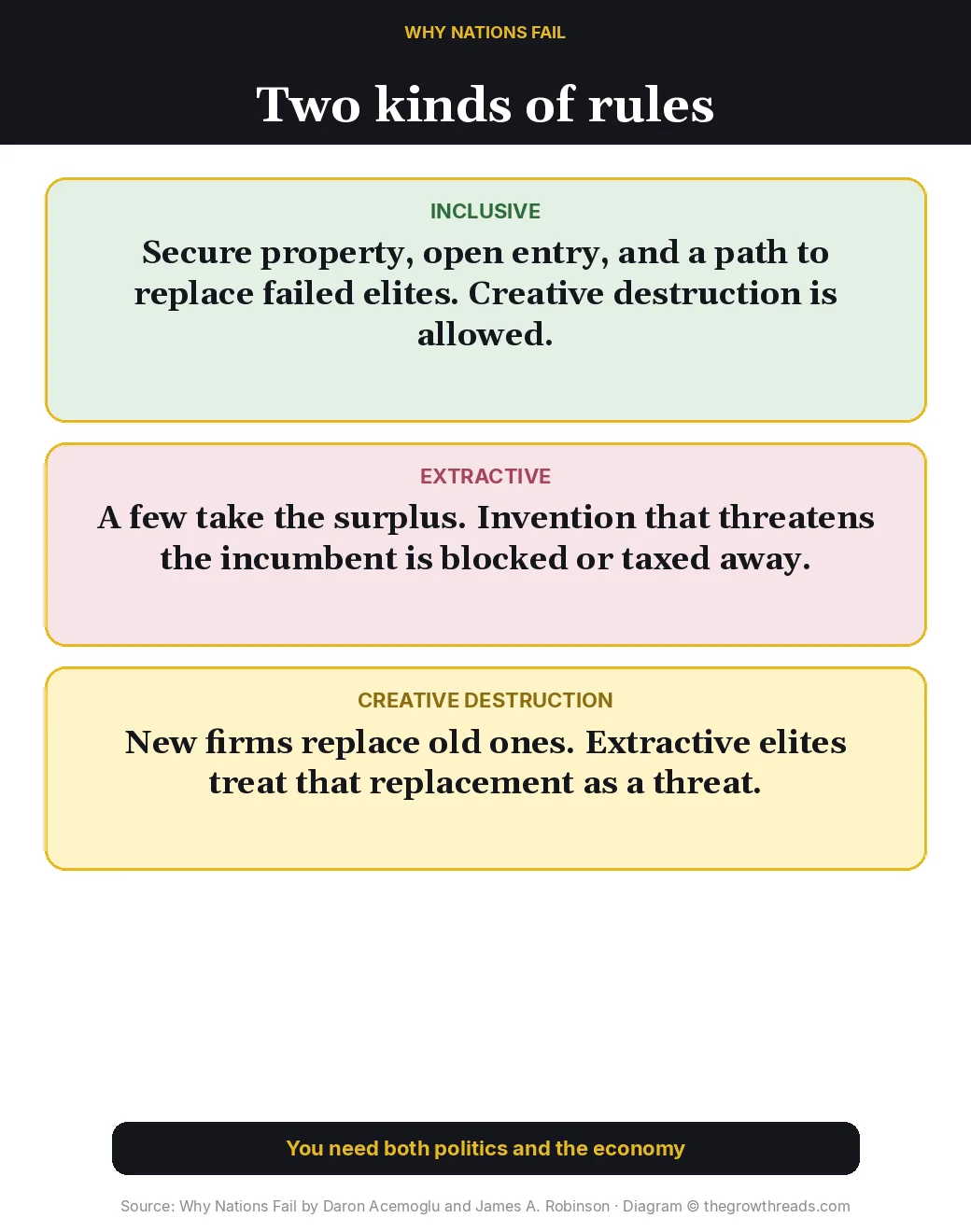
- Inclusive versus extractive: Inclusive rules spread access and constrain elites. Extractive rules concentrate the surplus and the veto.
- You need both politics and the economy: Open markets without pluralism get reversed. Pluralism without open entry is a speech with no firm.
- Creative destruction is the engine: New firms replace old ones. That is prosperity — and the reason incumbents fight the book’s prescription.
- Extractive growth is real, then limited: A state can copy factories for a burst. Without replacement of failed elites, the burst has a ceiling.
- Small differences plus a juncture lock in: A plague, trade shock, or revolution can freeze either loop for centuries.
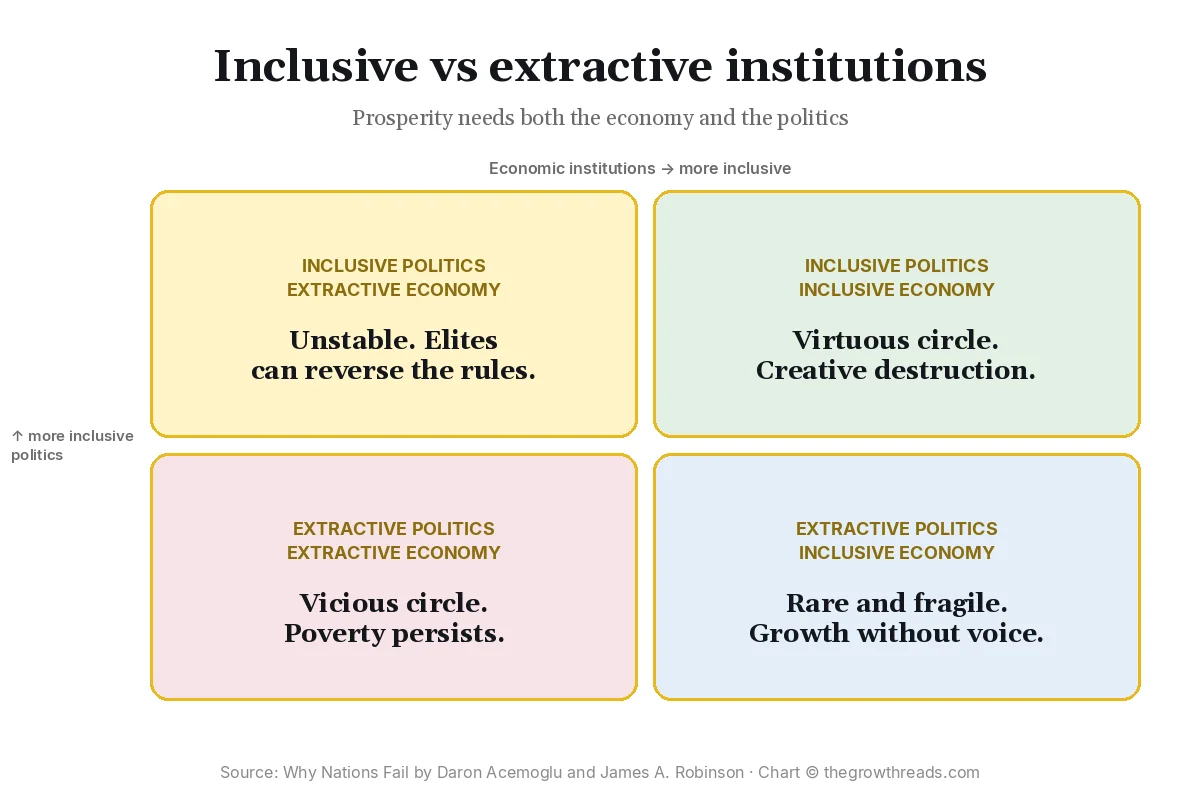
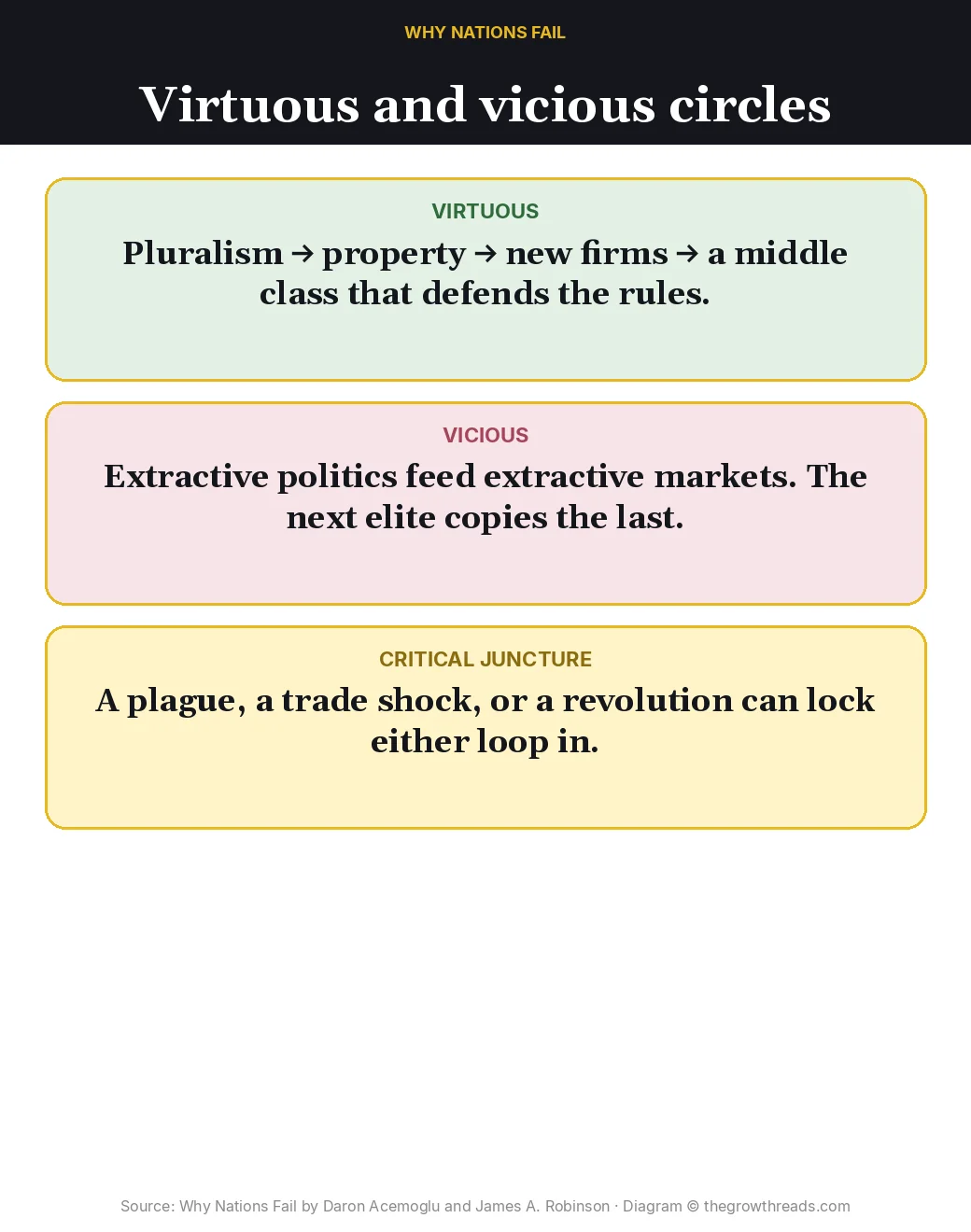
- Virtuous and vicious circles: Inclusive politics protect property, which grows a middle class, which defends the rules. Extractive politics do the reverse.
- The iron law of oligarchy is optional: New elites often copy the old unless pluralism survives.
- Botswana, 1688, the US South: The mold does break when pluralism survives the first victory.
- Use it on a firm this week: Who can enter, who owns the upside, who can veto a better tool.
What is Why Nations Fail about?
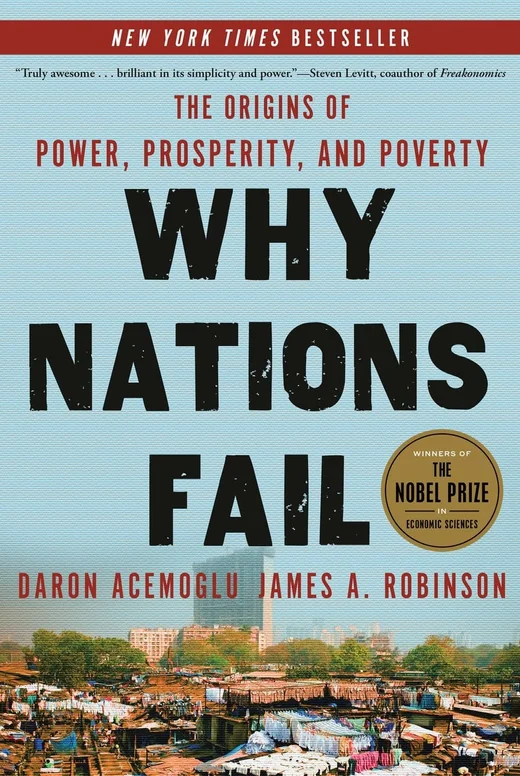
Why Nations Fail argues that prosperity comes from inclusive institutions — open entry, secure property, and constrained power — while extractive institutions keep a few in charge and stall the creative destruction that makes a country rich. Historical cases from Nogales to Botswana show the mechanism, not a vibe.
About the author
Daron Acemoglu is a Turkish-American economist at MIT, Institute Professor, 2005 John Bates Clark medalist, and, with James A. Robinson and Simon Johnson, a 2024 Nobel laureate in economic sciences. He has spent three decades on political economy, labour, and why some states grow while others stall. James A. Robinson is a British-American economist and political scientist at the University of Chicago’s Harris School, previously at Harvard, and the co-author of Economic Origins of Dictatorship and Democracy and The Narrow Corridor. Together they write the public version of a research programme: institutions as the difference that survives the usual excuses. Why Nations Fail is the book to start with; the Nobel is the later stamp on the same comparative method. Explore all Daron Acemoglu book summaries →
Key concepts at a glance
| Concept | What it means | Use it when |
|---|---|---|
| Inclusive institutions | Open entry, property, and a path to replace failed elites | A system claims to be “pro-growth” but blocks new firms |
| Extractive institutions | A few take the surplus and guard the veto | Output is high for insiders and dead for everyone else |
| Creative destruction | New firms and tools replace old ones | The incumbent calls a better method “disruption” as an insult |
| Critical juncture | A shock that can lock a virtuous or vicious loop | A crisis is being used to rewrite who may enter |
| Virtuous circle | Pluralism protects property, which grows a defending class | You are designing a rule that should survive the first election |
| Vicious circle | Extractive politics feed extractive markets, then copy themselves | A reform only changes the name of the rent |
| Pluralism | Power is split enough that one faction cannot rewrite the surplus overnight | You cannot name a second veto |
| Iron law of oligarchy | New elites often extract like the old ones | A revolution has already spent its moral capital |
Part 1: Nogales, and the theories that don’t work
The book opens on a fence. Nogales, Arizona and Nogales, Sonora share a valley, families, and a climate. They do not share an income. On the US side: working property rights and some chance a mayor can be replaced. On the Mexican side, for much of the twentieth century: a politics that treated the town as a resource to administer. If the story were germs, work ethic, or “they never heard of growth,” the fence would be a curiosity. It is the experiment.
Three popular theories then retire. Geography cannot explain why the same mountain sits under a rich city and a poor one, or why the two Koreas diverged after 1950. Culture does not track the Nogales split or the DMZ. Ignorance fails because extractive elites often know the growth recipe — including creative destruction, which would unseat them — and still pick extraction on purpose.
The colonial contrast is Nogales at century scale. Spanish America, in this telling, built extractive machines around silver and a small elite. English North America, after early extractive fantasies failed in Virginia, had to induce settlers to stay, and assemblies got a voice. Small differences, then a fork — not a morality play about national character.
TGR Note: Smith’s pin factory in The Wealth of Nations assumes you may enter the trade. Acemoglu and Robinson are writing the prequel: why some places never let you into the factory floor. If you want the village-level experiments that sit under those rules, keep Poor Economics on the desk as well.
Part 2: Inclusive versus extractive institutions
The core vocabulary is simple on purpose. Inclusive economic institutions let a wide group own, contract, start firms, and keep enough upside that invention is worth the risk. Inclusive political institutions spread power and make it expensive for one faction to rewrite property overnight. Extractive institutions invert both: a few take the surplus, and politics protects that taking. Open entry without pluralism is a temporary permit. Pluralism without open entry is a parliament that cannot birth a firm.
Creative destruction is the uncomfortable engine. Each new tool threatens someone who already collects a rent. Inclusive systems allow the replacement. Extractive systems treat it as a security issue. The Soviet Union is the set-piece: factories and sputnik under a party that could force saving and copy technology — then a ceiling, because replacing the technology would also replace the party. China, later in the book, is a cousin of that pattern, not a refutation: catch-up can be fast and still lack the pluralism that lets yesterday’s champion fail.
The same geometry shows up in a company. Promote only insiders, block a tool the VP did not design, treat a better alternative as disloyalty — that is extractive with a modern brand. Inclusive firms still have hierarchy. They also let a better method win without a coup. That is creative destruction for a reader who will not rewrite a constitution this quarter.
TGR Note: Marx’s circuit in Das Kapital asks where the surplus sits in a working day. This book asks who is allowed to capture it, and whether a new firm may try. Read them as two cameras on the same factory, not as a fight. Ferguson’s The Ascent of Money then supplies the banks and bonds those institutions ride on.
Part 3: Critical junctures and the two circles
History here is a set of forks, not a smooth climb. A critical juncture — plague, Atlantic trade, revolution, a commodity boom — hits two societies that already differ a little. That little difference decides the loop. England after 1688 is the virtuous exhibit: the Glorious Revolution constrained the Crown, made property more credible, and opened space for finance and invention. The claim is not that 1688 was inevitable. It is that once pluralism and property reinforce each other, the loop is hard to unwind.
Virtuous circle: pluralism protects property and open entry; those grow firms and a middle class that defends the rules. Vicious circle: extractive politics feed extractive markets; the surplus buys more coercion; the next elite copies the extraction. Michels’s iron law of oligarchy is the pessimistic cousin. The book’s narrower claim: the iron law is common, not fate, if pluralism survives the first victory.
Venice later closing the Great Council is a virtuous circle padlocked by elites. You do not need every case. You need the loop: does this rule create a class that will defend open entry, or a class that will defend the gate?
TGR Note: If you want the behavioural side of why people defend a gate even when it hurts them, The Psychology of Money is the companion. Housel writes about personal loops. Acemoglu and Robinson write about the political ones those personal loops sit inside. Freakonomics-style surprises still need a rule that lets you act on them — see Freakonomics for the micro puzzles, this book for the lock on the door.
Part 4: Why nations fail today — and how the mold breaks
The late chapters tour living extractive machines and the exceptions. Zimbabwe, Sierra Leone, and Argentina appear as modern vicious circles: the state as loot, then a macro story that looks like “bad policy” but is the policy extractive elites wanted. The US South after Reconstruction is the domestic exhibit — extractive labour rules that took a civil-rights juncture, not a pamphlet, to crack. The unit of change is a coalition that can make pluralism stick.
Botswana is the hopeful set-piece: poor at independence, diamonds still in the ground, then a bargain that did not turn the mines into a private army. The point is not “be Botswana.” It is that a juncture plus slightly more inclusive starting politics can be steered. The mold breaks when the people who would lose from open entry do not hold the only veto.
Apply it without a constitution. A hiring rule that only admits one school is extractive entry. A promotion rule that cannot kill a failed project is extractive politics. Inclusive versions still have standards — they publish them, allow a second path, and let a better tool win. The 7-day plan below is that translation. Stop blaming the mountain when the licence is in the way.
TGR Note: If this month’s problem is a paycheck system, start with I Will Teach You to Be Rich or The Psychology of Money, then come back. This book is the organisational X-ray, not a 6-week automation plan.
Who is Why Nations Fail best for — and who should read something else first?
Best for operators, investors, and citizens who already have a basic money system and want to see why two similar groups compound so differently — especially founders hiring across borders and people writing licences.
Read something else first if you need a budget or index-fund script this month: The Psychology of Money or I Will Teach You to Be Rich. Village trials: Poor Economics. Pin factory and prices: The Wealth of Nations. The 1867 surplus: Das Kapital. Then this book is the political-economy sequel.
Questions to reflect on
- In the last system you ran, who could enter without a personal introduction?
- Which incumbent tool would lose if you shipped a better one on Friday — and who holds that veto?
- Can you name a second faction that can delay a rule change, or is there only one signature?
- Where did a past “reform” only change the name of the rent?
- What small inclusive rule could you write this week that would still be in force after you left the room?
🔥 Ready to test the rules around you?
Read Why Nations Fail in the Currency paperback — then run the institutions test on one firm or city.
How to apply Why Nations Fail (7-day plan)
- Day 1: Pick one workplace, city board, or club. Write two lines: who can enter, and who can say no to the person at the top.
- Day 2: Run the Nogales test. Name two teams or towns with similar talent and a different result. Circle the rule that splits them.
- Day 3: Name one licence, tool, or process that would lose if a better one shipped. Write who currently holds the veto.
- Day 4: Check pluralism. List two factions that can delay a rule change. If you cannot name them, the politics are extractive.
- Day 5: Strengthen one virtuous loop: a written property of work (who owns the file), a contract, or a published scoreboard.
- Day 6: Map one vicious loop that looks efficient — a gate that protects a rent. Note who would lose if it opened.
- Day 7: Change one small inclusive rule you control: an open slot, a written appeal, or a rotating chair. Review it on Friday.
Frequently asked questions
What is the main message of Why Nations Fail?
Nations get rich when they run inclusive economic institutions — secure property, open entry, and a real chance to replace failed elites — backed by inclusive politics that spread power instead of parking it. Extractive rules can produce a burst of growth, then stall, because the people at the top block the creative destruction that would threaten their rents. Geography, culture, and “the leader did not know the recipe” do not explain why Nogales, Arizona is so much richer than Nogales, Sonora. Same people, same valley, different rules. Use the book as a test of the rules around you, not as a slogan about national character.
What are inclusive and extractive institutions?
Inclusive economic institutions let a wide group own, contract, start firms, and keep the upside of invention. Inclusive political institutions spread power, constrain the executive, and make it hard for one faction to rewrite the rules overnight. Extractive versions do the reverse: a few take the surplus, and politics exists to protect that taking. The authors insist you need both sides. A dictator can copy factories for a while. Without political pluralism, the next machine that would unseat the incumbent gets blocked. Apply it at work: who can enter, and who can say no to the person at the top.
Does Why Nations Fail say geography and culture do not matter?
The authors do not claim climate, germs, or work ethic are fiction. They claim those forces do not track the income gaps that need explaining. The Korea peninsula, the Nogales border, and towns a few miles apart with the same malaria belt keep showing up. Culture can follow institutions: people invest in skills when the rules let them keep the return. Some economists still give geography and human capital a larger role; that debate belongs in a seminar. For a practical reader, the usable move is to stop blaming the mountain and inspect the property right, the licence, and the veto.
Does China’s growth disprove Why Nations Fail?
The authors treat China’s rise as a case of extractive growth that is real and that still has a ceiling. Catch-up, imported technology, and a state that can override local blockers can raise output fast. Creative destruction — new firms replacing connected ones — is the part extractive politics delay. The book’s claim is not “China cannot grow.” It is that growth without inclusive politics stays vulnerable to a turn when the incumbent’s rents are threatened. Read that chapter as a diagnostic for any boom built on permission rather than on open entry, including inside a company.
How long is Why Nations Fail and which edition should I buy?
The Currency paperback (ISBN 9780307719225) runs 529 pages. At a steady pace, budget about twelve to sixteen hours. The argument is front-loaded: Nogales, the rejected theories, then inclusive versus extractive institutions. Later chapters are historical cases — England after 1688, the Soviet burst, Botswana, the US South — that you can sample once the lens is in place. The 2012 Crown hardcover is the same book. This summary is the sixteen-minute version of the lens. This is not investment, tax, or financial advice; it is a way to read the rules that sit under prices.
Who should read Poor Economics or The Wealth of Nations first?
If you want village-level experiments on schools, bed-nets, and incentives, start with Poor Economics by Banerjee and Duflo, then come here for the macro rules those trials sit inside. If you want the pin factory, wages, and the system of natural liberty, start with The Wealth of Nations and use Why Nations Fail as the political-economy sequel: why some places never get a pin factory that anyone can enter. If you want the wage and the surplus in 1867 syntax, Das Kapital is the X-ray. If you need a first savings system this month, read The Psychology of Money first and return when you want the national story.
Did Acemoglu and Robinson win the Nobel Prize for this book?
In 2024 Daron Acemoglu, James A. Robinson, and Simon Johnson shared the Nobel Memorial Prize in Economic Sciences for comparative work on why nations differ in prosperity. Why Nations Fail (2012) is the public statement of the institutions research that prize recognised, written with historical cases rather than journal algebra. The Narrow Corridor and Economic Origins of Dictatorship and Democracy are the companion volumes if you want more political science. The prize does not make every case airtight. It does mean the inclusive-versus-extractive test is now a standard tool, not a blog theme. Use it on a firm, a city, or a licence regime this week.
Related summaries
- The Wealth of Nations — the pin factory this book explains why some nations never open.
- Poor Economics — village trials inside the rules Acemoglu and Robinson map at national scale.
- Das Kapital — where the surplus sits in a working day, once institutions decide who may capture it.
- The Ascent of Money — the banks and bonds that ride on inclusive or extractive politics.
Browse titles on our Best Money Books pillar page.
How we analyze books: our summaries are built from a full read of the source text, cross-referenced against the author’s published interviews and research where relevant, and structured around practical application rather than critique. We disclose our editorial process and affiliate relationships in full. Read our full methodology.