

★★★★½ 4.6/5 — Habits are context memories, not character tests. Design the room and tired you still ships.
Best for: people who already know what they should do and still don’t — plus anyone whose streak dies the minute the usual kitchen disappears.
Reading time: ~8 hours (320 pages) · this guide ~12 min
Difficulty to apply: Medium — you have to rearrange objects, not collect a sterner personality.
Good Habits, Bad Habits in one minute
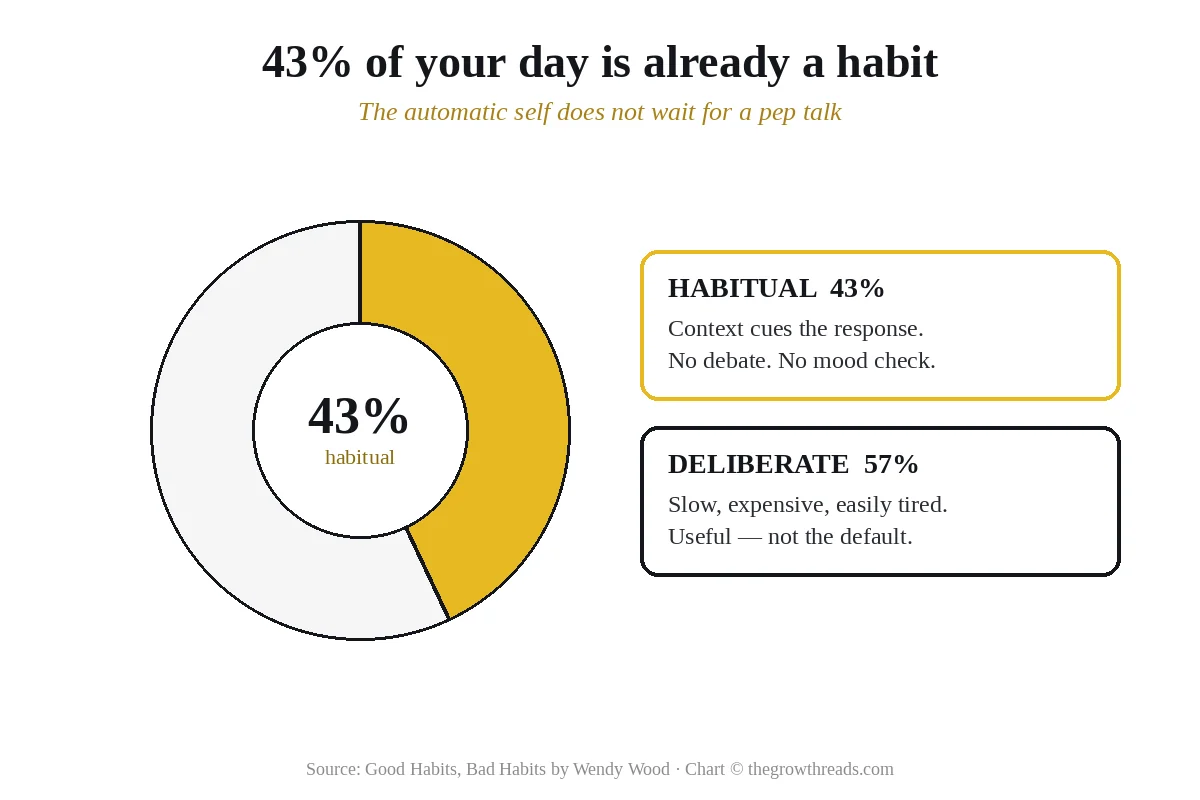
You do not rise to your goals. You fall to your furniture. Wendy Wood, a USC psychologist who spent three decades measuring what people actually do between meetings, estimates that about 43% of daily behavior is habitual: same place, little debate, the body already moving. The automatic self learns from a stable context, enough repetition, and a reward that arrives now — not in a quarterly review. Willpower is a slow committee. When you are tired, the committee goes home and the room runs the show. That is why the gym plan dies at 9 p.m. and why you can drive a familiar route and remember none of the last miles. Keep one sentence: stop auditioning for discipline in a room that still cues the old script. Change the cue, add friction to the bad path, put an immediate payoff on the good one, and let repetition do what pep talks cannot.
Key takeaways
- 43% is already automatic: a slice of the day is cued by context, not a fresh decision.
- Habits are memories: a place, time, or object can start a response before you choose.
- Willpower is the backup generator: real, limited, and a terrible daily operating system.
- Reward must be immediate: delayed virtue does not teach the automatic self.
- Friction is a design tool: remove it from the good action, add it to the bad one.
- Stress reveals the training: depleted you runs whatever the room has practiced.
- The 21-day myth wastes quits: speed depends on stable context and reps, not folklore.
- Don’t white-knuckle a live cue: disrupt the context or swap the response.
- Stack on life that already happens: kettle, commute, login beat inspirational calendars.
- Self-control is situation selection: Odysseus tied to the mast is a furniture decision.
What is Good Habits, Bad Habits about?
Good Habits, Bad Habits explains how habits form as context-response memories, why intention so often loses to the room you are standing in, and how to change behavior by redesigning friction, cues, and immediate rewards rather than by collecting more motivation.
About the author
Wendy Wood is Provost Professor Emerita of Psychology and Business at the University of Southern California. UK-born, she previously taught at Texas A&M and Duke and served as vice dean of social sciences at USC Dornsife. For more than thirty years her labs have measured the unglamorous middle of the day: what people do, where they do it, and whether they are thinking about it. That work — experience-sampling that produced the “43%” figure, cinema-popcorn experiments that showed a strong habit can overpower stale food — sits under almost every habit book on this site. Good Habits, Bad Habits (Farrar, Straus and Giroux, 2019; Picador paperback, 2020) is her public translation. She will not give you a new identity mantra. She will tell you why the chair is winning. Explore all Wendy Wood book summaries →
Key concepts at a glance
| Concept | What it means | Use it when |
|---|---|---|
| Habitual vs deliberative | Two systems: a fast context-cued self and a slow, effortful one. | You keep writing plans that only the slow self would keep. |
| Context-response memory | A stable place or cue can launch an action before a decision. | You “find yourself” opening an app with no memory of choosing it. |
| Immediate reward | The automatic self learns from payoffs that arrive now. | The gym’s benefit is next quarter and the sofa’s benefit is tonight. |
| Friction | Steps, distance, and annoyance that make an action easier or harder. | You can name the good action but it still takes six taps. |
| Habit discontinuity | A life change wipes old cues — a rare open window. | You moved, switched jobs, or your commute died. |
| Substitution | Keep the cue, attach a better response. | You cannot leave the sofa but you can change what the sofa starts. |
| Situation selection | Self-control as choosing the room, not winning a debate inside it. | You keep losing arguments with a kitchen that still offers chips. |
| Stress fallback | Depletion does not erase habits; it reveals them. | Your streak is perfect until a bad week, then the old script returns. |
Part 1: Your second self already runs the day
Wood’s opening move is a measurement. In experience-sampling studies, people are pinged at random and asked what they are doing and whether they are thinking about it. A shocking share of answers look like this: I am doing the usual thing, in the usual place, and I am not really deciding. Across that work the round number that stuck is 43%. Treat it as a magnitude, not a sacred percentage. You brush, commute, check, snack, and open the same three tabs with a mind that is elsewhere. That is not laziness. That is how a nervous system saves effort for the moments that actually need a committee.
The productivity world loves the committee. We buy planners for the 57% of the day that can still deliberate, then we are shocked when 9 p.m. you does not hold a meeting. Wood’s picture is simple: the deliberative self is slow and easily tired; the habitual self is a set of context-response memories. A kitchen, a laptop chime, a chair, an hour — these can start a sequence before you “choose.” Driving is the clean demonstration. You complete a familiar route and remember none of the last miles because the context ran a stored program. Nobody calls that a character flaw. We should stop calling the evening version one. If almost half the day is automatic, “try harder” is aimed at the smaller, more exhausted team. The useful question is not “How do I want more?” It is “What has this room been teaching my hands?”
TGR Note: Clear’s four laws are a friendly translation of this dual-system picture. Start with our Atomic Habits summary if you want the operator’s manual. For the earlier popular loop, see The Power of Habit.
Part 2: Context, repetition, and reward
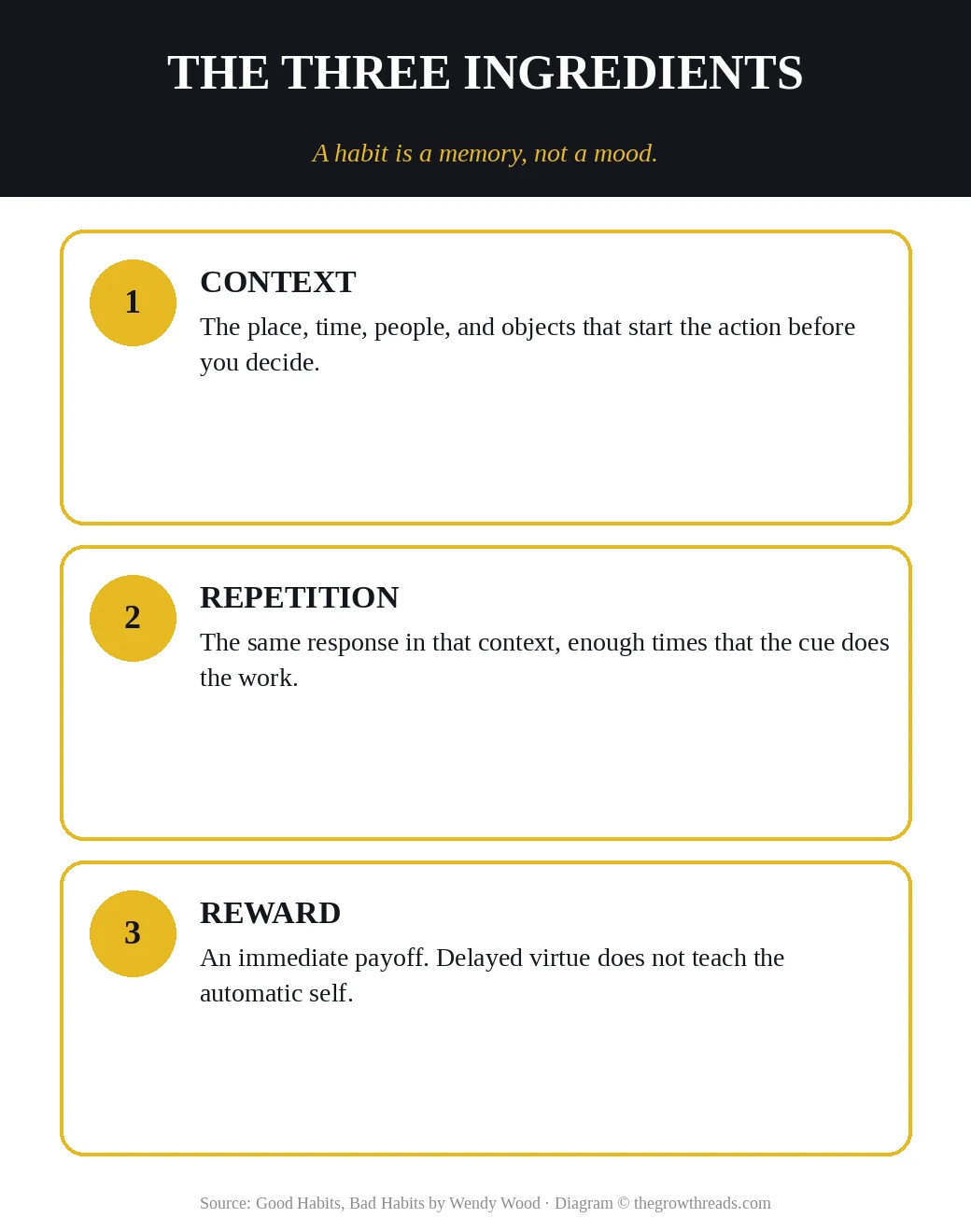
Wood’s engine has three parts, and skipping one is how “I meant to” becomes a personality. First, context: an association between a relatively stable situation and a response. Time of day, the people in the room, the device in your hand — these are the start button. That is why a routine that works at home can vanish on a work trip without you becoming a different human overnight. The cues changed. The memory had nothing to grab.
Second, repetition in that context. The automatic self needs the same response paired with the same cues often enough that perception of the context starts the action. Popular culture wants a cinematic decision. Wood wants the unglamorous thing in the same kitchen until the kitchen does it. If you “work out whenever I feel like it,” you are practicing deliberation, not a habit.
Third, reward — and it has to land now. The deliberative self can wait for June. The habitual self learns from the next seconds: taste, ease, a hit of done. That is why “I will feel proud later” loses to a soft couch tonight. If the good action has no immediate payoff, the automatic self files it as unpaid labor. Put a small, honest reward on the rep: a check in a log, tea, a song, a doc already open.
The cinema-popcorn studies make this concrete. People with a strong cinema-and-popcorn habit ate similar amounts whether the popcorn was fresh or stale. People without that habit ate less of the stale stuff, because taste still had a vote. The strong-habit group was not undisciplined. They were well practiced in a room. If a stale bucket cannot stop a script, a lecture in your own head will not stop one either.
TGR Note: If the first rep is the blocker, shrink it until repetition can happen: Tiny Habits and Mini Habits are the on-ramps. Wood explains why those on-ramps work — they create stable pairings, not because “tiny” is a personality.
Part 3: Friction beats a pep talk
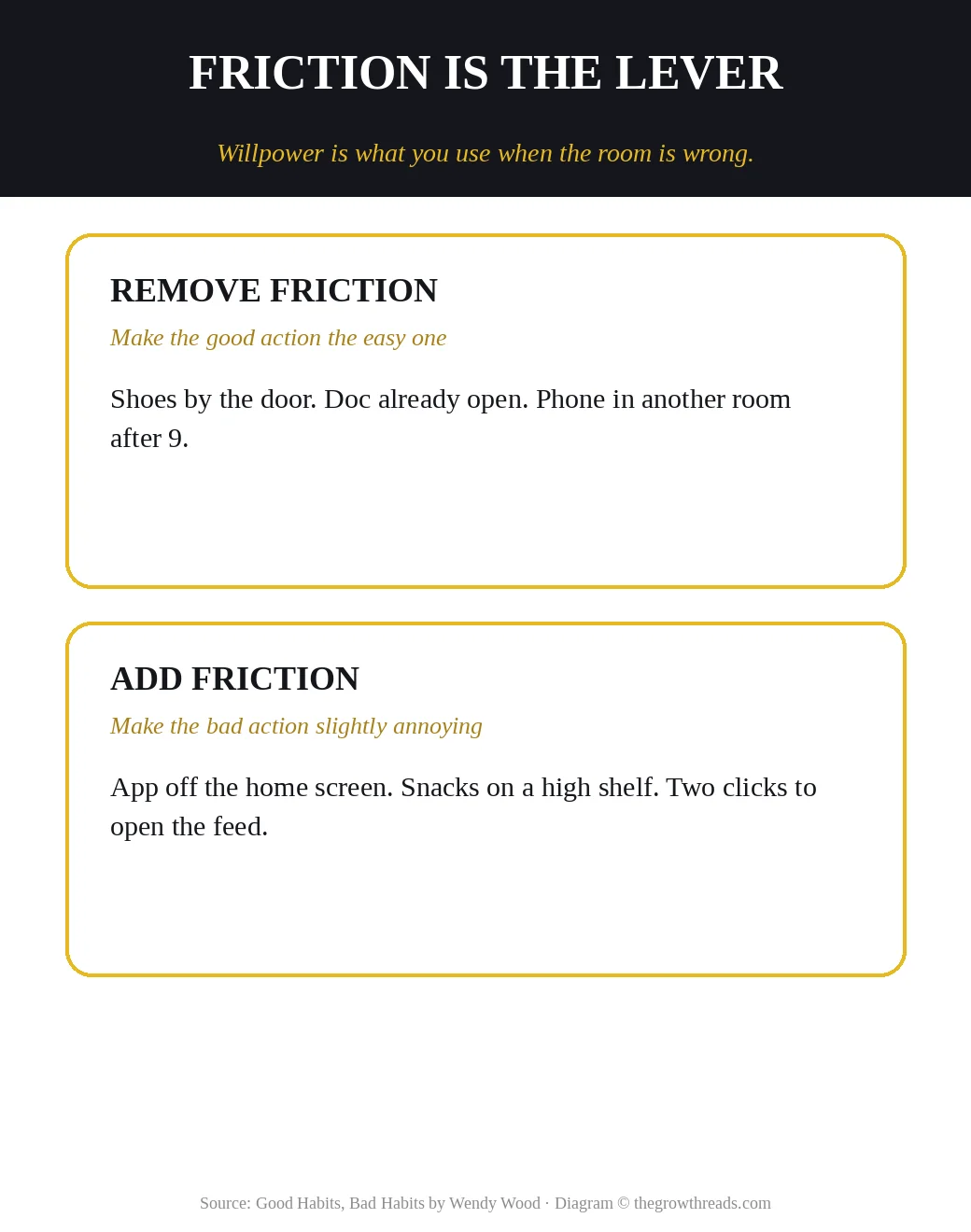
If there is a single practical lever in the book, it is friction. Wood treats the number of steps between you and an action as a moral-free design choice. Reduce steps for the behavior you want. Add steps for the behavior you do not. The chips on the counter are not a test of your soul. They are a low-friction path. The running shoes behind a suitcase are a high-friction path. You already know this when you hide a website behind a password you do not remember. Wood’s contribution is to stop treating that trick as a hack and start treating it as the main event.
Self-control, in her reading, is often situation selection: you pick the mast before the sirens sing. Odysseus did not win a debate in the moment. He arranged the moment so debate was unnecessary. The modern version is ordinary. Phone charges in the kitchen. Apps off the home screen. The deep-work doc already open at 8:55. The snack you regret on a high shelf. None of this is clever. All of it is more reliable than a 10 p.m. pep talk from someone who already spent their deliberative budget on email. A two-minute start works because it collapses steps until repetition can happen in the room you actually have. A plan is a note to the committee. Friction is a note to the room.
TGR Note: Gretchen Rubin’s Better Than Before and The Four Tendencies add a personality layer Wood mostly skips: some people need outer accountability more than a quieter kitchen. Use Rubin when the environment is already decent and you still stall on expectations.
Part 4: Break, swap, and stack
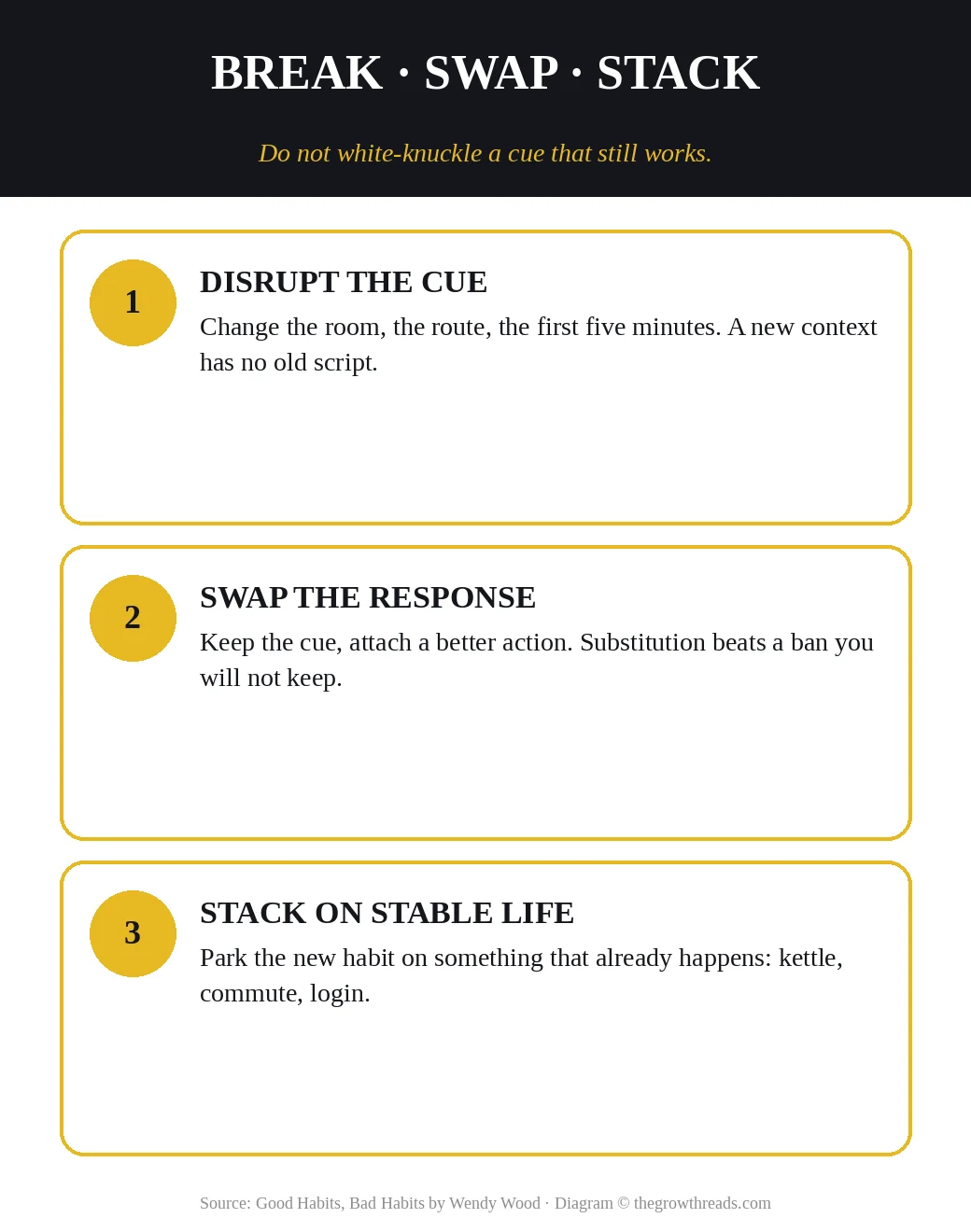
Breaking a habit, in Wood’s frame, is not a personality reboot. It is an attack on the memory. Disrupt the cue: a different route, a different chair, the device in another room, a life change while the old script has nothing to grab. Add friction so even if the cue fires, follow-through is annoying. Or swap the response: keep the sofa after bedtime if you must, and attach a different action to it. Vigilance — “I will just resist” — is a night strategy. It is a poor quarter strategy because it spends the slow self on a fight the fast self already won.
Building a good habit is the same physics in reverse. Pick a context that already exists. Repeat a small version there. Give it an immediate reward. Reduce friction until a tired person could still do it. Stacking — parking a new behavior on a kettle, a login, a commute — borrows a cue that life is already paying to maintain. Unstable cues (vacations, Monday motivation, a new notebook) feel meaningful and teach almost nothing.
When you are depleted, you do not become a vacuum. You become a playback device. A hard week runs whatever script you trained. That is a reason to rearrange furniture on the easy weeks, while you still have a committee. The 21-day myth is a cousin of this error: a folklore deadline that makes people quit a pairing that was still forming. Count consistent contexts. Ignore the folklore.
TGR Note: The depletion debate has its own book: Willpower by Baumeister and Tierney. Wood’s useful move is not to win that fight in the abstract. It is to make sure tired-you has a trained script worth running. High Performance Habits is the ambitious cousin if you want a coaching stack on top of the science.
Who is Good Habits, Bad Habits best for — and who should read something else first?
Read this if you already know the advice and still lose at the end of the day — especially if streaks die on the road, or if you keep hiring willpower for a job that furniture should be doing. It is a good second book after you have a basic “show up” practice and want to know why showing up still depends on the room.
Read something else first if you cannot start at all — go to Tiny Habits or Mini Habits. If you want a friendlier popular system, start with Atomic Habits. If the missing piece is how you respond to expectations, The Four Tendencies is the personality map. If you want the depletion debate in its own voice, Willpower is the companion. Wood will not build your calendar. She will tell you which objects on that calendar are doing the teaching.
Questions to reflect on
- Where, exactly, does the action you regret usually start — which room, which device, which first five minutes?
- What friction could you add tomorrow morning that would make that action slightly rude to complete?
- What friction could you remove so the action you want is possible when you are already tired?
- What immediate reward does the good action currently pay — and if the answer is “none,” what tiny payoff could you attach?
- When the usual kitchen disappears (travel, illness, guests), what portable cue still travels with you?
🔥 Ready to stop using willpower as the plan?
Design one context this week. The second self will take the next hundred reps from there.
How to apply Good Habits, Bad Habits (7-day plan)
- Day 1 — Name one good action and one bad action. Write the exact context where each currently fires (room, time, device). If you cannot name the context, you do not have a habit target yet.
- Day 2 — Score friction 1–5 for both. What would make the good action one step easier, and the bad action one step ruder?
- Day 3 — Install the friction change before motivation is required: shoes, tabs, snacks, chargers, app placement. Photograph the new setup.
- Day 4 — Attach an immediate reward to the good action (check, song, tea, a one-line log). Delayed health does not teach the automatic self.
- Day 5 — Run the good action in the same context, even if the rep is tiny. Repetition in a stable place is the lesson, not a heroic session.
- Day 6 — For the bad habit, either leave the cue and swap the response, or take a different first five minutes. Do not sit in the old script and lecture yourself.
- Day 7 — Write the travel / stress version. When the usual room disappears, what portable cue and friction still travel? Block that version on the calendar.
Frequently asked questions
What is Good Habits, Bad Habits about in one paragraph?
Good Habits, Bad Habits is Wendy Wood’s map of how habits actually form. Drawing on decades of lab and field work, she shows that about 43% of daily behavior is cued by context rather than by a fresh decision. The automatic self learns from repetition plus an immediate reward in a stable place. Willpower is real, but slow, so the practical move is to design friction and cues until the right action fires when you are tired. It is a science book you can take into the kitchen.
How is this different from Atomic Habits or The Power of Habit?
Charles Duhigg gave the popular cue–routine–reward loop. James Clear added identity and four laws you can run on a Tuesday. Wood is the researcher underneath both shelves. She cares less about a catchy loop and more about what the data does: context-response memory, immediate versus delayed reward, friction, and what happens to good intentions when you are stressed. Read Clear to start. Read Duhigg for stories. Read Wood when you want to know why your “identity” still loses to the chair.
Is the 21-day habit rule true?
No. The number is folklore dressed as a deadline. Wood’s point is that speed depends on how stable the context is, how often you repeat the response, and how immediate the reward feels. A simple action in the same kitchen can lock faster than a complex one you only attempt on chaotic days. Treating day 21 as a verdict is how people quit a practice that was still forming. Count consistent contexts, not calendar magic. If the cue still is not firing, change the room first.
Can I use this if my willpower is already low?
Yes — that is the intended reader. Wood treats low willpower as a design clue, not a moral failure. When you are depleted, you fall back on whatever the room has trained. If the trained action is useful, tired you still ships. If it is the feed, tired you scrolls. The application is physical: shoes by the door, app off the home screen, snacks out of the first grab. You are not trying to become a sterner person by Friday. You are trying to make sternness unnecessary.
What does Wood mean by 43% of daily behavior?
In experience-sampling work, people are pinged through the day and asked what they are doing and whether they are thinking about it. Across studies, Wood’s team finds that roughly two in five everyday actions are reported as habitual. That is not a claim that 43% of your life is meaningless. It is a claim that a huge slice of output is already on rails. Productivity advice that only talks to the deliberative 57% is talking to the smaller, tireder committee. Design the rails.
How do I break a bad habit without white-knuckling?
Do not sit in the old cue and try to out-argue it. Disrupt the context, add friction to the old response, and attach a substitute to the same life. A cinema-popcorn habit is not a popcorn personality; it is a room paired with a script. Change the room or the first action in it. Vigilance works for a night. Substitution plus a new setup works for a quarter. If you must keep the cue, swap what it is allowed to start.
Should I read Tiny Habits or Mini Habits instead?
Read Tiny Habits or Mini Habits if the problem is starting at all — they shrink the first rep until resistance is bored. Read Good Habits, Bad Habits if you already start and still lose at 9 p.m. or on travel weeks. Fogg and Guise are the on-ramps. Wood is the engine diagram. They nest: make it tiny so you repeat it, then make the context so stable that tiny becomes automatic. None of them replace rearranging the room you live in.
Related summaries
- Atomic Habits — the popular operating system; Wood is the lab underneath.
- The Power of Habit — Duhigg’s cue–routine–reward stories.
- Tiny Habits — shrink the first rep until friction is bored.
- The Four Tendencies — personality type when the environment is not the whole story.
- Best productivity books — the full Productivity pillar.
How we analyze books: every book on The Growth Reads is read cover to cover, summarized in thousands of words of original analysis, and rated against our five-criteria rubric (lasting impact, evidence quality, practical application, writing & originality, external consensus). Read our full methodology.