

⭐⭐⭐⭐⭐ 4.6 / 5 — The timeless blueprint for building wealth through discipline, smart investing, and living below your means.
Best for: Anyone starting their financial journey or looking for foundational money principles that never go out of style.
Reading time: ~3.5 hours (this guide: 14 min)
Difficulty to apply: Low — the principles are simple, but consistency is the real challenge.
The Richest Man in Babylon in one minute
Wealth is not about how much you earn — it is about how much you keep. Written as a collection of parables set in ancient Babylon, George S. Clason’s classic teaches that anyone can build lasting wealth by following a handful of timeless principles: save at least ten percent of your income, make your money work for you through wise investments, guard against loss by seeking expert counsel, and continuously invest in your own earning power. The lessons are delivered through characters like Arkad, the richest man in Babylon, who proves that prosperity comes not from luck or inheritance but from disciplined habits practiced over time. Nearly a century after its first publication, these principles remain as relevant as modern financial planning advice — because the fundamentals of wealth have never changed.
Key takeaways
- Pay yourself first: Before paying any bills or expenses, set aside at least one-tenth of your income. This single habit is the foundation of all wealth building.
- Live below your means: Distinguish between necessary expenses and desires. Budget carefully so that your spending never exceeds ninety percent of your earnings.
- Make your money work: Savings sitting idle lose value over time. Invest your gold where it can earn returns and compound, turning each coin into a worker that earns more coins.
- Guard against loss: Protect your principal above all else. Only invest with people who have proven expertise, and never risk money in ventures you do not understand.
- Own your home: Reducing your largest recurring expense frees up capital for investment and creates long-term stability for your family.
- Plan for the future: Set aside money for retirement and to provide for your family in case of misfortune. Wealth without security is fragile.
- Invest in yourself: Your greatest asset is your ability to earn. Continuously improve your skills, knowledge, and professional value to command higher income.
- Seek wise counsel: Consult those who handle money daily and have proven results — not well-meaning friends who have no experience in the area you need guidance.
- Take action: Knowledge without action is useless. The difference between a rich person and a poor person is that the rich person acts on what they know.
- Luck favors the prepared: What most people call “luck” is actually the result of preparation meeting opportunity. Good fortune comes to those who are ready for it.
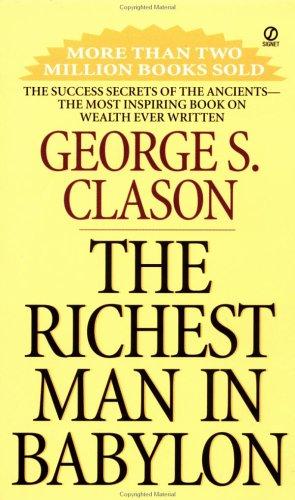
What is The Richest Man in Babylon about?
The Richest Man in Babylon is a collection of financial parables set in ancient Babylon that teach timeless wealth-building principles through storytelling. George S. Clason uses characters like Arkad, Bansir, and Dabasir to illustrate how saving consistently, investing wisely, avoiding debt, and continuously improving your skills leads to lasting financial prosperity.
About the author
George Samuel Clason (1874–1957) was an American author and businessman who founded the Clason Map Company of Denver, Colorado, which published the first road atlas of the United States. In the 1920s, he began writing a series of informational pamphlets about financial success, using parables set in ancient Babylon. Banks and insurance companies distributed these pamphlets widely, and they became so popular that Clason compiled them into a single volume in 1926. The book has since sold over six million copies worldwide and remains one of the most recommended personal finance books of all time, praised by everyone from financial advisors to self-help icons for its accessible, story-driven approach to money management. Explore all George S. Clason book summaries →
Key concepts at a glance
| Concept | What it means | Use it when |
|---|---|---|
| Pay Yourself First | Save at least 10% of every paycheck before any other spending | You receive any income, no matter how small |
| Seven Cures for a Lean Purse | Seven sequential steps to transform empty pockets into lasting wealth | You want a complete beginner’s framework |
| Five Laws of Gold | Rules governing how money grows and how it’s lost | You’re deciding where to invest savings |
| Goddess of Good Luck | Opportunity favors those who act decisively and are prepared | You hesitate to start or take the first step |
| The Gold Lender of Babylon | Lend only with collateral; better a small sure return than a large risky one | Someone asks you to co-sign or invest in a “sure thing” |
| The Camel Trader of Babylon | A determined soul can pay off any debt and reclaim financial freedom | You feel overwhelmed by debt and want a repayment plan |
| The Walls of Babylon | Insurance and emergency funds protect against catastrophic loss | You’re building financial safety nets |
Part 1: The man who desired gold — why most people stay broke
The book opens with Bansir the chariot builder and Kobbi the musician lamenting their empty purses despite years of hard work. They decide to seek out their childhood friend Arkad, who somehow became the richest man in all of Babylon while starting from the same humble origins.
Arkad’s answer surprises them: wealth is not about luck, talent, or inheritance. It is about a simple decision — to keep a part of everything you earn. Arkad explains that as a young scribe, he worked long hours copying clay tablets but had nothing to show for it. Then a wealthy client named Algamish gave him the insight that changed everything: “A part of all I earn is mine to keep.” This was not a clever trick but a fundamental shift in thinking — most people pay everyone else (landlords, merchants, tax collectors) before themselves, leaving nothing for their own future.
Arkad began saving one-tenth of his income and quickly realized that simply saving was not enough. He needed to make that money multiply. His first investment failed — he gave his savings to a brickmaker who claimed to know about jewels, and the man was swindled. Algamish’s lesson was harsh but vital: never seek investment advice from someone who is not an expert in that specific field.
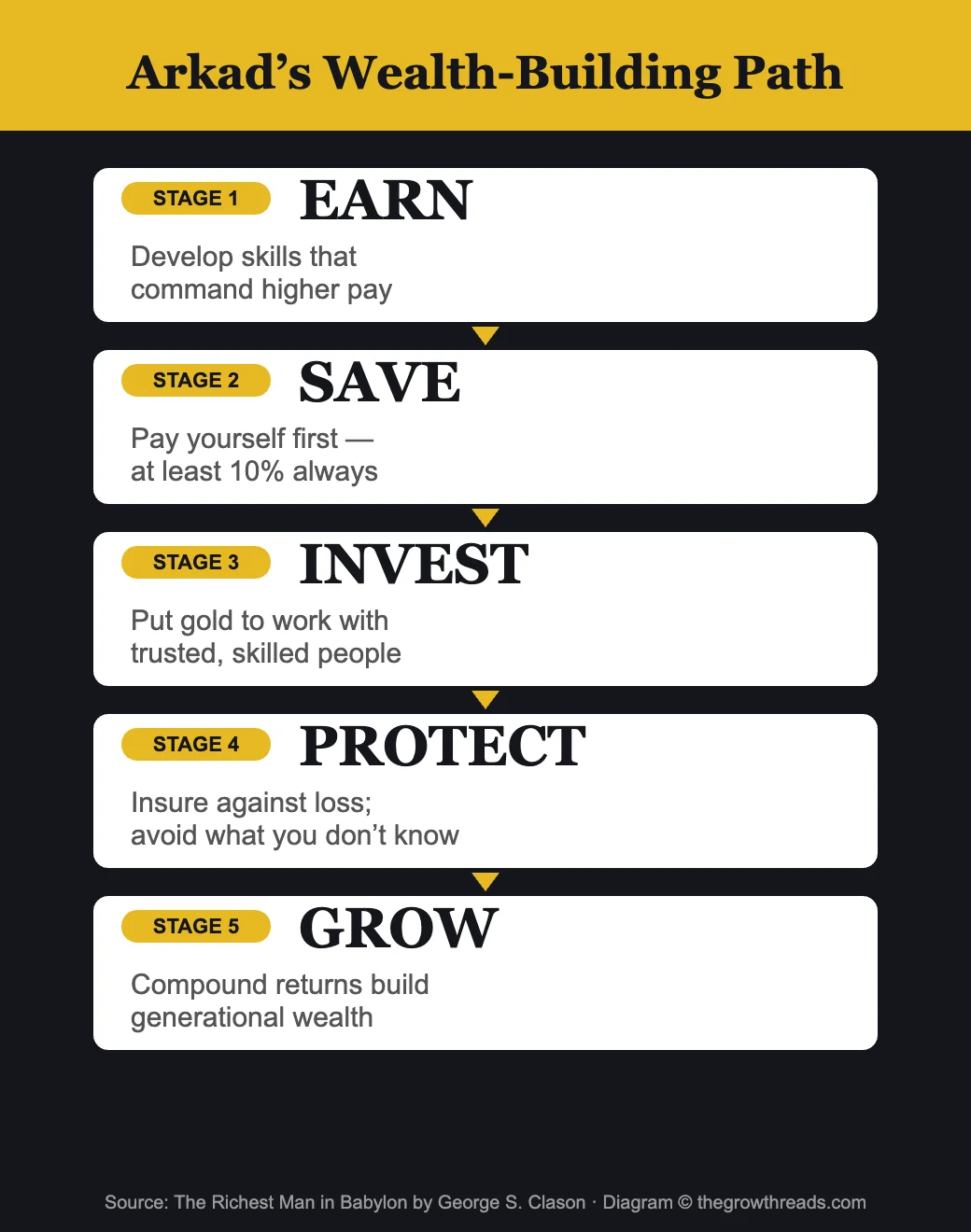
Clason uses this opening to establish the book’s core philosophy: wealth starts with a single discipline (saving), accelerates through wise investment, and is protected through expert counsel. The parable format makes the lesson stick — readers remember Arkad’s story long after they forget bullet points from a finance textbook.
Part 2: The seven cures and five laws — Arkad’s complete system
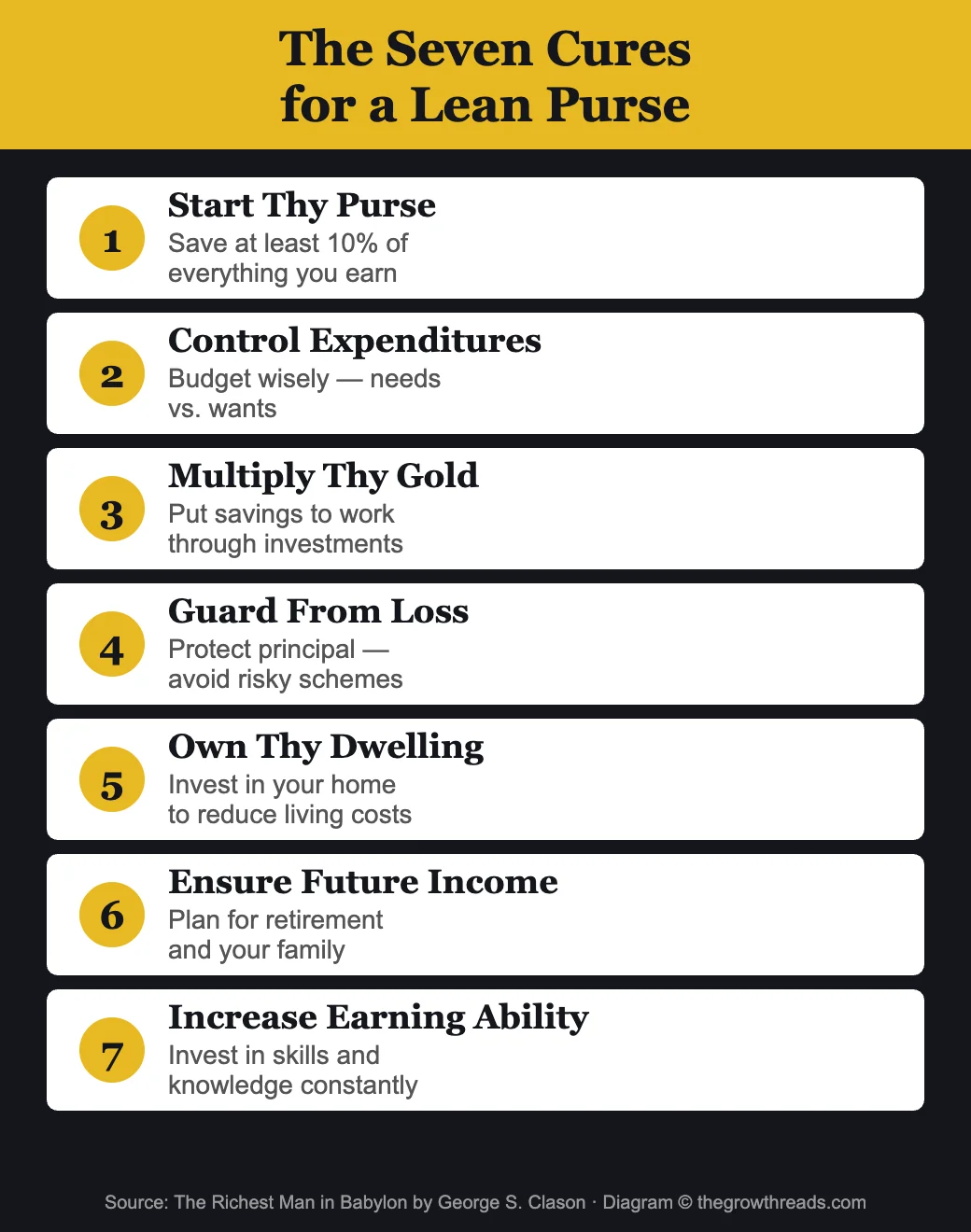
When King Sargon learns that Babylon’s wealth is concentrated among a few, he commissions Arkad to teach the common citizens how to become prosperous. Arkad presents his Seven Cures for a Lean Purse over seven days to a class of one hundred students.
The first cure — saving at least one-tenth — is the foundation. But Arkad is quick to note that saving alone creates a stagnant pond, not a flowing river. The second cure addresses the most common objection: “But I cannot afford to save.” Arkad shows that most people confuse desires with needs. A careful budget reveals that many “necessary” expenses are actually optional comforts that can be trimmed without reducing quality of life.
The third cure — putting savings to work — introduces the concept of compound growth centuries before it had a name. Arkad describes each coin as a “worker” that earns more coins, and those earned coins become workers themselves. The mathematics of compounding, expressed through ancient metaphor, remain identical to what modern investment advisors teach.
Cures four through seven address protection (avoid risky investments), homeownership (reduce your largest expense), future planning (insurance and retirement), and skill development (increase your earning power). Together, these seven steps form a complete personal finance system that progresses logically from saving to investing to protecting to growing.
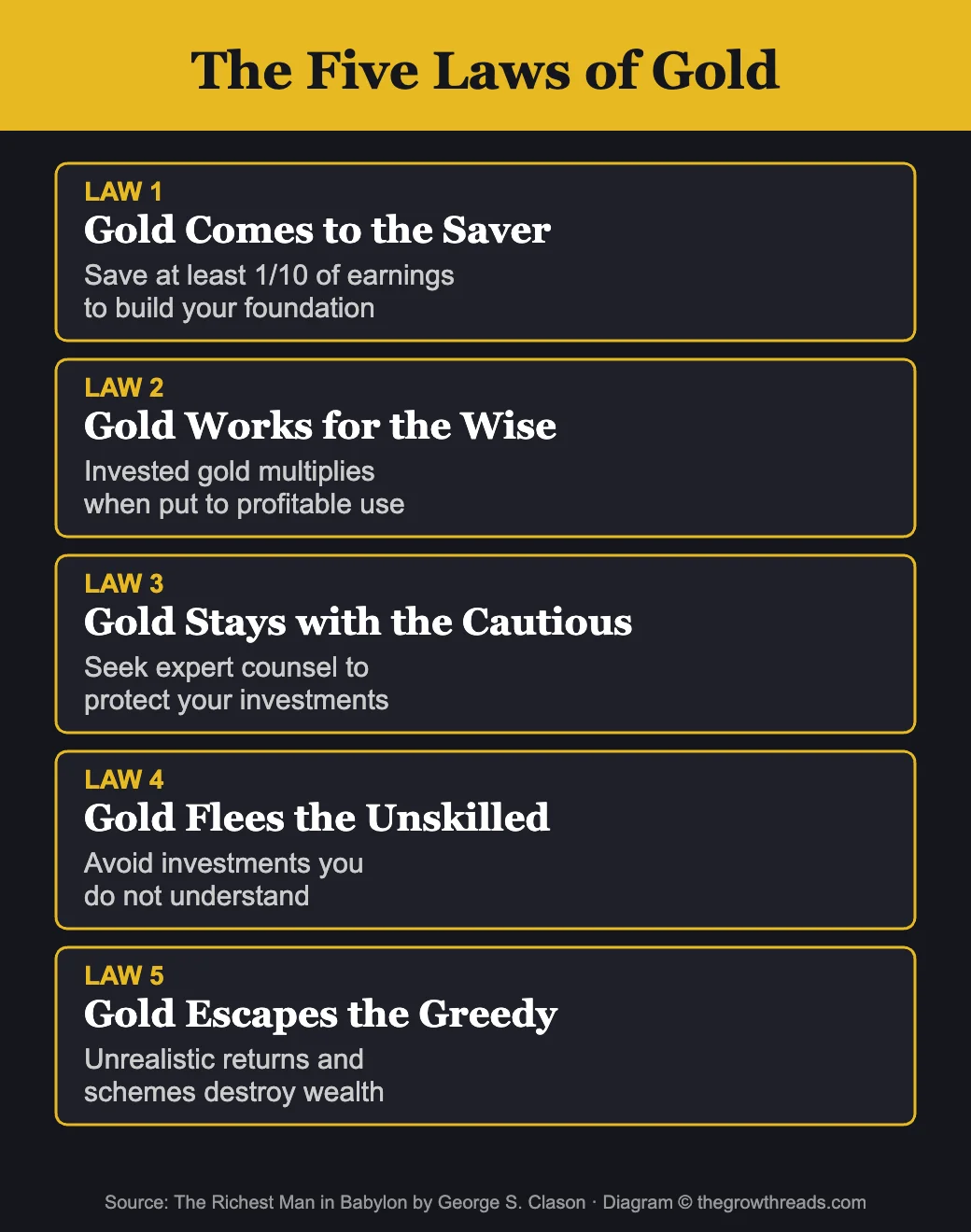
The Five Laws of Gold, taught later in the story by Arkad’s son Nomasir, reinforce these principles from the perspective of someone who learned them the hard way. Nomasir was given both gold and a clay tablet inscribed with the five laws. He quickly lost all the gold through foolish ventures but was saved by the wisdom on the tablet, eventually earning back far more than he lost.
Part 3: The parables of debt, luck, and protection
Clason dedicates several chapters to characters who illustrate specific financial challenges. The Camel Trader of Babylon tells the story of Dabasir, who falls into slavery through accumulated debt and reckless spending. His escape and eventual prosperity demonstrate that no amount of debt is insurmountable if you commit to a structured repayment plan while simultaneously saving.
Dabasir’s plan is strikingly similar to modern debt repayment strategies: he allocates seventy percent of his income to living expenses, twenty percent to creditors, and ten percent to savings. He refuses to stop saving even while paying off debt — because, as Arkad taught, the saving habit must never be broken once started. His creditors, initially skeptical, come to respect his plan because they see consistent payments arriving month after month.
The Goddess of Good Luck parable addresses the universal human desire for a windfall. Through a debate among merchants, Clason concludes that luck is not random — it favors those who take decisive action when opportunity appears. The man who hesitates, overthinks, or waits for a “better deal” watches fortune pass to someone bolder. This is not about recklessness but about preparedness: when you have savings, skills, and knowledge, you can recognize and seize good opportunities that others miss.
The Walls of Babylon parable emphasizes protection and insurance. Just as Babylon’s massive walls protected its citizens from invading armies, adequate insurance and emergency funds protect your wealth from catastrophic events. Clason argues that this is not optional but essential — wealth without protection is built on sand.
Part 4: The gold lender and the lessons of wise investment
The final parables focus on lending and investment wisdom. Mathon the gold lender shares his lifetime of experience evaluating borrowers. His core insight: the safety of your principal must always be your first consideration. A small, guaranteed return is infinitely better than a large, speculative one — because losing your principal means losing not just that money but all the future returns it would have generated.
Mathon categorizes borrowers and investments by their likelihood of repayment. Loans backed by property or collateral are safest. Loans to people with proven earning records and good character come next. Loans to people with no track record, no collateral, and grand promises are almost guaranteed losses. This hierarchy of risk assessment is essentially the same framework used by banks, venture capitalists, and credit agencies today.
The book closes with a powerful reminder that the principles of Babylon work in any era. Clason draws explicit parallels to modern American life (modern for the 1920s, but the lessons remain universal): the factory worker who saves ten percent will outpace the executive who spends everything. The immigrant who invests wisely will build more wealth than the trust fund heir who speculates recklessly.
Who is The Richest Man in Babylon best for — and who should read something else first?
This book is ideal for anyone who is just beginning to take their finances seriously — young adults getting their first paycheck, recent graduates, or anyone who has never had a clear savings and investment framework. The parable format makes it one of the most approachable personal finance books ever written, and the principles are universal across income levels, cultures, and time periods.
If you already have a solid savings habit and want more advanced investment strategies, you may find the advice too basic. In that case, start with our summary of The Intelligent Investor for deep investment theory or The Psychology of Money for a modern behavioral perspective. If your primary challenge is debt rather than saving, The Total Money Makeover offers a more detailed step-by-step debt elimination plan.
Questions to reflect on
- What percentage of your income are you currently saving — and what would it take to reach at least ten percent?
- Are you seeking financial advice from people who have actually achieved what you want, or from well-meaning friends without relevant experience?
- Which of your current “necessary” expenses are actually desires that you could reduce without meaningfully lowering your quality of life?
- Have you ever missed an opportunity because you hesitated too long — and what would have happened if you had acted decisively?
- What is one skill you could develop in the next six months that would increase your earning power by at least ten percent?
🔥 Ready to build wealth the Babylonian way?
Start with the timeless principles that have helped millions build financial freedom.
How to apply The Richest Man in Babylon (7-day plan)
- Day 1 — Calculate your current savings rate. Look at last month’s income and expenses. What percentage did you actually save? Write the number down — awareness is the first step.
- Day 2 — Set up automatic savings. Open a separate savings account and set up an automatic transfer of at least 10% of your income on payday. Make it happen before you can spend it.
- Day 3 — Audit your desires vs. needs. Go through your last three months of expenses and mark each as “need” or “desire.” Identify three desires you can eliminate or reduce this month.
- Day 4 — Find your Algamish. Identify one person in your life who has achieved the financial results you want. Reach out and ask for a 20-minute conversation about how they got started.
- Day 5 — Review your investments for risk. List every place your money is currently invested. For each, ask: “Do I understand exactly how this makes money?” If not, research it or consult an expert.
- Day 6 — Create a debt repayment plan. If you carry consumer debt, use Dabasir’s 70/20/10 model: 70% living expenses, 20% to creditors, 10% to savings. Never stop the savings portion.
- Day 7 — Invest in your earning power. Identify one skill, certification, or area of knowledge that could increase your income within the next year. Sign up for a course, book, or mentorship to begin learning.
Frequently asked questions
Is The Richest Man in Babylon still relevant today?
Absolutely. The core principles — save at least ten percent, invest wisely, avoid debt, seek expert counsel, and continuously improve your skills — are the same advice given by modern financial planners, just expressed through ancient parables. The book has sold over six million copies precisely because these fundamentals never change. While specific investment vehicles have evolved, the behavioral principles that drive wealth accumulation remain identical whether you live in ancient Babylon or modern New York.
What are the Seven Cures for a Lean Purse?
The Seven Cures are Arkad’s step-by-step wealth-building system: (1) Start thy purse to fattening by saving at least 10%, (2) Control thy expenditures through budgeting, (3) Make thy gold multiply by investing, (4) Guard thy treasures from loss by avoiding risky schemes, (5) Make of thy dwelling a profitable investment by owning your home, (6) Ensure a future income through retirement planning, and (7) Increase thy ability to earn by developing your skills. Together, they form a complete personal finance framework.
What are the Five Laws of Gold?
The Five Laws describe how money grows and how it is lost: (1) Gold comes gladly to those who save at least one-tenth, (2) Gold multiplies for those who invest it wisely, (3) Gold clings to the protection of cautious owners who seek expert advice, (4) Gold slips away from those who invest in unfamiliar ventures, and (5) Gold flees from those who force it into impossible earnings or follow tricksters. Laws 1–3 describe wealth creation; Laws 4–5 describe wealth destruction.
How long does it take to read The Richest Man in Babylon?
The book is approximately 144 pages in most editions and takes about 3 to 4 hours to read at an average pace. The writing style is accessible and story-driven, making it one of the fastest reads in the personal finance genre. Many readers finish it in a single sitting. The parable format means there are no dense charts, formulas, or technical jargon to slow you down — just engaging stories with clear financial lessons woven throughout.
Is this book good for teenagers and young adults?
The Richest Man in Babylon is one of the best financial books for young people. The story format is far more engaging than a typical personal finance textbook, and the principles — save early, avoid consumer debt, invest wisely — are exactly what young adults need to hear before they develop spending habits that are harder to change later. Many schools and parents use this book as a financial literacy introduction because it teaches sophisticated concepts through memorable characters and narratives.
What is the main message of The Richest Man in Babylon?
The main message is that wealth is available to anyone who follows a few simple, consistent principles: pay yourself first by saving at least ten percent of your income, live below your means, invest your savings wisely with guidance from experts, protect your principal from risky schemes, and continuously improve your ability to earn more. Clason emphasizes that these principles work regardless of your starting income — what matters is discipline and consistency over time, not the size of your paycheck.
How does this compare to modern personal finance books?
The Richest Man in Babylon laid the foundation that virtually every modern personal finance book builds upon. Dave Ramsey’s baby steps, Ramit Sethi’s automation framework, and even the FIRE movement’s savings-rate obsession all trace back to Arkad’s core teaching. The key difference is that modern books offer updated investment vehicles (index funds, Roth IRAs, robo-advisors) while Clason provides the unchanging behavioral principles. Reading Babylon alongside a modern guide gives you both the timeless mindset and the current tactical tools.
Related summaries
If you enjoyed this summary, explore more from our best money books collection:
- The Psychology of Money Summary — why your behavior matters more than your knowledge when it comes to money.
- I Will Teach You to Be Rich Summary — a modern, automated system for managing your money.
- The Intelligent Investor Summary — the definitive guide to value investing, recommended by Warren Buffett.
- The Total Money Makeover Summary — Dave Ramsey’s step-by-step plan to eliminate debt and build wealth.
Related Money Summaries
Set for Life Summary & Review: Build Wealth to Quit Your Day Job
The Automatic Millionaire Summary & Review: Build Wealth on Autopilot
The Intelligent Investor Summary & Review: Timeless Wisdom for Building Wealth
The Wealthy Barber Summary & Review: The Simple Habits That Build Real Wealth
Winning the Loser’s Game Summary and Review