

★★★★★ 4.6/5 — The original X-ray of the wage, the price, and the surplus hiding between them.
Best for: Readers who want the source text behind “capital” and “surplus,” not a first budgeting checklist
Reading time: ~25–35 hrs for Penguin Volume I · ~16 min for this guide
Difficulty to apply: The lens is usable this week; 1867 sentences and the value theory are the hard part
Das Kapital in one minute
A capitalist economy is a circuit, not a pile of coins: money buys labour and tools, those become commodities, and the commodities sell for more money than the round began with. The extra is surplus value — hours worked beyond what replaces the wage. Marx’s 1867 Volume I teaches you to see a coat, a wage, and a factory clock as forms of that relation. Prices look like natural facts; underneath them are people working. The fetish is mistaking the skin for the body. Diagnostic: on your last working day, which hours replaced your keep, and which hours became someone else’s growth?
Key takeaways
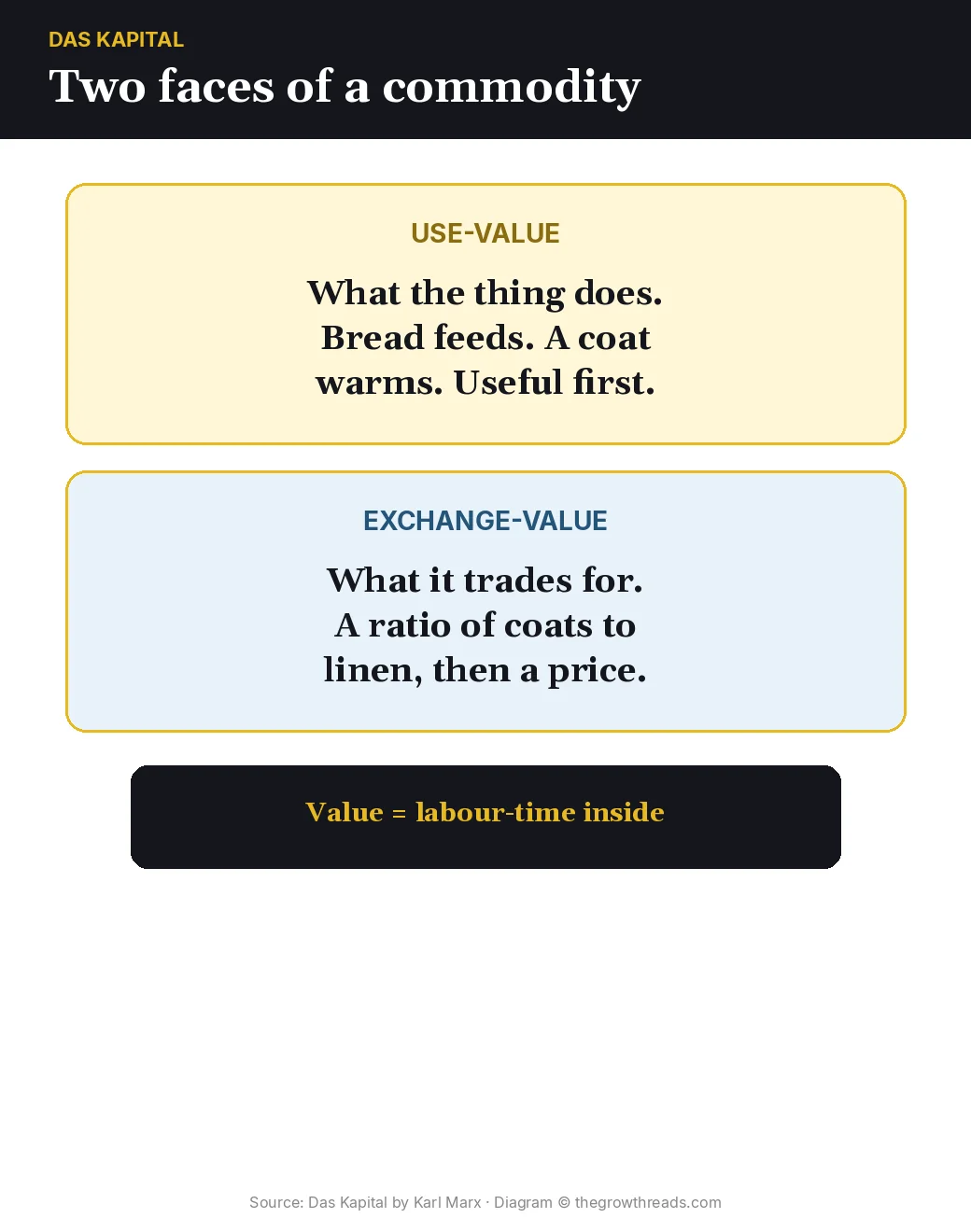
- A commodity has two faces: Use-value is what the thing does. Exchange-value is what it trades for.
- Value is labour-time, socially necessary: The time a society currently needs, with average skill and tools, to reproduce that useful object — not your private effort.
- Money is the form value takes in public: Once every commodity speaks price, the hours inside it recede.
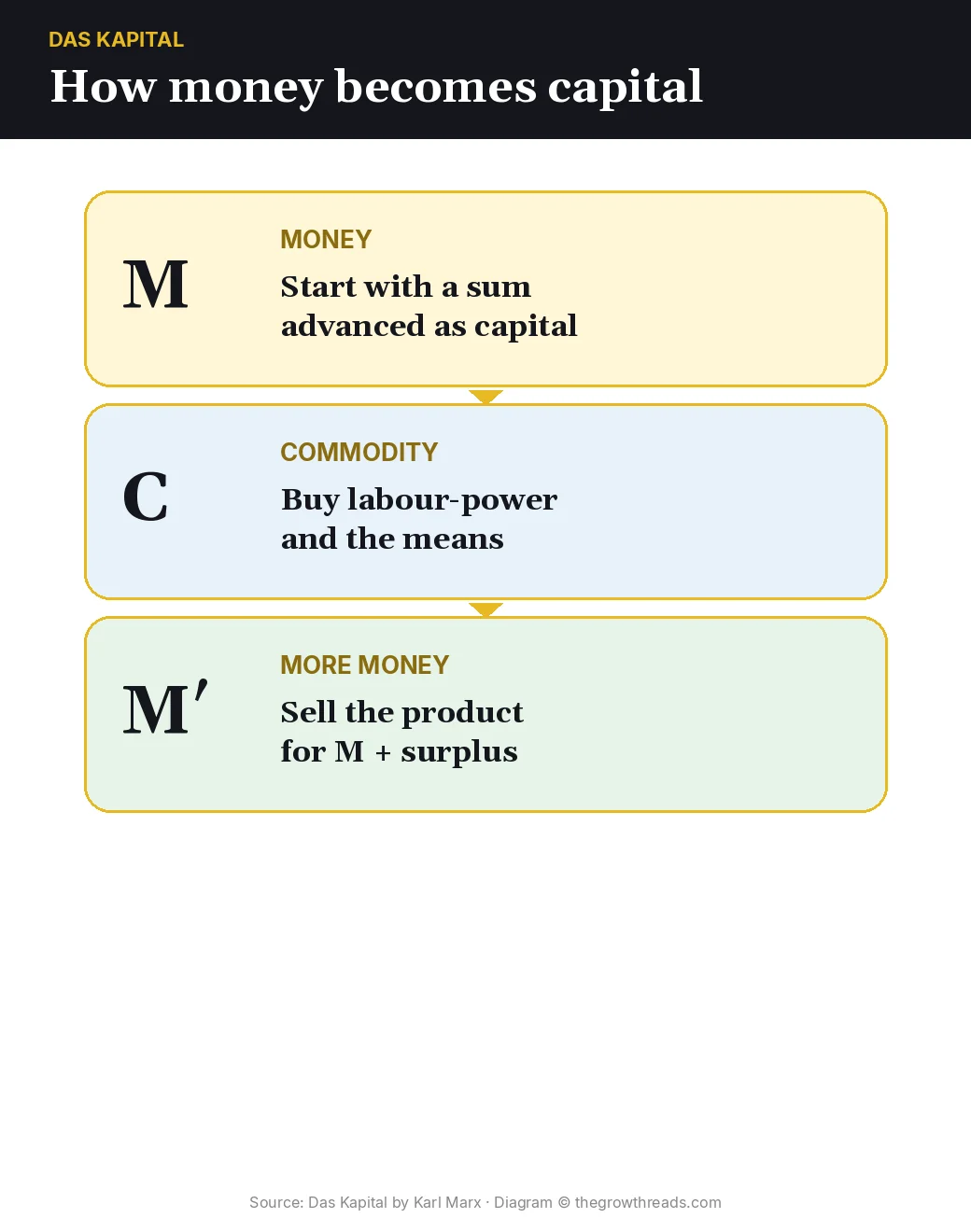
- Simple trade is C–M–C; capital is M–C–M′: You sell in order to buy something useful. Capital buys in order to sell for a larger sum.
- Surplus value is unpaid labour-time: Part of the day replaces the wage. The rest appears as profit, interest, and rent once the product is sold.
- The working day is a contested length: Absolute surplus lengthens the day. Relative surplus cheapens keep or raises output per hour.
- Machinery is a surplus machine, not just a convenience: A tool that doubles output without doubling pay shifts the split inside the same clock.
- The fetish makes relations look like things: “The market decided” often names no one who worked, owned, or kept the extra.
- The “free” market had a start: Enclosures, colonial plunder, and a class with only labour-power to sell are the pre-history Volume I ends on.
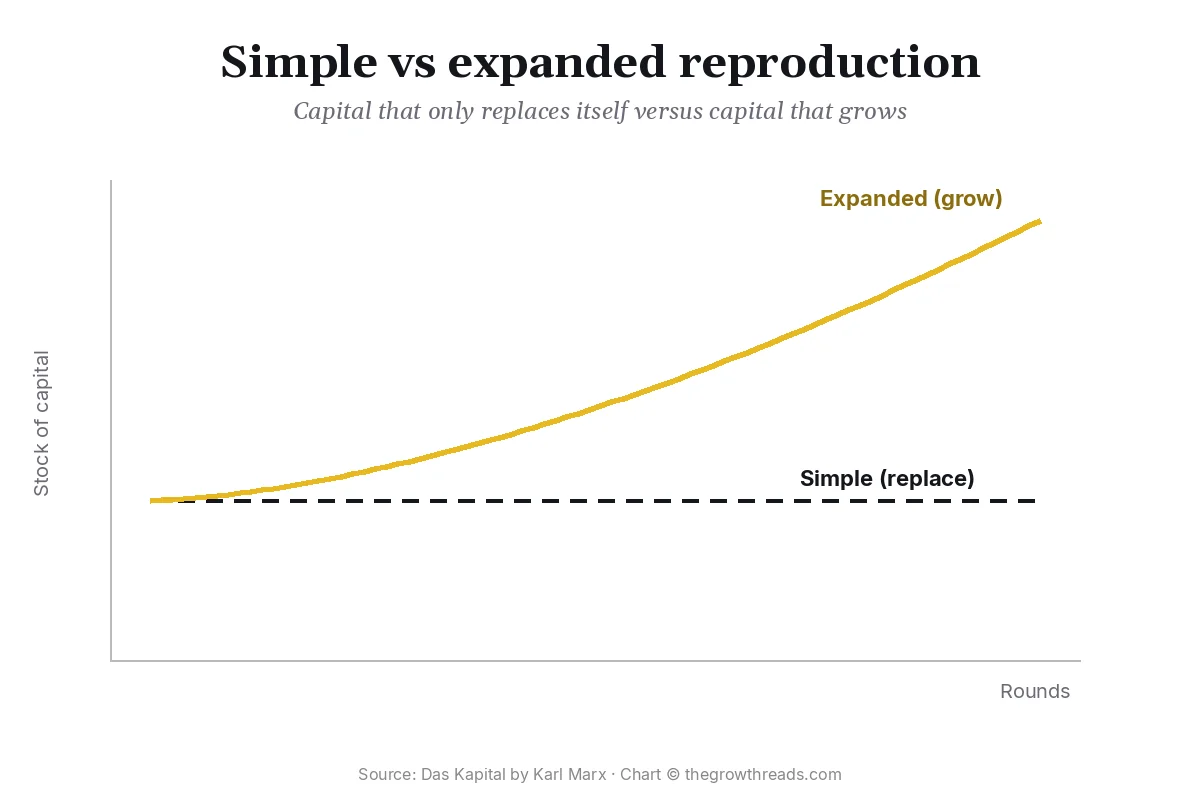
- Expanded reproduction is the growth rule: Capital that only replaces itself is a pause. Capital that must grow is ordinary weather.
What is Das Kapital about?
Das Kapital Volume I is Karl Marx’s 1867 analysis of how a capitalist economy produces, hides, and grows surplus. It follows the commodity into money, money into capital, and the working day into unpaid hours — then shows how accumulation and a violent pre-history made that circuit look natural.
About the author
Karl Marx (1818–1883) was born in Trier, trained in Hegelian philosophy, and spent most of his working life in exile after the 1840s revolutions. With Friedrich Engels he wrote the 1848 Manifesto; the larger project was a critique of political economy. London’s British Museum Reading Room is the workshop behind Volume I (Hamburg, 1867). Engels later edited Volumes II and III from drafts. Marx lived on journalism, loans, and Engels’s factory income. He is buried at Highgate Cemetery in London. The usable inheritance is a method for reading a wage, a price, and a factory clock as one story. Explore all Karl Marx book summaries →
Key concepts at a glance
| Concept | What it means | Use it when |
|---|---|---|
| Use-value | What a thing does for a human need | A purchase is being justified only by the sticker |
| Exchange-value | The ratio in which one commodity trades for another | You cannot tell a price from a use |
| Socially necessary labour-time | The average time now required to reproduce that useful object | Effort feels like value but the market disagrees |
| Labour-power | The commodity the worker sells: the capacity to work, for a wage | A contract talks as if hours and output were the same sale |
| Surplus value | Value produced beyond what replaces the wage | Profit appeared and no one can say which hours made it |
| M–C–M′ | The capital circuit: money, commodities, more money | You are mixing household swapping with a firm that must grow |
| Commodity fetish | Social relations that appear as relations between things | “The market decided” is doing too much work in a meeting |
| Primitive accumulation | The historical making of owners and of people with only labour-power to sell | A market is described as if it had no opening scene |
Part 1: The commodity, value, and the fetish
Marx opens where a shop opens: with a thing that can be useful and a thing that can be traded. A coat warms. Twenty yards of linen can stand in for that coat in exchange. Use-value is qualitative — warmth, food, shelter. Exchange-value is a ratio. Chapter 1 asks what makes those unlike objects commensurate. His answer is labour: not private sweat, and not pride. Socially necessary labour-time is the time a society, with average skill and tools, currently needs to reproduce that useful object. When looms improve, the linen contains less value even if the weaver is as tired as yesterday.
Money arrives as the public language of that commensurability. Once every commodity can speak price, the hours inside it recede. That is the fetish — not a mystical insult, a description of experience. In exchange we meet coats, tickets, and brands as if they had social power by nature. What we are actually meeting is a relation among producers who do not coordinate in advance. “Capital is dead labour, that, vampire-like, only lives by sucking living labour.” The sentence is theatrical; the claim is dry. Past work (tools, inventories, money) only grows by commanding living work now.
The application is smaller than the metaphysics. Take one ordinary purchase. Line one: what it does. Line two: what you paid. If you cannot write line one, you bought a symbol. If you cannot imagine the hours in line two, you are inside the fetish — which is normal. Volume I trains you to notice it.
TGR Note: Smith’s Wealth of Nations starts with the pin and asks how useful goods multiply. Marx starts with the commodity and asks what a price is hiding. Keep them as a pair with Naked Economics for the modern price logic without 1867 syntax.
Part 2: How money becomes capital
Household trade, in Marx’s letters, looks like C–M–C. You sell a commodity you have (labour-power, a crop, a craft) to buy a different useful thing. The aim is the use at the end. Capital inverts the letters: M–C–M′. A sum is advanced, commodities are bought — including labour-power, the one commodity whose use-value is to create value — and the product is sold for more money than the advance. The aim is the increment. If M′ were not greater than M, the sum was never capital; it was a hoard or a consumer’s purse.
The equal-exchange puzzle sits here. If every trade is equivalents, where does the extra come from? Marx stops looking for marketplace cheating and looks in production. Labour-power is sold at its value — the cost of reproducing the worker at the going standard. Its use, once bought, can produce more value than that cost. The difference is surplus value. Factory reports of the 1850s and 1860s — night work, the Ten Hours Bill — are the file for a working day long enough that the second half is not replacement.
You do not need a mill to use M–C–M′. A payroll, a studio, a shop, a platform take a sum, buy time and tools, and need a larger sum back. A household selling time to buy groceries is still C–M–C. Mixing the letters is how a wage gets called an investment when it is replacement, or a firm’s growth gets called “just trade” when it must expand. Draw last month as one or the other.
TGR Note: For the behavioural half of a surplus you already have, read The Psychology of Money. For a small-business rule that grabs profit before the circuit spends it, Profit First is a blunt cousin of “do not confuse revenue with the increment.”
Part 3: The working day, machines, and relative surplus
Once surplus exists, two ways to raise it dominate Volume I’s middle. Absolute surplus lengthens the working day — more unpaid hours on the same split. Relative surplus shortens the part that replaces the wage: cheaper keep, or more output per hour so replacement packs into fewer clock hours. The English factory acts and the clocking of meal times are the case file. A twelve-hour day with six hours of replacement is not the same object as a twelve-hour day with three. The clock looks the same. The split is not.
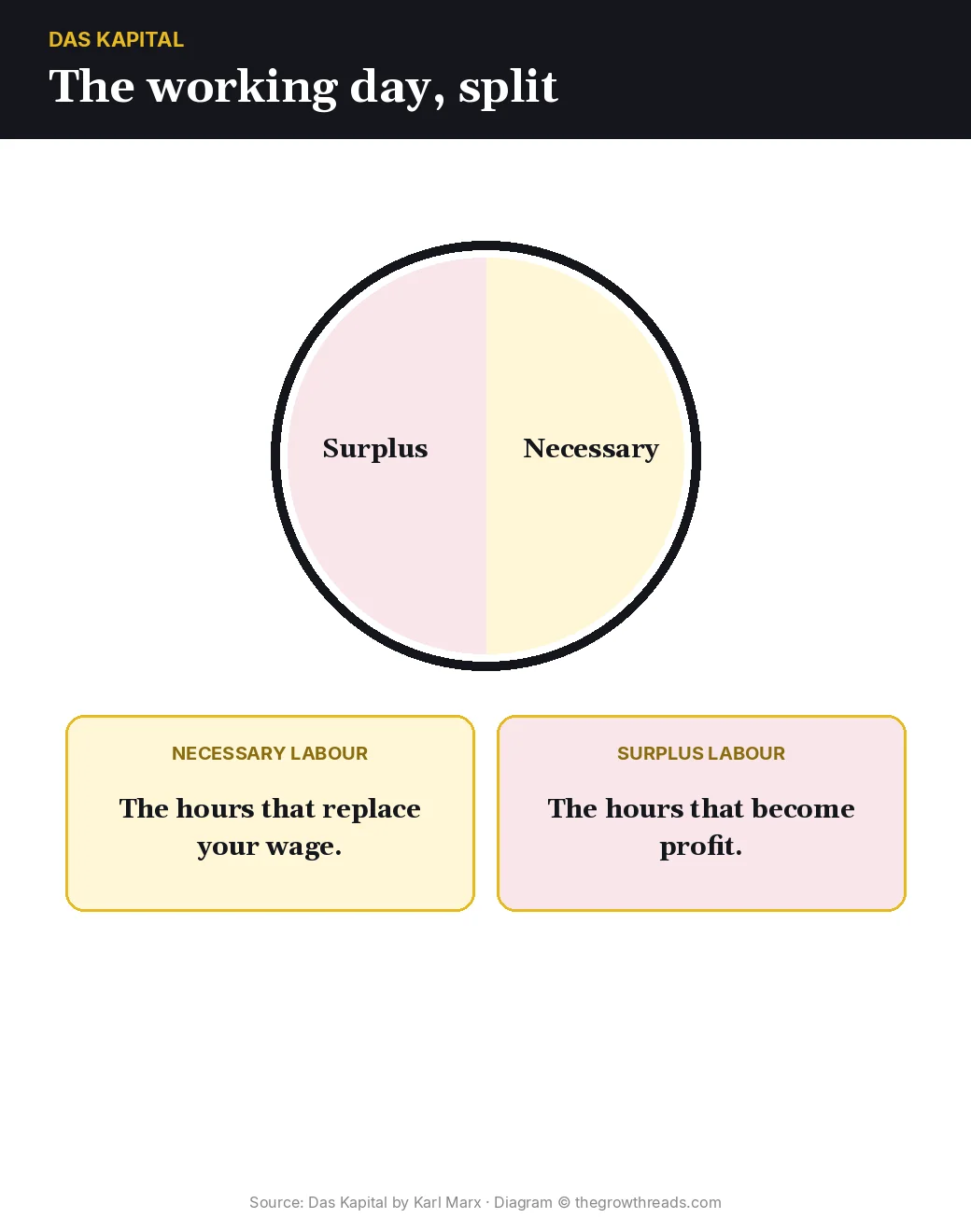
Machinery, cooperation, and manufacture are the relative-surplus toolkit. A machine that doubles output without doubling pay is not a neutral convenience — it moves the split. Cooperation under one plan produces a force no individual sold. Manufacture splits crafts into detail work; large-scale industry hangs those details on a mechanical skeleton. The practical read is not “hate tools.” It is: name who captures the extra when a process gets faster.
A knowledge-work translation holds if you stay honest. Automation that clears twice the tickets without twice the headcount has moved a split. Overtime culture is absolute surplus with better snacks. Neither observation requires you to settle the labour theory of value in a thread. Both require a calendar and a willingness to stop calling every extra hour hustle.
TGR Note: Scarcity of time and attention is the household face of a long day — see Scarcity. For measured poverty rather than mill reports, Poor Economics tests interventions the way Marx mined inspector files: look at the actual day, not the slogan.
Part 4: Accumulation and the so-called primitive start
If surplus is reinvested rather than eaten, the circuit repeats on a larger scale. That is expanded reproduction — the gold curve on the chart above. Simple reproduction only replaces what it used. Volume I treats accumulation as ordinary weather, not a vice of greedy men. Capital that does not grow is, in this model, failing at being capital. Concentration follows: more means in fewer hands, a reserve of labour when machines eject workers, boom and slack that feel like nature.
Then the historical twist. How did a class of owners and a class with nothing to sell but labour-power get into position? The last part, on so-called primitive accumulation, refuses the children’s story of thrifty elites and lazy poor. English enclosures, colonial plunder, public debt, and the making of wage-labourers are the opening scene. “So-called” is doing work: this was not modest pin-money saving. It was a political making of the starting lineup. Once that lineup exists, ordinary exchange can look peaceful while the circuit grows.
The 2026 application is not to reenact 1688. Ask, of any market you enter, what had to be fenced before “free trade” could be the language — a license, a platform gate, a city where housing was financialised before you arrived. The question keeps you from treating today’s split of a working day as nature, the same error as treating a price as nature in Chapter 1.
TGR Note: For the long history of the wagon and the bank, read The Ascent of Money. For remaining assets once a surplus exists, The Intelligent Investor is a different craft: buying claims without pretending the factory clock has vanished.
Who is Das Kapital best for — and who should read something else first?
Start here if you already have a money system and want the source text behind capital, surplus, and “the market.” It is a strong second book after The Wealth of Nations: Smith shows how specialization multiplies useful goods; Volume I shows how that surplus takes the form of a circuit that must grow.
Read something else first if you need tactics this month. The Psychology of Money and The Simple Path to Wealth are better first money books. Naked Economics is a gentler door into prices. This is not financial, legal, or political advice.
Questions to reflect on
- On your last working day, where is the line between hours that replaced your keep and hours that did not?
- Name one purchase from this week. What was its use-value, and what story did the price tell?
- Are you in a C–M–C month or an M–C–M′ month — and who, besides you, needs M′ to grow?
- Which tool on your desk has raised output without a matching change in pay?
- What had to be enclosed or gated before your industry could call itself a free market?
🔥 Ready to see the factory behind the price?
Start with Volume I in the Penguin Classics edition.
How to apply Das Kapital (7-day plan)
- Day 1: Pick one ordinary purchase and write two lines: what it does, what you paid.
- Day 2: Sketch your own M–C–M′ or C–M–C on one page using last month’s income.
- Day 3: Split a real working day into hours that replace your keep and hours that do not.
- Day 4: Name one tool or process that raised output without a matching raise.
- Day 5: Catch one ‘natural’ price or brand and name the relation underneath it.
- Day 6: Find one enclosure story in your industry — a license, a patent, a platform gate.
- Day 7: Write a one-page X-ray: where surplus appeared this week, and one boundary to test.
Frequently asked questions
What is the main message of Das Kapital?
A capitalist economy is a circuit, not a pile of coins: money buys labour-power and tools, those become commodities, and the commodities sell for more money than the round began with. The extra is surplus value — hours beyond what replaces the wage. Prices and ‘the market’ are the visible skin of that relation. The usable message is diagnostic. Separate what a thing does from what it trades for. Then ask which hours of a real working day replace your keep and which hours show up as someone else’s growth. Volume I is that X-ray, not a budget app.
Is Das Kapital still worth reading in 2026?
Yes, if you want the source text behind words you already use — commodity, capital, exploitation, accumulation — instead of a thread-sized version of them. The labour theory of value has been debated for a century and a half; the practical habit of tracking surplus, power, and the difference between a wage and a circuit has not aged out. Read Volume I as a lens for workplaces, platforms, and balance sheets. Pair it with a modern money book when you need account-level tactics. This summary is a map, not a substitute for the Penguin text, and it is not financial, legal, or political advice.
How long is Das Kapital and do I need all three volumes?
Volume I is the book people mean by a Das Kapital summary: the 1867 analysis of the commodity, surplus value, the working day, machinery, and accumulation. The Penguin Classics Fowkes translation runs over a thousand pages with apparatus. Volumes II and III, edited by Engels after Marx’s death, follow capital through circulation and the formation of a general rate of profit. Start with Volume I. If the circuit and the working-day split are clear, you already have the engine. II and III are the plumbing. Most readers who ‘finish Marx’ have finished I, then returned later if they needed the rest.
What is surplus value in simple terms?
Surplus value is the extra created in production after the labour-power that made it has been paid for. If six hours of a twelve-hour day replace the wage, the other six become profit, interest, and rent once the product is sold. Lengthen the day (absolute surplus) or raise output per hour with machines (relative surplus). You do not need every equation to use the split. Look at a shift or a billable day and ask which hours are replacement and which hours are growth for someone else.
How is Das Kapital different from The Wealth of Nations?
Smith starts in the pin factory and asks why nations get richer in useful goods: divide the work, trade the surplus, let prices coordinate. Marx starts with the commodity and asks why that surplus takes the form of capital that must grow. Smith’s slices of a price are wages, profit, and rent. Marx wants to know how profit appears if equivalents exchange. The books are a pair, not a replacement. Read Smith for specialization and the wagon he calls money. Read Marx for the circuit that wagon enters when it is advanced as capital. Our Wealth of Nations summary is the other half of this conversation.
Is the labour theory of value still accepted?
Among working economists, no — not as a complete theory of prices. Marginal and later schools explain relative prices without socially necessary labour-time as the substance of value. Marxists and some historians of economics still use the labour lens to talk about exploitation and growth. That debate belongs in a seminar. The application that survives the debate is plainer: a wage is not the same thing as the value a working day can produce, and a growing firm is not the same thing as a household swapping useful objects. Treat the equations as a model. Keep the X-ray.
Who should not start with Das Kapital?
Skip it as a first money book if you need a budget, a debt snowball, or an index-fund setup this month. Start with The Psychology of Money or The Simple Path to Wealth, then come back. Skip it if you want a biography rather than Volume I — this is a treatise. And skip it if you only want a slogan that markets are good or bad. The book is a slow argument about a circuit. It rewards readers who will mark a working day and a receipt. This is not a substitute for advice from a licensed professional.
Related summaries
- The Wealth of Nations — the pin factory and the wagon Marx’s circuit enters.
- Naked Economics — prices without 1867 syntax.
- The Ascent of Money — the history of the banks and debts Volume I assumes.
- The Psychology of Money — what people do with a surplus once it exists.
Browse titles on our Best Money Books pillar page.
How we analyze books: our summaries are built from a full read of the source text, cross-referenced against the author’s published interviews and research where relevant, and structured around practical application rather than critique. We disclose our editorial process and affiliate relationships in full. Read our full methodology.