

4.6/5 — A clear, practical framework for translating love into the language your partner actually understands.
Best for: Couples, parents, and anyone whose good intentions keep landing wrong.
Reading time: ~10 min guide (book: ~5 hrs)
Difficulty to apply: Easy — one conversation and daily attention
The 5 Love Languages in one minute
Most relationship friction is not about love disappearing — it is about love being spoken in the wrong language. Gary Chapman, a marriage counselor with decades of couples sessions behind him, noticed the same pattern over and over: partners who loved each other deeply but felt unloved, because each expressed affection the way they personally preferred to receive it. His answer is the five love languages — Words of Affirmation, Quality Time, Receiving Gifts, Acts of Service, and Physical Touch. Everyone has a primary language that fills their emotional “love tank” fastest, and most people default to speaking their own language rather than their partner’s. The fix is not more love — it is translation: noticing what someone complains about and asks for, then deliberately speaking their language, especially once the early rush of falling in love settles into a relationship that runs on choice.
Key takeaways
- Love has five languages: Words of Affirmation, Quality Time, Receiving Gifts, Acts of Service, and Physical Touch.
- Everyone has a primary language: one language fills your emotional tank faster and more completely than the others.
- People give what they want to receive: most of us default to expressing love in our own language, not our partner’s.
- The “in love” stage is temporary: the euphoric infatuation of new romance typically fades within about two years.
- Real love is a choice: once infatuation fades, love becomes a daily decision to act, not just a feeling that shows up on its own.
- The love tank needs refilling: emotional connection runs low without consistent, language-specific deposits.
- Complaints are clues: what a partner criticizes most often usually points straight at their unmet love language.
- Requests reveal the language too: what someone asks for repeatedly is rarely random — it is their tank asking to be filled.
- Each language has dialects: two people who share a language may still want it expressed in different, specific ways.
- The framework travels beyond marriage: Chapman later adapted it for children, singles, and coworkers.
What is The 5 Love Languages about?
The 5 Love Languages is a relationship guide by counselor Gary Chapman that identifies five distinct ways people express and experience love — Words of Affirmation, Quality Time, Receiving Gifts, Acts of Service, and Physical Touch — and shows couples how to identify their own and their partner’s primary language so affection actually lands as intended.
About the author
Gary Chapman holds a PhD in adult education from Fuller Theological Seminary and has spent over four decades as a marriage counselor and pastor in Winston-Salem, North Carolina. Long before he wrote a word of The 5 Love Languages, he sat across from hundreds of couples in counseling sessions and kept hearing the same complaint phrased in different words: “I do not feel loved.” Listening for patterns in what people asked for and what they criticized, Chapman began sorting emotional needs into five categories — a framework simple enough to explain in a single conversation, yet specific enough to change how couples actually treat each other day to day. Since its first publication in 1992, the book has sold more than 20 million copies and been adapted into editions for singles, teenagers, children, and the workplace. Explore all Gary Chapman book summaries →
Key concepts at a glance
| Concept | What it means | Use it when |
|---|---|---|
| Love tank | The emotional reservoir that runs low without love, and needs regular refilling | You sense your partner pulling away or feeling flat |
| Primary language | The one language that fills your tank fastest and most completely | Identifying what actually reassures your partner, not just what feels natural to you |
| In-love stage | The temporary euphoric phase of new romance, typically fading within about two years | Explaining why a relationship suddenly needs more intention than it used to |
| Words of Affirmation | Verbal appreciation, encouragement, and specific praise | Your partner lights up at compliments and wilts at criticism |
| Quality Time | Focused, undistracted attention and shared activity | Your partner says you are “always on your phone” or “never really here” |
| Acts of Service | Helpful actions that reduce your partner’s workload | Your partner says “actions speak louder than words” often |
| Dialects | Personal variations within a single love language | A gesture in the “right” language still somehow misses the mark |
Part 1: Why Good Intentions Keep Missing the Mark
Chapman opens with an observation that will feel familiar to anyone who has ever tried hard in a relationship and still been told, “I do not feel loved.” It is rarely a lack of effort. Couples who genuinely care about each other still end up feeling unseen, because the effort is being spent in the wrong currency. A husband who shows love by fixing the car, mowing the lawn, and handling the finances can be doing real, tiring work — and still leave a partner who needed a twenty-minute conversation feeling completely unloved. Neither person is failing on purpose. They are simply fluent in different languages.
Part of the problem is timing. Early romantic love runs on a chemical high researchers sometimes call limerence — the obsessive, effortless infatuation that makes new couples want to spend every waking hour together. Chapman notes this stage reliably fades, often within about two years, regardless of how “right” the relationship is. What happens next determines everything. Couples who mistake the fading of infatuation for the fading of love often drift or look elsewhere for the feeling to return. Couples who understand that real love is a decision — something practiced daily rather than something that either is or is not present — are the ones who build relationships that outlast the initial spark.
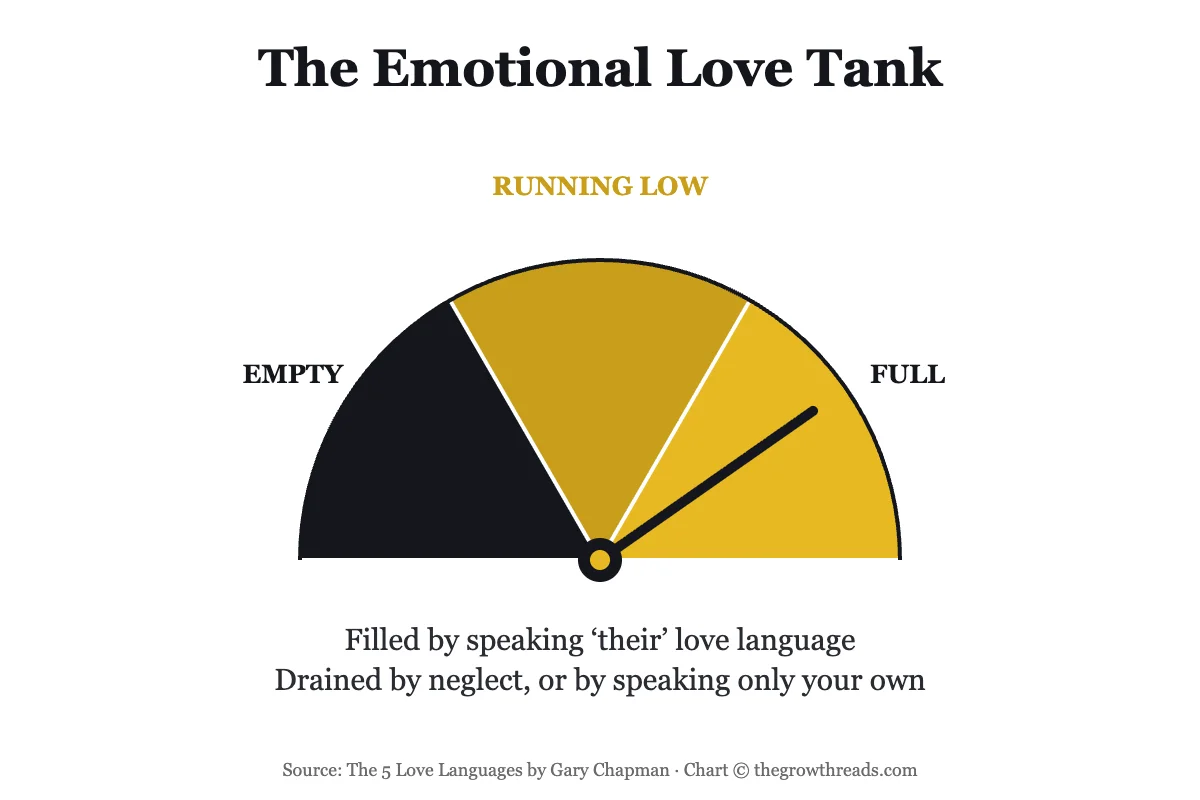
This is where the love tank metaphor becomes useful. Chapman describes every person as carrying an emotional reservoir that needs steady refilling. When the tank is full, small stresses roll off easily and both partners give each other the benefit of the doubt. When it runs low, the same small stresses turn into resentment, criticism, and distance. Crucially, the tank is not refilled by love in general — it is refilled specifically by the deposits that match a person’s primary language. A partner can be affectionate, generous, and hardworking, and still leave the tank running low simply because none of that effort was delivered in the language the other person actually reads as love.
Part 2: The Five Love Languages Explained
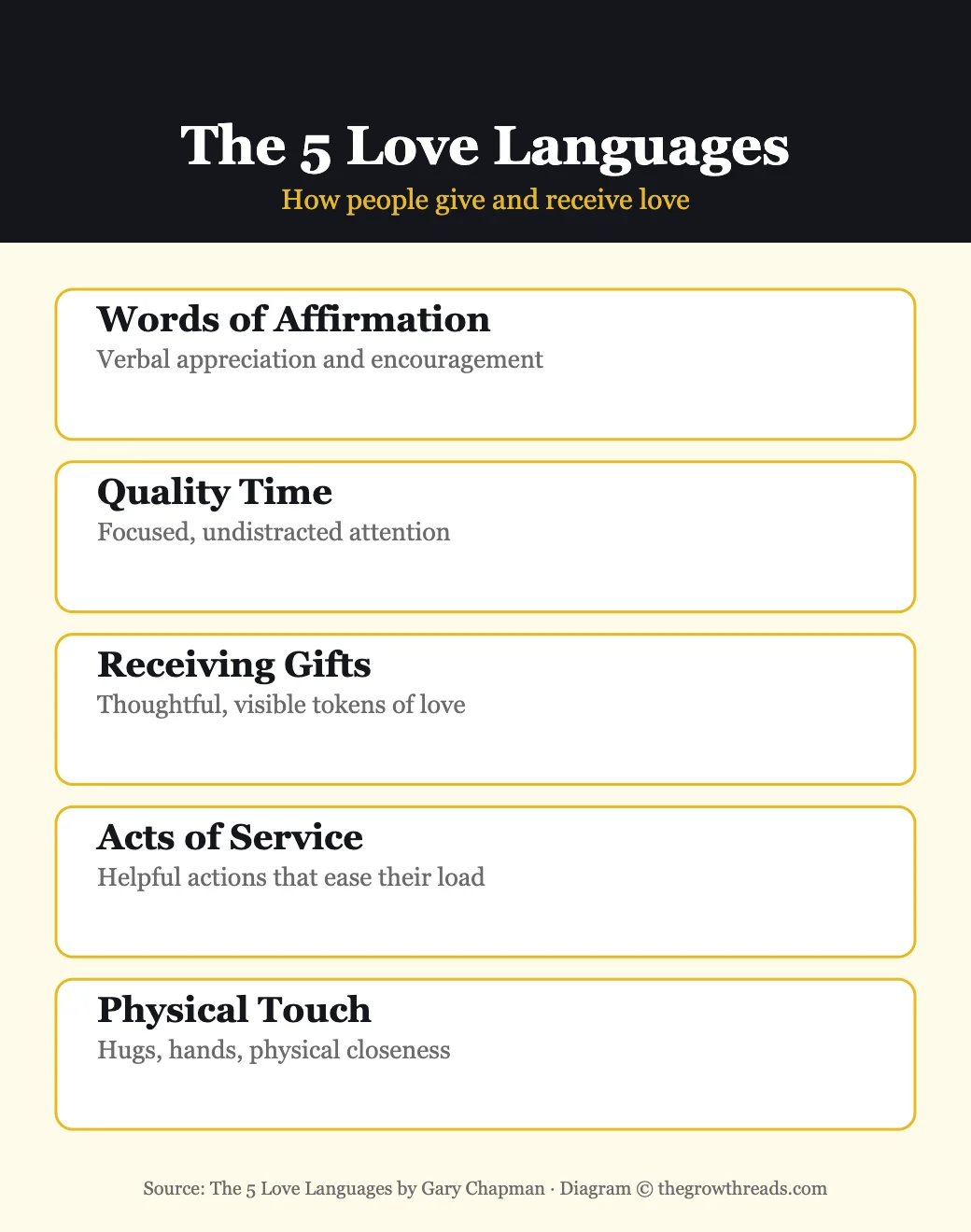
The core of the book is a simple taxonomy, but each language carries more nuance than its one-line label suggests.
Words of Affirmation covers verbal and written appreciation — compliments, encouragement, and specific praise rather than generic flattery. For someone who speaks this language, “thank you for handling that, I noticed” lands harder than an expensive gift ever could, and unkind words cut unusually deep.
Quality Time means focused, undistracted attention, not just physical proximity. Sitting in the same room scrolling separate phones does not count. Chapman distinguishes “quality conversation” — sharing feelings and experiences without interrupting or fixing — from “quality activities,” doing something together purely because the other person enjoys it.
Receiving Gifts is the language most often misunderstood as materialism. It is really about visible, tangible proof that you were thought of while apart. The gift rarely needs to be expensive; a flower picked on the walk home can outperform something costly bought without thought.
Acts of Service is love expressed through helpful action — cooking a meal, running an errand, handling a dreaded task before being asked. Chapman is careful to note that service given with resentment or as silent leverage in an argument stops counting; it has to be freely given to register as love.
Physical Touch extends well beyond intimacy — a hand on the shoulder, sitting close on the couch, a hug at the door. For people who speak this language, consistent small touches communicate security in a way words rarely match.
TGR Note: If you are curious about why some people crave certain languages more intensely than others, our summary of Attached digs into adult attachment styles — a useful companion lens once you know which language you speak.
Part 3: Discovering Your Language — and Your Partner’s
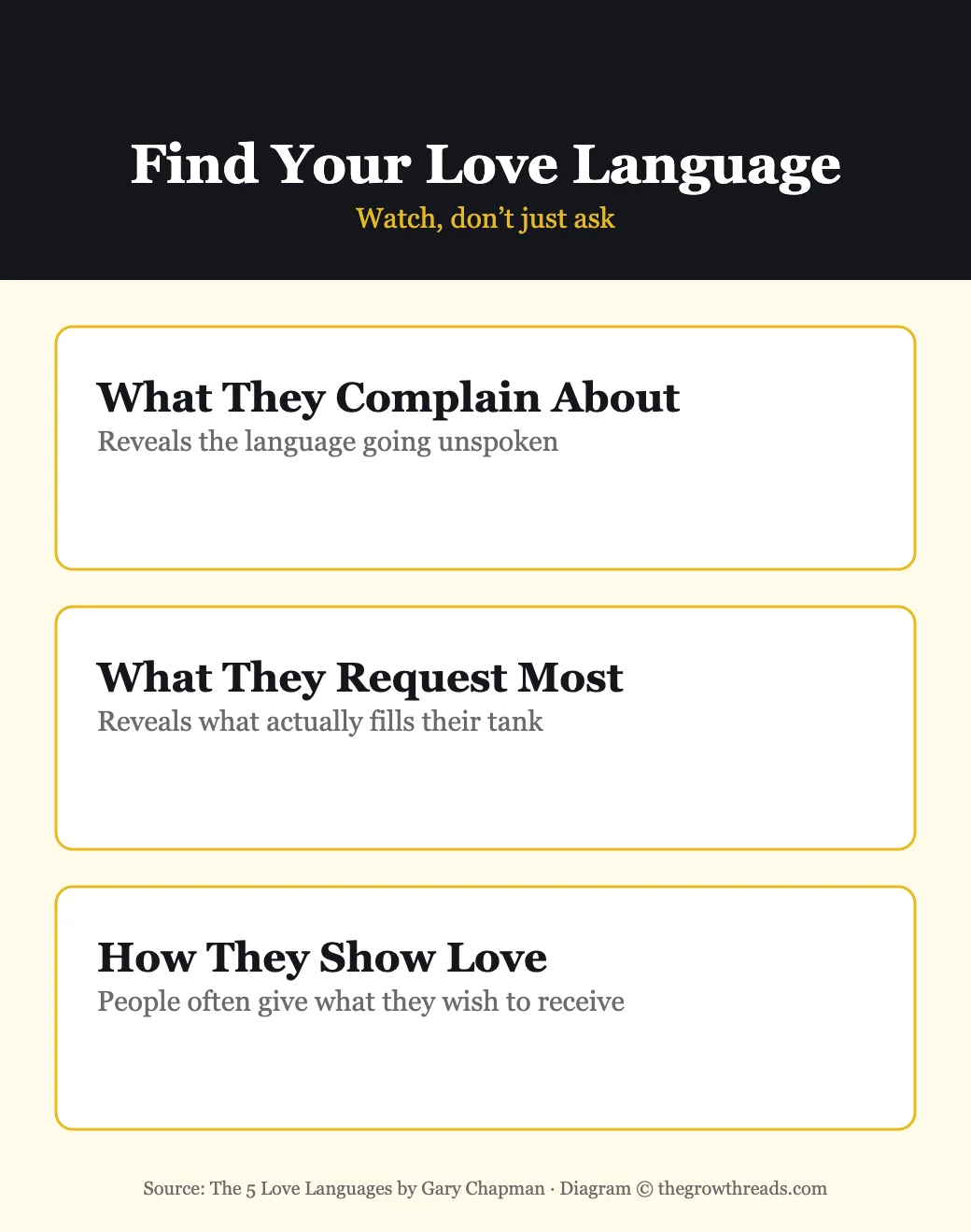
Chapman offers three practical ways to identify a love language, and they work better as observation than as direct questioning.
Watch what they complain about. A partner who repeatedly says “you never help around here” is telling you their language is Acts of Service. One who says “we never really talk anymore” is telling you it is Quality Time. Complaints are unmet requests in disguise.
Watch what they request most. If someone regularly asks for a hug, a compliment, an evening together, or a small surprise, they are not being needy — they are handing you the answer directly, more often than most people realize.
Watch how they naturally show love to others. People tend to give in the language they most want to receive. Someone who is constantly doing favors for friends and family, unprompted, is often revealing their own primary language rather than simply being generous.
Most people have one dominant language and a secondary one close behind, and Chapman is clear that a match on paper is not enough — each language has dialects. Two people who both value Quality Time might disagree over whether that means deep conversation or a shared hobby; two people who value Acts of Service might want completely different chores prioritized. Getting the language right is only step one; getting the dialect right is what makes it land. The framework also extends past marriage — later books apply the same five languages to children, to single adults dating, and to coworkers and managers who want appreciation to actually register at work.
TGR Note: Once you both know your languages, the harder work is often repair after conflict. Our summary of Hold Me Tight maps the emotional cycles couples fall into when neither partner feels heard — useful once the vocabulary from this book is in place.
Part 4: Speaking It Daily — Turning Insight Into Habit
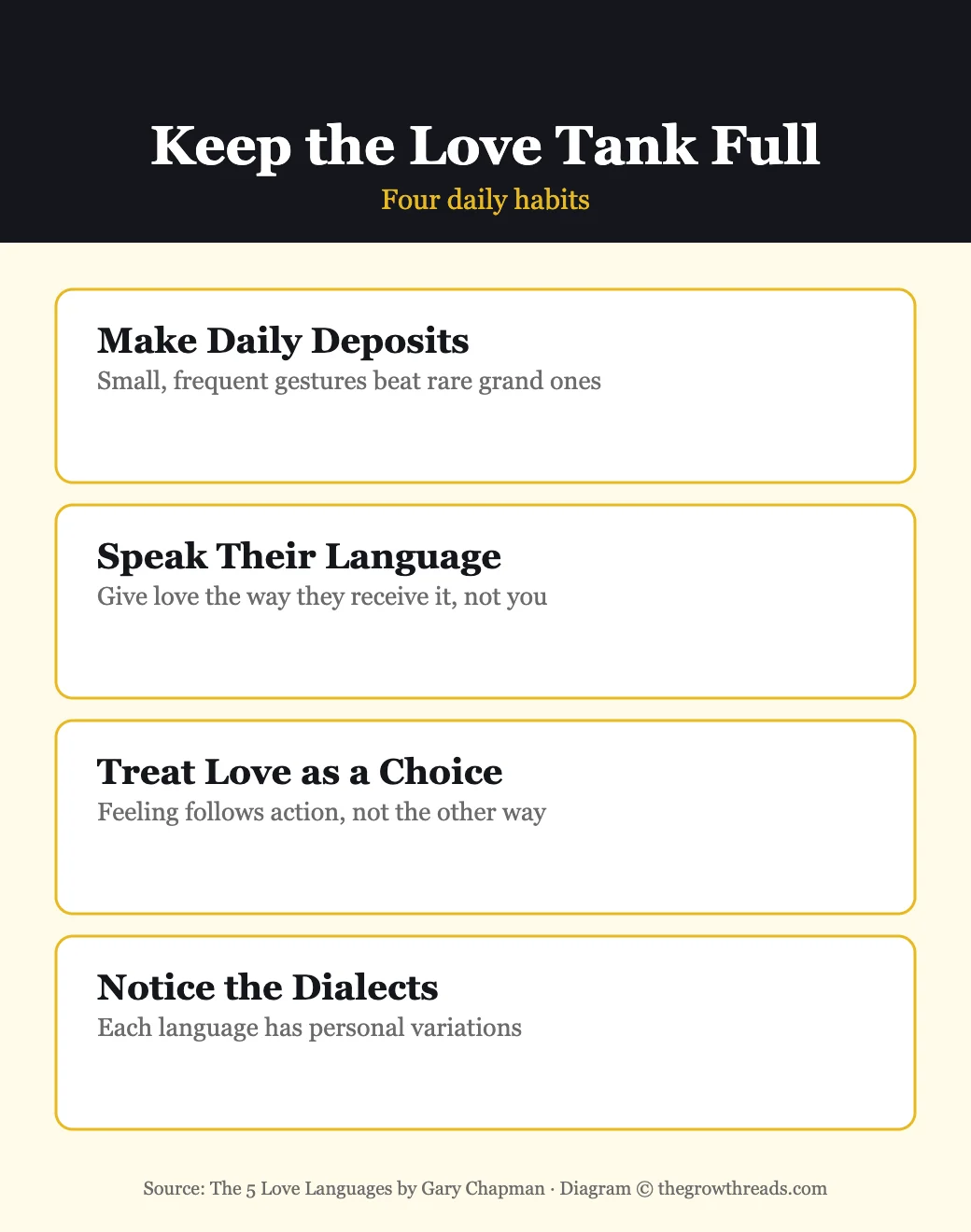
Knowing your partner’s language changes nothing on its own. The book’s real argument is that love, past the infatuation stage, is a choice made repeatedly rather than a feeling that either shows up or does not. That reframing matters because it removes the excuse of “I am just not feeling it right now” — deposits in a partner’s love language are treated as a discipline, similar to exercise or saving money, that compounds over time regardless of mood.
Chapman warns against two common mistakes. The first is relying on occasional grand gestures instead of small, frequent deposits — an expensive anniversary gift does not make up for months of a mostly empty tank. The second is what might be called love language malpractice: doing something in your own language, calling it effort, and feeling confused when it does not register. Effort only counts as a deposit when it is delivered in the receiver’s language and dialect, not the giver’s.
The practical shift, then, is small and daily rather than occasional and large: one sentence of specific affirmation, ten minutes of undistracted attention, one small unprompted gift, one task handled without being asked, one deliberate moment of physical closeness — repeated, in whichever combination matches the people involved, until it becomes habit rather than performance.
TGR Note: For a broader, systems-level approach to marriage health beyond daily language habits, see our summary of The Seven Principles for Making Marriage Work — it pairs well with Chapman’s day-to-day framework.
Who is The 5 Love Languages best for — and who should read something else first?
This book is best for couples who love each other but keep having the same low-grade argument about feeling unappreciated, and for anyone who wants a shared vocabulary for talking about affection without it turning into a fight. It is also useful for parents and for singles who want to understand their own needs before they date. If your relationship’s core issue is repeated betrayal, contempt, or emotional withdrawal rather than mismatched expression, start with Hold Me Tight or Attached instead — they address the deeper attachment wounds this book assumes are not present. If you want structured scripts for the conflict conversations themselves, Nonviolent Communication is the better starting point.
Questions to reflect on
- What do you complain about most often in your closest relationship — and which love language does that complaint point to?
- When was the last time you felt truly loved? What specifically did the other person do?
- How do you naturally show love to the people around you — and is that actually their language, or just yours?
- What is one small, specific deposit you could make today in your partner’s primary language?
- Where might you be mistaking the fading of infatuation for the fading of love itself?
🔥 Ready to speak a language your partner actually feels?
Grab a copy and start the conversation that changes how you love each other.
How to apply The 5 Love Languages (7-day plan)
- Day 1: Write down what you complain about and request most often in your relationship — that is your language, in your own words.
- Day 2: Ask your partner to do the same, out loud, during a relaxed conversation, not mid-argument.
- Day 3: Name your top two languages to each other, plus one dialect each — the specific way you like it delivered.
- Day 4: Give one deliberate act in your partner’s primary language, even if it feels unnatural to you.
- Day 5: Notice what your partner does for you unprompted this week — it is likely revealing their own primary language, not yours.
- Day 6: Pick one recurring complaint, translate it into a language, and act on that translation directly.
- Day 7: Set a standing weekly check-in — one specific way you will each keep filling the tank next week.
Frequently asked questions
What are the 5 love languages?
The five love languages are Words of Affirmation, Quality Time, Receiving Gifts, Acts of Service, and Physical Touch. Gary Chapman developed the framework from patterns he observed across years of marriage counseling, noticing that partners consistently expressed and craved love in one of these five ways more than the others. Most people have a clear primary language and a secondary one close behind, and understanding both your own and your partner’s makes it far easier to give affection that actually registers as love rather than effort that goes unnoticed.
How do I find my love language?
Chapman suggests three signals rather than guessing: notice what you complain about most in relationships, notice what you request most often, and notice how you naturally express love to other people, since most people default to giving in the language they most want to receive. Many readers also find it useful to simply rank the five languages against each other directly, imagining which one you would miss most if a partner stopped offering it entirely.
Can someone have more than one love language?
Yes. Most people have a clear primary language that fills their emotional tank fastest, and a secondary language that also matters but less urgently. Chapman notes the primary language is usually easy to identify once you look at complaints and requests, while the secondary language often only becomes obvious once the primary one is already being consistently met.
Does the framework apply outside romantic relationships?
Yes. Chapman and co-authors have adapted the five languages for parent-child relationships, for singles dating, and for workplace appreciation with Paul White’s The 5 Languages of Appreciation in the Workplace. The core idea stays the same in each version: appreciation and affection are received differently by different people, so a one-size-fits-all approach to showing you care will always miss some of the people you are trying to reach.
Is the love languages theory scientifically proven?
The core insight — that people differ in how they prefer to give and receive affection — is broadly uncontroversial and matches everyday relationship experience. However, some psychology researchers have published studies questioning whether people truly have one fixed dominant language, and whether “matching” languages predicts relationship satisfaction better than simply receiving more affection overall, in any form. Treat the framework as a practical communication tool refined through decades of counseling rather than a strictly validated psychological theory.
What if my partner and I have completely different love languages?
That is the normal case, not the exception, and it is exactly the problem the book is written to solve. The goal is not to find a partner who happens to share your language — it is to deliberately learn and speak a language that does not come naturally to you, the same way you might learn a second spoken language for someone you care about.
How long does it take to read, and is it worth the full book?
The book runs a little over 200 pages and most readers finish it in under five hours. While the core framework can be summarized in a few minutes, the full book is worth reading for its many real counseling examples, which make the five languages and their dialects far easier to recognize in your own relationship than the summary alone.
Related summaries
- Attached — the science of adult attachment styles, a deeper lens on why some languages matter more to certain people.
- Nonviolent Communication — scripts for the harder conversations love languages alone will not resolve.
- Hold Me Tight — repairing the emotional cycles that keep couples feeling disconnected.
- The Seven Principles for Making Marriage Work — a systems-level companion to Chapman’s daily framework.
Or browse the full best relationship books list.
How we analyze books: Every TGR summary is built from the book’s original text, the author’s public interviews and essays, and where relevant, follow-up research — cross-checked for accuracy, then structured into a practical framework you can act on the same day. Read our full methodology.