

★★★★½ 4.6/5 — A deceptively simple pen-and-paper system that turns scattered thoughts into a clear, intentional life.
Best for: Anyone scattered across five different apps who wants one analog system for tasks, notes, and reflection.
Reading time: ~4 hours to read, about 20 minutes to learn the core method.
Difficulty to apply: Easy to start tonight, moderate to sustain past the first month.
The Bullet Journal Method in one minute
Most productivity systems fail because they ask you to trust an app with your attention. The Bullet Journal Method asks you to trust a pen. Ryder Carroll’s system replaces sprawling to-do apps, planners, and sticky notes with a single notebook and five simple symbols. You “rapid log” tasks, events, and notes in short, dated entries, then migrate anything unfinished into the next day or month, by hand, on purpose. That single act of rewriting is the method’s real engine: it forces you to ask whether a task still deserves your time before you recommit to it. The result isn’t just a to-do list that gets done. It’s a running, searchable record of what you actually thought, did, and cared about, and a practical framework Carroll calls “intentional living,” where your calendar finally matches your values instead of just your inbox.
Key takeaways
- Rapid Logging replaces sentences with symbols: tasks, events, and notes are captured in short, dated bullets instead of full paragraphs, so capturing a thought takes seconds.
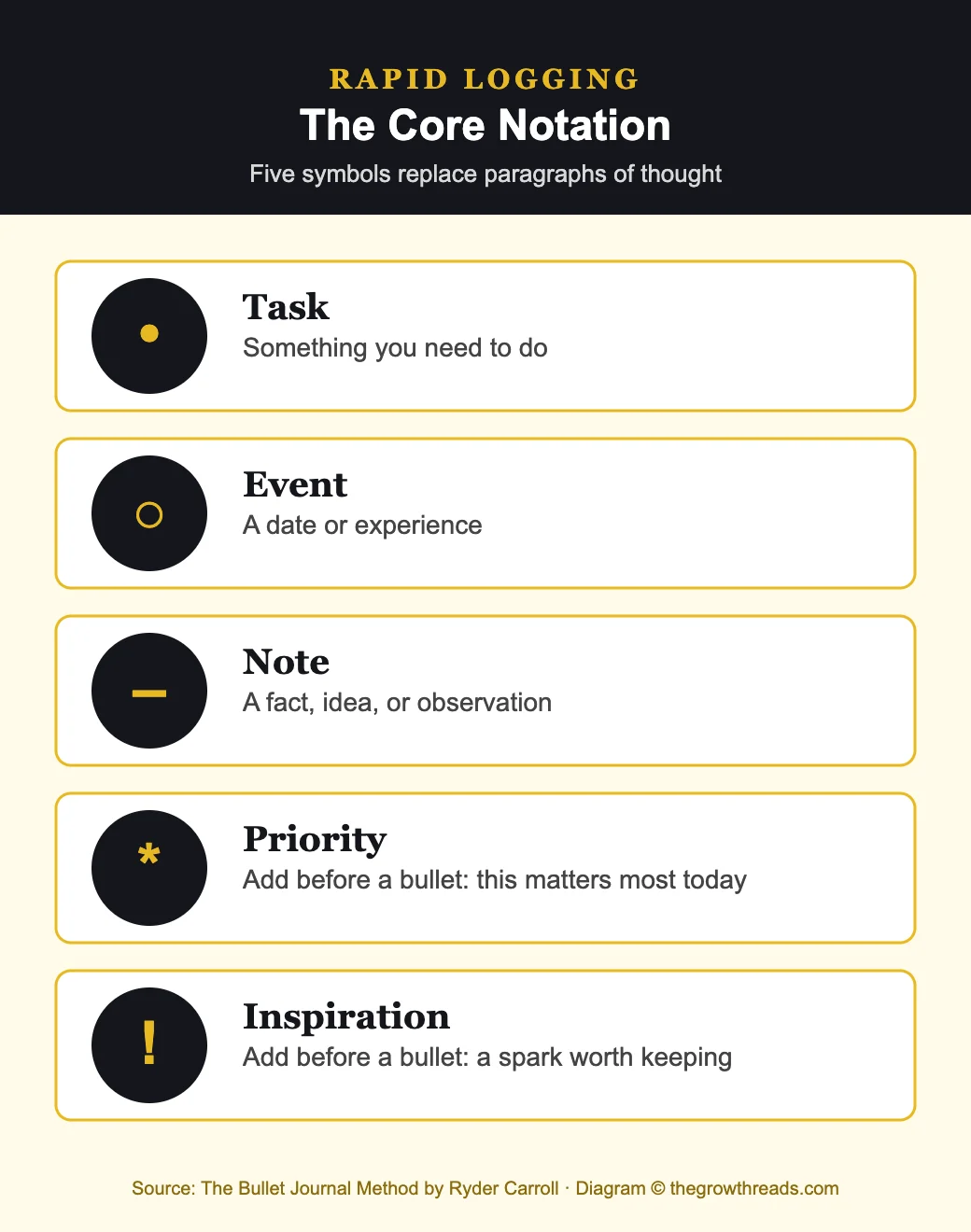
- Five signifiers carry all the meaning you need: a dot for tasks, a circle for events, a dash for notes, plus a star for priority and an exclamation point for inspiration.
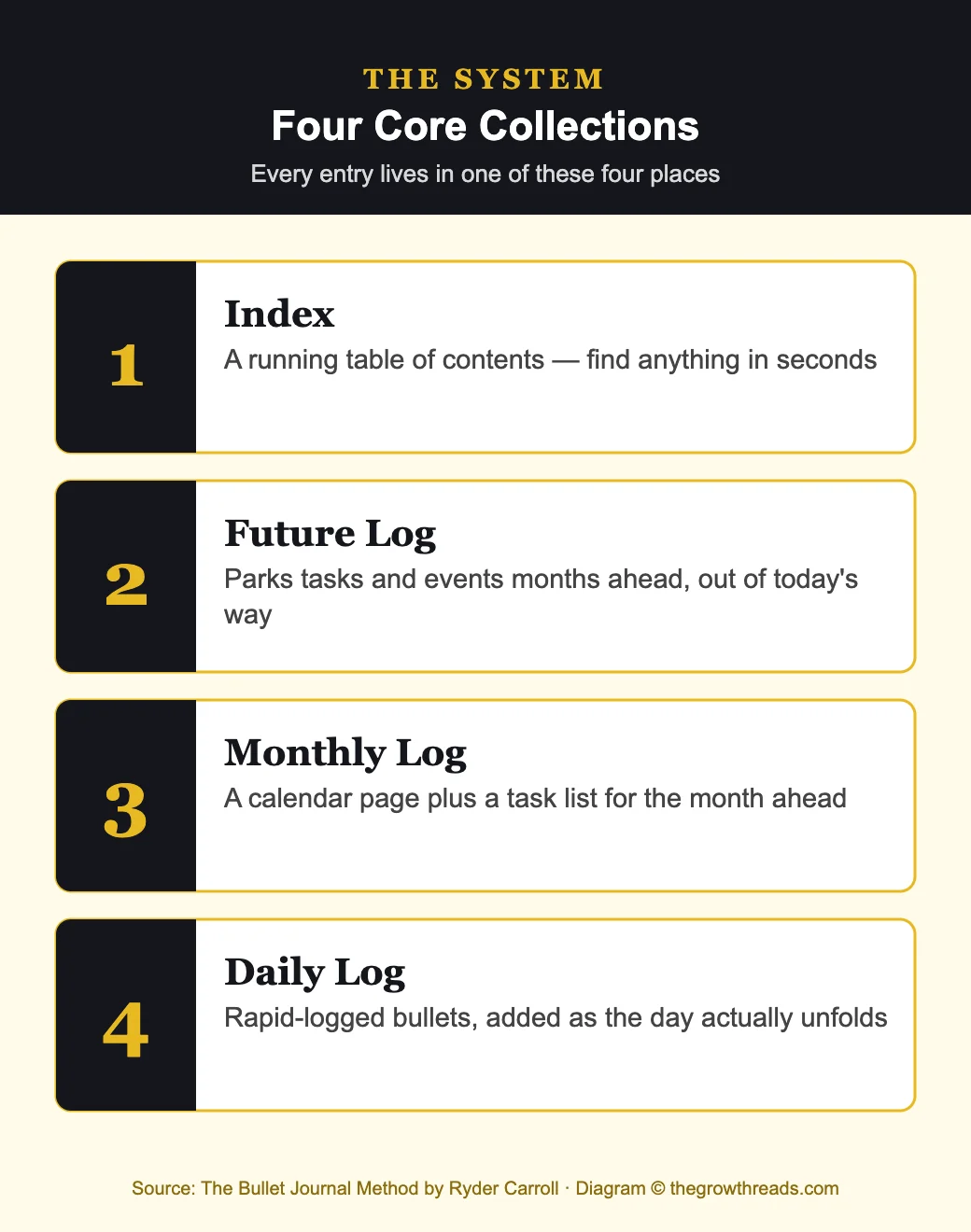
- The notebook runs on four core collections: an Index, a Future Log, Monthly Logs, and Daily Logs, each holding information at a different time horizon.
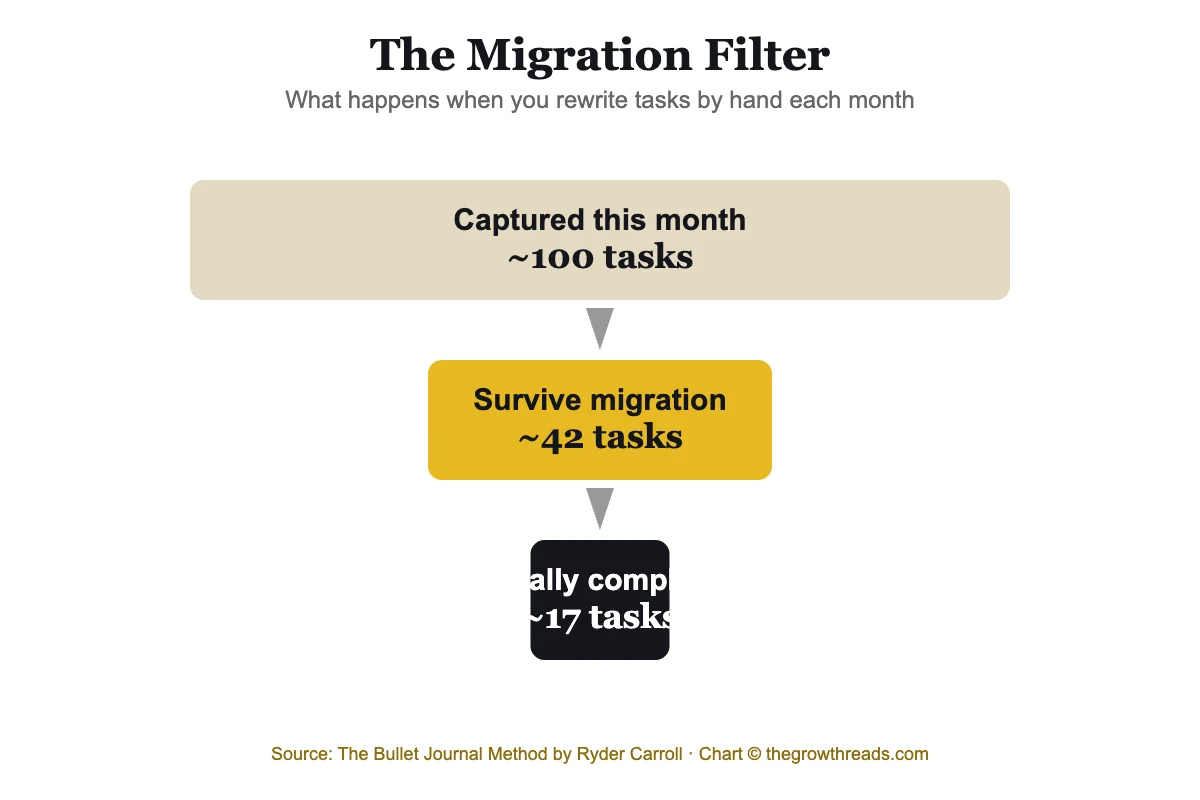
- Migration is the method’s real engine: unfinished tasks aren’t just carried over, they’re hand-copied, which forces you to reconsider whether they’re worth keeping.
- Most tasks don’t survive migration, and that’s the point: the friction of rewriting something filters out obligations you never actually intended to do.
- Collections keep related information together: custom lists for books to read, gift ideas, or a project’s moving parts live in their own section, indexed for instant retrieval.
- Threading connects related entries across the notebook: a simple page-number notation lets a single ongoing project be tracked across months without duplicating it.
- The system is analog on purpose: handwriting slows you down just enough to notice what you’re committing to, which digital tools rarely do.
- Productivity is a means, not the goal: Carroll frames the whole practice as “intentional living,” using the page to keep your actions aligned with what actually matters to you.
What is The Bullet Journal Method about?
The Bullet Journal Method (2018) by Ryder Carroll is a guide to an analog organizational system that combines a to-do list, planner, and diary in one notebook. It teaches Rapid Logging notation, four core collections, and a monthly migration habit that filters tasks down to what genuinely matters, framing the whole practice as a tool for intentional living rather than pure output.
About the author
Ryder Carroll is a digital product designer based in Brooklyn, New York, and the creator of the Bullet Journal, an analog organizational method that began as a personal fix for his own restlessness. Diagnosed with attention deficit disorder as a child, Carroll spent years testing planners, apps, and to-do systems that never quite stuck, eventually distilling what worked into a simple notation he used privately for over two decades. In 2013 he posted a short video explaining the method online, and it spread into a global movement with millions of practitioners. His 2018 book, The Bullet Journal Method, expanded the practice beyond productivity into what he calls intentional living, using a notebook to notice what actually matters. He has given a TEDx talk on intentionality and consulted for companies including Adidas, IBM, and American Express. Explore all Ryder Carroll book summaries →
Key concepts at a glance
| Concept | What it means | Use it when |
|---|---|---|
| Rapid Logging | Short, symbol-based notation for tasks, events, and notes | You need to capture a thought in under five seconds |
| Signifiers | A star or exclamation point added before a bullet to flag priority or inspiration | A handful of entries need to stand out from the rest |
| Index | A running table of contents at the front of the notebook | You need to find a collection you logged weeks ago |
| Future Log | A holding page for tasks and events more than a month away | Something is real but not yet actionable |
| Monthly Log | A calendar spread plus a task list for the coming month | You’re planning the next four weeks |
| Daily Log | Rapid-logged entries added as the day unfolds | You’re capturing what’s actually happening today |
| Migration | Hand-copying unfinished tasks forward, or crossing them out | A month or notebook ends and it’s time to reassess |
| Threading | Noting a page number to link related entries across the notebook | A project or topic spans more than one collection |
Part 1: The Foundation — Rapid Logging & Core Notation
Carroll starts from a diagnosis, not a productivity hack: most systems fail because they demand full sentences for thoughts that arrive as fragments. Rapid Logging is his fix, a shorthand of bullets. A dot marks a task, an open circle marks an event, a dash marks a note. Two modifiers sit in front of any bullet: a star for something urgent enough to reorder your day around, and an exclamation point for an idea worth protecting before it evaporates. Carroll deliberately kept the vocabulary small, five symbols, memorizable in a minute, because a notation system that requires a legend defeats the purpose of writing fast. Each entry also gets a short, specific label: not “email stuff” but “email Sarah re: Q3 budget,” because vague tasks are the ones that quietly survive months of migration without ever getting done. Completed tasks get an X through the bullet; tasks that no longer apply get struck through entirely; tasks that move get a small arrow indicating where they went. The notation compounds: after a week of use it becomes as automatic as shorthand, and the page starts to read less like a to-do list and more like a lightly annotated diary of the day.
TGR Note: Readers who liked Atomic Habits‘ emphasis on small, repeatable cues will recognize the same logic here — Carroll isn’t asking for willpower, he’s asking for a smaller, faster action (one symbol) that’s easier to repeat than a full sentence.
Part 2: The Four Collections — Building Your System
Individual rapid-logged entries only become a system once they’re organized into collections, and Carroll’s book leans on four in particular. The Index sits at the front of the notebook and simply records which page holds which collection, so a notebook with no chapters becomes searchable in seconds — you flip to the index, not through fifty pages of daily entries. The Future Log holds anything real but not yet actionable: a friend’s wedding six months out, a subscription renewal, a goal you’re not ready to break into steps yet. It exists so today’s page doesn’t get cluttered with things you can’t act on today. The Monthly Log is a two-page spread: a bare calendar on the left for anything date-specific, and a task list on the right for everything else you intend to get to that month. The Daily Log is where Rapid Logging actually happens, a running, undated-until-you-date-it list of tasks, events, and notes, added continuously rather than planned in advance. Carroll also describes optional Custom Collections, packing lists, reading lists, meeting notes, habit trackers, that live wherever you started them and get indexed like anything else. The distinction between these four buckets is what keeps the notebook from turning into an undifferentiated wall of text.
TGR Note: This layered structure is close in spirit to Building a Second Brain‘s idea of capturing now and organizing later, except Carroll’s version needs no software, just a pen and the discipline to flip to the index instead of a search bar.
Part 3: Migration — The Practice of Letting Go
The chapter on migration is where the book stops being a notebook format and becomes a philosophy. At the end of each month, Carroll has you look at every unfinished task in the current Monthly Log and ask three questions before copying it forward: is it still relevant, will you actually do it, and does it still serve you. If the answer to any of those is no, the task gets crossed out, not completed, just released. If the answer is yes, you don’t just draw an arrow to the next page; you physically rewrite the task in the new Monthly Log. That extra ten seconds of handwriting is deliberate friction. Carroll’s own tracking, and the experience of the millions who’ve adopted the method, shows that a large share of tasks quietly fail this test — things that felt urgent in week one look optional by week four once you have to justify rewriting them. Migration also happens at a larger scale, when a notebook fills up and its entire contents get triaged into a new one, which doubles as a natural point to notice patterns: recurring notes-to-self, goals that keep getting deferred, collections nobody’s opened in months. Carroll’s argument is that this isn’t wasted time. The alternative, infinite scroll in a to-do app where nothing needs to be rewritten and nothing therefore gets reconsidered, is why so many digital lists silently balloon into hundreds of items nobody looks at.
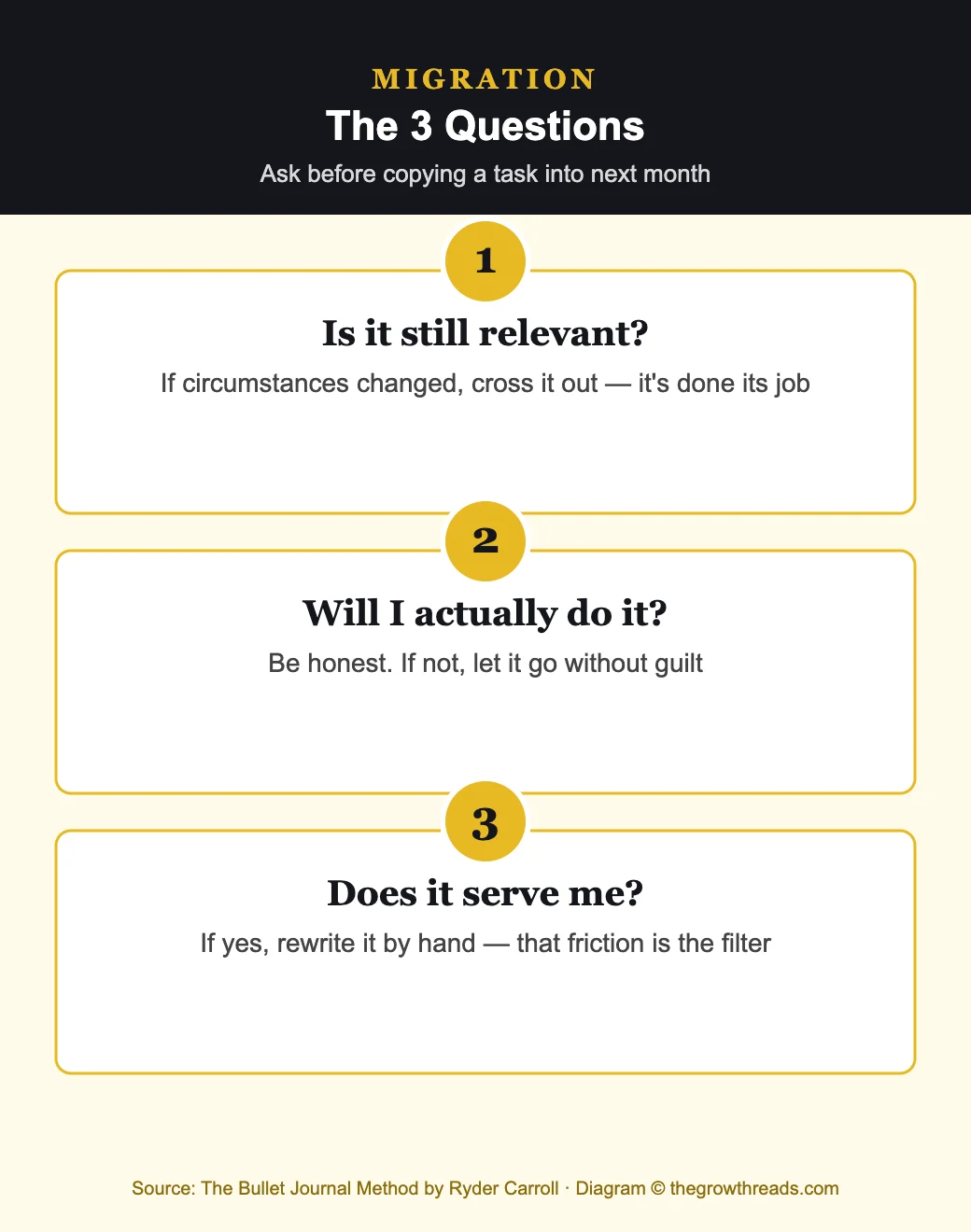
TGR Note: If migration sounds like it overlaps with the prioritization habits in other productivity books, the difference is timing — most systems ask you to prioritize once, in the morning; migration forces a repeat prioritization every single month, which is why old tasks don’t survive as long here as they do in a plain digital list.
Part 4: Intentionality — From Productivity to Purpose
The last third of the book is the part most readers don’t expect from a notebook system, and it’s arguably the reason the method spread as far as it did. Carroll argues that getting more done is not, by itself, a meaningful goal — it’s easy to be extremely productive at things that don’t matter. He introduces the idea of asking “why” before adding almost any task: why does this deserve space in the notebook, and by extension, space in your day. Recurring, unexamined tasks, the ones that get migrated forward for the third or fourth month in a row without being questioned, are treated as data, not failures: they usually point either to a task that isn’t actually a priority, despite how it feels, or to a goal important enough that it needs to be broken into a real plan instead of sitting on a list. Carroll also devotes attention to reflection as a scheduled practice rather than an occasional afterthought: short daily reflections to close out the page, and longer monthly and yearly reflections that ask what actually mattered, not just what got checked off. The book closes by reframing the entire method: the notebook isn’t the point. It’s a tool for noticing, your patterns, your avoidances, your actual priorities, clearly enough that you can act on them on purpose instead of by default.
TGR Note: This is the same territory Four Thousand Weeks covers from a different angle — both books conclude that the real productivity problem is choosing what deserves your limited time, not squeezing more tasks into it.
Who is The Bullet Journal Method best for — and who should read something else first?
This book is best for people who feel scattered across five different apps and want to consolidate onto paper, for anyone who’s abandoned planners before because they felt too rigid, and for readers who want a system flexible enough to double as a to-do list, a diary, and a project tracker. It particularly suits people who process thoughts better by writing them by hand than by typing them.
If you’re already fully committed to digital tools and don’t want to give them up, Building a Second Brain applies similar capture-and-organize thinking to apps and notes software instead of paper. If your main problem is distraction rather than organization, Digital Minimalism tackles that more directly. And if you want the habit-formation research behind why small daily systems like this one stick, Atomic Habits is the natural companion read.
Questions to reflect on
- Which three tasks on your current to-do list have been migrated forward more than twice without being finished, and why?
- If you couldn’t check anything off today, what would still have made it a good day?
- Where in your week do you rely on an app to remember something a pen could hold just as well?
- What’s one collection, a list, a log, a tracker, you keep meaning to start but haven’t given a page to yet?
- When you look back at last month, what took up the most time that you wouldn’t choose again?
🔥 Ready to get organized on paper?
Grab The Bullet Journal Method and start your first Future Log tonight.
How to apply The Bullet Journal Method (7-day plan)
- Day 1: Buy any notebook (grid or dot paper helps but isn’t required) and set up an Index on the first two pages, leaving the page numbers blank for now.
- Day 2: Learn the five signifiers, task, event, note, priority, inspiration, and start a Daily Log using only Rapid Logging, no full sentences.
- Day 3: Set up your first Monthly Log: a bare calendar for dated items, a task list for everything else you intend to do this month.
- Day 4: Start a Future Log for anything real but more than a month away, so it stops cluttering today’s page.
- Day 5: Create one Custom Collection for something you actually need, a reading list, a project’s moving parts, or a habit tracker.
- Day 6: Do a short daily reflection: cross out what’s done, note what’s not, and ask which unfinished tasks you’d actually rewrite by hand.
- Day 7: Practice a mini migration: pick five unfinished tasks and put each through the three migration questions before deciding whether to carry it forward.
Frequently asked questions
Do I need a special notebook to bullet journal?
No — any notebook works, including the classic composition books Carroll started with. Dot-grid paper is popular because it makes drawing tables, trackers, and calendars easier than lined paper, and it’s less visually busy than graph paper, but it’s a preference, not a requirement of the method. What matters more is a notebook you’ll actually carry and open daily, since the system only works if entries happen close to real time rather than being reconstructed from memory later. Many longtime users start with a plain notebook and only upgrade once they know which features they actually use.
Is Bullet Journaling the same as the decorative journals I see online?
Not necessarily. The elaborate, hand-illustrated spreads popular on social media are one style built on top of the method, but Carroll’s original system is explicitly function over decoration: plain bullets, minimal art, and speed over aesthetics. The book itself recommends ignoring the artistic pressure if it gets in the way of actually using the notebook daily. A functional page with crossed-out bullets and no color can be just as correct a Bullet Journal as an elaborately decorated one; the test Carroll uses is whether the system helps you track, organize, and reflect.
How long does it take to see results?
Most new users report the notation feeling natural within one to two weeks, since it only involves five symbols. The bigger shift, trusting the notebook instead of your memory or a phone, tends to take a full monthly cycle, because the first migration is where the method’s real value shows up: you can directly see which tasks survived being rewritten and which quietly disappeared. Carroll frames the first month as a trial run rather than a verdict, and recommends completing at least one full migration before deciding whether the system fits your habits.
Can I use a Bullet Journal alongside digital tools like a phone calendar?
Yes, and most practitioners do. Carroll doesn’t argue for abandoning digital tools entirely, he uses a phone calendar himself for shared or recurring events, but suggests keeping personal task capture, notes, and reflection on paper, where handwriting slows you down enough to filter out noise. A common hybrid approach is a digital calendar for anything that needs to sync with other people, paired with a paper Bullet Journal for personal tasks, ideas, and the monthly migration ritual that a shared calendar can’t easily replicate.
What if I fall behind and miss several days of logging?
This is common and the method is built to tolerate it. Because entries are dated individually rather than tied to pre-printed pages, you simply pick up on the day you resume, there are no blank pages to feel guilty about, unlike a traditional planner. Carroll suggests a brief catch-up migration: skim back over the missed days, pull forward anything still relevant, and let the rest go. The flexibility to skip periods without breaking the format is one reason the system tends to survive busy weeks better than app-based streaks do.
Is this method backed by research, or is it just Carroll’s personal experience?
The book is primarily experiential, Carroll developed the system for his own attention challenges over two decades before writing about it, but its core mechanisms align with established ideas in cognitive psychology, including externalizing memory to reduce mental load and using specific, well-defined tasks to boost follow-through. The book doesn’t present clinical studies of its own, and results are necessarily anecdotal and individual, but the underlying logic has support elsewhere in the productivity and psychology literature.
How is this different from a regular planner or to-do app?
A regular planner pre-prints dates and structure whether you need them or not, and a to-do app lets tasks accumulate indefinitely without ever forcing a review. The Bullet Journal Method’s structure, Index, Future Log, Monthly Log, Daily Log, is built as you go, so you never pay for a January page in a year you stop using the notebook in October. The migration step is the sharper difference: unlike an app where old tasks sit untouched, the notebook makes leaving something un-migrated the default, so unfinished, unimportant tasks are naturally weeded out rather than piling up.
Related summaries
- Atomic Habits — the habit-formation research behind why small daily systems like this one stick.
- Getting Things Done — a more exhaustive, work-oriented system for capturing and processing tasks.
- Building a Second Brain — the digital-first version of capture, organize, reflect.
- Digital Minimalism — for readers whose real problem is distraction, not disorganization.
See all the best productivity books we’ve reviewed →
How we analyze books: our team reads each title in full, cross-references the author’s other interviews and essays, and tests the frameworks described before writing a summary. We focus on practical application over academic critique. Read our full methodology.