

The verdict: The Algorithmic Leader is a practical playbook for executives and managers who feel the ground shifting under their judgment as data and algorithms move into daily decision-making. Mike Walsh argues the leaders who thrive won’t out-compute machines — they’ll out-think them, by pairing an “algorithmic mindset” with the distinctly human judgment machines still can’t replicate.
Best for: managers and executives leading teams that already use data tools and AI, and anyone who wants a structured way to build evidence-based decision habits without losing their own judgment.
\n
The Algorithmic Leader in one minute
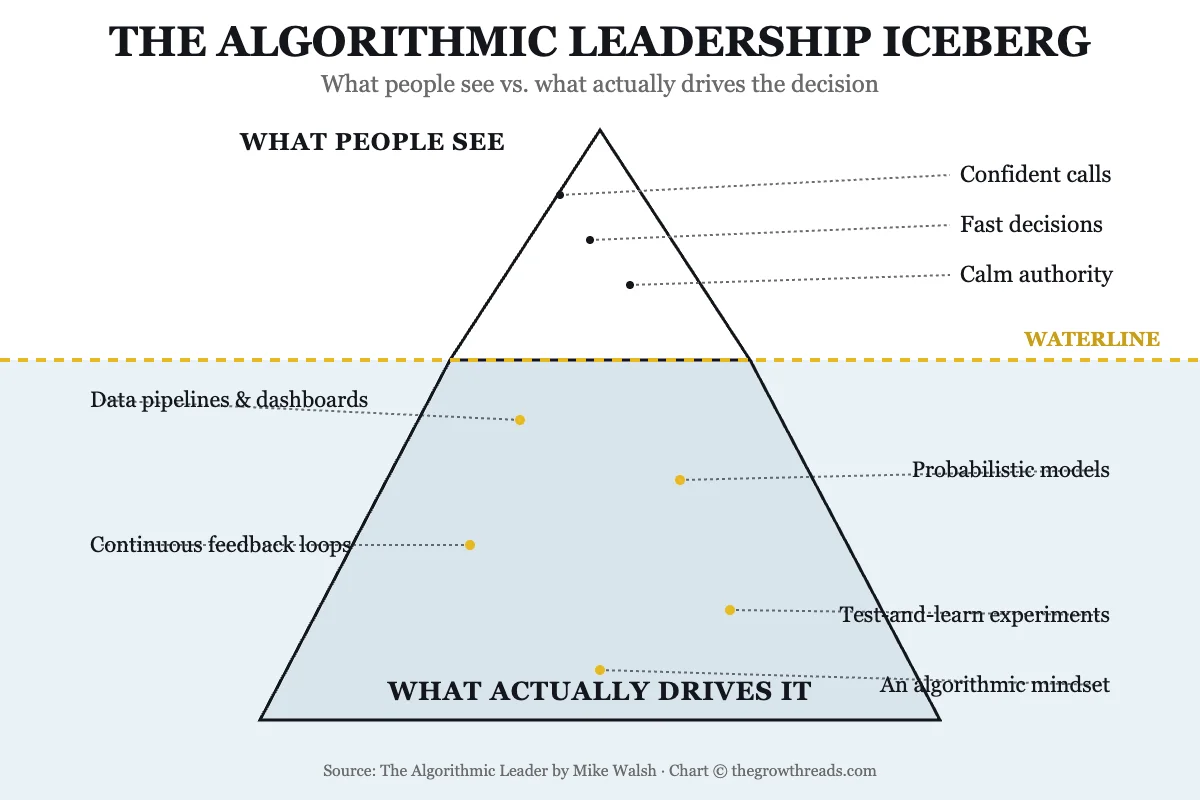
Mike Walsh, a global futurist and CEO of the consultancy Tomorrow, wrote The Algorithmic Leader for a very specific moment: the point where algorithms move from back-office tools into the center of how organizations decide, hire, price, and plan. His core claim is that leadership itself has to change shape. For most of business history, seniority and experience were the main credentials for good judgment. In an algorithmic age, Walsh argues, the best decisions increasingly come from combining machine-generated evidence with human context — and the leaders who resist that shift, treating algorithms as a threat to their authority rather than a new kind of colleague, will be outpaced by those who don’t.
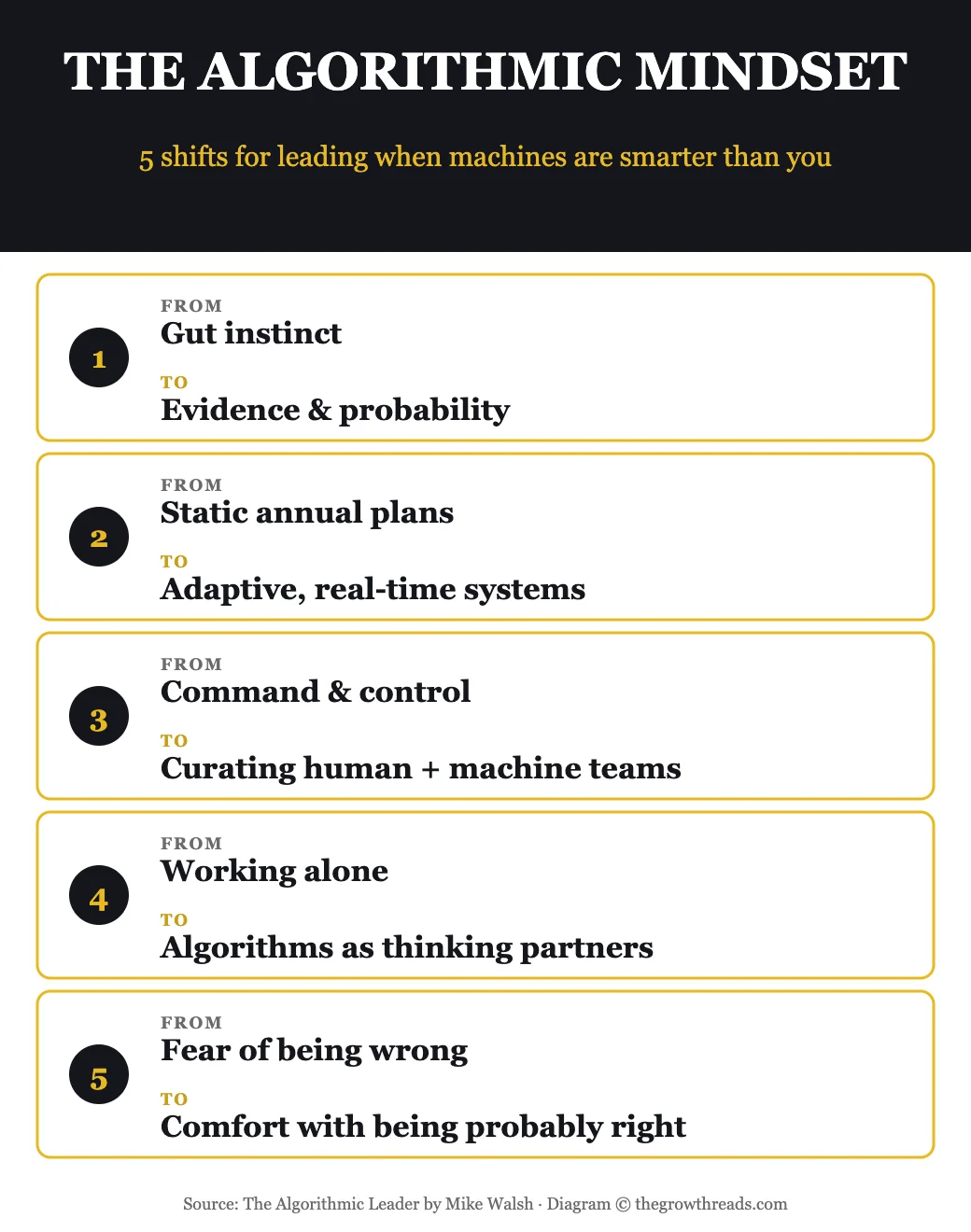
The book is less a technology primer than a leadership-behavior manual. Walsh spends little time on how machine learning models work under the hood and a great deal of time on how leaders should think, question, delegate, and build teams once those models are already running in the business. The throughline is what he calls the “algorithmic mindset” — a discipline of breaking problems into testable questions, trusting evidence over instinct when the two conflict, and treating every process as a draft that data can improve.
\n
Key takeaways
- Judgment is shifting from experience-based to evidence-based. Intuition built on years of pattern-matching is being supplemented — and sometimes outperformed — by models trained on far more data than any one career can accumulate.
- Algorithms are thinking partners, not replacements. The goal isn’t to hand decisions to machines; it’s to use their outputs as a faster, wider-angle input into a decision a human still owns.
- The algorithmic mindset is a personal skill before it’s an organizational one. Leaders have to practice testable, evidence-first thinking themselves before they can credibly ask a team to work that way.
- Culture, not tooling, is the real bottleneck. Most organizations that stall on AI adoption already have the technology; what they lack is a leadership habit of acting on what it shows them.
- Good algorithmic leadership asks better questions. The differentiator isn’t having answers — it’s knowing which questions to hand to data and which still require human context, values, and accountability.
- Small, continuous experiments beat big, occasional bets. Walsh favors a test-and-learn cadence over sweeping annual strategy calls, because it lets evidence correct course before mistakes compound.
\n
\n
\n
What is The Algorithmic Leader about?
At its center, The Algorithmic Leader is about the changing nature of authority. Walsh opens from a simple observation: for most of the twentieth century, a leader’s value came from accumulated experience — the ability to recognize a situation from having seen something like it before. That kind of pattern-matching is exactly what modern machine learning does at a scale no individual career can match. A model trained on millions of transactions, claims, or interactions can surface patterns a 30-year veteran would never encounter directly. That doesn’t make the veteran obsolete, Walsh argues, but it does mean their judgment now has to be paired with — and sometimes overruled by — evidence the algorithm surfaces.
The book is organized as a practical case for building what Walsh calls “algorithmic leadership” at three levels: the individual leader’s own thinking habits, the way they build and manage teams that blend human and machine work, and the culture and governance an organization needs so that algorithmic thinking doesn’t stay confined to a data science department. Rather than a chronological narrative, it reads more like a field guide, moving from personal mindset to team design to organizational capability, with real examples drawn from companies Walsh has advised through his consultancy, Tomorrow.
A recurring theme is that the shift is not really about technology adoption — most large organizations already have more data and more tooling than they use well. The bottleneck is leadership behavior: whether executives are willing to let evidence change their minds, whether they build teams that can test ideas quickly, and whether they’re comfortable delegating parts of decisions to systems while still owning the outcome. Walsh’s angle throughout is constructive rather than alarmist — he treats the algorithmic shift as an opportunity for leaders willing to adapt their habits, not a countdown to obsolescence.
Walsh also spends time on a subtler point: algorithmic leadership changes the emotional texture of decision-making, not just the mechanics. Leaders who are used to being the most experienced person in the room have to get comfortable being corrected by a dashboard, in front of their team, on a regular basis. He argues this requires a specific kind of confidence — not the confidence of always being right, but the confidence to update publicly and quickly without it reading as weakness. Organizations that reward leaders for holding a position rather than updating it, he suggests, will struggle to build this culture no matter how good their data infrastructure is.
\n
About the author
Mike Walsh is a global futurist and the CEO of Tomorrow, a consultancy that helps executive teams navigate disruptive technological change. Based across New York, Shanghai, and Sydney, he has spent two decades advising the leadership of Fortune 500 companies, governments, and global institutions on what it takes to lead in an algorithmic age. Walsh is a sought-after keynote speaker who has addressed audiences at the World Economic Forum, NASA, and Singularity University. He is the author of several books on the future of business and technology, including Futuretainment and The Dictionary of Dangerous Ideas, alongside The Algorithmic Leader, which distills his consulting work into a practical guide for executives. Explore all Mike Walsh book summaries →
\n
Key concepts at a glance
| Concept | What it means |
|---|---|
| Algorithmic mindset | A discipline of treating decisions as testable hypotheses rather than calls made purely on instinct or seniority. |
| Machines as thinking partners | Using AI outputs as an input to a human decision, not a replacement for one. |
| Evidence over intuition | Letting data override experience-based hunches when the two disagree, rather than defaulting to “what’s worked before.” |
| Test-and-learn cadence | Running frequent small experiments instead of big, infrequent strategic bets. |
| Human-in-the-loop design | Structuring workflows so people retain oversight and accountability even as machines handle more of the analysis. |
| Algorithmic culture | An organization-wide habit of acting on evidence, extended beyond the data team to every function and level. |
\n
Part 1: Why Intuition Alone Isn’t Enough Anymore
Walsh begins by dismantling a comfortable assumption: that experience is the most reliable guide to good decisions. He doesn’t argue experience is worthless — only that it’s incomplete in a world where machines can process patterns across far more cases than any career provides. A veteran manager’s gut sense is built from a few hundred or thousand personally observed situations; a well-trained model can draw on millions. The two aren’t in competition so much as operating at different scales, and Walsh’s point is that ignoring the second because you trust the first is now a real competitive liability.
He’s careful to frame this as an augmentation story rather than a replacement story. The chapters here build the case that judgment itself is evolving: instead of asking “what does my experience tell me,” algorithmic leaders learn to ask “what does the evidence tell me, and where does my experience add context the data can’t capture.” That combination — not a wholesale handover to machines — is what Walsh means by algorithmic leadership.
TGR Note: This lands well alongside Daugherty and Wilson’s Human + Machine, which makes a similar case for the “missing middle” of hybrid human-AI work — Walsh’s contribution is a sharper focus on what individual leaders need to change about their own thinking first.
\n
\n
Part 2: Building the Algorithmic Mindset
The next section turns from diagnosis to practice: how does a leader actually build this evidence-first way of thinking? Walsh describes it as a set of everyday habits rather than a one-time training. Leaders start treating assumptions as hypotheses worth testing instead of truths worth defending. They get comfortable saying “let’s find out” instead of “here’s what I think,” and they build a tolerance for being wrong quickly and cheaply through small experiments, rather than being wrong slowly and expensively through big decisions made on instinct alone.
A central practice is learning to ask better questions of data and of the people who work with it — not becoming a data scientist, but becoming literate enough to know what a model can and can’t tell you, and confident enough to push back when its output doesn’t match the context you know that it’s missing. Walsh frames this as a form of intellectual humility paired with rigor: trusting evidence more, but also interrogating it more, rather than either blindly deferring to an algorithm or dismissing it out of hand.
TGR Note: This mindset-first approach mirrors what we’ve seen in The Book of Why‘s emphasis on asking causal questions rather than settling for correlation — both books push readers to interrogate data rather than simply consume its outputs.
\n
Part 3: Leading Machines and People Together
With the individual mindset established, Walsh moves to team and workflow design. This is where the book gets most concrete about organizational change: how do you structure a team so that human judgment and machine analysis reinforce each other instead of working in separate silos? His answer centers on human-in-the-loop design — workflows where algorithms handle the pattern-recognition and heavy-lifting analysis, but a person retains a clear decision point and clear accountability for the outcome.
Walsh is pragmatic about the limits of automation here. He argues that the highest-value roles for algorithms are ones with lots of repeatable data and low ambiguity, while the highest-value roles for humans are ones requiring context, values judgments, or accountability to people outside the system. Getting that division right, more than the sophistication of the technology itself, is what separates teams that get real value from AI from teams that just bolt a dashboard onto an unchanged process.
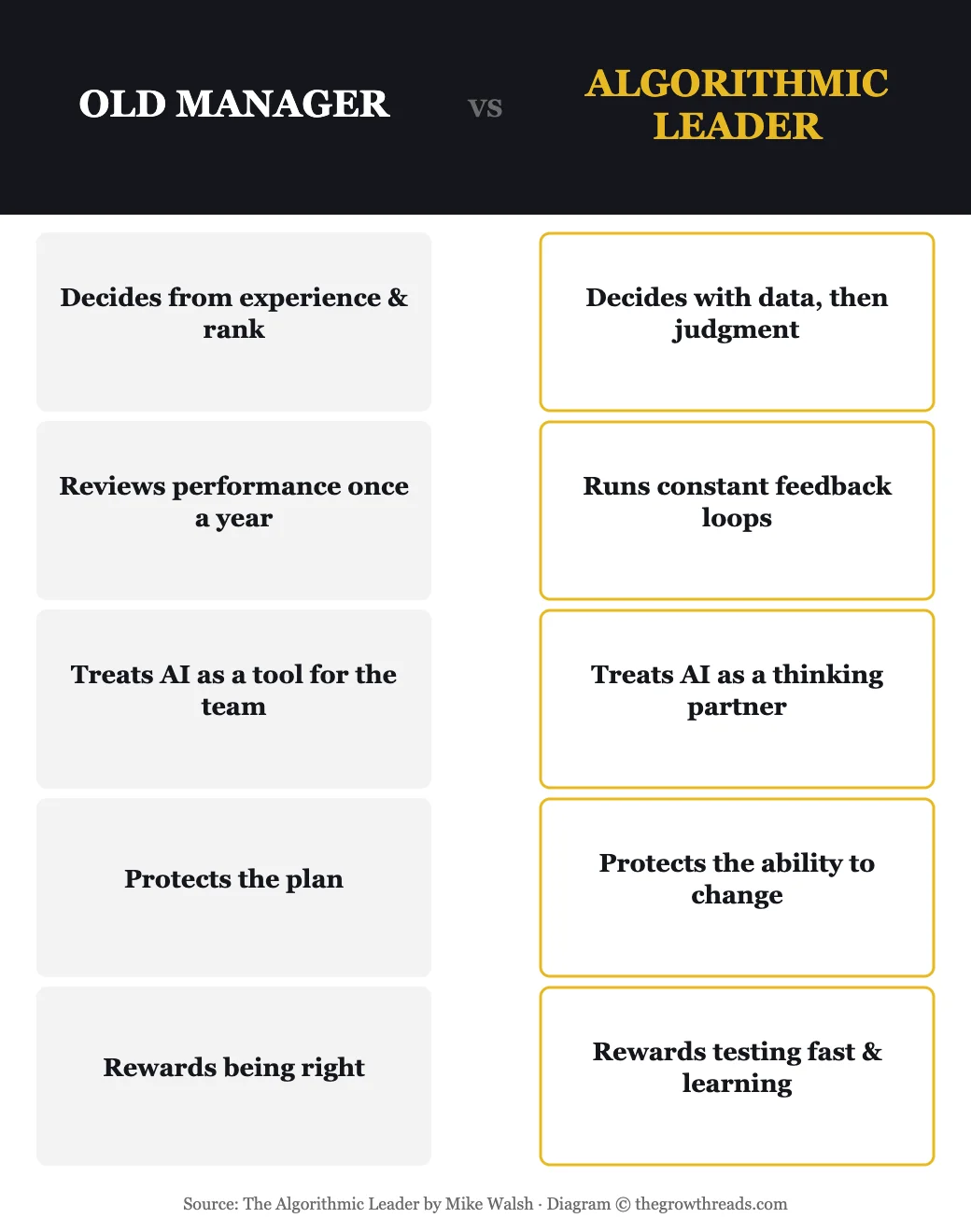
TGR Note: The contrast Walsh draws between old command-and-control management and algorithmic team leadership is one of the clearest parts of the book — see the comparison infographic below for the shorthand version.
\n
\n
Part 4: Designing an Algorithmic Culture
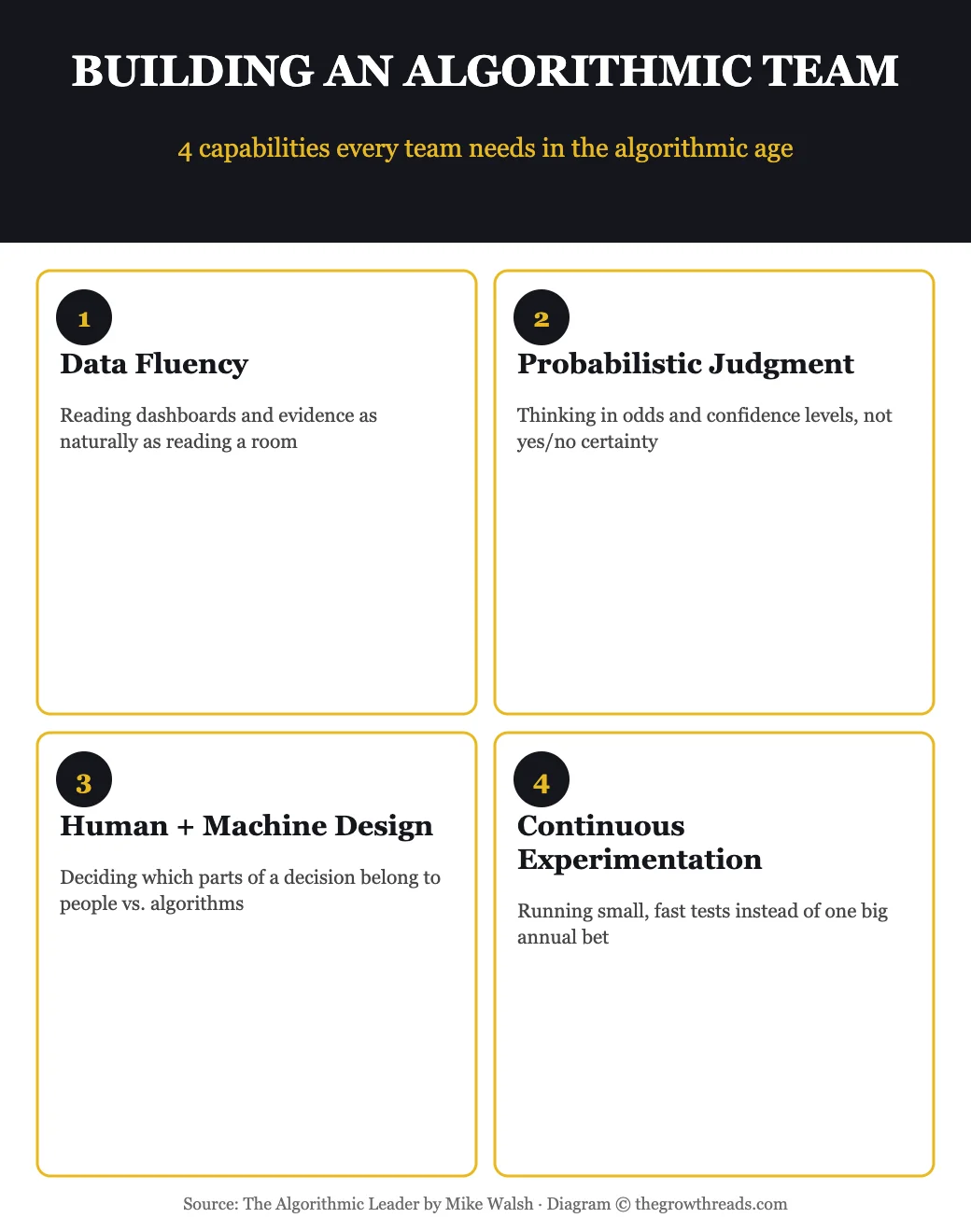
The final section widens the lens from teams to whole organizations. Walsh argues that algorithmic leadership fails to scale when it stays confined to a handful of enthusiastic managers or a data science function; it needs to become part of how the organization governs itself — how decisions get reviewed, how experiments get funded, and how success gets measured. He lays out the capabilities an organization needs to build this kind of culture deliberately, from psychological safety around being wrong in public to shared literacy about what data can and can’t answer.
He’s also candid that this is a governance and ethics question, not just a performance one. Leaders who build algorithmic culture without also building accountability for how models are used and audited are setting up for backlash later. The chapters close on a hopeful note: organizations that do this well don’t just get faster or more efficient, they get leaders throughout every level who are more comfortable with uncertainty and better equipped to make calls under it — a capability Walsh sees as durable regardless of which specific technologies come next.
TGR Note: This organizational lens pairs naturally with The Ethical Algorithm‘s focus on building fairness and accountability into systems from the start — Walsh’s leadership focus and that book’s technical focus are complementary reads.
\n
\n
Who is The Algorithmic Leader best for…
- Managers and executives whose teams already use data tools or AI, but who feel their own decision-making habits haven’t caught up.
- Leaders being asked to “do more with AI” without a clear framework for what that should actually change day to day.
- Anyone building or scaling a team that blends human judgment with automated analysis, and wants a practical model for where the line between the two should sit.
- Readers who enjoyed Human + Machine or The Book of Why and want a leadership-focused companion rather than a technical or academic one.
It’s a less natural fit for readers looking for deep technical detail on how machine learning models are built, or for a step-by-step change-management manual with org charts and templates — Walsh stays at the level of mindset and principle rather than implementation mechanics. Readers earlier in their career, without a team or budget to redesign, may also find the leadership-focused framing less directly actionable than the mindset-building ideas in Parts 1 and 2, which apply at the individual level regardless of seniority.
\n
Questions to reflect on
- Where in your own role do you currently trust experience over evidence by default — and what would it take to test that instinct?
- Which decisions on your team would benefit most from being treated as testable hypotheses rather than settled calls?
- Do the people who use data and models on your team have the literacy to question their outputs, not just accept them?
- Where does your organization’s culture reward being right the first time over learning quickly from being wrong?
\n
\n
How to apply The Algorithmic Leader (7-day plan)
- Day 1 — Audit your defaults. Write down three recent decisions you made mostly on instinct. Would evidence have been available to test any of them first?
- Day 2 — Pick one hypothesis. Choose a single recurring decision on your team and reframe it as a testable question rather than a judgment call.
- Day 3 — Find the data you already have. Most teams have more relevant data sitting unused than they realize. Spend the day identifying it before asking for anything new.
- Day 4 — Design a small experiment. Set up the smallest possible test of your Day 2 hypothesis — a one-week pilot, an A/B split, or a single case study.
- Day 5 — Draw the human-in-the-loop line. For one workflow, map exactly which part should be evidence-driven and which part needs human judgment and accountability.
- Day 6 — Ask better questions in one meeting. Practice replacing “here’s what I think” with “let’s find out” at least once in a real decision-making conversation.
- Day 7 — Review and share. Look back at what the week’s small experiment showed, and tell your team one thing you changed your mind about because of evidence.
\n
Frequently asked questions
What is the main idea of The Algorithmic Leader?
That leadership judgment is shifting from being mostly experience-based to being evidence-based, and that the leaders who thrive will pair machine-generated data with human context rather than treating algorithms as a threat to their authority.
Is The Algorithmic Leader a technical book about AI?
No. It focuses on leadership behavior and mindset rather than the mechanics of how machine learning models work, making it accessible to readers without a technical or data science background.
Who should read The Algorithmic Leader?
Managers and executives whose teams already use data or AI tools and want a practical framework for adapting their own decision-making habits, rather than a general audience introduction to artificial intelligence.
How is this different from Human + Machine by Daugherty and Wilson?
Human + Machine focuses more on redesigning business processes around the “missing middle” of hybrid work, while The Algorithmic Leader focuses more narrowly on the individual leader’s own mindset and decision habits as the starting point for organizational change.
Does the book require a background in data science or statistics?
No prior technical background is assumed. Walsh writes for a general business audience and explains concepts like evidence-based decision-making and test-and-learn experimentation in plain language.
What is the “algorithmic mindset” Walsh describes?
A discipline of treating decisions as testable hypotheses, favoring evidence over pure instinct when the two conflict, and running small frequent experiments rather than infrequent big bets.
Are the book’s examples still relevant today?
The specific company examples reflect the state of AI adoption when the book was published in 2019; some tools referenced have since evolved, but Walsh’s core framework for leadership mindset and team design has aged well and remains a useful lens for current AI adoption debates.
\n
Related summaries
- Human + Machine by Paul R. Daugherty and H. James Wilson
- The Book of Why by Judea Pearl and Dana Mackenzie
- The Ethical Algorithm by Michael Kearns and Aaron Roth
\n
Our methodology: This summary is based on a close reading of the book, cross-checked against the author’s public interviews and talks, and written to help you decide whether to read the full book and apply its ideas. All quotes are attributed and kept brief; we do not reproduce the book’s proprietary frameworks in full.
\n
Related Technology Summaries
Co-Intelligence Summary & Review: How to Actually Work With AI
Rebooting AI Summary & Review: Why Deep Learning Alone Won’t Get Us to Trustworthy Machines
Scary Smart Summary & Review: How to Shape What AI Learns From Us
The Master Algorithm Summary & Review: Five Tribes, One Learning Machine
The Singularity Is Near Summary & Review: Why Kurzweil Thinks 2045 Changes Everything