

★★★★★ 4.6/5 — a holistic, deeply practical blueprint for building wealth across five compounding dimensions, not just your bank account.
Best for: Ambitious professionals and entrepreneurs who have hit financial success but still feel something is missing
Reading time: ~7 hrs to read the book, 12 min for this guide
Difficulty to apply: Moderate — the frameworks are simple, but the 5-guide system takes consistent monthly review
The 5 Types of Wealth in one minute
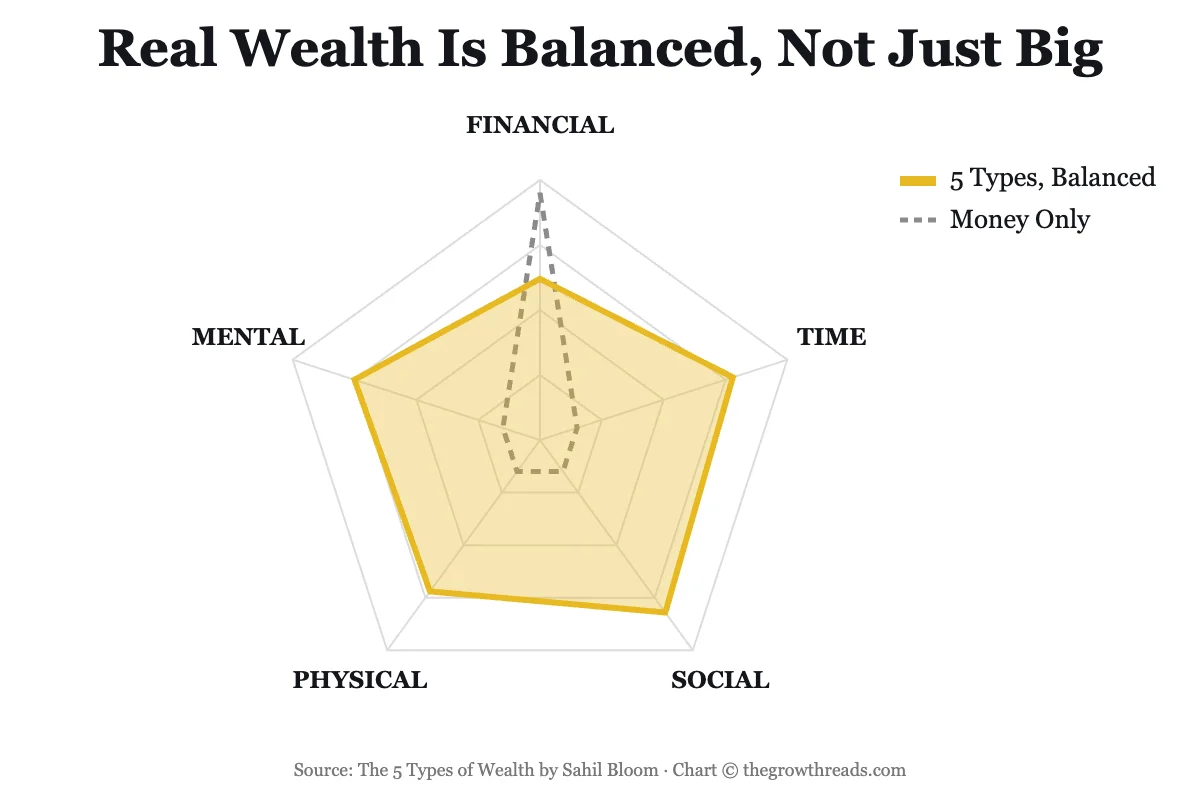
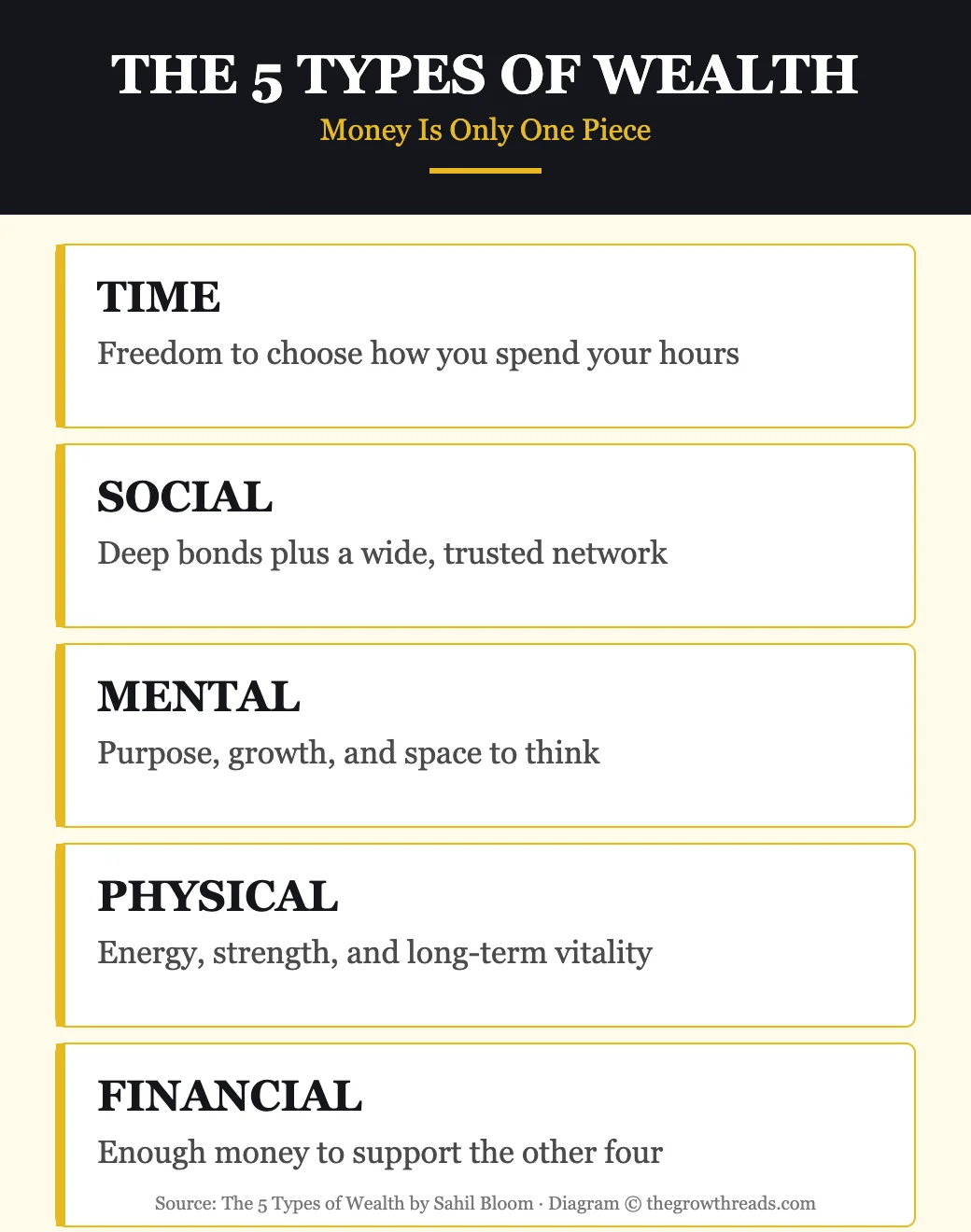
Money is not the finish line — it is one of five assets you are building, and neglecting the other four eventually taxes all of them. Sahil Bloom spent his twenties and early thirties chasing conventional success: a Stanford degree, four years on the baseball team, a career in private equity, a growing net worth. By his own account, he hit nearly every marker on the traditional scoreboard and still felt hollow. Digging into research, interviews, and a long-running birthday ritual of asking elders in their 80s and 90s what advice they would give their younger selves, he never once heard “make more money.” He heard about time, relationships, purpose, and health. The 5 Types of Wealth turns that pattern into a working system: five dimensions — Time, Social, Mental, Physical, and Financial Wealth — that you measure, prioritize, and build together, because progress in one quietly compounds into the others.
Key takeaways
- Money is one of five types of wealth, not the only one: Time, Social, Mental, Physical, and Financial wealth all compound, and ignoring any one for too long eventually taxes the rest.
- The “financial treadmill” is a psychological glitch: because money once solved real problems — rent, food, healthcare — your brain wrongly assumes more money will keep solving problems it can no longer touch.
- Calculate your Wealth Score before setting any goals: rate yourself 1–10 across all five types to see which ones are quietly draining while you focus on one.
- Time Wealth builds in three stages: awareness of where your hours actually go, attention on what matters most, and control to protect it.
- Kairos moments beat Chronos hours: a handful of meaningful moments with people you love outweighs a much larger stack of ordinary clock time.
- Social Wealth needs both depth and breadth: a tight inner circle for stability plus a wider network for opportunity, learning, and belonging.
- Mental Wealth compounds from purpose, growth, and space: find the overlap of what you love, what you are good at, and what the world needs.
- Physical Wealth rests on three basics: movement, nutrition, and recovery — none of which requires perfection, only consistency.
- Financial Wealth is a means, not the finish line: define your own number for “enough,” then redirect surplus energy toward the other four types.
- One Life Razor beats a dozen resolutions: a single identity-based sentence — “I’m the type of person who…” — makes daily trade-off decisions almost automatic.
What is The 5 Types of Wealth about?
The 5 Types of Wealth is Sahil Bloom’s 2025 framework for building a fulfilling life across five compounding dimensions — Time, Social, Mental, Physical, and Financial wealth — instead of chasing money alone. Drawing on research and personal interviews, Bloom shows readers how to measure, prioritize, and grow each dimension without quietly sacrificing the others.
About the author
Sahil Bloom is an American writer, investor, and former Stanford University baseball player turned entrepreneur. He graduated from Stanford with a BA in economics and sociology and an MA in public policy, then spent seven years as a private equity investor at Altamont Capital Partners before leaving finance to build his own platform. Bloom now reaches millions of readers each week through The Curiosity Chronicle, his biweekly newsletter on business, finance, and personal growth, and manages his own capital through SRB Ventures and SRB Holdings. The 5 Types of Wealth, published in February 2025, grew out of three years of research, personal experimentation, and what Bloom describes as thousands of conversations — including his own annual ritual of asking people in their 80s and 90s what advice they would give their younger selves. It debuted as an instant New York Times and USA Today bestseller. Explore all Sahil Bloom book summaries →
Key concepts at a glance
| Concept | What it means | Use it when |
|---|---|---|
| Wealth Score | A 1–10 self-rating across all five wealth types | You want a baseline before setting any goals |
| Life Razor | A one-sentence, identity-based rule for daily trade-offs | You keep making decisions that contradict your priorities |
| Financial Treadmill | The trap of assuming more money will keep solving problems | You have hit your income goals but still feel unsatisfied |
| Kairos vs. Chronos | Qualitative, meaningful time vs. quantitative clock time | You are deciding how to spend a free evening or weekend |
| Three Pillars of Time Wealth | Awareness, attention, control | You feel busy but never get to what matters |
| Depth and Breadth | Inner circle for stability, wide network for opportunity | You are building or auditing your relationships |
| The Overlap Method | Where what you love, what you are good at, and what is needed meet | You are searching for purpose or a career pivot |
| Definition of Enough | Your personal, specific number for financial security | You are deciding whether to chase the next raise or promotion |
| Anti-Goals | Outcomes you refuse to accept while pursuing a goal | You are setting yearly goals across all five wealth types |
Part 1: The Wealth Score — Redesigning What “Rich” Actually Means
Bloom opens with a confession: he built the career, the title, and the bank balance society told him to want, and none of it produced the satisfaction he expected. So he started asking a different question. Every year on his birthday, he would ask someone in their 80s or 90s the same prompt: “What advice would you give your younger self?” Across dozens of conversations, the answers clustered around relationships, health, purpose, and time — never money. Research backs the pattern up: beyond a baseline that covers food, shelter, and security, additional income does very little to move happiness. The problem is not that money is bad. The problem is that it makes a poor scoreboard, because there will always be someone richer than you, and the pursuit never resolves.
Bloom’s alternative is to track five types of wealth at once — Time, Social, Mental, Physical, and Financial — using a simple Wealth Score: rate your current satisfaction in each area from 1 to 10. The exercise is uncomfortable on purpose. Most people score high on the one or two dimensions they have been optimizing for years and low on the ones they have quietly let slide. From there, Bloom introduces the Life Razor — a single sentence, in the form “I’m the type of person who…,” that should be controllable (within your power regardless of circumstances), ripple-creating (it improves more than one area of life), and identity-defining (it describes who you actually want to be). Instead of relying on willpower for every individual decision, the Life Razor becomes a filter: when priorities collide, you ask what someone who lives by that sentence would do.
TGR Note: The Life Razor is a close cousin of the identity-based habits James Clear describes in our Atomic Habits summary — both argue that lasting change starts with a sentence about who you are, not a list of things you are trying to do. If you want the harder-edged, numbers-first version of “redefining rich,” read it alongside our Psychology of Money summary, which explains why the goalposts keep moving in the first place.
Part 2: Time Wealth and Social Wealth — The Two That Compound Fastest
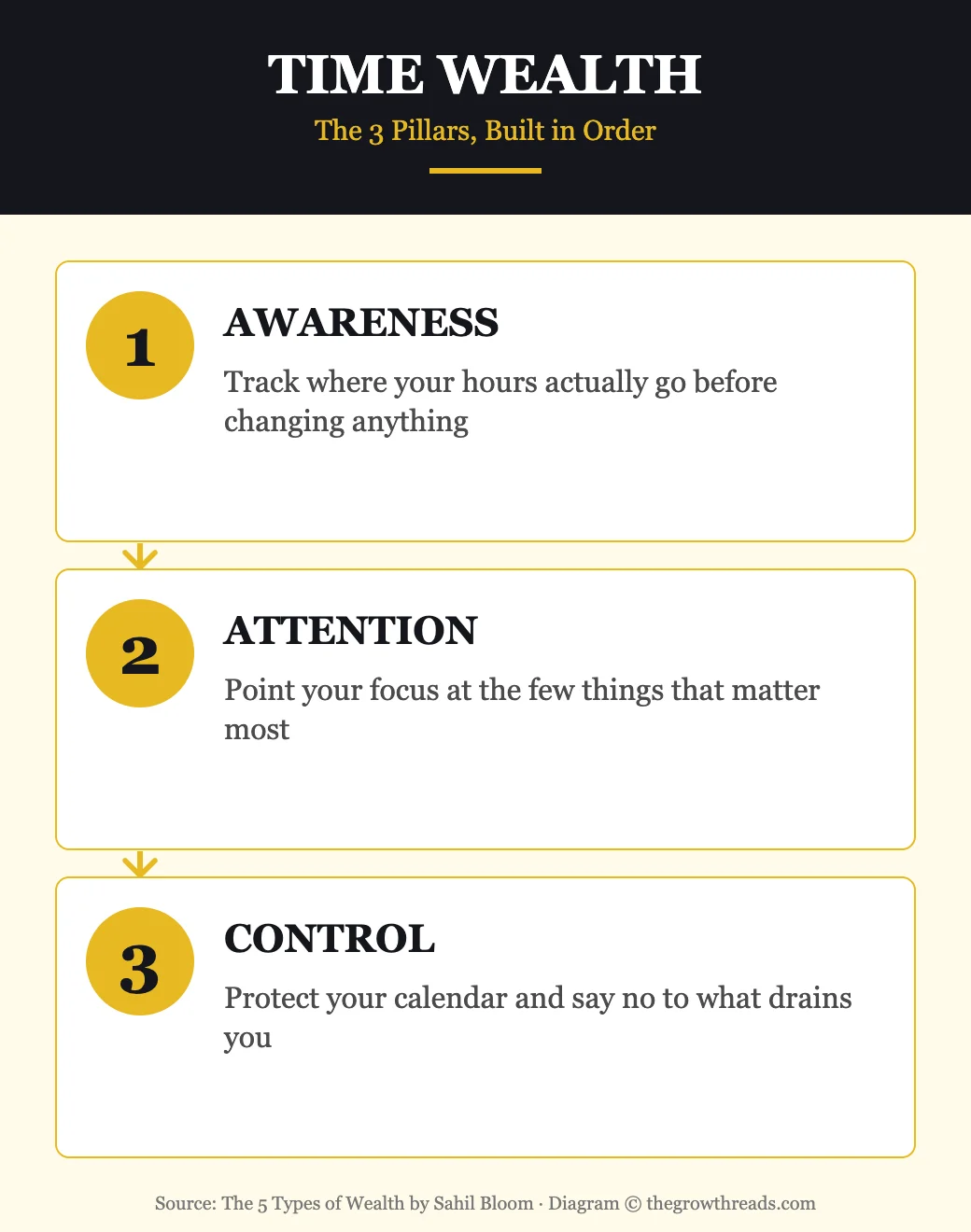
Time Wealth is not about squeezing more tasks into your day — Bloom is explicit that trying to do so usually makes people feel more time-poor, not less. He builds it in three progressive pillars. Awareness comes first: for one week, color-code your calendar green for energizing activities, yellow for neutral, and red for draining ones, then look for the pattern. Attention comes next — two short lists, one personal and one professional, with only your top few priorities circled, weighted toward the important-but-not-urgent work that compounds over years. Control is the payoff: a deep-work ritual you can trigger on demand, and a habit of pausing before you say yes to anything that does not serve your circled priorities. Underneath all three sits a distinction borrowed from ancient Greek: Chronos, quantitative clock time, versus Kairos, qualitative, meaningful time. Bloom’s point is blunt — a single Kairos evening with your kids or your closest friend outweighs a week of ordinary Chronos hours, so protect the former even if it costs you some of the latter.
Social Wealth follows a similar three-part structure: depth, breadth, and earned status. Depth is your inner circle — the handful of people you would call in a crisis, maintained through small, consistent gestures like a two-minute daily gratitude message rather than grand occasional ones. Breadth is your wider network, built by mapping your existing contacts (supportive, neutral, or draining; frequent or rare) and then deliberately seeking out new ones in places where people who share your interests already gather. Earned status is respect built on character and consistency rather than possessions — the kind of reputation that keeps compounding long after any purchase has stopped impressing anyone. Bloom’s prompt for testing all of this is uncomfortable but clarifying: who would be sitting in the front row at your funeral, and are you treating them like it?
TGR Note: Bloom’s Chronos-versus-Kairos split lands the same punch as Oliver Burkeman’s core argument in our Four Thousand Weeks summary — you cannot win the war against a finite life by optimizing harder, only by choosing more deliberately. And his relationship-mapping exercise pairs well with the tactical listening tools in our Never Split the Difference summary if you want to go deeper on the “breadth” pillar specifically.
Part 3: Mental Wealth and Physical Wealth — The Inner Foundation
Mental Wealth, in Bloom’s framing, is the inner life that shapes how everything else feels — clarity, curiosity, resilience, and growth. It rests on three pillars: purpose, growth, and space. To find purpose, Bloom recommends what he calls the overlap method: write down what you love doing, what you are naturally good at, and what the world around you actually needs, then look for where the three lists intersect. Crucially, he argues your purpose does not need to impress anyone or connect to your job title — it only needs to feel true. For growth, his favorite tool is teaching what you are trying to learn: explain a concept to someone with zero background in it, and their confused questions will show you exactly where your own understanding is thin. For space, he recommends a monthly “Think Day” away from obligations, paired with small daily habits — short device-free walks and an evening shutdown ritual — that protect a sliver of unstructured time every single day.
Physical Wealth gets the same three-pillar treatment: movement, nutrition, and recovery. Movement starts absurdly small — a two-minute routine of five push-ups, five squats, five lunges, and a 30-second plank — with the goal of consistency over intensity before progressing to structured cardio and resistance training. Nutrition follows an 80/20 rule: whole, single-ingredient foods four-fifths of the time, with room for whatever you enjoy the rest of the time, plus a standing habit of prioritizing protein and stopping meals at roughly 80% full. Recovery centers on sleep — consistent bed and wake times, a wind-down routine that clears screens an hour before bed, and a bedroom that is cool, dark, and quiet. None of it is exotic. Bloom’s argument is that physical wealth is the foundation the other four types stand on, so the basics done consistently beat anything extreme done occasionally.
TGR Note: Bloom’s overlap method is a simplified cousin of the four-circle framework in our Ikigai summary — both point you toward the same intersection of love, skill, and need. His sleep and recovery advice tracks closely with the research in our Why We Sleep summary, which goes much deeper into the biology behind the nine rules he lists.
Part 4: Financial Wealth and the Integration — Building All Five Without Sacrificing Any
Financial Wealth arrives last on purpose — Bloom wants readers to define the other four types before deciding how much money they actually need to support them. He builds it around three pillars: income generation (developing a marketable, versatile skill and gradually stacking related ones, across a main job, side work, and eventually passive streams), expense management (a budget, automatic savings, a six-month emergency fund, and resistance to lifestyle inflation as income rises), and long-term investment (low-cost index or target-date funds held consistently for years, since time in the market matters more than picking winners). The exercise that ties it together is defining your own number for “enough” — where you want to live, what you need to own, how much savings would make you feel secure — turning a vague anxiety into a specific, achievable target you can stop chasing past.
With all five types defined, Bloom’s closing argument is about integration, not perfect balance, which he says is impossible to sustain. Two tools carry the weight: the Life Razor for daily, in-the-moment decisions, and a Life Blueprint for longer-term planning — specific goals for each wealth type, paired with anti-goals, the outcomes you refuse to accept while pursuing success (for example, building a company without sacrificing family time or your health). Rather than treating all five as equal at every moment, he suggests dialing intensity up or down by life stage — leaning into financial and mental wealth while building a career, leaning into time and social wealth during a young family phase — while never letting any single dimension drop to zero, since neglect in any one area compounds into damage that takes years to repair.
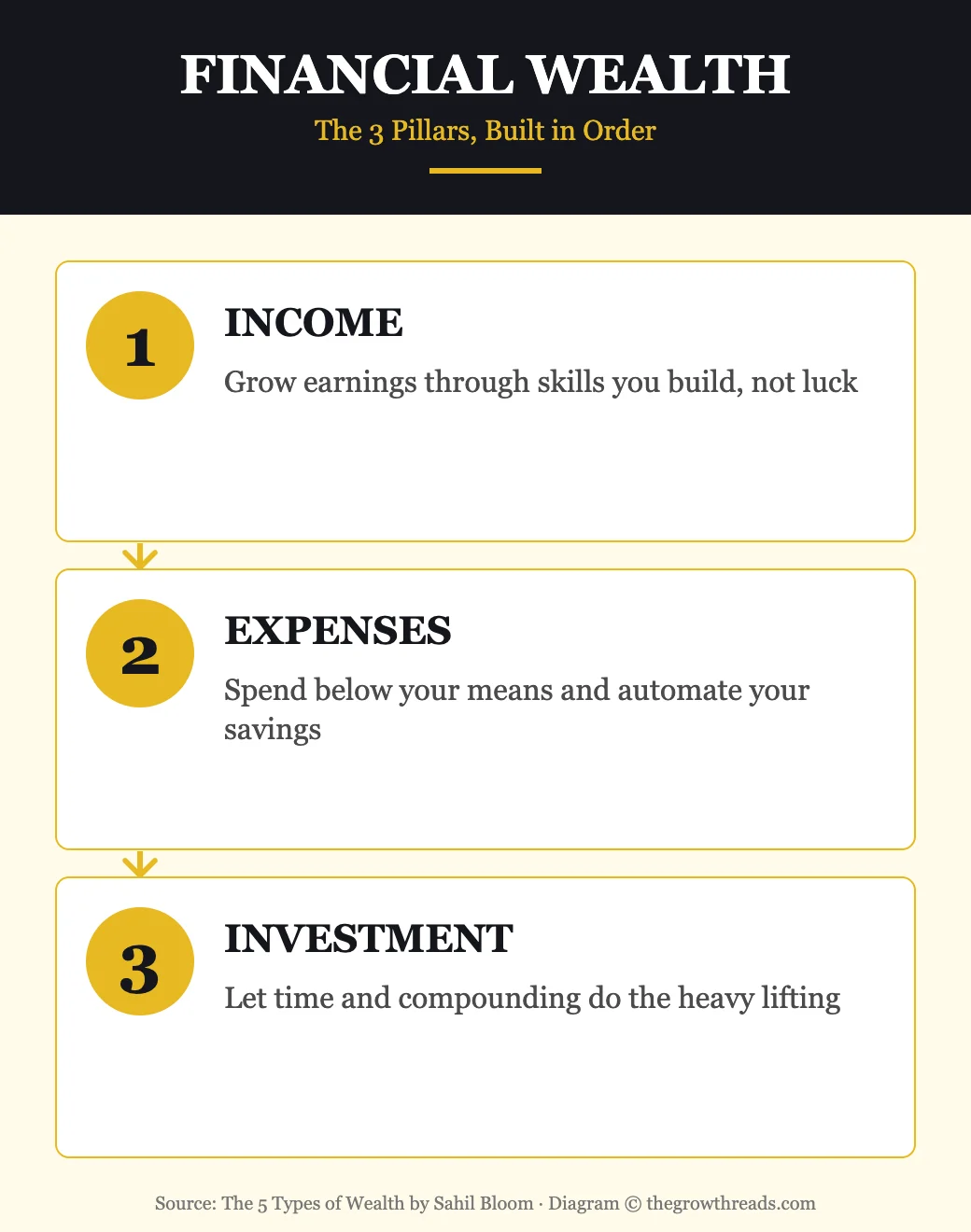
TGR Note: Bloom’s three pillars of financial wealth echo the sequencing in our Simple Path to Wealth summary — earn, save, invest, in that order, with index funds doing the heavy lifting. And his “definition of enough” exercise is the practical, worksheet version of the mindset shift Morgan Housel argues for in our Psychology of Money summary.
Who is The 5 Types of Wealth best for — and who should read something else first?
This book is built for people who have already made progress on one wealth type — usually financial or career — and sense that the progress has not translated into the life they actually wanted. Entrepreneurs, mid-career professionals, and anyone approaching a major transition (new parent, empty nester, retiree) will find the five-domain framework genuinely useful for making trade-off decisions. If you want tactical, numbers-first investing guidance without the broader life framework, start with our Simple Path to Wealth summary or our Rich Dad Poor Dad summary instead. If you specifically want the psychology of your relationship with money, without the four other wealth types, our Psychology of Money summary is the tighter read. And if time is your single biggest pain point, our Four Thousand Weeks summary goes deeper on that one dimension alone.
Questions to reflect on
- If you kept living exactly as you are for the next year, would your life improve, or would it stay the same?
- What would the people sitting in the front row at your funeral want you to prioritize this week?
- Where does your Wealth Score reveal the biggest gap right now, and what is one small action that would move it?
- What is your specific, written definition of “enough” — and how far are you from it today?
- If you finished the sentence “I’m the type of person who…” honestly, not aspirationally, what would it say?
🔥 Ready to design your dream life?
Get Bloom’s full frameworks, worksheets, and all five wealth guides in the original book.
How to apply The 5 Types of Wealth (7-day plan)
- Day 1: Take the Wealth Score self-assessment — rate all five types 1–10 without trying to fix anything yet.
- Day 2: Write your Life Razor. Complete “I’m the type of person who…” and test it against controllable, ripple-creating, and identity-defining.
- Day 3: Run the Energy Calendar exercise — color-code yesterday’s hours green, yellow, or red and look for the pattern.
- Day 4: List your five front-row people, then send one specific, two-minute thank-you message to someone in your inner circle.
- Day 5: Do one pass of the overlap method — list what you love, what you are good at, and what is needed, and circle the intersection.
- Day 6: Complete the two-minute physical routine (five push-ups, five squats, five lunges, a 30-second plank) plus a 15-minute phone-free walk outside.
- Day 7: Write your specific definition of “enough” and set one anti-goal — an outcome you refuse to accept — for the next 90 days.
Frequently asked questions
What are the 5 types of wealth in Sahil Bloom’s book?
Sahil Bloom identifies Time Wealth (freedom over how you spend your hours), Social Wealth (deep and wide relationships), Mental Wealth (purpose, growth, and space to think), Physical Wealth (health, fitness, and vitality), and Financial Wealth (enough money to support the other four). His central argument is that true fulfillment requires progress across all five simultaneously, not maximizing one — usually money — at the expense of the rest. He frames financial wealth as an enabler of the other types rather than the ultimate goal itself.
Is The 5 Types of Wealth worth reading if I am already financially comfortable?
Yes, arguably more so. Bloom wrote the book specifically for people who have already hit conventional financial milestones and still feel something is missing — his own story starts from that exact position. The financial chapters are useful but relatively basic; the real value for financially comfortable readers is in the Time, Social, and Mental Wealth sections, which address the “now what” question that money alone cannot answer.
What is a “Life Razor” and how do I write one?
A Life Razor is a single sentence, in the form “I’m the type of person who…,” that guides daily decisions when priorities compete. Bloom says an effective one is controllable (within your power regardless of circumstances), ripple-creating (it improves more than one area of your life), and identity-defining (it reflects who you actually want to be). To write one, look for the single commitment that, honored consistently, would build the life you want, then test it against a real recent decision to see if it actually clarifies anything.
How is this different from other money or productivity books?
Most money books optimize financial wealth alone, and most productivity books optimize time alone. Bloom’s contribution is treating five domains as one interconnected system, with a shared decision-making layer — the Life Razor and Life Blueprint — that sits above all five. The trade-off is depth: each individual wealth type gets a lighter treatment than a book devoted entirely to it, which is why we pair this summary with narrower reads like Psychology of Money or Four Thousand Weeks above.
Does the book include exercises, or is it mostly theory?
It is heavily exercise-driven. Each of the five sections ends with a “guide” of practical systems — the Wealth Score, the Energy Calendar, relationship mapping, the overlap method, the 80/20 nutrition rule, and defining your number for “enough,” among others. Bloom also provides a companion quiz on his website to calculate your baseline Wealth Score before you start applying any of the frameworks, which most readers find more useful than reading the chapters alone.
What is the “Wealth Score” and how do I calculate mine?
The Wealth Score is a simple 1–10 self-rating across each of the five wealth types, done before you set any goals. The value is diagnostic, not scientific — it surfaces which dimensions you have been neglecting while focused on one or two others. Bloom recommends revisiting the score monthly or quarterly alongside your Life Blueprint, since your priorities and honest ratings will shift as you move through different seasons of life.
Are Bloom’s claims about money and happiness backed by research?
The core claim — that additional income above a baseline of security produces diminishing happiness returns — is well supported in the behavioral economics literature Bloom cites, though the exact income threshold is debated and varies by cost of living and individual circumstances. Some of the book’s more specific statistics on relationships and time use come from a mix of academic studies and Bloom’s own surveys, so treat those as directional rather than precise. The five-domain framework itself is a practical model, not a peer-reviewed one, and works best as a decision-making tool rather than a scientific claim.
Related summaries
- The Psychology of Money Summary & Review
- Rich Dad Poor Dad Summary & Review
- The Simple Path to Wealth Summary & Review
- Die With Zero Summary & Review
- See all of our best money books
How we analyze books: every TGR summary is built from the full published text plus the author’s own interviews and public essays, cross-checked against independent research where the book makes empirical claims, then structured around practical application rather than plot or chapter order. Read our full methodology.
Related Money Summaries
Die With Zero Summary & Review: How to Spend Your Money Before You Run Out of Time
Freakonomics Summary and Review
Get Good with Money Summary & Review: Ten Steps to Financial Wholeness
Happy Money Summary & Review: The Japanese Art of Making Peace with Your Finances
The Simple Path to Wealth Summary & Review: One Fund, Zero Complexity, Total Freedom