

★★★★½ 4.5 / 5 — A deeply moving memoir that proves the most fascinating case study a neurologist can write is his own life.
Best for: Anyone searching for their own path, readers fascinated by neuroscience and the human mind, memoir lovers, anyone who has ever felt like an outsider.
Reading time: ~8 hours (400 pages) | Audiobook: ~11 hrs
Difficulty to apply: Low — this is a book that changes how you see yourself and others, not a prescriptive guide. Its lessons arrive through reflection, not action steps.
On the Move in one minute
Oliver Sacks lived more lives in one lifetime than most people dare to imagine. This autobiography traces his journey from a shy, science-obsessed boy in wartime London to a leather-clad motorcyclist and record-breaking weightlifter in 1960s California, to one of the most beloved neurologists and writers of the twentieth century. Along the way, Sacks wrestled with addiction, decades of loneliness, a complicated relationship with his family, and the slow, courageous process of accepting his identity as a gay man. What emerges is not a story about medicine or achievement — it is a story about what it means to find your place in the world by following your deepest curiosities. On the Move is proof that the richest lives are not the ones planned in advance, but the ones lived with radical openness to experience.
Key takeaways
- Follow obsessive curiosity: Sacks did not plan his career — he followed whatever fascinated him most intensely, from chemistry to motorcycles to rare neurological conditions, and each obsession led to the next chapter of his life.
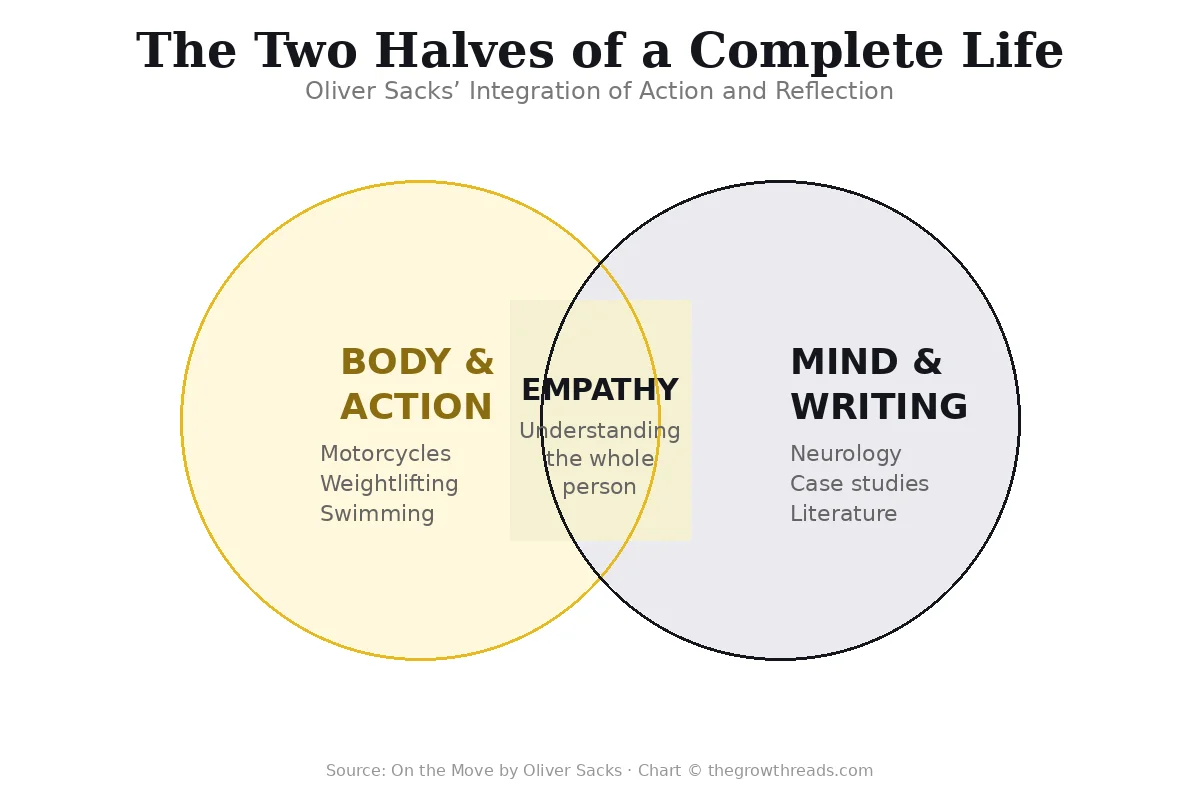
- Physical experience fuels intellectual work: Weightlifting, swimming, and motorcycle journeys across America were not distractions from Sacks’s writing — they were the embodied experiences that deepened his understanding of the human body and mind.
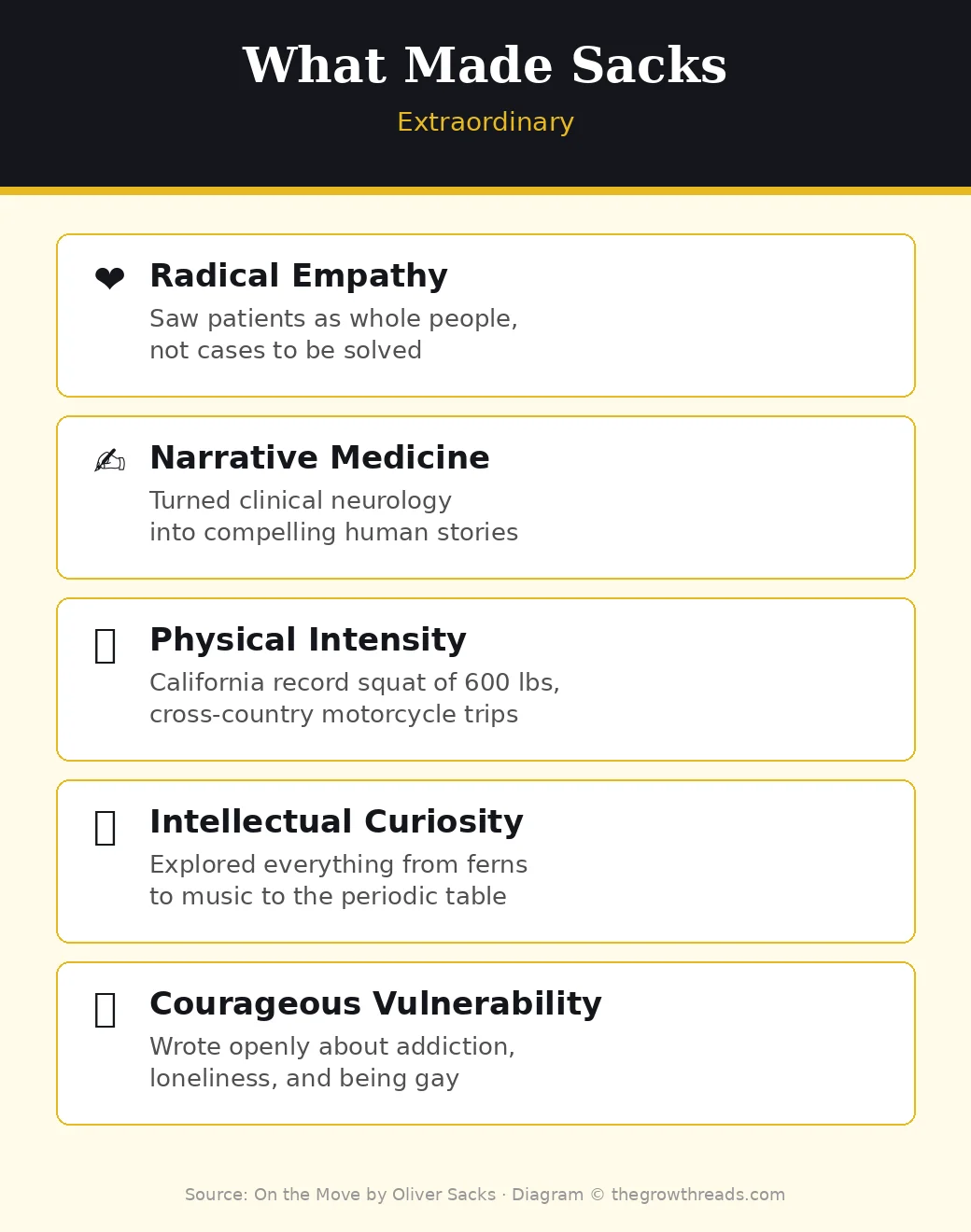
- Patients are people first: Sacks’s greatest contribution was treating neurological patients not as broken brains but as whole human beings with stories, desires, and inner worlds worth exploring.
- Outsiders see what insiders miss: Sacks felt like a perpetual outsider — as a gay man, as a British immigrant, as a doctor who wrote literary case histories — and that outsider’s perspective became his greatest professional asset.
- Loneliness is survivable: Sacks spent 35 years without a romantic partner and wrote honestly about the pain of that solitude, proving that a life can be both lonely and profoundly meaningful.
- Identity acceptance is a lifelong process: Coming to terms with his sexuality, his unconventional career, and his complicated family took Sacks decades — and he modeled that patience without self-pity.
- Writing is a form of self-discovery: Sacks kept journals obsessively from adolescence onward, using the act of writing not just to communicate but to understand his own mind and emotions.
- Mentors change the course of lives: From the great Soviet neuropsychologist A.R. Luria to the poet W.H. Auden, Sacks’s life was shaped by people who saw his potential and encouraged his unconventional path.
- Empathy is a skill, not a trait: Sacks learned empathy through clinical practice, deep listening, and decades of sitting with patients — it was something he built, not something he was born with.
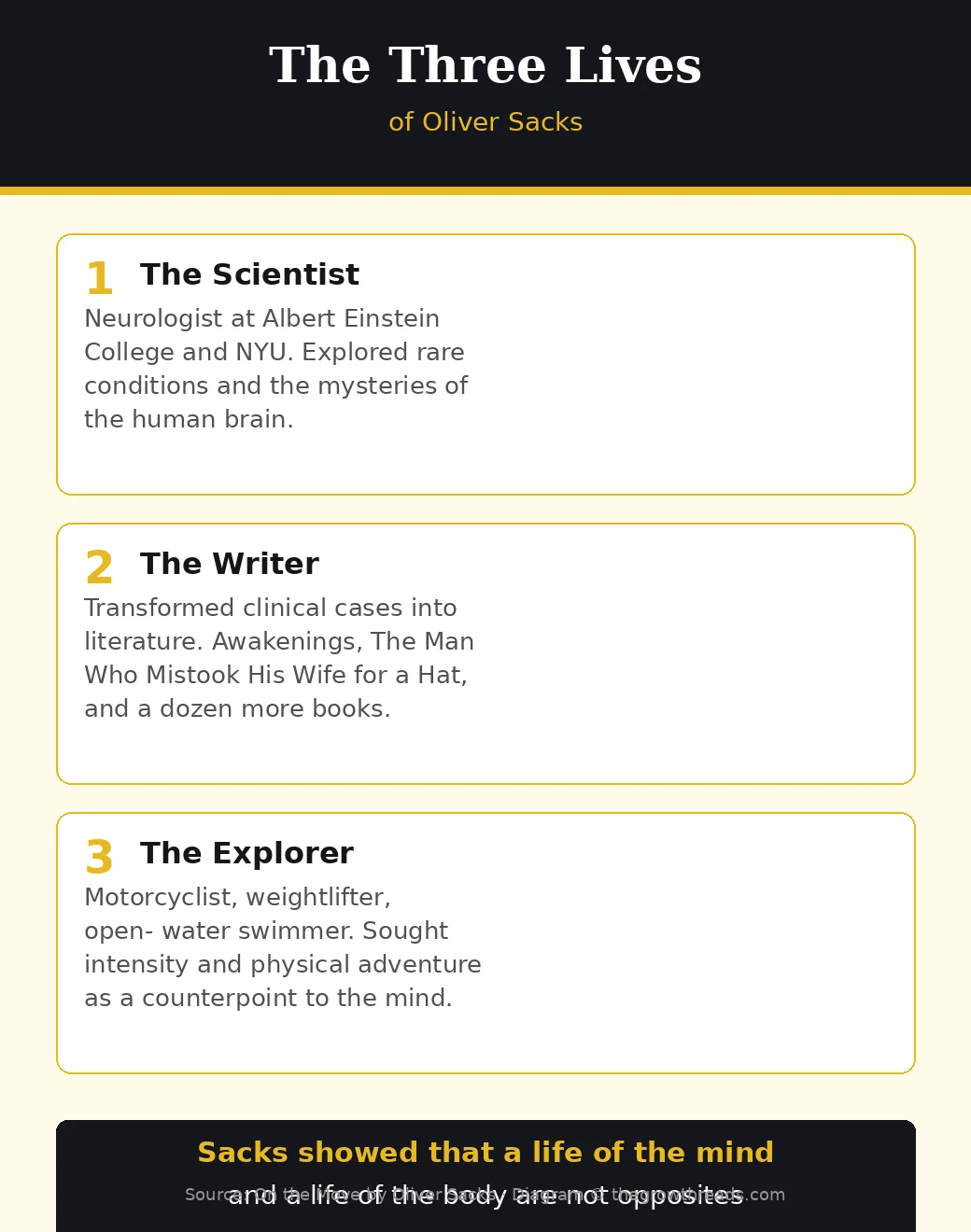
- A meaningful life does not require a conventional shape: Sacks never married, never had children, lived modestly, and devoted himself entirely to his patients and his writing — and found deep fulfillment in that singular devotion.
What is On the Move about?
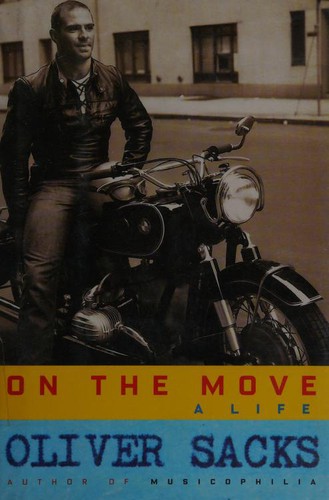
On the Move is the autobiography of Oliver Sacks, the British-American neurologist and bestselling author of Awakenings and The Man Who Mistook His Wife for a Hat. Written in 2015, just months before his death, the book traces his entire life — from a childhood fascination with chemistry in wartime London, through decades of clinical work with neurological patients in New York, to his late-life acceptance of love and identity. It is simultaneously a medical memoir, a coming-of-age story, and a meditation on what it means to live fully.
About the author
Oliver Sacks (1933–2015) was born in London to a family of doctors and scientists. Both his parents were physicians, and his early exposure to medicine and chemistry shaped a lifelong devotion to science. After studying at Oxford and completing his medical training in London, Sacks moved to the United States in 1960, eventually settling in New York City where he spent the rest of his life. He held clinical positions at Beth Abraham Hospital, Albert Einstein College of Medicine, and NYU, while simultaneously writing a dozen books that transformed how the public understood neurological conditions. His work bridged the gap between clinical science and literary storytelling, earning him comparisons to Chekhov and Freud. He was awarded a CBE in 2008 and was named one of Time magazine’s most influential people. Explore all Oliver Sacks book summaries →
Key concepts at a glance
| Concept | What it means | Use it when |
|---|---|---|
| Narrative medicine | Treating patients as characters in their own stories, not just diagnoses | You want to understand someone beyond their surface condition |
| Radical empathy | Deep, patient-centered listening that honors the person’s full experience | You need to truly understand what someone is going through |
| Embodied knowledge | Physical experiences (riding, lifting, swimming) that inform intellectual understanding | You feel disconnected from your body or stuck in your head |
| Outsider advantage | Using marginal or unconventional status as a lens for original insight | You feel different from peers and wonder if that’s a liability |
| Obsessive curiosity | Following a fascination to its deepest roots without concern for career logic | You are choosing between practical and passionate pursuits |
| Late-blooming identity | The process of self-acceptance that can take decades, not months | You feel behind in figuring out who you are |
| Journaling as cognition | Using daily writing not for productivity but for emotional and intellectual processing | You want to understand yourself better but therapy isn’t enough |
| Mentorship constellations | Multiple mentors across different domains who collectively shape a life’s direction | You are looking for guidance but no single mentor fits |
Part 1: Growing up and getting away (London and early years)
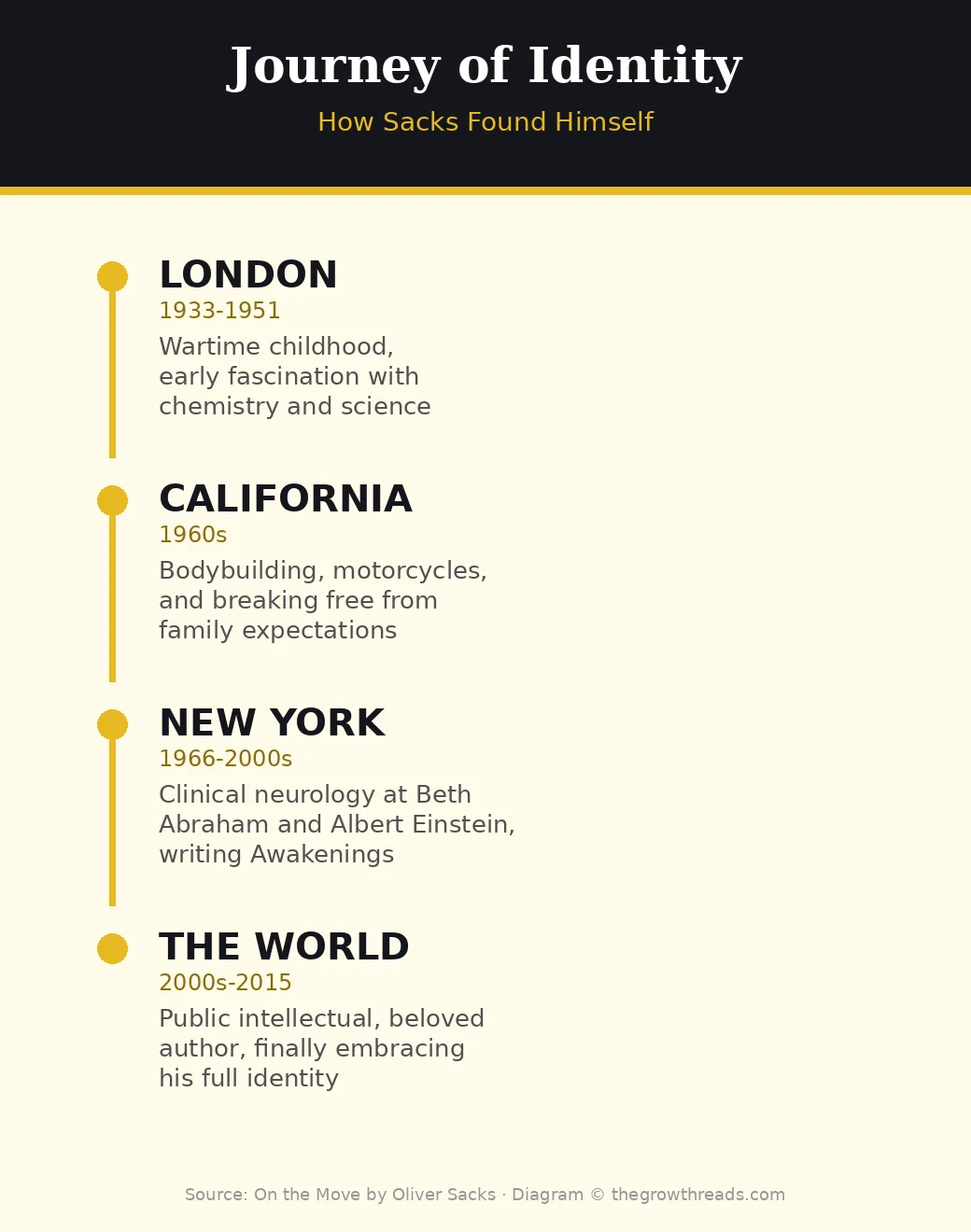
Sacks opens the memoir with his childhood in wartime London, where he and his brother Michael were evacuated to a boarding school in the Midlands. The experience was brutal — the headmaster was sadistic — and it left lasting scars. Back home, both parents were busy physicians, and emotional warmth was scarce. But science became his refuge. His uncle Dave, a physicist and inventor, introduced him to the periodic table, and Sacks developed a consuming passion for chemistry that would last his entire life. He set up a home laboratory and spent hours experimenting, finding in chemical reactions a sense of order and beauty that the outside world lacked.
At Oxford, Sacks studied medicine but felt increasingly drawn to neurology — the intersection of biology and human experience. He was also beginning to grapple with his sexuality. When he told his mother he was gay, her response was devastating: she called him an abomination. That single word would haunt him for decades. After qualifying as a doctor, Sacks felt suffocated by the expectations of his family and English medical culture. He needed to escape, and in 1960, he did — he left for North America and never looked back.
Part 2: California — the body, the bike, and the breakdown
The California chapters are among the most surprising in the book. Sacks arrived in San Francisco in 1960 and quickly reinvented himself. He bought a motorcycle — the first of many — and began taking long, solitary rides across the American West. He also discovered weightlifting at Muscle Beach in Venice, eventually squatting 600 pounds and winning the title of California’s strongest man in his weight class. These were not casual hobbies. For Sacks, physical intensity was a form of self-medication — a way to manage anxiety, loneliness, and the disorientation of being a young immigrant in a new country.
But California also brought darkness. Sacks became addicted to amphetamines, spending weekends in drug-fueled binges that nearly destroyed his health and career. He describes one terrifying episode in which he hallucinated an entire conversation with friends who were not there — an experience that gave him visceral insight into the neurological conditions he would later study in his patients. The addiction lasted several years before he managed to stop, largely through the help of a supportive friend and the realization that he was heading toward death. He never used drugs again, channeling his addictive intensity instead into swimming, writing, and clinical work.
Part 3: New York — patients, writing, and finding a voice
In 1965, Sacks moved to New York and began working at Beth Abraham Hospital in the Bronx, a chronic care facility where he encountered a group of patients who had been frozen in a catatonic state since the encephalitis lethargica epidemic of the 1920s. When he administered the drug L-DOPA, these patients briefly “awoke” — some for the first time in decades — before many relapsed. The experience became the basis for his most famous book, Awakenings, and later a Hollywood film starring Robin Williams and Robert De Niro.
Sacks describes how writing Awakenings transformed him from a doctor who wrote into a writer who practiced medicine. The medical establishment was initially hostile — his literary approach to case histories was seen as unscientific, even unprofessional. But Sacks found an unexpected champion in the great Soviet neuropsychologist A.R. Luria, who wrote to him praising Awakenings and encouraging him to continue what Luria called the tradition of “romantic science” — clinical work that honored the patient’s full human experience. That letter changed Sacks’s life. He continued writing clinical tales, publishing The Man Who Mistook His Wife for a Hat in 1985, which became an international bestseller and established him as a public intellectual.
Throughout this period, Sacks was profoundly lonely. He had not been in a romantic relationship since his early thirties, and he would remain celibate for 35 years. He poured his emotional energy into his patients, his writing, and his friendships — and the memoir is bracingly honest about how painful that solitude was, even as his public life flourished.
Part 4: Integration — love, legacy, and coming home to himself
The final section of On the Move covers the most private and moving territory. In his late seventies, Sacks met the writer Billy Hayes, and for the first time in decades, fell in love. He describes the experience with a tenderness that is startling from a writer so accustomed to clinical observation — as if all his years of studying other people’s inner worlds had finally given him permission to explore his own. The relationship brought him a happiness he had long believed was not available to him.
Sacks also writes about aging, illness, and mortality with characteristic directness. He was diagnosed with a rare ocular tumor in 2005 and later with metastatic cancer. Rather than retreating, he accelerated — writing more books, seeing more patients, traveling more widely. He describes his final years as a period of integration, when the different threads of his life — science, writing, physical adventure, emotional connection — finally wove together into something whole. The book ends not with death but with gratitude, with Sacks expressing astonishment at the richness of the life he had lived.
Who is On the Move best for — and who should read something else first?
On the Move is ideal for readers who love literary memoirs, anyone fascinated by neuroscience and the human brain, people grappling with questions of identity and belonging, and anyone who has ever felt like they do not fit the conventional mold. It is also a superb entry point for readers new to Sacks’s work — the autobiography provides context for all his other books.
If you are looking for a more prescriptive book on self-discovery with clear action steps, try The Defining Decade by Meg Jay. If you want a deep dive into how the brain constructs identity, start with Incognito by David Eagleman. And if memoirs about unconventional lives appeal to you but you want something focused on creativity rather than science, consider Originals by Adam Grant.
Questions to reflect on
- What obsessive curiosity have you been ignoring because it does not seem practical or career-relevant?
- Is there an identity or truth about yourself that you have been slow to accept — and what would change if you stopped resisting it?
- Do you use physical activity as a way to process emotions, or do you live primarily in your head? What would happen if you changed that balance?
- Who are the mentors — even distant or unlikely ones — who have shaped the direction of your life, and have you acknowledged their influence?
- If you wrote your own autobiography today, would it read as a story of someone moving toward their deepest interests, or away from discomfort?
🔥 Ready to experience one of the greatest memoirs ever written?
On the Move will change how you think about identity, curiosity, and what it means to live fully.
How to apply On the Move (7-day plan)
- Day 1 — Name your obsessive curiosity. Write down the subject or activity that fascinates you most, even if it has no obvious career value. Commit to spending 30 minutes exploring it today.
- Day 2 — Move your body with intention. Choose a physical activity that challenges you — a long walk, a swim, a bike ride — and pay attention to how it changes your thinking afterward. Sacks believed physical intensity sharpened mental clarity.
- Day 3 — Write a journal entry as if no one will read it. Sacks kept journals his entire life. Spend 20 minutes writing honestly about something you rarely discuss: a fear, a desire, a question you cannot answer.
- Day 4 — Practice radical listening. In one conversation today, resist the urge to solve, advise, or redirect. Instead, ask follow-up questions and listen as if the other person’s experience is the most interesting case study you have ever encountered.
- Day 5 — Identify your mentors. List three to five people who have shaped your direction — teachers, authors, colleagues, even people you have never met. Write a note of gratitude to at least one of them.
- Day 6 — Sit with discomfort about identity. Is there something about yourself you have not fully accepted? Spend 15 minutes writing about it without judgment. Sacks’s lesson: acceptance does not need to happen all at once.
- Day 7 — Integrate. Look at your week: what connected your physical activity, your curiosity, your relationships, and your writing? Sacks’s life teaches that a meaningful existence is not about choosing one path — it is about weaving all of who you are into a single, honest life.
Frequently asked questions
Is On the Move a good book?
On the Move is widely regarded as one of the finest scientific autobiographies of the twenty-first century. It holds a 4.1 average on Goodreads from over 30,000 ratings and was a New York Times bestseller. Critics praised its candor, warmth, and literary quality. The book works both as a standalone memoir and as a companion to Sacks’s clinical writings, giving readers the personal context behind books like Awakenings and The Man Who Mistook His Wife for a Hat. It is especially valued for Sacks’s willingness to write openly about addiction, sexuality, and loneliness.
What are the main themes of On the Move?
The book explores several interconnected themes: identity and self-acceptance (particularly Sacks’s experience as a gay man in mid-twentieth-century society), the relationship between physical experience and intellectual work, the ethics of empathy in medicine, the power of mentorship, the pain and productivity of solitude, and what it means to live an unconventional life with integrity. It also examines how writing itself can be a tool for self-understanding, and how a career can emerge organically from following genuine curiosity rather than a predetermined plan.
Do I need to read Oliver Sacks’s other books first?
No. On the Move works perfectly as a standalone memoir and actually serves as an excellent introduction to Sacks’s entire body of work. He discusses the circumstances behind each of his major books — Awakenings, The Man Who Mistook His Wife for a Hat, An Anthropologist on Mars, Musicophilia, and others — giving you the personal backstory that enriches all of them. Many readers find that On the Move is the best starting point, after which they can explore whichever clinical book interests them most.
How long does it take to read On the Move?
On the Move is approximately 400 pages in the paperback edition. At an average reading speed, it takes roughly 7 to 9 hours to finish. The audiobook runs about 11 hours and is narrated by Dan Woren, though many readers wish Sacks had recorded it himself. The prose is accessible and narrative-driven, not technical — it reads more like a novel than a medical text. Most readers report finishing it in three to five sittings, often staying up later than intended because the story is genuinely hard to put down.
What is the relationship between On the Move and Awakenings?
Awakenings (1973) is Sacks’s clinical account of treating post-encephalitic patients with L-DOPA at Beth Abraham Hospital. On the Move tells the personal story behind that clinical work — what Sacks was going through emotionally and professionally when he made those discoveries, how the medical establishment initially rejected his approach, and how the book and later film changed his career. Reading both gives you the clinical story and the human story of the same extraordinary events, and each enriches the other considerably.
Was Oliver Sacks really a weightlifter and motorcyclist?
Yes, and this is one of the most surprising elements of the memoir. In the 1960s, Sacks trained at Muscle Beach in Venice, California, and reportedly squatted 600 pounds, setting a California state record in his weight class. He also rode motorcycles extensively, making solo cross-country trips across the United States and Canada. These physical pursuits were not youthful phases — Sacks was an avid swimmer well into his seventies. He saw physical intensity and intellectual work as complementary, not contradictory, and his athletic life directly informed his understanding of the body-mind connection in neurology.
Is On the Move similar to Man’s Search for Meaning by Viktor Frankl?
Both books are memoirs by doctors who found deep meaning through their clinical work, and both deal with suffering, identity, and the search for purpose. However, they are quite different in tone and structure. Frankl’s book is centered on a single extreme experience (surviving the Holocaust) and derives a philosophical framework from it. Sacks’s memoir is more episodic and wide-ranging, covering an entire life rather than a defining crisis. If you loved Man’s Search for Meaning for its exploration of purpose through adversity, On the Move offers a complementary perspective: purpose discovered through curiosity, connection, and the slow work of self-acceptance.
Related summaries
If On the Move resonated with you, explore these related summaries in our psychology collection:
- Incognito by David Eagleman — a deep dive into the hidden workings of the brain that would have fascinated Sacks
- Emotional Intelligence by Daniel Goleman — the science behind the empathy Sacks practiced instinctively
- The Happiness Hypothesis by Jonathan Haidt — ancient and modern wisdom on the ingredients of a good life
- Quiet by Susan Cain — why the introverted, solitary path Sacks walked has its own profound strengths
- Explore all our psychology book reviews on the Best Psychology Books pillar page