

⭐⭐⭐⭐ 4.4/5 — A data-driven rebuttal to the “having it all is impossible” narrative, built on real time logs.
Best for: Working parents (and anyone skeptical of work/family balance) who want evidence, not just encouragement.
Reading time: ~5 hrs to read, 20 min to guide
Difficulty to apply: Low to moderate — most shifts are about redefining categories, not adding hours.
I Know How She Does It in one minute
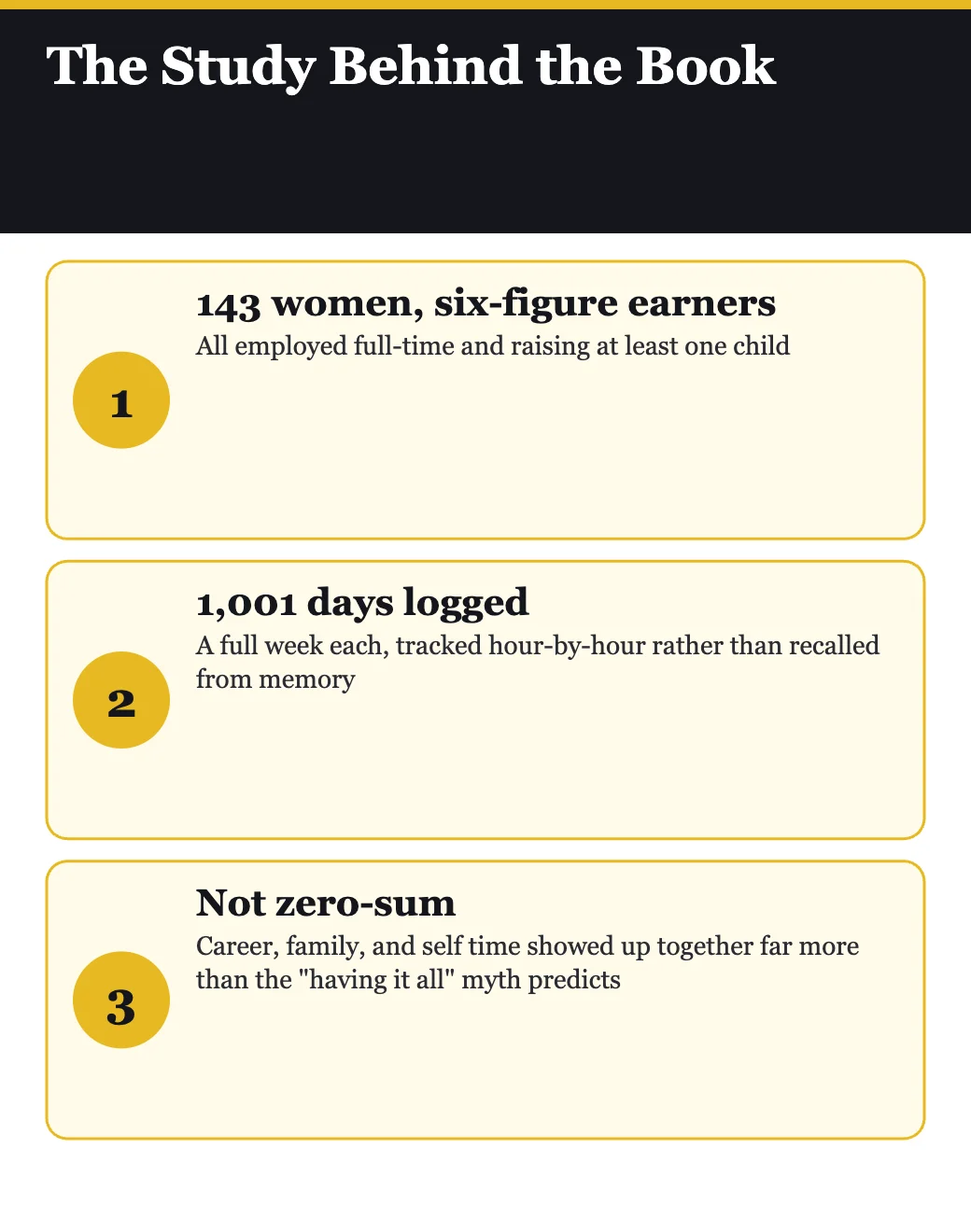
The “you can’t have a big career and an engaged family and a life of your own” story is mostly built on anecdote — the actual time logs tell a different story. Laura Vanderkam collected 1,001 days of hour-by-hour time diaries from 143 women earning six figures with at least one child, and found that career success, real family time, and personal time weren’t trading off against each other the way the popular narrative assumes. The tradeoff that did show up in the data was smaller and more specific than “work vs. family” — and understanding exactly where it falls is what makes this book more useful than another round of general reassurance.
Key takeaways
- The data, not anecdote: 1,001 logged days from 143 six-figure-earning mothers replace guesswork with an actual time-diary study.
- Work and family aren’t zero-sum: high-earning, engaged-parent, and personally fulfilled aren’t mutually exclusive in the sample.
- The real tradeoff is personal time: logged data pointed to leisure and self-care, not family time, as what shrinks to make room for work.
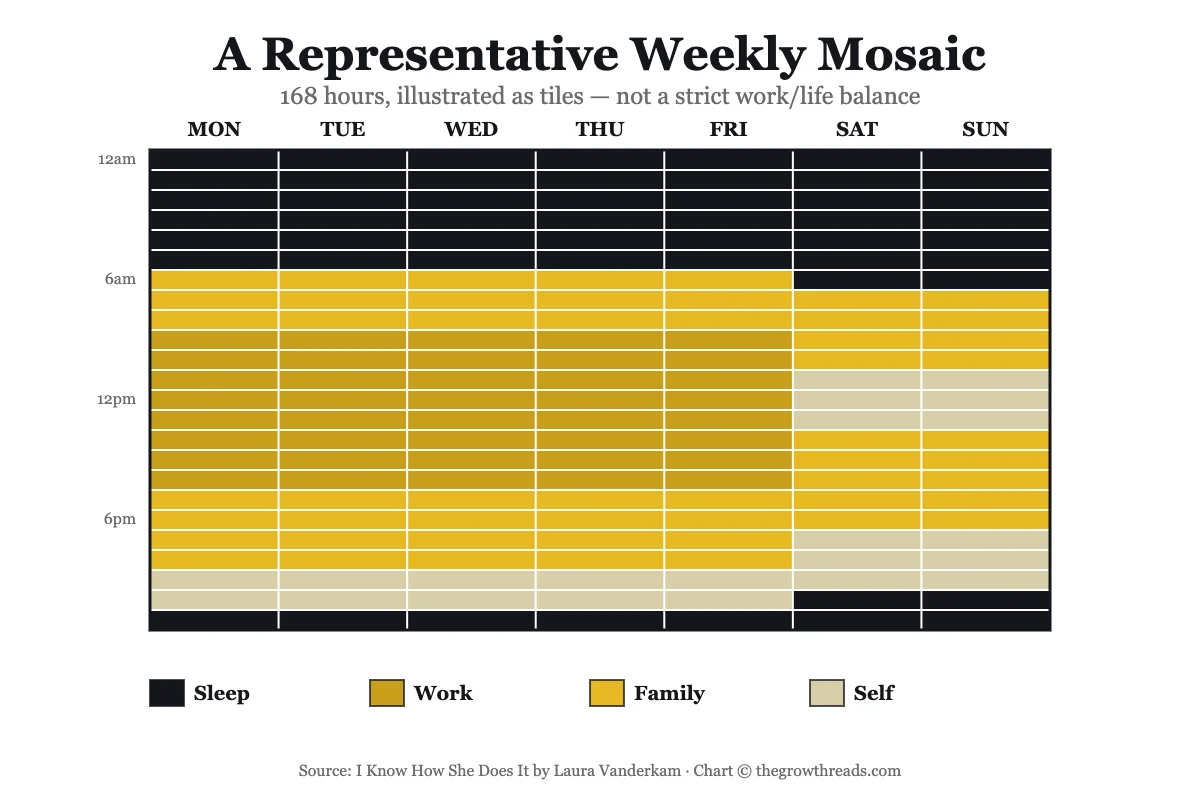
- The “mosaic,” not strict balance: a week is built from many small tiles of work, family, and self rather than one rigid daily split.
- The split shift works: a standard office block followed by a short evening work session after family time shows up repeatedly in the case studies.
- Family time isn’t only dinner: mornings and small daily moments count as real engaged time, not just a formal evening together.
- “Good enough” housework: lowering the cleanliness bar and delegating frees hours without touching family or work time.
- 168 hours is the real unit: planning by the week, not the day, makes room for both a demanding job and a full life.
- Time logging is the diagnostic: tracking a real week in half-hour blocks reveals more flexibility than a vague sense of “maxed out” suggests.
- The sample has real limits: six-figure earners with schedule control and resources to delegate aren’t representative of every working parent.
What is I Know How She Does It about?
I Know How She Does It uses time-diary data from 143 six-figure-earning mothers — 1,001 logged days in total — to challenge the assumption that career success, engaged parenting, and personal time are mutually exclusive. Vanderkam finds career and family aren’t the real tradeoff; personal time is what disproportionately gets sacrificed instead.
About the author
Laura Vanderkam has built her career around time-diary research rather than general productivity advice, and this book represents her most data-driven project: an original study of 143 women earning at least $100,000 a year with at least one child, each completing a full seven-day, half-hour-increment time log. That’s 1,001 total days of primary data — not a synthesis of others’ research, but Vanderkam’s own fieldwork, distinguishing this book from more essay-driven titles in her catalog. The scale of the undertaking is itself notable — coordinating 143 participants through a full week of half-hour-increment logging is a substantially heavier research lift than the interview- or survey-based approach more common in the genre, and it’s what gives the book’s central claims a firmer evidentiary footing than a collection of success stories alone would provide. Her earlier book, 168 Hours, established the “168 hours a week, not 24 hours a day” framing this book builds on — the idea that thinking in terms of a full week rather than a single day opens up planning options a daily view obscures; here, she applies that framework specifically to the gendered “having it all” debate, using real logged data rather than the dueling anecdotes that usually dominate that conversation. Explore all Laura Vanderkam book summaries →
Key concepts at a glance
| Concept | What it means | Use it when |
|---|---|---|
| The time-diary study | 1,001 logged days from 143 six-figure-earning mothers, tracked hour-by-hour | You want evidence rather than anecdote on the “having it all” question |
| Not zero-sum | Career, family, and self time weren’t fundamentally trading off in the data | You’ve assumed success in one area must come at the cost of another |
| The real tradeoff | Personal/leisure time, not family time, was what most often shrank | You’re deciding what to cut and assume family time is the obvious target |
| The mosaic | A week built from many small tiles of work, family, and self rather than a strict daily split | Daily “balance” feels impossible but the week as a whole might work |
| The split shift | A standard work block plus a short evening session after family time | A rigid 9-to-5 doesn’t fit both work demands and family presence |
| 168-hour planning | Using the full week, not the day, as the unit for fitting everything in | A single day never seems to have enough room for everything that matters |
| Good enough housework | Lowering cleanliness standards and delegating instead of doing it all | Chores are consuming hours that could go to family, work, or rest |
Part 1: What the data actually showed
Vanderkam’s study is unusually direct for a book in this genre: rather than arguing from a handful of inspiring anecdotes, she collected 1,001 days of real time logs from 143 women earning at least six figures with at least one child. Participants tracked their time hour-by-hour across a full week rather than reconstructing it from memory afterward, which matters — self-reported impressions of how time was spent tend to overweight the most stressful or effortful parts of a day and underweight everything else, while a contemporaneous log captures the full picture as it happens. This methodological choice is what separates this book from a typical survey-based study on the same topic — asking someone to estimate their weekly hours from memory is a fundamentally different measurement than asking them to record each half-hour block as it occurs, and the two methods reliably produce different, often conflicting, pictures of the same actual week.
What the logs showed, in aggregate, was a direct challenge to the “having it all is impossible” narrative: the women in the sample weren’t uniformly sacrificing family time to sustain demanding careers, nor sacrificing career ambition to stay present with their kids. Both showed up together in the data far more often than the zero-sum framing predicts. That doesn’t mean every week felt effortless or that nothing was traded away — it means the specific tradeoff wasn’t the one most commonly assumed.
It’s also worth being precise about what this study can and can’t claim. A sample of 143 women, however carefully logged, doesn’t establish that having it all is straightforward or universally achievable — it establishes that among this specific group, the popular narrative’s specific prediction (family time as the primary casualty) didn’t consistently hold. That’s a narrower, more useful claim than “you can have it all if you just manage your time better,” and the book is more credible for sticking closer to what the data actually supports. Readers looking for a sweeping, universal promise may find this narrower framing less satisfying than a more triumphant self-help pitch, but it’s also less likely to set up the kind of disappointment that comes from advice pitched at a broader situation than the evidence actually covers.
Part 2: Where the real tradeoff falls
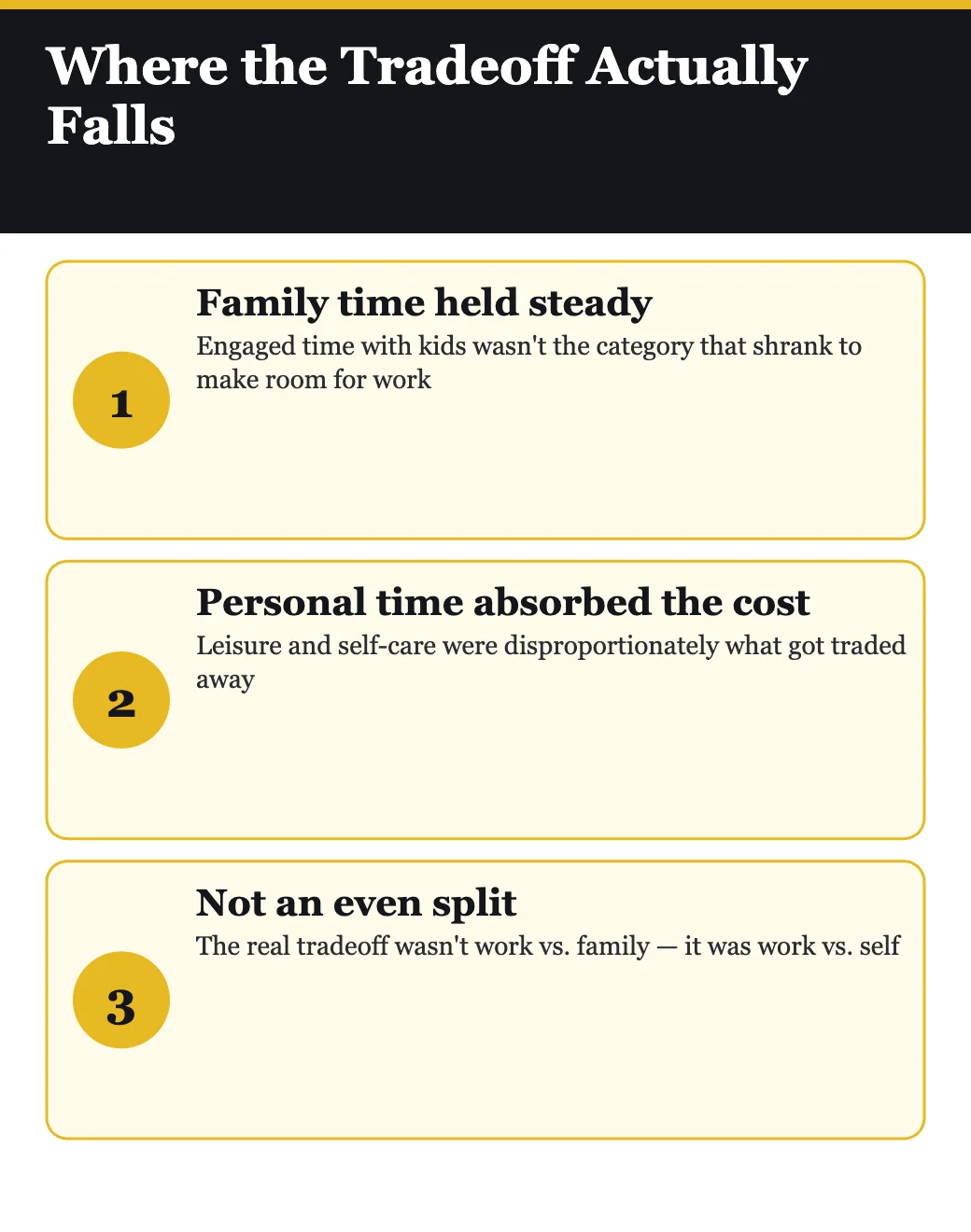
If career and family weren’t trading off against each other, something still had to give in a full week — and the logs pointed to personal time, not family time, as the category that most consistently absorbed the cost. Leisure, hobbies, and self-care were disproportionately what shrank to make room for demanding careers and engaged parenting, rather than either of those two higher-priority categories being cut to make room for the other.
This finding reframes a common piece of advice. “Work-life balance” discourse often implicitly treats family time as the thing under threat from a demanding career, and frames the solution as working less. The data here suggests a different diagnosis for at least this sample: the actual pressure point was personal time, which means the fix isn’t necessarily cutting hours at work — it’s more deliberately protecting a category of time that tends to get silently deprioritized because, unlike a work deadline or a child’s bedtime, nothing forces it onto the calendar.
This is part of why personal time is the category most vulnerable to erosion in the first place: work has external deadlines, and children have needs that announce themselves loudly and immediately. Personal time has no equivalent external enforcement mechanism — nobody notices or complains when it quietly disappears, which means it survives only when someone deliberately protects it. The book’s implicit argument is that this protection has to be intentional precisely because nothing else in a busy week will do it automatically.
Part 3: The mosaic instead of daily balance
Vanderkam’s central metaphor for what these successful weeks actually looked like is a mosaic — many small tiles of work, family, and self-time arranged across a full 168-hour week, rather than a rigid daily formula that has to balance perfectly every single day. This matters because “daily balance” is often an impossible standard: some days are unavoidably work-heavy, others family-heavy, and demanding that every 24-hour period hit some ideal ratio sets people up to feel like they’re failing even when the week as a whole is working well.
The mosaic framing shifts the unit of evaluation from the day to the week. A Tuesday that’s almost entirely consumed by a work deadline isn’t a failure if Wednesday morning includes real time with kids and Thursday evening includes something restorative for yourself. What matters, in this framing, is whether the full mosaic — assembled across seven days — includes enough tiles of each category, not whether any single day achieves a perfect, symmetrical split.
There’s a psychological benefit to this reframe beyond its practical accuracy. Daily balance is a standard almost nobody actually meets consistently, which means measuring success day by day sets up frequent, low-stakes “failures” that can accumulate into a broader sense of falling short even when the underlying week is going reasonably well. Measuring by the week instead gives uneven days room to even out, which more closely matches how most demanding jobs and family schedules actually operate — in bursts and lulls rather than a perfectly even distribution.
Part 4: Practical habits from the case studies
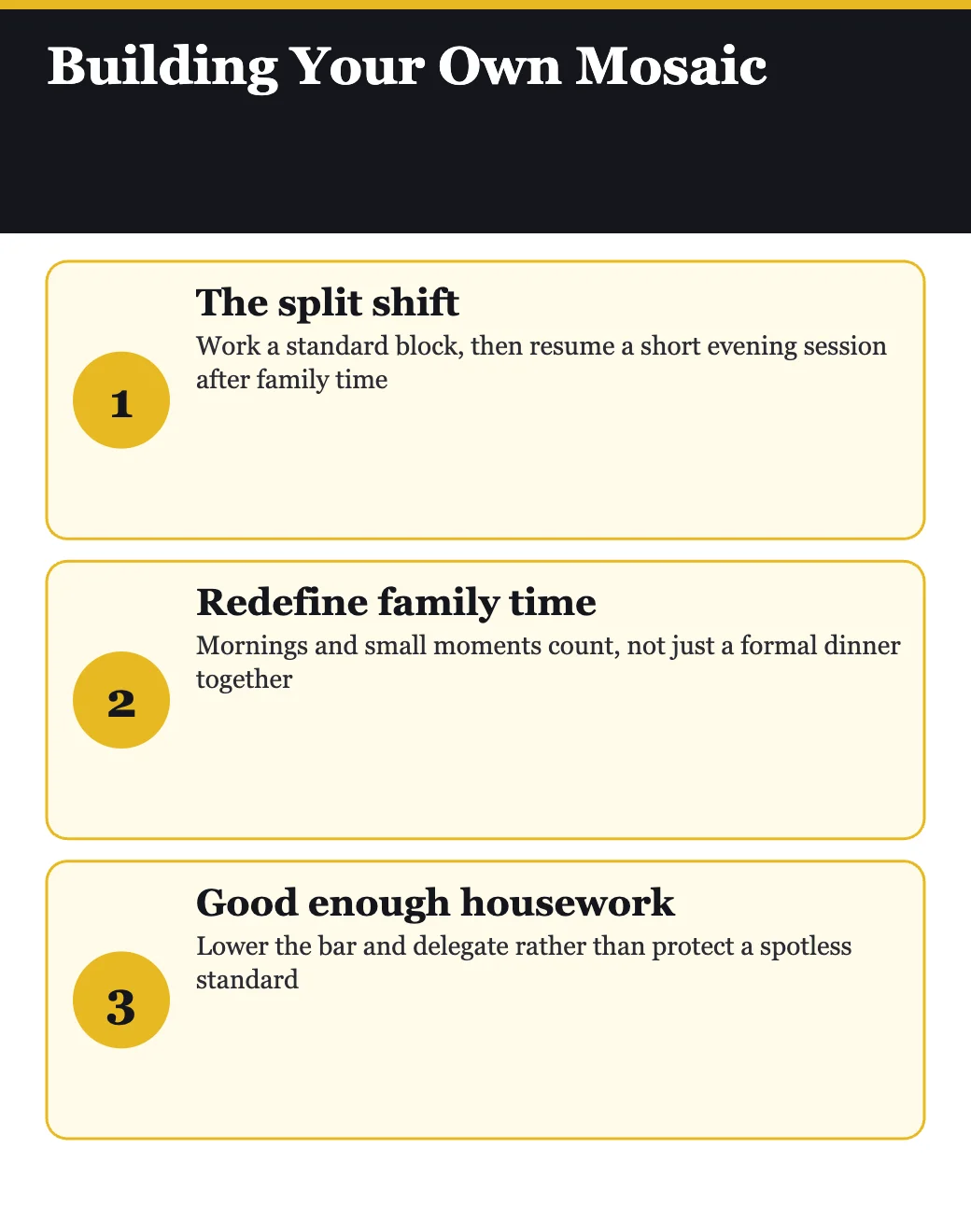
Beyond the aggregate findings, the book’s case studies surface specific, repeatable habits. The “split shift” appears often: working a standard office block, then resuming a shorter session of work in the evening after dedicated family time, rather than treating work as one unbroken block that has to end before family time can begin. This isn’t about working more hours total — it’s about restructuring when those hours happen so that family time doesn’t get pushed to whatever’s left over after work is “done.”
Redefining what counts as family time matters too. Rather than treating a formal evening dinner as the only real family time that counts, several case studies describe counting mornings, school drop-offs, and small daily moments as genuine engaged time — which makes hitting a meaningful weekly total far more achievable than if only a narrow evening window counts. This redefinition matters because a narrow standard for what “counts” as family time can create a false scarcity — if only a formal, undistracted evening dinner qualifies, a genuinely demanding week can leave a parent feeling like family time barely happened, even when dozens of smaller real moments were scattered across the week: a school drop-off conversation, a shared breakfast, ten minutes of undivided attention before bed. On the household side, a recurring theme is lowering the standard for housework and delegating or outsourcing where possible, treating a “good enough” clean home as a reasonable target rather than a source of additional unpaid labor competing for the same hours as everything else.
Delegation appears in several forms across the case studies — hired help where the budget allows, but also simply redistributing tasks among household members or accepting a lower standard without paying anyone at all. The common thread isn’t the specific mechanism, it’s the willingness to treat housework as one more category competing for finite hours rather than as a fixed, non-negotiable obligation that has to be fully met before anything else gets attention. Reframing it this way opens up hours that a rigid, all-or-nothing standard would keep locked away.
Who is I Know How She Does It best for — and who should read something else first?
This book is best for working parents — particularly working mothers — who feel like they’re constantly failing at some invisible balance test, and who would benefit from seeing actual data rather than more anecdote or reassurance. It’s a strong pairing with 168 Hours for the underlying weekly-planning framework. Readers whose constraints are primarily financial or structural — inflexible hourly work, no ability to delegate childcare or housework — may find the case studies less directly applicable, since the sample — women earning at least six figures, with the schedule control and financial resources that income tends to bring; a book more focused on time perception generally, like Off the Clock, may translate more broadly.
Questions to reflect on
- When you imagine cutting back to “make more time,” what do you assume gets cut first — and does the data here match that assumption?
- What would it look like to evaluate your week as a whole mosaic rather than judging each day individually?
- Is there a version of the split shift that could work with your actual job, even in a small way?
- What currently doesn’t count as “real” family time for you that arguably should?
- Where has a high housework standard quietly been competing with time you’d rather spend elsewhere?
🔥 Ready to see the data behind “having it all”?
Get I Know How She Does It and see what 1,001 days of real time logs actually show.
How to apply I Know How She Does It (7-day plan)
- Day 1: Start a time log — track your day in half-hour blocks without changing your behavior yet.
- Day 2: Continue the log. At day’s end, note which category — work, family, or self — got the least time.
- Day 3: Try a version of the split shift: pause work for dedicated family time, then resume a short session later if needed.
- Day 4: Count one small morning or in-between moment as real family time rather than waiting for a formal evening block.
- Day 5: Identify one housework task you could lower your standard on or delegate this week.
- Day 6: Protect one hour of personal time specifically — the category most likely to get silently cut.
- Day 7: Review the full week as a mosaic — did work, family, and self all show up somewhere, even if no single day balanced perfectly?
Frequently asked questions
What is the core finding of I Know How She Does It?
Based on 1,001 days of time-diary data from 143 women earning six figures with at least one child, the book argues that career success, engaged family time, and personal time aren’t fundamentally zero-sum. The tradeoff that did show up in the data fell disproportionately on personal/leisure time rather than on family time, challenging the common assumption that family is what gets sacrificed for career success.
What is the “mosaic” concept?
The mosaic is Vanderkam’s metaphor for how a full week is actually built — many small tiles of work, family, and self-time across 168 hours, rather than a rigid daily formula that has to balance perfectly every single day. It shifts the unit of evaluation from any one day to the week as a whole.
How is this different from Vanderkam’s other books, 168 Hours and Off the Clock?
168 Hours establishes the general “168 hours a week” framework and time-logging methodology. I Know How She Does It applies that framework specifically to the gendered work/family debate, using original primary research on six-figure-earning mothers. Off the Clock addresses a related but distinct question — why equally busy people feel differently about the same hours — rather than how work and family time are actually allocated.
What is the “split shift”?
It’s a pattern that appears repeatedly in the book’s case studies: working a standard office block, then resuming a shorter work session in the evening after dedicated family time, rather than treating work as one unbroken block that must finish before family time begins. It restructures when work happens rather than necessarily reducing total work hours. Some readers may find this less appealing than a genuine reduction in total work hours, since it doesn’t shrink the overall workload — it redistributes it. But for professionals whose total hours are relatively fixed by the nature of the job, restructuring when those hours land can matter as much as reducing them, since a rigid single block that swallows the entire evening leaves no room for family presence at all, while a split arrangement at least guarantees a protected window in between.
Does this book apply to women without high incomes or flexible jobs?
The study’s sample specifically covers women earning at least six figures with schedule control and resources to delegate housework or childcare, which limits how directly the findings generalize to women in less flexible or lower-income circumstances. The underlying principles — protecting personal time, redefining family time broadly, evaluating the week rather than the day — may still be useful, but the specific tactics assume a degree of flexibility not everyone has.
What research methodology does the book use?
Vanderkam collected 1,001 total days of time logs from 143 women earning at least $100,000 a year with at least one child, each tracking a full seven-day week in half-hour increments. This is original primary research rather than a synthesis of others’ studies, distinguishing this book from more essay-driven titles in her catalog.
Who is I Know How She Does It best for?
It’s best suited to working parents, particularly working mothers, who feel like they’re failing an invisible balance test and want data-backed evidence rather than more anecdote. It pairs well with 168 Hours for the underlying weekly-planning framework, though readers with less schedule flexibility or fewer resources to delegate may find the specific case studies less directly applicable.
Related summaries
Explore more time-management guides: 168 Hours · Off the Clock · How to Manage Your Home Without Losing Your Mind · see the full Time Management hub for more.
How we analyze books: we read the source material, cross-reference author interviews and published summaries, and build original diagrams and 7-day application plans so every TGR guide adds value beyond the book itself. Read our full methodology.
Related Time Management Summaries
Die Empty Summary & Review: Spend Your Potential Before It’s Gone
Do It Today Summary & Review: Beat Procrastination with One Simple Rule
How to Have a Good Day Summary & Review: Small Shifts, Better Workdays
Peak Mind Summary & Review: Train Your Attention in 12 Minutes a Day
Your Best Year Ever Summary & Review: A 5-Step Plan for Your Best Year