

⭐⭐⭐⭐ 4.4/5 — A research-grounded look at why equally busy people feel differently about the same hours.
Best for: Anyone who feels perpetually rushed despite not having a heavier schedule than they used to.
Reading time: ~5 hrs to read, 20 min to guide
Difficulty to apply: Low — most techniques are small shifts in attention and planning, not schedule overhauls.
Off the Clock in one minute
Two people can work the exact same 60-hour week and come away with completely different senses of whether they had enough time. In Off the Clock: Feel Less Busy While Getting More Done, time-management researcher Laura Vanderkam turns her signature time-diary methodology toward a new question: not how many hours we have, but why the same number of hours can feel abundant to one person and suffocating to another. Drawing on a study of over 900 full-time employed people who logged a full day hour-by-hour, she argues the difference isn’t workload — it’s what people do with attention, anticipation, and memory around the hours they already have.
Key takeaways
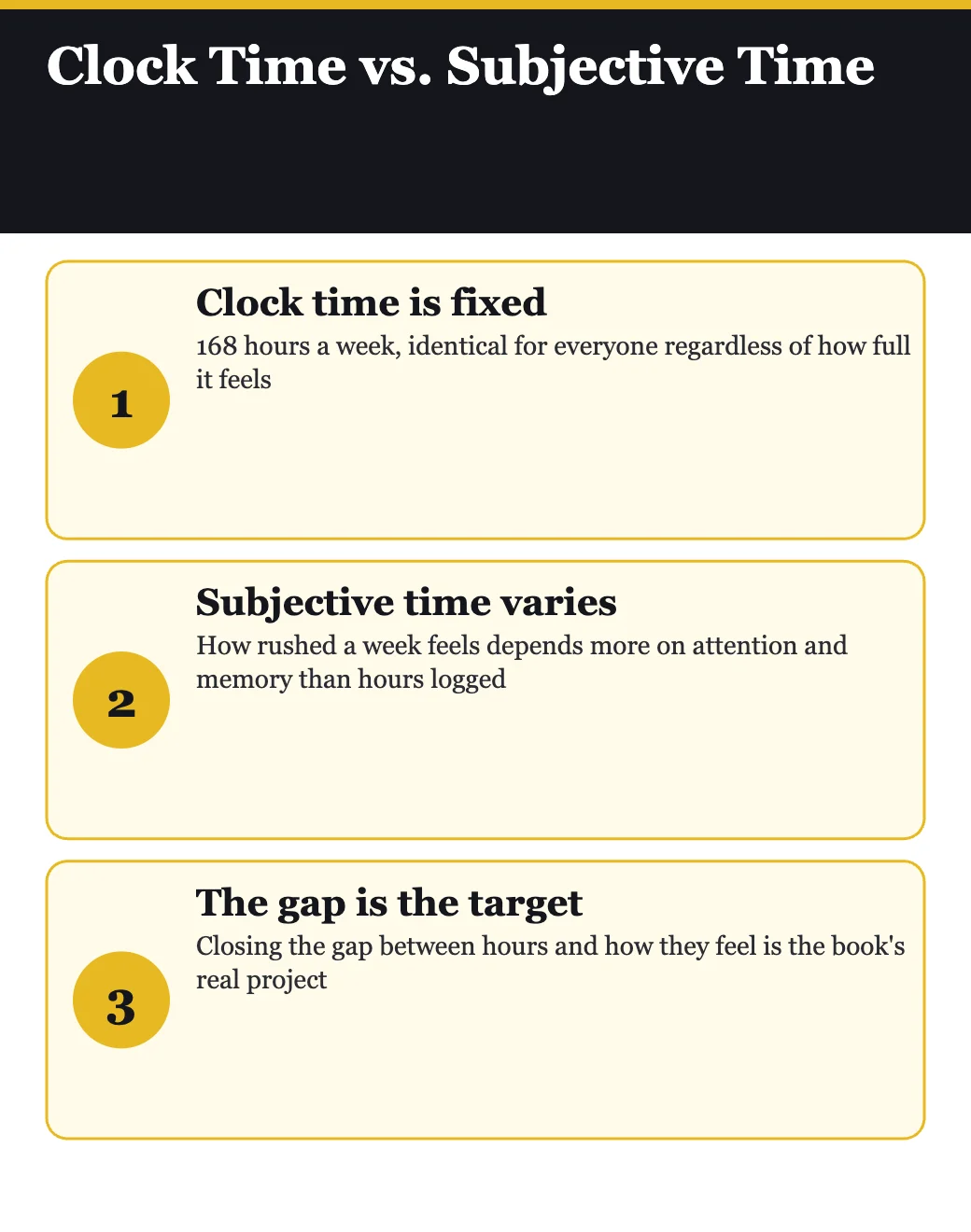
- Clock time is fixed, subjective time isn’t: everyone gets 168 hours a week, but how full or rushed those hours feel varies enormously.
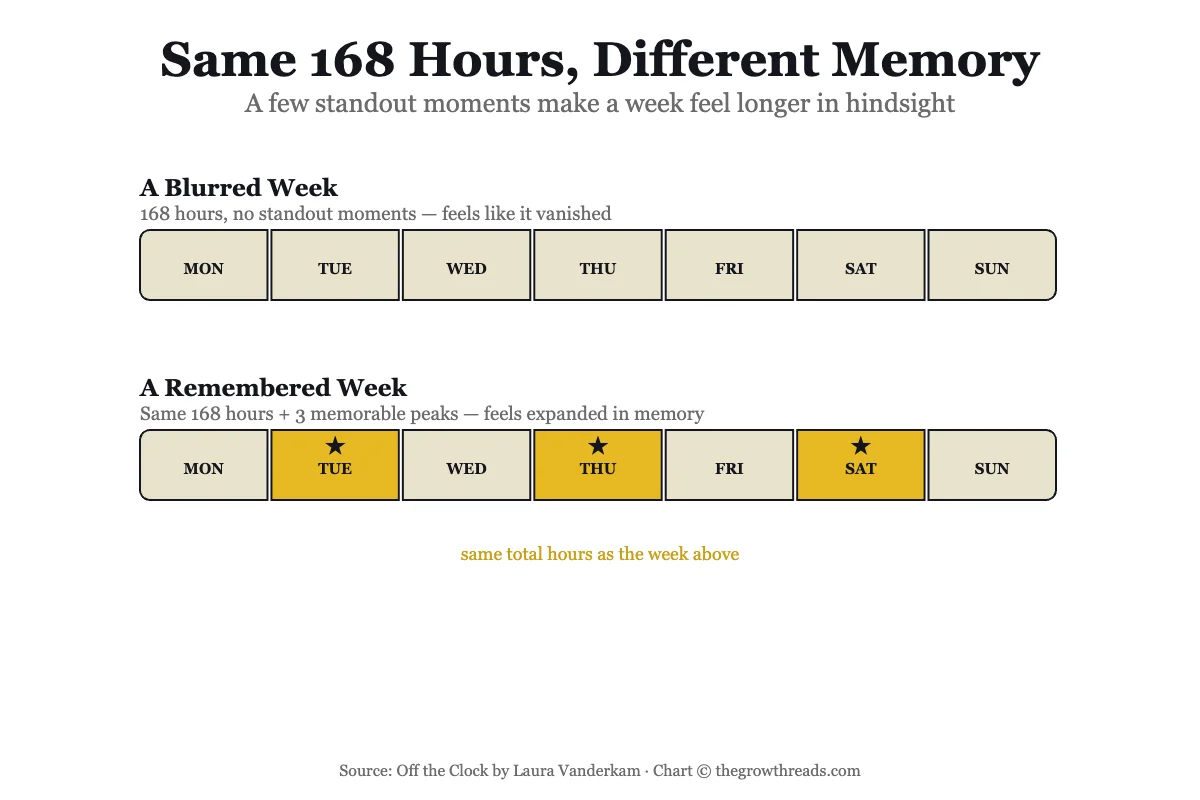
- Time perception is partly a memory problem: weeks with no standout moments tend to blur together and feel like they vanished.
- Peak moments anchor a week in memory: a handful of memorable events give a week distinct shape, making it feel longer in hindsight.
- Anticipation extends felt time: looking forward to something adds to a sense of time-richness before it even happens.
- Time logging closes the perception gap: tracking a real week in blocks often reveals more available time than a vague sense of “always busy” suggests.
- A full calendar isn’t automatically a good one: protecting unscheduled space matters as much as filling productive time.
- Savoring stretches good moments: deliberately lingering in a good experience, rather than rushing to the next task, makes it more memorable later.
- Busy professionals with kids can still feel time-abundant: the book’s case studies focus on people managing demanding schedules who nonetheless report feeling like they have enough time.
- Self-reported “busy” often overstates actual pressure: logged days tend to be rated more positively than people’s general, abstract sense of being busy.
- Small, repeatable rituals build felt abundance: the fixes are habits of attention, not a smaller to-do list.
What is Off the Clock about?
Off the Clock investigates why equally busy people report very different senses of having enough time. Drawing on time-diary research with over 900 professionals, Laura Vanderkam argues the gap between clock time and felt time comes down to memory, attention, and anticipation — and offers small habits for closing it without necessarily working less.
About the author
Laura Vanderkam has built her career studying how people actually spend their time, using time-diary methodology rather than relying on self-reported impressions of busyness. Her earlier book, 168 Hours, made the quantity argument — that most people have more genuinely available time each week than they assume, once every hour is accounted for. Off the Clock shifts from quantity to quality: rather than asking where the hours are hiding, it asks why the same number of hours can feel scarce to one person and abundant to another. Vanderkam draws this book from a 2017 study in which more than 900 full-time employed people, many with children, logged an entire day hour-by-hour and answered questions about both that specific day and their general sense of time pressure — paired with qualitative case studies of specific busy professionals she calls “time makeovers.” It’s worth noting that these makeover subjects tend to be self-selected, motivated professionals already willing to log and reflect on their time — a limitation worth keeping in mind when generalizing the case studies to readers in very different circumstances. Explore all Laura Vanderkam book summaries →
Key concepts at a glance
| Concept | What it means | Use it when |
|---|---|---|
| Clock time | The fixed, measurable 168 hours everyone has each week | You want an objective baseline before addressing how time feels |
| Subjective time | How full, rushed, or abundant those same hours feel in the moment and in memory | You feel busier than your actual schedule seems to justify |
| Memory anchoring | Standout moments give a week distinct shape; routine days blur together | A past week or month feels like it vanished without a trace |
| Anticipation | Looking forward to something adds felt time-richness before it happens | Your calendar has no upcoming events to look forward to |
| Time logging | Tracking a real week in blocks to see where hours actually go | Your sense of “always busy” hasn’t been checked against an actual log |
| Savoring / lingering | Deliberately staying present in a good moment rather than rushing past it | Good moments pass by without registering as memorable |
| Protected blank space | Unscheduled time treated as valuable, not as a gap to fill | A full calendar has started to feel like the goal itself |
Part 1: Clock time and subjective time are different problems
Vanderkam’s starting observation is one that will feel familiar to almost any reader: two people with structurally similar 60-hour weeks — same job demands, same number of kids, same commute — can report wildly different levels of time pressure. One feels perpetually behind and describes their life as chaotic; the other, doing comparably demanding work, describes feeling like they have enough time. If the raw hours are similar, something other than workload is driving the difference in how those hours feel.
It’s worth being precise about what this observation does and doesn’t claim. It isn’t saying workload doesn’t matter at all, or that someone genuinely overloaded should simply think their way to feeling fine — an unreasonable schedule is still an unreasonable schedule. What it does claim is that among people whose schedules are in a broadly comparable, non-extreme range, the variance in felt time-pressure is large enough that workload alone can’t be the whole explanation. That leaves real room for habits of attention and memory to account for a meaningful share of the difference, which is the space the rest of the book operates in.
This is the book’s organizing distinction: clock time, the measurable 168 hours everyone gets each week regardless of circumstance, versus subjective time, the felt sense of how full, rushed, or abundant those hours are. Her earlier book, 168 Hours, focused primarily on clock time — finding hidden hours in a real week through logging and reallocation. Off the Clock shifts the focus to the second half of the equation: why the same number of hours can feel scarce to one person and generous to another, and what specifically the time-abundant group is doing differently.
It’s a genuinely different research question, not a rebranding of the same one. Finding hidden hours, the project of 168 Hours, is a logistical exercise — audit the week, reallocate low-value time toward what matters. Explaining why felt time-pressure varies among people with similar logistics is closer to a psychological question, and it requires a different kind of evidence: not just how hours are spent, but how people remember, anticipate, and attend to them. Vanderkam’s decision to pursue this second question with the same rigor she brought to the first — a large time-diary study rather than pure anecdote — is part of what distinguishes this book from more purely motivational treatments of the same broad topic.
Part 2: Why memories make time feel longer
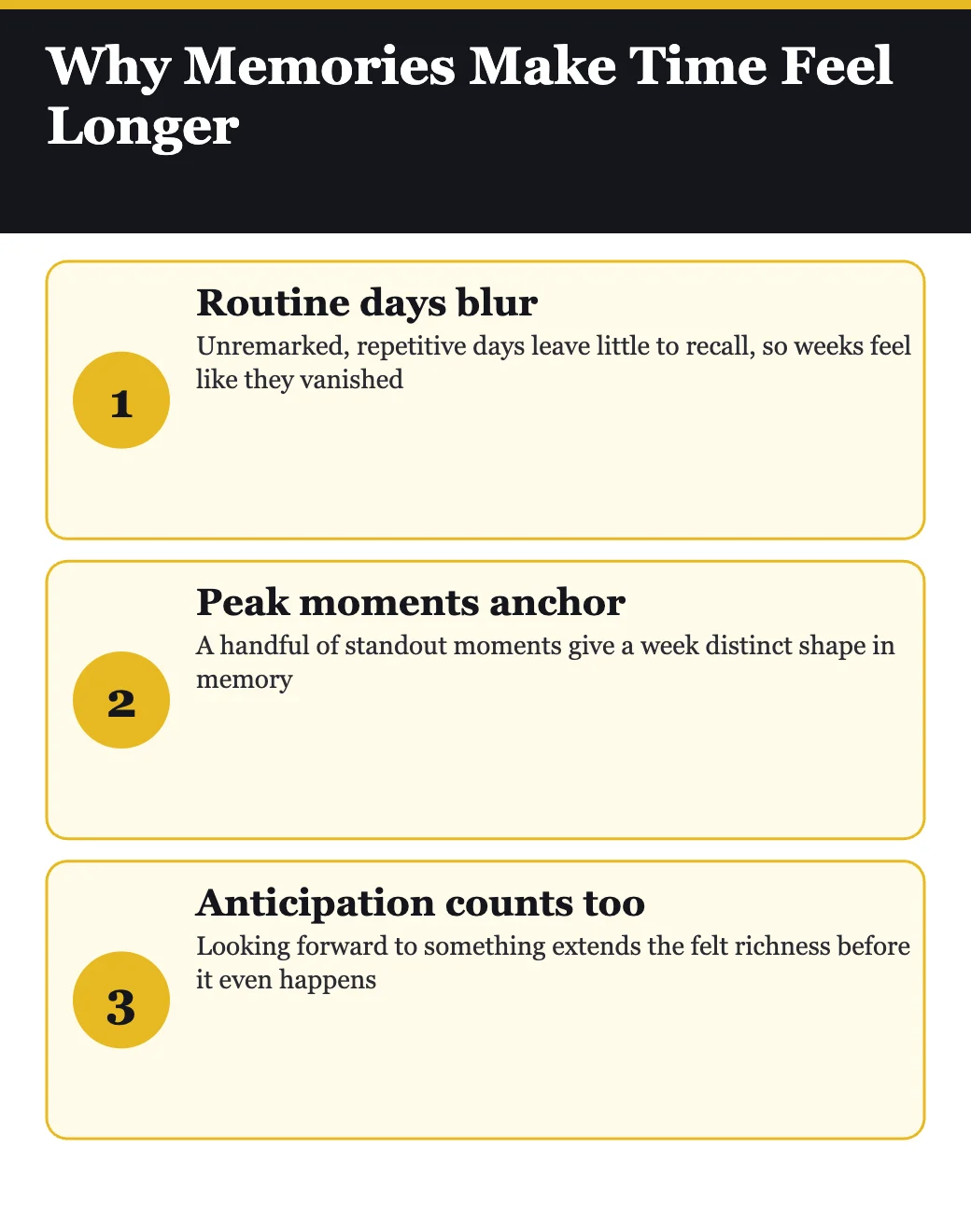
One of the book’s most consistently cited ideas across reviews and summaries is the connection between memory and felt time-abundance: the more memorable moments a period contains, the longer and richer it tends to feel in retrospect, even if the total hours were identical to a more forgettable stretch. This is consistent with a broader pattern researchers have noted in how people evaluate extended experiences generally: overall judgment of a period tends to be shaped disproportionately by its most notable moments, rather than by an even average across every moment within it. Applied to an ordinary week, this means a handful of genuinely distinct events can outweigh dozens of forgettable, routine hours in determining how the whole week gets remembered afterward — which is exactly why adding a small number of standout moments can shift felt time-abundance more than it might seem it should, given how few hours those moments actually occupy. A week with no standout moments — same meetings, same commute, same routine dinners — tends to blur together and feel like it barely happened at all, even though it consumed just as many hours as any other week. A week with even a few genuinely memorable moments, by contrast, feels fuller and longer when looked back on, because there’s more to actually recall.
This has a practical implication that runs counter to a common instinct: when time feels scarce, the reflex is often to cut activities in order to “save time,” but Vanderkam’s framing suggests that deliberately adding a small number of memorable, novel experiences can do more for felt time-abundance than subtracting obligations does. It’s not about doing more in total — it’s about ensuring that some of what you do stands out enough to be remembered, rather than every week looking identical to the last.
This also reframes what “wasted time” means. A stretch of passive, low-engagement activity — scrolling, half-watching something without interest — isn’t costly primarily because it takes up minutes that could have gone elsewhere; it’s costly because it tends to leave nothing behind in memory, contributing to the blur that makes a week feel like it slipped away. A shorter but more engaged activity, by contrast, can leave a disproportionately strong trace precisely because it was memorable, even if it consumed less clock time than the passive alternative it replaced.
Part 3: Anticipation and presence
Beyond memory of the past, the book gives real weight to anticipation of the future. Having something to look forward to — even something modest, like a planned dinner with a friend or a weekend outing — appears to add to a sense of time-richness well before the event itself occurs. A calendar with nothing on the horizon to anticipate can feel emptier in a subjective sense than one with a few small things planned, independent of how the actual hours are filled in between.
The flip side of anticipation is presence: fully engaging with an experience while it’s happening, rather than mentally rushing ahead to the next task, appears to make that experience both more enjoyable in the moment and more memorable afterward — reinforcing the same memory-anchoring effect described above. Some case studies in the book describe people deliberately “lingering” in good moments rather than immediately moving on, treating presence itself as a small, repeatable skill rather than something that just happens naturally when circumstances allow it.
Anticipation and presence work together across the timeline of an experience rather than at a single point: anticipation adds felt richness beforehand, presence and lingering add it during, and the resulting memory adds it afterward. Neglecting any one stage weakens the effect — an event that’s anticipated but rushed through, or fully present but instantly forgotten, contributes less to overall time-abundance than one where all three stages are given some deliberate attention. The book’s case studies suggest this doesn’t require large blocks of free time, just a shift in how existing moments are approached.
Part 4: Turning the research into habits
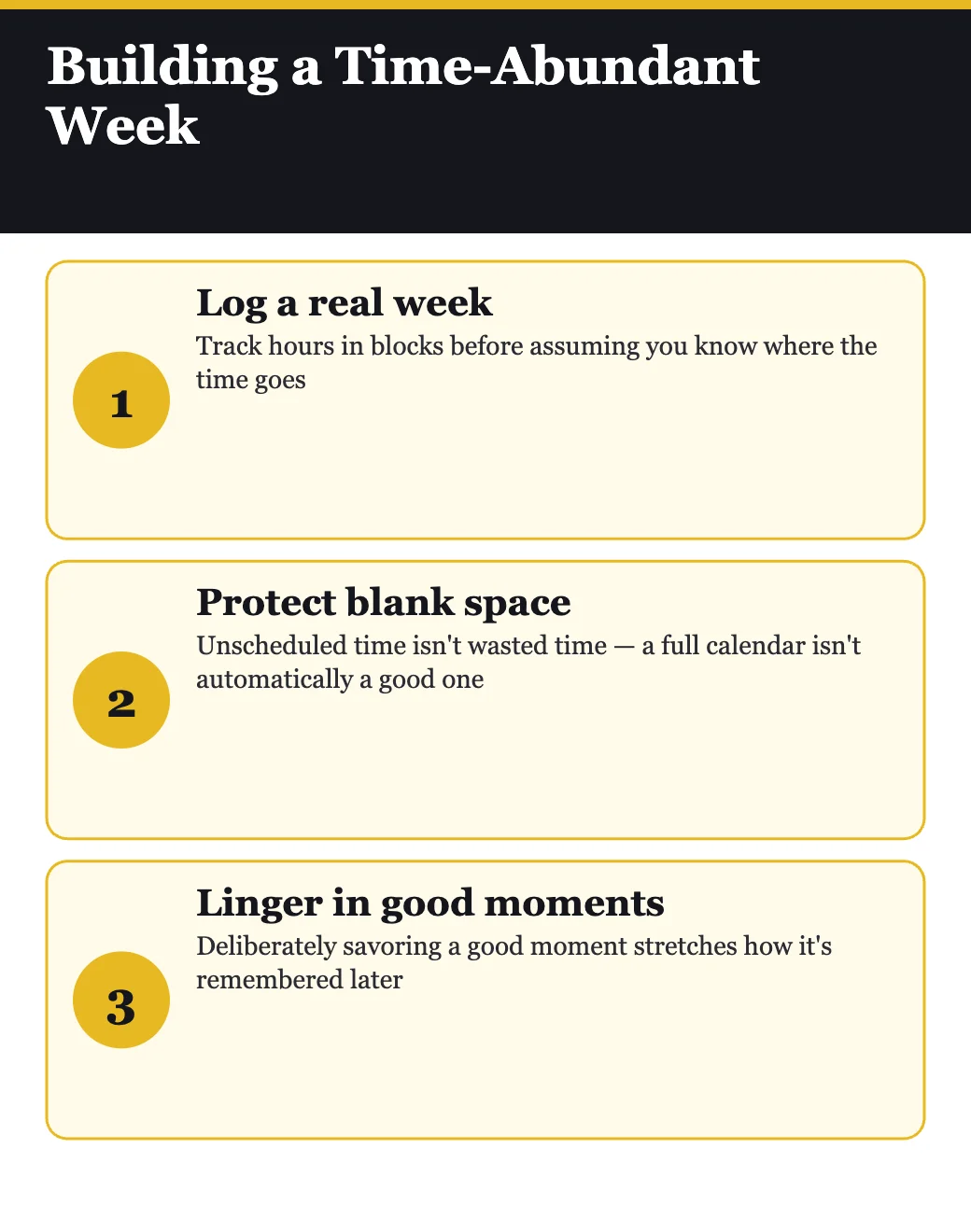
True to her research background, Vanderkam anchors the book’s advice in the time-logging methodology she’s known for: tracking a real week in 15-to-30-minute blocks before assuming you already know where the hours go. A common finding across her work is that people’s abstract sense of “I never have any time” often doesn’t survive contact with an actual log, which tends to reveal more discretionary time than expected, just distributed differently than intuition suggests.
This gap between perceived and logged time isn’t necessarily a sign of dishonesty or exaggeration — it reflects how memory works under stress. The most demanding, effortful parts of a day tend to be overrepresented in how a person recalls it afterward, while the smaller pockets of downtime, waiting, or low-intensity activity tend to be underrepresented or forgotten entirely. A log corrects for this bias by capturing every block as it happens rather than relying on end-of-day recall, which is why the exercise often surprises people who were confident they already knew their own schedule cold.
From there, the book’s case studies point toward habits that protect and shape that time rather than simply filling it: guarding some unscheduled space instead of treating a packed calendar as inherently virtuous, building in small anticipated events, and deliberately lingering in good moments instead of rushing to the next item on the list. None of these are large schedule overhauls — they’re closer to habits of attention layered on top of whatever schedule a reader already has, which is consistent with the book’s core argument that felt time-abundance is more about how time is noticed and used than about how much of it exists.
There’s also a compounding element to these habits that’s easy to underestimate: a single memorable evening or a single act of lingering won’t transform how a whole month feels, but a week that consistently includes small anticipated moments, occasional standout experiences, and a bit of protected unscheduled time tends to accumulate a noticeably different feel than a week built entirely of undifferentiated obligations. The book frames this the same way it frames most durable change — not as a single decisive intervention, but as a habit repeated often enough to shift the overall texture of how time is experienced.
Who is Off the Clock best for — and who should read something else first?
This book is best for readers who already have a reasonably functional schedule but still feel chronically rushed, and who suspect the problem is more about perception and attention than about needing to cut more obligations. It pairs especially well with 168 Hours for readers who want both the quantity and quality sides of the time-management question. Readers whose core problem is genuinely too many obligations, rather than how existing time feels, may get more immediate traction from a book focused on prioritization, like 168 Hours itself.
Questions to reflect on
- Think of a recent week that felt like it vanished — what, if anything, do you actually remember from it?
- What’s one small, plannable thing you could look forward to in the next two weeks?
- Where do you tend to rush past a good moment instead of lingering in it?
- If you logged your actual hours for a week, do you expect the result would match your general sense of “always busy”?
- Is your calendar full because it needs to be, or because a full calendar has started to feel like a goal in itself?
🔥 Ready to feel less busy without doing less?
Get Off the Clock and learn what time-abundant people actually do differently with the same 168 hours.
How to apply Off the Clock (7-day plan)
- Day 1: Start a time log — track your day in 30-minute blocks without changing your behavior yet.
- Day 2: Continue the log. Note which parts of the day you’d already forgotten by evening.
- Day 3: Plan one small, specific thing to look forward to in the next week — put it on the calendar now.
- Day 4: Practice lingering: pick one good moment today and stay in it an extra minute instead of moving on immediately.
- Day 5: Review your log so far — identify one block of “always busy” time that turned out to be more flexible than assumed.
- Day 6: Protect one block of unscheduled time this weekend rather than filling it with a task.
- Day 7: Look back on the week — which day do you actually remember, and what made it memorable?
Frequently asked questions
What is the difference between clock time and subjective time?
Clock time is the fixed, measurable 168 hours everyone has each week, regardless of circumstance. Subjective time is how full, rushed, or abundant those same hours feel — both in the moment and in memory afterward. Vanderkam’s central argument is that two people with similar clock time can have very different subjective time, and that gap is driven more by attention, memory, and anticipation than by actual workload.
How does Off the Clock relate to Vanderkam’s earlier book, 168 Hours?
168 Hours focuses on the quantity side of time management — finding and reallocating hidden hours across a real week through logging. Off the Clock shifts to the quality/perception side — why equally busy people feel differently about the same number of hours. The two books are best read as complementary: one addresses where the hours go, the other addresses how they feel once accounted for.
What research is this book based on?
The book draws on a 2017 study of more than 900 full-time employed people, many with children, who logged an entire day hour-by-hour and answered questions about both that specific day and their general sense of time pressure. This is paired with qualitative case studies of specific busy professionals. The time-diary methodology is consistent with Vanderkam’s earlier, well-documented research approach.
Why do memorable moments make time feel longer?
According to the book, routine days with nothing distinct tend to blur together in memory, making a period feel like it passed quickly or vanished. A week with even a few standout, memorable moments gives that period more distinct shape when recalled later, which tends to make it feel fuller and longer in retrospect — even when the total hours were identical to a more forgettable week.
Does this book suggest doing less, or doing things differently?
The emphasis is mostly on doing things differently rather than simply cutting obligations. Rather than focusing purely on removing tasks to “save time,” the book suggests that adding small, memorable, anticipated experiences and protecting some unscheduled space can improve felt time-abundance more than subtraction alone.
What is “lingering” or savoring in this book’s context?
It refers to deliberately staying present in a good moment rather than mentally rushing ahead to the next task. Case studies in the book describe this as a practicable, repeatable habit rather than something that only happens naturally — the idea being that presence in the moment reinforces the memory-anchoring effect that makes time feel richer afterward.
Who is Off the Clock best for?
It’s best suited to readers who already have a functional, if demanding, schedule but still feel chronically rushed, and who suspect the issue is more about perception and attention than a genuine excess of obligations. It pairs naturally with 168 Hours for readers wanting both the quantity and quality sides of the time question.
Related summaries
Explore more time-management guides: 168 Hours · How to Manage Your Home Without Losing Your Mind · Do Nothing · see the full Time Management hub for more.
How we analyze books: we read the source material, cross-reference author interviews and published summaries, and build original diagrams and 7-day application plans so every TGR guide adds value beyond the book itself. Read our full methodology.
Related Time Management Summaries
Extreme Productivity Summary & Review: Judge Output, Not Hours
How a Little Becomes a Lot Summary & Review: Small Habits That Actually Stick
Peak Mind Summary & Review: Train Your Attention in 12 Minutes a Day
The Perfect Day Formula Summary & Review: Structure Equals Freedom
Wait Summary & Review: The Art and Science of Delay