

⭐⭐⭐⭐⭐ 4.7/5 — A compassionate, practical guide for people who’ve never had home-management systems actually stick.
Best for: Self-described “naturally messy” people who’ve tried and abandoned more rigid organizing systems.
Reading time: ~4 hrs to read, 20 min to guide
Difficulty to apply: Low — the core habits take minutes a day, not a weekend overhaul.
How to Manage Your Home Without Losing Your Mind in one minute
Housekeeping isn’t a project with an end point — it’s an ongoing process, and treating it like a one-time fix is why most organizing advice fails. Dana K. White, who blogs and podcasts as “A Slob Comes Clean,” wrote this book for people she calls naturally messy — not lazy, just missing the automatic habits that naturally tidy people take for granted, like noticing clutter or intuitively knowing where things belong. Her alternative isn’t a bigger, better system to install all at once; it’s a handful of small, repeatable habits — visible clutter first, easiest decisions first, one short daily reset — that don’t depend on motivation or a naturally organized brain to keep working.
Key takeaways
- Messiness isn’t a character flaw: it’s a missing set of automatic habits that naturally organized people never had to learn consciously.
- The visibility rule: if you can’t see it, you forget it exists — hidden clutter never gets processed on its own.
- Deciding is the hard part: most decluttering friction comes from decision fatigue, not from the physical act of moving items.
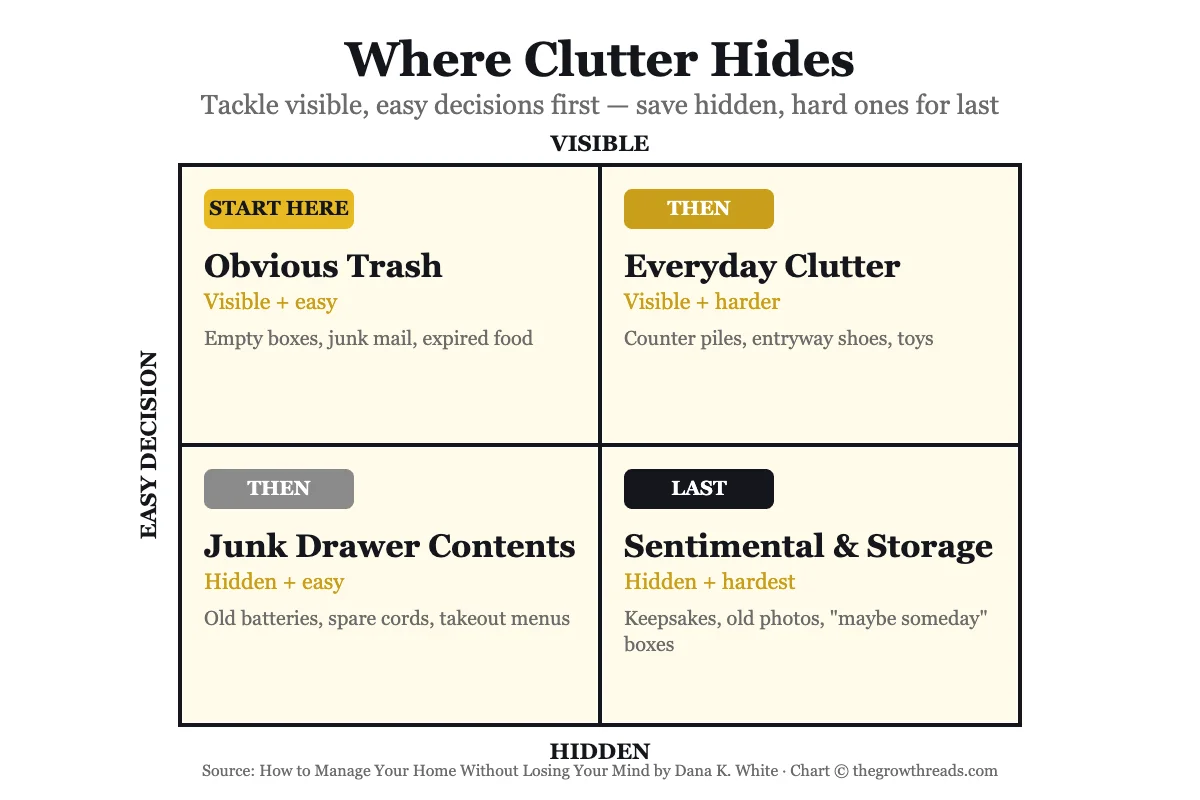
- Start with visible clutter: the mess you see every day erodes motivation fastest, so it should be tackled first.
- Easiest decisions first: trash requires zero evaluation — start there before moving to harder, more sentimental categories.
- Containers set the ceiling: a space can only hold what fits in it; the fix for overflow is removing items, not adding storage.
- Small, timed sessions beat marathons: short, capped decluttering bursts are easier to start and sustain than open-ended purges.
- The nightly reset anchors everything: one small non-negotiable habit, done at the same time daily, does more than an elaborate schedule.
- Progress over perfection: success is measured by whether today’s small task got done, not by an idealized finished home.
- Housekeeping has no finish line: accepting it as continuous, rather than a project to complete, removes the all-or-nothing trap.
What is How to Manage Your Home Without Losing Your Mind about?
The book is a home-management guide for people who feel chronically disorganized despite genuinely trying. Dana K. White argues that messiness reflects missing habits, not laziness, and offers small, repeatable routines — tackling visible clutter first, easiest decisions first, and one nightly reset — instead of a single big organizing overhaul.
About the author
Dana K. White began writing under the pseudonym “Nony” on her blog, A Slob Comes Clean, in 2009, documenting her own struggle with chronic disorganization in real time rather than presenting herself as a naturally tidy expert. That blog grew into a long-running podcast of the same name, and her willingness to describe her own home’s mess in detail — rather than offering advice from a place of assumed competence — became the foundation of her credibility with readers who felt unseen by more polished organizing content. How to Manage Your Home Without Losing Your Mind, published by Thomas Nelson in 2016, was her first traditionally published book, later followed by Decluttering at the Speed of Life, which goes deeper into the decision-making side of getting rid of things. Together the two books form a loose pair: this one focused more broadly on daily home-management habits, the later one focused specifically on the psychology of decluttering decisions. Explore all Dana K. White book summaries →
Key concepts at a glance
| Concept | What it means | Use it when |
|---|---|---|
| Naturally messy | White’s term for people missing automatic tidiness habits, not lacking willpower | You’ve blamed yourself for not being “naturally organized” |
| Visibility rule | Clutter you can’t see gets forgotten and never processed | You keep “storing” items in closed containers you never revisit |
| Decision fatigue | The hard part of decluttering is deciding, not moving items | You freeze in front of a pile instead of physically sorting it |
| Easiest decisions first | Start with trash, then obvious clutter, save sentimental items for last | You’re stuck trying to decide on hard items before building any momentum |
| Container concept | A space can only hold what fits — the fix is removing items, not adding storage | You’ve considered buying another bin instead of decluttering |
| Nightly reset | A short, same-time-every-day habit that anchors the whole house | You want one non-negotiable habit rather than a full daily schedule |
| Progress, not perfection | Success is judged by today’s small task, not an idealized finished home | All-or-nothing thinking has derailed past organizing attempts |
Part 1: Why “just get organized” advice doesn’t work for everyone
White opens from a place of genuine empathy: most organizing content is written by people who were already naturally tidy, describing systems that assume skills the reader doesn’t have. Advice like “a place for everything” sounds simple, but it presumes you’ll notice when something isn’t in its place and feel a pull to correct it — an automatic response that naturally organized people don’t even register as a skill. For someone who doesn’t have that automatic noticing, the same advice just produces another abandoned system and another round of self-blame.
White is careful to note that this isn’t a critique of organizing advice in general — plenty of it is genuinely useful for the people it was written for. The issue is a mismatch between audience and assumption: advice that says “just put it back where it belongs” is trivially easy to follow if you already have a strong internal sense of where things belong and a habit of acting on it immediately. For a reader without that internal sense, the same sentence isn’t a reminder, it’s an instruction with several invisible prerequisites missing, which is why following it faithfully so often still doesn’t produce lasting change.
Her reframe is important: disorganization isn’t a moral failing or a discipline problem, it’s a mismatch between the demands of a task and the automatic habits a person actually has. This isn’t just a comforting reframe — it changes what kind of solution actually works. Instead of trying to will yourself into noticing clutter the way a naturally tidy person does, the book builds explicit, external routines that do the noticing for you: visible-first ordering, timed sessions, and a container ceiling that limits how much can accumulate before it forces a decision.
This reframe also changes how failure feels along the way. If disorganization is a character flaw, every relapse into clutter reads as further proof of a personal shortcoming, which makes it easy to give up entirely after one bad week. If it’s instead a missing routine, a relapse is just a signal that a particular habit didn’t fit and needs adjusting — not evidence that the whole effort was doomed. White returns to this distinction repeatedly, because she sees the shame spiral around “failing” at organizing as a bigger obstacle to lasting change than the clutter itself.
Part 2: The visibility rule and decision fatigue
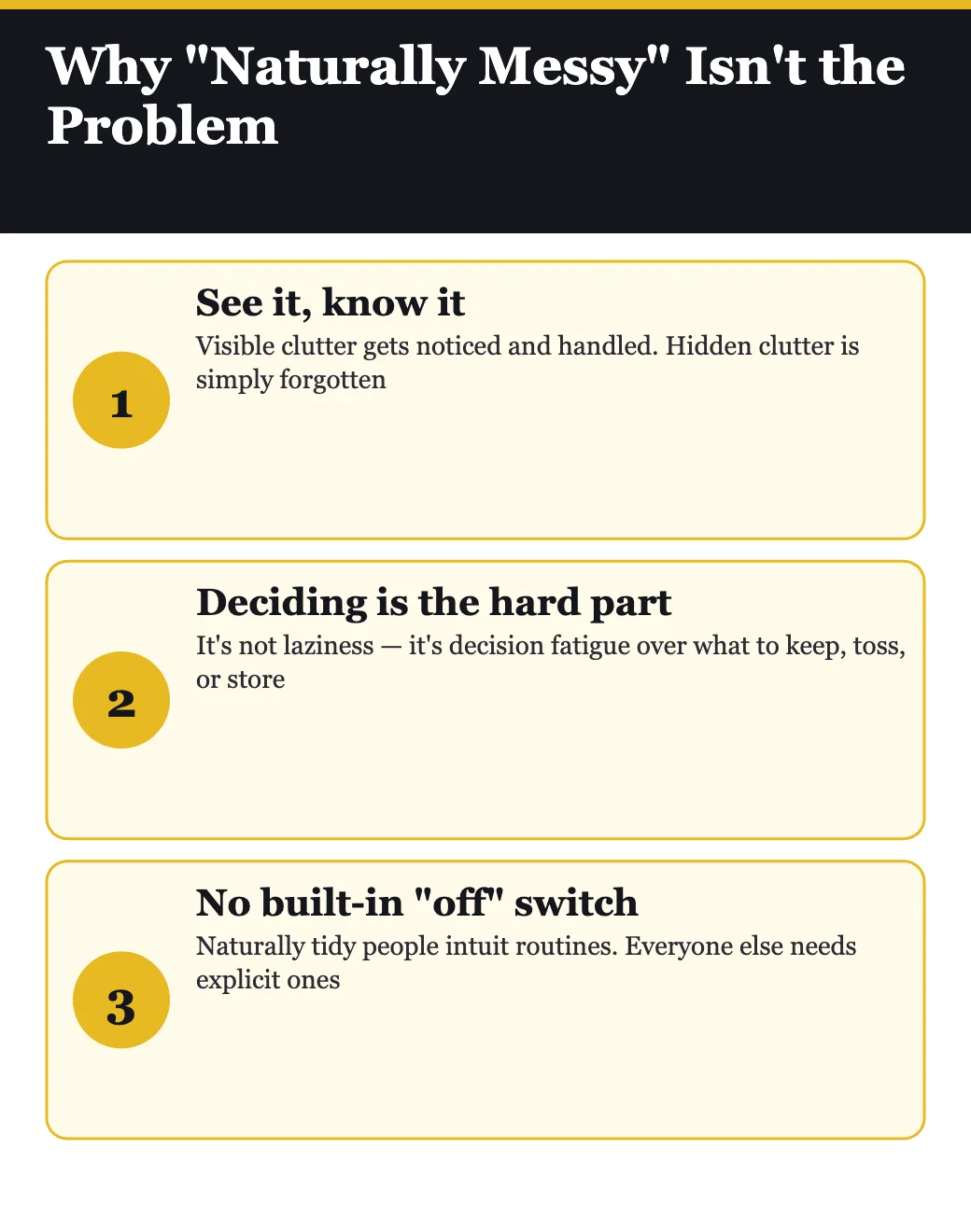
Two ideas do most of the work in this book. The first is the visibility rule: if an item is out of sight, it’s effectively out of existence as far as your daily decision-making is concerned. A drawer that’s closed, a box that’s stacked, a closet that’s shut — none of these prompt a decision, so their contents simply accumulate indefinitely. This is why White repeatedly directs readers to start with what’s visible rather than what’s technically most cluttered; visible mess is what actually erodes daily motivation and makes a home feel unmanageable, even if a closed closet holds more total stuff.
The second idea is that decluttering’s real bottleneck isn’t physical effort, it’s decision fatigue. Physically moving an item from one place to another takes seconds; deciding whether to keep, donate, or discard it is what actually drains willpower over a session. White’s practical response is to reduce the number of genuine decisions required — starting with trash, which requires no evaluation at all, before moving to categories that demand real judgment. By the time a reader reaches genuinely difficult, sentimental items, they’ve built momentum and used up the easy wins, which in her framing is exactly the right order: hard decisions deserve fresh energy, not leftover willpower.
White also notes that this ordering has a practical side benefit beyond momentum: the visible progress from clearing trash and obvious clutter first creates immediate, tangible feedback that the effort is working, well before the harder categories are even touched. That early feedback matters more than it might seem — for someone who has repeatedly started and abandoned organizing projects, seeing a counter or table visibly clear within the first few minutes is often what keeps a session going long enough to reach the more demanding decisions later.
There’s a related point about timing sessions: White consistently recommends capping decluttering bursts with a timer rather than working until a space is “finished.” An open-ended session invites decision fatigue to compound unchecked, and it also makes the task harder to start in the first place, since an unbounded commitment feels heavier than a defined ten or fifteen minutes. A capped session, by contrast, is easy to say yes to even on a low-energy day, and stopping at the timer — even mid-task — is treated as a success rather than an incomplete failure.
Part 3: Easiest decisions first
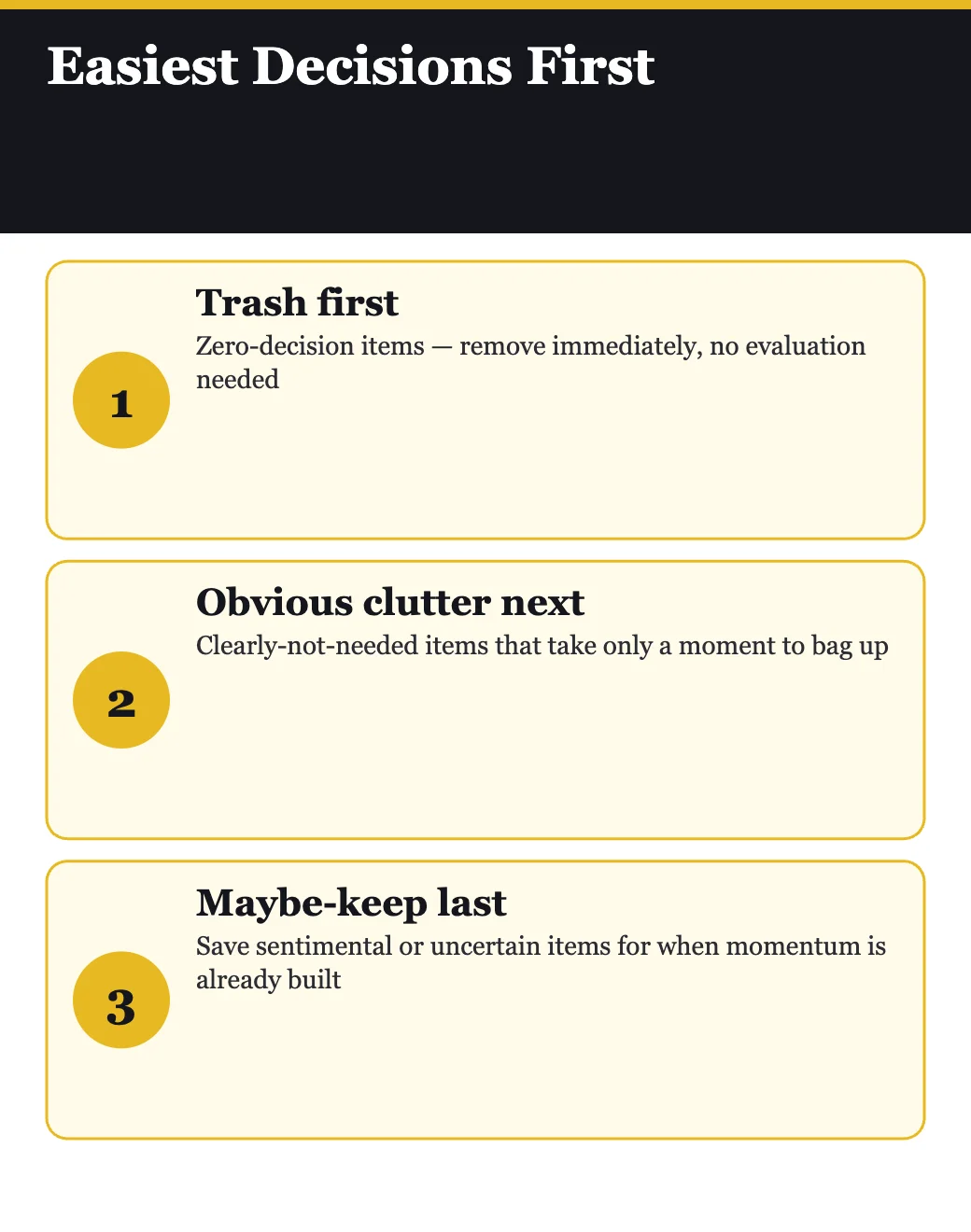
The book’s practical decluttering order follows directly from the decision-fatigue idea: trash first, obvious-but-not-trash clutter second, uncertain or sentimental items last. Trash requires no real decision — expired food, empty packaging, and broken items can be removed on sight without any evaluation, which makes it the fastest way to create visible progress and build early momentum. Obvious clutter — the stuff that’s clearly not needed but isn’t quite trash, like duplicate kitchen tools or clothes that no longer fit — comes next, since it still requires only a light decision.
Sentimental and uncertain items are deliberately saved for last, and White frames this as strategic rather than avoidant. By the time a reader reaches a box of old photographs or a keepsake with unclear value, they’ve already cleared the easy categories, built visible progress, and — ideally — developed enough momentum and confidence in the process to make a harder call without it derailing the whole session. Tackling sentimental items first, by contrast, tends to stall momentum before it starts, since those decisions are inherently slower and more emotionally loaded.
The book also acknowledges that this order isn’t a rigid law — the point is the underlying principle of sequencing decisions by difficulty, not the specific categories themselves. A reader whose hardest decisions center on kitchen gadgets rather than sentimental keepsakes can apply the same logic: clear whatever counts as “easy” for them first, and save the genuinely difficult calls for once momentum and confidence are already established. The ordering is meant to be diagnostic of your own decision-making, not a fixed checklist to follow regardless of fit.
This flexibility extends to categories themselves — the book doesn’t insist that every household follow an identical trash-clutter-sentimental sequence. Some readers find that certain digital or paper clutter (old mail, expired coupons) belongs in the “easy” tier alongside physical trash, while others discover that even seemingly simple categories carry unexpected emotional weight and should be moved later in the sequence. The value of the framework lies in the habit of noticing decision difficulty at all, not in memorizing a universal order that applies identically to every home.
Part 4: The nightly reset and sustaining the system
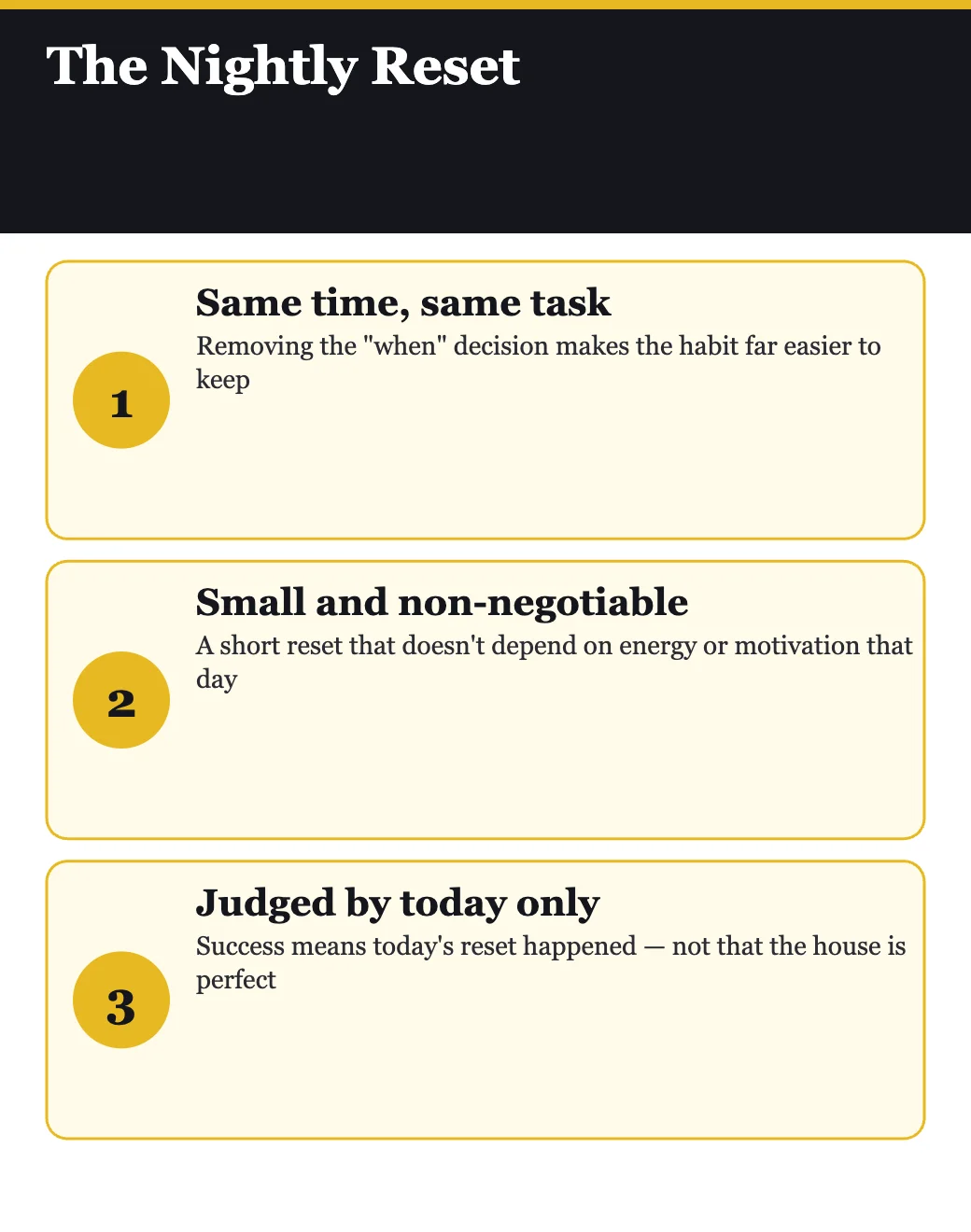
Beyond one-time decluttering, White emphasizes a single daily anchor habit — commonly a short kitchen or living-space reset done at the same time every day, such as right before bed. The point isn’t to deep-clean anything; it’s to remove the daily decision of when to tidy by fixing it to a consistent trigger, the way brushing your teeth doesn’t require a fresh decision each night. A habit that’s small, consistent, and non-negotiable is far more sustainable than an ambitious schedule that depends on having enough energy or motivation on a given day.
White is explicit that success under this system looks different from a spotless house: it looks like today’s reset happening, even on a bad day, even if the rest of the house is still a work in progress. This “progress, not perfection” framing runs through the whole book and directly counters the all-or-nothing thinking she identifies as a major reason organizing attempts fail — the belief that if the whole house isn’t perfect, none of it matters, which makes it easy to abandon a system after a single missed day.
White also addresses what happens when the routine breaks — a sick week, travel, a busy season at work. Rather than treating a missed reset as a failure that invalidates the whole system, she frames it as simply a gap to close, not a reason to restart from scratch or feel like the effort was wasted. The habit resumes the next available day exactly as it was, with no penalty or “catching up” required. There’s no attempt to make up for several missed nights at once, since trying to “catch up” on a habit tends to turn a small, sustainable task into a large, resented one — exactly the kind of oversized obligation the whole system was designed to avoid in the first place. This forgiveness built into the system is part of why it tends to outlast more rigid schedules, which often collapse entirely the first time real life interrupts them.
Who is How to Manage Your Home Without Losing Your Mind best for — and who should read something else first?
This book is best for readers who’ve tried more rigid, all-at-once organizing systems and abandoned them, and who respond better to small daily habits than to a big weekend overhaul. It’s also a strong fit for anyone who’s internalized “I’m just not a naturally organized person” as a fixed trait rather than a solvable gap in habits. Readers whose main challenge is deciding what to keep, rather than daily upkeep, may prefer the deeper decision-focused framework in Decluttering at the Speed of Life. Readers drawn to a more timer-driven, room-by-room method might also enjoy The CHAOS Cure.
Questions to reflect on
- What clutter in your home is currently hidden from view — and how long has it been since you last dealt with it?
- Where do you tend to freeze on a decision rather than struggle with the physical task of decluttering?
- What’s one nightly reset habit small enough that you could do it even on your worst day?
- Which category of belongings would you naturally save for last — and is that actually the right order for you?
- Where has “the whole house isn’t perfect” talked you out of doing today’s small task?
🔥 Ready to stop losing your mind over your home?
Get How to Manage Your Home Without Losing Your Mind and build habits that don’t depend on being naturally tidy.
How to apply How to Manage Your Home Without Losing Your Mind (7-day plan)
- Day 1: Set a 10-minute timer and clear only the most visible clutter in one room — nothing hidden, nothing sorted deeply.
- Day 2: Repeat in a second visible space, starting with obvious trash before anything else.
- Day 3: Pick one nightly reset habit — a single small task done at the same time every night, non-negotiable.
- Day 4: Open one closed container (drawer, bin, closet) and apply the same easiest-decisions-first order to its contents.
- Day 5: Notice one spot where you’ve considered buying more storage — try removing items instead of adding space.
- Day 6: Do your nightly reset even if today felt unproductive — the goal is consistency, not a perfect day.
- Day 7: Review the week: which habit stuck without effort, and which felt forced? Keep the one that stuck.
Frequently asked questions
What is the “container concept” in this book?
The container concept is Dana K. White’s idea that a space — a shelf, drawer, closet, or even a house — can only hold what physically fits inside it. When a space overflows, the fix isn’t adding more storage to accommodate the excess; it’s removing items until what remains actually fits. The book introduces this idea, though her later book, Decluttering at the Speed of Life, develops it in more depth as its central framework.
What is the visibility rule?
The visibility rule holds that clutter you can’t see gets forgotten and never processed — a closed drawer or a stacked box doesn’t prompt any decision, so its contents simply accumulate indefinitely. This is why the book directs readers to tackle visible clutter first: it’s what actually affects daily motivation and how “managed” a home feels, even when hidden clutter technically takes up more space.
Why does the book recommend starting with trash first?
Because decluttering’s real bottleneck is decision fatigue, not physical effort. Trash requires no evaluation at all — it can be removed on sight — which makes it the fastest way to create visible progress and build momentum before facing harder, more sentimental decisions later in a session.
How is this different from Decluttering at the Speed of Life?
This 2016 book is a broader home-management guide covering daily habits and routines, including a brief introduction to the container concept. Decluttering at the Speed of Life, published later, goes deeper specifically into the psychology of deciding what to keep. The two are frequently read as a pair, with this one focused on sustaining daily order and the later one focused on the decision-making side of decluttering.
What is the nightly reset habit?
It’s a short, consistent task — often a quick kitchen or living-space tidy — done at the same time every day, typically right before bed. The point isn’t deep cleaning; it’s removing the daily decision of when to tidy by attaching the habit to a fixed trigger, which makes it far more sustainable than a schedule that depends on available motivation.
Is this book only about decluttering, or does it cover cleaning too?
It covers both, though its throughline is habits rather than a room-by-room cleaning checklist. The book addresses ongoing home management broadly — decluttering, daily resets, and sustaining routines — treating housekeeping as a continuous process rather than a project with a defined end point.
Who is How to Manage Your Home Without Losing Your Mind best for?
It’s best suited to readers who’ve tried rigid, all-at-once organizing systems and abandoned them, and who respond better to small, forgiving daily habits than to an ambitious overhaul. Readers whose main obstacle is specifically deciding what to keep, rather than daily upkeep, may get more from the author’s later, decision-focused book.
Related summaries
Explore more organization and productivity guides: Decluttering at the Speed of Life · Sidetracked Home Executives · The CHAOS Cure · see the full Time Management hub for more.
How we analyze books: we read the source material, cross-reference author interviews and published summaries, and build original diagrams and 7-day application plans so every TGR guide adds value beyond the book itself. Read our full methodology.
Related Time Management Summaries
Eat Sleep Work Repeat Summary & Review: Rebuilding Joy at Work
How a Little Becomes a Lot Summary & Review: Small Habits That Actually Stick
It Doesn’t Have to Be Crazy at Work Summary & Review: Build the Calm Company
Wait Summary & Review: The Art and Science of Delay
Zen to Done Summary & Review: The Simple Productivity System That Actually Sticks