

⭐⭐⭐⭐⭐ 4.7/5 — A warm, funny, genuinely practical fix for chronic household disorganization.
Best for: Anyone who feels perpetually behind on housework and has tried (and abandoned) more complicated planners.
Reading time: ~4 hrs to read, 20 min to guide
Difficulty to apply: Low — the entire system is a box of index cards.
Sidetracked Home Executives in one minute
You don’t need more discipline — you need a system small enough to actually finish. Pam Young and Peggy Jones, twin sisters who describe themselves as reformed “slobs,” built Sidetracked Home Executives: From Pigpen to Paradise around a single insight: chronically messy homes aren’t caused by laziness, they’re caused by tasks that are too big and too vague to ever feel done. Their fix is almost embarrassingly simple — write every household task on its own 3×5 index card, sort the cards by how often each task needs doing, and pull one card at a time instead of staring at “the whole house” and freezing. The book calls the target reader a “SHE” — a Sidetracked Home Executive — someone smart and capable whose home doesn’t reflect it, not because she can’t organize, but because she’s never had a system sized to how her attention actually works.
Key takeaways
- Disorganization is a systems problem, not a character flaw: the authors reframe “slob” behavior as a mismatch between task size and follow-through, not a moral failing.
- One task, one card: every chore gets its own 3×5 card — small, specific, and finishable in one sitting.
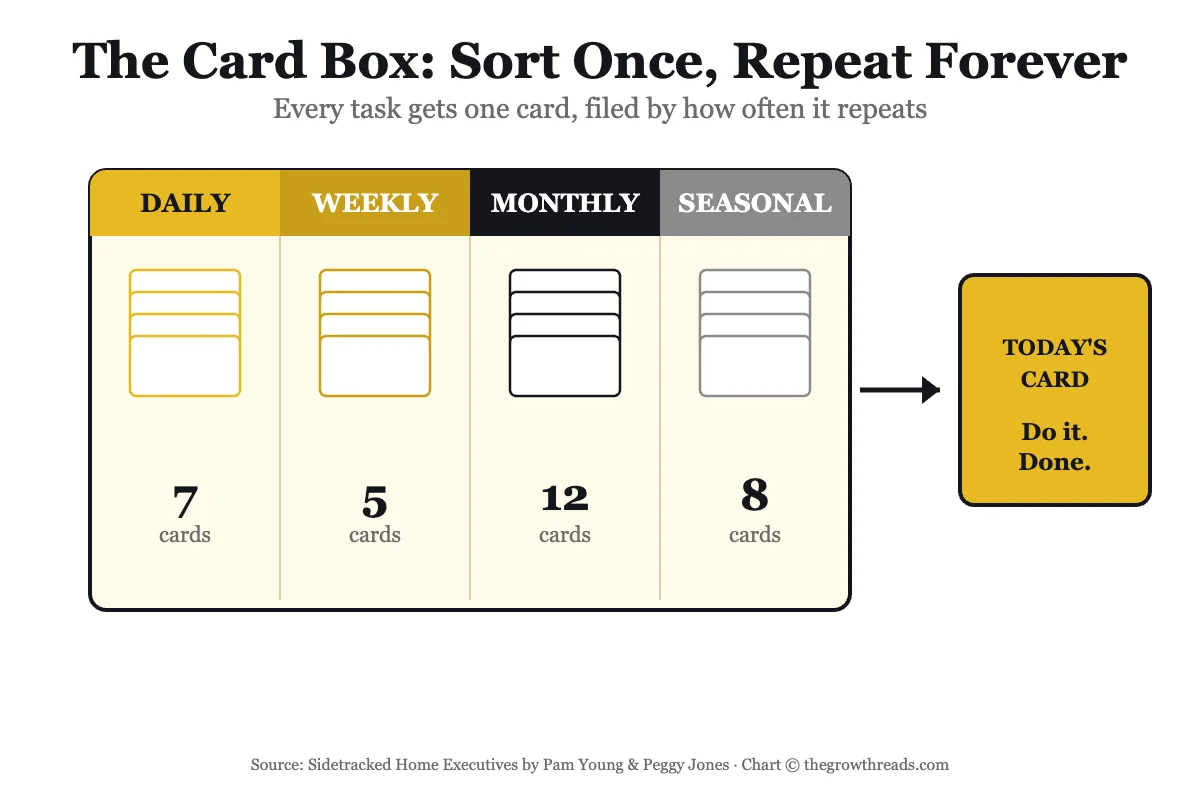
- Sort by frequency, not by room: cards are filed daily, weekly, monthly, or seasonally, so you only ever see what’s actually due today.
- Pull one card at a time: the system deliberately hides the full scope of the house from you — you only ever face the next card.
- Perfectionism is a hidden cause of mess: waiting for the “right” time or full energy to tackle a task is often what delays it indefinitely.
- Procrastination compounds fast: one skipped card becomes a pile; the system’s job is to make skipping visible and rare.
- Finish, don’t perfect: a card completed imperfectly still counts as done — the system rewards closure over polish.
- Put it away immediately: handling an item once, right when you’re done with it, prevents most clutter before it starts.
- Small completions build momentum: each finished card is a small win that makes the next card easier to start.
- The system should bend to you: the card categories are a starting template, not a rulebook — readers are encouraged to adapt frequencies to their own household.
What is Sidetracked Home Executives about?
Sidetracked Home Executives is a practical guide for chronically disorganized homemakers built around a 3×5 index-card system: every task gets its own card, cards are sorted by frequency, and you work one card at a time so the whole house never has to be tackled at once.
About the author
Pam Young and Peggy Jones are twin sisters who wrote Sidetracked Home Executives in 1977 after independently struggling with chronic household disorganization for years. Rather than presenting themselves as naturally tidy experts, they built their authority on the opposite premise — describing themselves as reformed “slobs” who devised their card-file system out of desperation and repeated failed attempts at more conventional organizing advice. Their conversational, self-deprecating tone became the book’s signature: readers are treated as capable people who’ve simply never had a system sized to how they actually think and work, not as people who need to be lectured into discipline. The sisters’ SHE (Sidetracked Home Executives) framework later extended into a licensed planner product line, and their approach is frequently cited as a direct influence on later home-organization systems built around small, frequency-based routines. Explore all Pam Young book summaries →
Key concepts at a glance
| Concept | What it means | Use it when |
|---|---|---|
| SHE (Sidetracked Home Executive) | The book’s name for a capable person whose home doesn’t reflect her competence | You recognize the pattern in yourself and want a system, not a lecture |
| 3×5 card system | One task per index card, filed by how often it repeats | You need every chore to be small enough to actually finish |
| Frequency sorting | Cards divided into daily, weekly, monthly, and seasonal categories | You want to see only what’s due today, not the whole house |
| Pull one card | Work a single card at a time rather than surveying everything undone | The scope of the house feels overwhelming |
| Perfectionism as root cause | Waiting for ideal conditions to start a task delays it indefinitely | You notice yourself avoiding “small” tasks because they don’t feel worth doing “right” |
| Put it away immediately | Return an item to its place the moment you’re finished with it | You want to prevent clutter rather than clean it up later |
| Finish over perfect | A card done imperfectly still counts as complete | You tend to abandon tasks that can’t be done “properly” |
Part 1: Why organizing advice usually fails a SHE
Most organizing advice assumes the reader already has the habit of following through — it offers better categories, better containers, better labels, but not a smaller unit of action. Young and Jones argue this is exactly backwards for a genuinely sidetracked person. The problem isn’t knowing that the kitchen needs cleaning; it’s that “clean the kitchen” is too large and vague a target to actually start. There’s no clear beginning, no clear end, and no way to feel finished partway through. The authors describe their own years of failed attempts at conventional systems — weekly schedules, room-by-room chore charts, elaborate planners — all of which collapsed the moment life got busy, because the tasks on them were still too big.
Their solution reframes the unit of work itself. Instead of “clean the kitchen,” a SHE writes “wipe counters,” “load dishwasher,” and “sweep floor” as three separate cards, each one small enough to complete in a few minutes and each one unambiguously either done or not done. This isn’t just a time-management trick — it directly targets the perfectionism and procrastination the authors identify as the real drivers of chronic mess. A vague, oversized task invites indefinite postponement because there’s no obviously “good enough” version of it. A small, specific card has a clear finish line, which makes it far easier to actually start.
The authors also point out a subtler benefit of shrinking tasks this way: it removes the need for motivation as a prerequisite. A large, vague task like “organize the garage” requires you to feel ready before you begin — enough energy, enough time, enough mental space to see it through. A card that says “clear one shelf” requires none of that. You can do it on a tired Tuesday evening in the ten minutes before dinner, and it still counts as a completed card. Over time, this removes the false choice between “do it properly” and “don’t do it at all,” which the authors identify as the trap that keeps so many capable people stuck.
Part 2: Building the card-file system
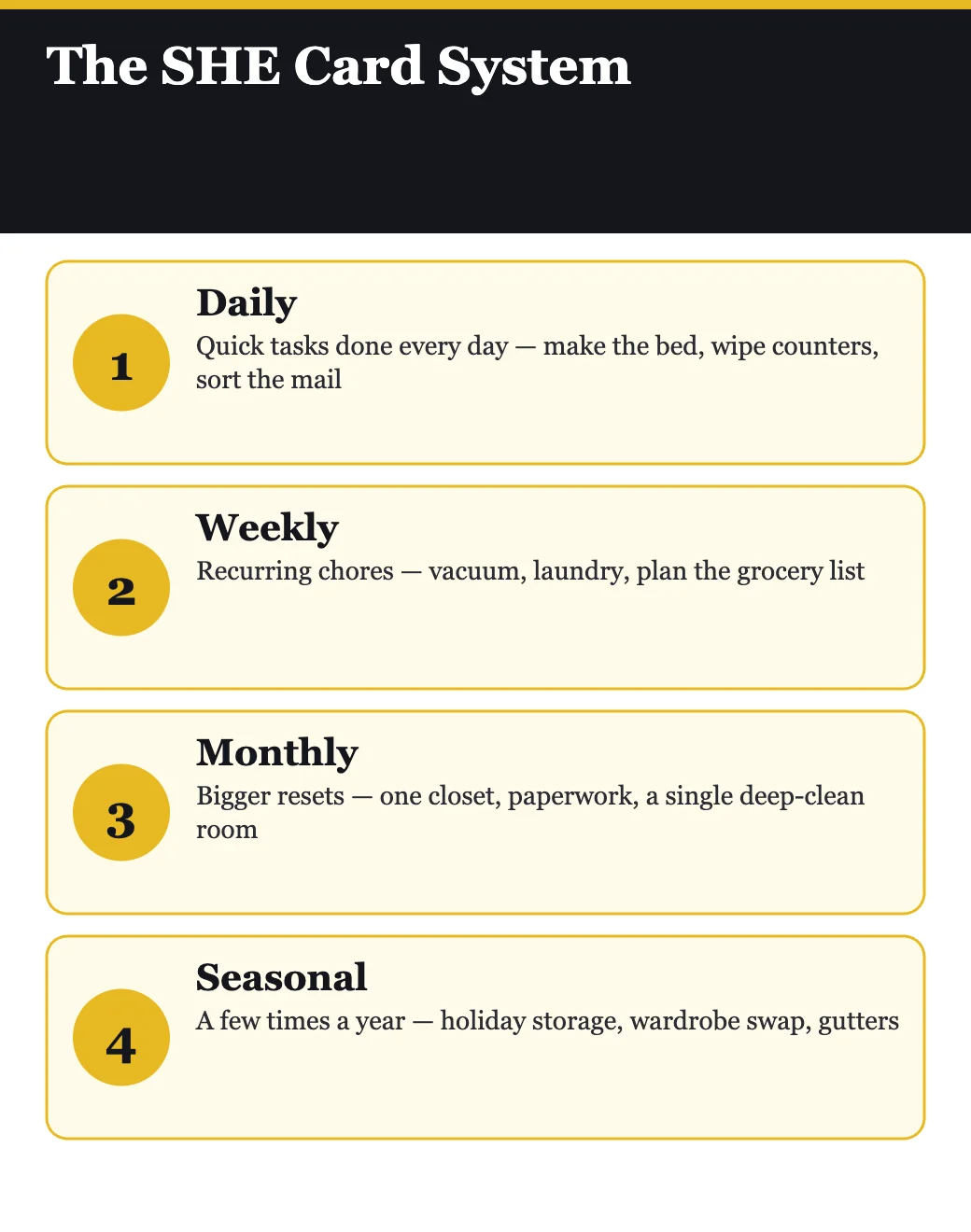
The mechanics are deliberately low-tech: a small box, a stack of 3×5 cards, and colored dividers. Every recurring household task gets written on its own card — one task per card, described specifically enough that there’s no ambiguity about what “done” looks like. The cards are then filed behind dividers by frequency: daily tasks in one section, weekly in another, then monthly and seasonal. A card for “wipe bathroom sink” lives in the daily section; a card for “flip the mattress” lives in the seasonal section. The system doesn’t ask you to remember any of this — it asks you to flip to today’s section and simply work through what’s there.
What makes this more than a glorified to-do list is the constraint it imposes: you never look at the whole box at once. You only ever see today’s small stack of daily cards, plus whatever weekly or monthly cards happen to fall due. This is a deliberate design choice, not an accident — the authors are explicit that seeing the full scope of an undone house is itself demoralizing enough to stall a SHE before she starts. Filing by frequency instead of by room also means the system self-limits: there are only so many cards that can be due on any given day, which keeps the daily list realistically short.
The authors also recommend keeping the cards themselves genuinely minimal — a task description short enough to read at a glance, not a paragraph of instructions. This matters more than it first appears: a card that takes real effort to read becomes its own small barrier, especially on a day when energy is already low. The physical act of flipping through a small, labeled box is also part of the design — it turns “figure out what needs doing” into a five-second lookup instead of an open-ended mental scan of the entire house, which is often the step that stalls a SHE before any actual work begins.
Part 3: The real obstacle — perfectionism and procrastination
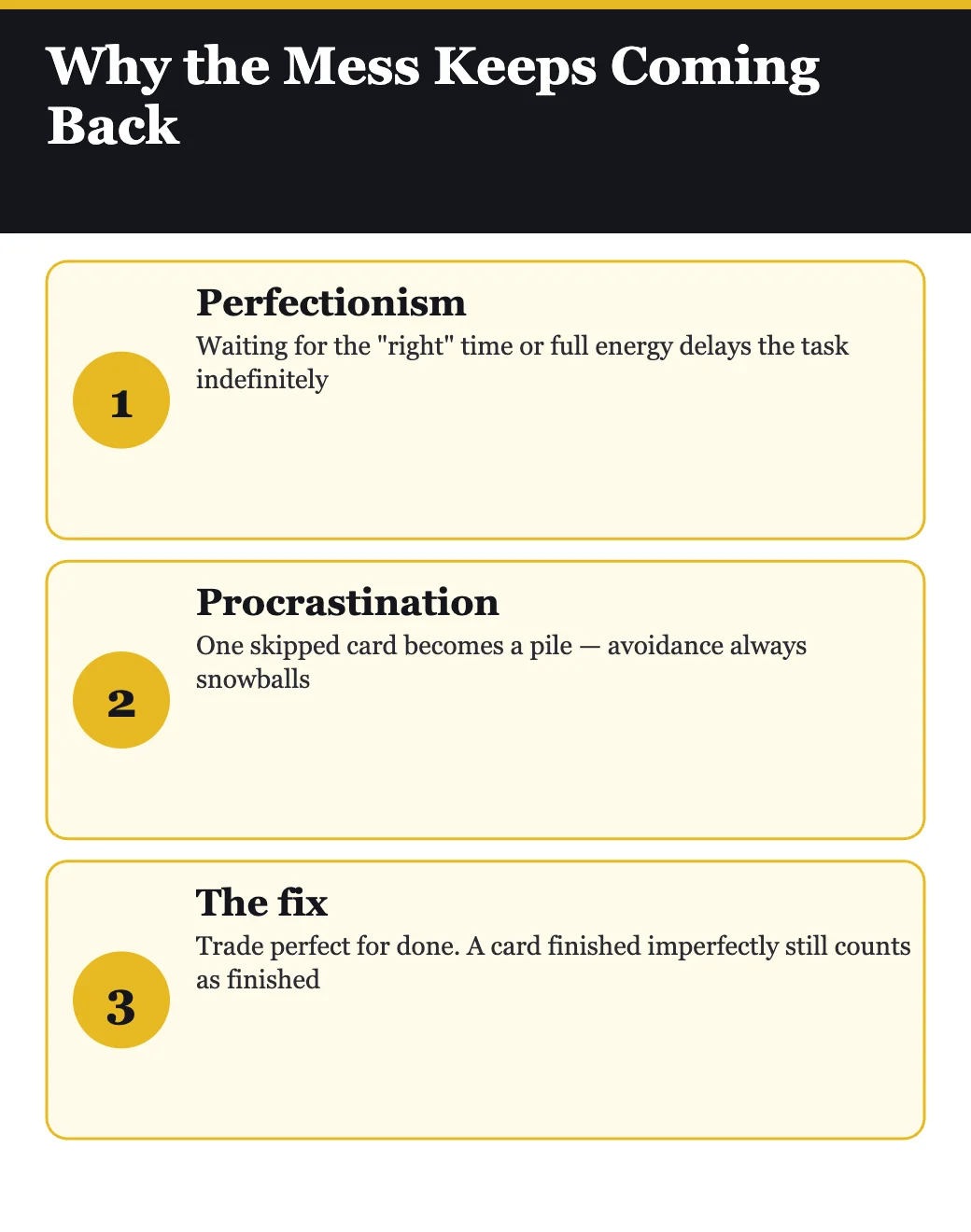
Young and Jones spend a meaningful portion of the book on the psychology behind chronic disorganization, and their central claim is that it’s rarely about laziness. More often, it’s perfectionism in disguise: a task feels too big, too undefined, or not worth doing unless it can be done thoroughly, so it gets pushed to “later” — a later that never quite arrives. The card system is partly a workaround for this: because each card describes a small, specific, achievable task, there’s no version of it that requires ideal conditions or a large block of free time. You can do it now, imperfectly, and it still counts.
Procrastination, in their framing, is less a standalone problem than a downstream effect of tasks being too large. One skipped or postponed task rarely stays isolated — it tends to compound, since an oversized, unfinished job creates a kind of psychological residue that makes the next task feel heavier too. The authors’ repeated advice is to interrupt this early: finish what you start, even in a small way, rather than leaving it half-done. A half-finished task, in their view, is worse than an unstarted one, because it keeps taking up mental space without producing the relief of completion.
This is also where the book departs from purely mechanical productivity advice: the authors aren’t just offering a filing system, they’re naming an emotional pattern. Many chronically disorganized people don’t lack the ability to plan — they’ve simply learned, through repeated failed attempts, that starting a big task often ends in an unfinished, guilt-inducing mess. The card system works partly because it removes the opportunity to fail that way. A five-minute card either gets done or it doesn’t, and either outcome is easy to see clearly and move past, rather than accumulating into the vague, heavy sense of “I never finish anything” that keeps people stuck longer than the actual mess does.
Part 4: Small habits that keep the system working
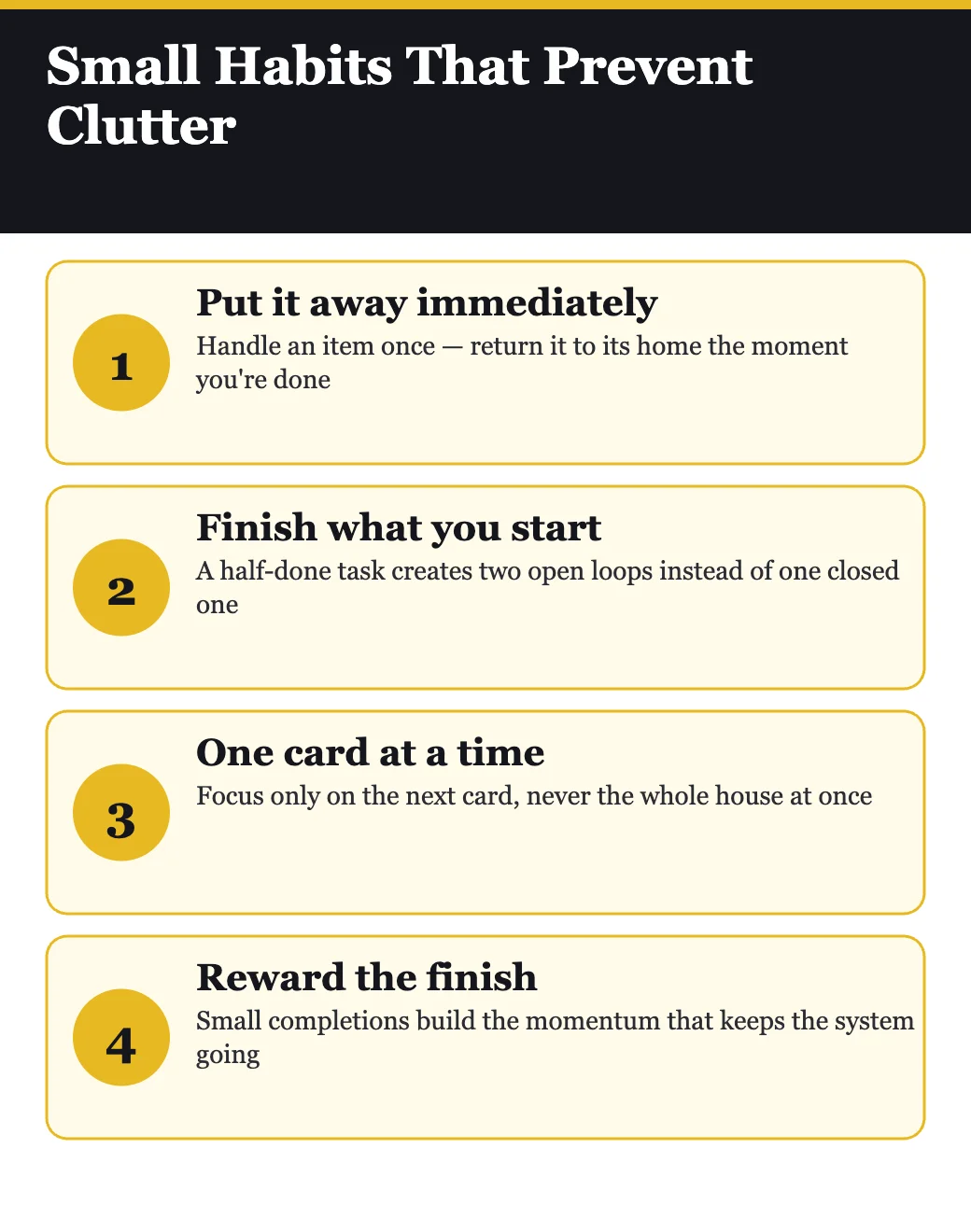
Beyond the card box itself, the book leans on a handful of small daily habits meant to prevent mess from accumulating in the first place, rather than relying solely on periodic catch-up cleaning. The most repeated of these is “put it away immediately” — the idea that handling an item once, and returning it to its designated place the moment you’re finished with it, prevents the vast majority of clutter before it ever becomes a pile to deal with later. Paired with this is the instruction to finish what you start: leaving a task half-done, the authors argue, creates more mental and physical clutter than either finishing it or not starting it at all.
The authors also emphasize working one card at a time rather than trying to hold the whole day’s list in mind, and building in small rewards or acknowledgments when a card is completed. None of these habits are individually dramatic, but the book’s throughline is that consistency in small actions compounds into a genuinely different-feeling home over weeks and months — the same logic that shows up, decades later, in habit-formation research on small consistent behaviors rather than large sporadic efforts.
It’s worth noting that the book offers these habits as defaults, not rigid rules — the authors are explicit that a SHE who finds a category too broad or a frequency mismatched to her actual life should adjust it rather than force her home to fit the original template. A “weekly” card that keeps getting skipped might genuinely belong in the monthly section; a “daily” habit that never sticks might need to be broken into something smaller still. This flexibility is part of why the underlying system has outlasted the specific card-box format it was originally built around — the principle of matching task size and frequency to real behavior, rather than an idealized schedule, transfers cleanly to almost any organizing tool.
Who is Sidetracked Home Executives best for — and who should read something else first?
This book is best for anyone who has repeatedly tried more elaborate organizing systems and abandoned them because the tasks felt too big or too vague — the card system’s whole appeal is its low-tech simplicity. It’s also a good fit for readers who respond better to a warm, humor-driven voice than to a clinical productivity framework. Readers who want a more modern, app-based approach to home routines might prefer The CHAOS Cure, which updates similar frequency-based thinking with a timer-driven method. Readers whose clutter problem is more about physical volume of belongings than task scheduling may get more immediate traction from Decluttering at the Speed of Life.
Questions to reflect on
- Which recurring task in your home currently feels too big or vague to ever actually start?
- Where has waiting for the “right time” quietly become your way of avoiding a small task indefinitely?
- What’s one item you handle multiple times a day instead of putting away immediately after use?
- If you sorted your own chores into daily, weekly, monthly, and seasonal cards, how many would actually be due today?
- What’s a task you left half-finished recently — and what would it take to close it out completely, even imperfectly?
🔥 Ready to build your own card box?
Get Sidetracked Home Executives and turn an overwhelming house into a stack of small, finishable cards.
How to apply Sidetracked Home Executives (7-day plan)
- Day 1: Get a small box and a stack of 3×5 cards (or a notes app if you prefer digital). Write down five daily tasks you already do, one per card.
- Day 2: Add five more cards for weekly tasks — laundry, vacuuming, grocery planning — and file them behind a “weekly” divider.
- Day 3: Add a handful of monthly cards for bigger resets, like one closet or one drawer of paperwork.
- Day 4: Practice “put it away immediately” for one full day — track how many times you catch yourself about to set something down instead.
- Day 5: Pull only today’s cards and work them one at a time, finishing each before starting the next.
- Day 6: Notice one task you’re avoiding because it feels too big — split it into two or three smaller cards.
- Day 7: Review the week: which cards got skipped repeatedly? Adjust their frequency or size rather than forcing the original plan.
Frequently asked questions
What is the SHE system in Sidetracked Home Executives?
The SHE (Sidetracked Home Executive) system is the book’s core organizing method: every household task is written on its own 3×5 index card, and cards are filed by how often the task needs doing — daily, weekly, monthly, or seasonal. Instead of facing the whole house at once, you only ever work through the small stack of cards due today. The name also describes the target reader — a capable person whose home doesn’t reflect her competence, not because of laziness but because she’s never had a system sized to match how her attention actually works.
Do I need physical index cards, or can I use an app?
The book was written in 1977 and describes a physical card box, but the underlying principle — one small task per unit, sorted by frequency, worked one at a time — transfers cleanly to any digital reminder or task app with recurring due dates. Many readers now recreate the system digitally; the specific tool matters far less than keeping each task small and specific and only ever looking at what’s due today rather than the full list.
How is this different from a regular to-do list or chore chart?
A regular chore chart usually lists tasks by room or by day in a way that’s visible all at once, which can feel overwhelming. The card system deliberately limits what you see: you only ever pull today’s cards, not the full box. It also enforces smaller task sizes than most chore charts, since each card is meant to describe a single, specific, quickly finishable action rather than a broad category like “clean the kitchen.”
What do the authors say causes chronic disorganization?
Young and Jones frame chronic mess as a byproduct of perfectionism and procrastination rather than a character flaw. Tasks that feel too large or vague get delayed indefinitely while waiting for ideal conditions, and one delayed task tends to compound into a larger backlog. Their card system addresses this by making every task small and specific enough to complete without needing a large block of time or energy.
Is the book’s advice dated?
Some of the book’s social framing reflects the era it was written in, and a few examples lean on now-dated domestic norms; the 2001 edition reviewed here is billed as revised and updated. That said, the underlying mechanism — small, specific, frequency-sorted tasks worked one at a time — holds up independently of the era and is the reason the book is still recommended decades later.
What is “put it away immediately” and why does it matter?
It’s the book’s rule for handling an item only once: the moment you’re finished using something, you return it to its designated place rather than setting it down “for now.” The authors present this as one of the single highest-leverage habits in the book, since most clutter accumulates not from big messes but from small items repeatedly set down instead of put away.
Who is Sidetracked Home Executives best for?
It’s best suited to readers who’ve tried more complex organizing systems and abandoned them because the tasks felt too big or too vague, and who respond well to a warm, humor-driven tone rather than a clinical productivity framework. It’s less suited to readers looking for a system built around modern apps or timers from the outset, though the underlying principles adapt easily to either.
Related summaries
Explore more organization and productivity guides: The CHAOS Cure · Decluttering at the Speed of Life · Gentle · see the full Time Management hub for more.
How we analyze books: we read the source material, cross-reference author interviews and published summaries, and build original diagrams and 7-day application plans so every TGR guide adds value beyond the book itself. Read our full methodology.
Related Time Management Summaries
Gentle Summary & Review: A Sustainable Alternative to Hustle Culture
Hell Yeah or No Summary & Review: Say No to Almost Everything
How to Have a Good Day Summary & Review: Small Shifts, Better Workdays
The Perfect Day Formula Summary & Review: Structure Equals Freedom
Two Awesome Hours Summary & Review: Protect Your Peak Time Each Day