

★★★★★ 4.5/5 — A calm counterpoint to hustle culture, built from small, scalable practices rather than one big overhaul.
Best for: chronically overwhelmed readers who’ve tried pushing harder and want a sustainable alternative instead.
Reading time: ~4 hrs to read · ~20 min to skim this guide
Difficulty to apply: Easy — every practice has a smaller, lower-effort version built in.
Gentle in one minute
Rest isn’t the reward you earn after pushing through — it’s the foundation that makes a sustainable life possible in the first place. In Gentle, Courtney Carver argues that chronic overwhelm is a structural problem created by hustle culture, not a personal failing to grind through. She reframes gentleness — toward yourself, your schedule, your possessions — as genuine self-care rather than laziness or an “easy way out,” building her case around a simple but sharp distinction: gentle isn’t sacrifice, people-pleasing, or giving up; it’s consistency, and it’s strength expressed through stillness rather than intensity. The book organizes its practices into three seasons — Rest, Less, and Rise — and every practice comes with a smaller, “gentler” version built in, so a reader in the middle of a genuinely overwhelming week can still participate without the plan itself becoming one more source of pressure. It’s Carver’s third book, following Soulful Simplicity and her wardrobe-minimalism project Project 333, and it shifts her long-running “Be More with Less” philosophy from what to remove toward how to actually live once you have.
Key takeaways
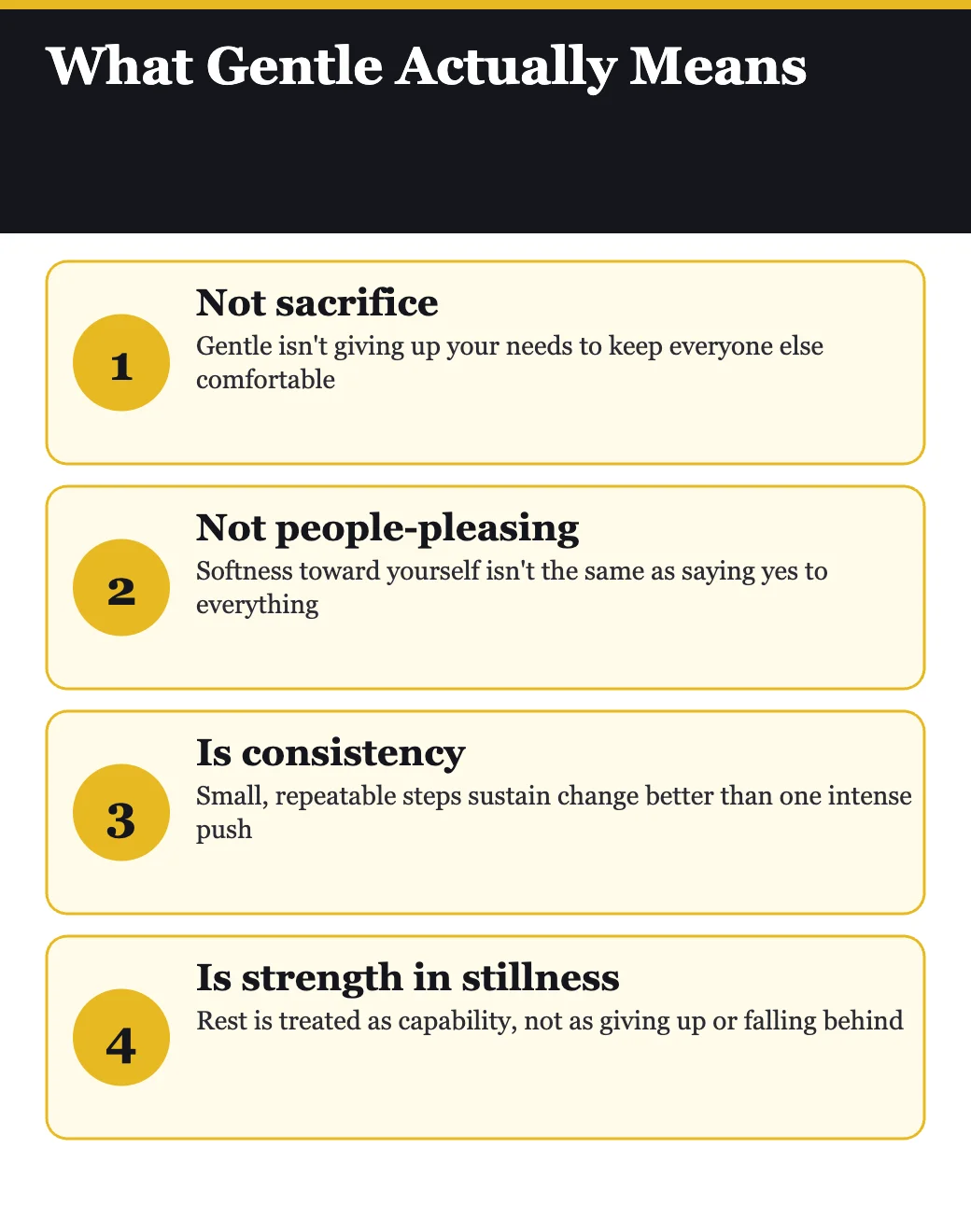
- Gentle is not sacrifice or people-pleasing: it’s consistency and self-compassion, not giving up your own needs to keep others comfortable.
- Rest comes first, not last: Carver treats recovery as the prerequisite for clear thinking and sustainable action, not a reward for finishing everything else.
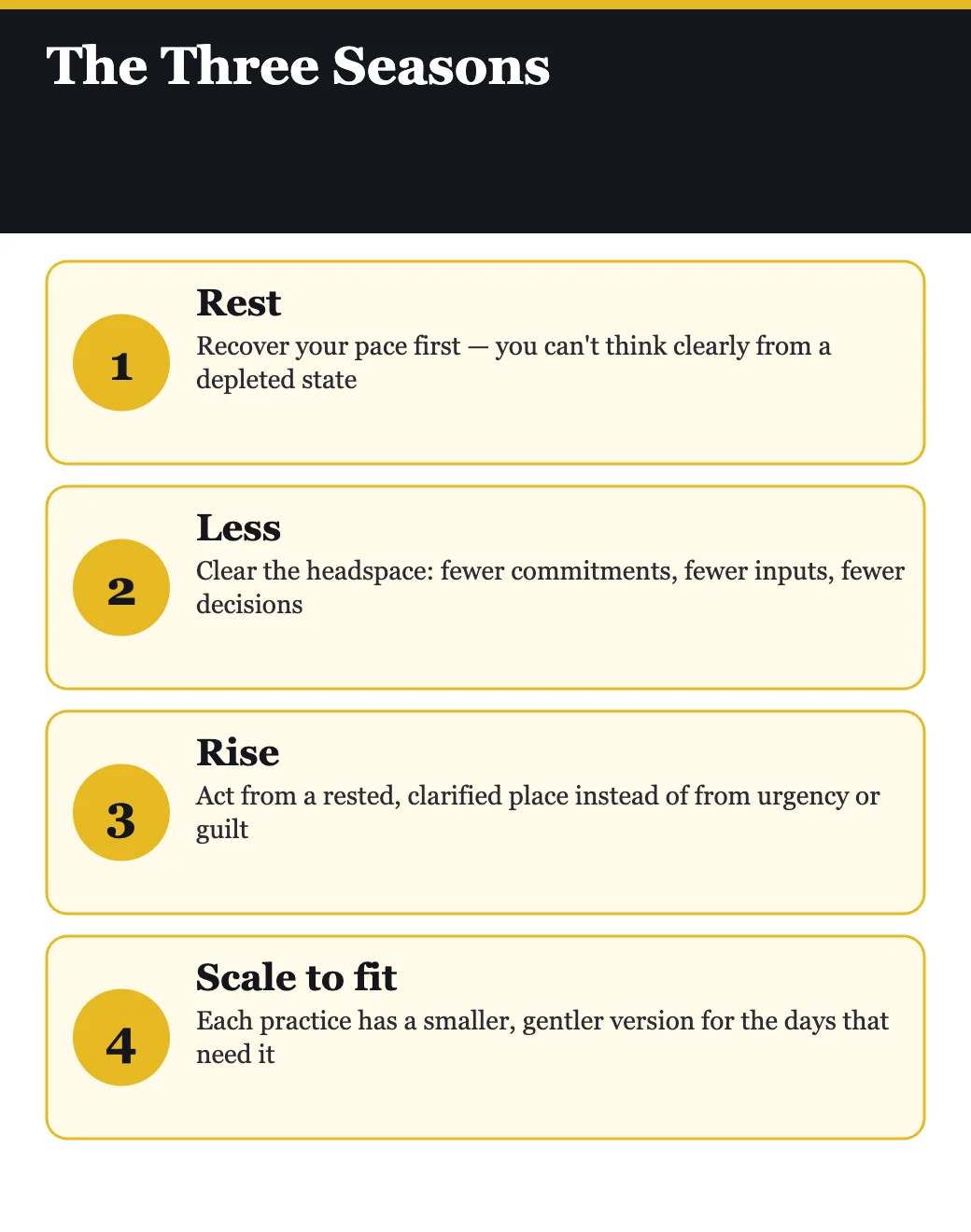
- The book moves through three seasons: Rest (recover your pace), Less (clear the headspace), and Rise (act from a rested, clarified place).
- Every practice scales down: a full version and a smaller “teeny tiny step” version exist side by side, so overwhelmed weeks don’t derail the whole plan.
- Consistency beats intensity: small, repeatable practices sustain real change better than one dramatic overhaul that burns out in a month.
- Permission is a practice: explicitly telling yourself rest is allowed today, not earned, removes a surprisingly large amount of daily friction.
- Media and news boundaries protect the edges of the day: keeping the first and last hour free of feeds changes how the whole day feels.
- Decluttering and boundary-setting are identity work: Carver treats what you keep and what you agree to as expressions of your values, not just tidiness or scheduling.
- Gentle is a continuation, not a rebrand: it builds on the same “Be More with Less” philosophy as her earlier books, applied to rest and stress rather than possessions.
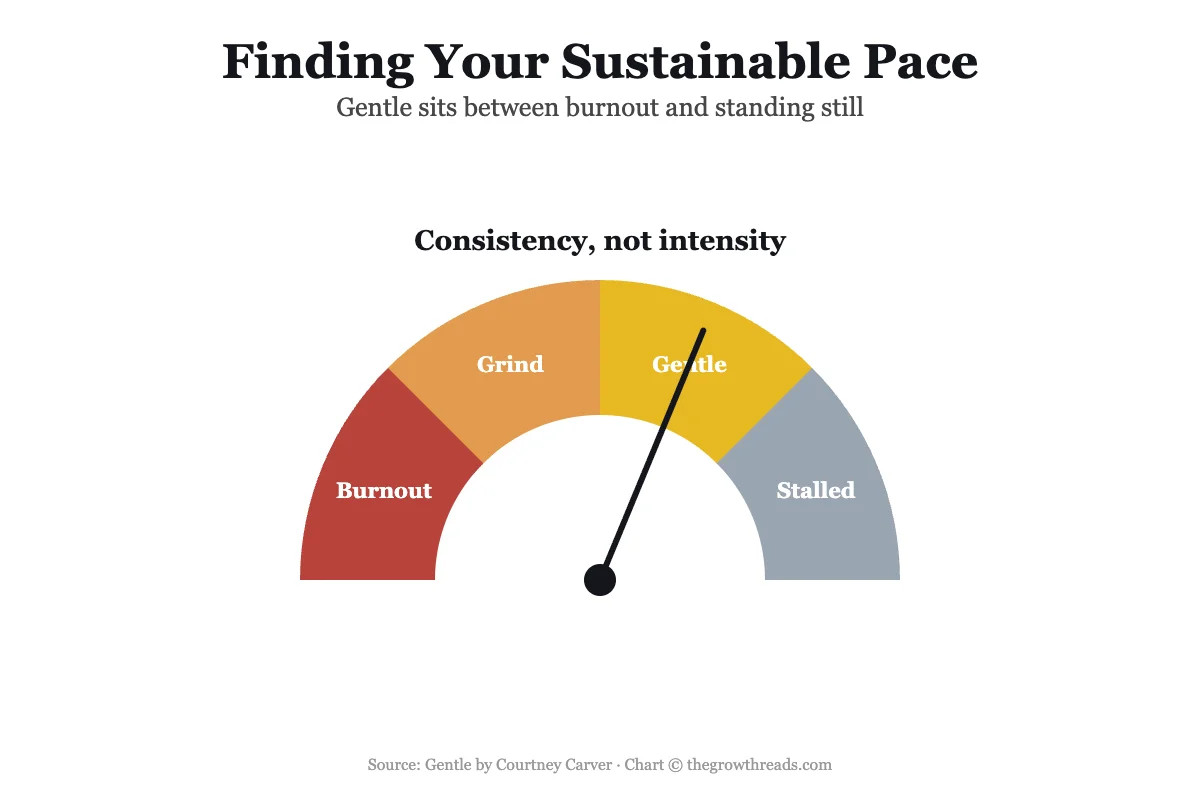

What is Gentle about?
Courtney Carver’s Gentle argues that rest and self-compassion, not more effort or willpower, are what make a sustainable life possible, offering a three-season structure — Rest, Less, Rise — of scaled practices for readers exhausted by hustle culture.
About the author
Courtney Carver has spent more than a decade writing about simplicity and sustainable living through her blog and platform “Be More with Less,” which she started in 2010. She’s best known for Project 333, a minimalist wardrobe challenge that asks participants to dress with 33 items or fewer for three months, and for her first book, Soulful Simplicity, which explored the spiritual dimension of owning less. Gentle, published in February 2025 by Balance, marks a shift in focus for Carver: where her earlier work centered on what to remove from your life — possessions, wardrobe excess — this book turns to how to actually live once the removal is done, addressing the emotional exhaustion that often sits underneath the impulse to simplify in the first place. Her authority throughout is experiential rather than academic — she writes as a long-time simplicity advocate speaking from personal practice, not as a researcher citing external studies. She’s also open, in interviews and on her blog, about the fact that her own path to this material wasn’t linear — an earlier health scare and years of quietly running on empty while appearing outwardly successful were part of what pushed her toward simplicity in the first place, and that same pattern of appearing fine while privately depleted is a large part of what she’s writing to for readers of Gentle. Explore all Courtney Carver book summaries →
Key concepts at a glance
| Concept | What it means | Use it when |
|---|---|---|
| The Gentle You | Finding strength in softness and fierceness in flexibility, rather than pushing through | You default to self-criticism when you’re overwhelmed |
| Three seasons: Rest, Less, Rise | A sequence for moving out of overwhelm — recover, clear, then act | You don’t know where to start when everything feels like too much |
| Scaled practices | Every recommended habit has a smaller, lower-effort version built in | A full practice feels impossible on a genuinely hard day |
| Permission slip | An explicit, self-directed reminder that rest is allowed, not earned | You feel guilty resting before finishing everything else |
| Media boundary | Keeping the first and last hour of the day free of feeds and news | Mornings or bedtimes feel reactive rather than intentional |
Part 1: Why gentle isn’t the easy way out
Carver opens by directly confronting the assumption that gentleness is a lesser, softer alternative to real effort — a consolation prize for people who can’t hack it. She rejects that framing outright: gentle isn’t sacrifice, it isn’t people-pleasing, it isn’t giving up, and it isn’t ignoring real pain or real problems. What it is, in her framing, is consistency, and a kind of strength that shows up as stillness rather than constant motion. This distinction matters because it changes what “trying harder” actually looks like — instead of applying more force to the same unsustainable pattern, gentle asks what a version of effort looks like that a person can actually sustain for years, not just for a motivated week. That framing shows up in how she talks about ambition, too — she isn’t arguing against wanting more, whether that’s more calm, more health, or more meaningful work, only against the assumption that wanting more requires constant self-pressure to get there.
She’s explicit that this isn’t a philosophy of low standards. The bar doesn’t move; the method for reaching it does. This distinction is easy to state and harder to actually feel in the moment, which is part of why she returns to it repeatedly across the book rather than making the point once and moving on — most readers arrive with a deeply internalized association between softness and lesser effort, and unwinding that association takes more than a single reframing. A gentle approach to a goal still aims at the same outcome — better health, calmer finances, more meaningful relationships — but gets there through steps small enough to survive a bad week, rather than steps so large they only work when everything else in life is already going well. This is where the book’s title comes from directly: gentle, applied consistently, tends to outlast intense effort applied sporadically. Carver draws an implicit contrast with the more familiar cultural script, where rest is treated as something to be earned through sufficient output — finish the list, then you’re allowed to stop. She argues this script actually undermines the output it’s meant to protect, because a person operating from constant depletion makes worse decisions, communicates less patiently, and burns out in ways that erase weeks or months of progress at once. Gentle, in her framing, isn’t the slower path — it’s the path that doesn’t periodically require starting over from zero.
Part 2: The three seasons — Rest, Less, Rise
The book’s structure follows three stages Carver calls seasons, meant to be moved through roughly in order, though she allows that readers can return to an earlier season whenever life demands it. Rest comes first, deliberately, because she argues clear thinking and good decisions are nearly impossible from a depleted state — trying to declutter your schedule or your home while running on empty tends to produce worse decisions, not better ones. Less follows: once some baseline capacity is recovered, the work turns to reducing inputs — fewer commitments, fewer unnecessary decisions, fewer things competing for attention — which clears the headspace needed for the final stage. Rise is where action happens, but action taken from a rested, clarified place rather than from urgency, guilt, or the momentum of habit.
What distinguishes this structure from a typical productivity framework is the explicit permission to move slower than expected, or to spend longer in one season than planned. Carver treats the sequencing as directional guidance rather than a rigid timeline — the point isn’t to rush through Rest to get to the “real” work of Rise, but to trust that time spent recovering capacity pays off in the quality of everything that follows. She’s also candid that the three seasons aren’t a one-way staircase — a person can be well into Rise on their career while needing to circle back to Rest in their health, or well into Less with their possessions while still needing an entire season of Rest around their relationships. The framework is meant to apply per-domain rather than as a single global state, which makes it more realistic for anyone whose different life areas are, honestly, rarely all in the same season at once.
Part 3: What gentleness actually looks like day to day
Rather than staying abstract, Carver grounds the philosophy in specific, low-effort practices readers can start immediately. These reportedly include short, protected mid-week breaks to interrupt the momentum of a busy week before it compounds into exhaustion; a bedtime alarm that treats sleep as a scheduled commitment rather than whatever’s left over after everything else; and a written “permission slip” — a brief, self-directed note that resting today is allowed, not something that has to be earned through a full day of output first. She also recommends boundaries around media and news consumption specifically at the edges of the day, keeping the first and last hour free of feeds, on the reasoning that how a day starts and ends shapes the tone of everything in between.
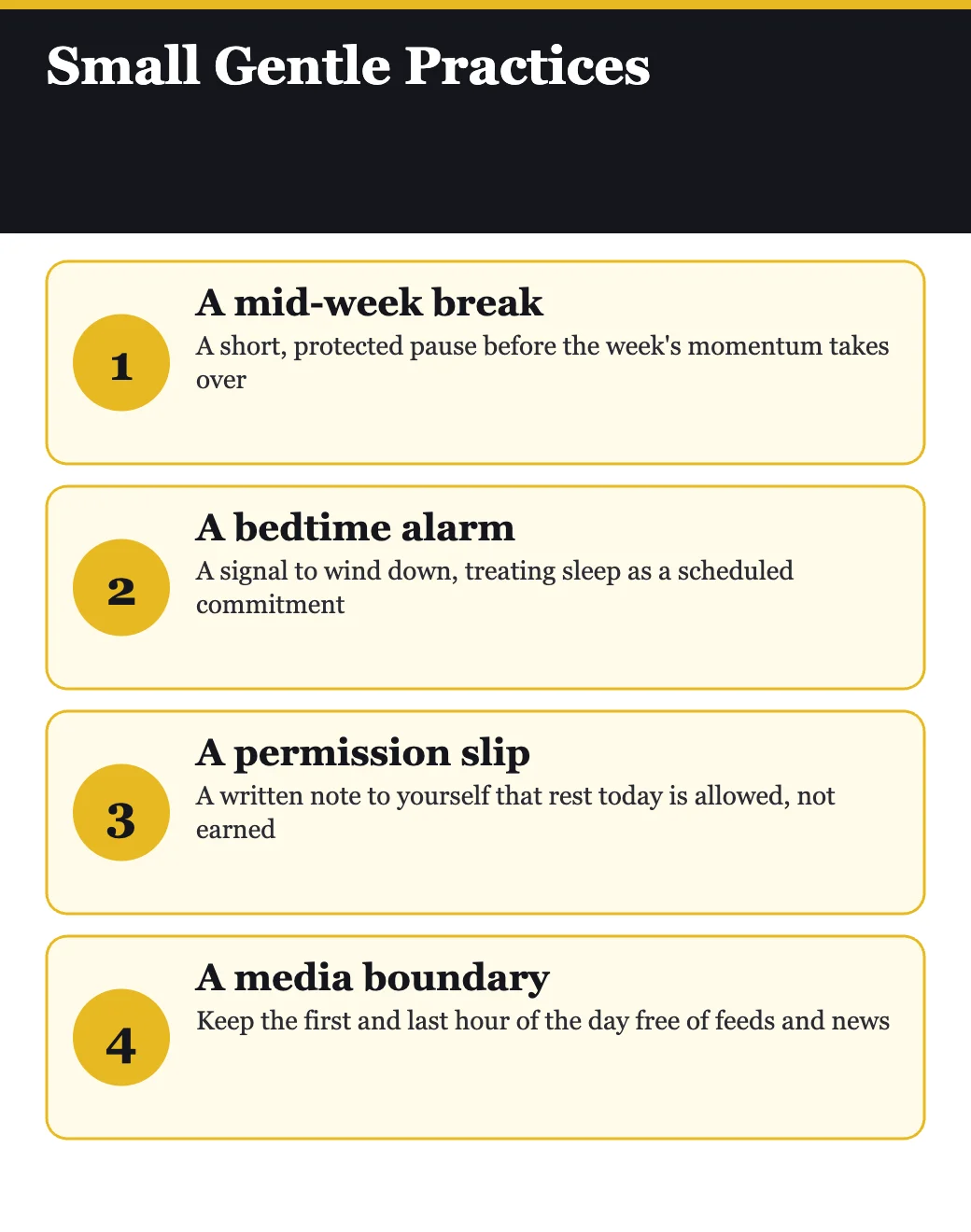
Each of these practices, per reviewer descriptions of the book’s format, comes paired with a scaled-down version — a “teeny tiny step” alternative for days when even the small version feels like too much. The mid-week break, for instance, might scale from a full afternoon off down to a single protected fifteen-minute walk with the phone left behind; the bedtime alarm might scale from a full wind-down routine down to simply turning off one screen ten minutes earlier than usual. The point of the smaller version isn’t to be impressive — it’s to be reliably repeatable, even on the exact days a person is least likely to have energy for the full version. This dual-track design is one of the more distinctive structural choices in the book: rather than treating a skipped day as failure, the smaller alternative keeps the habit technically alive, which Carver’s framework treats as more valuable than an unbroken streak of full-effort days. It’s a subtle but meaningful shift from the all-or-nothing framing common in habit-tracking culture, where a missed day often triggers abandoning the habit entirely rather than simply doing a smaller version of it. By designing the smaller version in from the start, rather than treating it as a fallback improvised in a moment of guilt, Carver removes the shame that usually accompanies scaling back — the teeny tiny step isn’t a lesser attempt, it’s the plan working as intended.
Part 4: What kept me, decluttering, and identity
Because Carver’s background is in simplicity and decluttering, the book carries some of that earlier material forward, but reframed through the lens of identity rather than tidiness alone. Decisions about what to keep — possessions, commitments, relationships that no longer fit — are treated as expressions of values, not just space management. A recommended practice for sentimental items, drawn from her decluttering background, is photographing them before deciding whether to keep the physical object, which preserves the memory without requiring the item itself to be stored indefinitely. This particular practice bridges her two books directly — it’s the same underlying instinct behind the Two Questions and Container Concept covered in Dana K. White’s decluttering approach, applied here through Carver’s own lens: separate the memory from the object, and let the object go once the memory is preserved in some other form.
This identity framing extends to boundary-setting more broadly: saying no to a commitment isn’t just a scheduling decision in Carver’s framework, it’s a statement about what actually matters, made concrete through the specific choice in front of you. She’s practical about how this plays out in daily conversation, too — suggesting short, unapologetic scripts for declining a request rather than the drawn-out, over-explained refusals many people default to when they feel guilty about saying no. A boundary stated plainly and without a lengthy justification, she argues, tends to be respected more readily than one hedged with excuses, since over-explaining often reads as an invitation to negotiate. She connects this back to the book’s central distinction — a boundary set gently, from clarity rather than resentment, tends to hold better than one set reactively, in a moment of overwhelm, which is more likely to be inconsistent or later regretted. Reactive boundaries also tend to be harsher than necessary, since they’re set at the point of maximum frustration rather than in a calmer moment, which can damage relationships that a clearer, earlier boundary would have preserved.
The book closes by returning to its central image: gentle strength, not force, as the sustainable path through an overwhelming life. Carver is candid that this isn’t a one-time fix — the three seasons repeat, in smaller cycles, as life’s demands shift, and the goal isn’t to graduate out of needing rest but to build a rhythm flexible enough to include it permanently. She closes with an image she returns to throughout the book: gentle strength as something closer to water than to force — able to move around an obstacle rather than through it, and no less effective for the detour.
Who is Gentle best for — and who should read something else first?
This book is best suited to readers who feel chronically overwhelmed and have already tried pushing harder without lasting relief — it offers a genuine alternative rather than another intensity-based system. Readers whose overwhelm comes primarily from physical clutter rather than pace or commitments may get more immediate, concrete value from our Decluttering at the Speed of Life summary first. If your challenge is specifically about protecting time on a calendar rather than emotional permission to rest, Margin is a more structural starting point.
Questions to reflect on
- Where in your week could a genuinely protected, low-stakes break actually fit?
- What would your “teeny tiny step” version of your hardest current habit look like?
- Which of your current commitments would you keep if you were setting boundaries from clarity instead of guilt?
- What does your first and last hour of the day currently look like — and what would you want them to look like instead?
- Is your instinct in a hard week to push harder or to rest first — and what would change if you tried the opposite?
🔥 Ready to trade intensity for something you can actually sustain?
Grab a copy and start with the smallest version of one practice this week.
How to apply Gentle (7-day plan)
- Day 1: Write one permission slip — a short note that rest today is allowed, not something to be earned first.
- Day 2: Set a bedtime alarm and treat it as a real commitment, not a suggestion.
- Day 3: Keep the first hour of the day free of feeds and news; notice how the morning feels different.
- Day 4: Identify one commitment you’d remove if you were choosing from clarity instead of guilt.
- Day 5: Try the “teeny tiny step” version of a habit you’ve been avoiding at full effort.
- Day 6: Schedule a short, protected mid-week break before the week’s momentum takes over.
- Day 7: Review the week and decide which season — Rest, Less, or Rise — you actually need more of next week.
Frequently asked questions
Is “gentle” just another word for lowering your standards?
No — Carver is explicit that gentle changes the method for reaching a goal, not the goal itself. It replaces one dramatic, unsustainable push with smaller, repeatable steps designed to survive a bad week, on the argument that consistency over time outperforms intensity that burns out after a few weeks.
What are the three seasons in the book?
Rest, Less, and Rise. Rest comes first because Carver argues clear decisions are hard to make from a depleted state; Less follows by reducing commitments and inputs to clear headspace; and Rise is where action happens, but from a rested, clarified place rather than urgency or guilt.
Does this book cite research or studies on rest and stress?
Based on available reviews and publisher materials, the book appears to draw primarily on Carver’s own experience and more than a decade of writing on simplicity, rather than citing academic studies or named researchers. This isn’t confirmed as a complete absence of citations, but no reviewer has highlighted specific external sources, so the book reads as experiential guidance rather than a research-driven text.
How does Gentle relate to Carver’s earlier books like Soulful Simplicity?
Gentle is a continuation of the same “Be More with Less” philosophy rather than a rebrand or departure. Her earlier work, including Soulful Simplicity and Project 333, focused on what to remove — possessions, wardrobe excess. Gentle shifts to how to actually live once you’ve simplified, addressing the emotional exhaustion that often sits underneath the impulse to declutter in the first place.
Is the advice in Gentle realistic for people with less flexibility or fewer resources?
Some reader reviews have raised this concern, noting that certain examples around rest and simplification can reflect assumptions about flexible schedules or financial cushion that not every reader has. It’s a fair, worth-noting limitation of personal-experience-driven advice generally; the book’s scaled-down practices do partly address it by keeping the smallest version of each habit genuinely low-cost and low-time, even if the larger vision assumes more slack than some households have.
Is the book repetitive or thin on content?
Some reader reviews describe parts of the book as familiar if you’ve read Carver’s blog or earlier books, and a few felt certain sections could have been shorter. This is a common critique of personal-development books built around a small number of core ideas applied across many scenarios — the repetition is arguably intentional, since the book is designed to be referenced practice by practice rather than read once and fully absorbed.
Do I need to read Carver’s other books first?
No — Gentle is designed to stand on its own and doesn’t assume familiarity with Soulful Simplicity or Project 333, though readers who’ve followed her earlier work will recognize the underlying philosophy. It works well as either an introduction to Carver’s approach or a natural next step after her decluttering-focused material.
Related summaries
- Decluttering at the Speed of Life — a forgiving, small-session decluttering method
- Laziness Does Not Exist — a counterweight to nonstop optimization
- Margin — building slack and reserves into a busy life
- More time management book summaries
Related Time Management Summaries
Company of One Summary & Review: Why Bigger Isn’t Always Better
It Doesn’t Have to Be Crazy at Work Summary & Review: Build the Calm Company
Master Your Time, Master Your Life Summary & Review: Ten Categories, One Focused System
The Distracted Mind Summary & Review: Why Your Brain Fights Focus
Work Clean Summary & Review: Borrow a Chef’s Discipline