

★★★★★ 4.6/5 — Tracy turns success into a checklist: repeatable daily habits anyone can install, starting today.
Best for: entrepreneurs, salespeople, and anyone who wants concrete daily systems instead of vague motivation.
Reading time: ~4.5 hrs to read · ~25 min to skim this guide
Difficulty to apply: Easy — the habits are small, specific, and designed to be started the same day.
Million Dollar Habits in one minute
Success isn’t a personality trait or a stroke of luck — it’s a cluster of specific, learnable habits practiced consistently until they become automatic. In Million Dollar Habits, Brian Tracy argues that the gap between people who achieve extraordinary results and everyone else is not talent or circumstance but the accumulated weight of daily choices: how they think about themselves, how they manage money, how they set goals, and how they act under pressure. Tracy calls this the law of cause and effect applied to personal achievement — for every effect in your life, including wealth, health, and relationships, there is a specific, identifiable cause, and that cause is almost always a habit. The book is structured as a practical manual: it explains how habits form and how to install new ones deliberately, then walks through the specific habits Tracy has observed in high achievers across money, thinking, goal-setting, and daily action. The throughline is optimistic and direct — you are not stuck with the habits you have. You can choose new ones, rehearse them until they’re automatic, and let them compound quietly in the background of your life.
Key takeaways
- Your self-concept sets your ceiling: the way you see yourself — your self-ideal, self-image, and self-esteem — determines what you attempt, persist at, and allow yourself to achieve.
- Habits are installed, not willed: a habit becomes automatic through decision, repetition, and reinforcement — Tracy’s own estimate is roughly three weeks of consistent practice, though the exact timeline varies by habit and person.
- Cause and effect governs achievement: wealth, health, and relationships are effects of specific, repeatable causes — find people getting the result you want and copy their habits.
- Zero-based thinking clears dead weight: regularly ask, “Knowing what I now know, would I start this again today?” — if not, it’s time to stop.
- The habit of saving 10% builds financial independence: pay yourself first from every paycheck, before any other expense, and let the habit — not willpower — do the saving.
- Decide with no exceptions: a habit only takes hold when you remove the option of skipping it “just this once.”
- The ABCDE method forces real prioritization: rank every task by consequence, not urgency, and always do the A-tasks first.
- Clear, written goals outperform vague ambitions: Tracy’s goal-setting formula turns a wish into a plan with a deadline and a daily action.
- Positive self-talk and visualization rehearse the identity before the results arrive: you tend to act consistently with the self-image you rehearse most often.
- Action orientation beats perfect planning: successful people have a bias toward starting, adjusting, and finishing — not toward endless preparation.
What is Million Dollar Habits about?
Million Dollar Habits is a practical guide to the specific daily habits — around money, thinking, goal-setting, and action — that Brian Tracy identifies as the real drivers of financial and personal success, arguing that anyone can install these habits deliberately, regardless of their starting point.
About the author
Brian Tracy is a Canadian-American author and professional speaker who built his career from an unusually rough starting point. He didn’t finish high school, worked a series of labor jobs, and spent years without a clear direction before discovering sales and, later, the study of success psychology. That self-directed education — reading widely, testing ideas in his own work, and studying how top performers actually behaved — became the foundation for his later career. Tracy went on to become a business executive and eventually the chairman of Brian Tracy International, a company focused on training and personal development. He has written more than 80 books, including Eat That Frog! and The Psychology of Achievement, and has spoken to audiences in over 70 countries. Million Dollar Habits, first published in 2017 by Entrepreneur Press, distills decades of that material into a single, habit-focused framework — his central claim, echoed throughout his other books, is that success is a set of learnable skills, not an innate gift. Explore all Brian Tracy book summaries →
Key concepts at a glance
| Concept | What it means | Use it when |
|---|---|---|
| Self-concept | The self-ideal, self-image, and self-esteem that together set your performance ceiling | You keep bumping into the same limit despite trying harder |
| Law of cause and effect | Every result in your life has a specific, identifiable cause — usually a habit | You want a result someone else already has |
| Zero-based thinking | Asking whether you’d start a commitment again today, knowing what you know now | Reviewing a job, relationship, investment, or project |
| Habit installation formula | Decide with no exceptions, then repeat and reinforce until the behavior is automatic | Starting any new daily practice |
| Six-part money plan | A structured approach to saving, investing, and protecting income, starting with paying yourself first | Building financial independence from any income level |
| ABCDE method | Ranking tasks by consequence so the highest-value work always goes first | Your to-do list is long and everything feels urgent |
| Goal-setting formula | A written, deadline-driven process for turning a wish into a plan | You have ambitions but no concrete next action |
Part 1: The psychology behind every habit
Tracy opens with a claim that shapes the rest of the book: habits are not incidental to success, they are the mechanism of it. He frames this through the law of cause and effect — the idea, borrowed loosely from the philosophical tradition running through thinkers like Adam Smith, that outcomes are never random. Every effect, Tracy argues, has a specific and often traceable cause, and in personal achievement that cause is usually a repeated behavior rather than a single decisive moment. This reframes the entire project of self-improvement: instead of asking “how do I become successful,” the more useful question becomes “what is the specific habit that produces the result I want, and who already has it?”
Central to this is what Tracy calls the self-concept — a three-part internal structure made up of your self-ideal (the person you wish to become), your self-image (how you currently see yourself acting and performing), and your self-esteem (how much you like and value yourself). He argues these three components interact constantly: a low self-esteem shrinks your self-image, which narrows what you attempt, which then reinforces the low self-esteem. Conversely, deliberately raising any one of the three — often starting with self-esteem through small wins and positive self-talk — tends to lift the others. This is not presented as a rigorously validated psychological model so much as a practical lens Tracy has used in decades of coaching; readers looking for the academic grounding of self-concept theory will find closer parallels in the psychological literature on self-efficacy.
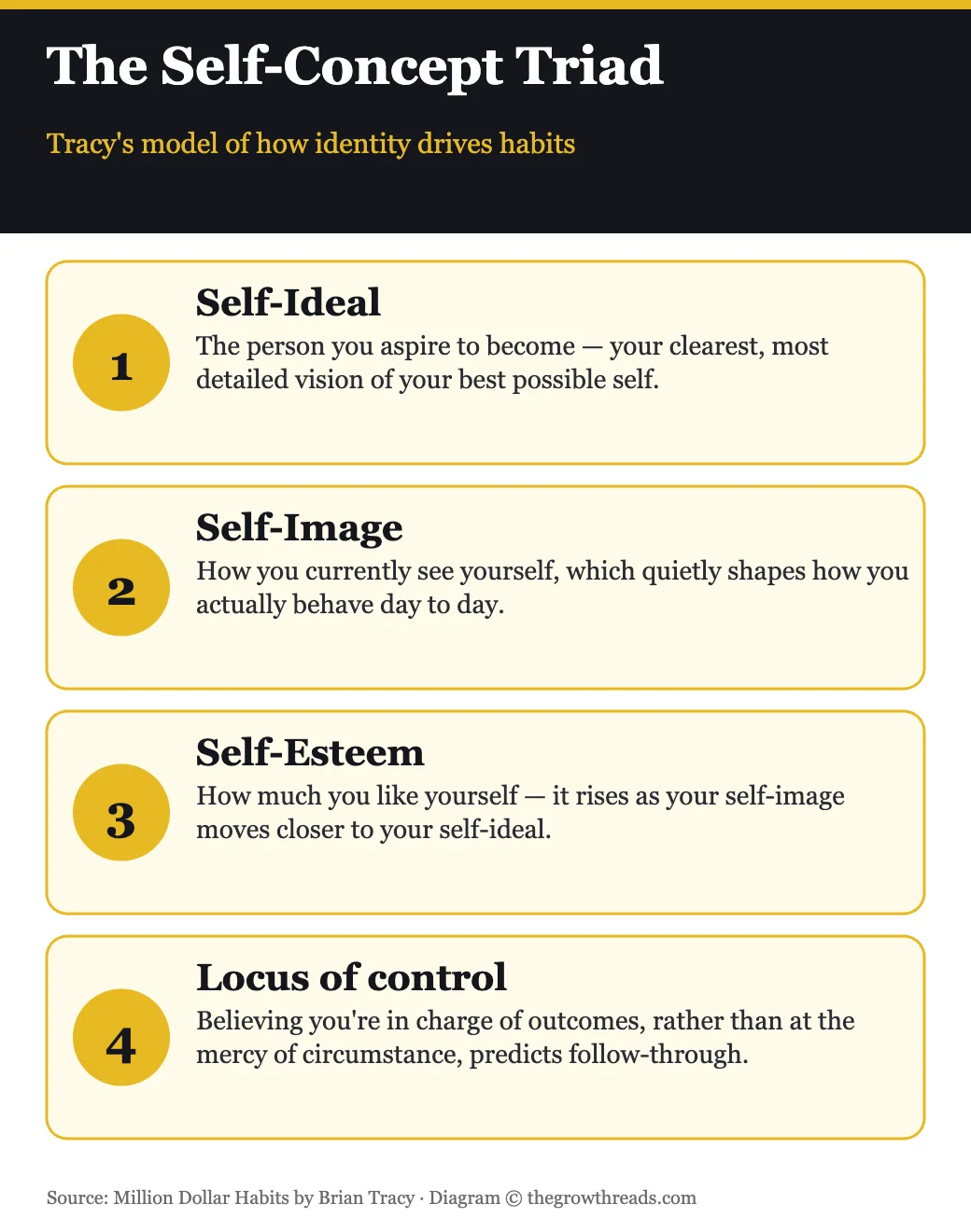
Tracy also introduces the idea of locus of control — whether you believe you are the primary cause of events in your life (internal locus) or that events happen to you (external locus). People with a strong internal locus of control, he argues, take more initiative, persist longer through setbacks, and are more willing to experiment with new habits because they believe the experiment will actually matter. This isn’t framed as blaming people for their circumstances; rather, it’s a claim about which mental stance makes habit change more likely to stick once you’ve decided to pursue it.
Part 2: Installing a habit on purpose
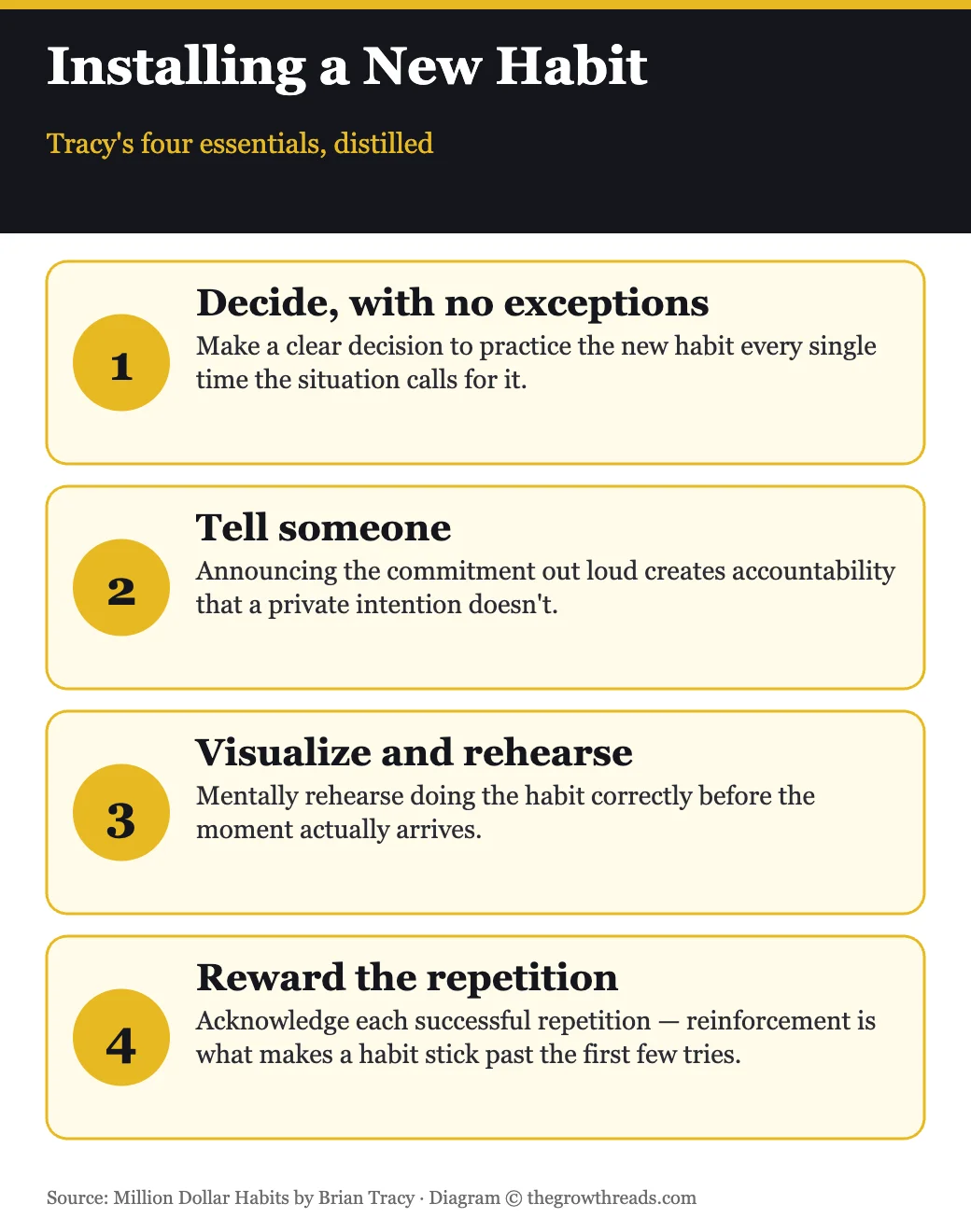
The second part of the book gets mechanical: how, specifically, does a new habit become automatic? Tracy’s answer is a four-step process. First, make a decision with no exceptions — the habit only takes root once you close off the option of skipping it “just this once,” because every exception resets the learning curve. Second, never allow an exception during the formation period, however small the excuse feels in the moment. Third, tell other people about the commitment, which adds social accountability. Fourth, visualize and mentally rehearse yourself performing the new habit successfully, which primes the behavior before you’ve actually built the track record.
Tracy’s own estimate is that this process takes roughly three weeks of consistent, no-exceptions practice, though he’s candid that the timeline varies by habit and person — a quick habit like drinking a glass of water each morning locks in faster than a complex habit like a daily sales-prospecting routine. This estimate is worth holding loosely: broader research on habit formation (notably the widely cited work following University College London researcher Phillippa Lally) has found automaticity can take anywhere from about three weeks to several months depending on the behavior’s complexity, so treat Tracy’s three-week figure as a useful minimum rather than a guarantee.
He also leans on the concept of comfort zones — the idea that most people unconsciously optimize for the familiar rather than the beneficial, and that this pull is strongest right at the point a new habit starts to feel effortful. Tracy’s advice here is unglamorous but concrete: expect the resistance, treat it as a normal part of the process rather than a signal to stop, and use the reinforcement of small, visible wins (a checked box, a small reward, a moment of pride) to counteract the pull back toward the old pattern.
Part 3: The habits that build wealth
Tracy spends a substantial portion of the book on money habits specifically, framed around a six-part financial plan. The plan starts with paying yourself first — saving a fixed percentage, Tracy suggests starting around 10%, of every dollar earned before any other spending happens, so the saving habit runs on autopilot rather than willpower. From there, the plan covers setting a specific net-worth goal with a deadline, tracking spending closely enough to know exactly where money goes, investing consistently rather than sporadically, protecting income and assets through insurance and reserves, and continuously increasing earning capacity through skill development.
A recurring tool throughout this section is zero-based thinking: periodically asking, of any job, investment, relationship, or ongoing commitment, “Knowing what I now know, would I start this again today?” If the honest answer is no, Tracy argues that’s the signal to exit or change course rather than continuing out of sunk-cost inertia. He extends this to spending habits specifically — reviewing recurring expenses and subscriptions with the same zero-based question tends to surface money that can be redirected into the saving habit without feeling like a sacrifice.
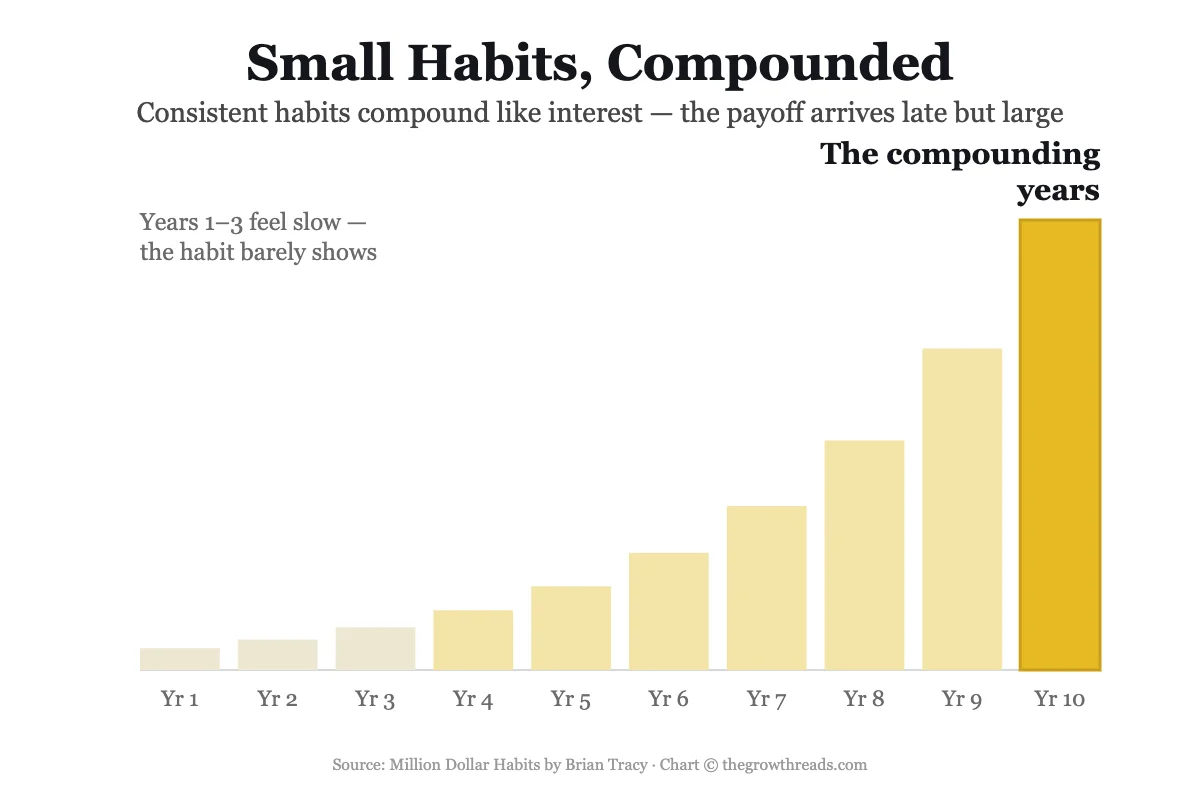
Tracy is explicit that these money habits aren’t exotic — none of them require a windfall, a special opportunity, or insider knowledge. The entire argument rests on compounding: a modest, consistent saving and investing habit, maintained over years rather than months, produces outsized results not because any single month looks impressive but because the habit never breaks. He illustrates this with reference to how compound interest behaves mathematically — small, regular deposits outperform larger, irregular ones over long time horizons — and draws a direct parallel to how personal habits compound in exactly the same shape.
Part 4: Goals, priorities, and taking action
The final section turns to how successful people actually decide what to do each day. Tracy’s goal-setting formula is deliberately simple: decide exactly what you want, write it down, set a deadline, list everything you can think of that you’ll need to do, organize that list into a plan, and take action on it immediately — then do something toward the goal every single day. He credits much of this structure to decades of trial and error in his own sales career, where vague intentions consistently underperformed specific, written, deadline-bound targets.
For daily prioritization, Tracy offers the ABCDE method: label every task A (serious consequences if not done), B (mild consequences), C (no consequences either way), D (delegate), or E (eliminate) — then always work through the A-tasks in order before touching anything else, regardless of how tempting the smaller C-tasks feel. He’s candid that this is uncomfortable in practice, since A-tasks are often the hardest or most intimidating items on the list, which is precisely why they tend to get avoided without a forcing mechanism like ABCDE.
Underneath both the goal-setting and prioritization habits sits a broader argument about action orientation. Tracy repeatedly emphasizes that successful people are distinguished less by the quality of their initial plan and more by their willingness to start, get feedback, and adjust quickly — a bias toward motion over perfect preparation. He references the writer Elbert Hubbard’s emphasis on initiative and self-reliance, and echoes a theme found in Viktor Frankl’s work on meaning: that a sense of purpose, not just tactics, sustains the daily discipline these habits require. He also nods to positive psychology researcher Martin Seligman’s work on optimism as a trainable explanatory style, arguing that how you interpret setbacks — as temporary and specific rather than permanent and pervasive — shapes whether you keep the habit going after an inevitable bad week.
Who is Million Dollar Habits best for — and who should read something else first?
This book is best suited to readers who want direct, checklist-style guidance on money and daily discipline — entrepreneurs, salespeople, and early-career professionals building their first real financial habits will get the most immediate use out of it. Readers who’ve already read extensively in the habit-formation genre may find some frameworks familiar; if you want the more research-grounded version of habit mechanics specifically, start with our Atomic Habits summary instead. If your main challenge is following through once motivation fades rather than getting started in the first place, Finish What You Start is the better starting point.
Questions to reflect on
- Which single habit, if you installed it with zero exceptions for the next three weeks, would most change your financial trajectory?
- Where in your life would zero-based thinking — “would I start this again today?” — likely produce an uncomfortable but honest answer?
- Is your current self-image expanding or shrinking what you’re willing to attempt this year?
- What is the one A-task you’ve been quietly avoiding by staying busy with C-tasks?
- Who already has the specific result you want, and what daily habit of theirs could you copy this week?
🔥 Ready to build the habits that compound into real results?
Grab a copy and start installing your first no-exceptions habit this week.
How to apply Million Dollar Habits (7-day plan)
- Day 1: Pick one financial habit to install with no exceptions — start with automating a 10% transfer to savings on payday.
- Day 2: Run zero-based thinking on three recurring commitments (a subscription, a routine, a commitment) and cancel or change one.
- Day 3: Write your top goal for the next 12 months, give it a deadline, and list every step you can think of to get there.
- Day 4: Sort tomorrow’s to-do list using ABCDE and commit to finishing your single A1 task before anything else.
- Day 5: Tell one person about the habit you’re installing this week, out loud, to add social accountability.
- Day 6: Spend five minutes visualizing yourself performing the new habit successfully and calmly, as if it’s already automatic.
- Day 7: Review the week: note where you kept the habit with zero exceptions and where you slipped, then recommit for week two.
Frequently asked questions
Is Brian Tracy’s claim that 95% of behavior is habitual accurate?
Tracy states that as much as 95% of what people do is habitual rather than the result of fresh, conscious decisions each time. This figure is presented as an estimate drawn from his decades of coaching and observation rather than a single cited study, and some reviewers have noted it’s higher than figures from formal behavioral research, which more often puts the habitual share of daily behavior closer to 40–45%. The exact percentage matters less than the underlying point, which is well supported: a large share of daily behavior runs on autopilot, so changing outcomes usually means changing the habit rather than relying on willpower in the moment.
How long does it actually take to build a new habit, according to the book?
Tracy’s working estimate is roughly three weeks of consistent, no-exception practice, though he acknowledges simpler habits lock in faster and more complex ones take longer. Broader habit-formation research, including studies following participants over time, has found automaticity can take anywhere from about three weeks to several months depending on the habit’s complexity and how consistently it’s practiced, so it’s reasonable to treat three weeks as an encouraging minimum rather than a fixed deadline.
What is the “pay yourself first” habit and why does Tracy emphasize it?
Pay yourself first means automatically saving a fixed percentage of every paycheck — Tracy suggests starting around 10% — before spending on anything else, so the saving happens by default rather than depending on leftover money at the end of the month. He emphasizes it because it removes the habit from the realm of willpower and turns it into a structural default, which is far more reliable over years than deciding to save “if there’s anything left over.”
What is zero-based thinking and how do I use it?
Zero-based thinking means periodically asking, of any job, relationship, investment, or ongoing commitment, “Knowing what I now know, would I start this again today?” If the answer is no, that’s a signal to change course rather than continuing purely out of momentum or sunk cost. It’s a useful monthly or quarterly check-in question for recurring expenses, commitments, and even daily routines that may have outlived their usefulness.
Is Million Dollar Habits mainly about money, or does it cover other areas of life?
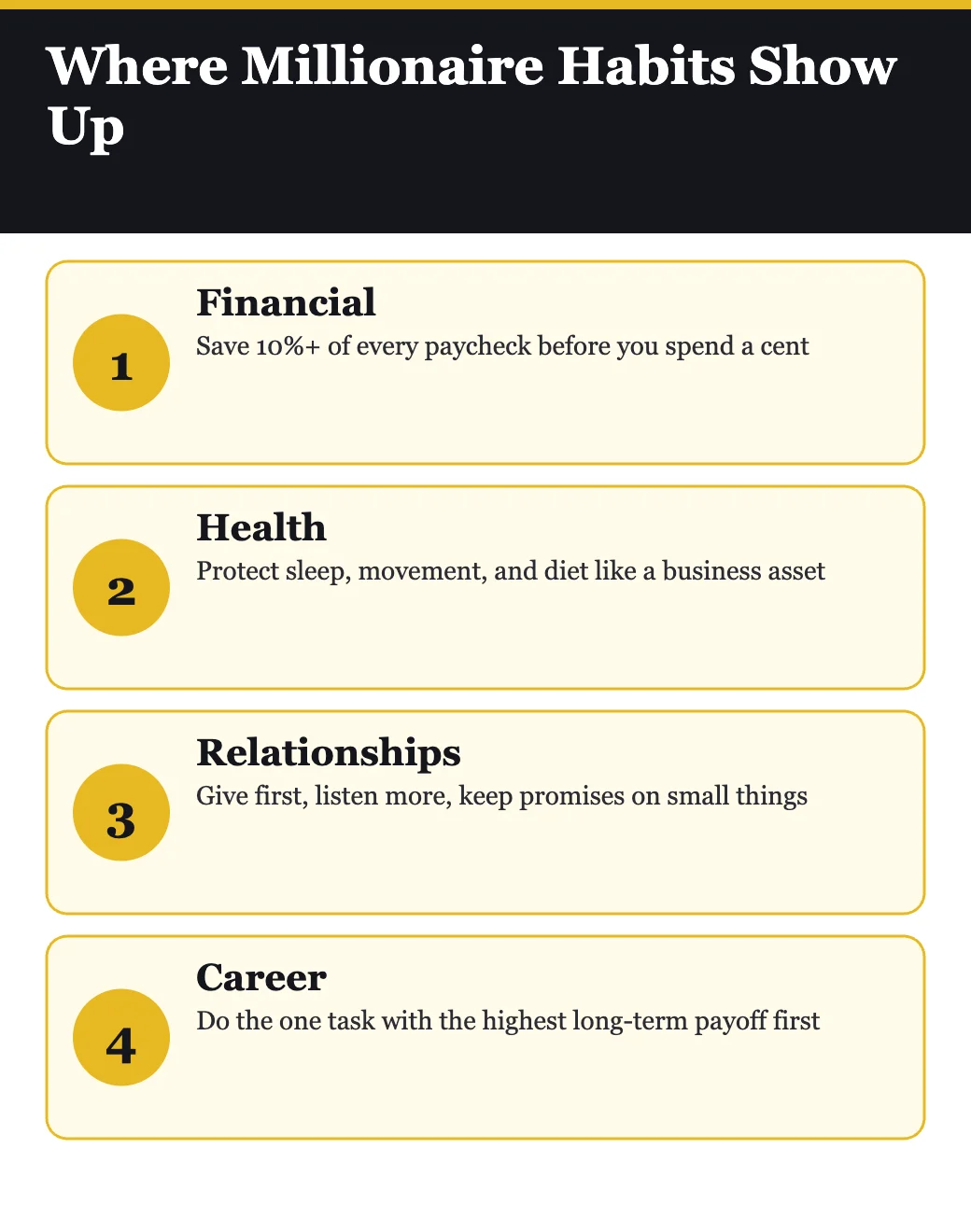
Money habits are a major focus, particularly the six-part financial plan, but the book’s framework — self-concept, habit installation, goal-setting, and daily prioritization — is presented as general-purpose and applies just as directly to health, relationships, and career habits. Tracy treats financial success as one visible proof of the underlying habit system rather than the only application of it.
How does this book compare to Atomic Habits?
Both books argue that identity and self-image shape which habits stick, but they differ in method: Atomic Habits leans on cognitive science and environment design (cues, friction, habit stacking), while Million Dollar Habits leans more on direct decision-making, no-exceptions commitment, and visualization drawn from Tracy’s sales and success-coaching background. Readers who want the more evidence-grounded mechanics of habit formation may prefer starting with Atomic Habits; readers who want a direct, action-first checklist for money and daily discipline specifically will likely get more immediate use from Tracy’s book.
Do I need to read Brian Tracy’s other books first?
No — Million Dollar Habits is self-contained and doesn’t assume you’ve read Eat That Frog!, The Psychology of Achievement, or Tracy’s other titles, though longtime readers will recognize recurring frameworks like ABCDE prioritization and goal-setting across his catalog. It works well as either a first Tracy book or a consolidated refresher if you’ve read others.
Related summaries
- Finish What You Start — follow through without relying on motivation
- Laziness Does Not Exist — a counterweight to nonstop optimization
- Margin — building slack and reserves into a busy life
- More time management book summaries
Related Time Management Summaries
Hell Yeah or No Summary & Review: Say No to Almost Everything
How to Do Nothing Summary & Review: Resisting the Attention Economy
Meditations for Mortals Summary & Review: Why Your Limitations Are the Point
Solving the Procrastination Puzzle Summary & Review: Why Delay Is an Emotion Problem
The Time Bandit Solution Summary & Review: Recovering Stolen Time You Never Knew You Had