

★★★★☆ 4.3/5 — A UC Irvine informatics professor’s decades of data on attention, distilled into a framework that treats focus as a rhythm, not a resource to white-knuckle.
Best for: Anyone who’s noticed their own attention getting shorter and wants the research behind it, not just another blocking app.
Reading time: ~8 hours (384 pages)
Difficulty to apply: Moderate — the framework is intuitive, but it asks you to work with your attention’s natural rhythm instead of forcing constant focus.
Attention Span in one minute
We now spend an average of just 47 seconds on any screen before shifting our attention — down from about two and a half minutes in 2004. That single statistic, drawn from two decades of Gloria Mark’s research, anchors her book’s central argument: attention hasn’t simply gotten weaker, it’s been reshaped by technology, culture, and our own habits into something far more fragmented than it used to be. Mark, a Chancellor’s Professor of Informatics at UC Irvine and a visiting researcher at Microsoft Research since 2012, rejects the popular idea that “flow” — one long, uninterrupted stretch of deep focus — is the only worthwhile state of attention. Instead she offers a new framework she calls kinetic attention: focus that naturally moves through different states over a day, and that can be worked with deliberately rather than forced into a single unbroken mode.
Key takeaways
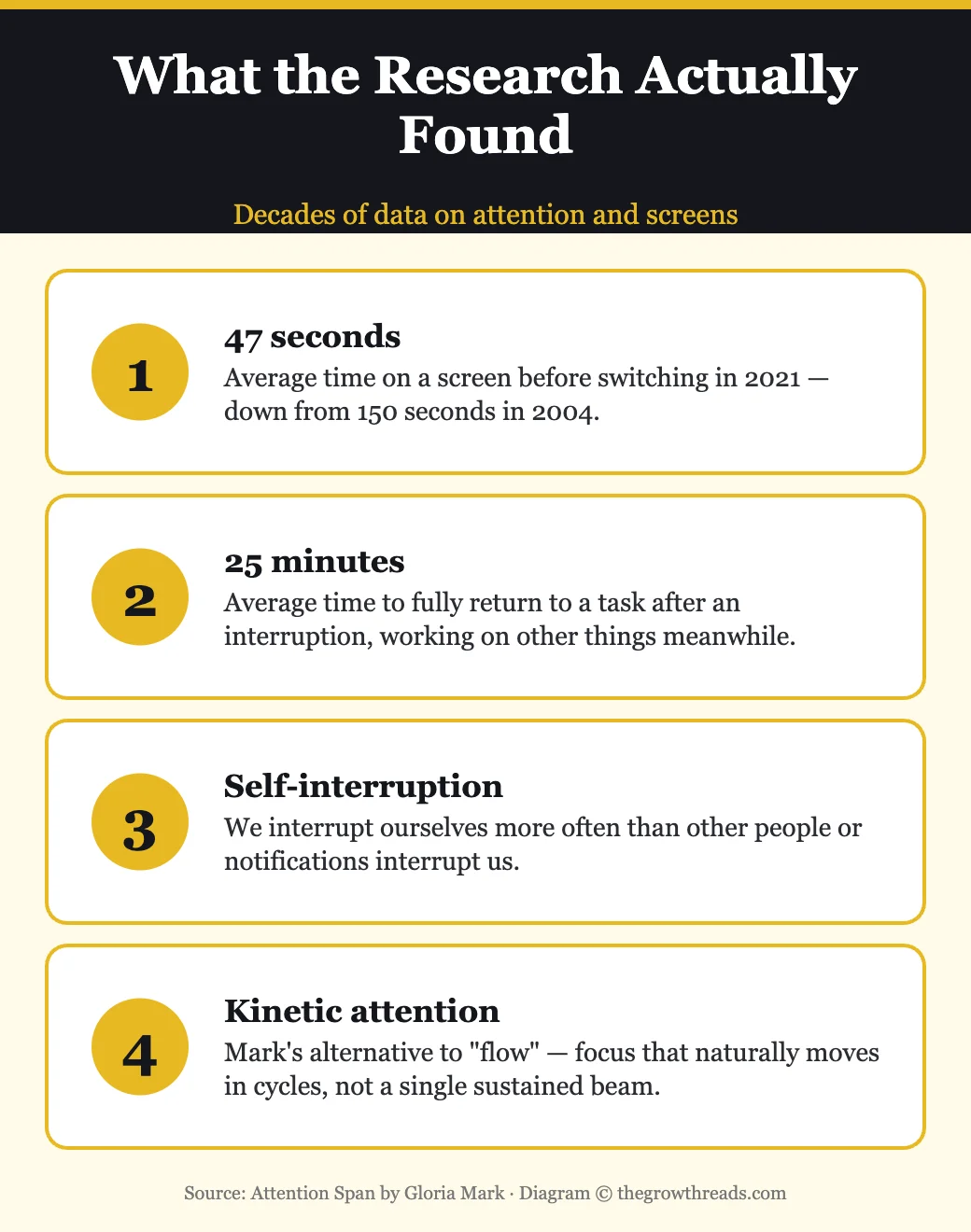
- Screen time before switching has collapsed: from about 150 seconds in 2004 to roughly 47 seconds by 2021, according to Mark’s research.
- Interruptions cost about 25 minutes: that’s how long it takes, on average, to fully return to a task after being pulled away from it.
- We interrupt ourselves more than others interrupt us: self-interruption, not notifications, is often the bigger driver of fragmented attention.
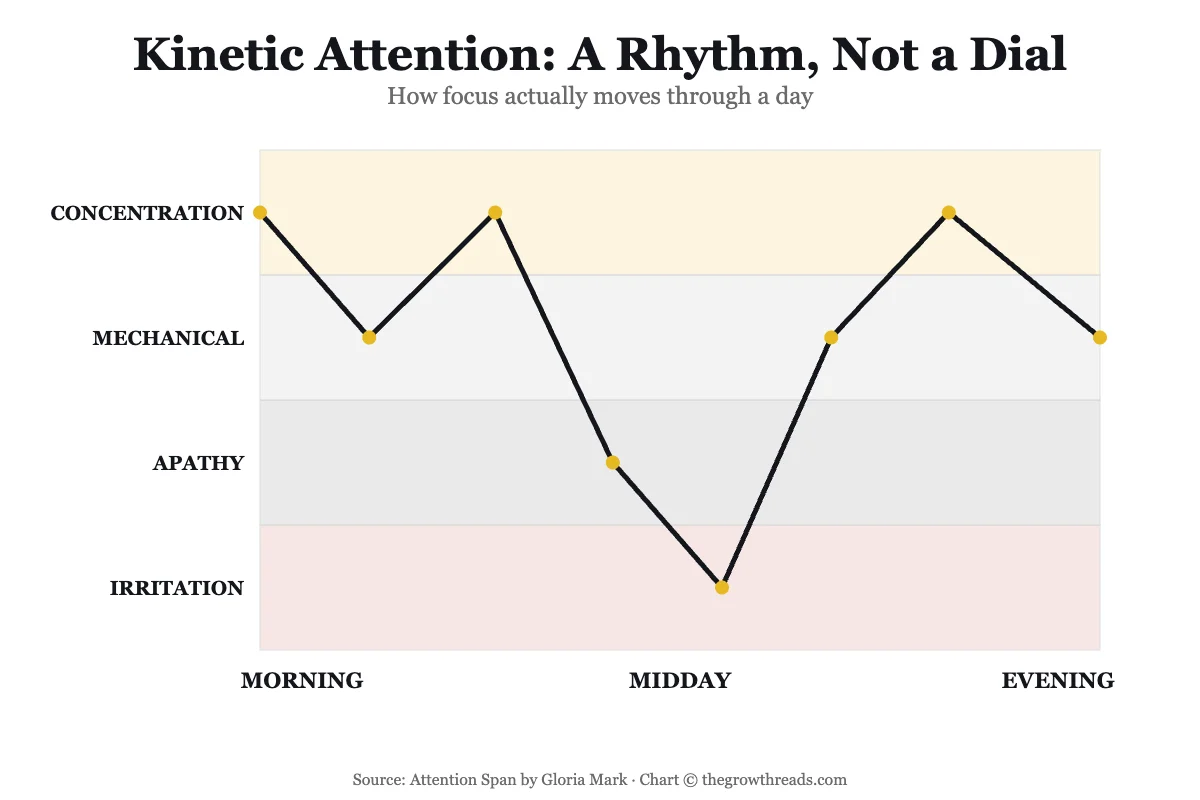
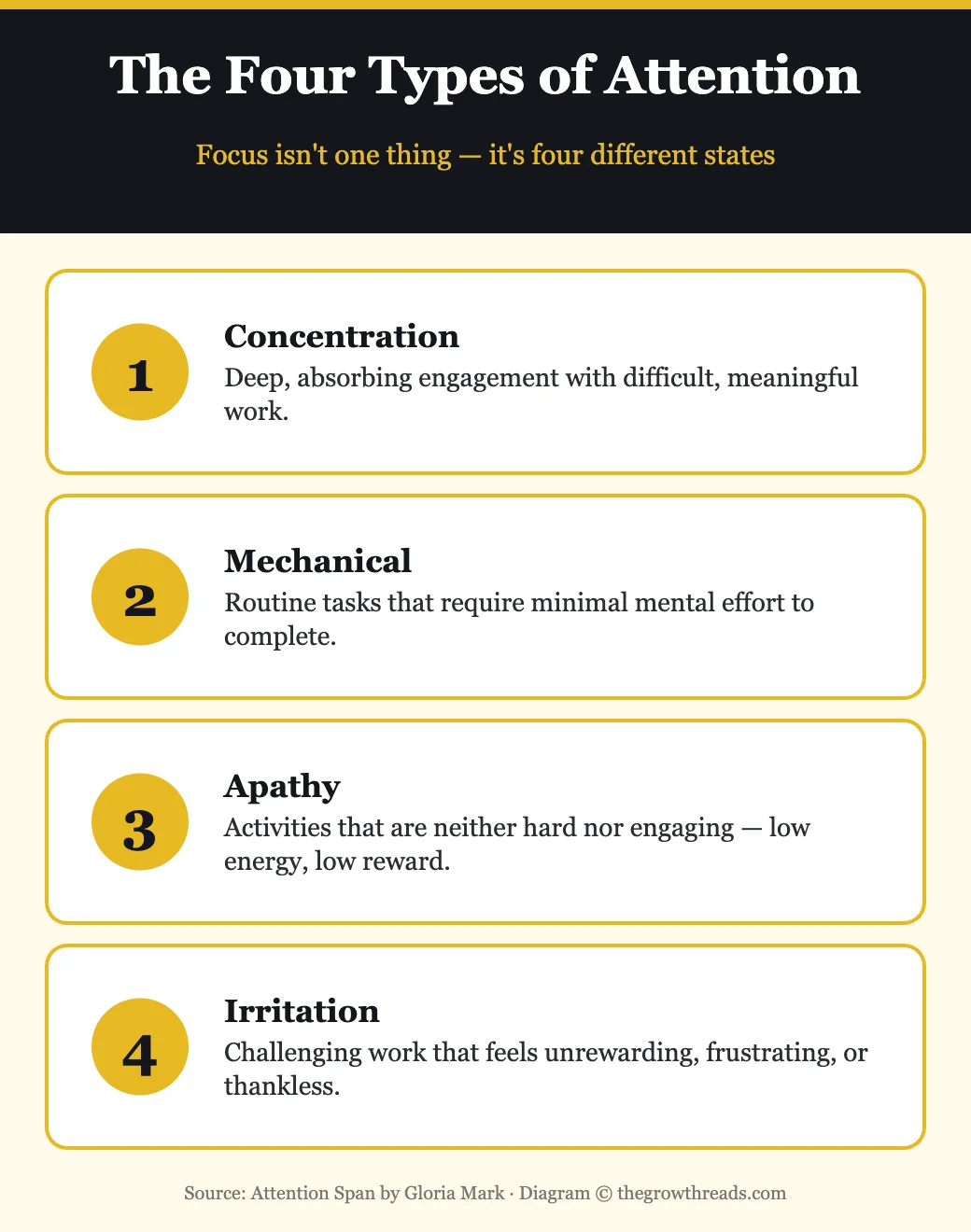
- Attention isn’t one thing: Mark identifies four distinct states — concentration, mechanical, apathy, and irritation — that we cycle through daily.
- “Flow” isn’t the only goal: her alternative framework, kinetic attention, treats focus as naturally rhythmic rather than a single sustained beam.
- Distraction isn’t purely a willpower failure: technology and entertainment are deliberately engineered to capture and hold attention.
- Self-awareness comes first: knowing your own peak concentration windows is a prerequisite for using any other strategy well.
- Strategic scheduling beats forcing focus: matching demanding work to your peak windows works better than trying to concentrate on command.
- Planned breaks beat willpower-only restriction: building rest into your schedule sustains attention better than relying solely on blocking apps.
- The goal is wellbeing, not just output: Mark frames restored attention as serving happiness and balance first, productivity second.
What is Attention Span about?
Attention Span draws on Gloria Mark’s decades of research into technology and focus to explain why our attention has fragmented — screen time before switching fell from 150 seconds in 2004 to 47 seconds by 2021. She introduces four types of attention and a framework called kinetic attention, offering practical strategies for working with focus’s natural rhythm instead of forcing constant concentration.
About the author
Dr. Gloria Mark is Chancellor’s Professor of Informatics at the University of California, Irvine, and has been a visiting senior researcher at Microsoft Research since 2012. She received her PhD in psychology from Columbia University and has been a two-time recipient of the Google Research Award as well as a recipient of the prestigious NSF CAREER award. Described by Cal Newport as “the definitive expert on distraction and multitasking,” Mark has spent more than two decades studying how people actually use technology in real workplace and personal settings, tracking attention patterns through direct observation rather than lab-only experiments. Attention Span, published in 2023 and featured on Armchair Expert, The Ezra Klein Show, and in the Wall Street Journal and New York Times, distills that research into her most accessible book to date. Explore all Gloria Mark book summaries →
Mark’s core statistics come from a research method she pioneered rather than borrowed: outfitting willing office workers with unobtrusive screen-logging software, then combining that continuous digital trace with periodic biometric readings and end-of-day interviews, so she could see not just what people clicked on but how their bodies responded and how they explained their own switching in the moment. The headline number from that decade-plus of fieldwork is stark: in 2004, the average time spent on a single screen before switching to something else was about two and a half minutes; by the mid-2010s it had fallen to roughly 47 seconds, and for many knowledge workers today it is closer to 40 seconds. Crucially, Mark’s data shows more than half of those switches are self-interrupted — the person chooses to leave a task, not an external notification. That distinction reframes the entire discussion: attention span in Mark’s usage is not a fixed trait being eroded by outside forces alone, but a pattern of behavior shaped by boredom thresholds, emotional regulation habits, and environment, all of which can be deliberately changed.
Key concepts at a glance
| Concept | What it means | Use it when |
|---|---|---|
| Kinetic attention | Mark’s framework for attention as a natural rhythm, not a single sustained beam | You feel like a failure for not sustaining “flow” all day |
| The 47-second stat | Average time spent on a screen before switching, as of 2021 | You want hard evidence attention fragmentation is real and measurable |
| Attention residue | The lingering cognitive cost of an interruption, taking about 25 minutes to clear | You’re wondering why “quick” interruptions derail an entire work session |
| Four types of attention | Concentration, mechanical, apathy, and irritation | You want to diagnose which state you’re actually in before choosing a task |
| Self-interruption | Interrupting your own focus more often than outside sources do | You’ve blocked notifications but still feel constantly distracted |
| Gentle self-moderation | Planned breaks and genuine self-control, not just restriction apps | Blocking tools alone haven’t fixed your attention problems |
Part 1: The research behind the collapse in attention
Mark’s central claim rests on data collected over roughly two decades of studying how people actually use their devices in real workplace settings, not simulated lab environments. In 2004, her research found people spent an average of about 150 seconds — two and a half minutes — on any given screen or application before switching to something else. By 2021, that number had fallen to just 47 seconds. This isn’t a subjective impression of feeling more distracted; it’s a measured, repeated finding across years of observational research, and the trend line is one of the most consistent results in her body of work.
The cost of switching isn’t limited to the moment of the switch itself. Mark’s research on interruptions found that it takes about 25 minutes, on average, to fully return to an original task after being pulled away from it — and crucially, people typically work on several other tasks in between, rather than resuming the interrupted one directly. This compounding effect means a handful of seemingly minor interruptions across a day can consume far more total time and cognitive capacity than their individual durations would suggest.
Perhaps the most counterintuitive finding in this section is that self-interruption outpaces external interruption. People check email, open a new tab, or glance at their phone on their own initiative more often than a notification or colleague pulls them away. This reframes the distraction problem: removing external interruptions — turning off notifications, silencing a phone — addresses only part of the pattern, since much of the fragmentation is self-generated, often as an automatic response to boredom, difficulty, or discomfort with a task.
TGR Note: The 25-minute return cost pairs well with the stress-regulation approach in Time Anxiety — Chris Guillebeau’s argument that a triggered nervous system, not just a scattered task list, is often what makes returning to focus so slow after an interruption.
Part 2: The four types of attention
Rather than treating focus as a single dial that’s either on or off, Mark identifies four distinct states people move through over a normal day. Concentration is the deep, absorbing engagement most people picture when they think of “real” focus — difficult, meaningful work that fully occupies attention. Mechanical attention covers routine tasks that require minimal mental effort: filing, simple data entry, familiar administrative work that can run almost on autopilot. Apathy describes activities that are neither difficult nor engaging, a kind of low-energy neutral state. Irritation is the most uncomfortable of the four — challenging work that feels unrewarding or thankless, the state most likely to trigger self-interruption as an escape valve.
The practical value of this framework is that it replaces a vague, moralized sense of “I should be focusing better” with a more precise diagnostic question: which of these four states am I actually in right now, and does the task in front of me match it? Scheduling concentration-level work during a period when you’re actually in an apathetic or irritated state sets up a mismatch that no amount of willpower reliably overcomes — the fix isn’t trying harder, it’s recognizing the state and either changing the task or changing the conditions.
Mark is also careful to note that mechanical and apathetic states aren’t failures to be eliminated — they’re a normal, necessary part of a functional day, and trying to force concentration-level intensity into every hour is itself a recipe for exhaustion. The goal isn’t maximizing concentration time; it’s matching each state to work that actually fits it.
TGR Note: This four-state model complements the reserve-based thinking in Margin — where Richard Swenson tracks emotional, physical, financial, and time capacity separately, Mark applies the same “not one undifferentiated resource” logic specifically to attention.
Part 3: Kinetic attention — a rhythm, not a dial
Mark’s most original contribution is a direct challenge to “flow” as the gold standard of focus. Flow, as popularized by psychologist Mihaly Csikszentmihalyi, describes a state of total absorption in a task — and it has become something of a productivity ideal, the implicit standard against which people judge their own attention as deficient. Mark’s research suggests this standard is both unrealistic and, for many kinds of modern knowledge work, not even the right goal. Attention naturally moves — between concentration, mechanical tasks, brief rests, and back again — and trying to hold it artificially still in one sustained state fights against how it actually operates.
She calls this natural movement kinetic attention: a rhythm rather than a single beam pointed in one direction for hours. The implication is significant for how people plan their days. Instead of treating every dip out of concentration as a failure to be corrected, kinetic attention treats the dips as an expected, even useful part of a functional attention cycle — mechanical tasks and brief low-stimulation periods give the concentration state room to recover and return, rather than depleting it further by forcing constant intensity.
This reframing also changes what “distraction” means. Not every shift away from a hard task is a failure of discipline; some of it is the natural rhythm doing what it does. The practical skill Mark teaches isn’t eliminating all movement in attention — it’s learning to recognize which shifts are the rhythm working as intended and which are self-interruptions worth noticing and redirecting.
TGR Note: Mark’s rejection of flow-as-the-only-goal rhymes with the “good enough” theme in Meditations for Mortals — both authors push back against an idealized standard (perfect flow, perfect output) that ends up working against the very outcome it’s meant to produce.
This reframing has a practical edge that’s easy to miss on a first read. If flow is the goal, every dip in concentration reads as a small failure, and the natural response is to treat rest as something to be defended against with more willpower or stricter blocking software. If kinetic attention is the goal instead, that same dip becomes expected — even useful — because the mechanical and rote-task portions of the rhythm are where the mind consolidates and where boredom-driven creative insight tends to surface. Mark’s fieldwork found that people who fought the rhythm hardest, forcing themselves back to demanding work the moment their focus wavered, reported more stress and lower-quality output over a full day than people who let a dip run its course through a lower-effort task before returning to concentrated work. The practical shift this book asks for isn’t scheduling more focus blocks; it’s noticing which of the four attention states you’re actually in at a given moment and matching the task to it, rather than treating every hour of the workday as if it should look the same.
Part 4: Three strategies for working with your attention
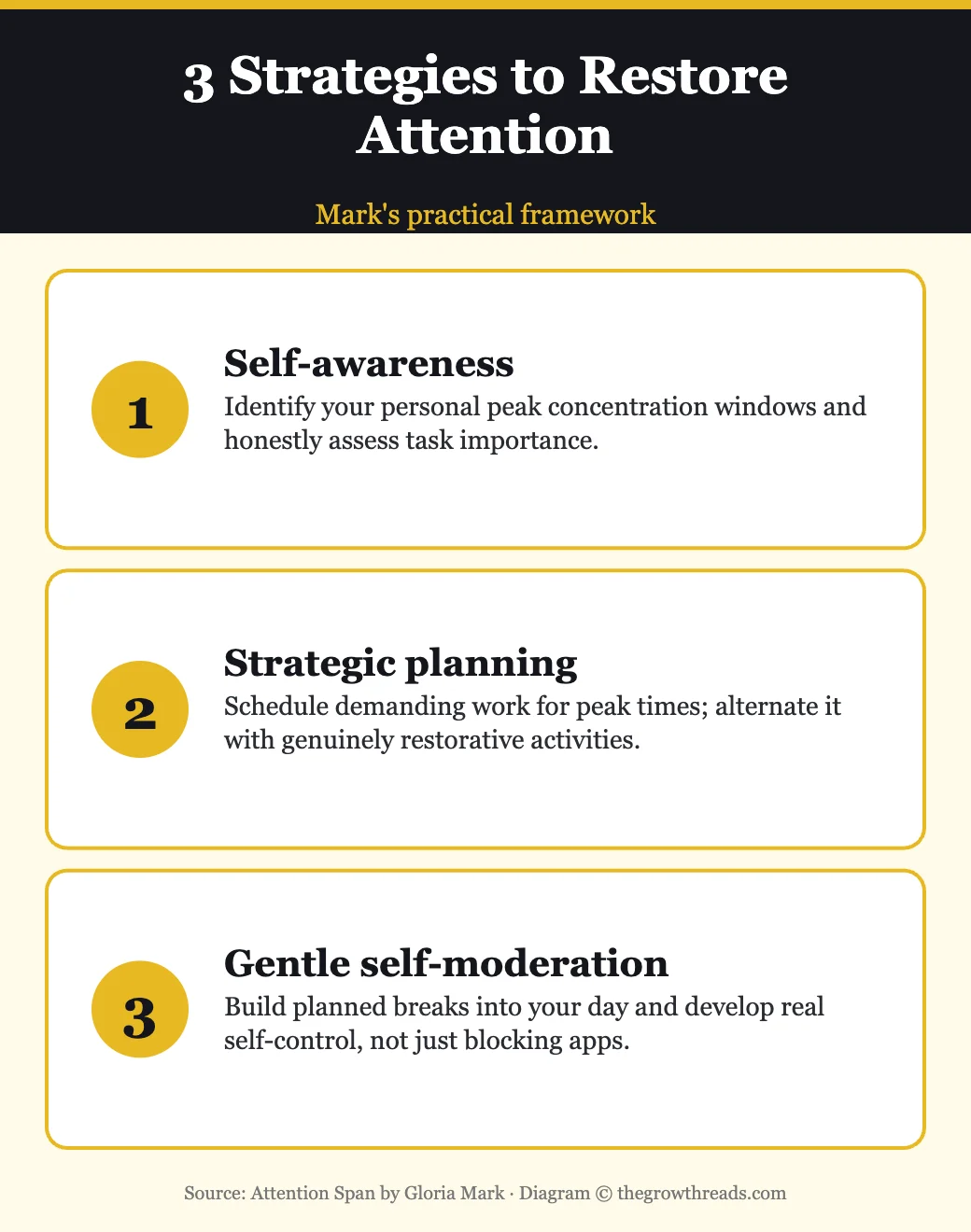
Mark’s practical recommendations follow directly from the kinetic attention framework rather than prescribing a single rigid system. The first strategy is self-awareness: identifying your own personal peak concentration windows, which vary significantly by individual and don’t necessarily match conventional “9-to-5 morning person” assumptions, and honestly assessing which tasks actually require concentration-level attention versus which could be handled in a mechanical state.
The second is strategic planning — deliberately scheduling your most demanding, concentration-requiring work for your identified peak windows, and interspersing it with genuinely restorative activities rather than simply pushing through fatigue. This is where the four-type framework becomes actionable: knowing you’re heading into a naturally lower-attention period is useful information for planning mechanical or administrative work into that slot instead of forcing difficult work against the grain.
The third strategy, gentle self-moderation, is where Mark diverges most clearly from the popular advice to simply install a blocking app and rely on external restriction. She argues that sustainable change requires building planned breaks directly into a schedule and developing genuine internal self-control, rather than outsourcing all discipline to software. Blocking tools can help, but Mark’s research suggests they work best as a scaffold for building real self-regulation, not as a permanent substitute for it — a distinction that matters because external restrictions tend to lose effectiveness once a person finds a way around them, while internal skill compounds over time.
TGR Note: The emphasis on barriers and structure over raw willpower echoes a theme in Do It Today — Darius Foroux’s case that removing friction, not gritting your teeth harder, is what actually changes behavior reliably.
Who is Attention Span best for — and who should read something else first?
This book is best for readers who want the underlying research, not just another set of focus tips — Mark’s academic background means the recommendations come with genuine evidentiary weight rather than intuition alone. It’s especially useful for people who’ve tried blocking apps and strict discipline-based approaches and found them unsustainable, since the book’s central argument directly explains why willpower-only strategies tend to fail.
If your attention problem is really more about a fragmented mind under stress than distraction specifically, Time Anxiety addresses the anxious, stress-driven layer more directly. If you’re looking for a broader diagnostic across more than just attention — emotional, physical, financial, and time capacity together — Margin is the wider-lens option. And if compulsive stimulation-seeking specifically, not general fragmentation, is your main pattern, Dopamine Detox offers a narrower, faster tactical reset.
It’s also worth knowing what this book is not. It isn’t a nostalgia argument for some pre-smartphone golden age of concentration, and Mark is explicit that she isn’t anti-technology — much of her research finds that certain digital tools, used deliberately, support the kinetic rhythm rather than undermine it. Readers hoping for a hard digital detox manifesto or a case for deleting every app will find the tone more measured than that: the book asks for awareness and redesign of habits and environments, not renunciation. That makes it a better fit for people who need to stay connected to email, chat, and collaborative tools for work and want a realistic framework for doing that without losing the ability to concentrate, rather than for someone whose goal is to unplug entirely.
Questions to reflect on
- When during your day are you actually in a concentration state, versus mechanical, apathetic, or irritated — and does your schedule match that reality?
- How often do you interrupt yourself, compared to how often something external interrupts you?
- What task are you currently forcing into a low-attention window where it’s unlikely to go well?
- Where have you relied entirely on a blocking app instead of building the underlying self-regulation skill?
- What would change if you stopped treating every dip in focus as a personal failure?
🔥 Ready to work with your attention instead of against it?
Get the research-backed guide to restoring focus without chasing an impossible standard.
How to apply Attention Span (7-day plan)
- Day 1 — Track your attention states. Note, every couple of hours, which of the four types — concentration, mechanical, apathy, irritation — you’re actually in.
- Day 2 — Identify your peak window. Based on Day 1’s data, find the time of day you consistently hit concentration state most easily.
- Day 3 — Schedule your hardest task for that window. Move your most demanding work to your identified peak, and mechanical work elsewhere.
- Day 4 — Count your self-interruptions. For one work session, tally how often you interrupt yourself versus how often something external does.
- Day 5 — Build one planned break. Add a genuine, scheduled break before fatigue forces one, rather than pushing through.
- Day 6 — Notice an irritation-state task. Identify one task that consistently triggers irritation, and either change how you approach it or when you do it.
- Day 7 — Practice one self-moderation habit without an app. Choose a boundary you enforce yourself, without relying on a blocker, and see how it goes.
Frequently asked questions
What is the main finding in Attention Span by Gloria Mark?
The book’s headline finding is that average screen time before switching attention fell from about 150 seconds in 2004 to roughly 47 seconds by 2021, based on Mark’s two decades of workplace attention research. Beyond that statistic, her broader argument is that attention isn’t a single resource to maximize but a rhythm with four distinct states — concentration, mechanical, apathy, and irritation — that people move through naturally across a day.
What is kinetic attention?
Kinetic attention is Gloria Mark’s alternative to the popular ideal of “flow.” Rather than treating sustained, uninterrupted focus as the only worthwhile state, kinetic attention describes how focus naturally moves through different states over time — concentration, mechanical tasks, rest, and back again. The framework treats this movement as normal and even useful, rather than as a series of failures to eliminate.
What are the four types of attention?
Mark identifies concentration (deep, absorbing engagement with difficult work), mechanical (routine tasks requiring minimal effort), apathy (activities that are neither difficult nor engaging), and irritation (challenging work that feels unrewarding). Recognizing which state you’re actually in helps match the right kind of task to the right moment, instead of forcing concentration-level focus at the wrong time.
Why does an interruption cost 25 minutes if it only takes a few seconds?
Mark’s research found that returning fully to an interrupted task takes about 25 minutes on average — not because the interruption itself is long, but because people typically work on several other tasks in between before resuming the original one, and reorienting to where you left off has its own cognitive cost. The brief interruption is only the visible part of a much longer chain of attention fragmentation.
Does the book recommend blocking apps to fix distraction?
Not as a primary solution. Mark’s third strategy, gentle self-moderation, favors building planned breaks and genuine internal self-control over relying solely on restriction software. Blocking tools can serve as a helpful scaffold, but her research suggests they work best alongside developing real self-regulation skill, since external restrictions tend to lose effectiveness once someone finds a way around them.
Is this book based on real research or just personal opinion?
It’s grounded in Gloria Mark’s own academic research — she’s a Chancellor’s Professor of Informatics at UC Irvine, a visiting researcher at Microsoft Research since 2012, and has studied attention and technology use for more than two decades through direct observation of real workplace behavior, not just lab experiments. Cal Newport has described her as “the definitive expert on distraction and multitasking.”
What should I read after Attention Span?
If a fragmented mind under stress, more than distraction itself, is your pattern, Time Anxiety addresses that layer directly. For a broader audit across emotional, physical, financial, and time capacity, Margin is the wider-lens option. And if compulsive stimulation-seeking is your main issue, Dopamine Detox offers a faster, narrower reset.
Related summaries
- Time Anxiety by Chris Guillebeau — regulating the stress response behind chronic rushing.
- Margin by Richard Swenson — a diagnostic framework for restoring reserve capacity.
- Dopamine Detox by Thibaut Meurisse — a short, practical reset for a raised stimulation baseline.
- More Time Management book summaries
How we analyze books: Every summary on The Growth Reads is built from a full read of the source material, cross-checked against the author’s interviews and published research where available, and structured around practical application rather than just recap. We focus on what you can actually do differently after reading. Read our full methodology.
Related Time Management Summaries
How to Do Nothing Summary & Review: Resisting the Attention Economy
Scrum Summary & Review: Doing Twice the Work in Half the Time
The 5 Choices Summary & Review: The Path to Extraordinary Productivity
The CHAOS Cure Summary & Review: Clean Your House in 15 Minutes a Day
Your Best Year Ever Summary & Review: A 5-Step Plan for Your Best Year