

★★★★☆ 4.2/5 — A short, focused guide to a single, well-defined tactic: temporarily removing high-stimulation triggers so hard work feels rewarding again.
Best for: Anyone who notices ordinary, meaningful tasks feel flat compared to their phone, and wants a concrete reset, not a philosophy.
Reading time: ~1.5-2 hours (a short, focused guide)
Difficulty to apply: Easy to start, uncomfortable to sustain — the first detox period is the hardest part by design.
Dopamine Detox in one minute
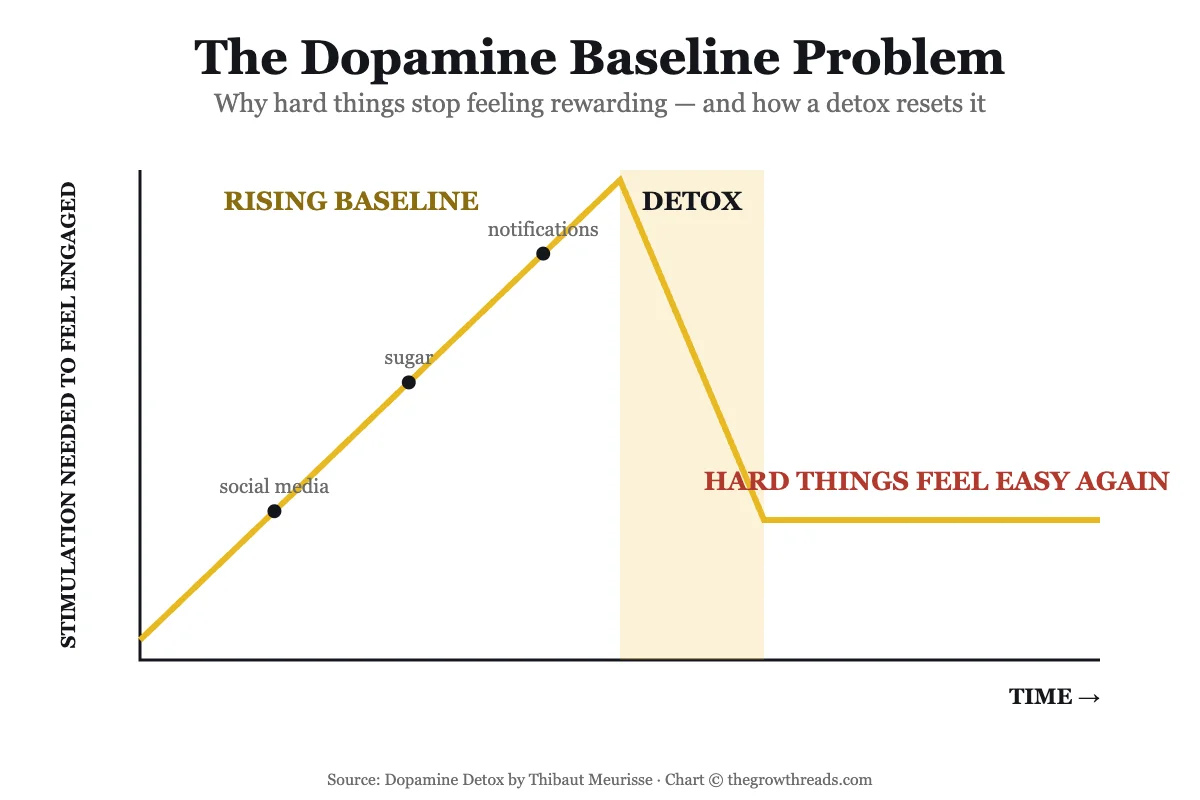
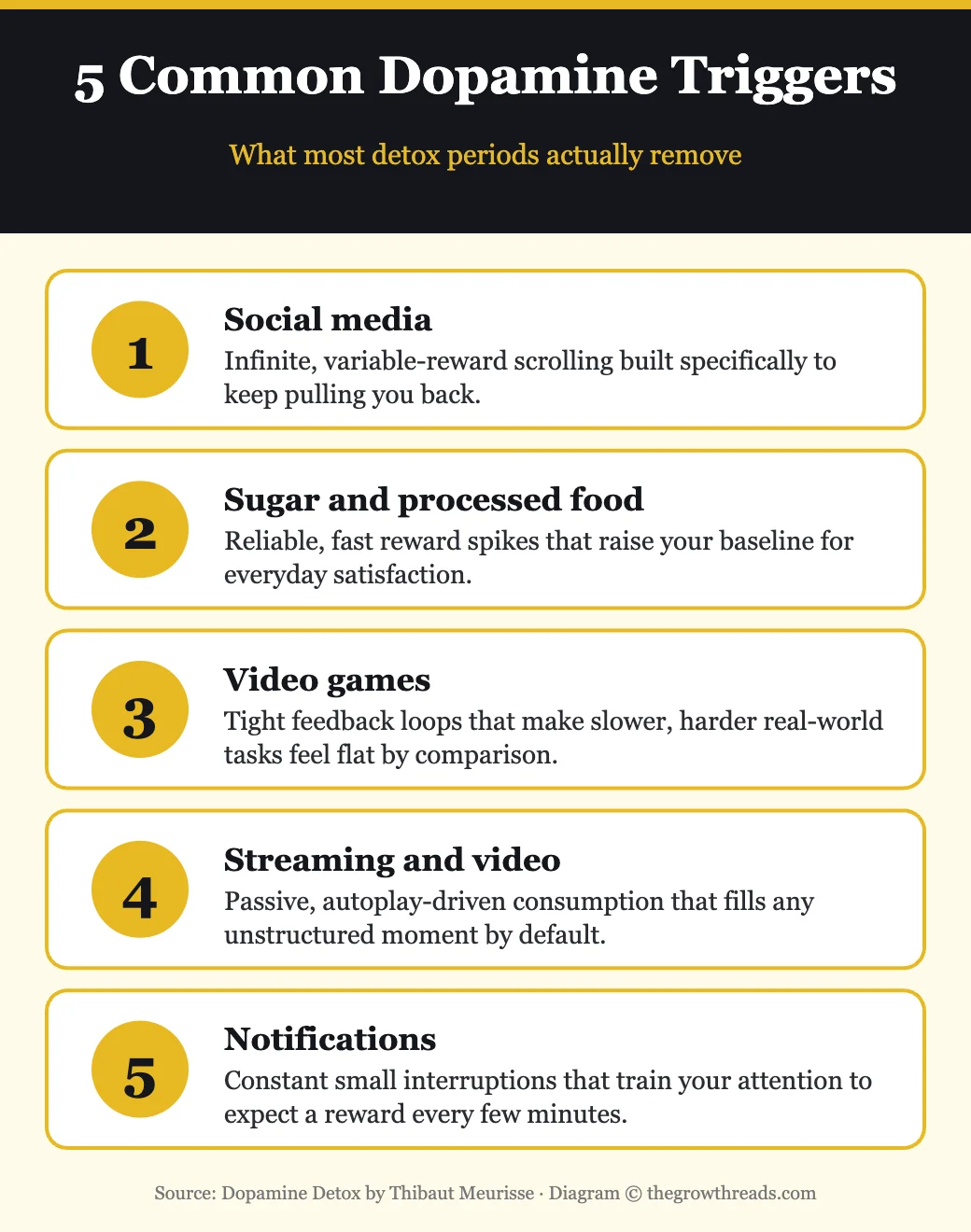
Dopamine isn’t the pleasure chemical — it’s the cue that sends you chasing more stimulation. Thibaut Meurisse’s short guide, part of his Productivity Series, takes that one neuroscience-adjacent idea and turns it into a practical method: because constant exposure to high-stimulation activities — social media, sugar, notifications, video games — steadily raises the amount of stimulation your brain expects, ordinary, meaningful work starts to feel dull and unrewarding by comparison. A dopamine detox is the deliberate, temporary removal of those triggers, long enough to lower that baseline back down so slower, harder, more valuable work can compete again. The book is short by design and stays close to one clear mechanism and a repeatable three-step method, rather than trying to cover the full landscape of focus and productivity advice.
Key takeaways
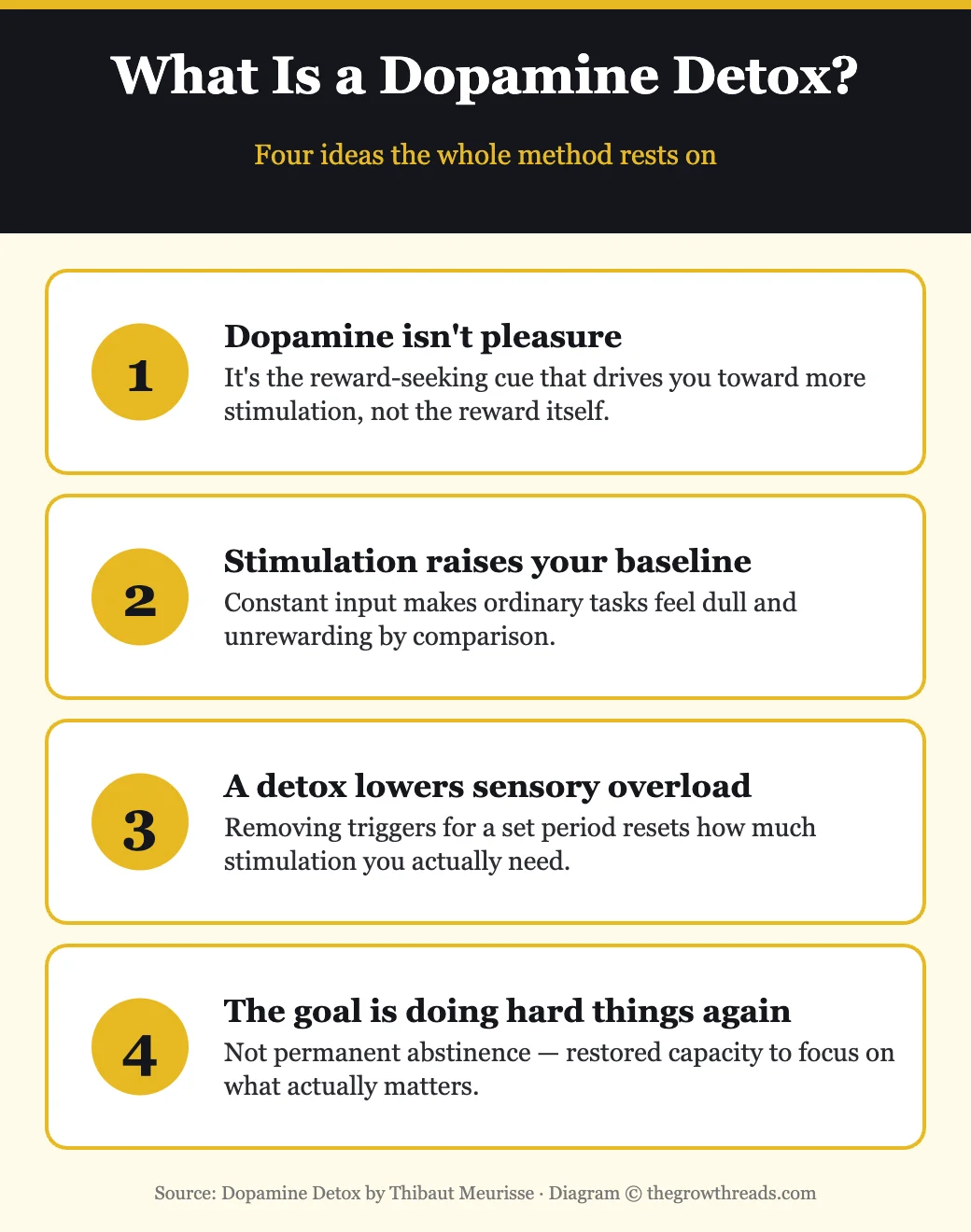
- Dopamine is a cue, not a reward: it’s the chemical signal that drives reward-seeking behavior, not the pleasant feeling itself.
- Constant stimulation raises your baseline: the more intense input you’re used to, the less rewarding ordinary tasks feel by comparison.
- A detox lowers sensory overload on purpose: removing triggers for a set period resets how much stimulation you actually need to feel engaged.
- There are two detox formats: a total detox (24-48 hours, everything removed) and a limited detox (one major trigger removed for 30 days).
- Limited detoxes tend to be more sustainable: removing one primary trigger long-term beats a short, intense reset that’s hard to repeat.
- Barriers beat willpower: physically removing access to a trigger works better than trying to resist it in the moment.
- Mornings set the tone: a stimulation-free start to the day makes the rest of it easier to protect.
- The goal is capacity, not abstinence: the point isn’t permanently avoiding stimulation, but restoring the ability to focus on hard things.
- Self-compassion matters after a lapse: Meurisse frames slipping back into old triggers as expected, not a reason to abandon the method.
- A prioritized task list locks in the gains: the detox creates capacity; a clear list of high-impact work is what actually uses it.
What is Dopamine Detox about?
Dopamine Detox explains why constant stimulation from social media, sugar, and notifications makes ordinary tasks feel unrewarding, and offers a practical method for temporarily removing those triggers to reset your baseline. Thibaut Meurisse lays out two detox formats and a three-step implementation plan for restoring the capacity to focus on meaningful, difficult work.
About the author
Thibaut Meurisse is a personal development author and the creator of the Productivity Series and Master Your Life Series, which together include titles like Master Your Emotions, Master Your Thinking, and Master Your Focus. Writing under his own independent imprint, he specializes in short, action-oriented guides that distill a single concept into a practical method readers can apply within a day or two of finishing the book, rather than long-form treatments that require sustained study. Dopamine Detox is one of his most widely read titles, reflecting a broader shift in his catalog toward attention, focus, and the psychological mechanics of productivity. Explore all Thibaut Meurisse book summaries →
Key concepts at a glance
| Concept | What it means | Use it when |
|---|---|---|
| Dopamine | The chemical cue for reward-seeking behavior, not pleasure itself | You want to understand why stimulation feels compulsive, not just enjoyable |
| Baseline stimulation | The level of input your brain has adapted to expect | Ordinary tasks feel boring compared to your phone or other high-stimulation habits |
| Total detox | Removing all dopamine-triggering activities for 24-48 hours | You want a fast, intense reset and can clear your schedule briefly |
| Limited detox | Removing one primary trigger for about 30 days | You want a sustainable change without disrupting your whole routine |
| Barriers over willpower | Physically removing access instead of relying on self-control | You keep breaking resolutions to simply “use it less” |
| Stimulation-free mornings | Starting the day before high-dopamine input gets a chance to hijack it | Your days consistently get derailed within the first hour |
Part 1: Why stimulation quietly raises the bar
Meurisse opens by correcting a common misconception: dopamine isn’t the brain’s pleasure chemical, it’s the signal that motivates you to pursue a reward in the first place. That distinction matters because it explains why high-stimulation activities feel compulsive rather than simply enjoyable — they trigger the reward-seeking cue repeatedly and reliably, training your brain to expect that level of input as normal. Over time, this creates what amounts to an inflated baseline: activities that would have felt engaging a year ago — reading, a focused work session, an unhurried conversation — start to feel flat, because they can’t compete with the immediacy and intensity of a notification, a short video, or a sugar hit.
This is the book’s central mechanism, and Meurisse keeps it deliberately simple rather than diving deep into neuroscience. The practical implication is that the problem isn’t a lack of willpower or discipline in the moment you sit down to do hard work — it’s that your baseline has been recalibrated by weeks or months of high-stimulation input, and no amount of trying harder in a single sitting fixes a baseline that took that long to build. The fix has to operate on the same timescale as the problem: a deliberate period of reduced stimulation, not a single act of willpower.
Framed this way, a dopamine detox isn’t a punishment or a purity test — it’s closer to recalibrating an instrument that’s drifted out of range. The goal throughout is restoring your capacity to find slower, harder, more meaningful work rewarding again, not eliminating pleasure or stimulation from your life permanently.
It’s worth noting the term “dopamine fasting” was originally popularized by the clinical psychologist Cameron Sepah, whose more technical version specifically targeted compulsive behaviors tied to clinical addiction patterns. Meurisse’s book is a more accessible, general-audience adaptation of that idea — stripped of the clinical framing and rebuilt around everyday attention and productivity problems rather than addiction treatment. This is worth knowing going in: the book borrows a term with a more rigorous clinical origin and applies it to a broader, more common problem, which is part of why it reads as approachable rather than technical.
None of this requires believing stimulation is inherently bad. Meurisse is explicit that entertainment, social connection online, and enjoyable food all have a legitimate place — the problem he’s addressing is specifically the mismatch between how much stimulation you’ve become accustomed to and how much slower, more valuable work can realistically provide. Framing the goal as recalibration rather than elimination is what keeps the book from reading as an ascetic lifestyle pitch, and it’s also what makes the method easier to actually sustain, since nobody has to commit to permanently giving anything up.
TGR Note: This baseline mechanism is a close cousin of the efficiency trap described in Meditations for Mortals — in both cases, adapting to a higher input (speed, in Burkeman’s case; stimulation, in Meurisse’s) quietly raises what feels normal, so the fix has to reset the baseline, not just work harder within it.
Part 2: Two ways to run a detox
Meurisse presents two distinct formats rather than a single prescribed method, and is explicit that the right choice depends on your circumstances and tolerance for disruption. The total detox is the more intense option: a 24-to-48-hour window with every major stimulation source removed at once — internet, phone, TV, music, and processed food — replaced with low-stimulation activities like journaling, walking, or meditation. It produces a fast, noticeable reset, but its intensity is also what makes it hard to repeat often; most readers can manage a total detox occasionally, not as a weekly habit.
The limited detox trades speed for sustainability. Instead of removing everything at once, you identify your single biggest trigger — often social media, video games, or sugar — and eliminate just that one source for roughly 30 days while otherwise living normally. Because it asks less of you moment to moment, Meurisse presents it as the more realistic choice for lasting change, even though the reset it produces is slower and less dramatic than a total detox.
Neither format is framed as inherently superior — the book’s practical stance is that a total detox works well as an occasional reset when you need a fast recalibration, while a limited detox works better as an ongoing practice you can actually sustain across months rather than days.
Choosing between the two often comes down to a practical question Meurisse poses directly: can you realistically clear a full day or weekend, or does your life require you to keep functioning normally while making a change? Parents, people with demanding jobs, or anyone with fixed obligations will usually find the limited detox more realistic, since it doesn’t require stepping away from responsibilities. A total detox works best when you have genuine flexibility — a free weekend, a vacation day, or a planned reset — and want the fastest possible recalibration rather than a gradual one.
It’s also worth setting realistic expectations about pace. A single detox period, of either format, rarely produces a permanent change on its own — Meurisse frames it more like exercise than a one-time fix: the baseline creeps back up between resets the same way fitness declines without maintenance, which is why the book treats periodic detoxing as an ongoing practice rather than a single milestone to complete once and never revisit.
Part 3: The three-step implementation plan
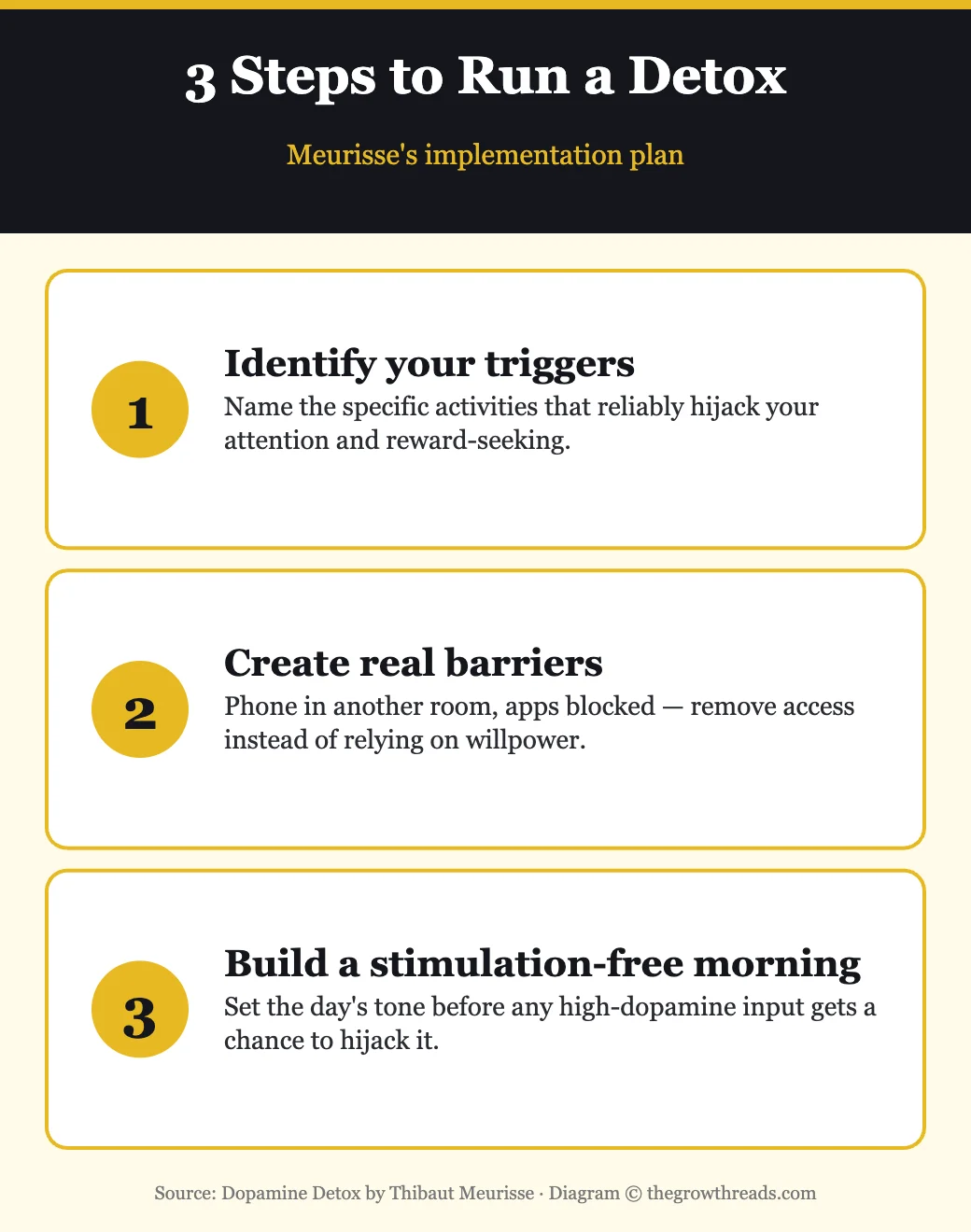
The book’s most actionable section breaks the process into three concrete steps, deliberately avoiding reliance on in-the-moment willpower. The first is identifying your specific triggers — not stimulation in general, but the exact activities that reliably hijack your attention, since the right target varies significantly from person to person. The second step is creating real physical barriers rather than relying on resolutions: putting your phone in another room, using app blockers, or removing a trigger from your environment entirely, on the reasoning that willpower is a limited and unreliable resource, while a removed option requires no ongoing effort to avoid.
The third step is establishing a stimulation-free morning routine, which Meurisse treats as disproportionately important relative to its simplicity. His argument is that the first high-dopamine input of the day — checking a phone immediately on waking, for instance — sets a tone that’s difficult to recover from, since it primes the brain to keep seeking that same level of stimulation for the rest of the day. A calmer opening sequence, even a short one, makes every subsequent hour easier to protect.
The trigger-identification step is less obvious than it first appears, because the most disruptive trigger isn’t always the most visible one. For some readers it’s clearly social media or video games; for others, it’s something less commonly flagged, like constantly checking work email or news notifications, which can feel productive or responsible even while functioning as exactly the same kind of reward-seeking loop. Meurisse’s advice is to track honestly, for a day or two, which activities you return to compulsively rather than deliberately — the pattern of returning matters more than the content of the activity itself.
TGR Note: The “barriers over willpower” principle mirrors a theme in Time Anxiety, where Chris Guillebeau argues that regulating your environment and nervous system has to come before you can reliably apply better judgment — trying to reason your way past a triggered state rarely works in either book’s framework.
Part 4: Making the reset stick
Meurisse spends the book’s final section on sustainability, treating relapse as the expected default rather than a sign of failure. Because the triggers being removed were, by definition, effective at capturing attention, he’s direct that most readers will slip back into old patterns at some point, and frames self-compassion — noticing the lapse without extended self-criticism — as more productive than trying to maintain perfect discipline indefinitely. Meurisse also touches briefly on accountability as a support for sustaining the change — telling someone else about your detox, or tracking it visibly, makes it harder to quietly abandon than a private, unstated intention. The point of the method isn’t never touching a trigger again; it’s building the ability to notice when your baseline has crept back up and reset it again deliberately.
The other half of making the reset stick is using the capacity it creates. Meurisse pairs the detox with a simple practice: building a prioritized task list of genuinely high-impact work, so that the attention freed up by removing low-value stimulation has somewhere specific and meaningful to go. Without this step, he notes, freed-up time and attention tend to get absorbed by whatever’s most available — which is often another, slightly less obvious source of stimulation — rather than the deep work the detox was meant to make room for.
This closing emphasis on direction, not just removal, is what keeps the book from reading as a pure abstinence pitch. The detox clears space; a deliberate list of what actually matters is what fills it back in on purpose.
Who is Dopamine Detox best for — and who should read something else first?
This book is best for readers who want a short, specific, immediately actionable method rather than a fuller exploration of attention and focus. Because it’s brief and tightly scoped to one mechanism, it works well as a quick reset or a companion to a longer book, rather than a comprehensive treatment on its own. Readers whose main problem is a general sense of overload rather than a specific stimulation-seeking pattern may find the diagnosis doesn’t quite fit their situation.
If your core issue is broader overload rather than a specific stimulation habit, Margin covers a wider range of reserves worth auditing. If your problem shows up more as anxious urgency than compulsive stimulation-seeking, Time Anxiety addresses that pattern directly. And if you want the philosophical case for accepting limits rather than a tactical reset, Meditations for Mortals is the better starting point.
The book’s brevity is also a legitimate selling point on its own terms. Readers who are already dealing with time anxiety or overload — exactly the audience most likely to pick up a book like this — are unlikely to finish a 300-page treatment on attention and neuroscience. A guide that can be read in under two hours and acted on the same day removes a common failure point: books about focus that are too long to actually finish while distracted.
Questions to reflect on
- Which specific activity, if you’re honest, is doing the most to raise your stimulation baseline right now?
- Would a total detox or a limited detox actually fit your current circumstances better?
- What barrier could you put in place today that would remove a trigger without relying on willpower?
- How does your first hour after waking currently set the tone for the rest of your day?
- If you freed up an hour of attention this week, what specific high-impact task would you point it at?
🔥 Ready to reset your baseline?
Get the short, practical guide to running your first dopamine detox.
How to apply Dopamine Detox (7-day plan)
- Day 1 — Identify your biggest trigger. Name the one activity that most reliably hijacks your attention and reward-seeking.
- Day 2 — Build one physical barrier. Remove access to that trigger — another room for your phone, an app blocker, or a deleted app.
- Day 3 — Design a stimulation-free morning. Delay your first high-dopamine input by at least 30 minutes after waking.
- Day 4 — Try a short total detox. Pick a few hours to remove internet, phone, and processed food entirely, replaced with a low-stimulation activity.
- Day 5 — Start a 30-day limited detox. Commit to removing your single biggest trigger for the next month.
- Day 6 — Build your high-impact list. Write down the specific, meaningful work you want your freed-up attention to go toward.
- Day 7 — Practice self-compassion after a lapse. If you slipped back into a trigger, note it without extended self-criticism and reset the barrier.
Frequently asked questions
What is a dopamine detox, according to Thibaut Meurisse?
A dopamine detox is the intentional, temporary removal of activities that trigger dopamine — the chemical cue for reward-seeking behavior, not pleasure itself — in order to lower sensory overload. Constant exposure to high-stimulation activities like social media and sugar raises the amount of stimulation your brain expects, making ordinary tasks feel unrewarding by comparison. Removing those triggers for a set period resets that baseline so slower, more meaningful work can feel engaging again.
What’s the difference between a total detox and a limited detox?
A total detox removes every major stimulation source — internet, phone, TV, music, processed food — for 24 to 48 hours, producing a fast but intense reset that’s hard to repeat often. A limited detox removes just your single biggest trigger, such as social media or sugar, for about 30 days, which is slower but far more sustainable as an ongoing practice. Meurisse presents the total detox as an occasional reset and the limited detox as the more realistic long-term approach.
Does this book require completely giving up technology or entertainment?
No. The goal is restoring your capacity to find meaningful, difficult work rewarding, not permanently eliminating stimulation or entertainment from your life. Meurisse frames the detox as a recalibration tool used periodically, not a lifestyle of permanent abstinence, and explicitly treats occasional relapses into old triggers as expected rather than a sign of failure.
What are the three steps in Meurisse’s implementation plan?
The three steps are identifying your specific triggers — the exact activities that hijack your attention, which vary by person — creating physical barriers that remove access rather than relying on willpower, and establishing a stimulation-free morning routine, since the first high-dopamine input of the day tends to set the tone for the hours that follow.
Is Dopamine Detox based on solid science?
The book draws on a popularized, simplified version of dopamine’s role in reward-seeking behavior rather than a technical neuroscience text, and Meurisse is careful to correct the common misconception that dopamine is the “pleasure chemical” itself. The underlying idea — that repeated high-stimulation input raises what a person needs to feel engaged — is a widely discussed pattern in behavioral psychology, though readers looking for a deep scientific treatment should expect this short guide to stay practical rather than academic.
How is this different from digital minimalism?
Digital minimalism, as a broader philosophy, focuses on curating which technologies deserve a place in your life based on your values. Dopamine Detox is narrower and more mechanical: it targets the specific neurological pattern of a raised stimulation baseline and offers a temporary reset method, regardless of which particular technology or habit is responsible. The two approaches are compatible — a detox can be the reset that makes a minimalist redesign easier to sustain afterward.
What should I read after Dopamine Detox?
If your core issue is broader overload rather than one specific habit, Margin covers a wider range of reserves worth auditing. If anxious urgency is more your pattern than compulsive stimulation-seeking, Time Anxiety addresses that directly. And for the philosophical case behind accepting limits rather than a tactical reset, Meditations for Mortals is a strong next step.
Related summaries
- Margin by Richard Swenson — a diagnostic framework for restoring reserve capacity.
- Time Anxiety by Chris Guillebeau — regulating the stress response behind chronic rushing.
- Meditations for Mortals by Oliver Burkeman — a philosophy of imperfectionism and good enough.
- More Time Management book summaries
How we analyze books: every TGR summary is built from a full reading of the book, cross-referenced against the author’s other published work and independent research where relevant, then structured around the practical decisions a reader actually needs to make. We never critique an author’s ideas in a summary — our job is to help you decide whether and how to apply them. Read our full methodology.
Related Time Management Summaries
How to Manage Your Home Without Losing Your Mind Summary & Review: Small Habits for “Naturally Messy” People
Margin Summary & Review: Restoring the Reserves Overload Has Stolen
Scrum Summary & Review: Doing Twice the Work in Half the Time
The Ruthless Elimination of Hurry Summary & Review: Slowing Down in a World Built for Rush
The Time Trap Summary & Review: The Classic Guide to Self-Generated vs. Environmental Time Wasters