

★★★★★ 4.6/5 — Chris Guillebeau treats time scarcity as a psychological problem first and a scheduling problem second, and the reframe changes what actually works.
Best for: Anyone who feels perpetually behind despite a reasonable workload — the feeling, not the calendar, is the problem this book targets.
Reading time: ~6 hours (288 pages)
Difficulty to apply: Moderate — the tools are simple, but they ask you to tolerate discomfort you’ve been avoiding for years.
Time Anxiety in one minute
Time scarcity isn’t caused by a lack of hours — it’s caused by unrealistic expectations and misaligned priorities. That’s the reframe at the center of Chris Guillebeau’s Time Anxiety, and it’s a genuinely different starting point than most time management books. Guillebeau, the New York Times bestselling author of The $100 Startup, argues that the panicky, falling-behind feeling so many people carry through an ordinary day isn’t primarily a scheduling failure — it’s a nervous-system response to cognitive distortions and unwritten rules most people never chose in the first place. Instead of another system for packing more into your day, the book offers a way to build tolerance for incomplete to-do lists, regulate the stress response that makes routine tasks feel high-stakes, and consciously rewrite the invisible rules that quietly govern how urgent everything feels.
Key takeaways
- Time anxiety is a feeling, not a fact about your schedule: the sense of falling behind often persists even when your actual workload is reasonable.
- Cognitive distortions inflate routine tasks into emergencies: catastrophizing a late reply is a thinking pattern, not an accurate read of the stakes.
- The nervous system drives behavior before logic does: grounding and breathwork can lower stress before you try to reason your way out of it.
- “Catching up” is a goal that can’t be reached: building tolerance for an incomplete to-do list works better than chasing an empty one.
- Most time pressure comes from unwritten rules: self-imposed standards like same-day replies are chosen, even when they don’t feel that way.
- You can test a rule by breaking it once: most invisible deadlines turn out to matter far less than the anxiety around them suggests.
- “Good enough” is usually the actual standard: perfectionism is frequently the anxiety talking, not a requirement anyone imposed on you.
- Disappointing someone is the cost of having real priorities: avoiding all disappointment usually means avoiding prioritization altogether.
- Trade-offs, not more effort, resolve competing priorities: finite energy has to be allocated, not stretched to cover everything.
- The goal is savoring limited time, not maximizing it: breaking the cycle of overstressing and overdoing is what makes room for actually living.
What is Time Anxiety about?
Time Anxiety argues that chronic rushing and deadline dread stem from unrealistic expectations and misaligned priorities, not a real lack of hours. Chris Guillebeau combines research on time perception and cognitive distortions with practical tools for regulating stress, tolerating incomplete to-do lists, and rewriting the unwritten time rules that make ordinary tasks feel urgent.
About the author
Chris Guillebeau is the New York Times bestselling author of The $100 Startup, Side Hustle, and The Happiness of Pursuit, which have together sold over a million copies. Before becoming a full-time writer, he spent a lifetime of self-employment that included a four-year stint as a volunteer executive in West Africa, and he visited every country in the world — 193 in total — before turning thirty-five. He writes the newsletter A Year of Mental Health, which informed much of the psychological research behind Time Anxiety. The book marks a shift from his earlier entrepreneurship-focused titles toward the psychological roots of overwhelm, drawing on research into executive functioning, avoidance, and time perception to explain why so many capable, productive people still feel perpetually behind. Explore all Chris Guillebeau book summaries →
Key concepts at a glance
| Concept | What it means | Use it when |
|---|---|---|
| Time anxiety | The felt sense of falling behind, independent of actual workload | You feel rushed despite a genuinely manageable schedule |
| Cognitive distortions | Thinking patterns that inflate routine tasks into emergencies | A small delay is triggering a disproportionate stress response |
| Unwritten time rules | Self-imposed standards you never consciously chose | You’re stressed about a deadline nobody actually set for you |
| Nervous system regulation | Grounding and breathwork used to calm stress before deciding anything | You need to think clearly instead of react automatically |
| Tolerating incompleteness | Accepting an unfinished to-do list instead of chasing an empty one | You’re exhausted trying to “catch up” to a goalpost that keeps moving |
| Good enough | Treating adequate completion as the real standard, not perfection | Perfectionism is stalling a task that doesn’t require it |
Part 1: The illusion of urgency — why falling behind feels like an emergency
Guillebeau opens by naming a pattern most readers will recognize instantly: an unanswered email, an incomplete to-do list, or a missed personal goal can trigger a level of stress wildly out of proportion to the actual consequences. He calls the underlying condition time anxiety, and his central claim is that it doesn’t come from having too much to do — it comes from a mismatch between how much time you believe you should need and how much time things actually take, compounded by a habit of treating every unfinished item as evidence that something is wrong with you rather than as ordinary, unremarkable incompleteness.
This distinction matters because it changes where the fix has to happen. If the problem were purely a scheduling problem, better time-blocking or a faster task-completion system would solve it. But Guillebeau’s research into time perception suggests the anxiety often persists at the same intensity regardless of how efficient someone becomes, because efficiency doesn’t touch the underlying belief that falling behind is dangerous. Two people with identical, entirely manageable workloads can experience wildly different levels of time pressure, and the difference isn’t discipline — it’s the story each of them is telling themselves about what an unfinished list means.
The book’s opening move is to separate the objective facts of a schedule from the subjective experience of urgency, because most productivity advice only ever addresses the first one. Guillebeau’s argument is that meaningful relief requires addressing the second — not by ignoring real deadlines, but by dismantling the illusion that every task carries the same emergency-level stakes.
Guillebeau also draws a useful distinction between urgency and importance that runs through the rest of the book. Urgency is a feeling generated in the moment, often by whatever thought or notification most recently grabbed attention; importance is a judgment about what actually serves your priorities over a longer horizon. Time anxiety collapses the two — everything that feels urgent gets treated as important, and anything that doesn’t create an immediate alarm gets deprioritized regardless of its actual value. Separating them explicitly, he argues, is a prerequisite for any of the book’s later tools to work, because you can’t apply good judgment about trade-offs while urgency is doing all the deciding for you.
TGR Note: This lines up closely with the diagnostic framing in Margin — where Richard Swenson treats overload as a structural gap between load and limits, Guillebeau zooms into the psychological layer on top of that gap: the anxiety that persists even when the actual load is manageable.
Part 2: The cognitive distortions behind time anxiety
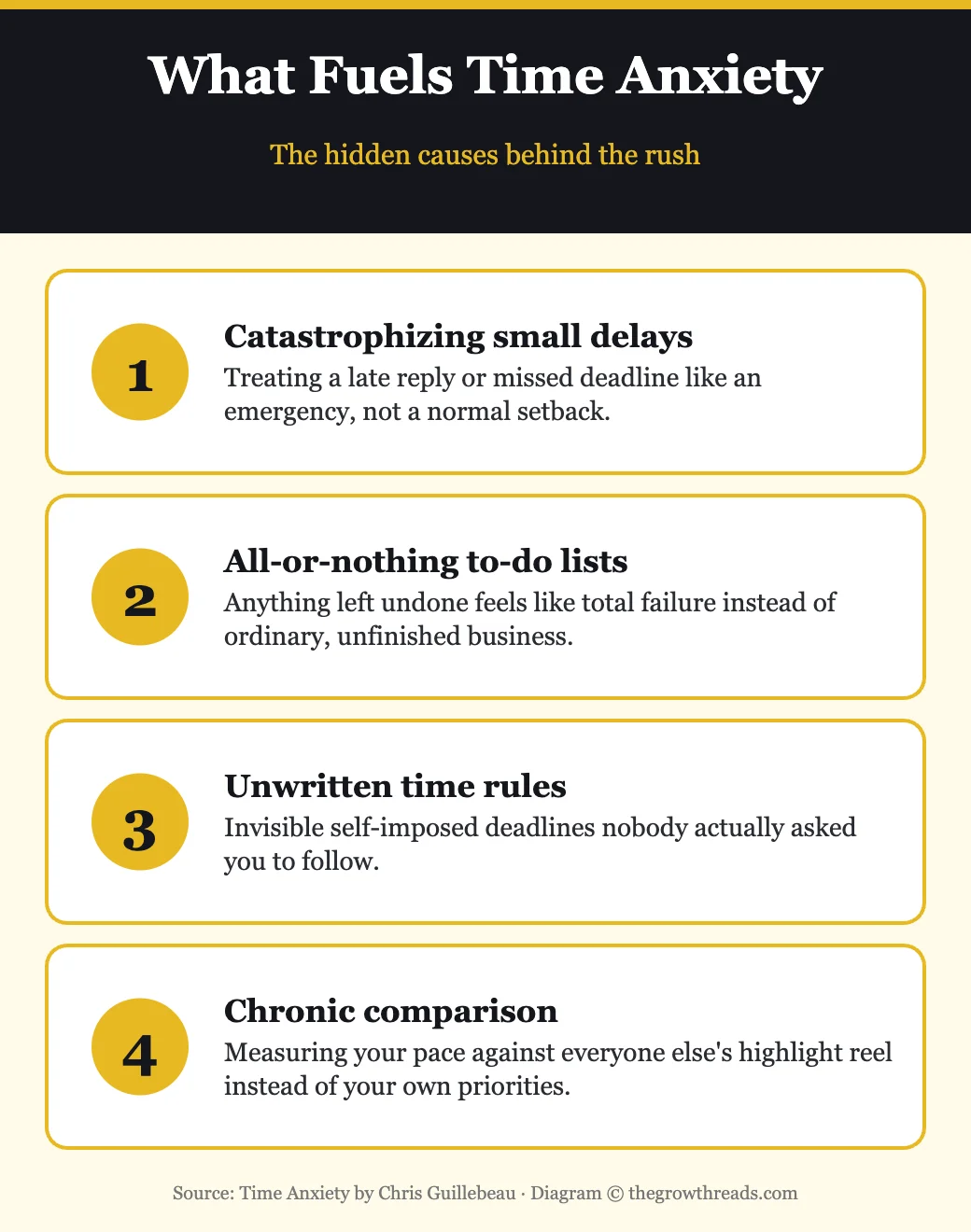
A significant portion of the book catalogs the specific thinking patterns that convert ordinary incompleteness into felt emergency. Catastrophizing is the most common — treating a late reply, a missed workout, or an unfinished report as a serious problem rather than a normal, recoverable setback. All-or-nothing thinking compounds it: a to-do list with nine items finished and one left undone gets experienced as a failure, not as ninety percent complete. Guillebeau also identifies chronic comparison as a driver — measuring your own pace against other people’s visible output, usually their best moments, rather than against your own actual priorities and constraints.
Perhaps the most useful of these distortions to name is the unwritten time rule — a self-imposed standard, like replying to every email within an hour or finishing every task the day it’s assigned, that was never actually required by anyone but feels as binding as a real deadline. These rules accumulate over years, often inherited from a specific job, boss, or period of life where they briefly made sense, and they persist long after the original justification has expired. Because they’re unwritten, most people never examine them directly — they just feel the pressure the rule creates without recognizing the rule as a choice rather than a law.
Naming these distortions is the necessary first step, but Guillebeau is careful to note that naming alone rarely dissolves them, because they’re maintained by a nervous-system stress response as much as by conscious belief. That’s why the book pairs cognitive work with somatic tools rather than relying on insight alone.
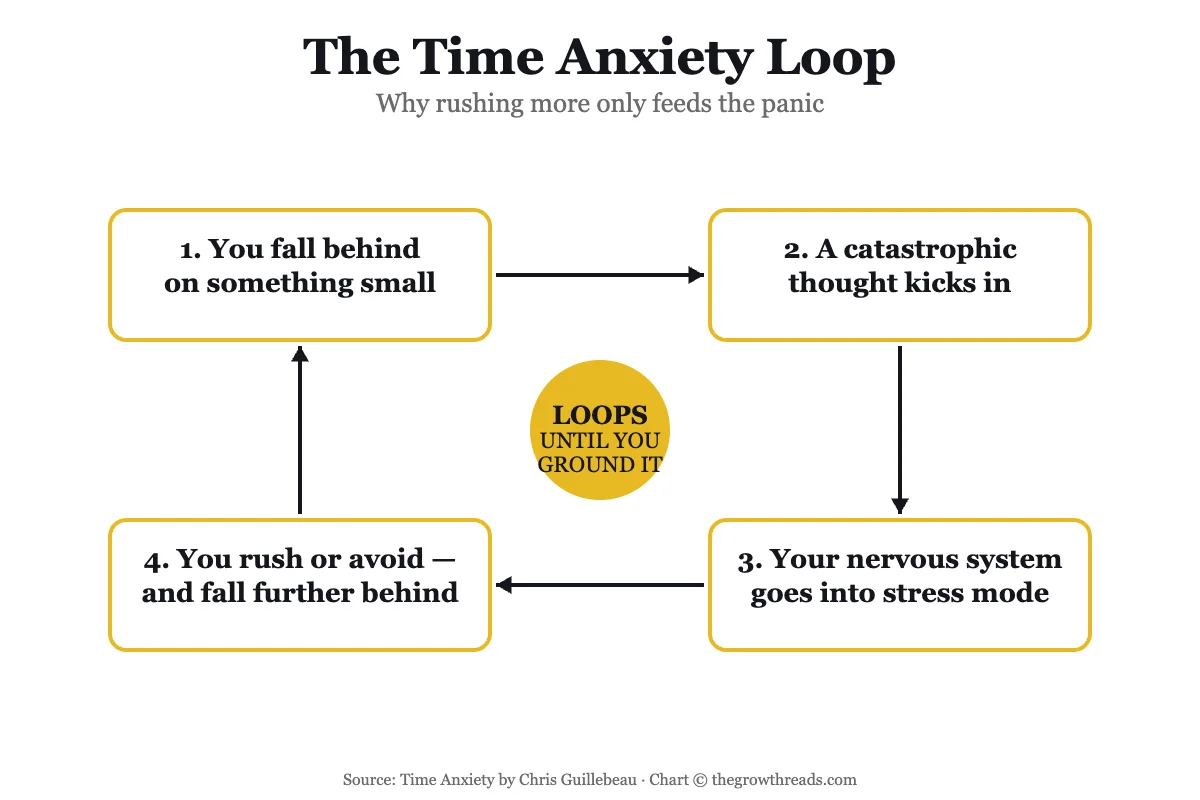
Guillebeau also notes that these distortions rarely operate in isolation — a single missed deadline can trigger catastrophizing, which activates all-or-nothing thinking about the rest of the day’s list, which then feeds comparison with how “together” other people appear to be handling similar pressures. The compounding is part of what makes time anxiety feel so disproportionate to any single trigger: by the time the stress response peaks, several distortions have usually stacked on top of each other, each amplifying the last.
TGR Note: The all-or-nothing distortion Guillebeau describes is close cousin to the perfectionism Oliver Burkeman addresses in Meditations for Mortals — both books arrive at “good enough” as the practical antidote, from different starting disciplines.
Part 3: Regulating the nervous system before managing the calendar
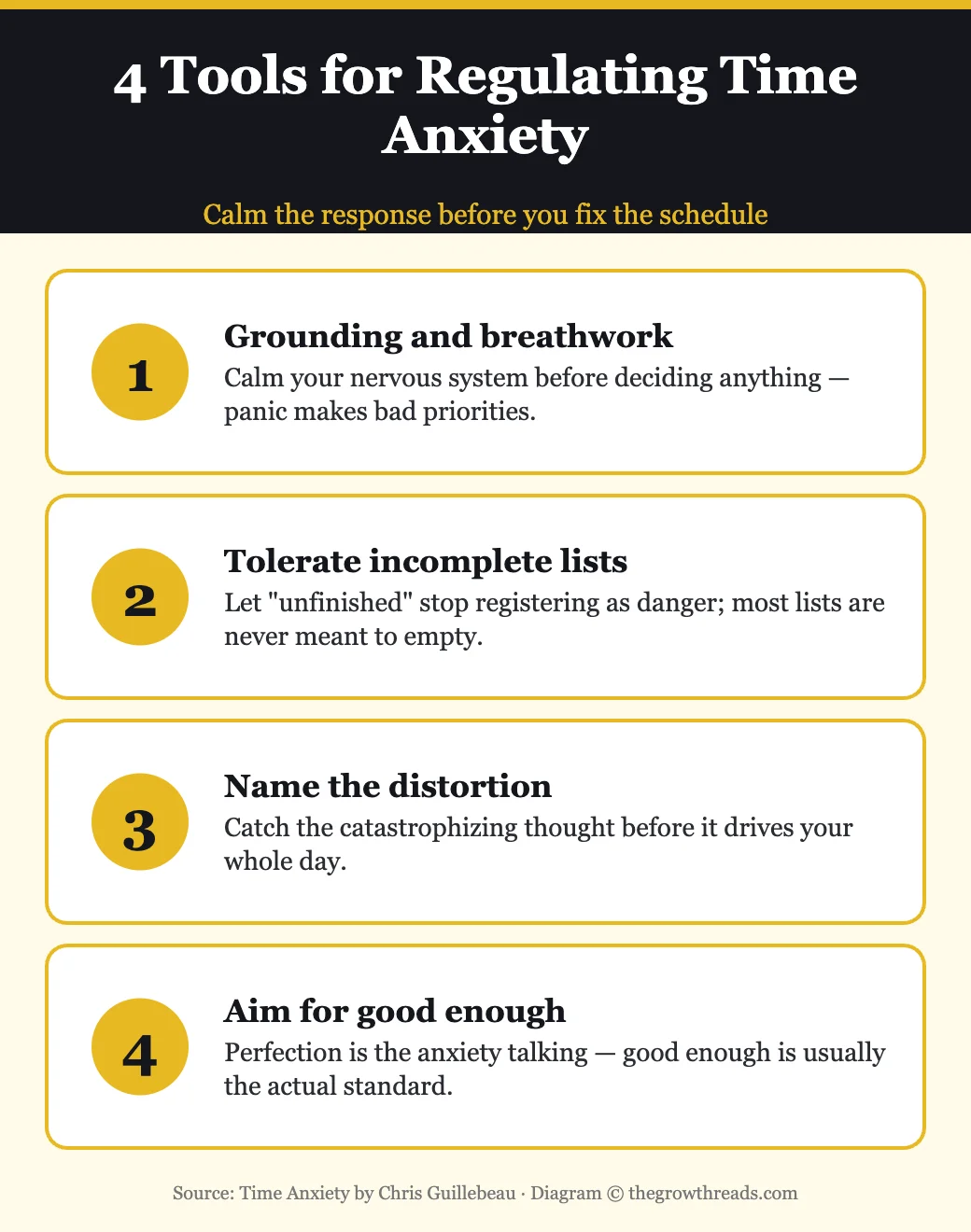
Guillebeau’s most distinctive contribution is insisting that stress regulation has to come before scheduling advice, not after it. If a cognitive distortion has already triggered a stress response, trying to reason your way to a calmer, more rational to-do list rarely works, because the nervous system is running the show at that point, not the analytical brain. His practical tools here draw on grounding techniques and breathwork — simple, repeatable exercises meant to lower physiological stress enough that clearer thinking becomes possible again, before any decision about priorities gets made.
This ordering matters more than it might sound. A person in an activated stress state tends to default to whatever feels most urgent in the moment, which is frequently not the same as what’s actually most important — urgency and importance get confused precisely because stress narrows attention onto immediate threats. By addressing the physiological layer first, Guillebeau’s approach creates the conditions for someone to actually evaluate trade-offs clearly, rather than reactively working through tasks in whatever order feels most alarming.
The other major tool in this section is building tolerance for incompleteness directly — treating an unfinished to-do list not as a problem to solve but as the normal, permanent state of having more possible tasks than time. Guillebeau frames “catching up” as a goal that structurally can’t be reached, since new tasks arrive continuously, and argues that chasing it guarantees perpetual anxiety regardless of how much gets done. The alternative isn’t giving up on tasks getting done — it’s giving up on the specific, unreachable target of an empty list.
Guillebeau is careful to frame these tools as regulation, not avoidance — the goal isn’t to stop caring about deadlines or become indifferent to real obligations, but to interrupt the automatic stress response long enough for a more accurate assessment to happen. He compares it to the difference between a smoke detector that goes off for every trace of steam and one calibrated to distinguish steam from an actual fire: both detect something, but only one produces useful information. Nervous system regulation, in his framing, is how you recalibrate the detector rather than just learning to live with constant false alarms.
Part 4: Rewriting your unwritten time rules
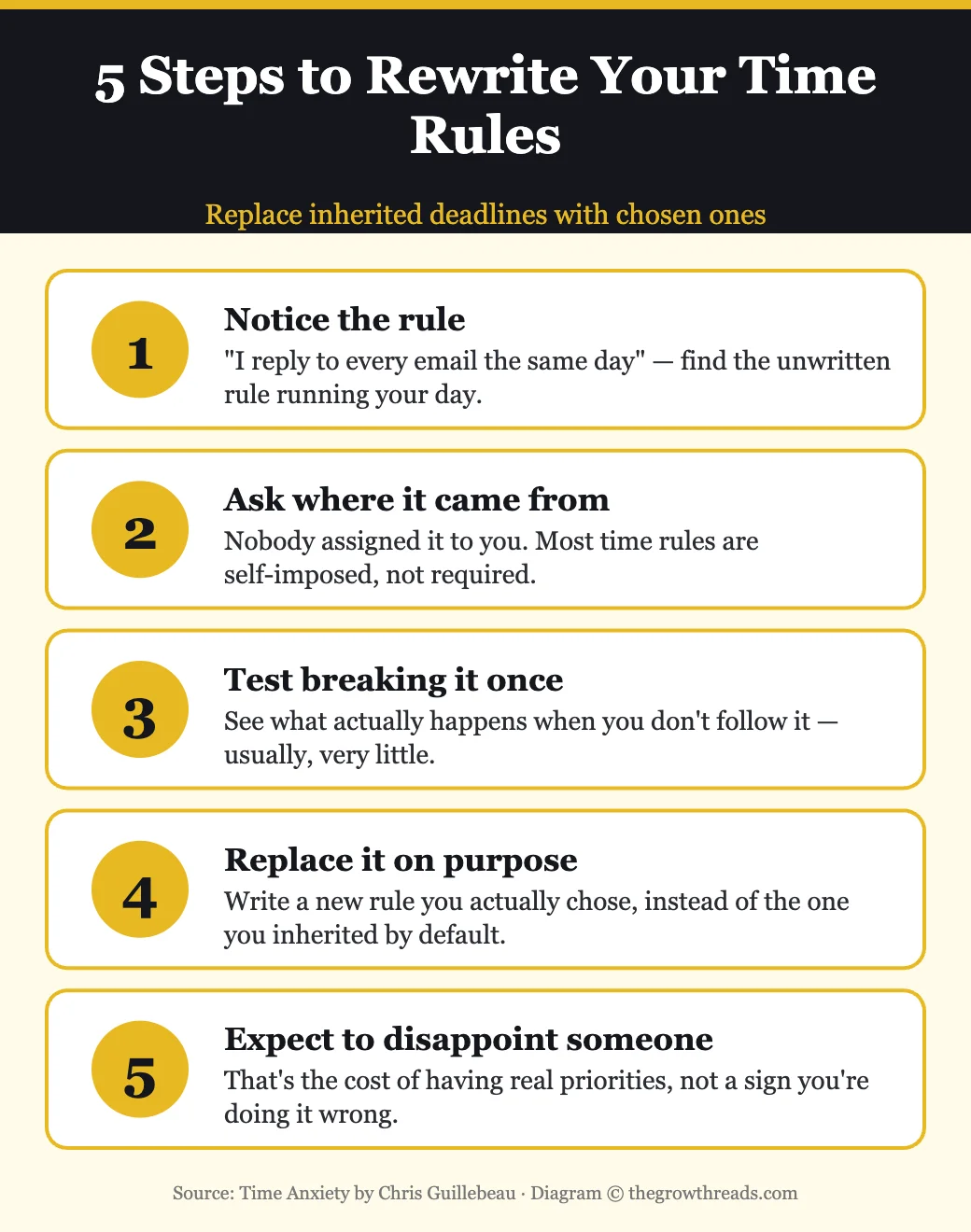
The book’s final practical section turns the unwritten time rules identified in Part 2 into something actionable: a process for finding, testing, and deliberately replacing them. Guillebeau’s method starts with simply noticing a rule in operation — catching the moment a task feels urgent and asking where that urgency actually comes from, rather than assuming it’s self-evident. Often the honest answer is that the rule was inherited from a specific past context — a demanding manager, an early career habit, a family expectation — that no longer applies, if it ever genuinely required what it seemed to.
The next step is deliberately testing the rule by breaking it once, in a low-stakes way, and observing what actually happens. Guillebeau’s argument is that most unwritten time rules turn out to matter far less than the anxiety attached to them suggests — the same-day reply that doesn’t arrive rarely causes the catastrophe the anxious mind predicted. This is less about permanently abandoning standards and more about recalibrating which standards are actually load-bearing versus which are just habitual.
From there, the book moves into weighing trade-offs explicitly — recognizing that finite time and energy have to be allocated across competing values rather than stretched to cover all of them, and that choosing where to invest necessarily means under-investing somewhere else. Guillebeau is direct about the emotional cost of this: operating from real priorities means disappointing someone, sometimes regularly, and he treats that as an acceptable and even necessary price of living intentionally rather than a failure to be avoided.
TGR Note: The willingness to disappoint someone on purpose echoes a theme in Do It Today, where Darius Foroux treats avoidance itself — not laziness — as the real driver of procrastination. Both authors land on the same practical move: acting despite discomfort, rather than waiting to feel ready.
Who is Time Anxiety best for — and who should read something else first?
This book is best for people whose stress about time doesn’t track their actual workload — the ones who feel behind even during genuinely light weeks, or who notice the panic returning almost immediately after a productive burst resolves it temporarily. It’s especially useful for readers who’ve already tried conventional time-management systems and found the anxiety persisted regardless of how organized they became, since that’s the exact gap this book is built to address.
If your problem is more structural overcommitment than anxious perception — you genuinely have too many real obligations, not just too much guilt about normal ones — Margin offers a more diagnostic framework for auditing where your actual reserves are thin. If perfectionism specifically, rather than time pressure generally, is your main obstacle, Meditations for Mortals covers similar ground with a philosophical rather than clinical lens.
Readers should also know the book leans practical rather than academic — Guillebeau writes in short, example-driven chapters rather than dense literature reviews, which makes it easy to read in short bursts even for someone who currently feels too time-pressed to sit with a longer, denser book. That accessibility is arguably part of the point: a book about time anxiety that demanded hours of uninterrupted focus to get through would be working against its own argument.
Questions to reflect on
- Where does your felt sense of being behind not match your actual workload — and what might that gap be telling you?
- What unwritten time rule are you currently following that you never consciously chose?
- What would happen, specifically, if you broke one of your self-imposed deadlines this week?
- Whose disappointment are you currently avoiding at the cost of your own real priorities?
- Where would “good enough” actually be enough, if you let it be?
🔥 Ready to break the time anxiety loop?
Get the book that treats time scarcity as a mindset to regulate, not just a schedule to optimize.
How to apply Time Anxiety (7-day plan)
- Day 1 — Track the gap. Notice one moment your felt urgency didn’t match the actual stakes of a task, and write down what triggered the feeling.
- Day 2 — Name a distortion. Catch yourself catastrophizing or thinking all-or-nothing about your to-do list, and name the pattern out loud.
- Day 3 — Try grounding before deciding. The next time you feel rushed, pause for two minutes of breathwork before choosing what to do next.
- Day 4 — Identify one unwritten rule. Find a self-imposed deadline or standard you’ve never actually examined, and ask where it came from.
- Day 5 — Break that rule once. Deliberately don’t follow it, in a low-stakes way, and notice what actually happens.
- Day 6 — Let a list stay unfinished. End the day with tasks still open on purpose, and practice tolerating it without extending your hours to compensate.
- Day 7 — Choose a trade-off on purpose. Pick one priority to invest in fully this week, and consciously accept what gets less of your time as a result.
Frequently asked questions
What is time anxiety, according to Chris Guillebeau?
Time anxiety is the felt sense of falling behind or running out of time, which Guillebeau argues often exists independently of a person’s actual workload. It stems from cognitive distortions — like catastrophizing small delays or all-or-nothing thinking about to-do lists — combined with unwritten, self-imposed time rules that create pressure nobody actually required. The book treats it as a psychological pattern to regulate, not primarily a scheduling problem to solve with more efficient systems.
How is Time Anxiety different from typical time management books?
Most time management books assume the problem is an inefficient schedule and offer systems to organize tasks better. Guillebeau starts from a different premise: that the anxious feeling of falling behind often persists at the same intensity regardless of how efficient someone becomes, because efficiency doesn’t address the underlying cognitive distortions and nervous-system stress response. The book pairs psychological tools — grounding, breathwork, naming distortions — with practical steps for rewriting unwritten time rules.
What are “unwritten time rules”?
Unwritten time rules are self-imposed standards — like replying to every email within an hour, or finishing every task the day it’s assigned — that a person follows as though they were required, even though no one actually imposed them. They’re often inherited from a specific past context, such as a demanding job or an early career habit, and persist long after that context has changed. Guillebeau’s process involves noticing these rules, testing them by breaking one deliberately, and replacing them with rules chosen on purpose.
Does the book offer practical exercises, or is it mostly theory?
Both, though it leans practical. Guillebeau explains the research behind time perception and cognitive distortions, but the bulk of the book is organized around specific tools: grounding and breathwork techniques for regulating stress, methods for identifying and testing unwritten time rules, and frameworks for weighing trade-offs between competing priorities. The goal throughout is building tolerance for incompleteness rather than achieving a permanently caught-up state.
Is Time Anxiety useful if my workload is genuinely heavy, not just anxiety-driven?
Some of it will still help — the tools for regulating stress and rewriting unwritten rules apply regardless of how heavy your actual workload is. But if your core problem is structural overcommitment rather than a mismatch between perceived and actual urgency, a more diagnostic book like Margin, which audits emotional, physical, financial, and time reserves directly, may address your specific situation more completely.
What does Guillebeau mean by “good enough”?
“Good enough” is Guillebeau’s alternative standard to perfectionism — the idea that most tasks have an adequate completion point well short of flawless, and that pushing past it usually serves anxiety rather than the actual purpose of the task. He treats the drive toward perfection as frequently a symptom of time anxiety itself, not a genuine external requirement, and argues that recognizing “good enough” as the real bar frees up significant time and mental energy.
What should I read after Time Anxiety?
If your overload is more structural than psychological, Margin offers a diagnostic framework for auditing which reserves are actually running low. If perfectionism specifically is your obstacle, Meditations for Mortals covers similar ground through a philosophical lens. And if procrastination is your main symptom, Do It Today tackles the avoidance pattern directly.
Related summaries
- Margin by Richard Swenson — a diagnostic framework for restoring reserve capacity.
- Meditations for Mortals by Oliver Burkeman — a philosophy of imperfectionism and good enough.
- Do It Today by Darius Foroux — a tactical approach to beating procrastination.
- More Time Management book summaries
How we analyze books: every TGR summary is built from a full reading of the book, cross-referenced against the author’s other published work and independent research where relevant, then structured around the practical decisions a reader actually needs to make. We never critique an author’s ideas in a summary — our job is to help you decide whether and how to apply them. Read our full methodology.
Related Time Management Summaries
Hell Yeah or No Summary & Review: Say No to Almost Everything
Procrastinate on Purpose Summary & Review: The Focus Funnel for Multiplying Your Time
Solving the Procrastination Puzzle Summary & Review: Why Delay Is an Emotion Problem
The Time Trap Summary & Review: The Classic Guide to Self-Generated vs. Environmental Time Wasters
Your Brain at Work Summary & Review: Work With Your Brain, Not Against It