

★★★★★ 4.6/5 — A physician’s field guide to the modern epidemic of overload, first published in 1992 and still strikingly current.
Best for: Anyone who feels perpetually behind, overcommitted, or one bad week away from burnout.
Reading time: ~6 hours (roughly 240 pages)
Difficulty to apply: Moderate — the ideas are simple, but living them means saying no to things you currently say yes to.
Margin in one minute
You don’t have a time-management problem. You have a margin problem. Richard Swenson, a physician who spent years watching overload show up in his patients before it showed up in the research, argues that most of what we call stress isn’t caused by any single crisis — it’s caused by living with zero reserve capacity, so that any crisis, however small, tips us into overload. Margin is what’s left over: the space between your load (everything demanding your energy, time, money, and attention) and your limits (what you’re actually able to carry). When margin shrinks to nothing, you’re not just busy — you’re marginless, and marginless living is fragile by design. The book’s core claim is that progress, for all its genuine gains, has been quietly consuming the very reserves it was supposed to free up, and that restoring margin is less about doing more efficiently and more about deliberately doing less.
Key takeaways
- Margin is a gap, not a feeling: it’s the measurable space between your load and your limits — and like any gap, it can be calculated, protected, or spent.
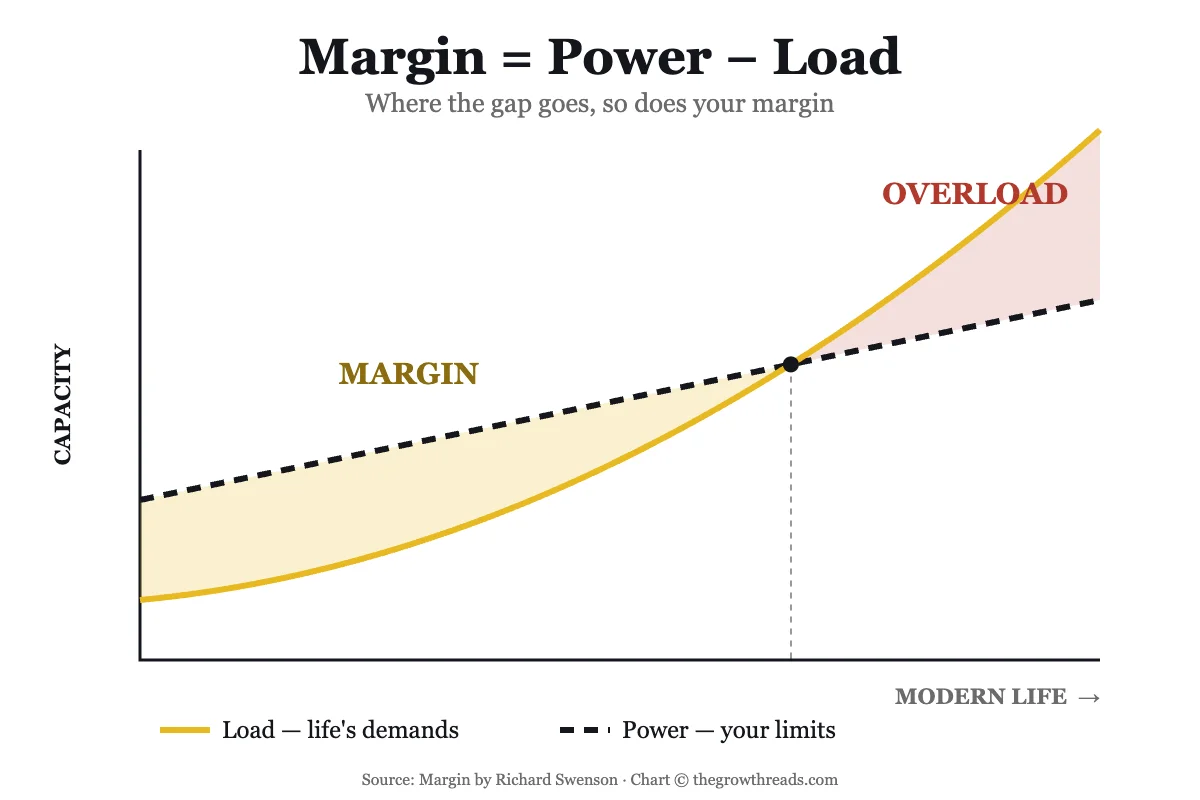
- The formula is Power minus Load: your capacity (power) minus your commitments (load) equals your margin; overload happens the moment load exceeds power.
- Progress raises both sides of the equation: technology and convenience increase your power, but they increase load faster, which is why “labor-saving” devices haven’t given anyone more free time.
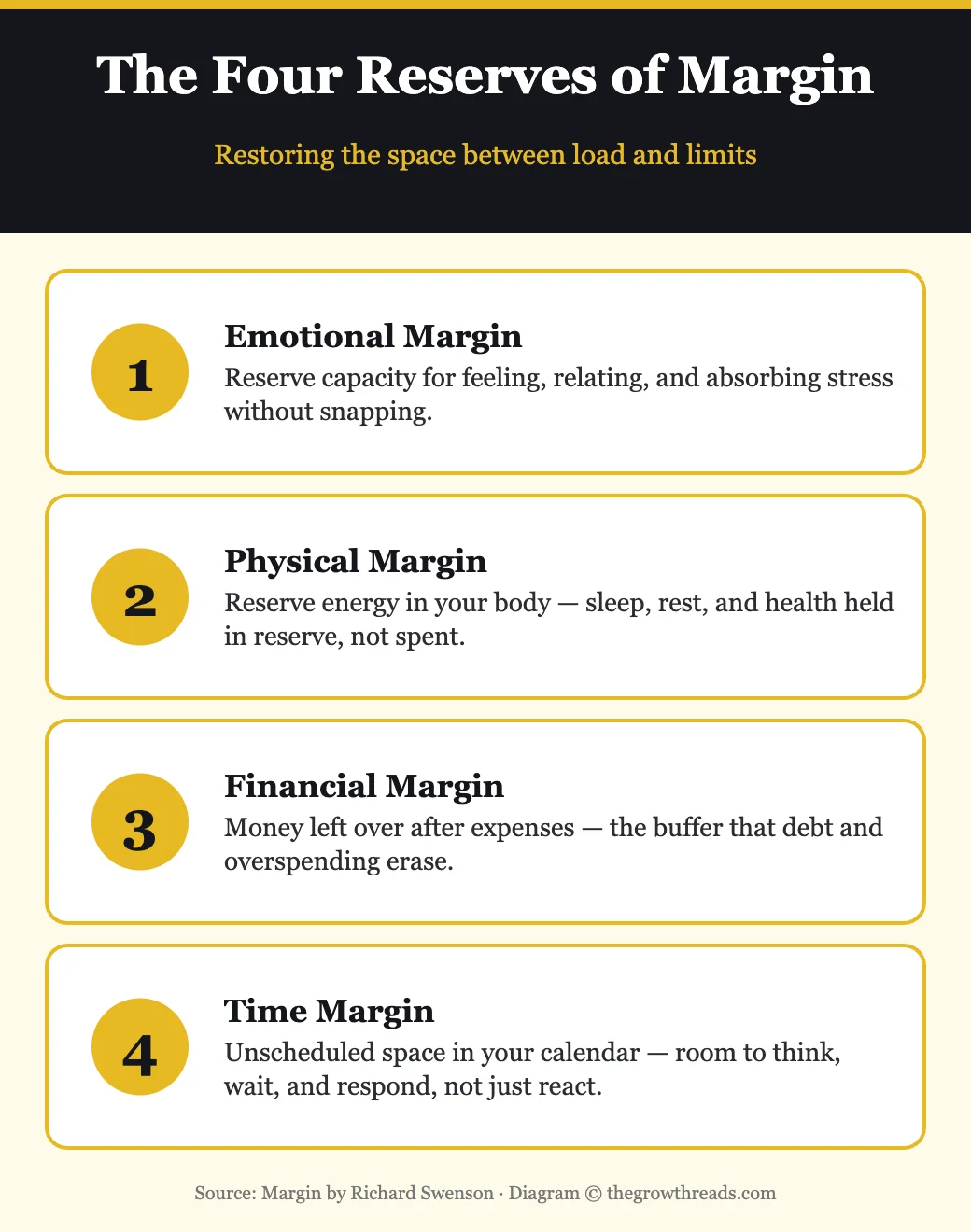
- There are four separate reserves: emotional, physical, financial, and time margin each run on their own account, and a surplus in one doesn’t cover a deficit in another.
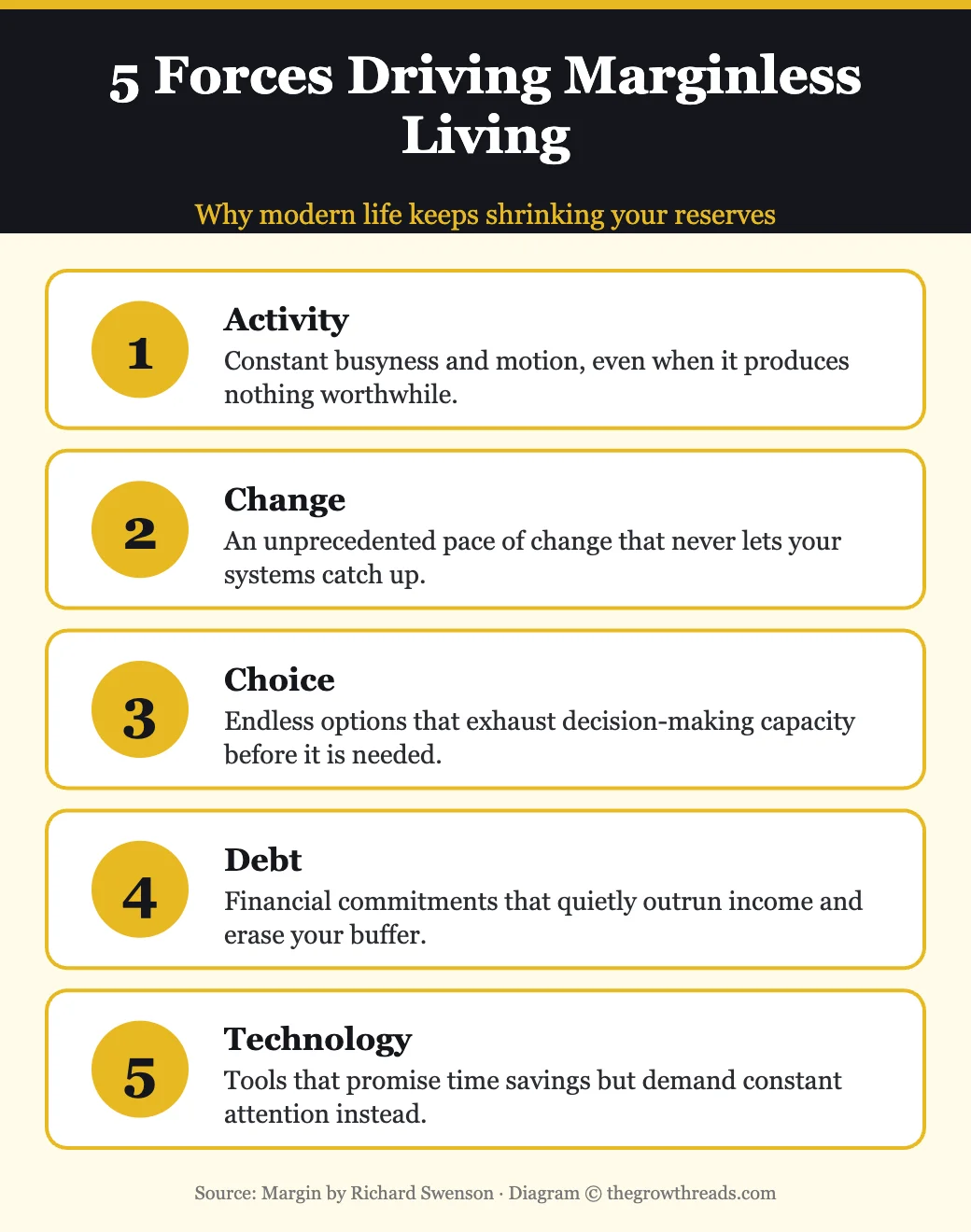
- Marginless living has identifiable causes: Swenson names specific overload factors — activity, change, choice, debt, technology, and more — that erode reserve capacity one commitment at a time.
- Contentment is trainable: the drive to acquire, achieve, and keep up is a habit of mind, not a fixed personality trait, and it responds to deliberate practice.
- Simplicity restores margin faster than optimization: cutting commitments creates more breathing room than doing the same commitments more efficiently.
- Rest is a prescription, not a reward: Swenson treats regular, deliberate rest as a medical necessity, not something you earn after everything else is done.
- Debt is margin borrowed from your future self: financial margin works the same way as time margin — every commitment against future income is a future reserve already spent.
- Margin is built by subtraction, not addition: you don’t find margin by managing your existing load better; you find it by carrying less load in the first place.

What is Margin about?
Margin is a book about restoring reserve capacity — emotional, physical, financial, and time — that modern life’s pace and complexity have quietly eliminated. Physician Richard Swenson argues overload isn’t a personal failing but a structural byproduct of progress, and offers practical, research-grounded prescriptions for rebuilding buffer into an overloaded life.
About the author
Richard A. Swenson, M.D. spent years in family medicine before stepping back from full-time clinical practice to study the relationship between progress and human well-being — a shift prompted by watching the same pattern show up in exam room after exam room: patients whose symptoms traced back not to any single diagnosis but to lives with no reserve left to absorb ordinary stress. He later taught preventive medicine at the University of Wisconsin and built a body of work — including The Overload Syndrome, A Minute of Margin, and Hurtling Toward Oblivion — that applies a physician’s diagnostic instincts to the pace of contemporary life. Margin, first published in 1992 and still in print in multiple editions, remains his best-known work and the one where his central idea — that overload has an anatomy, and margin is its antidote — is laid out most fully. Explore all Richard Swenson book summaries →
Key concepts at a glance
| Concept | What it means | Use it when |
|---|---|---|
| Margin | The space between your load and your limits — your reserve capacity | You want a concrete way to measure how “full” your life actually is |
| Load | Everything currently demanding your time, energy, money, or attention | You’re trying to see why you feel overwhelmed despite “managing fine” |
| Power (limits) | Your actual capacity to absorb demands — physical, mental, financial, relational | You’re deciding whether to take on one more commitment |
| Marginless living | The state of load meeting or exceeding limits, with no reserve left | You notice you’re one small setback away from feeling like everything is falling apart |
| The four reserves | Emotional, physical, financial, and time margin — tracked separately | You want to diagnose which specific reserve is actually running out |
| The Progress Paradox | Progress increases both power and load, but load grows faster | You’re wondering why modern conveniences haven’t made life feel easier |
| Subtraction over optimization | Restoring margin by removing commitments, not managing them more efficiently | You’ve tried productivity systems and still feel maxed out |
Part 1: The Progress Paradox — why more hasn’t made life easier
Swenson opens with an observation that sounds almost too simple to matter: in every prior era, humans lived close to their limits because their power was low — subsistence, disease, and scarcity kept load in check by keeping options in check. Progress changed that equation on both sides at once. Medicine, technology, and economic growth genuinely increased human power: we can travel farther, communicate faster, treat illnesses that used to be fatal, and produce more with less physical labor than any generation before us. If power were the whole story, margin should be at an all-time high.
It isn’t, because load rose even faster. Every increase in power created new possibilities, and humans — individually and collectively — filled those possibilities with new load almost as fast as they appeared. Faster communication didn’t reduce correspondence; it multiplied it, because now everyone expects a same-day reply instead of a same-month one. Cheaper travel didn’t reduce commitments; it added more distant ones. Labor-saving devices didn’t create free afternoons; they raised the baseline of what a “productive” day looks like. Swenson calls this the Progress Paradox: the same force that hands you more capacity also hands you, on average, even more demand for that capacity — so margin doesn’t grow with progress. It shrinks.
This matters because it reframes overload as structural rather than personal. If margin were simply a matter of discipline or time management, the people struggling most with overload would be the least organized among us. In practice, it’s often the opposite — the most capable, most conscientious people are the ones with the least margin, precisely because their competence lets them absorb more load before symptoms appear. Swenson’s point isn’t that effort or organization don’t matter. It’s that no amount of either one can substitute for actually having reserve capacity, and reserve capacity has to be built on purpose, because nothing about modern life builds it automatically.
TGR Note: This diagnosis pairs well with Ashley Whillans’ research in Time Smart, which measures the same shortage — what she calls “time poverty” — using survey data rather than clinical observation. Swenson explains why the gap exists; Whillans shows how to buy it back one decision at a time.
Part 2: Marginless living — the forces draining your reserves
Swenson spends a significant portion of the book cataloging the specific factors that erode margin, and the list is longer than most readers expect — activity, change, choice, commitments, competition, debt, decisions, education, expectations, fatigue, hurry, information, media, mobility, obligations, pace, people, pollution, possessions, problems, technology, traffic, and work all make his list of contributors to marginless living. The point of the long list isn’t to overwhelm the reader with problems; it’s to make a specific argument — overload rarely comes from one dramatic source. It accumulates from dozens of small, individually reasonable additions, none of which felt like “too much” when you said yes to it.
Five of these factors do most of the damage, and they’re worth examining directly. Activity is the most visible: modern life prizes visible busyness as a proxy for worth, so people fill unstructured time with activity even when it produces nothing they’ll remember or value. Change compounds the problem — not change itself, but its pace, which has accelerated to the point that systems (personal, family, organizational) rarely finish adapting to one shift before the next one arrives. Choice, counterintuitively, is a load factor rather than a relief: every option you’re offered costs decision-making capacity whether or not you take it, which is why a grocery store with forty cereal options is more exhausting to shop than one with four. Debt quietly converts future income into present load, obligating tomorrow’s margin to pay for today’s spending. And technology, despite its promise of efficiency, has proven to be a net load-adder for most people — it doesn’t just complete tasks faster, it generates new tasks (notifications, updates, expectations of constant availability) that didn’t exist before the tool did.
None of these factors is inherently bad — Swenson isn’t arguing for a return to a pre-technological, pre-choice existence. His argument is narrower and more useful: each of these factors has a marginal cost that’s easy to underestimate in the moment, and the cumulative effect of underestimating dozens of small costs is a life with no reserve left for the ordinary emergencies — a sick kid, a car repair, a hard week at work — that used to be absorbable and now aren’t.
TGR Note: Swenson’s point about choice-as-load echoes what Darius Foroux argues in Do It Today — that decision fatigue, not laziness, is often the real reason a task doesn’t get done. Reducing your options is frequently a bigger productivity lever than reducing your task list.
Part 3: The four reserves — emotional, physical, financial, and time margin
The book’s most practically useful contribution is treating margin as four separate accounts rather than one undifferentiated sense of “being busy.” Emotional margin is your reserve capacity to feel, relate, and absorb stress without snapping at the people closest to you; when it runs out, the symptoms show up as irritability, a shortened fuse, or a flattened capacity for empathy — not because you stopped caring, but because caring itself costs a resource you no longer have spare. Physical margin is straightforward reserve energy — sleep, rest, and general health held in reserve rather than spent; chronic physical marginlessness looks less like acute illness and more like a baseline of fatigue that never fully resolves, because there’s never enough slack to actually recover.
Financial margin is the money left over after necessary expenses — not wealth, just buffer. Swenson treats financial margin as functionally similar to time margin: every dollar committed to debt service or lifestyle inflation is a dollar of future flexibility already spent, the same way every hour committed to a standing obligation is an hour of future flexibility already spent. And time margin — unscheduled space in your calendar — is the reserve most readers reach for the book to fix, but Swenson is careful to note it’s often a symptom of the other three rather than the root cause; people overschedule their time in part because their emotional or financial margin is already so thin that they’re using activity to avoid sitting with the discomfort underneath.
The reason the four-reserve framing matters practically is that it explains why generic advice like “just relax” or “just budget better” so often fails — it addresses one account while three others stay overdrawn. Someone who takes a vacation (time margin) while still carrying unsustainable debt (financial margin) hasn’t actually restored margin; they’ve just borrowed against a different account to temporarily patch the visible symptom. Real restoration, in Swenson’s framework, means auditing all four reserves honestly and addressing the one that’s actually driving the others down.
Part 4: The prescription — practical ways to restore margin
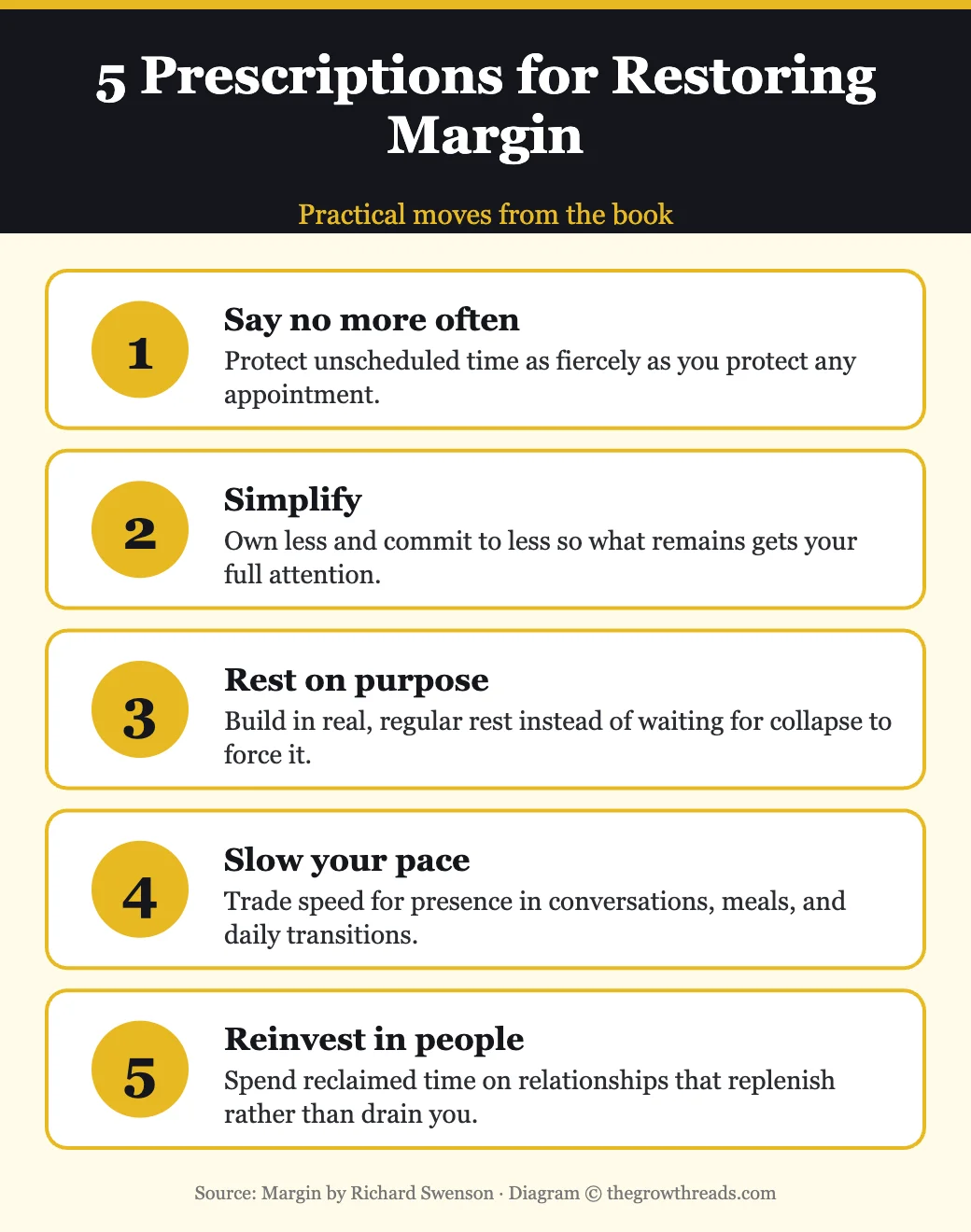
Swenson resists the idea that restoring margin requires escaping modern life altogether, and instead offers what he frames as prescriptions — deliberate, repeatable practices rather than one-time fixes. The first and most load-bearing is learning to say no more often, and specifically to say no to good things, not just bad ones. Most overload doesn’t come from saying yes to obviously bad commitments; it comes from saying yes to a long series of individually reasonable, individually good opportunities that collectively exceed capacity. Protecting unscheduled time, in his framing, requires treating “no plans” as a legitimate calendar entry worth defending as fiercely as any appointment.
Simplicity is the second prescription, and Swenson distinguishes it clearly from minimalism-as-aesthetic — the goal isn’t fewer possessions for their own sake, but fewer commitments, obligations, and maintenance burdens so that what remains gets your full attention rather than a divided fraction of it. Rest is the third, and here Swenson is most emphatic: he treats regular, deliberate rest — not collapse-driven rest, but scheduled rest taken before exhaustion forces it — as closer to a medical necessity than a lifestyle preference, drawing an explicit parallel to the biblical Sabbath principle of rest as a rhythm built into the structure of a healthy life, not an occasional indulgence.
The fourth prescription is slowing your actual pace — not just freeing up hours, but changing how you move through the hours you have, trading speed for presence in conversations, meals, and the small transitions between tasks that most people rush through unconsciously. And the fifth is reinvesting reclaimed capacity in relationships rather than more activity — Swenson’s argument is that people who successfully create margin and then immediately fill it with more scheduled activity haven’t actually solved the underlying problem, because the goal was never an empty calendar for its own sake. It was capacity for the relationships and reflection that a marginless life crowds out.
TGR Note: Swenson’s “say no to good things” prescription is a close cousin of the weekly-capacity thinking in Getting Results the Agile Way, where J.D. Meier frames a fixed weekly capacity as the boundary that makes prioritization actually work, rather than an infinite to-do list you’re perpetually behind on.
Who is Margin best for — and who should read something else first?
Margin is best for people who feel chronically overcommitted but can’t point to a single obvious cause — the accumulation, not any one decision, is the problem. It’s especially useful for high-capacity, conscientious people who tend to absorb more load precisely because they’re competent enough to handle it, right up until they aren’t. Readers drawn to a diagnostic, “why does this keep happening” framing will get more out of it than readers who just want a scheduling system.
If you already understand that you’re overloaded and want a concrete weekly system for cutting your task list down to size, Getting Results the Agile Way is a faster, more tactical starting point. If your specific struggle is procrastination rather than overcommitment, Do It Today addresses that more directly. And if you want the research-backed case for why time itself, not just tasks, deserves to be budgeted like money, Time Smart is the better entry point.
Questions to reflect on
- Which of the four reserves — emotional, physical, financial, or time — is actually the most overdrawn in your life right now, even if it’s not the one that feels most visible?
- What is the last “good opportunity” you said yes to that you now wish you’d declined, and what made it hard to say no in the moment?
- Where in your life have you tried to fix a margin problem with more efficiency instead of less commitment?
- If you added up every small source of load in your week — not just the big obligations — what would surprise you about the total?
- What would you do with reclaimed time or energy if you’re honest that “more activity” isn’t actually the goal?
🔥 Ready to restore your margin?
Get the book that names the problem most productivity advice never quite addresses.
How to apply Margin (7-day plan)
- Day 1 — Audit your four reserves. Rate your emotional, physical, financial, and time margin from 1-10. Identify which one is lowest; that’s your priority, not the one that feels most urgent.
- Day 2 — Track your load factors. Write down every activity, choice, and obligation competing for your attention today, including small ones. Notice how many you’d never have listed if asked from memory.
- Day 3 — Decline one good thing. Find one reasonable, legitimately good opportunity or request and say no to it, specifically to practice declining things that aren’t bad ideas.
- Day 4 — Protect two hours of unscheduled time. Block it on your calendar like an appointment and defend it from anything that isn’t a genuine emergency.
- Day 5 — Cut one recurring commitment. Choose something you keep doing out of habit or guilt rather than value, and remove it rather than trying to do it more efficiently.
- Day 6 — Take deliberate rest. Schedule a block of rest before you feel like you need it, not after exhaustion forces it, and protect it the same way you’d protect a meeting.
- Day 7 — Reinvest, don’t refill. Notice any capacity you freed up this week, and spend it on a relationship or reflection rather than immediately scheduling something new into the gap.
Frequently asked questions
What is the main idea of Margin by Richard Swenson?
The main idea is that “margin” — the reserve space between your load and your limits — has been quietly eliminated by modern progress, and that most stress and burnout stem from marginless living rather than any single crisis. Swenson argues progress increases both your capacity and your commitments, but commitments grow faster, leaving less buffer over time. Restoring margin means deliberately subtracting load rather than managing it more efficiently, across four separate reserves: emotional, physical, financial, and time.
Is Margin a religious book?
Margin does draw on Swenson’s Christian faith, particularly in its discussion of rest and the biblical Sabbath principle, and some passages frame contentment and purpose in explicitly spiritual terms. That said, the core diagnostic framework — margin as the gap between load and limits, and the four-reserve model — is presented in practical, broadly applicable terms that readers of any background can use without engaging the faith-specific material.
How is Margin different from typical time management books?
Most time management books start from the assumption that your schedule is the problem and offer systems to organize tasks more efficiently. Margin starts further upstream, arguing that the deeper problem is a total absence of reserve capacity across emotional, physical, financial, and time domains — and that efficiency alone can’t fix a fundamentally overcommitted life. It’s a diagnostic book first and a tactical one second.
What are the four types of margin in the book?
Swenson identifies emotional margin (reserve capacity to feel and relate without being overwhelmed), physical margin (reserve energy and health), financial margin (money left over after expenses), and time margin (unscheduled space in your calendar). He treats these as four separate accounts — a surplus in one doesn’t compensate for a deficit in another, which is why generic advice to “just relax” often misses the actual shortage.
Does Margin offer practical steps, or is it mostly theory?
Both. The first half of the book is largely diagnostic — naming overload factors and explaining why progress hasn’t delivered more breathing room. The second half offers concrete prescriptions, including saying no more deliberately, simplifying commitments, scheduling rest before exhaustion forces it, slowing your pace, and reinvesting freed capacity into relationships rather than more activity.
Is Margin still relevant, since it was first published in 1992?
Notably so — reviewers and readers consistently note that the book’s diagnosis of overload predates smartphones and social media, yet describes their effects on daily life with unusual accuracy. The specific technologies have changed, but the underlying dynamic Swenson identifies — that added capacity gets filled with added load almost immediately — has, if anything, accelerated since the book’s original publication.
What should I read after Margin?
If you want a more tactical, weekly system for managing the load Margin diagnoses, Getting Results the Agile Way is a strong next step. If your overload shows up specifically as procrastination, Do It Today addresses that more directly, and Time Smart offers a research-backed framework for treating time itself as a budgeted resource.
Related summaries
- Time Smart by Ashley Whillans — a research-backed case for budgeting time like money.
- Do It Today by Darius Foroux — a tactical approach to beating procrastination.
- Getting Results the Agile Way by J.D. Meier — a weekly system for managing realistic capacity.
- More Time Management book summaries
How we analyze books: every TGR summary is built from a full reading of the book, cross-referenced against the author’s other published work and independent research where relevant, then structured around the practical decisions a reader actually needs to make. We never critique an author’s ideas in a summary — our job is to help you decide whether and how to apply them. Read our full methodology.
Related Time Management Summaries
Extreme Productivity Summary & Review: Judge Output, Not Hours
Meditations for Mortals Summary & Review: Why Your Limitations Are the Point
Stillness Is the Key Summary & Review: The Discipline Behind Clear Thinking
Time Anxiety Summary & Review: Ending the Illusion of Urgency
Your Brain at Work Summary & Review: Work With Your Brain, Not Against It