

★★★★☆ 4.3/5 — Time Smart is a research-backed playbook for treating time like the scarce, spendable resource it actually is — and for catching yourself the moment you trade it away for money you don’t need.
Best for: Busy professionals and high-earners who default to money-first decisions without noticing
Reading time: ~22 minutes (book: ~4 hours, 208 pages)
Difficulty to apply: Easy — most strategies take under 10 minutes to start
Time Smart in one minute
There’s an 80 percent chance you’re poor — time poor, that is. Harvard Business School professor Ashley Whillans opens with a simple, uncomfortable statistic: four out of five adults feel they have too much to do and not enough time to do it. That feeling isn’t a minor inconvenience. Whillans’s research finds that time stress produces a stronger negative effect on day-to-day happiness than unemployment does. People who feel time-poor laugh less, sleep worse, exercise less, and are more likely to divorce.
Time Smart argues that most of us got the trade-off backward. We were taught to protect money and spend time freely, when the science says the opposite pays off: people who prioritize time over money report higher life satisfaction, even controlling for income. The book is Whillans’s attempt to make “time affluence” as concrete and actionable as personal finance — with a diagnostic framework (the Six Time Traps), a strategic toolkit (the Five Strategies), and a metric for putting a dollar value on happiness itself.
Key takeaways
- Time poverty hurts more than income poverty: in Whillans’s studies, feeling chronically short on time predicts lower wellbeing more strongly than being unemployed.
- Money and time compete for the same decisions: every purchase, commute, and “yes” is really a trade between the two, whether you notice it or not.
- Technology turns free hours into “time confetti”: notifications shred unstructured time into fragments too small to actually enjoy.
- Busyness became a status symbol: humans shifted from flaunting leisure (the aristocratic ideal) to flaunting overwork, which makes time poverty feel aspirational instead of avoidable.
- “Happiness dollars” make time visible: Whillans’s research assigns a dollar-equivalent happiness value to time-saving choices, so the trade-off is no longer abstract.
- Outsourcing dreaded tasks reliably boosts happiness: across income levels — including women running vegetable stalls in Kenya — paying to remove disliked chores increased measured wellbeing.
- The Five Strategies are: find, fund, reframe, block, and say no — a full-cycle system for auditing, protecting, and reclaiming time.
- “Proactive time” is the highest-leverage category: time deliberately reserved for what’s important but not urgent — the first thing eaten by a busy calendar.
- Two archetypes drive most decisions: “Morgan” defaults to money, “Taylor” defaults to time — and the book is a manual for becoming more Taylor.
- Small, unglamorous shifts compound: Whillans is explicit that this isn’t about quitting your job or moving off-grid — it’s a mindset and habit shift inside the life you already have.
What is Time Smart about?
Time Smart is Harvard Business School professor Ashley Whillans’s research-backed guide to “time affluence” — the feeling of having enough time for what matters. It diagnoses six habits that create time poverty and prescribes five practical strategies, backed by original studies, for reclaiming hours and converting them into measurable happiness.
About the author
Ashley Whillans is an assistant professor at Harvard Business School and one of the leading voices in the emerging field of time and happiness research. She earned her BA, MA, and PhD in social psychology from the University of British Columbia before joining Harvard, where she studies how people navigate trade-offs between time and money. Her research has been conducted with an unusually wide range of populations — management consultants, married couples, members of the US military, and women managing vegetable stands in Kenya — and has appeared in the New York Times, the Washington Post, CNN, the BBC, the Atlantic, and the Economist. Time Smart, published by Harvard Business Review Press in 2020, was her debut book and was named one of Behavioral Scientist’s Notable Books of 2020 and one of the Globe & Mail’s Best Business Books of 2020. Explore all Ashley Whillans book summaries →
Key concepts at a glance
| Concept | What it means | Use it when |
|---|---|---|
| Time poverty | The chronic feeling of having too much to do and not enough time | You notice you’re always rushing, never catching up |
| Time affluence | The felt sense of having enough discretionary time | Setting a personal or family goal around free time, not just income |
| Time confetti | Free time shredded into unusable fragments by notifications and multitasking | Your evenings feel busy but you can’t say what you did |
| Happiness dollars (h$) | The income-equivalent value of the joy a time choice produces | Deciding whether a time-saving purchase or trade is “worth it” |
| The Six Time Traps | Habits — tech, money focus, undervaluing time, busyness-as-status, idleness aversion, overcommitting — that drain time | Diagnosing why you feel time-poor despite a “normal” schedule |
| The Five Strategies | Find, fund, reframe, block, and say no — the full toolkit for reclaiming time | Building a repeatable weekly system, not a one-off fix |
| Proactive time | Time blocked for what’s important but not urgent | Protecting deep work, exercise, or family time before the calendar fills up |
| Morgan vs. Taylor | Whillans’s two archetypes for money-first vs. time-first decision-making | Catching yourself mid-decision and asking “which one am I being right now?” |
Part 1: The Time Poverty Epidemic
Whillans opens by making the case that time poverty is a measurable, population-wide phenomenon — not a personal failing. Surveys across income brackets and countries consistently find the same four-in-five ratio: most adults feel they have too much on their plate. What makes the finding matter is the comparison Whillans draws to well-studied predictors of misery. In her data, the negative effect of feeling time-stressed on life satisfaction rivals — and in some models exceeds — the hit people take from losing a job.
The book’s central claim is that modern life systematically nudges people toward money-maximizing choices instead of time-protecting ones, even when the time-protecting choice is objectively the happier trade. Part of this is structural: pay raises and promotions are visible and comparable, while an extra 45 minutes of free time is not the kind of thing you can put on a resume or brag about at a reunion. Part of it is psychological: money feels finite and countable, so we manage it carefully, while time feels like it will always be there — until, on any given evening, it clearly isn’t.
Whillans backs this with her own field research, including a notable finding from women running vegetable stands in rural Kenya: even in a context with far less disposable income than the average American reader, paying a small amount to outsource a disliked task produced a measurable happiness gain. The implication is important — this isn’t a luxury-goods argument for the wealthy. Time affluence operates the same way across very different income levels, which is why the book treats it as a mindset shift available to nearly everyone, not a lifestyle only the rich can afford.
Part 2: The Six Time Traps
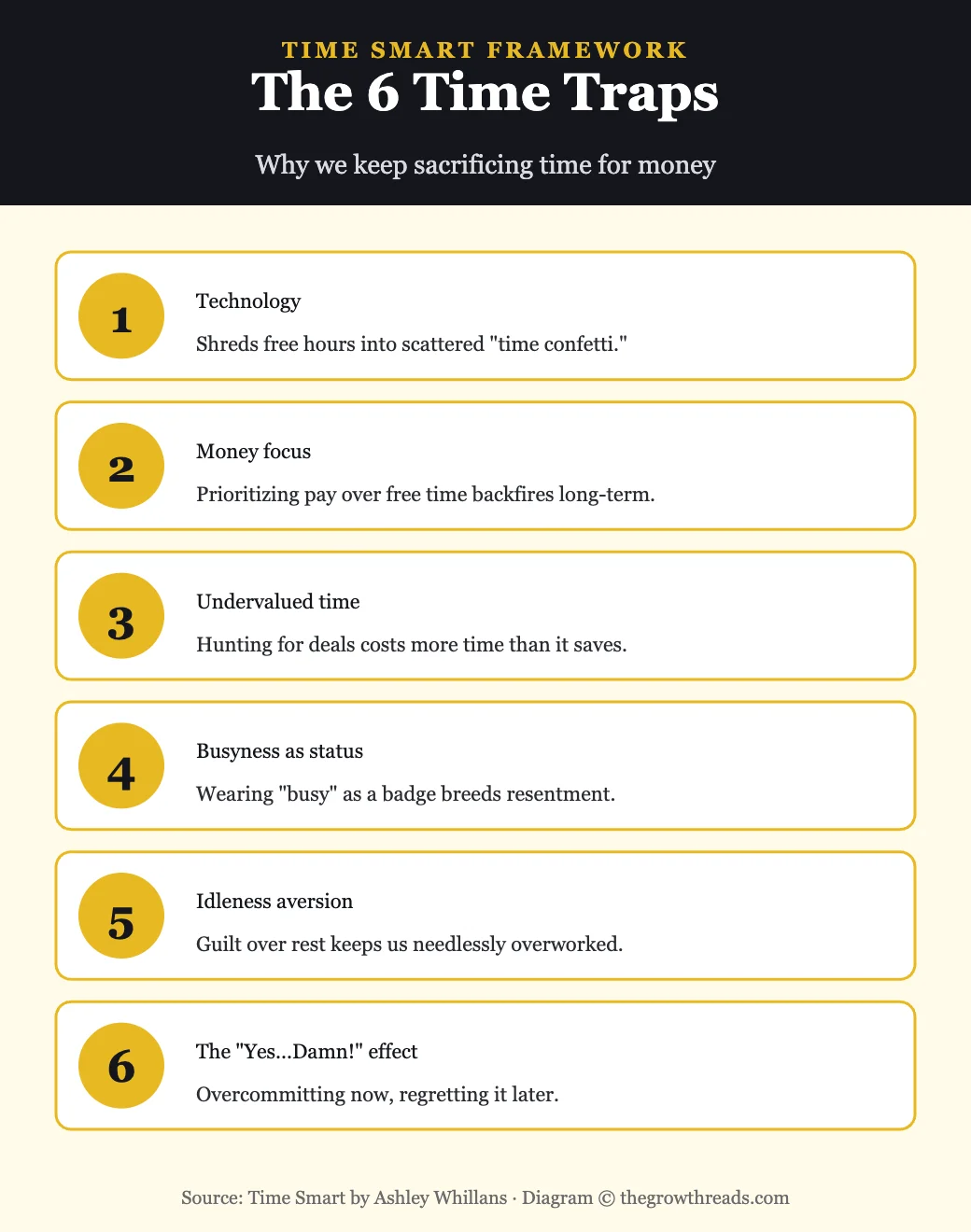
The diagnostic core of the book is a set of six specific habits Whillans has identified, through her research, as the everyday behaviors that manufacture time poverty. She frames them less as personality flaws and more as environmental defaults — patterns that are easy to fall into and require deliberate effort to notice and reverse.
Technology is the first and most visible trap. Notifications, feeds, and always-on connectivity don’t just steal minutes; they shred the minutes that remain into what Whillans calls “time confetti” — fragments too small and too interrupted to produce real rest or focus. Money focus is the second: prioritizing income and career advancement over free time predicts lower happiness over the long run, even though it’s the default most professional cultures reward. Undervalued time shows up in small, sneaky ways — comparison shopping for an hour to save five dollars, for instance — where the time cost quietly exceeds the value gained.
Busyness as status is a cultural inversion Whillans traces historically: where visible leisure was once the marker of success, visible overwork has become the new status symbol, which makes escaping time poverty feel like a demotion instead of a win. Idleness aversion is the discomfort many people — Americans especially, in Whillans’s data — feel when they’re not “being productive,” which pushes them to fill open time rather than protect it. And the “Yes…Damn!” effect closes the loop: in-the-moment, low-stakes commitments feel easy to accept, and only later, when the calendar is full, does the cumulative cost become obvious.
Each trap comes with an implementation toolkit in the original book — a self-assessment and small experiments to test which traps apply most to your own life. The value of naming them explicitly, rather than just feeling generally “busy,” is that each trap suggests its own specific counter-move, which sets up the Five Strategies in Part 3.
TGR Note: The busyness-as-status trap pairs well with Laura Vanderkam’s 168 Hours, which makes a similar point with a harder edge — most people who say they’re “too busy” have more discretionary time than a real audit reveals. Read them together: Whillans explains why busyness feels virtuous, Vanderkam gives you the audit to test whether it actually is.
Part 3: The Five Strategies to Reclaim Your Time
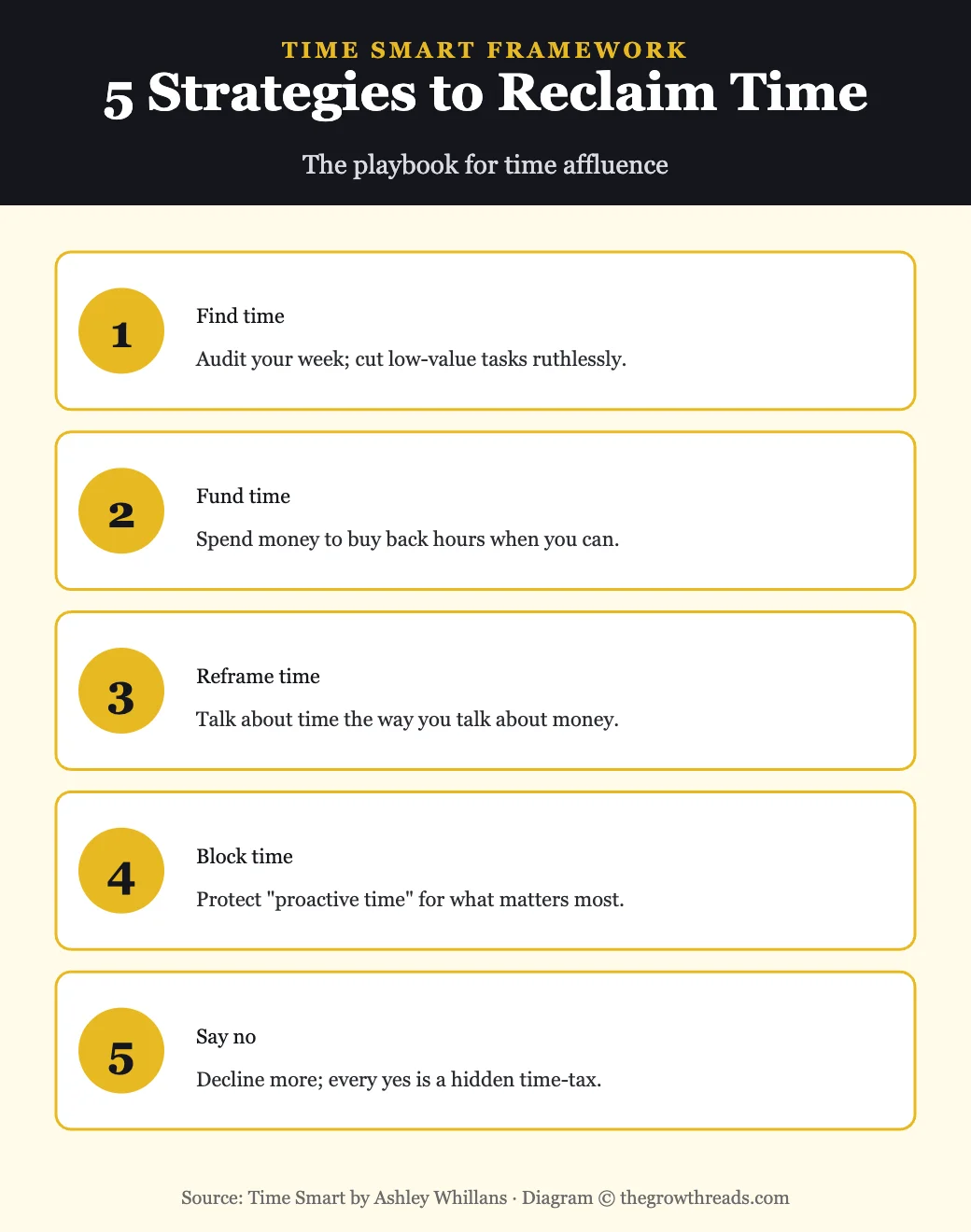
Where the Six Time Traps diagnose the problem, the Five Strategies are Whillans’s prescription — a sequence meant to be used together rather than picked from individually. Find time comes first: a structured audit of a typical week to locate the hours already being lost to low-value activity, which is usually more than people expect once it’s written down instead of estimated from memory.
Fund time is the strategy Whillans is most associated with in the press — the research-backed case for spending money to buy back time when you’re able to. This isn’t a blanket “hire people for everything” message; it’s specifically aimed at tasks you dislike and that don’t build any skill or relationship you value, where the happiness dollar math clearly favors paying someone else. Reframe time asks you to talk about your schedule the way you talk about your bank account — noticing when you say “I don’t have time” the same way you’d notice overspending, rather than treating it as a fixed, unquestionable fact.
Block time introduces the book’s most quietly important idea: proactive time, hours deliberately reserved for what’s important but not urgent, before the calendar fills with what’s merely loud. Whillans argues this is the first category to disappear under time pressure and the hardest to get back once it’s gone, which is why it needs to be scheduled rather than hoped for. Say no closes the loop, functioning as the practical antidote to the “Yes…Damn!” effect from Part 2 — a habit of pausing before accepting new commitments rather than defaulting to agreement in the moment.
Taken together, the five strategies form a cycle: find where time leaks, fund your way out of the tasks worth outsourcing, reframe how you talk about what’s left, block the time that matters most, and say no to protect the boundary going forward.
TGR Note: The “fund time” strategy is essentially the personal-life version of the delegation case made in Dan Martell’s Buy Back Your Time, which focuses on outsourcing at the business-owner level. Whillans supplies the wellbeing research behind why the trade works; Martell supplies the operational playbook for doing it at scale.
Part 4: Morgan vs. Taylor — Building a Time-Smart Identity
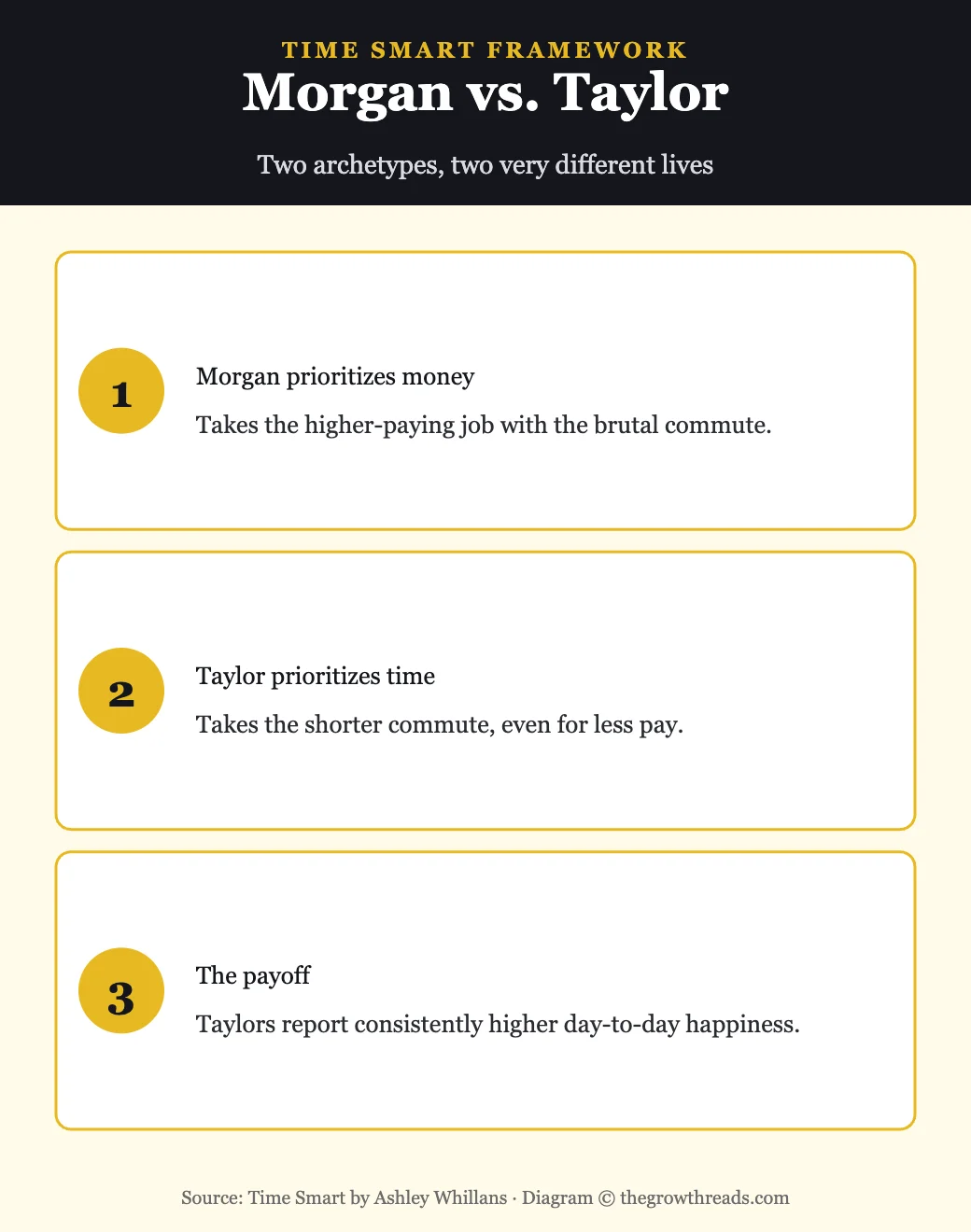
To make the abstract trade-off between time and money concrete, Whillans introduces two recurring archetypes: Morgan, who defaults to prioritizing money, and Taylor, who defaults to prioritizing time. The two aren’t moral opposites — Morgan isn’t reckless and Taylor isn’t lazy — they’re simply two different default settings for the same decisions: which job offer to take, whether to accept a longer commute for more pay, how to spend a Saturday. Across her studies, Whillans finds that Taylors report meaningfully higher day-to-day happiness, even when their income is comparable to or lower than Morgans’.
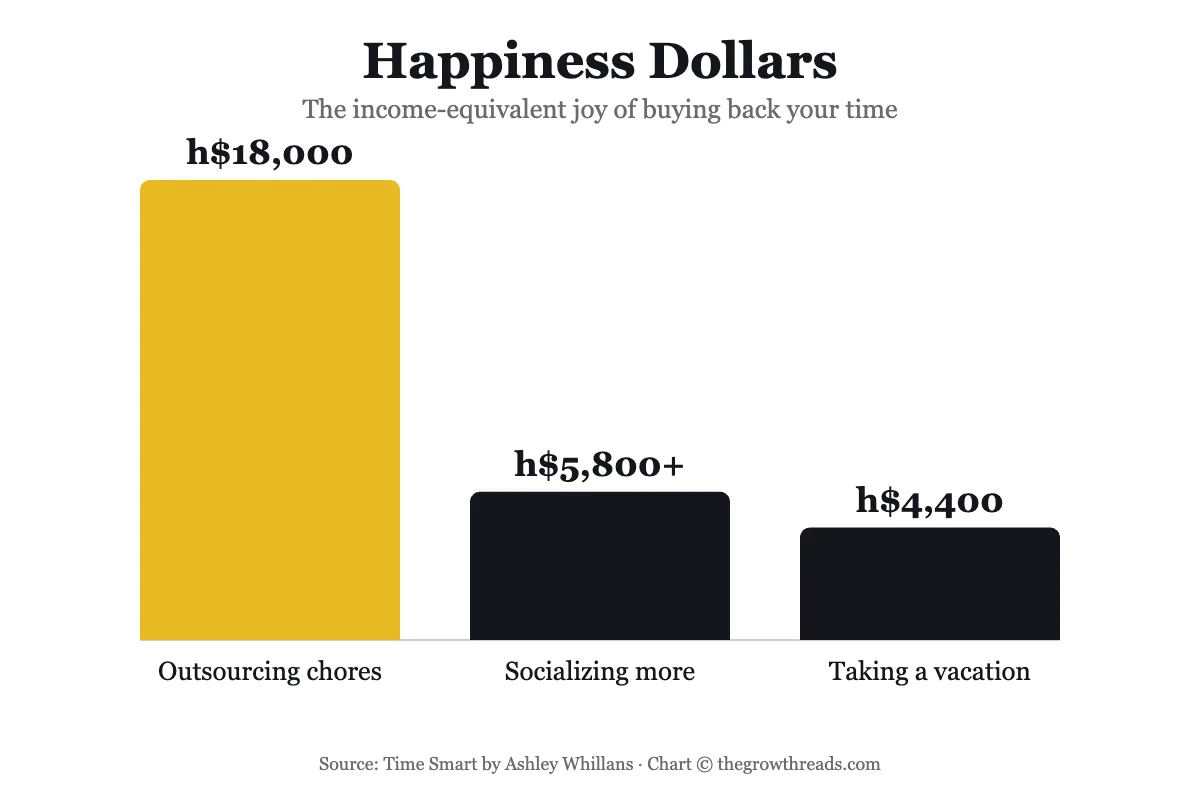
This is where the book’s signature metric, happiness dollars, does its most useful work. By assigning an income-equivalent value to the joy produced by a time-related choice, Whillans converts a fuzzy feeling into a number people can actually compare. In her research, outsourcing disliked chores was worth roughly h$18,000 in happiness terms, socializing more was worth over h$5,800, and taking a vacation contributed about h$4,400 — figures meant less as universal constants and more as a demonstration that time choices have a calculable payoff, the same way a raise or a bonus does.
The identity framing matters because Whillans is explicit that becoming more Taylor doesn’t require a dramatic life overhaul. Most readers aren’t choosing between two job offers with wildly different commutes every week. What they are doing, constantly, is making dozens of small Morgan-or-Taylor micro-decisions — whether to drive across town for a slightly cheaper deal, whether to say yes to one more obligation, whether to spend a free evening scrolling or resting. The book’s closing argument is that noticing which archetype is driving a given decision, in the moment, is itself most of the work.
TGR Note: The Morgan/Taylor framework is a close cousin of the prioritization logic in Richard Koch’s The 80/20 Principle — both argue that a small number of deliberate choices account for most of your wellbeing, and that the default, unexamined choice is usually the wrong one. Koch applies the lens to results broadly; Whillans applies it specifically to the time-versus-money trade-off.
Who is Time Smart best for — and who should read something else first?
Time Smart is best suited to busy professionals and high earners who notice they default to money-first decisions without questioning it — the promotion that adds hours, the “deal” that costs an evening, the commitments accepted on autopilot. It’s also a strong fit for anyone who has the means to outsource more but feels guilty doing it, since the happiness-dollars research gives that trade-off a research-backed green light.
If your problem is less “I don’t protect my time” and more “I genuinely don’t know where my hours go,” start with Laura Vanderkam’s 168 Hours for the audit, then come back to Time Smart for the strategy. And if overwork itself — not just time allocation — is the core issue, Do Nothing tackles the cultural roots of busyness-as-status in more depth.
Questions to reflect on
- Which of the Six Time Traps shows up most in your own week — and what’s one specific moment this week where you can catch it happening?
- Think of a task you dislike but keep doing yourself. What would it actually cost, in money, to outsource it — and how does that compare to what an extra hour a week is worth to you?
- Are you currently closer to “Morgan” or “Taylor” in how you make trade-offs? What’s one recent decision that revealed which one you defaulted to?
- Do you have any protected “proactive time” on your calendar right now — hours reserved for what’s important but not urgent? If not, what’s crowding it out?
- What’s one low-stakes commitment you said yes to recently that you’d say no to if you could redo it — and what made it hard to decline in the moment?
🔥 Ready to become more Time Smart?
Grab the book and start with the happiness-dollars framework — it’s the fastest way to see your own time-money trade-offs clearly.
How to apply Time Smart (7-day plan)
- Day 1 — Audit: Write down, hour by hour, how you spent yesterday. Circle anything that felt like a waste even as you did it.
- Day 2 — Name your traps: Read through the Six Time Traps and mark which two apply most to your week right now.
- Day 3 — Price one chore: Pick one disliked task you keep doing yourself. Look up what it would actually cost to outsource it, even if you don’t do it yet.
- Day 4 — Block proactive time: Put one 90-minute block on next week’s calendar for something important but not urgent — and treat it as a real meeting.
- Day 5 — Practice one no: Decline one low-stakes request or invitation you’d normally accept on autopilot.
- Day 6 — Reframe out loud: Notice one moment you say “I don’t have time” and rephrase it as a choice you’re making, the way you would about money.
- Day 7 — Review and choose one strategy: Of find, fund, reframe, block, and say no, pick the one that felt hardest — that’s the one to build into next week’s routine.
Frequently asked questions
What is the main idea of Time Smart?
The main idea is that most people undervalue time relative to money in their everyday decisions, and that this trade-off is measurable and reversible. Ashley Whillans introduces “happiness dollars” — an income-equivalent value for the joy a time-related choice produces — to make the trade-off concrete, then offers six diagnostic “time traps” and five practical strategies (find, fund, reframe, block, say no) for shifting the balance back toward time. The book’s core claim is that becoming more “time affluent” reliably increases day-to-day happiness, often more than an equivalent increase in income would.
What are the Six Time Traps in Time Smart?
The Six Time Traps are technology (which fragments free time into “time confetti”), money focus (prioritizing income over free time), undervalued time (spending more time than something is worth to save a small amount of money), busyness as status (treating overwork as a badge of honor), idleness aversion (discomfort with unstructured rest), and the “Yes…Damn!” effect (accepting low-stakes commitments that add up to overcommitment). Whillans presents each as a common, reversible habit rather than a fixed personality trait.
What are “happiness dollars” in Time Smart?
Happiness dollars (h$) are Whillans’s metric for the income-equivalent value of the wellbeing a time-related choice produces. For example, her research estimated that outsourcing disliked chores was worth roughly h$18,000 in happiness terms for the people studied. The metric isn’t meant as a universal constant for every reader — it’s a tool for making abstract time-versus-money trade-offs comparable to decisions people already know how to make, like evaluating a raise or a bonus.
Who are Morgan and Taylor in Time Smart?
Morgan and Taylor are two archetypes Whillans uses to illustrate default decision-making styles: Morgan tends to prioritize money in trade-offs (a higher-paying job with a longer commute, for instance), while Taylor tends to prioritize time (a shorter commute even at somewhat lower pay). Across her studies, people who behave more like Taylor report higher day-to-day happiness on average. The framework isn’t a rigid personality test — most people are a mix, and the book’s point is to notice, decision by decision, which one is driving your choice.
Is Time Smart based on real research?
Yes. Ashley Whillans is a behavioral scientist and Harvard Business School professor, and the book draws on her own published studies as well as collaborations with researchers including Michael Norton and Elizabeth Dunn. Her data comes from a deliberately wide range of populations — including management consultants, married couples, members of the US military, and women running vegetable stands in Kenya — which is part of why the book argues time affluence matters across income levels, not just for the wealthy. As with any single research program, some specific figures (like exact happiness-dollar amounts) are estimates from particular studies rather than universal constants, but the underlying time-affluence findings are well supported and consistent with the broader wellbeing literature.
How is Time Smart different from other time management books?
Most time management books focus on productivity — getting more done in the time you have. Time Smart focuses on wellbeing — using the time you have (or reclaim) in ways that actually make you happier, even if that means doing less. It’s closer to behavioral economics than to a productivity system: instead of to-do lists and prioritization frameworks, it offers a psychological diagnosis (the Six Time Traps) and a research-backed case for spending money, saying no, and protecting unstructured time as legitimate strategies, not shortcuts.
What’s a good first step from Time Smart if I only have 10 minutes?
Do the Day 1 audit from this guide’s 7-day plan: write down, hour by hour, how you spent yesterday, and circle anything that felt like a waste even while you were doing it. Whillans’s own research suggests that simply making time expenditure visible — the way a budget makes money expenditure visible — is often enough to shift a few decisions immediately, before you’ve applied any of the Five Strategies formally.
Related summaries
- 168 Hours by Laura Vanderkam — the audit-first companion to this book’s diagnosis.
- Buy Back Your Time by Dan Martell — the business-owner’s playbook for the “fund time” strategy.
- Do Nothing by Celeste Headlee — a deeper look at busyness-as-status and overwork culture.
- The 80/20 Principle by Richard Koch — the prioritization logic behind the Morgan/Taylor framework.
- Browse all Productivity book summaries →
How we analyze books: Every TGR summary is built from a full reading of the source material, cross-checked against the author’s published interviews and research where relevant, and structured around practical application rather than just recap. We never reproduce a book chapter-by-chapter — instead we synthesize the core arguments, verify claims where possible, and add original frameworks (diagrams, 7-day plans, reflection questions) you won’t find in the book itself. Read our full methodology.
Related Time Management Summaries
Extreme Productivity Summary & Review: Judge Output, Not Hours
Margin Summary & Review: Restoring the Reserves Overload Has Stolen
The Miracle Equation Summary & Review: Two Decisions That Make Goals Inevitable
What the Most Successful People Do Before Breakfast Summary & Review
Zen to Done Summary & Review: The Simple Productivity System That Actually Sticks