

★★★★★ 4.6/5 — A sharp, combative case that you can’t trust a decision, an opinion, or a system until you know whether the person behind it is exposed to its consequences.
Best for: readers who want a rigorous ethical framework for spotting advice-givers, forecasters, and bureaucrats who bear no risk for being wrong · Reading time: ~8 hrs (this guide: ~12 min) · Difficulty to apply: Moderate — the diagnostic lens is easy to grasp, applying it consistently to your own choices takes more discipline
Skin in the Game in one minute
You cannot fully judge a decision, a belief, or a piece of advice until you know whether the person behind it is exposed to its consequences — and Nassim Nicholas Taleb argues that symmetry of risk and reward is what makes people, institutions, and systems trustworthy. The fifth and final volume of his Incerto series, Skin in the Game examines how forecasters, pundits, consultants, and bureaucrats routinely dispense opinions and advice while remaining insulated from the downside of being wrong — a structural unfairness Taleb traces back to Hammurabi’s Code, which put builders to death if their houses collapsed on the owners. He introduces the “minority rule,” showing how a small, inflexible, committed minority can end up dictating outcomes for an entire indifferent majority, and the “Lindy Effect,” which holds that non-perishable things — ideas, books, technologies — become more likely to survive with every year they’ve already endured. Published in 2018, the book is as much an ethical manifesto as a risk-theory text, coining the term “Intellectual Yet Idiot” for credentialed elites who mistake theory for knowledge and are baffled when people with real skin in the game reject their prescriptions.
Key takeaways
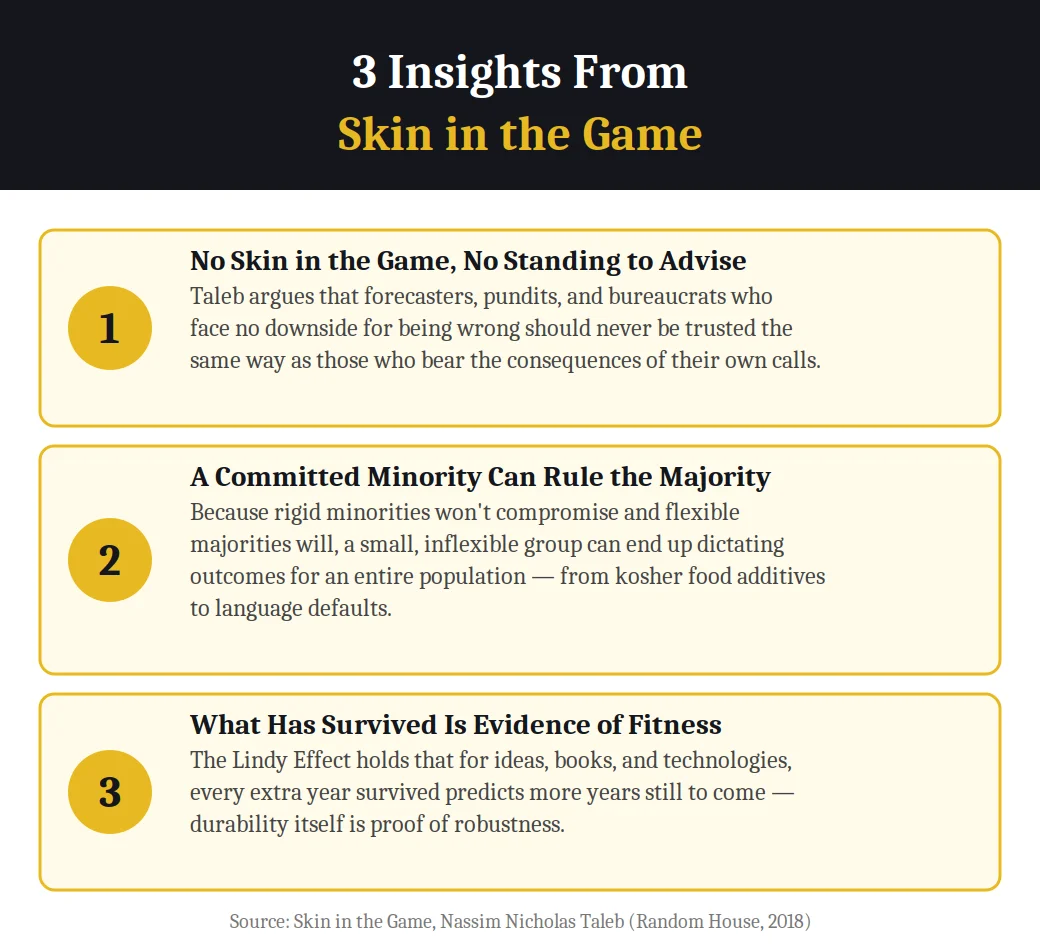
- No skin in the game means no standing to advise: forecasters, pundits, and bureaucrats who face no downside for being wrong shouldn’t be trusted the same way as those who bear the consequences of their own calls.
- Hammurabi’s Code enforced brutal symmetry: if a builder’s house collapsed and killed the owner, the builder was put to death — an ancient, extreme version of the accountability Taleb wants restored today.
- A committed minority can rule the majority: because rigid minorities won’t compromise and flexible majorities will, a small, inflexible group can end up dictating outcomes for an entire population.
- The Lindy Effect rewards what’s already endured: for non-perishable things like ideas, books, and technologies, every extra year survived predicts more years still to come.
- “Soul in the game” goes further than skin in the game: it means risking something existentially dear — reputation, even life — for a belief, not just money.
- The “Intellectual Yet Idiot” mistakes credentials for knowledge: Taleb’s term for elites who generalize from theory, dismiss those with real-world exposure, and are baffled by “populism” when their prescriptions are rejected.
- The Silver Rule beats the Golden Rule: “do not do unto others what you would not want done to you” is a more robust, restraint-based ethic than the Golden Rule’s do-unto-others.
- The “Bob Rubin trade” is the pattern to watch for: executives who collect bonuses in good years and walk away unscathed in bad ones — profit without corresponding risk.
- You will never fully convince someone with argument alone: Taleb insists only reality — actual consequences — changes minds and behavior in a way pure reasoning cannot.
What is Skin in the Game about?
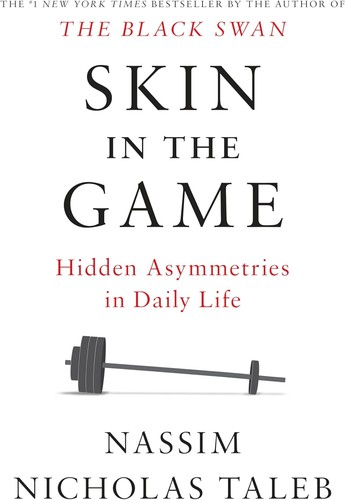
Skin in the Game is Nassim Nicholas Taleb’s argument that symmetry between risk and reward — actual exposure to the consequences of your own decisions, advice, and claims — is the foundation of fairness, competence, and functioning systems. The fifth and final volume of his Incerto series, following Fooled by Randomness, The Black Swan, The Bed of Procrustes, and Antifragile, the book widens its lens from markets and forecasting to ethics, religion, politics, and everyday life, arguing that forecasters, bureaucrats, and pundits who face no downside for being wrong are a source of systemic fragility and injustice. Published in 2018, it introduces the minority rule, the Lindy Effect, and the “Intellectual Yet Idiot,” building toward a broader ethical claim: you should never fully trust an opinion, a policy, or a piece of advice from someone who bears no cost for being wrong.
About the author
Nassim Nicholas Taleb is a former derivatives trader turned scholar, essayist, and statistician who spent two decades as a quantitative trader before turning to writing and academia, an experience that shaped his skepticism toward conventional forecasting and risk models. He is the author of the five-volume philosophical essay collection Incerto — Fooled by Randomness, The Black Swan, The Bed of Procrustes, Antifragile, and Skin in the Game — which explores how humans misunderstand luck, probability, and exposure to risk. Taleb has held academic and advisory positions at NYU’s Tandon School of Engineering and Universa Investments, a tail-risk hedge fund built around the ideas developed in his books, and Skin in the Game closes the Incerto project by turning its risk-theory lens directly onto ethics and everyday decision-making. Explore all Nassim Nicholas Taleb book summaries →
Key concepts at a glance
| Concept | What it means | Use it when |
|---|---|---|
| Skin in the Game | Bearing real exposure to the downside of your own decisions, advice, or claims | You’re deciding how much weight to give someone’s opinion or prediction |
| The Lindy Effect | For non-perishable things, life expectancy rises with every year already survived | You’re weighing a new trend against something time-tested |
| The Minority Rule | A small, inflexible, committed minority can impose its preference on an indifferent majority | You’re trying to understand why a strict standard became the default for everyone |
| Intellectual Yet Idiot (IYI) | Credentialed elites who mistake theory and style for real, tested knowledge | You’re evaluating advice from someone with impressive credentials but no real exposure |
| The Silver Rule | “Do not do unto others what you would not want done to you” — a restraint-based ethic | You’re deciding how to treat people whose preferences you don’t fully understand |
Part 1: Why no skin in the game means no standing to advise
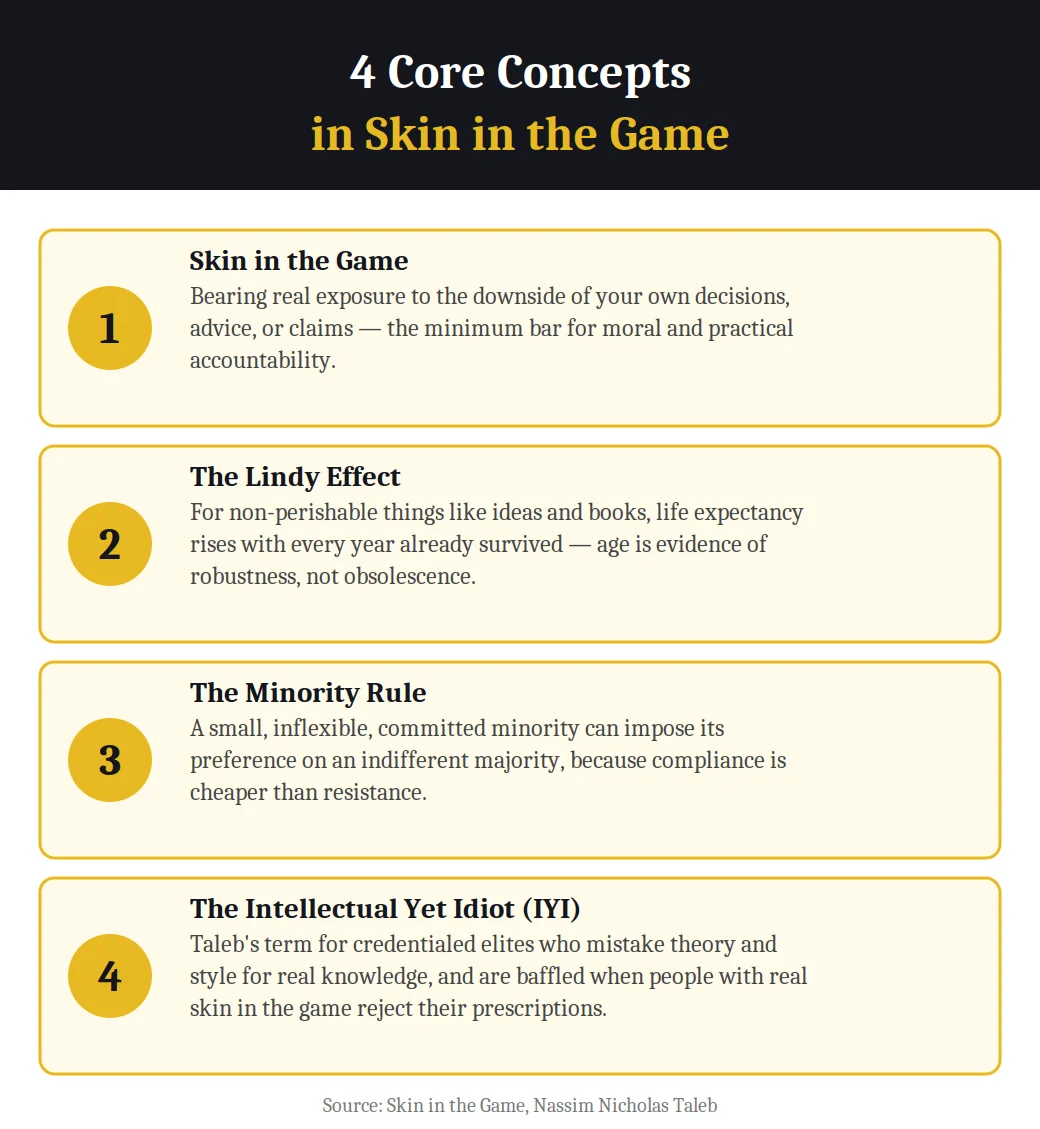
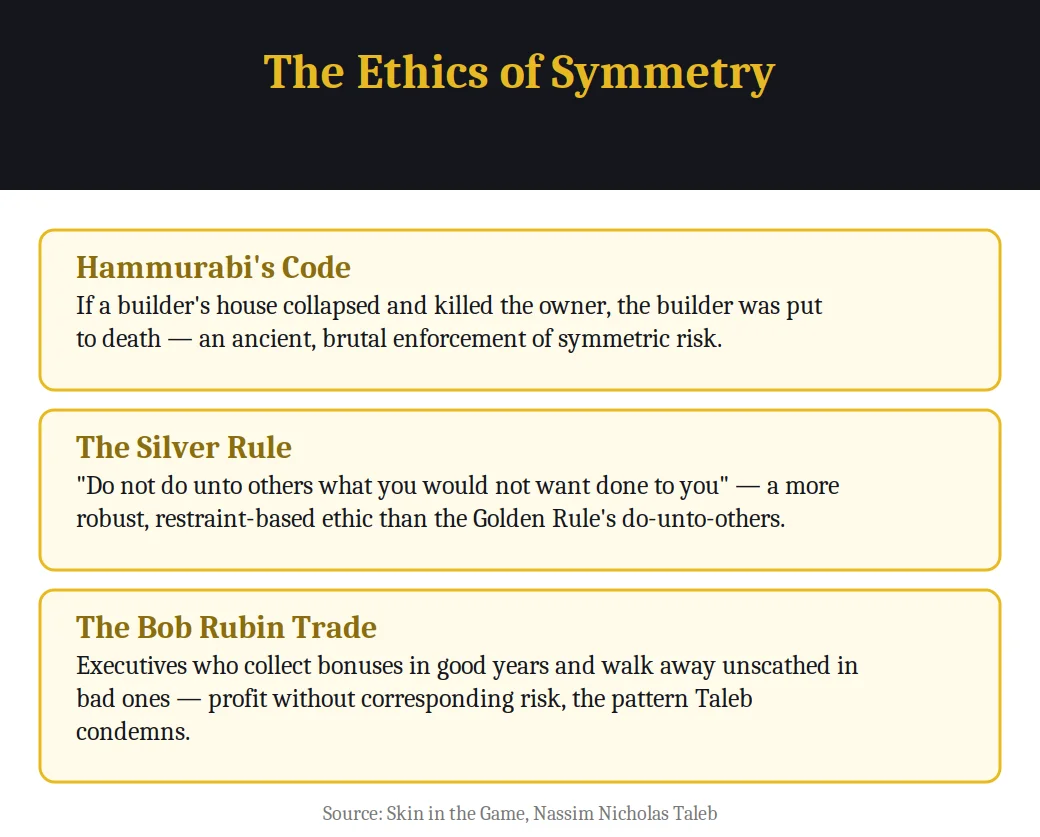
Taleb’s central claim is that opinions, forecasts, and advice should be weighted by how much the person offering them stands to lose if they’re wrong. He traces this principle back to Hammurabi’s Code: if a builder’s house collapsed and killed its owner, the builder was put to death — a brutal but perfectly symmetric enforcement of accountability. Modern life, Taleb argues, has stripped this symmetry out of huge swaths of decision-making: forecasters, pundits, and policy consultants routinely offer high-confidence predictions and prescriptions while remaining completely insulated from the consequences of being wrong. He calls this out sharply with lines like “don’t tell me what you ‘think,’ just tell me what’s in your portfolio” — a demand that people back their opinions with real exposure, not just confident language.
TGR Note: This distrust of unaccountable expertise echoes The Black Swan‘s critique of forecasters who confidently predict rare events they have no real ability to foresee — both books share Taleb’s core suspicion of confident, consequence-free opinion.
Part 2: The minority rule and the Lindy Effect
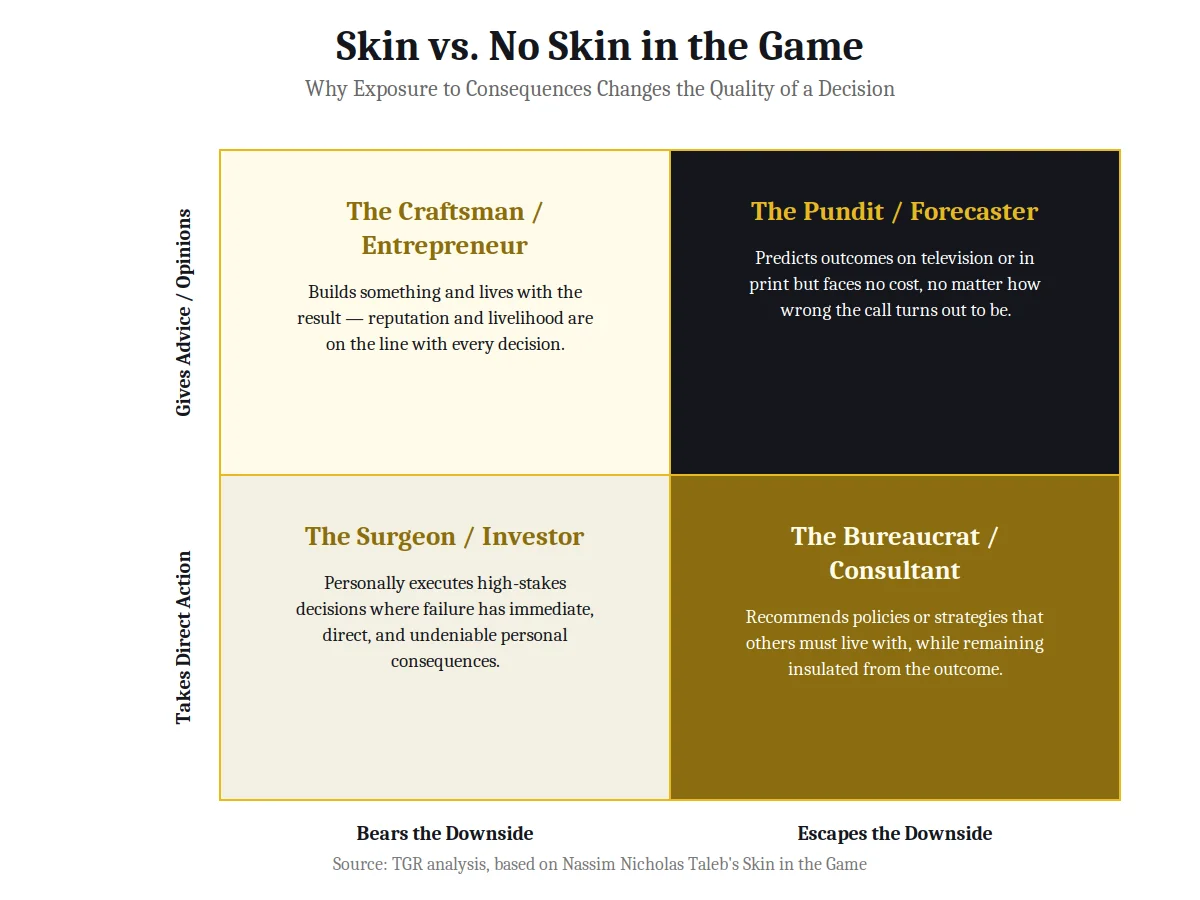
Two of the book’s most quoted ideas explain how individual accountability scales into collective outcomes. The “minority rule” shows how a small, inflexible, committed minority can end up dictating preferences to an entire indifferent majority — because it’s cheaper for the flexible majority to simply comply than to resist a group that won’t budge, which is why, Taleb argues, kosher and halal food standards quietly shape entire supply chains even though observant consumers are a small fraction of the market. The “Lindy Effect” operates on a different axis: for non-perishable things like ideas, books, and technologies, every additional year already survived increases the expected years still to come, meaning durability itself is evidence of robustness rather than a sign something is merely old-fashioned. Together, the two ideas argue that what persists — whether a rule imposed by a minority or an idea tested by time — usually persists for a structural reason, not by accident.
Part 3: The ethics of symmetry and the Intellectual Yet Idiot
Taleb extends skin in the game into a full ethical framework. The “Silver Rule” — do not do unto others what you would not want done to you — is, he argues, more robust than the Golden Rule, because it restrains you from imposing your own preferences on people whose situation you don’t fully understand, rather than actively prescribing what’s good for them. He names the pattern of asymmetric reward the “Bob Rubin trade,” after executives who collect enormous bonuses in good years and walk away unscathed when their bets go bad in others — profit without corresponding risk. The book’s sharpest coinage, the “Intellectual Yet Idiot” (IYI), targets credentialed elites — pundits, policy wonks, some journalists and academics — who mistake theoretical fluency and social status for real knowledge, and who are consistently baffled when people with actual skin in the game reject the prescriptions handed down to them.
Who is Skin in the Game best for — and who should read something else first?
This book is best for readers who want a rigorous, often combative ethical framework for evaluating advice, forecasts, and institutions — investors, managers, and anyone frustrated by pundits and consultants who face no consequences for being wrong. Its polemical tone and frequent detours into etymology and personal scores-settling reward readers who enjoy Taleb’s voice more than those seeking a neutral, textbook-style summary.
If you haven’t read it yet, The Black Swan lays the risk-theory groundwork this book builds its ethics on top of, and Scarcity offers a very different, psychology-first lens on how situations — not character — shape decisions.
Questions to reflect on
- Where in your own work do you give advice or opinions without bearing any real cost if you turn out to be wrong?
- Can you think of an “Intellectual Yet Idiot” moment of your own — a time you trusted theory or credentials over someone’s lived, tested experience?
- Is there a “Bob Rubin trade” pattern in your organization — someone rewarded for upside while others absorb the downside?
- What belief or practice in your life has survived a long time (the Lindy Effect) that you’ve been tempted to abandon for something newer?
- Where could you apply the Silver Rule — restraint rather than active prescription — the next time you’re tempted to tell someone else what’s good for them?
🔥 Ready to stop trusting advice from people with nothing at stake?
This guide covers the core framework — the book gives you Taleb’s full argument, historical examples, and closing essays from the Incerto series.
How to apply Skin in the Game (7-day plan)
- Day 1: Identify one source of advice or opinion in your life — a pundit, a newsletter, a consultant — and ask what they personally lose if they’re wrong.
- Day 2: Find one decision where you gave an opinion without exposure to its outcome, and decide how to add real accountability next time.
- Day 3: Look for a “minority rule” pattern around you — a small, inflexible group quietly setting the default for everyone else.
- Day 4: Identify something in your life that has survived a long time (the Lindy Effect) that deserves more trust, not less, because of its age.
- Day 5: Spot a “Bob Rubin trade” in your own organization or industry — who profits without bearing the matching risk?
- Day 6: Practice the Silver Rule once: hold back from prescribing what’s “good” for someone whose situation you don’t fully share.
- Day 7: Write down one place you could put more of your own skin in the game — money, time, or reputation — behind something you claim to believe.
Frequently asked questions
What does “skin in the game” mean in the book?
Bearing real exposure to the downside of your own decisions, advice, or claims — the minimum bar Taleb sets for moral and practical accountability.
What is the minority rule?
The idea that a small, inflexible, committed minority can impose its preference on an indifferent majority, because compliance is cheaper than resistance.
What is the Lindy Effect?
For non-perishable things like ideas and books, life expectancy rises with every year already survived — durability itself is evidence of robustness.
What is an “Intellectual Yet Idiot”?
Taleb’s term for credentialed elites who mistake theoretical fluency for real knowledge and dismiss people with genuine, tested experience.
How does this book relate to The Black Swan?
It’s the fifth and final Incerto volume, extending the earlier risk-theory arguments into ethics, politics, and everyday decision-making.
What is the Silver Rule?
“Do not do unto others what you would not want done to you” — a restraint-based ethic Taleb argues is more robust than the Golden Rule.
What is the “Bob Rubin trade”?
The pattern of executives collecting bonuses in good years while walking away unscathed in bad ones — profit without corresponding risk.
Related summaries
If Skin in the Game resonated, these dig further into related territory: The Black Swan on risk and rare events, Scarcity on situational blind spots, and other titles in our best money and economics books pillar page.
How we analyze books: We work from the full book — reconstructing its core arguments in our own words, adding commentary that connects it to related research and other books in our library, and pressure-testing the advice in a practical 7-day plan. Ratings weigh usefulness, readability, and evidence quality. Read our full methodology.
Related Money Summaries
Secrets of the Millionaire Mind Summary & Review: Reset Your Financial Thermostat
The Dhandho Investor Summary & Review: Low-Risk Value Investing That Works
The Little Book of Common Sense Investing Summary & Review: The Only Investment Guide You Will Ever Need
The Little Book That Still Beats the Market Summary and Review
Think and Grow Rich Summary & Review: Napoleon Hill’s Timeless Success Formula