

★★★★☆ 4.3/5 — Gladwell’s case that the advantages we assume matter most are often overrated, and that real disadvantages, faced under the right conditions, can force the creative strategies that let underdogs win.
Best for: underdogs, founders facing better-resourced competitors, and anyone who’s ever been told they lack what’s “required” to succeed · Reading time: ~7 hrs (this guide: ~15 min) · Difficulty to apply: Moderate — the reframe is simple, applying it honestly to your own disadvantages takes self-awareness
David and Goliath in one minute
The advantages we think we need aren’t always the ones that matter — and the disadvantages we fear most can, under the right conditions, become genuine strengths. Malcolm Gladwell’s 2013 book reopens the biblical story of David and Goliath and argues that we’ve misread it from the start: Goliath’s size and armor were never the guarantee of victory they appeared to be, and David’s sling was never the desperate long shot it’s remembered as. From there, Gladwell builds a wider argument using an inverted-U curve to show that more resources don’t help indefinitely and can eventually hurt, a theory of “desirable difficulties” to show how disability, early loss, and scarcity can — under specific conditions — sharpen rather than limit a person, a “big fish, little pond” effect to explain why relative rank shapes confidence more than absolute ability, and a “principle of legitimacy” to explain when people accept authority and when they revolt against it. Together, these ideas challenge the assumption that being an underdog is simply a disadvantage to overcome.
Key takeaways
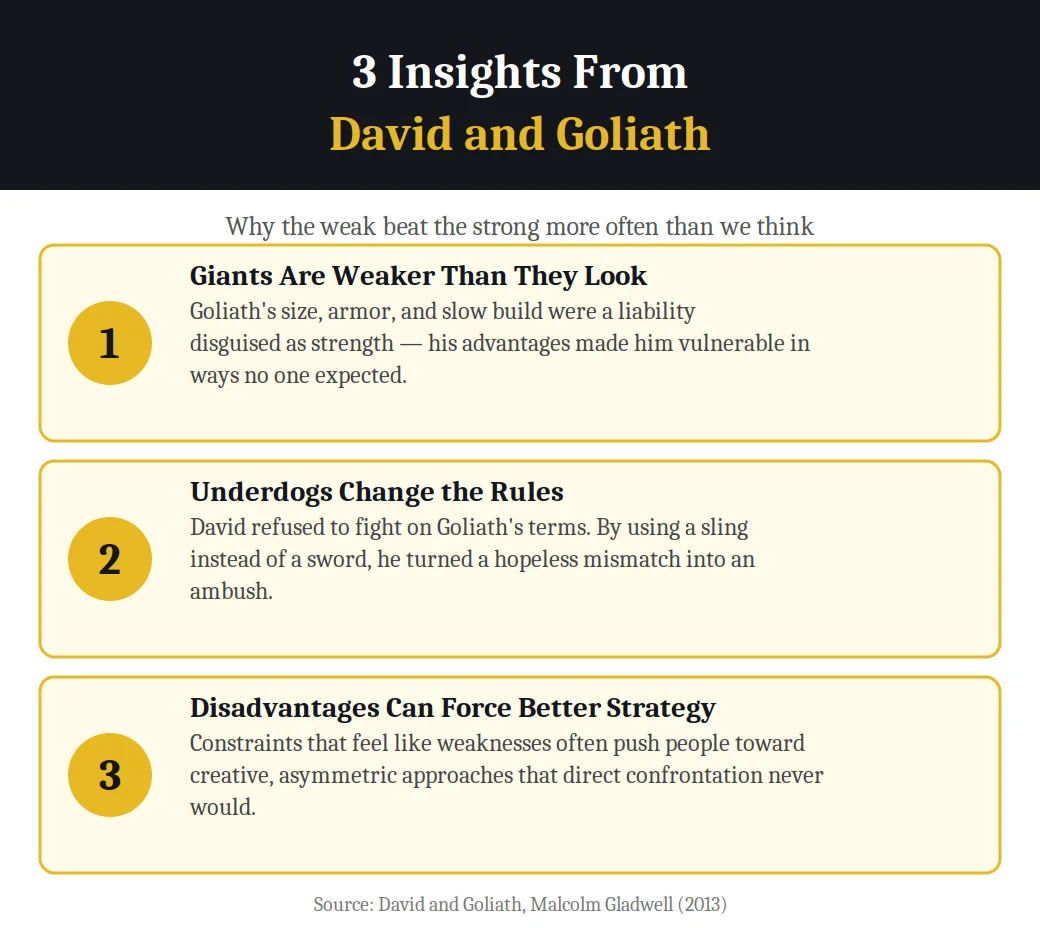
- Goliath’s size was a liability, not just an advantage: historians and physicians cited in the book suggest his enormous stature may have been a symptom of acromegaly, a condition often associated with impaired vision — meaning the giant may have been far more vulnerable than he appeared.
- David never intended to fight Goliath at close range: slinging was a recognized, lethal skill in ancient warfare, and David’s plan was a calculated ambush using a weapon Goliath’s armor couldn’t defend against, not a desperate gamble.
- More resources don’t always help — and can start to hurt: Gladwell’s inverted-U curve shows that money, class size, and other resources tend to improve outcomes up to a point, then plateau, then actively work against the outcome they were meant to help.
- Some difficulties are “desirable” — but only under specific conditions: disability, the early loss of a parent, and growing up in scarcity can, in some people, force the development of compensating skills — but this pattern only holds alongside enough surrounding support and stability, not as a universal rule.
- Dyslexia appears disproportionately among successful entrepreneurs: Gladwell argues that many built strong delegation, communication, and problem-solving skills specifically because they couldn’t rely on the paths that came easily to others.
- Being a relatively big fish in a small pond can beat being a small fish in a big pond: Gladwell shows that students near the top of a less selective school often out-persist equally capable peers who land in the middle of the pack at an elite one.
- Confidence is often driven by relative rank, not absolute ability: the psychological effect of comparing yourself to your immediate peers can outweigh the objective value of the environment you’re in.
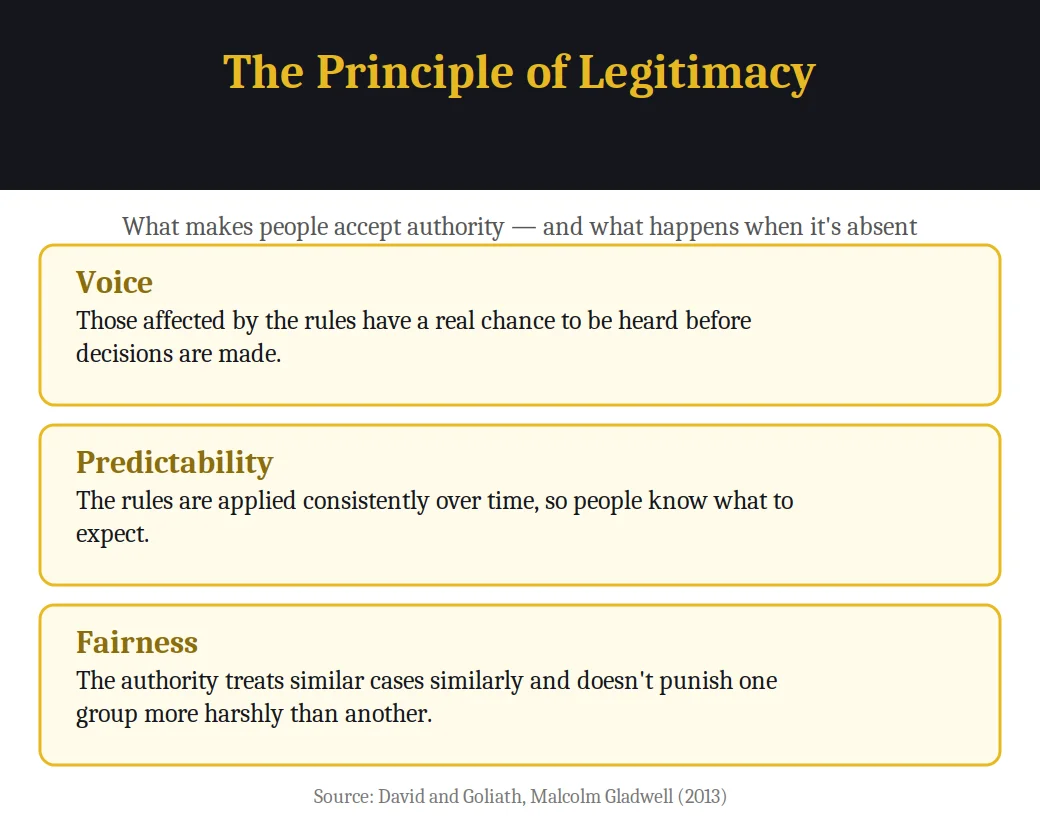
- Authority requires legitimacy to be respected: people accept rules and authority when they have a voice in them, when the rules are applied predictably, and when the authority is perceived as fair — remove any of the three and compliance breaks down.
- Overwhelming force can backfire against legitimacy: Gladwell’s account of the Troubles in Northern Ireland shows how disproportionate, indiscriminate use of power by an authority can generate more resistance than it suppresses.
What is David and Goliath about?
David and Goliath is Malcolm Gladwell’s argument that we routinely misjudge advantages and disadvantages — believing that more resources, size, and prestige reliably produce better outcomes, and that disability, hardship, and being outmatched are simply things to overcome. Reopening the biblical story as his central metaphor, Gladwell contends that Goliath’s size and armor made him more vulnerable than he appeared, while David’s sling was a deliberate, lethal strategy rather than a desperate long shot. From there, the book examines the inverted-U curve of resources, the concept of “desirable difficulties,” the “big fish, little pond” effect, and the “principle of legitimacy” governing when people accept or resist authority.
About the author
Malcolm Gladwell is a Canadian-British journalist and longtime staff writer for The New Yorker who has become one of the most influential popularizers of social science ideas in the world. Since his 2000 debut, The Tipping Point, each of his books has built a distinct thesis around counterintuitive research findings paired with vivid, specific storytelling: Outliers examined the hidden advantages behind extraordinary success, Blink explored the power and pitfalls of snap judgments, and Talking to Strangers investigated why people are so bad at reading strangers. Published in 2013, David and Goliath extends this signature approach to the nature of advantage and disadvantage itself. Explore all Malcolm Gladwell book summaries →
Key concepts at a glance
| Concept | What it means | Use it when |
|---|---|---|
| The reframed David and Goliath story | Goliath’s size and armor were a liability; David’s sling was a calculated, lethal strategy, not a desperate gamble | You’re facing an opponent whose apparent strength may be a hidden weakness |
| The inverted-U curve | More resources help up to a point, then plateau, then start actively hurting the outcome | You’re deciding whether more money, staff, or resources will actually help further |
| Desirable difficulties | Disability, early loss, and scarcity can — under the right conditions — force compensating skills that create real advantage | You’re evaluating whether a hardship might be reshaping someone’s capabilities, not just limiting them |
| Big fish, little pond | Relative rank among immediate peers shapes confidence and persistence more than the absolute quality of the environment | You’re choosing between a smaller pond where you’d rank higher and a bigger one where you’d rank lower |
| The principle of legitimacy | Authority is accepted when people have voice, the rules are predictable, and the authority is seen as fair | You’re trying to understand why people are complying with — or resisting — a rule or authority |
Part 1: Why Goliath was never as strong as he looked
Gladwell opens by re-examining the biblical showdown itself. The traditional reading treats David’s victory as a miraculous long shot: a shepherd boy somehow defeating an armored giant. Gladwell argues this reading misunderstands both fighters. Slinging was a recognized, lethal skill in ancient warfare — a skilled slinger could kill at a distance with accuracy comparable to a modern handgun. David never intended to meet Goliath in hand-to-hand combat; his plan was to exploit an attack vector Goliath’s armor and size couldn’t defend against. Meanwhile, historians and physicians cited in the book suggest Goliath’s unusual size may point to acromegaly, a pituitary condition often associated with impaired vision — meaning Goliath may have been half-blind and slow, walking into a fight he was never equipped to win the way it’s traditionally understood.
TGR Note: This reframe echoes The Tipping Point‘s core lesson that apparent strength and actual strength are often two different things — small, specific factors decide outcomes far more than raw size or force.
Part 2: The inverted-U curve and the limits of resources
Gladwell generalizes the David and Goliath dynamic into a broader pattern: the inverted-U curve. More of a good thing — money, class size, parental involvement — tends to help up to a point, then the marginal benefit shrinks, and eventually more actively starts to hurt. He illustrates this with research on class size, showing that very small classes can lose the beneficial peer dynamics of slightly larger ones, and with research on wealth and parenting, showing that past a certain income level, additional money stops making parenting easier and can start making it harder by removing the natural boundaries scarcity used to provide.
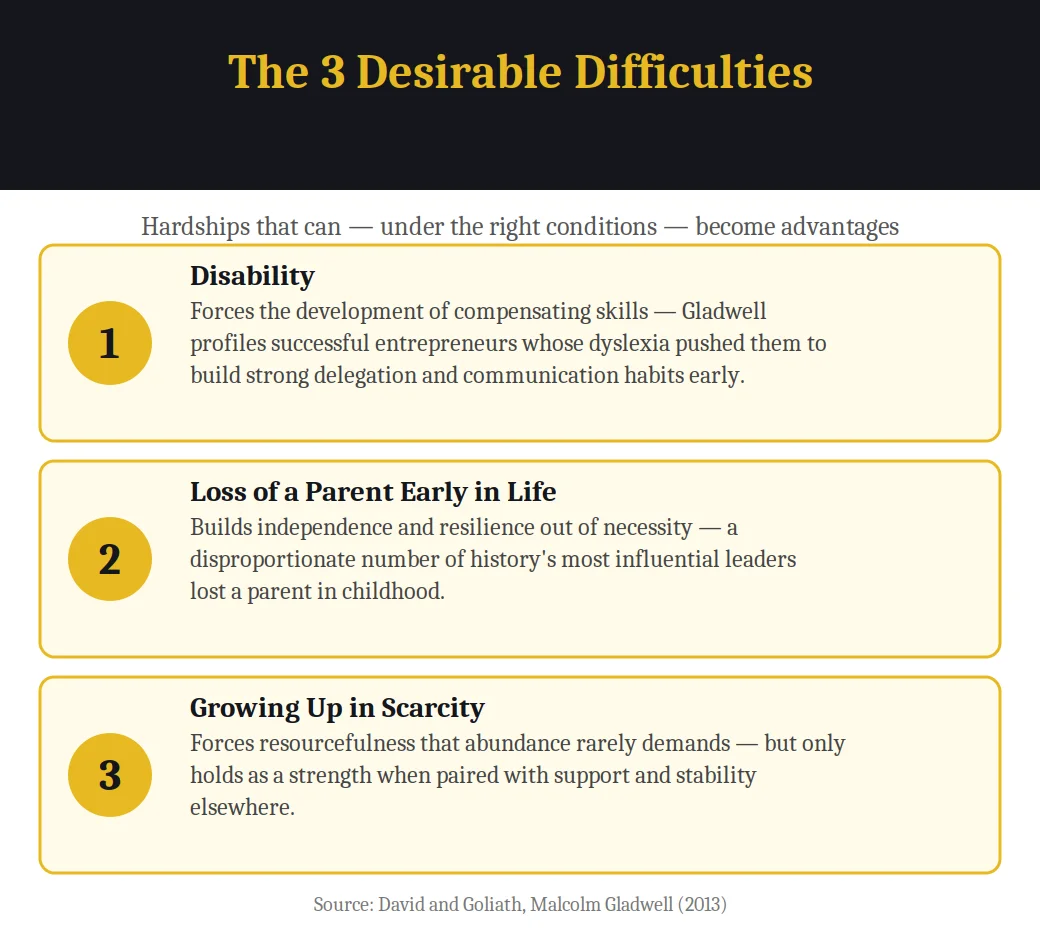
From the inverted-U curve, Gladwell moves to “desirable difficulties” — disability, the early loss of a parent, and growing up in scarcity — which can, in specific circumstances, force the development of compensating skills rather than simply limiting a person. His clearest example is the disproportionate number of successful entrepreneurs who are dyslexic: unable to rely on the reading-heavy paths that came easily to peers, many built unusually strong delegation, verbal communication, and problem-solving skills out of necessity. Gladwell is careful to note this isn’t a universal rule — the same hardship can just as easily be purely destructive without enough surrounding support and stability to convert it into strength.
TGR Note: The conditional nature of desirable difficulties pairs well with Outliers‘ argument that success depends heavily on the specific structure of opportunity around a person, not on hardship or talent in isolation.
Part 3: Big fish, little pond
Gladwell turns next to relative rank. Drawing on research into students who choose between a less selective school where they’d rank near the top and a more prestigious one where they’d rank in the middle, he shows that the students at the “lesser” school often persist further in demanding fields like STEM, because their confidence is driven by how they compare to their immediate peers, not by the objective prestige of the institution. A capable student who ranks in the middle of an elite cohort often experiences enough discouragement to abandon a field they were fully capable of succeeding in — while an equally capable student who’s the top of a smaller pond keeps going.

The practical implication is uncomfortable for a culture obsessed with prestige: choosing the most prestigious environment available isn’t automatically the right move if it puts you at a relative disadvantage that erodes your confidence and persistence over time. Sometimes being the strongest person in a less impressive room produces a better long-run outcome than being an average person in an impressive one.
TGR Note: This connects directly to Blink‘s broader theme that our instinctive judgments about status and prestige are often poor predictors of what will actually help us succeed.
Part 4: The principle of legitimacy
Gladwell closes with a study of authority itself: what makes people accept rules, and what makes them revolt. He identifies three conditions for legitimacy — people need a voice in the process, the rules need to be applied predictably over time, and the authority needs to be perceived as fair, treating similar cases similarly. When any of these three break down, obedience breaks down with it. His central case study is the Troubles in Northern Ireland, where the British government’s use of overwhelming, indiscriminate force against the Catholic population — internment without trial, mass searches, disproportionate retaliation — violated all three conditions and generated far more resistance and recruitment for paramilitary groups than it suppressed.
The lesson generalizes well beyond geopolitics: any leader, manager, or institution that leans on raw power rather than legitimacy is trading short-term compliance for long-term resistance. Gladwell’s point throughout the book is consistent — the tools that look most powerful (size, force, resources, prestige) frequently aren’t, and the constraints that look most limiting (hardship, being an underdog, having less) frequently aren’t either, once you look closely enough at how they actually function.
Who is David and Goliath best for — and who should read something else first?
This book is best for underdogs of every kind — founders facing better-funded competitors, students choosing between schools, leaders trying to earn genuine buy-in rather than mere compliance — and for anyone who’s been told they lack what’s “required” to succeed. It rewards readers who enjoy narrative-driven nonfiction with wide-ranging historical and personal case studies over dense academic argument.
If you want Gladwell’s account of how ideas and trends spread rather than how advantage and disadvantage function, The Tipping Point is the natural starting point in his catalog. If your interest is specifically in what produces extraordinary individual success, Outliers covers that related but distinct question in more depth. And if you’re more curious about the mechanics of snap judgment than about underdog strategy, Blink is Gladwell’s deepest treatment of that topic.
Questions to reflect on
- What’s an advantage you’ve assumed you needed but that, on reflection, might not matter as much as you think?
- Is there a disadvantage in your own life that’s forced you to develop a skill or strategy you wouldn’t otherwise have built?
- Are you currently a middling fish in a big, prestigious pond — and would you actually be better off as a leading fish in a smaller one?
- Think of a rule or authority you’ve resisted: was it missing voice, predictability, or fairness — or all three?
- Where in your own work or life might “more resources” have already crossed from helpful to counterproductive?
🔥 Ready to rethink what actually makes an underdog win?
This guide covers the core reframe — the book gives you Gladwell’s full case studies, historical research, and the nuance behind each one.
How to apply David and Goliath (7-day plan)
- Day 1: List the advantages you assume your strongest competitor or peer has, and question whether each one actually helps them as much as it appears to.
- Day 2: List your own perceived disadvantages, and identify one skill or strategy each has forced you to build.
- Day 3: Identify one area of your work or life where you suspect more resources have stopped helping and started hurting.
- Day 4: Honestly assess whether you’re a middling fish in a big pond somewhere — and what a smaller, more favorable pond might look like.
- Day 5: Pick one rule, policy, or expectation you’ve resisted, and diagnose which of the three legitimacy conditions it’s missing.
- Day 6: If you lead others, identify one place you’re relying on authority or force where earning genuine buy-in would work better.
- Day 7: Reflect on one upcoming challenge where you’re the “David” — and plan a strategy that avoids fighting on the giant’s terms.
Frequently asked questions
What is the main idea of David and Goliath?
David and Goliath argues that we routinely misjudge advantage and disadvantage — assuming resources, size, and prestige reliably help while treating hardship and being outmatched as pure liabilities — when in fact both are far more conditional than they appear.
Why does Gladwell say Goliath wasn’t as strong as he seemed?
Gladwell cites historians and physicians who suggest Goliath’s unusual size may indicate acromegaly, a condition often linked to impaired vision, meaning his size and slow build may have made him more vulnerable to David’s ranged attack, not less.
What is the inverted-U curve in David and Goliath?
The inverted-U curve describes how more of a good thing — money, class size, parental involvement — helps up to a point, then plateaus, then actively starts to hurt the outcome it was meant to improve.
What are “desirable difficulties”?
Desirable difficulties are hardships — disability, early loss of a parent, growing up in scarcity — that can, under the right conditions of surrounding support, force the development of compensating skills that become genuine strengths, rather than simply limiting a person.
What is the “big fish, little pond” effect?
It’s the finding that relative rank among your immediate peers shapes confidence and persistence more than the absolute prestige of the environment, meaning a top student at a less selective school often out-persists an equally capable but average-ranked student at an elite one.
What is the principle of legitimacy?
The principle of legitimacy holds that people accept authority when they have a voice in the rules, when the rules are applied predictably, and when the authority is seen as fair — and that overwhelming or arbitrary force tends to generate more resistance than compliance.
How is David and Goliath different from Gladwell’s other books?
David and Goliath focuses on the nature of advantage and disadvantage, while The Tipping Point covers how ideas spread, Outliers covers what produces individual success, and Blink covers the power and pitfalls of snap judgments.
Related summaries
If David and Goliath resonated, these dig further into related territory: The Tipping Point on how ideas and behaviors spread, Outliers on the hidden structural advantages behind extraordinary success, and Blink on the power and pitfalls of snap judgments. For more, see our best psychology books pillar page.
How we analyze books: We work from the full book — reconstructing its core arguments in our own words, adding commentary that connects it to related research and other books in our library, and pressure-testing the advice in a practical 7-day plan. Ratings weigh usefulness, readability, and evidence quality. Read our full methodology.
Related Psychology Summaries
Noise Summary & Review: The Hidden Flaw in Human Judgment
Radical Acceptance Summary and Review
The Happiness Hypothesis Summary & Review: Finding Modern Truth in Ancient Wisdom
The Scout Mindset Summary & Review: See Reality Clearly
The Untethered Soul Summary & Review: The Voice in Your Head Is Not You