

★★★★☆ 4.3/5 — Gladwell’s breakout case that ideas, products, and behaviors spread the same way epidemics do, and that small, specific changes can tip them into widescale adoption.
Best for: marketers, founders, and anyone curious why some ideas catch on while equally good ones disappear · Reading time: ~6 hrs (this guide: ~15 min) · Difficulty to apply: Moderate — the framework is simple, spotting the right people and moments takes practice
The Tipping Point in one minute
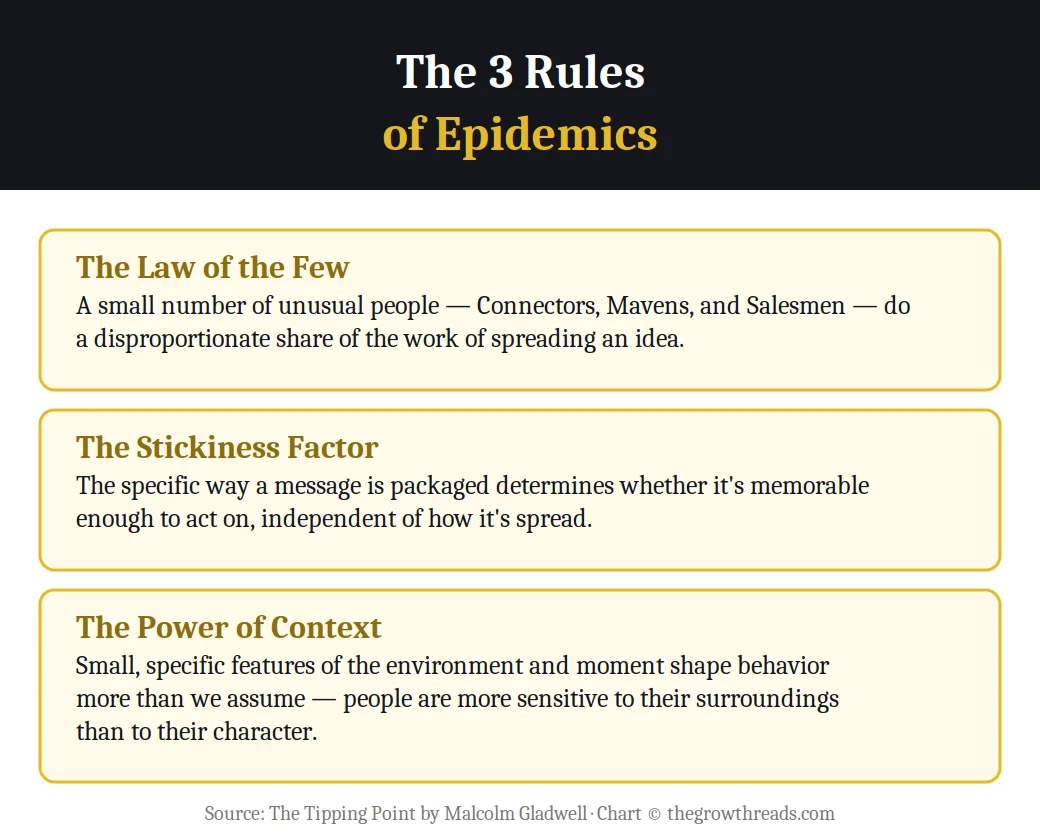
Trends, products, and behaviors don’t spread gradually — they spread like epidemics, quietly building until they suddenly tip into widescale adoption. Malcolm Gladwell’s breakout book, first published in 2000, argues that three specific factors determine whether an idea tips: the Law of the Few, meaning a small number of unusual people — Connectors, Mavens, and Salesmen — do a disproportionate share of the work of spreading it; the Stickiness Factor, meaning the specific way a message is packaged determines whether it’s memorable enough to act on; and the Power of Context, meaning small, particular features of the environment and moment shape behavior far more than most people assume. Together, these three rules explain why some ideas catch on explosively while other, seemingly better ideas quietly fail to spread at all.
Key takeaways
- Social epidemics follow the same logic as disease epidemics: a small initial change can cascade into a large-scale shift once specific conditions are met.
- Connectors have unusually large, diverse social networks: they introduce ideas across otherwise separate social worlds that would rarely intersect on their own.
- Mavens accumulate and share information out of genuine motivation: they aren’t trying to sell you anything — they simply want to help, which makes their recommendations especially trusted.
- Salesmen have a persuasive charisma that’s hard to name but easy to feel: their enthusiasm is often more contagious than the actual content of their pitch.
- Stickiness is about packaging, not just content: the exact same information can succeed or fail to spread depending on small, testable changes in how it’s presented.
- Context can override character: Gladwell argues people are far more sensitive to their immediate environment and circumstances than to fixed personality traits.
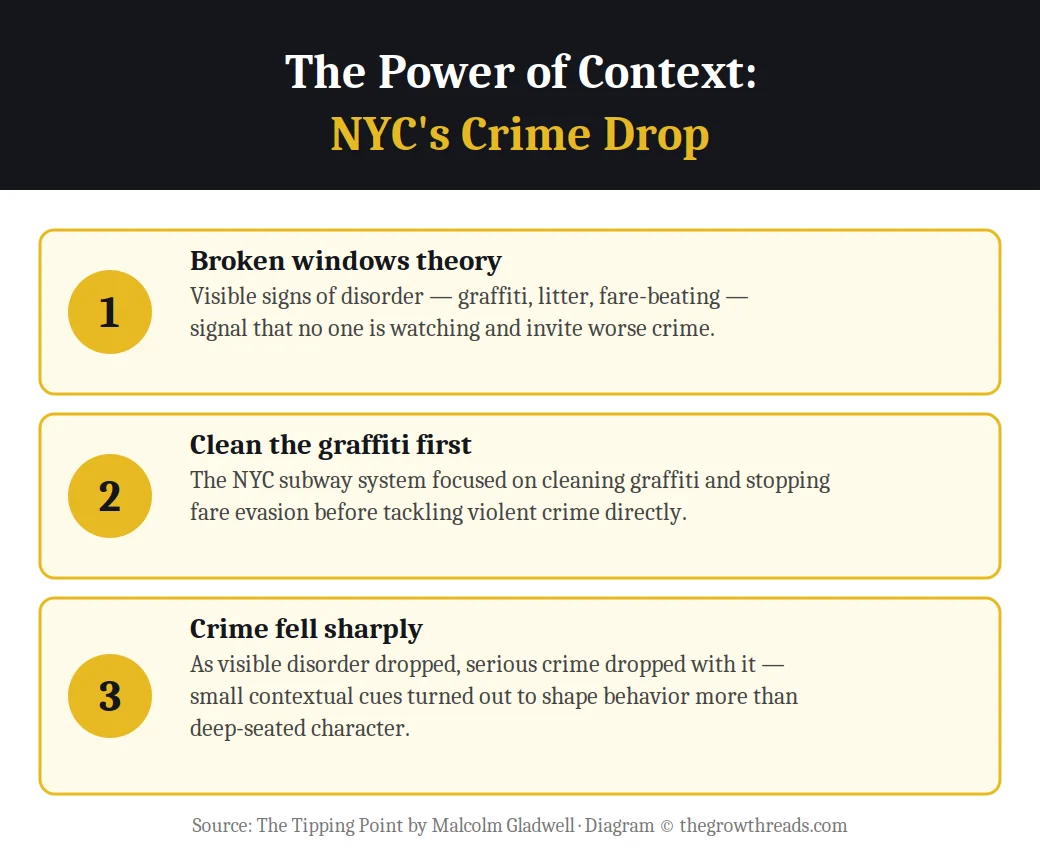
- The Broken Windows theory shows context in action: visible signs of disorder, like graffiti and fare-beating, signal permissiveness that invites more serious crime — and cleaning them up measurably reduced crime in New York City’s subway system.
- The Rule of 150 sets a natural limit on group cohesion: once a group’s size crosses roughly 150 people, personal relationships and shared understanding start to break down, which is why companies like Gore-Tex deliberately cap facility size.
- Small, deliberate changes can tip an entire system: the same underlying idea can go from ignored to unstoppable based on subtle shifts in who spreads it, how it’s framed, or where it’s introduced.
What is The Tipping Point about?
The Tipping Point is Malcolm Gladwell’s argument that ideas, products, and behaviors spread through society the same way epidemics spread through a population — quietly building, then suddenly crossing a threshold into widescale, self-sustaining adoption. Drawing on examples ranging from fashion trends and children’s television to crime rates and product launches, Gladwell identifies three specific rules that determine whether something tips: who spreads it (the Law of the Few), what makes it memorable (the Stickiness Factor), and where and when it takes hold (the Power of Context).
About the author
Malcolm Gladwell is a Canadian-British journalist and longtime staff writer for The New Yorker who, with The Tipping Point in 2000, became one of the most influential popularizers of social science ideas in the world. The book was Gladwell’s first, and it established the signature approach he would repeat across his career: blending counterintuitive research findings with vivid, specific storytelling to make complex academic ideas accessible well outside academic circles. He went on to write Blink, Outliers, and Talking to Strangers, among other books, and co-founded the audio company Pushkin Industries. Explore all Malcolm Gladwell book summaries →
Key concepts at a glance
| Concept | What it means | Use it when |
|---|---|---|
| The Law of the Few | Connectors, Mavens, and Salesmen do a disproportionate share of spreading an idea | You’re trying to figure out who to reach first with a new idea or product |
| The Stickiness Factor | The specific packaging of a message determines whether it’s memorable enough to act on | An idea isn’t spreading despite reaching plenty of people |
| The Power of Context | Small, specific environmental and situational factors shape behavior more than fixed character | You want to change behavior by changing surroundings, not persuading people directly |
| Broken Windows theory | Visible disorder signals permissiveness and invites more serious problems | You’re diagnosing why a small, visible issue seems to be enabling bigger ones |
| The Rule of 150 | Group cohesion and shared understanding tend to break down above roughly 150 people | You’re deciding how large to let a team, community, or facility grow before splitting it |
Part 1: The Law of the Few
Gladwell’s first rule holds that social epidemics are disproportionately driven by a small number of unusual people rather than spreading evenly through a population. He identifies three specific types: Connectors, who have unusually large and diverse social networks and introduce ideas across social worlds that would otherwise rarely intersect; Mavens, who accumulate detailed knowledge and feel a genuine, non-commercial need to share it, which makes their recommendations especially credible; and Salesmen, who have a persuasive charisma that makes people want to agree with them, independent of the specific content of what they’re saying.
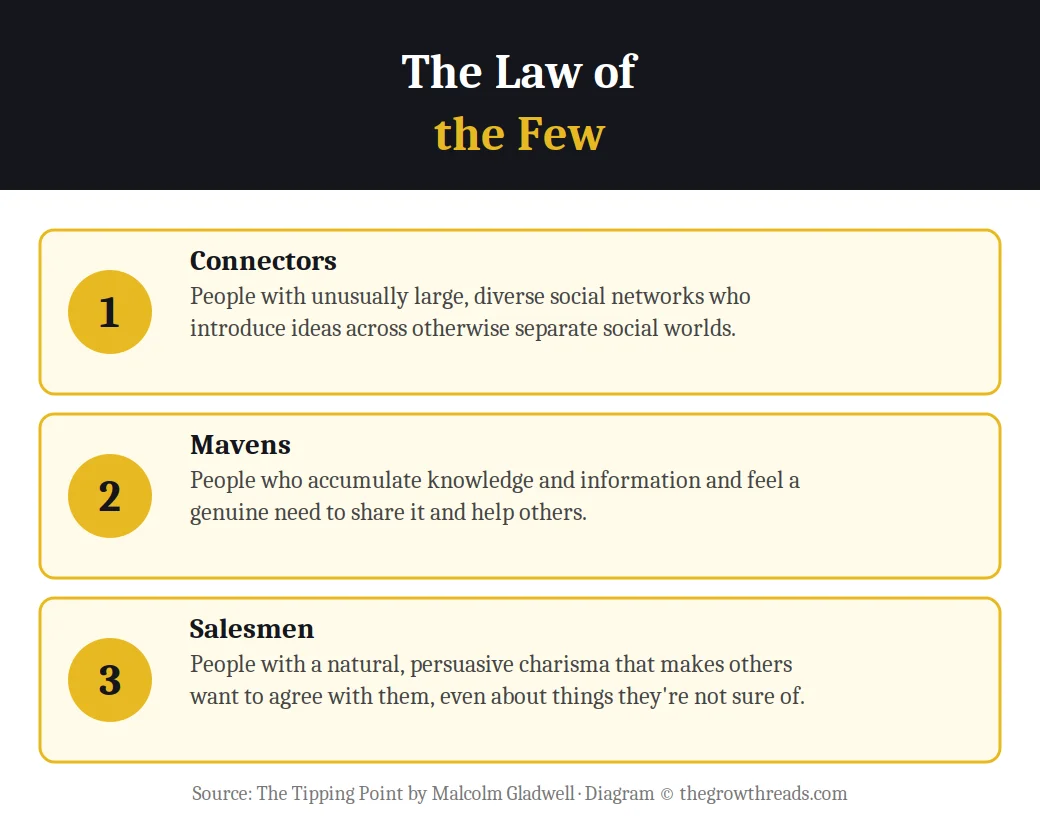
The practical implication is that reaching a large, undifferentiated audience is often less effective than reaching the specific handful of Connectors, Mavens, and Salesmen embedded within it. An idea that reaches the right few people can travel further and faster than the same idea broadcast widely but landing on people without the specific social role to spread it further.
TGR Note: The Law of the Few pairs naturally with Outliers‘ broader argument that outcomes depend heavily on structural position and opportunity, not just individual merit — both books push back on purely individualistic explanations for who succeeds or spreads an idea.
Part 2: The Stickiness Factor
Gladwell’s second rule addresses why some messages get remembered and acted on while others, reaching the same number of people, simply fade. Stickiness isn’t primarily about the underlying quality of an idea — it’s about the specific way it’s packaged: how simple, specific, and appropriately matched to its audience the message is. Small, seemingly minor changes to presentation can dramatically change whether a message sticks, independent of who’s delivering it or how widely it’s initially shared.
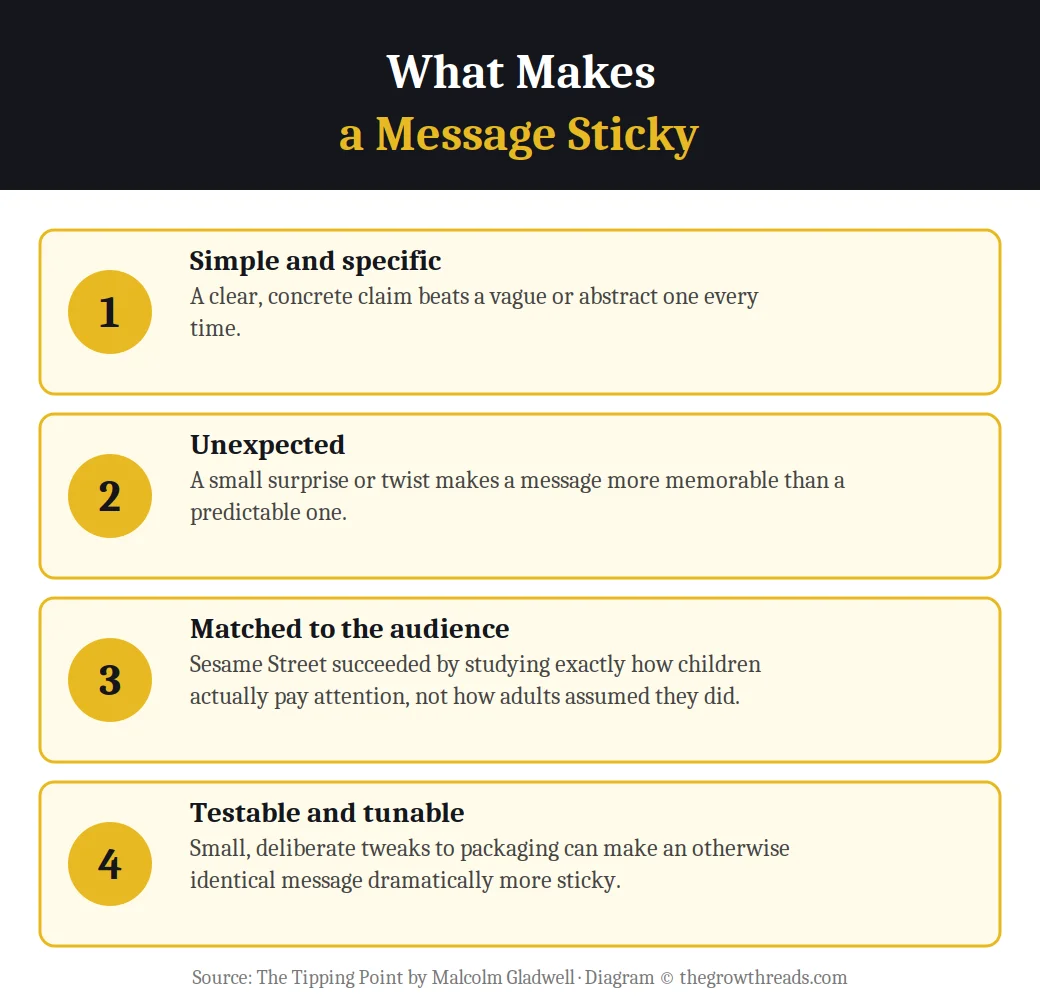
Gladwell’s central case study for stickiness is Sesame Street, whose creators discovered that children’s attention wasn’t driven by stimulation or excitement the way adults assumed, but by comprehension — kids watched when they understood what was happening and looked away when they were confused. Redesigning the show around that specific insight, rather than around adult intuitions about what should hold a child’s attention, is what made its educational content stick.
TGR Note: Stickiness is closely related to the ideas in Switch‘s “shrink the change” and “shape the path” concepts — both argue that how a message or change is framed and structured matters as much as the substance behind it.
Part 3: The Power of Context
Gladwell’s third rule argues that people are far more sensitive to specific features of their immediate environment and circumstances than to fixed, underlying character traits. His central illustration is the Broken Windows theory: visible signs of disorder, like graffiti and fare-beating on the New York City subway, signal that no one is watching or enforcing norms, which invites progressively more serious crime. When the city focused on cleaning graffiti and stopping fare evasion — addressing small, visible context rather than crime directly — serious crime dropped sharply as a result.
Gladwell extends the Power of Context to group size with the Rule of 150, drawing on research suggesting humans have a cognitive limit on how many genuine social relationships they can maintain at once. Companies like Gore-Tex have deliberately capped individual facility size at around 150 employees, on the theory that beyond that threshold, shared understanding and cohesion start to break down, splitting the group into cliques that no longer transmit ideas or norms as effectively.
TGR Note: The Power of Context’s emphasis on environment over character connects directly to Nudge‘s case for behavioral “choice architecture” — both argue that redesigning small features of a situation changes behavior more reliably than appealing to willpower or character alone.
Part 4: Putting the three rules together
Gladwell’s examples throughout the book — from Hush Puppies’ surprise revival to teen smoking trends to the spread of syphilis in Baltimore — show the three rules working in combination rather than in isolation. A message might be perfectly sticky but never reach the right Connectors and Mavens to spread; a Salesman might successfully spread an idea that isn’t sticky enough to be retained; and even a sticky message spread by the right people can fail if the surrounding context doesn’t support the behavior it’s trying to trigger.
The book’s broader implication is one of both opportunity and responsibility: because tipping points are sensitive to small, specific interventions, meaningful change doesn’t always require massive resources or sweeping effort — it can come from correctly identifying the few people, the right packaging, or the specific contextual lever that will let an idea cross its threshold and spread on its own.
Who is The Tipping Point best for — and who should read something else first?
This book is best for marketers, founders, public health communicators, and anyone curious about why certain ideas, products, or behaviors spread explosively while others don’t, despite similar merit. It rewards readers who enjoy narrative-driven nonfiction with wide-ranging examples over dense academic argument.
If your interest is specifically in why individual snap judgments succeed or fail, rather than how ideas spread across groups, Blink, Gladwell’s own follow-up, is a natural next step. If you want a deeper look at what produces individual extraordinary success rather than the spread of ideas, Outliers addresses that related but distinct question. And if you’re specifically focused on designing environments and choices to shift behavior, Nudge offers a more systematic, decision-science approach to the same underlying insight about context.
Questions to reflect on
- Thinking of an idea you’re trying to spread, who are the Connectors, Mavens, and Salesmen in your network who could carry it further than you can alone?
- Is your message actually sticky, or does it just need to reach more people — and how would you know the difference?
- What’s one small, visible feature of your environment (workplace, home, community) that might be quietly signaling permissiveness for behavior you don’t want?
- Have you ever seen a group or team cross a size threshold where cohesion or shared understanding visibly broke down?
- Which of the three rules — the Few, Stickiness, or Context — is most likely the missing ingredient for an idea you’ve tried and failed to spread?
🔥 Ready to understand why ideas actually spread?
This guide covers the three rules — the book gives you Gladwell’s full case studies and the research behind each one.
How to apply The Tipping Point (7-day plan)
- Day 1: Identify one idea, project, or product you’re trying to spread, and name your actual goal for it tipping.
- Day 2: Map the Connectors, Mavens, and Salesmen in your own network who could carry that idea further.
- Day 3: Test one change to how the idea is packaged or framed to make it more specific and memorable.
- Day 4: Identify one small, visible feature of your environment that might be shaping behavior more than you realized.
- Day 5: Share the idea with one specific Connector or Maven rather than broadcasting it broadly.
- Day 6: Review whether a group you’re part of has crossed a size threshold that’s affecting its cohesion.
- Day 7: Reflect on which of the three rules — Few, Stickiness, Context — is the weakest link in your own tipping point.
Frequently asked questions
What is the main idea of The Tipping Point?
The Tipping Point argues that ideas, products, and behaviors spread through society the same way epidemics spread through a population, driven by three factors: the Law of the Few (who spreads it), the Stickiness Factor (what makes it memorable), and the Power of Context (where and when it takes hold).
What are Connectors, Mavens, and Salesmen?
These are the three types of unusual people Gladwell identifies as disproportionately responsible for spreading ideas. Connectors have unusually large, diverse social networks; Mavens accumulate and share knowledge out of genuine motivation; Salesmen have a persuasive charisma that makes others want to agree with them.
What is the Stickiness Factor?
The Stickiness Factor is the idea that the specific way a message is packaged — its simplicity, specificity, and fit with its audience — determines whether it’s memorable enough for people to act on, independent of how widely it’s initially shared.
What is the Broken Windows theory in The Tipping Point?
Broken Windows theory holds that visible signs of disorder, like graffiti or fare-beating, signal that no one is enforcing norms and invite more serious problems. Gladwell cites New York City’s focus on cleaning graffiti and stopping fare evasion as a key factor in the subway’s sharp crime drop.
What is the Rule of 150?
The Rule of 150 refers to a proposed cognitive limit on the number of genuine social relationships a person can maintain. Gladwell cites companies like Gore-Tex that cap facility size at around 150 employees to preserve group cohesion and effective idea transmission.
Is The Tipping Point based on scientific research?
The book draws on social science research, epidemiology, and psychology, combined with journalistic case studies and storytelling. Some of Gladwell’s specific examples and interpretations have been debated by researchers, but the core three-rules framework remains widely referenced.
How is The Tipping Point different from Gladwell’s other books?
The Tipping Point, Gladwell’s first book, focuses on how ideas and trends spread across groups. Blink focuses on individual snap judgments, Outliers focuses on what produces individual extraordinary success, and Talking to Strangers focuses on why people misjudge those they don’t know.
Related summaries
If The Tipping Point resonated, these dig further into related territory: Outliers on the hidden advantages behind extraordinary success, Blink on the power and pitfalls of snap judgments, and Nudge on designing environments to shift behavior. For more, see our best psychology books pillar page.
How we analyze books: We work from the full book — reconstructing its core arguments in our own words, adding commentary that connects it to related research and other books in our library, and pressure-testing the advice in a practical 7-day plan. Ratings weigh usefulness, readability, and evidence quality. Read our full methodology.
Related Psychology Summaries
Sapiens Summary & Review: How Shared Fictions Built the Modern World
The Courage to Be Disliked Summary & Review: The Adlerian Path to Freedom
The Defining Decade Summary & Review: Why Your Twenties Matter
The Happiness Hypothesis Summary & Review: Finding Modern Truth in Ancient Wisdom
The Laws of Human Nature Summary & Review: Decode What Drives People