

★★★★☆ 4.1/5
One-liner: A no-nonsense blueprint for building wealth quickly on an ordinary salary by attacking housing costs, increasing income, and deploying savings into real estate and index funds.
Best for: Young professionals and early-career workers who want to reach financial independence in ten to fifteen years without waiting for a high salary or a lucky break.
Reading time: ~5 hours (260 pages)
Difficulty to apply: Moderate to high — requires significant lifestyle changes, especially around housing.
Set for Life in One Minute
Financial freedom is not about earning a fortune — it is about deploying an ordinary income with extraordinary discipline. Scott Trench, CEO of BiggerPockets, lays out a three-stage wealth-building blueprint for people starting with nothing. Stage one is the frugality stage: slash your biggest expense (housing) and save your first twenty-five thousand dollars as fast as possible. Stage two is the income stage: use that financial runway to take career risks — negotiate raises, switch jobs, build side hustles — and push your income higher. Stage three is the investment stage: deploy your accumulated capital into real estate (particularly house hacking) and low-cost index funds, letting compound returns carry you to financial independence. The book is aggressive, practical, and built for people who want to reach freedom in their thirties rather than their sixties.
Key Takeaways
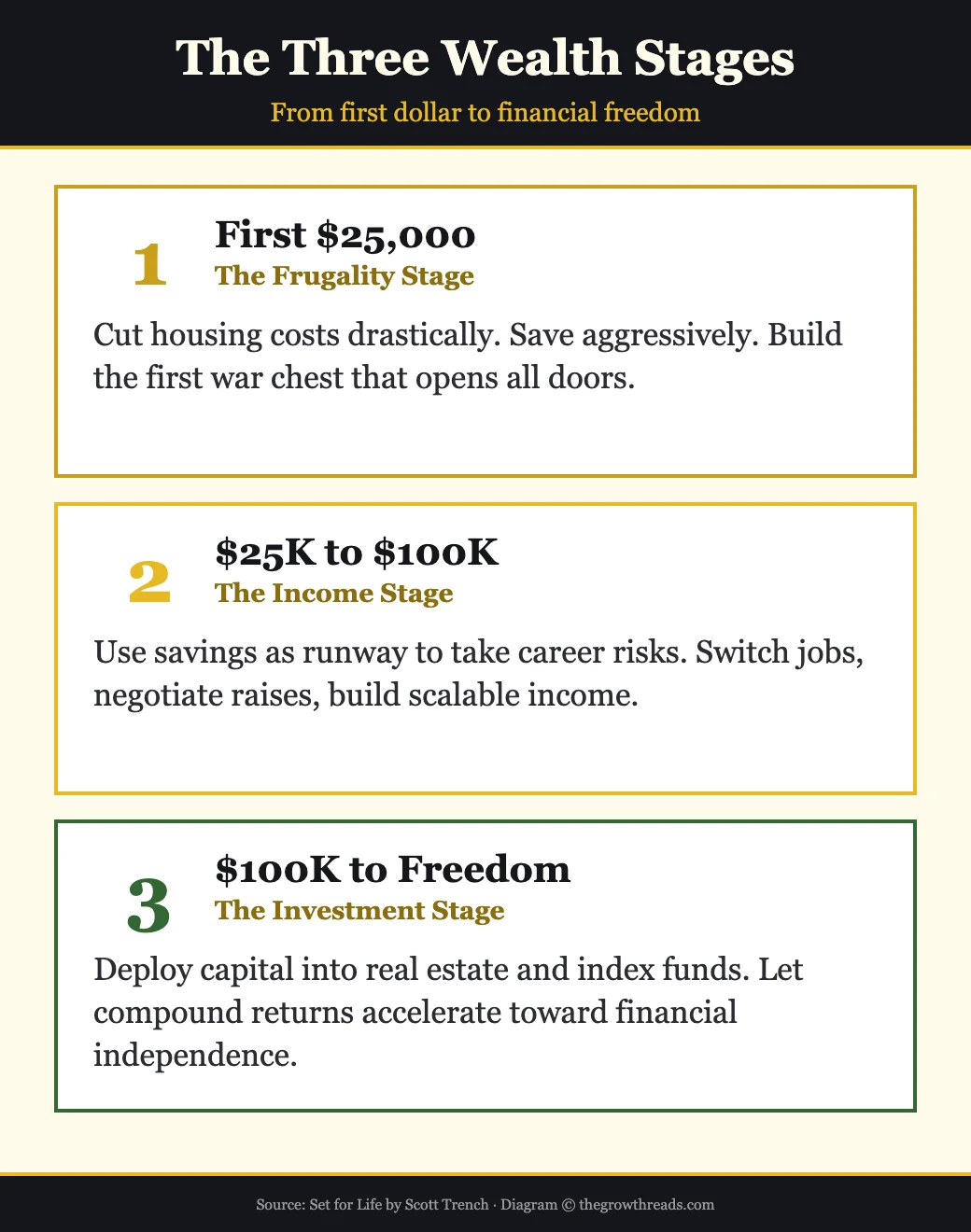
- Three stages define the path: Frugality first (save your first $25K), then income growth ($25K to $100K), then investment deployment ($100K to freedom).
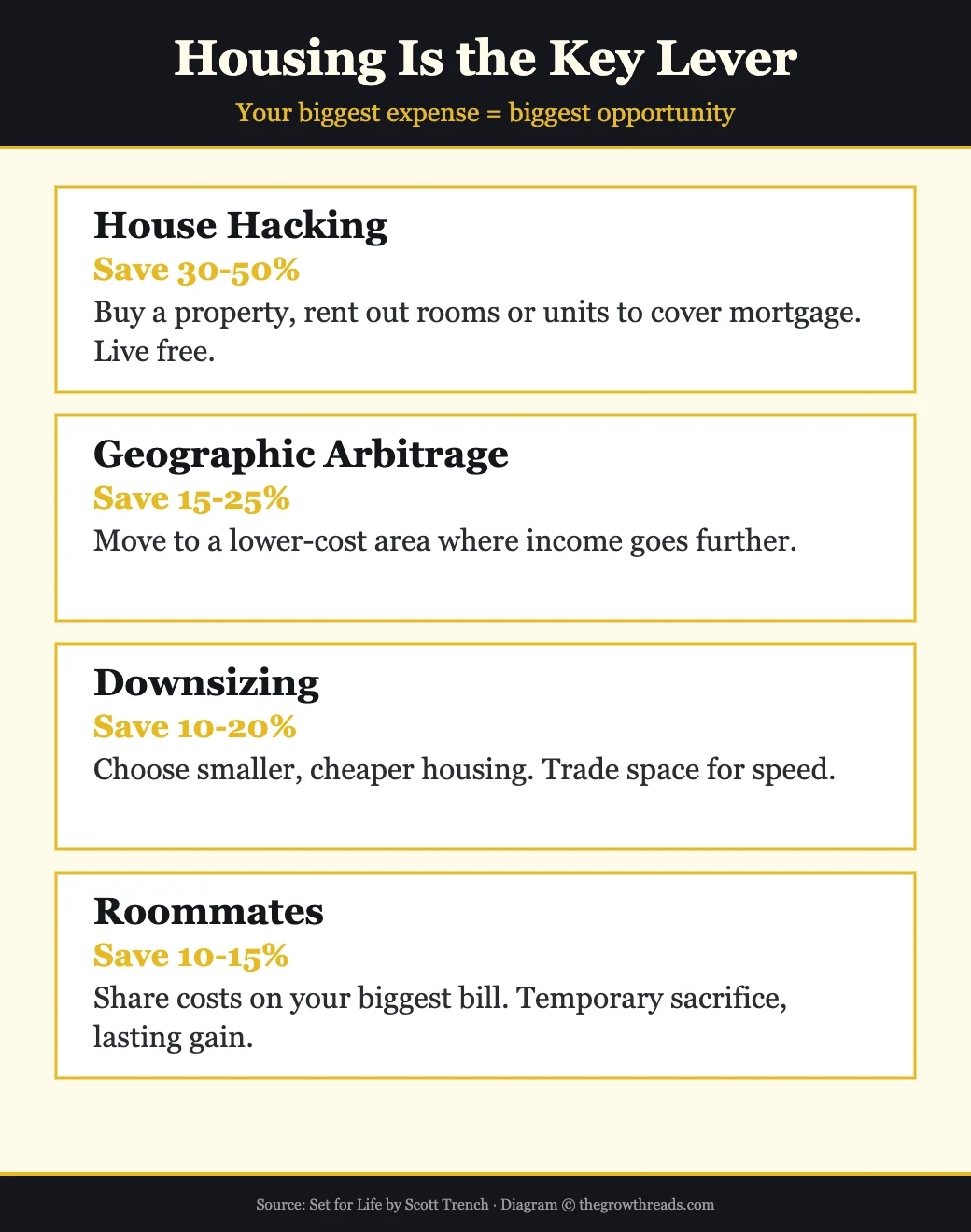
- Housing is the biggest lever: Most people spend thirty to fifty percent of income on housing. House hacking — buying a property and renting out rooms or units — can eliminate this cost entirely.
- Frugality has a floor, income does not: You can only cut expenses so far. The path to acceleration is increasing your earning power through skill-building, job changes, and side businesses.
- Your first $25,000 changes everything: The first chunk of savings creates options — an emergency fund, the ability to take career risks, and the down payment for a house hack.
- House hacking is the wealth accelerator: Living in one unit of a multi-unit property while renting the others can cover your mortgage and build equity simultaneously.
- Index funds are the foundation: Low-cost, diversified index funds provide reliable long-term returns without requiring expertise or active management.
- The 4% rule defines your number: Financial independence means your investment portfolio generates enough passive income (roughly four percent annually) to cover your living expenses.
- Career optimization is an investment: Spending money on education, certifications, networking, and skill development generates returns that compound throughout your career.
- Track your net worth obsessively: Net worth is the single number that measures your financial progress. Track it monthly and optimize for its growth.
- Speed matters: The earlier you start and the more aggressively you save, the more time compound interest has to do the heavy lifting.
What Is Set for Life About?
Set for Life presents a three-stage blueprint for reaching financial independence on an ordinary salary: save aggressively by slashing housing costs, grow income through career optimization and side hustles, then deploy capital into real estate and index funds. Designed for young professionals who want freedom in ten to fifteen years.
About the Author
Scott Trench is the CEO of BiggerPockets, the largest online community of real estate investors with over two million members. He joined BiggerPockets in his early twenties and used the strategies described in Set for Life to achieve financial independence himself — house hacking, aggressively saving, and investing in real estate while building his career. Trench writes from direct personal experience rather than theory, having tested every strategy in the book on his own finances. He is also the host of the BiggerPockets Money podcast, where he interviews people who have achieved financial independence through various paths. Explore all Scott Trench book summaries →
Key Concepts at a Glance
| Concept | What It Means | Use It When |
|---|---|---|
| Three Wealth Stages | Sequential phases: frugality → income growth → investment deployment | You want a clear roadmap from zero to financial independence |
| House Hacking | Buying a property and renting units/rooms to eliminate housing costs | Housing is your biggest expense and you want to neutralize it |
| The First $25K | Your initial savings that create options and a safety net | You are starting from scratch and need a first milestone |
| 4% Rule | Your portfolio can sustain annual withdrawals of 4% indefinitely | You want to calculate your financial independence number |
| Income Optimization | Treating your career as an investment with compounding returns | You have cut expenses but need to grow the income side |
| Net Worth Tracking | Monthly monitoring of assets minus liabilities as your primary metric | You want one number that captures your entire financial progress |
Part 1: The Frugality Stage — Saving Your First $25,000
Trench begins with what he calls the most important stage: saving your first twenty-five thousand dollars. This money is not just savings — it is options. It is an emergency fund that prevents financial setbacks from becoming financial disasters. It is a down payment for a house hack. It is the runway that allows you to take career risks without fear.
The key lever in this stage is housing. Trench argues that most personal finance advice focuses on cutting small expenses — lattes, subscriptions, dining out — while ignoring the elephant in the room. Housing typically consumes thirty to fifty percent of income, and reducing it by even half frees up more money than cutting every small expense combined. His recommendations are aggressive: get roommates, move to a cheaper area, or start house hacking as soon as possible.
The frugality stage also requires tracking every dollar. Trench recommends calculating your savings rate — the percentage of take-home pay you save — and treating it as your most important financial metric. A fifty percent savings rate means you are saving one year of expenses for every year you work. At that rate, financial independence is mathematically possible within fifteen to twenty years even without any income growth.
Part 2: The Income Stage — Growing from $25K to $100K
Once you have your first twenty-five thousand dollars saved, frugality alone is no longer enough. Trench shifts focus to income growth, arguing that there is a floor to how much you can cut but no ceiling to how much you can earn. This stage is about treating your career as an investment with compounding returns.
Trench recommends aggressive career optimization: negotiate raises with data, switch companies every two to three years for salary jumps, build marketable skills that command premium pay, and develop side income streams that are scalable. He is particularly bullish on skills that transfer across industries — sales, management, marketing, and financial analysis — because they provide optionality.
The income stage also introduces real estate investing, specifically house hacking. Trench details the mechanics: buy a duplex, triplex, or fourplex with an FHA loan requiring as little as three and a half percent down, live in one unit, and rent the others. If the rental income covers the mortgage, you have effectively eliminated your largest expense while building equity and learning the basics of real estate investing. This single strategy, Trench argues, is the most powerful wealth accelerator available to ordinary wage earners.
Part 3: The Investment Stage — $100K to Financial Freedom
With one hundred thousand dollars or more in accumulated savings and a growing income, the third stage shifts to investment deployment. Trench advocates a dual approach: low-cost index funds for simplicity and long-term growth, plus real estate for leveraged returns and tax advantages.
For index fund investing, Trench keeps it simple: total stock market index funds with low expense ratios, held in tax-advantaged accounts (401k, IRA, HSA) to the maximum extent possible. He recommends maxing out employer matches first, then Roth IRAs, then taxable brokerage accounts. The strategy is buy-and-hold for decades — no market timing, no individual stock picking, no complexity.
For real estate, Trench recommends continuing the house hacking strategy — buying a new property every one to two years, moving into it, and converting the previous property into a full rental. Over five to ten years, this builds a portfolio of rental properties generating passive income while the mortgages are paid down by tenants. Combined with index fund growth, this dual approach can achieve financial independence — the point where passive income exceeds living expenses — in ten to fifteen years on an ordinary salary.
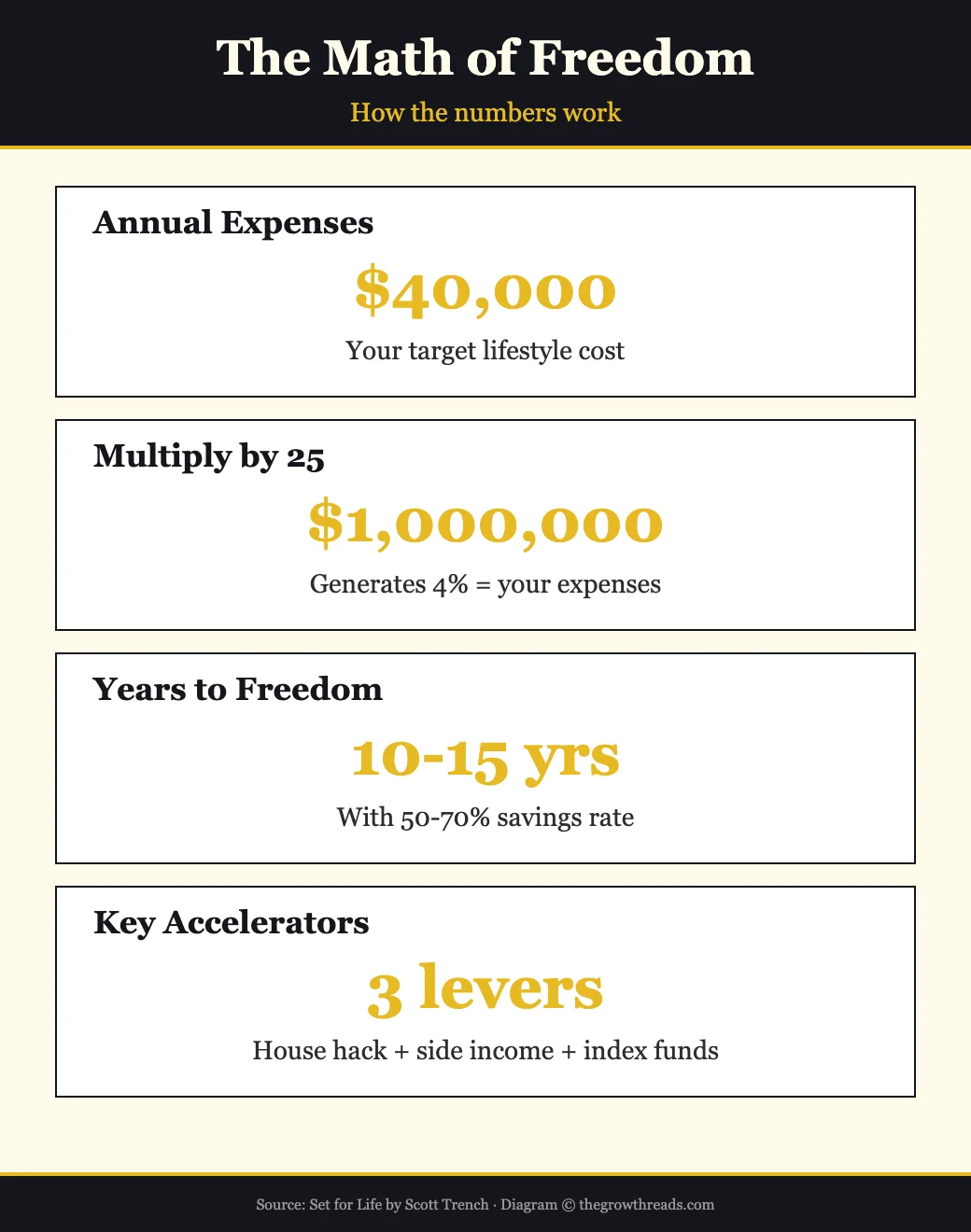
The math is straightforward: if your annual expenses are forty thousand dollars, you need one million dollars in investments generating four percent annually (the 4% rule). With a fifty to seventy percent savings rate, aggressive income growth, and leveraged real estate returns, reaching this number in a decade is ambitious but achievable.
Who Is Set for Life Best For — and Who Should Read Something Else First?
Set for Life is ideal for young professionals in their twenties and early thirties who are willing to make aggressive lifestyle changes — particularly around housing — to accelerate their path to financial independence. It is especially valuable for people interested in real estate investing and house hacking as wealth-building tools.
If you are looking for a less aggressive approach to building wealth, The Simple Path to Wealth provides a calmer, index-fund-focused path. If you want foundational financial literacy before pursuing independence, I Will Teach You to Be Rich covers the basics more thoroughly. This content is educational — not financial advice. Consider your own situation before making financial decisions.
Questions to Reflect On
- What percentage of your take-home pay do you currently save — and what would it take to double that number?
- Could you reduce your housing costs by twenty percent or more through house hacking, roommates, or downsizing?
- When was the last time you negotiated your salary or seriously explored higher-paying opportunities?
- Do you have a side income stream — and if not, what skill could you monetize within the next ninety days?
- What is your financial independence number, and how many years away are you at your current savings rate?
🔥 Ready to Set Yourself Up for Life?
Learn the three-stage blueprint for reaching financial independence on an ordinary salary in ten to fifteen years.
How to Apply Set for Life (7-Day Plan)
- Day 1 — Calculate your savings rate: Total last month’s income and savings. Divide savings by income. This percentage is your most important financial number.
- Day 2 — Audit your housing cost: Calculate what percentage of income goes to housing. Research house hacking, roommate, or downsizing options in your area.
- Day 3 — Set your $25K milestone: If you do not have $25,000 saved, calculate how long it will take at your current rate. Then calculate how much faster you could reach it with reduced housing costs.
- Day 4 — Assess your earning potential: Research what your role pays at competing companies. Identify one skill or certification that would increase your market value.
- Day 5 — Calculate your FI number: Multiply your annual expenses by 25. This is the investment portfolio that would sustain your lifestyle indefinitely through the 4% rule.
- Day 6 — Start investing: If you are not already investing, open an account with a low-cost brokerage and set up an automatic monthly investment into a total stock market index fund.
- Day 7 — Build your 5-year plan: Map out the three stages against your personal timeline. Set specific milestones for savings, income growth, and investment targets for each year.
Frequently Asked Questions
What is house hacking?
House hacking means buying a property — typically a duplex, triplex, or fourplex — living in one unit, and renting out the others. The rental income covers your mortgage payment, effectively eliminating your largest expense. You can also house hack a single-family home by renting spare rooms. The strategy builds equity, generates investment experience, and dramatically increases your savings rate, making it one of the most powerful wealth-building tools for ordinary earners.
What are the three wealth stages?
Stage one is frugality: slash expenses, especially housing, and save your first $25,000. Stage two is income growth: use your financial runway to negotiate raises, switch jobs, and build side income. Stage three is investment: deploy accumulated capital into real estate and index funds, letting compound returns carry you to financial independence. Each stage has a different primary focus but builds on the previous one.
What is the 4% rule?
The 4% rule states that a diversified investment portfolio can sustain annual withdrawals of four percent indefinitely, adjusted for inflation. This means you need approximately twenty-five times your annual expenses invested to be financially independent. If you spend $40,000 per year, you need $1,000,000. If you spend $60,000, you need $1,500,000. The rule comes from the Trinity Study and is widely used in the financial independence community as a planning target. This is a general guideline, not personalized advice.
Is Set for Life too aggressive for most people?
Trench acknowledges that his approach requires significant lifestyle changes, particularly around housing. Not everyone is willing to house hack, get roommates, or move to a cheaper area. However, even applying the principles partially — saving a higher percentage of income, optimizing career earnings, investing consistently — produces meaningful results. The three-stage framework scales to different levels of ambition and risk tolerance.
Do I need to invest in real estate?
No. Trench presents real estate as a powerful accelerator but acknowledges that index fund investing alone can achieve financial independence — it just takes longer without the leveraged returns of real estate. If managing properties does not appeal to you, a portfolio of low-cost index funds in tax-advantaged accounts is a perfectly valid path. The key principles — high savings rate, income growth, and consistent investing — work regardless of asset class.
What savings rate does Trench recommend?
Trench recommends saving fifty percent or more of take-home pay, especially in the early frugality stage. He argues that savings rate is the single most important determinant of how quickly you reach financial independence. At a fifty percent rate, you save one year of expenses for every year worked. At a seventy percent rate, you save 2.3 years of expenses per year worked. The math is aggressive but the logic is straightforward.
How does Set for Life compare to The Simple Path to Wealth?
Both books target financial independence but take different approaches. The Simple Path to Wealth focuses almost exclusively on index fund investing and takes a calmer, longer-term view. Set for Life is more aggressive and action-oriented, combining frugality, career optimization, and real estate investing into a compressed timeline. Collins writes for all ages; Trench writes specifically for young professionals who want to reach freedom in their thirties. They complement each other well.
Related Summaries
- The Simple Path to Wealth by JL Collins — the calmer, index-fund-focused path to financial independence.
- The Millionaire Fastlane by MJ DeMarco — an entrepreneurial approach to accelerated wealth building.
- The Psychology of Money by Morgan Housel — why behavior matters more than strategy in building wealth.
- Best Money Books — our complete guide to the top books on building wealth.
Related Money Summaries
Just Keep Buying Summary & Review: Data-Driven Wealth Building Made Simple
Rich Dad Poor Dad Summary & Review: The Asset Mindset That Actually Builds Wealth
The Automatic Millionaire Summary & Review: Build Wealth on Autopilot
The Intelligent Investor Summary & Review: Timeless Wisdom for Building Wealth
The Psychology of Money Summary & Review: Why Your Mindset Matters More Than Your Portfolio