

★★★★☆ 3.9/5
One-liner: The biggest threat to your investment returns is not the market — it is your own emotional reactions to the market.
Best for: Everyday investors who know what they should do with their money but keep making emotional decisions that cost them returns — and anyone who wants a simple, visual guide to better financial behavior.
Reading time: ~3 hours (176 pages)
Difficulty to apply: Low — the concepts are simple, but emotional discipline requires ongoing practice.
The Behavior Gap in One Minute
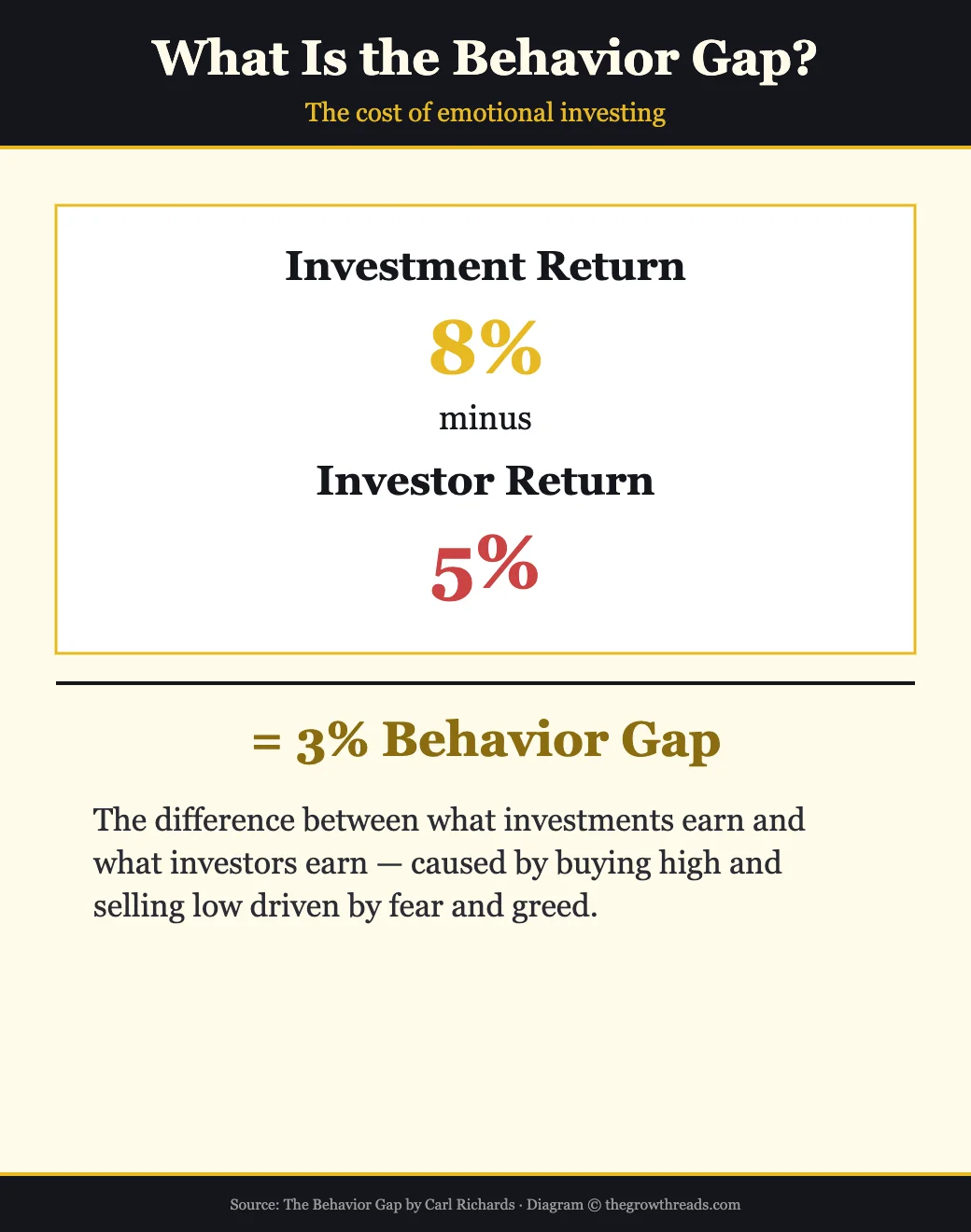
Investments earn eight percent, but investors earn five percent — the three percent difference is the behavior gap. Carl Richards, a certified financial planner and New York Times sketch columnist, reveals the simple but devastating truth that most investors underperform the very funds they invest in. The reason is not bad investment selection — it is bad investor behavior. People buy when markets are high (greed) and sell when markets are low (fear), systematically destroying value through emotional reactions. Richards argues that the solution is not more financial knowledge but better financial behavior: making a plan when calm, simplifying your portfolio, aligning spending with values, ignoring financial noise, and having an advisor who keeps you from making mistakes during market storms.
Key Takeaways
- The behavior gap is real and measurable: The difference between investment returns and investor returns consistently runs two to four percent per year, compounding into enormous wealth destruction over a lifetime.
- Emotions are the enemy of returns: Fear and greed drive the cycle of buying high and selling low — the exact opposite of what rational investing requires.
- Simplicity beats complexity: Complex portfolios invite tinkering and overthinking. A simple portfolio of low-cost index funds is harder to sabotage with emotional decisions.
- Plans made when calm outperform decisions made in storms: The time to decide your investment strategy is when markets are boring, not when they are crashing or soaring.
- Financial media makes you worse: Watching daily market commentary and reading financial news triggers emotional reactions that lead to behavior-gap-creating trades.
- Spending and saving are behavior problems too: The behavior gap extends beyond investing — spending more than you earn, failing to save, and ignoring insurance are all emotional decisions disguised as financial ones.
- Values-based spending reduces waste: When you align your spending with what genuinely matters to you, you naturally spend less on things that do not — creating more money to invest.
- A good advisor is a behavior coach: The primary value of a financial advisor is not stock-picking — it is preventing you from making emotional mistakes during market volatility.
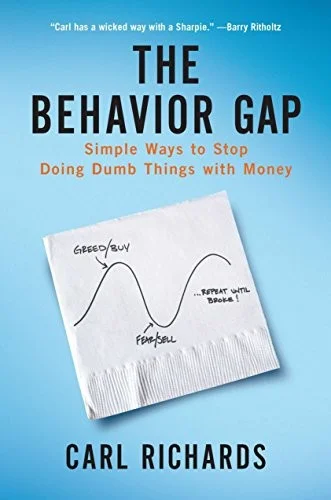
What Is The Behavior Gap About?
The Behavior Gap explains why investors consistently underperform their own investments due to emotional decision-making — buying high from greed and selling low from fear. Using simple sketches and clear language, Carl Richards provides a framework for closing this gap through planning, simplicity, and behavioral discipline.
About the Author
Carl Richards is a certified financial planner, the director of investor education at BAM Alliance, and the creator of the Sketch Guy column in the New York Times. Known for his ability to distill complex financial concepts into simple napkin sketches, Richards draws on over twenty years of experience as a financial advisor working with real clients who make real mistakes with real money. His approach emphasizes behavior over strategy, arguing that the financial industry’s focus on products and performance misses the biggest driver of investor outcomes: the investor’s own decisions. Explore all Carl Richards book summaries →
Key Concepts at a Glance
| Concept | What It Means | Use It When |
|---|---|---|
| The Behavior Gap | The difference between investment returns and investor returns, caused by emotional decisions | You want to understand why your returns are worse than your funds’ returns |
| Greed-Fear Cycle | The pattern of buying high during euphoria and selling low during panic | You feel the urge to make a trade based on market movement |
| Values-Based Spending | Aligning your spending with what genuinely matters to you | You want to spend less without feeling deprived |
| The Plan | An investment strategy made during calm times and followed during storms | You need a framework that survives market volatility |
| Simplicity Principle | Simple portfolios reduce the opportunity for emotional mistakes | Your portfolio is complex and you find yourself constantly tinkering |
| Noise Filter | Deliberately ignoring financial media and market commentary | You notice that financial news triggers emotional investment decisions |
Part 1: Understanding the Gap
Richards opens with the central insight that has defined his career: investments earn more than investors. Study after study confirms that the average mutual fund investor earns significantly less than the average mutual fund — not because they chose bad funds, but because they bought and sold at the wrong times. This is the behavior gap, and it is the most expensive mistake in personal finance.
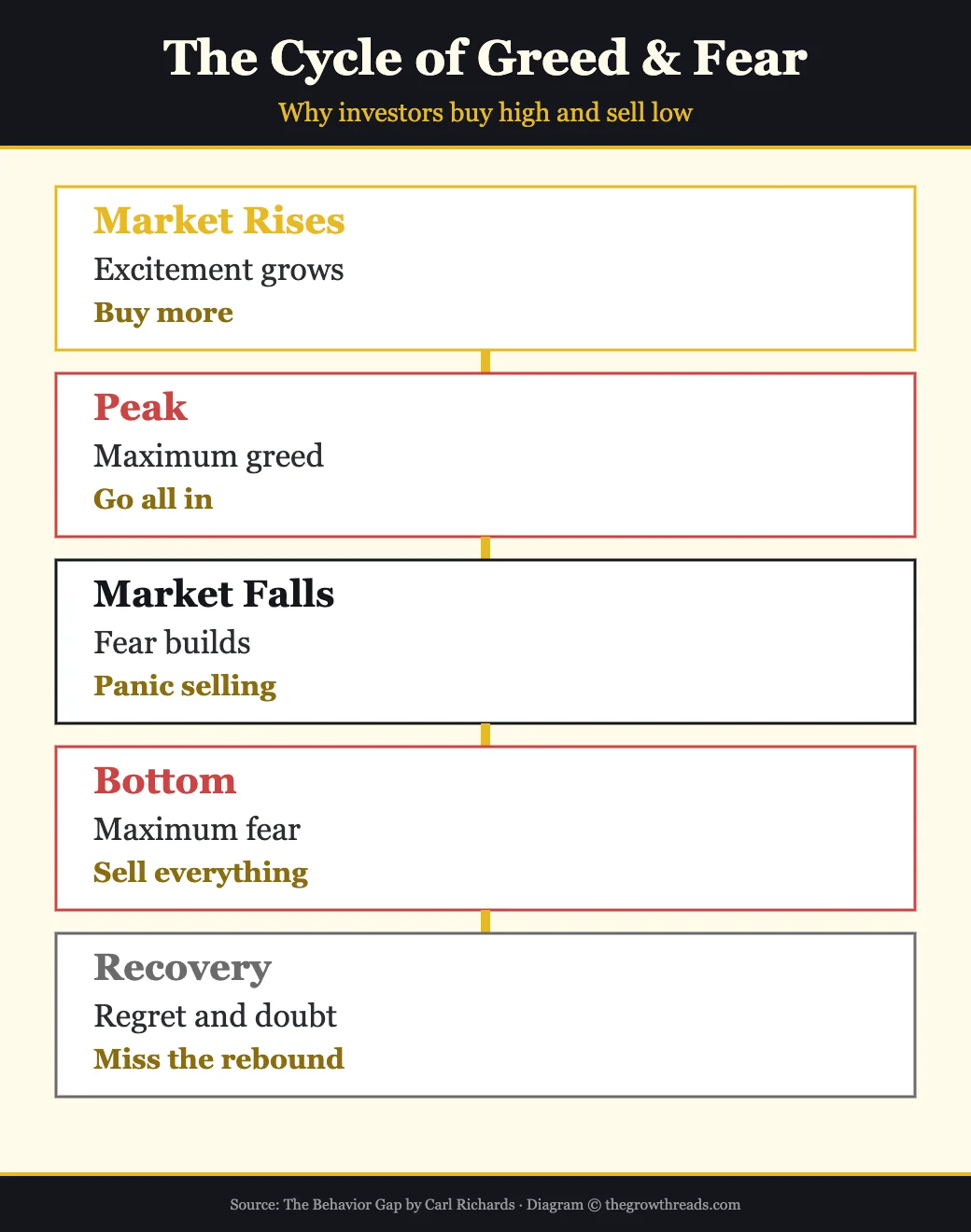
The mechanism is the greed-fear cycle. When markets rise, investors feel confident and pile in — buying at or near the peak. When markets fall, fear takes over and investors sell — locking in losses near the bottom. Then, when markets recover, they wait too long to get back in because the recent pain of losses is still vivid. This cycle — buy high, sell low, miss the recovery — reliably destroys two to four percent of annual returns. Over a thirty-year career, that compounds into hundreds of thousands of dollars in lost wealth.
Richards illustrates this with simple sketches that have become his trademark. A circle labeled “what we should do” and another labeled “what we actually do” with a gap between them — that gap is the behavior gap. It is not an information gap (most people know they should buy low and sell high). It is a behavior gap, driven by emotions that override knowledge in the moment.
Part 2: The Emotional Drivers
The middle section explores the psychological forces that create the behavior gap. Richards identifies overconfidence, loss aversion, recency bias, and herd behavior as the primary culprits. Overconfidence makes investors believe they can time the market — despite overwhelming evidence that even professionals cannot do so consistently. Loss aversion means the pain of a loss feels roughly twice as intense as the pleasure of an equivalent gain, making investors irrationally willing to sell during downturns to avoid further pain.
Recency bias causes investors to overweight recent events. After a long bull market, people assume stocks will continue rising indefinitely. After a crash, they assume the bottom has not been reached. And herd behavior — the instinct to follow the crowd — amplifies both greed and fear. When everyone around you is buying, it feels safe to buy. When everyone is selling, it feels dangerous not to sell. In both cases, the crowd’s behavior creates the very conditions that make following the crowd destructive.
Richards extends the behavior gap beyond investing to spending and saving. People overspend not because they do not know they should save, but because emotions — status anxiety, social comparison, the desire for instant gratification — override their knowledge. The spending behavior gap is just as real and just as costly as the investing behavior gap.
Part 3: Closing the Gap
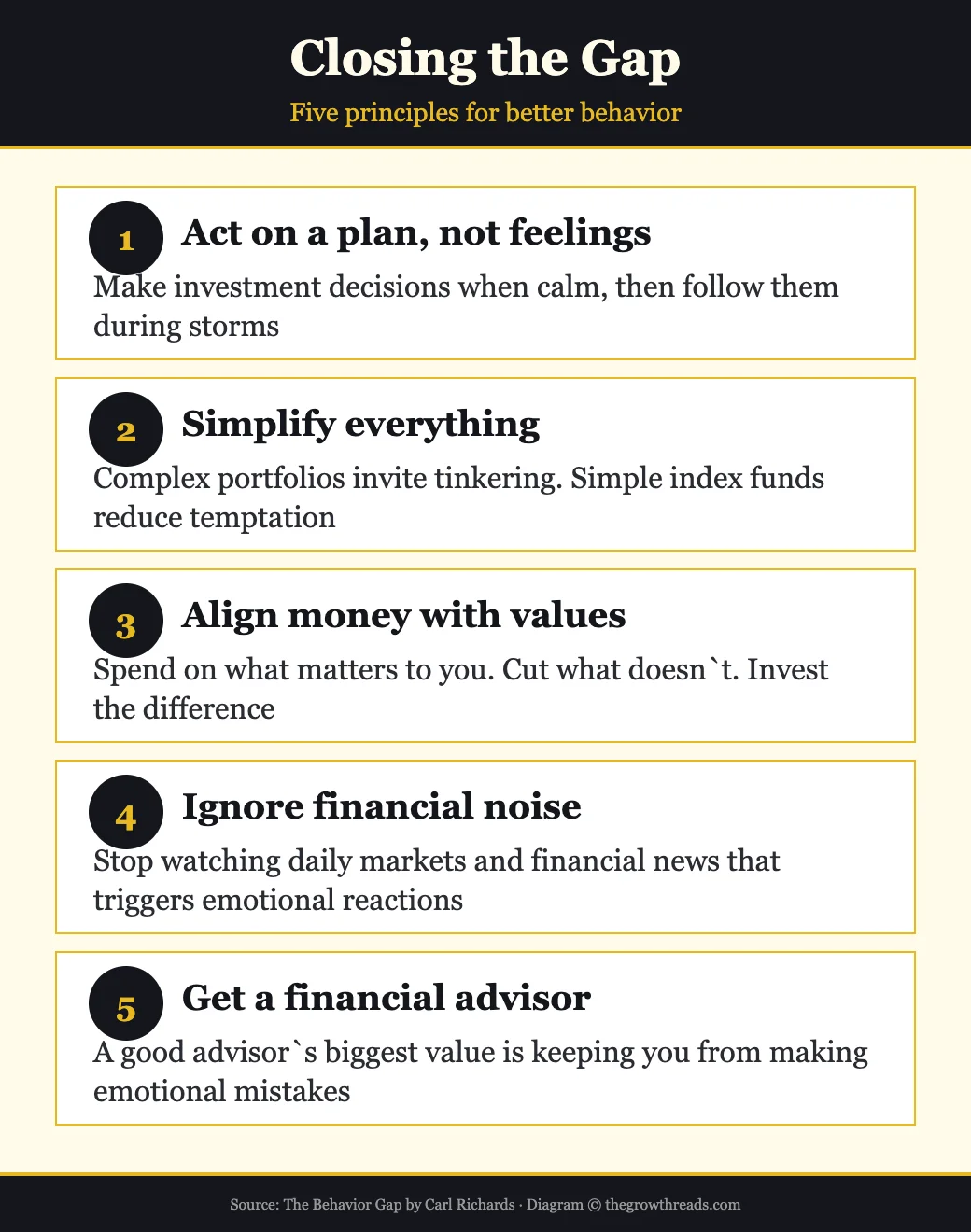
Richards’ solutions are deliberately simple. First, make a financial plan when you are calm — not during a market crash or a euphoric bull run. The plan should define your asset allocation, your savings rate, your timeline, and the circumstances under which you will make changes. Then, when emotions surge during market volatility, you follow the plan instead of your feelings.
Second, simplify your portfolio. Complex portfolios with dozens of funds, individual stocks, and alternative investments invite tinkering. Every holding is a temptation to make an emotional trade. A simple portfolio of two or three low-cost index funds — total stock market, total international, total bond — gives you broad diversification with almost nothing to tinker with.
Third, align your spending with your values. Richards asks clients a simple question: if you looked at your spending over the past year, would it reflect what you say matters most to you? For most people, the answer is no. Spending that aligns with genuine values creates satisfaction; spending that does not creates both financial waste and emotional emptiness. Cut the misaligned spending, and the savings fund your financial plan automatically.
Fourth, stop watching financial news. Every headline is designed to trigger an emotional reaction — and emotional reactions are precisely what create the behavior gap. Richards recommends checking your portfolio quarterly at most, and never making a trade the same day you read financial news.
Fifth, consider working with a financial advisor — but not for investment selection. The primary value of a good advisor is behavioral coaching: someone who talks you out of selling during a crash and buying during a bubble. Richards estimates this behavioral coaching is worth far more than any fund-selection alpha.
Who Is The Behavior Gap Best For — and Who Should Read Something Else First?
The Behavior Gap is perfect for everyday investors who understand the basics of investing but keep making emotional mistakes. It is especially valuable for people who check their portfolio daily, who feel anxious during market drops, or who have a history of buying high and selling low. The book is short, visual, and immediately applicable.
If you want a more comprehensive investing education, start with The Simple Path to Wealth or The Psychology of Money. If your challenge is not investing behavior but basic financial literacy, I Will Teach You to Be Rich covers the foundations more thoroughly.
Questions to Reflect On
- When was the last time you made an investment decision based on emotion rather than your plan — and what did it cost you?
- How often do you check your portfolio, and does that frequency help or hurt your decision-making?
- If you looked at your spending over the past month, would it reflect what you say matters most to you?
- Do you have a written investment plan that tells you what to do during a market crash?
- What financial media do you consume, and does it make you calmer or more anxious about your money?
🔥 Ready to Stop Sabotaging Your Returns?
Learn why the biggest threat to your wealth is not the market — it is your own behavior — and how to close the gap.
How to Apply The Behavior Gap (7-Day Plan)
- Day 1 — Calculate your personal behavior gap: Compare your actual investment returns over the past five years to the returns of the funds you invested in. The difference is your behavior gap.
- Day 2 — Write your investment plan: In one page, define your asset allocation, savings rate, and the specific conditions under which you will buy, sell, or rebalance. Post it where you will see it.
- Day 3 — Simplify your portfolio: List every holding and ask: does this add genuine diversification, or is it adding complexity that invites tinkering? Consolidate where possible.
- Day 4 — Audit your spending against values: Review last month’s spending. Highlight items that align with your top three values and items that do not. Calculate the gap.
- Day 5 — Cut one financial media source: Unsubscribe from one financial newsletter, unfollow one market commentator, or delete one investing app from your phone.
- Day 6 — Set a portfolio check schedule: Decide how often you will look at your investments — monthly or quarterly — and set a calendar reminder. Delete daily alerts.
- Day 7 — Write your crisis plan: Write down exactly what you will do when markets drop twenty percent. Tape it inside your desk drawer. When the moment comes, follow the plan, not your feelings.
Frequently Asked Questions
What is the behavior gap?
The behavior gap is the difference between what investments earn and what investors earn. Research consistently shows that investors underperform the very funds they invest in by two to four percent per year because they buy when prices are high (driven by greed) and sell when prices are low (driven by fear). Over decades, this gap compounds into enormous lost wealth — often hundreds of thousands of dollars.
How can I close the behavior gap?
Richards recommends five strategies: make an investment plan when calm and follow it during storms, simplify your portfolio so there is less to tinker with, align your spending with your values, stop consuming financial media that triggers emotional reactions, and work with a financial advisor whose primary role is behavioral coaching. The common thread is reducing the opportunities for emotions to override rational decision-making.
Is The Behavior Gap only about investing?
No. While investing is the primary focus, Richards extends the behavior gap concept to spending, saving, and financial planning generally. People overspend, undersave, and ignore insurance for the same reason they make bad investment trades: emotions override knowledge. The gap between what we know we should do and what we actually do applies to all areas of personal finance.
Do I need a financial advisor?
Not necessarily, but Richards argues that a good advisor’s biggest value is behavioral coaching — preventing you from making emotional mistakes during market volatility. If you can maintain discipline on your own — following your plan during crashes, not chasing performance during bubbles — you may not need one. But most people overestimate their emotional discipline, especially during market extremes. This is not financial advice — consider your own situation carefully.
How does The Behavior Gap compare to The Psychology of Money?
Both books argue that financial success depends more on behavior than intelligence or knowledge. Richards is more focused on specific practical solutions — plans, simplification, media reduction — while Housel provides a broader philosophical framework with historical stories. Richards writes from practitioner experience as a financial planner; Housel writes from a journalist’s research perspective. They complement each other well and reach remarkably similar conclusions.
Should I stop watching financial news?
Richards strongly recommends it. Financial media is designed to trigger emotional reactions — urgency, fear, excitement — because emotional viewers are engaged viewers. But these emotions are precisely what create the behavior gap. Every headline that makes you want to make a trade is a headline that is costing you money. Richards suggests checking your portfolio quarterly and getting financial information from annual reviews rather than daily news.
What are values-based spending decisions?
Values-based spending means aligning your money with what genuinely matters to you — not what advertising, social pressure, or impulse suggests. Richards asks clients to compare their actual spending to their stated values. When spending reflects values, people feel satisfied with less. When it does not, they feel dissatisfied despite spending more. The exercise naturally redirects money from low-value purchases to savings and investment.
Related Summaries
- The Psychology of Money by Morgan Housel — why financial success depends on behavior, not intelligence.
- The Simple Path to Wealth by JL Collins — the case for simple index fund investing.
- Thinking, Fast and Slow by Daniel Kahneman — the cognitive biases behind the behavior gap.
- Best Money Books — our complete guide to the top books on building wealth.
Related Money Summaries
The Four Pillars of Investing Summary & Review: Master Theory, History, Psychology, and Business
The Latte Factor Summary & Review: Turn Daily Spending Into Lifelong Wealth
The Millionaire Fastlane Summary & Review: Build Wealth Fast
The Millionaire Mind Summary & Review: What Self-Made Millionaires Actually Think
The Snowball Summary & Review: Warren Buffett and the Business of Life