

⭐⭐⭐⭐✦ 4.3 / 5
One-liner: A neuroscientist reveals that your conscious mind is just the tip of the iceberg — and the real action happens beneath the surface.
Best for: Curious minds who want to understand why they think, feel, and act the way they do — and why introspection alone cannot reveal the answers.
Reading time: ~6 hours (290 pages)
Difficulty to apply: Low — this is primarily a perspective shift rather than a skill-building book, though it changes how you approach every decision.
Incognito in one minute
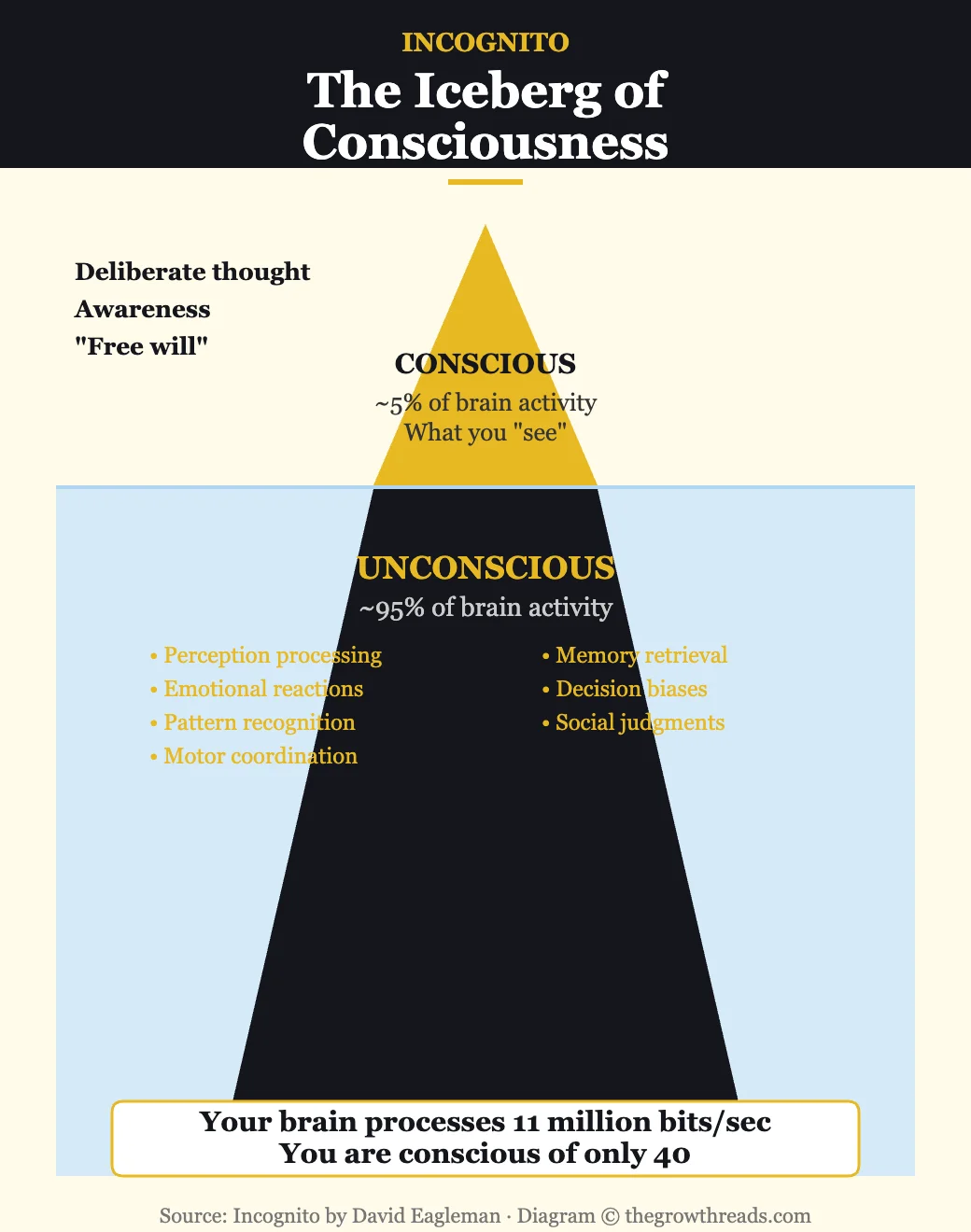
You are not the person you think you are. Neuroscientist David Eagleman takes readers on a tour of the brain’s hidden machinery, revealing that consciousness is merely the smallest tip of a vast neural iceberg. Your brain processes roughly 11 million bits of information per second, yet you are consciously aware of only about 40. The rest — perception, decision-making, emotional reactions, motor control, social judgments — happens entirely below the threshold of awareness. Eagleman argues that understanding this hidden architecture does not diminish us; it reveals us as far more complex and fascinating than we imagined, with profound implications for how we think about identity, free will, and the legal system.
Key takeaways
- Consciousness is the tip of the iceberg: The vast majority of your brain’s activity — pattern recognition, emotional processing, motor coordination — occurs without your awareness.
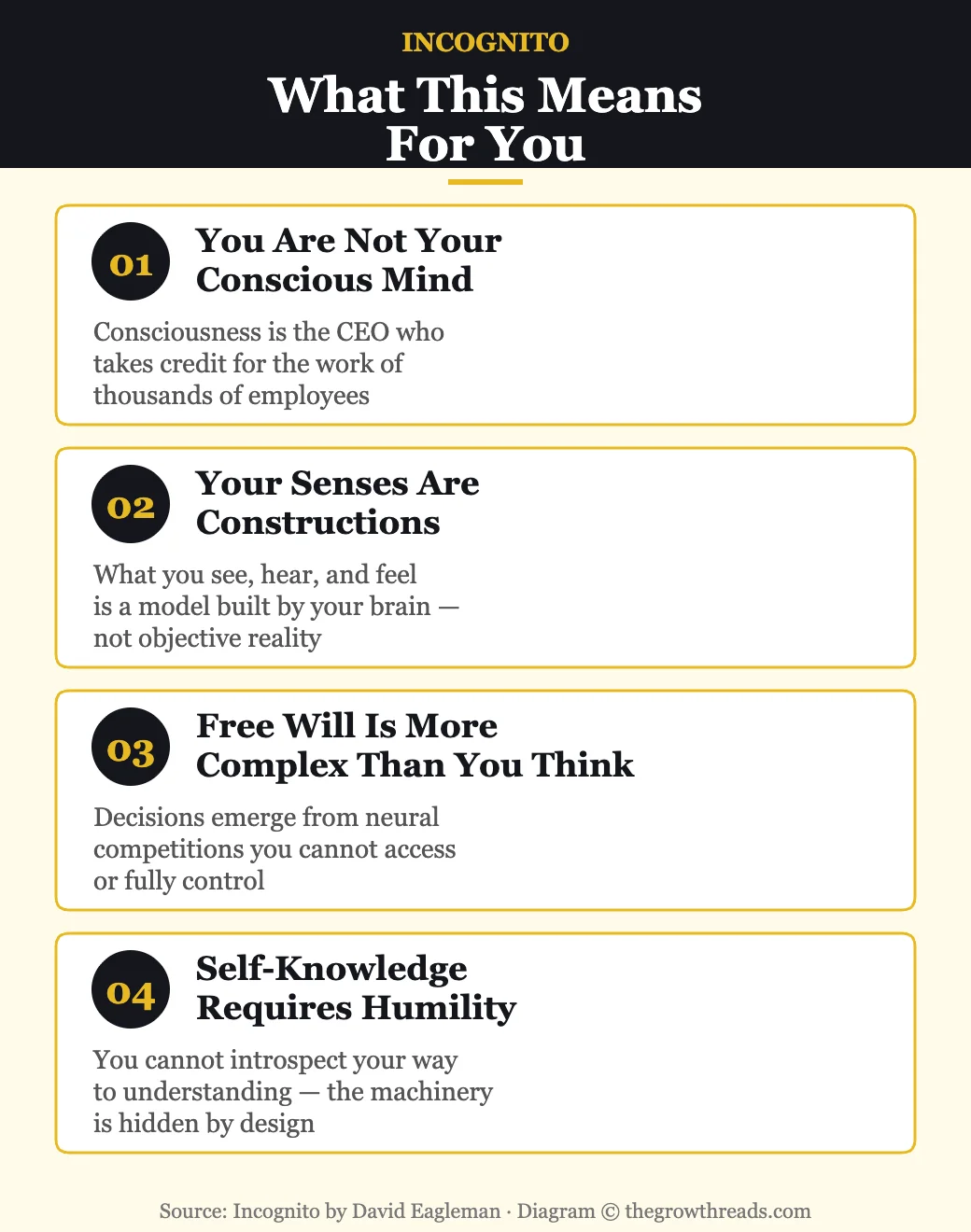
- Your senses are constructive, not receptive: What you see, hear, and feel is a model your brain actively constructs, not a passive recording of reality.
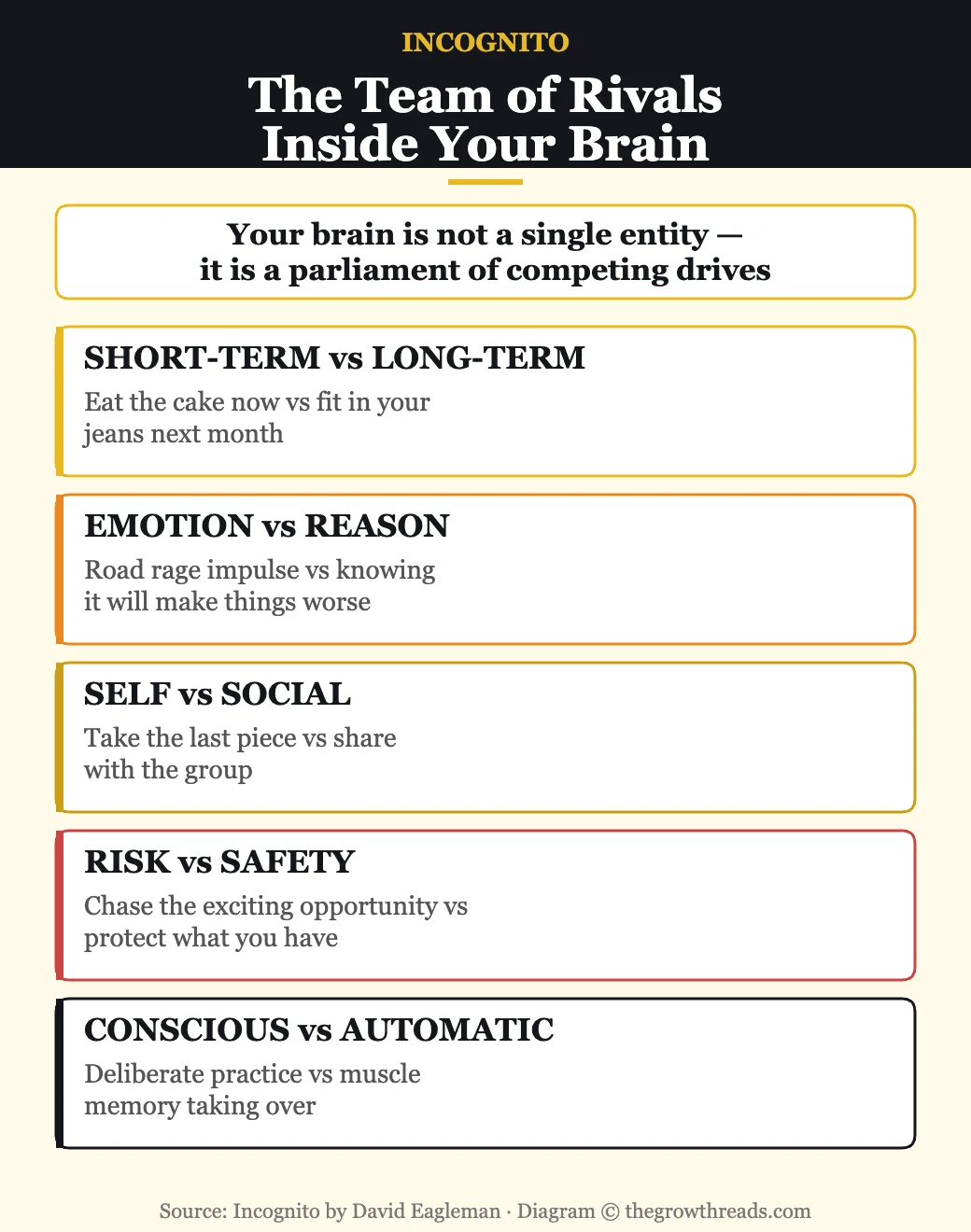
- The brain is a team of rivals: Multiple competing neural systems battle for control of your behavior, and what you experience as a unified “self” is actually the outcome of these internal competitions.
- You cannot access your own source code: Introspection has hard limits because the neural machinery that generates thoughts and emotions is hidden by design.
- Implicit biases are real and measurable: Your unconscious brain harbors preferences and prejudices that your conscious mind would disavow.
- Free will is more nuanced than we assume: Decisions emerge from neural processes that begin before you become aware of “deciding,” challenging simple notions of choice.
- The brain is plastic and adaptive: Neural wiring changes constantly based on experience, meaning who you are today is not who you were a year ago at the neural level.
- Automaticity is a feature, not a bug: Skills become unconscious through practice because the brain efficiently delegates routine tasks to faster, lower-level systems.
- Perception is expectation-driven: Your brain predicts what it expects to see and then checks against incoming data — illusions reveal the gaps in this system.
- Understanding the brain has legal implications: If behavior is driven by neural machinery beyond conscious control, it challenges traditional concepts of blame and punishment.
What is Incognito about?
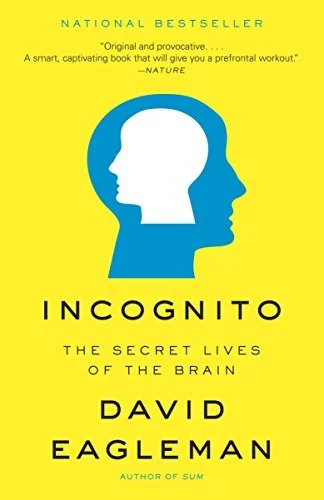
Incognito is a neuroscience book by David Eagleman that explores the vast unconscious processing that drives human behavior. The book reveals how perception, decision-making, emotional reactions, and identity are shaped by brain systems operating entirely below conscious awareness, and examines the implications for free will, criminal justice, and self-understanding.
About the author
David Eagleman is a neuroscientist, author, and entrepreneur who holds appointments at Stanford University. He runs the Center for Science and Law, which examines how brain science should inform legal policy, and founded Neosensory, a company that creates new sensory experiences for the brain. His PBS television series The Brain reached millions of viewers worldwide. Eagleman is known for making complex neuroscience accessible to general audiences, blending rigorous research with vivid storytelling and thought experiments that make the invisible workings of the brain tangible. Explore all David Eagleman book summaries →
Key concepts at a glance
| Concept | What it means | Use it when |
|---|---|---|
| The neural iceberg | Consciousness represents only a tiny fraction of brain processing | You overestimate how much of your behavior is consciously driven |
| Team of rivals | Multiple competing neural systems vie for control of behavior | You feel conflicted about a decision and wonder why |
| Constructive perception | Your brain builds reality rather than passively receiving it | You assume what you see is objective truth |
| Implicit processing | Unconscious biases and preferences shape choices without awareness | You want to understand hidden factors in your judgments |
| Neuroplasticity | Brain wiring changes continuously based on experience | You think your personality or abilities are fixed |
| Automaticity | Practiced skills are delegated to unconscious systems | You notice an expert performing effortlessly what once required concentration |
| The illusion of introspection | You cannot directly observe the neural processes generating your thoughts | You rely on “knowing yourself” through self-reflection alone |
Part 1: The hidden world beneath consciousness
Eagleman opens with a striking example: when you drive a familiar route, you often arrive with no memory of the journey. Your unconscious brain handled the steering, braking, lane changes, and navigation while your conscious mind wandered elsewhere. This is not a failure — it is a demonstration of how efficiently the brain delegates routine tasks to systems that operate below awareness.
The scale of unconscious processing is staggering. Your visual system alone processes about 10 billion bits of information per second, yet your conscious experience of seeing involves only about 40 bits. The vast computational work of edge detection, color processing, motion tracking, face recognition, and depth perception happens entirely without your knowledge. What you experience as “seeing” is the polished press release, not the messy factory floor.
Eagleman introduces the concept that consciousness is like a newspaper: it reports a simplified summary of events that occurred elsewhere. The actual journalism — the investigation, fact-checking, and editorial decision-making — happens in the unconscious. You read the headlines and believe you understand the story, but you have no access to the newsroom.
He demonstrates this with visual illusions and perceptual experiments. In the hollow-face illusion, people perceive a concave mask as convex because the brain’s face-recognition system is so powerful that it overrides raw sensory data. Your brain does not show you what is there; it shows you what it expects to be there, adjusted by incoming information.
Part 2: The team of rivals
Eagleman’s most powerful metaphor is that the brain is not a single entity but a “team of rivals” — a collection of competing neural systems that constantly battle for control of behavior. When you feel torn between eating the chocolate cake and sticking to your diet, that is not a single “you” debating options. It is two distinct neural systems — one driven by immediate reward, another by long-term planning — literally competing for dominance.
He traces this idea through evolution. The brain was not designed from scratch; it was built layer upon layer over millions of years. The brainstem handles basic survival. The limbic system manages emotions and motivation. The cortex handles abstract reasoning and planning. These systems often want different things, and consciousness is the arena where their conflicts play out.
The implications are profound. When an addict relapses, it is not simply a “failure of willpower.” It is one neural system (craving, reward) overpowering another (executive control, long-term planning). When a person acts generously despite self-interest, the empathy and social-bonding circuits have won the competition against the self-preservation circuits. Understanding this does not excuse behavior, but it explains it with far more nuance than folk psychology allows.
Eagleman presents the case of a man who developed sudden pedophilic urges due to a brain tumor. When the tumor was removed, the urges disappeared. When it regrew, they returned. This disturbing case illustrates that behavior we attribute to character or moral choice can be directly caused by physical changes in neural hardware.
Part 3: The constructed self and perception
One of Eagleman’s most unsettling arguments is that perception is not a window onto reality but a controlled hallucination. Your brain receives fragmented, noisy signals from your senses and constructs a smooth, coherent experience that feels like objective reality but is actually a model — optimized for survival, not for accuracy.
He demonstrates this with numerous examples. Your visual field has a blind spot where the optic nerve exits the retina, but you never notice because your brain fills in the gap. You experience color as a property of objects, but it is actually a construction of your visual cortex — wavelengths of light have no inherent color. You perceive time as flowing smoothly, but your brain actually samples the world in discrete snapshots and stitches them together.
The implications extend to memory. Eagleman shows that memories are not recordings but reconstructions — each time you recall an event, your brain rebuilds it from fragments, often adding, subtracting, or altering details without your awareness. This is why eyewitness testimony is so unreliable and why you can have vivid, confident memories of events that never happened.
Perhaps most striking is the evidence on sensory substitution. Eagleman describes experiments where blind people learn to “see” through their tongues (using a device that converts visual information to electrical patterns on the tongue) or deaf people learn to “hear” through vibrations on their skin. The brain does not care what kind of data it receives — it extracts patterns and builds a model regardless of the input channel. This flexibility reveals that perception is a brain process, not a sense-organ process.
Part 4: Free will, identity, and the legal system
The book’s final section tackles the hardest questions. If most of your brain’s activity is unconscious, if your decisions emerge from neural competitions you cannot access, if your perception is a construction rather than reality — what does this mean for free will, personal responsibility, and the legal system?
Eagleman does not argue that free will is an illusion. Instead, he advocates for a more nuanced view he calls “possibilianism” — the position that the relationship between brain activity and conscious choice is more complex than either pure determinism or traditional free will allows. He argues that the question “does this person have free will?” is less useful than “what is the biology behind this behavior, and can it be changed?”
This leads to his proposals for criminal justice reform. Rather than asking “is this person guilty?” (which assumes a simple model of free choice), Eagleman argues we should ask “what caused this behavior, and what can be done about it?” He advocates for a legal system informed by neuroscience — one that distinguishes between brains that can be rehabilitated and those that cannot, rather than applying uniform punishment based on the outdated assumption that all criminals exercised equal free choice.
He acknowledges the legitimate concern that a purely biological view of behavior could eliminate accountability. His response is pragmatic: even if behavior has neural causes, consequences still matter because the brain’s decision-making systems incorporate expected outcomes. Punishment works not because people “deserve” it in some abstract moral sense, but because the threat of consequences enters the neural competition and influences behavior.
Who is Incognito best for — and who should read something else first?
This book is perfect for anyone curious about how the brain actually works — not the simplified pop-psychology version, but the messy, fascinating, humbling reality. It is especially valuable for people who believe they understand themselves through introspection and want to discover why that assumption is flawed. Leaders, educators, and anyone involved in the legal system will find the implications directly relevant to their work.
If you want a more decision-focused application of cognitive science, start with Thinking, Fast and Slow by Daniel Kahneman. If you are more interested in how unconscious processes shape social behavior, Blink by Malcolm Gladwell is more accessible. And if you want the emotional-intelligence angle, Emotional Intelligence by Daniel Goleman explores how unconscious emotional processing shapes leadership and relationships.
Questions to reflect on
- When you make a decision that surprises you, do you consider that competing neural systems may have resolved their conflict differently than your conscious “self” would have predicted?
- How does knowing that perception is a brain construction — not a direct readout of reality — change your confidence in your own judgments?
- If you cannot directly access the neural processes that generate your thoughts and feelings, what does that mean for how much you can trust self-reflection?
- How would you redesign one institution — school, workplace, justice system — if you took the findings in this book seriously?
- Does understanding the unconscious machinery of your brain make you feel less free, or more awed by the complexity of being human?
🔥 Ready to discover the secret lives of your brain?
Explore the neuroscience of consciousness, identity, and the hidden forces driving your every decision.
How to apply Incognito (7-day plan)
- Day 1 — Notice autopilot: Three times today, catch yourself doing something on autopilot (driving, typing, walking a route). Pause and appreciate that your unconscious brain handled a remarkably complex task while your conscious mind was elsewhere.
- Day 2 — Question a perception: When you feel certain about something you saw or heard, ask: “Is this what actually happened, or is this my brain’s best guess?” Write down one instance where your perception might be a construction.
- Day 3 — Map your internal rivals: The next time you feel conflicted, name the competing drives. Write: “Part of me wants X because [reason], and part of me wants Y because [reason].” Acknowledge that this is not weakness — it is how brains work.
- Day 4 — Test an implicit bias: Take a free Implicit Association Test at Harvard’s Project Implicit. Compare your unconscious associations with your conscious beliefs. Notice the gap without judgment.
- Day 5 — Observe automaticity in action: Practice a skill you are good at (typing, playing music, a sport) and notice how conscious attention actually degrades performance. Then try something new and notice how much conscious effort it requires.
- Day 6 — Rebuild a memory: Recall a vivid childhood memory and write it down in detail. Then ask a family member who was there for their version. Notice how the reconstructions differ — neither is a recording.
- Day 7 — Practice epistemic humility: For every strong opinion you hold today, add a qualifier: “Based on what my brain is telling me, I believe X — but I know my brain constructs beliefs the same way it constructs visual images: imperfectly.”
Frequently asked questions
What is the main idea of Incognito?
The main idea is that consciousness represents only a tiny fraction of brain activity. The vast majority of perception, decision-making, emotional processing, and behavior is driven by unconscious neural systems operating entirely below awareness. David Eagleman argues that understanding this hidden architecture does not diminish human experience but reveals us as far more complex and fascinating than we typically imagine, with important implications for identity, free will, and justice.
What does Incognito say about free will?
Eagleman does not argue that free will is a complete illusion. Instead, he takes a position he calls “possibilianism” — the view that the relationship between brain activity and conscious choice is more complex than either pure determinism or traditional free will allows. Decisions emerge from neural competitions between multiple brain systems, and while we experience the outcome as a choice, the process involves machinery we cannot access or fully control.
What is the team of rivals metaphor?
Eagleman describes the brain as a “team of rivals” — not a single unified entity but a collection of competing neural systems. When you feel torn between short-term pleasure and long-term goals, that is two distinct brain systems literally competing for control. What we experience as a unified “self” is actually the outcome of ongoing internal competitions between reward, fear, empathy, self-interest, and dozens of other neural circuits.
How much of our brain activity is unconscious?
According to Eagleman, the brain processes approximately 11 million bits of information per second, but consciousness handles only about 40 bits. That means more than 99.99% of brain processing occurs below the threshold of awareness. This includes visual processing, emotional reactions, language comprehension, motor coordination, pattern recognition, social judgments, and many aspects of decision-making that we typically assume are conscious.
Is perception really a construction?
Yes, Eagleman presents extensive evidence that what we experience as perception is actively constructed by the brain rather than passively received. Your brain predicts what it expects to see, fills in blind spots, constructs color from wavelengths, and stitches together discrete snapshots into a seemingly continuous experience. Visual illusions, phantom limb sensations, and sensory substitution experiments all demonstrate that perception is a brain process, not a direct readout of external reality.
How does Incognito compare to Thinking, Fast and Slow?
Both books explore unconscious processing, but they take different angles. Kahneman’s Thinking, Fast and Slow focuses specifically on cognitive biases and heuristics — systematic errors in judgment caused by fast unconscious processing. Eagleman’s Incognito goes broader, exploring not just biases but the entire landscape of unconscious brain activity including perception, identity, free will, and the legal system. Kahneman is more prescriptive (here is how to avoid errors); Eagleman is more descriptive (here is how amazing the hidden machinery actually is).
What are the practical takeaways from Incognito?
The primary practical takeaway is epistemic humility — recognizing the limits of self-knowledge and conscious control. Specific applications include: questioning the certainty of your perceptions and memories, understanding internal conflict as competing neural systems rather than personal weakness, recognizing that implicit biases operate below awareness, designing environments that support good decisions rather than relying on willpower alone, and approaching others’ behavior with more curiosity about neural causes and less judgment about moral character.
Related summaries
- Thinking, Fast and Slow by Daniel Kahneman — The cognitive bias framework that complements Eagleman’s broader neuroscience.
- Blink by Malcolm Gladwell — How rapid unconscious processing drives snap judgments, for better and worse.
- The Happiness Hypothesis by Jonathan Haidt — The elephant-and-rider model of conscious and unconscious mind.
- Emotional Intelligence by Daniel Goleman — How unconscious emotional processing shapes leadership and relationships.
Explore more: 📚 Best Psychology Books