

★★★★☆ 4.2 / 5
One-liner: A disarmingly simple parable that proves you already earn enough to become wealthy — you just need to redirect the money you are wasting.
Best for: Anyone who believes they do not earn enough to invest, young professionals starting their financial journey, and readers who prefer stories over textbooks.
Reading time: ~2.5 hours (160 pages)
Difficulty to apply: Very easy — the core action takes less than 30 minutes to set up.
The Latte Factor in one minute
You are richer than you think — your daily spending habits are hiding a fortune in plain sight. David Bach tells the story of Zoey, a 27-year-old Brooklyn woman convinced she cannot afford to save or invest. Through a chance encounter with Henry, a wise barista and coffee shop owner, she discovers three financial secrets that transform her relationship with money. The book’s central insight — the Latte Factor — shows that the small, mindless purchases we make every day (a $5 coffee, a $3 snack, a $10 lunch upgrade) add up to hundreds of thousands of dollars over a lifetime when invested instead. Bach wraps proven financial principles inside a readable parable, making concepts like compound interest, automatic saving, and paying yourself first feel accessible rather than intimidating.
Key takeaways
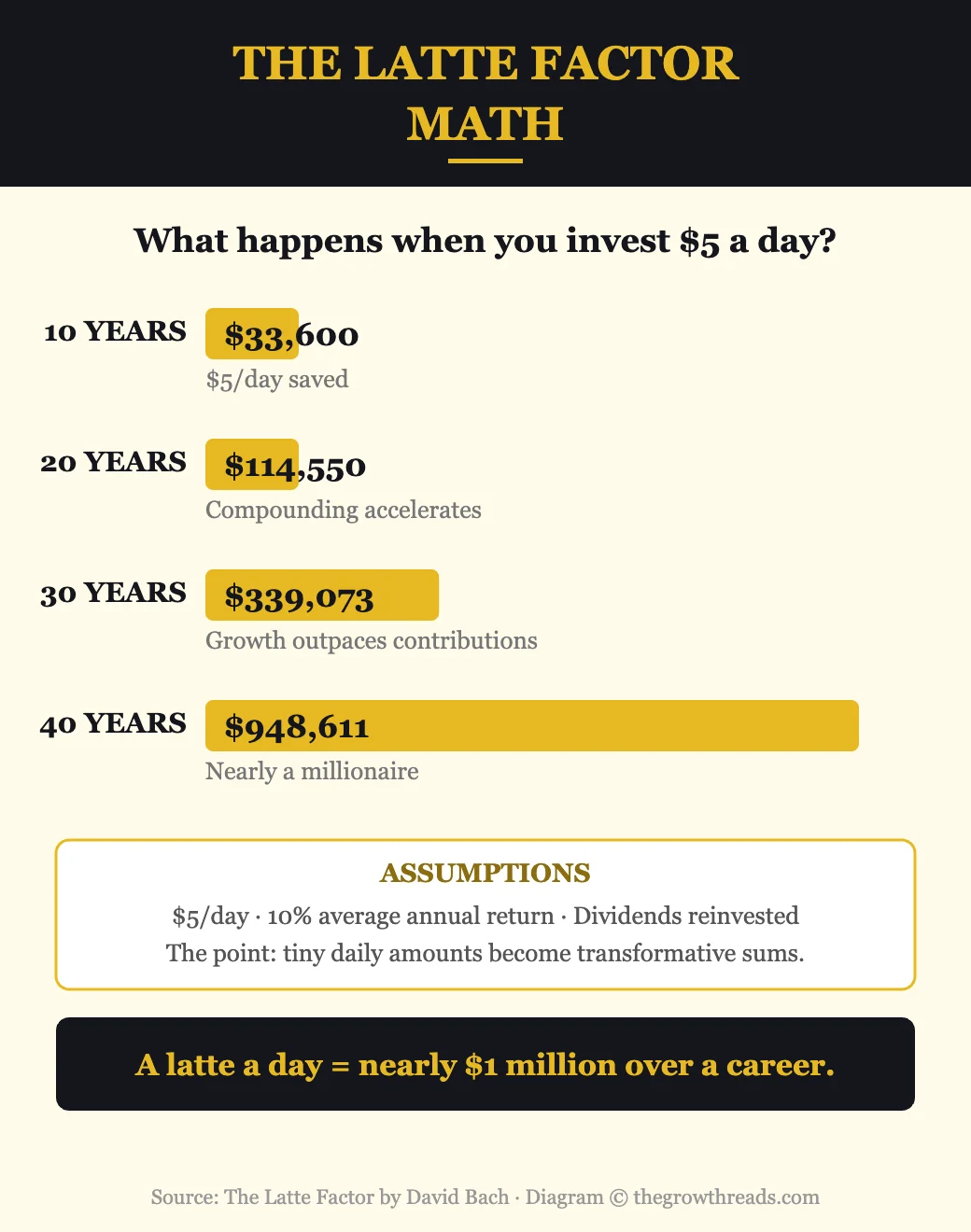
- Small amounts matter enormously: $5 per day invested at 10% annual returns grows to nearly $948,000 over 40 years. Most people drastically underestimate the power of compounding on small, consistent amounts.
- Pay yourself first — always: Save before you spend, not after. If you wait until the end of the month to save what is left over, there will never be anything left over.
- Make it automatic: The single most important financial move you can make is setting up automatic transfers to your investment accounts. Remove the decision from the equation entirely.
- You already earn enough: Most people believe their income is the problem. Bach argues the real problem is invisible spending — the daily leaks that drain your paycheck without delivering lasting happiness.
- Live rich now: Building wealth is not about deprivation. It is about redirecting money from things that do not matter to you toward things that genuinely do.
- Own, do not rent: Bach advocates for home ownership as a wealth-building tool, arguing that renters pay off someone else’s mortgage while owners build equity over decades.
- One hour a day of income: Bach recommends saving at least one hour of your daily pay — roughly 12.5% of your income — as a minimum starting point.
- Time is your greatest asset: The earlier you start, the less you need to invest. A 25-year-old investing $5 a day will vastly outperform a 40-year-old investing $15 a day, thanks to compound growth.
- Your latte factor is personal: It is not literally about coffee. It is about identifying whatever recurring expense you spend on automatically without thinking — and questioning whether that money could serve you better elsewhere.
- Wealth is a choice, not a circumstance: Bach insists that building wealth is available to virtually everyone. The barrier is not income — it is awareness and action.
What is The Latte Factor about?
The Latte Factor is a personal finance parable that teaches readers how small daily expenditures, when redirected into investments, can compound into life-changing wealth over time. Through the story of Zoey and her mentor Henry, David Bach demonstrates that financial freedom is less about earning more and more about being intentional with what you already earn.
About the author
David Bach is a financial educator who has written twelve consecutive New York Times bestsellers, including The Automatic Millionaire, Smart Women Finish Rich, and Start Late, Finish Rich. He co-founded AE Wealth Management, one of the largest registered investment advisory firms in the United States. Bach’s philosophy centres on making personal finance simple and automatic — he believes most people fail not because the strategies are complicated, but because they never set up systems to execute them. The Latte Factor, co-written with John David Mann (co-author of The Go-Giver), represents Bach’s attempt to package his core teachings into his most accessible format: a story. Explore all David Bach book summaries →
Key concepts at a glance
| Concept | What it means | Use it when |
|---|---|---|
| The Latte Factor | Small recurring expenses that seem insignificant but add up to enormous sums over time | You feel like you never have money left to save |
| Pay Yourself First | Save and invest before paying bills, not after | You want to guarantee you build wealth regardless of expenses |
| Make It Automatic | Set up systems so saving happens without conscious effort | You know what to do but struggle with follow-through |
| Live Rich Now | Spend freely on what you love while cutting what you do not notice | You fear that building wealth means suffering now |
| The One-Hour-a-Day Rule | Save at least one hour of your daily income (~12.5%) | You need a concrete starting target |
| The Double Latte Factor | Both partners in a couple tracking and redirecting mindless spending | You and a partner want to build wealth together |
| Own vs. Rent | Building equity through home ownership vs. paying someone else’s mortgage | You are deciding whether to buy or rent |
Part 1: Zoey’s wake-up call — discovering the invisible drain
The story opens with Zoey Daniels, a 27-year-old magazine editor living in Brooklyn, feeling financially stuck. She loves her job but believes her salary simply is not high enough to save or invest. She commutes by subway, eats modestly, and does not consider herself a big spender. By every conventional measure, she is doing fine — but she has virtually nothing saved.
Her financial awakening begins at Helena’s Coffee Bar, where the owner, Henry, a retired investor who runs the shop as a passion project, notices Zoey looking stressed. Over a series of conversations, Henry introduces her to a concept that reframes everything she thought she knew about money: the Latte Factor.
Henry asks Zoey to track every dollar she spends for one day. The results shock her. Between a morning latte, a lunchtime smoothie, a magazine, and a few other small purchases, she spends over $18 on things she barely notices. That is nearly $500 a month — more than $6,000 a year — flowing out of her account without delivering any lasting satisfaction.
The lesson is not that coffee is the enemy. It is that invisible spending — the purchases you make on autopilot without weighing their true cost — is the single biggest reason most people feel they cannot afford to invest.
Part 2: The compounding revelation — small numbers, massive results
Henry takes Zoey through the maths that forms the backbone of the book. If she invested just $5 a day — the cost of her daily latte and snack — at an average annual return of 10%, here is what would happen. After 10 years she would have approximately $33,600. After 20 years, around $114,550. After 30 years, the total reaches roughly $339,000. And after 40 years, she would be sitting on nearly $948,000 — just from redirecting the cost of a daily coffee.
The numbers work because of compound interest, which Bach calls the eighth wonder of the world. The returns you earn start generating their own returns, and over decades, that snowball effect becomes staggering. The critical variable is not how much you invest — it is how early you start and how consistently you continue.
Bach uses this section to address the most common objection head-on: “But I can’t afford $5 a day.” His answer is that you are already spending it. You just are not noticing. The money is not missing from your life — it is missing from your future.
Part 3: The three secrets and the automatic system
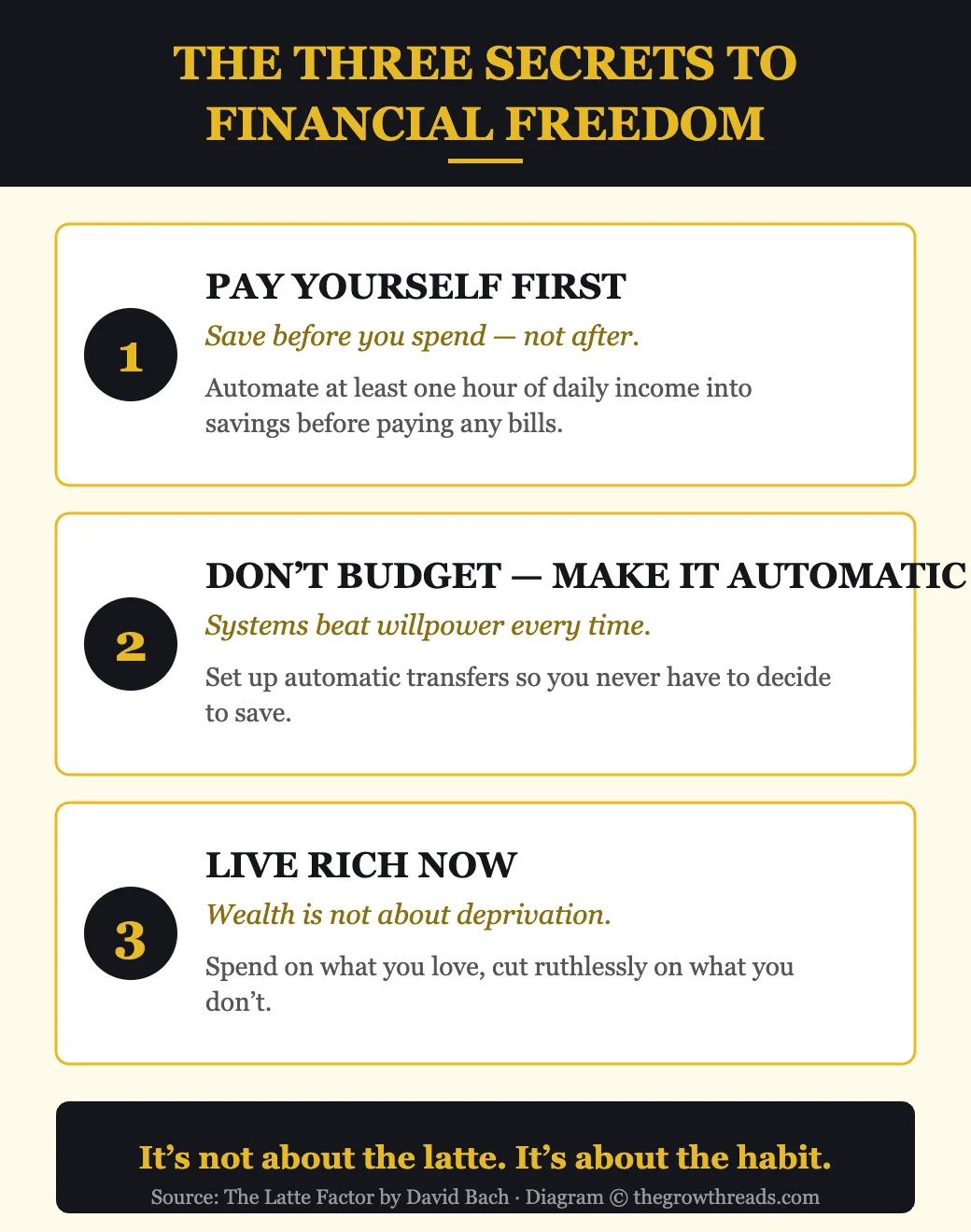
Henry distils his financial philosophy into three secrets. The first — Pay Yourself First — is the foundational principle. Most people pay their bills, their landlord, their credit card company, and the government first, then try to save whatever is left over. Bach flips the order. He argues you should treat your savings contribution as a non-negotiable expense, like rent, and pay it before anything else. His specific recommendation is to save at least one hour of your daily income, which works out to roughly 12.5% of gross pay.
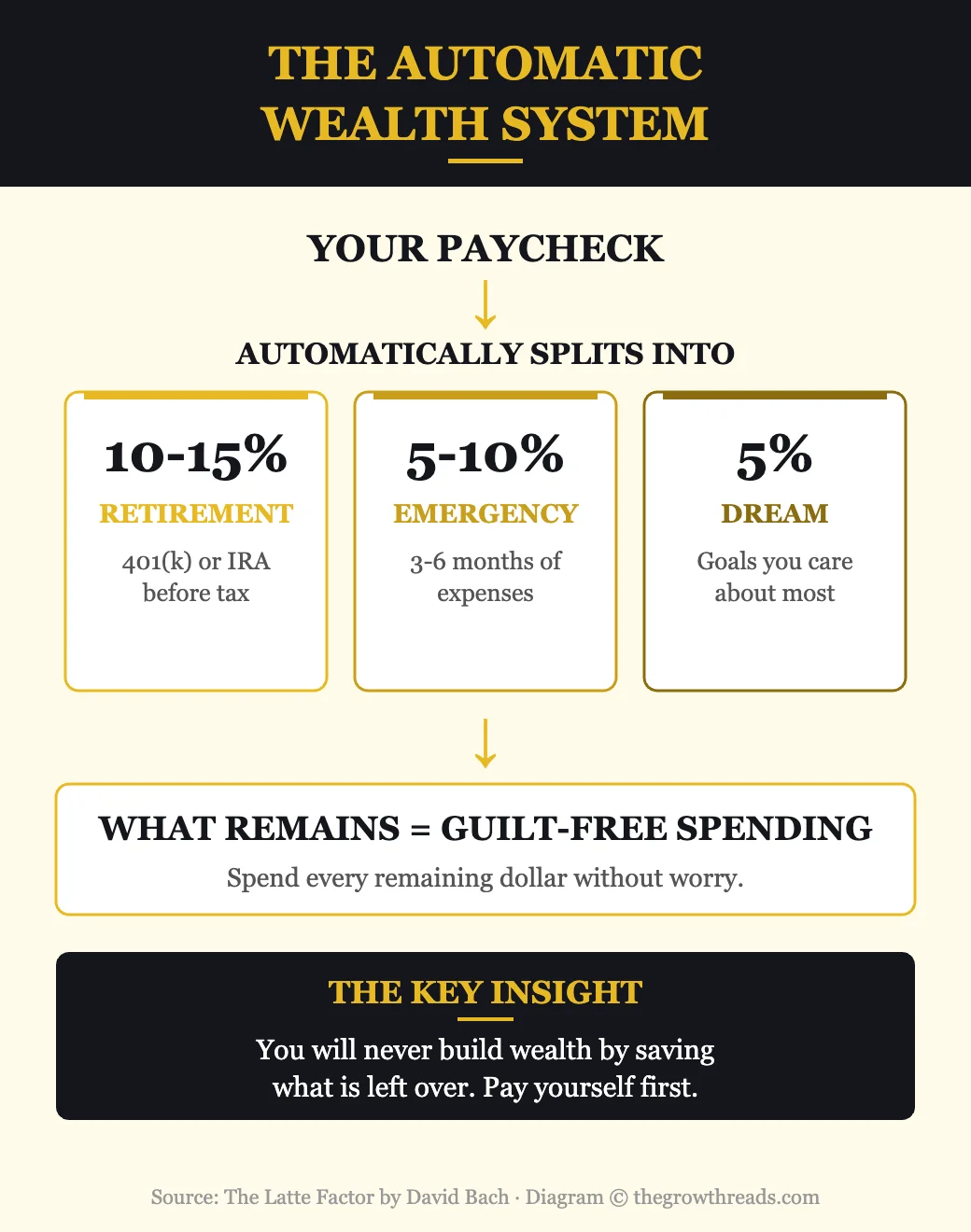
The second secret — Do not Budget, Make It Automatic — acknowledges that willpower is unreliable. Instead of tracking every purchase and trying to discipline your spending each month, Bach advocates setting up automatic transfers to your retirement accounts, emergency fund, and investment accounts. Once the system is running, you never have to think about it or decide to save. The money moves before you can spend it.
The third secret — Live Rich Now — is Bach’s answer to the objection that saving means suffering. He insists that building wealth and enjoying your life are not mutually exclusive. The key is to spend generously on things you genuinely love and cut ruthlessly on things you barely notice. If your daily latte genuinely brings you joy, keep it and find your latte factor somewhere else — a gym membership you never use, a streaming subscription you forgot about, an insurance policy you have never re-shopped.
Who is The Latte Factor best for — and who should read something else first?
This book is perfect for absolute beginners who are intimidated by personal finance, people who have never tracked their spending, and readers who learn better through stories than through data. It is an ideal gift for a young adult starting their first job. The message lands especially well for anyone who genuinely believes they do not earn enough to save.
If you already understand compound interest and automatic saving, the content may feel too basic. In that case, consider The Psychology of Money for deeper behavioural insights, or Financial Freedom by Grant Sabatier for a more advanced roadmap to early retirement. If you want Bach’s ideas in a traditional non-fiction format with more tactical depth, The Automatic Millionaire covers the same principles in greater detail.
Questions to reflect on
- What is your personal Latte Factor — the daily expense you barely notice but that adds up to thousands per year?
- If you tracked every dollar you spent yesterday, would any purchases surprise you?
- Are your savings automatic, or do you rely on willpower to transfer money each month?
- What would you do differently tomorrow if you had twice your current savings?
- Are you spending money on things that genuinely bring you joy, or out of habit and convenience?
🔥 Ready to find your latte factor?
Get the book that turns a coffee-shop conversation into a lifelong wealth-building habit.
How to apply The Latte Factor (7-day plan)
- Day 1: Track every single dollar you spend today. Write it down or use your banking app. No judgment — just awareness.
- Day 2: Review yesterday’s spending and circle any purchases you barely remember or did not truly enjoy. Add up the total — this is your daily Latte Factor.
- Day 3: Multiply your daily Latte Factor by 365 to see the annual cost. Then use a compound interest calculator to see what that amount becomes over 30 years at 10%.
- Day 4: Set up one automatic transfer from your current account to a savings or investment account. Start with whatever you can — even $5 per day. Schedule it to happen the day after each paycheck.
- Day 5: Cancel or downgrade one subscription or recurring charge you identified on Day 2. Redirect that exact amount to your automatic investment transfer.
- Day 6: If your employer offers a retirement plan with matching contributions, increase your contribution to at least the full match amount. This is free money you may be leaving on the table.
- Day 7: Write down one thing you want your money to buy you in the future — not a product, but a feeling. Freedom, security, time with family. Put it where you will see it when tempted to spend mindlessly.
Frequently asked questions
Is The Latte Factor saying I should never buy coffee?
Not at all. The book uses the latte as a symbol for any small, recurring, mindless expense. If your morning coffee genuinely brings you joy, keep it and find your Latte Factor somewhere else — an unused gym membership, a forgotten subscription, or daily impulse purchases you do not even remember by evening. The point is awareness, not deprivation.
Can $5 a day really make someone a millionaire?
At a 10% average annual return (the historical average of the S&P 500 before inflation), $5 a day invested consistently for 40 years grows to approximately $948,000. The key variables are time and consistency. Starting at 25 instead of 35 roughly triples the outcome because compounding has an extra decade to work. The maths is real — the challenge is having the patience to let it play out.
How is The Latte Factor different from The Automatic Millionaire?
Both books teach the same core principles — pay yourself first, make it automatic, harness compound interest. The Automatic Millionaire is a traditional non-fiction book with detailed how-to instructions for setting up automatic systems. The Latte Factor wraps the same lessons inside a narrative story featuring Zoey and Henry. If you want a quick, inspiring read, start with The Latte Factor. If you want step-by-step implementation detail, follow it with The Automatic Millionaire.
What does David Bach mean by “pay yourself first”?
It means treating your savings and investment contributions as a non-negotiable expense — like rent or utilities — that gets paid before anything else. Most people pay everyone else first (landlord, credit card company, government) and try to save whatever remains. Bach reverses the order: set up automatic transfers to your investment accounts immediately after each paycheck, then live on what is left. This guarantees you save consistently.
Is The Latte Factor relevant outside the United States?
The core concepts — tracking mindless spending, automating savings, and harnessing compound interest — work universally. The specific account types mentioned (401(k), IRA, Roth IRA) are American, but every developed country has equivalent tax-advantaged retirement accounts. Readers in Singapore, the UK, Canada, or Australia can apply the same principles using their local equivalents like CPF top-ups, ISAs, RRSPs, or Super contributions.
How long does it take to read The Latte Factor?
The Latte Factor is a short book — about 160 pages written in a breezy parable format. Most readers finish it in a single sitting of two to three hours. The brevity is intentional: Bach designed it to be the kind of book you can hand to a friend or family member who would never read a traditional personal finance textbook. It prioritises inspiration and accessibility over exhaustive detail.
What are the main criticisms of The Latte Factor concept?
The most common criticism is that it places too much emphasis on cutting small expenses rather than increasing income. Critics argue that for people with very low incomes, cutting a $5 coffee is not going to bridge a meaningful savings gap. Bach acknowledges this in the book by framing the latte as a starting point and a mindset shift, not a complete strategy. The concept works best for middle-income earners who genuinely have discretionary spending they are not tracking.
Related summaries
- The Automatic Millionaire Summary — David Bach’s non-fiction deep dive into automatic wealth systems
- The Psychology of Money Summary — The behavioural science behind spending and saving decisions
- Just Keep Buying Summary — Data-driven proof that consistent investing beats everything else
- 📚 Best Money Books — The Full List
Related Money Summaries
Skin in the Game Summary and Review
The Algebra of Wealth Summary & Review: A Simple Formula for Financial Security
The Barefoot Investor Summary & Review: The Only Money Plan You Need
The Four Pillars of Investing Summary & Review: Master Theory, History, Psychology, and Business
The Warren Buffett Way Summary & Review: 12 Tenets of the Greatest Investor