

★★★★☆ 4.5 / 5
One-liner: The definitive guide to unhooking from difficult emotions so you can live and lead with intention.
Best for: Professionals, leaders, and anyone who feels stuck in emotional ruts or autopilot thinking patterns.
Reading time: ~6 hours (288 pages)
Difficulty to apply: Medium — the concepts are intuitive, but building emotional awareness takes sustained practice.
Emotional Agility in one minute
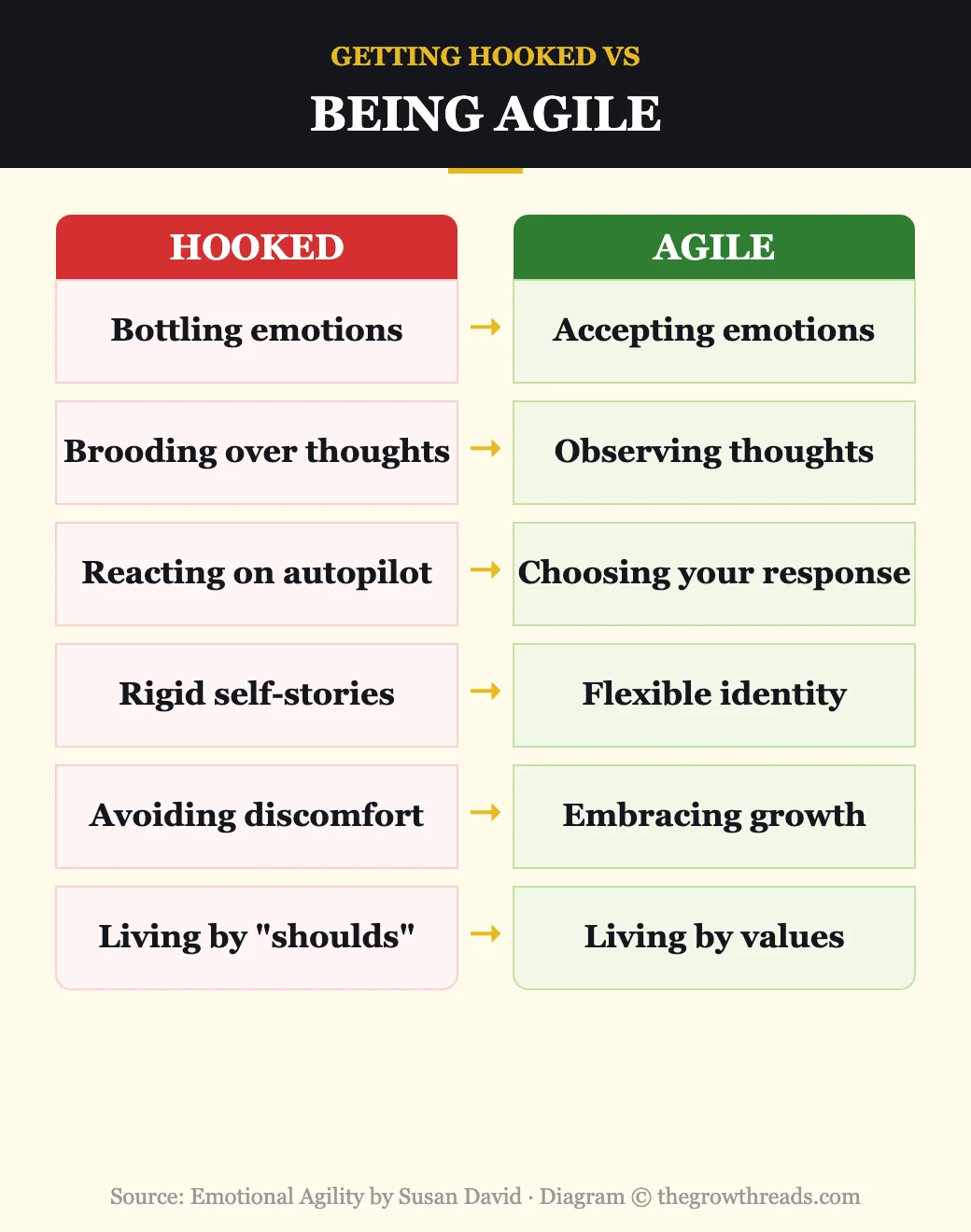
Your emotions are data, not directives. Susan David, a Harvard Medical School psychologist, argues that the way we navigate our inner world — our thoughts, feelings, and self-stories — determines everything: how we act at work, how we love, how we parent, and how we lead. Emotional agility is not about forcing positivity or suppressing negativity. It is the capacity to be present with all of your emotions, label them with precision, step back from the ones that no longer serve you, and take actions that align with who you genuinely want to be. David distils two decades of research into a four-step process — Showing Up, Stepping Out, Walking Your Why, and Moving On — that replaces rigid autopilot reactions with flexible, values-driven choices.
Key takeaways
- Emotions are not facts: Just because you feel incompetent does not mean you are. Treating thoughts as literal truth is the root of most psychological rigidity.
- Bottling and brooding both backfire: Suppressing emotions (bottling) amplifies them, and ruminating on them (brooding) creates a downward spiral. Neither strategy works long-term.
- Getting hooked is universal: Everyone gets hijacked by automatic thought patterns. The goal is not to avoid hooks but to notice them faster.
- Showing up means willingness: Accept your emotions without judgment. Curiosity toward discomfort, rather than avoidance, is the first step to change.
- Stepping out creates a gap: When you observe a thought rather than fuse with it — saying “I notice I am feeling anxious” rather than “I am anxious” — you reclaim the power to choose your response.
- Values are your compass: When you know what truly matters to you, decisions become clearer and daily life gains coherence even in chaotic circumstances.
- Tiny tweaks beat transformations: Sustainable change comes from minimal-viable adjustments at decision points — not sweeping reinventions that collapse under pressure.
- Emotional agility predicts success: Research shows it is more predictive of workplace performance, relationship satisfaction, and wellbeing than IQ or technical skill.
- The teeter-totter principle: Growth requires balancing competence (what you already do well) with challenge (what stretches you). Tipping too far in either direction breeds boredom or burnout.
- You can teach agility to children: Helping kids label emotions precisely and make values-aligned choices builds lifelong psychological flexibility.
What is Emotional Agility about?
Emotional Agility is about developing the psychological flexibility to handle life’s ups and downs without getting trapped by your own thoughts and feelings. Susan David presents a four-step framework — Showing Up, Stepping Out, Walking Your Why, and Moving On — that helps you move from rigid, autopilot emotional reactions to intentional, values-driven behaviour in every domain of life.
About the author
Susan David, PhD, is a psychologist at Harvard Medical School and co-founder of the Institute of Coaching at McLean Hospital. Born in apartheid-era South Africa, she experienced early loss and political turmoil that sparked her lifelong study of how people navigate adversity. Her research on emotional agility has been featured in the Harvard Business Review, the Wall Street Journal, and a TED Talk with over 12 million views. She serves as CEO of Evidence Based Psychology, advising leaders at Fortune 500 companies, and was named one of the world’s most influential management thinkers by Thinkers50. Explore all Susan David book summaries →
Key concepts at a glance
| Concept | What it means | Use it when |
|---|---|---|
| Emotional Agility | Flexible response to your inner experience | You catch yourself reacting on autopilot |
| Getting Hooked | Being hijacked by rigid thought patterns | An emotion drives behaviour before you decide |
| Bottling | Pushing emotions aside to “stay positive” | You notice yourself pretending everything is fine |
| Brooding | Obsessively replaying negative narratives | You are spiralling on the same thought for days |
| Showing Up | Facing emotions with curiosity not judgment | You feel discomfort and want to run from it |
| Stepping Out | Creating distance between you and a thought | You conflate “I feel stupid” with “I am stupid” |
| Walking Your Why | Aligning actions with core values | You need to make a hard career or relationship call |
| The Teeter-Totter | Balancing competence with challenge | You feel bored (too easy) or overwhelmed (too hard) |
Part 1 — Getting hooked: Why we get stuck
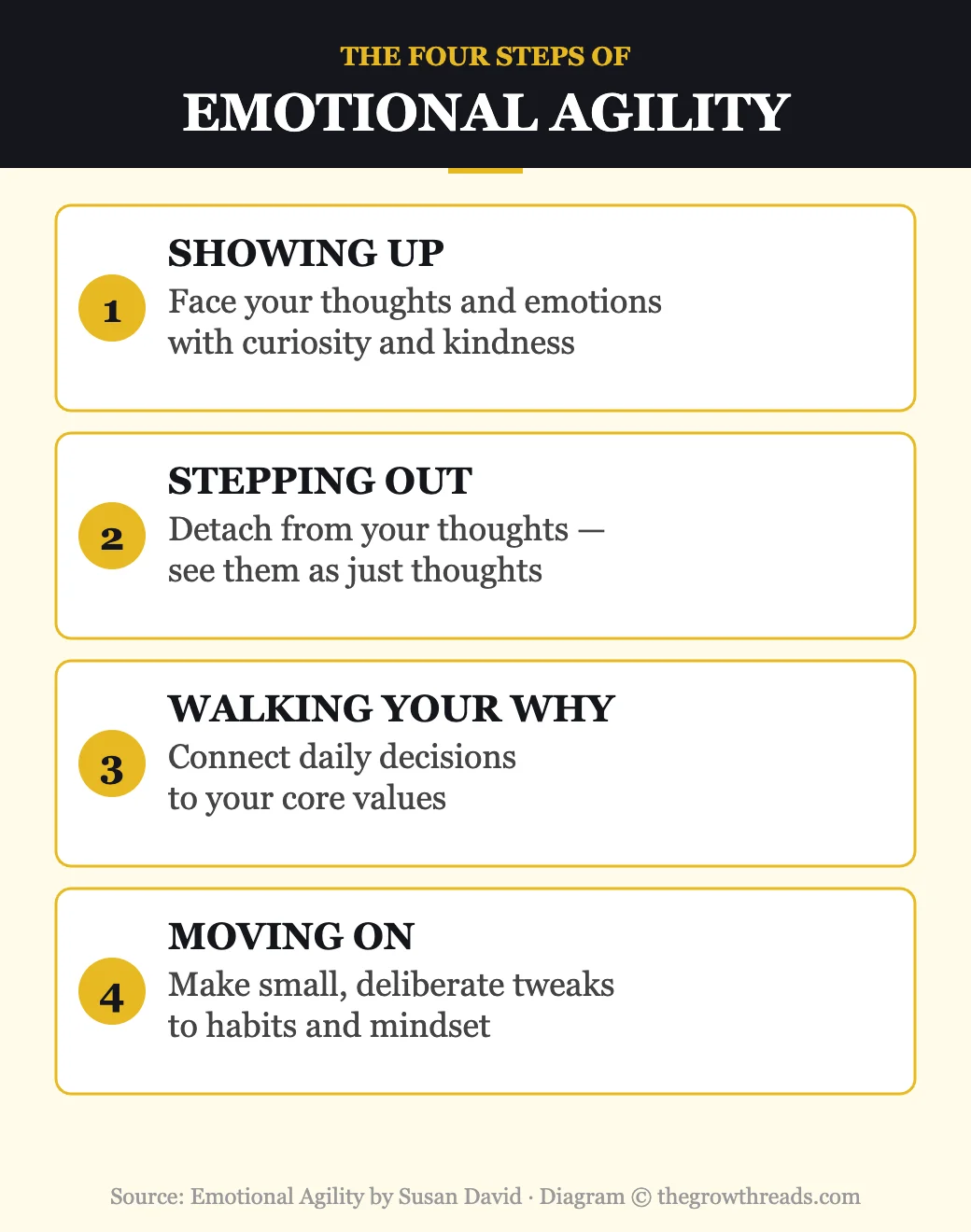
David opens with a stark observation: roughly a third of us either try to suppress unwanted emotions (bottlers) or dwell endlessly on them (brooders), and both strategies are scientifically proven to make things worse. Bottling creates an ironic rebound — the more you push a thought away, the more frequently it returns. Brooding feeds a cycle of self-focused rumination that is one of the strongest predictors of depression and anxiety.
The mechanism behind both patterns is what David calls getting hooked. A hook is any thought, feeling, or self-story that grabs you and drives behaviour before your conscious mind can weigh in. You feel anxious before a presentation, so you over-prepare for days. You feel angry at a colleague, so you fire off a sharp email. The feeling becomes the boss. David cites research showing that the average person has approximately 16,000 thoughts per day, most of them repetitive. When those thoughts run on autopilot, they dictate choices without your permission.
Crucially, David distinguishes between clean pain and dirty pain. Clean pain is the unavoidable discomfort of being human — grief, disappointment, nervousness. Dirty pain is the suffering we pile on top when we judge ourselves for having those feelings: “I shouldn’t feel this way,” “Something is wrong with me.” Emotional agility begins by recognising that clean pain is normal and dirty pain is optional.
Part 2 — Showing Up and Stepping Out: The inner game
Showing Up is David’s term for the willingness to face your emotions exactly as they are — without minimising, magnifying, or judging them. She draws on acceptance and commitment therapy research to show that people who allow themselves to experience difficult emotions, rather than fighting them, process those emotions more efficiently and recover faster. One study she cites found that people who wrote expressively about emotionally charged events for just 20 minutes a day over three days showed measurable improvements in physical health, immune function, and psychological wellbeing months later.
The key skill in Showing Up is emotional granularity: labelling your feelings with precision. Saying “I am stressed” is vague and unhelpful. Saying “I feel overwhelmed because I have three deadlines converging and I have not prioritised” gives your brain actionable information. Research by Lisa Feldman Barrett shows that people with high emotional granularity — a wide vocabulary for their feelings — regulate emotions more effectively, drink less, and retaliate less when hurt.
Stepping Out is the move from fusion to defusion. When you are fused with a thought (“I am a terrible leader”), you treat it as absolute reality. When you defuse (“I am noticing the thought that I am a terrible leader”), you create a gap — and in that gap lives your freedom to choose a different response. David offers several practical techniques: prefacing thoughts with “I notice I am having the thought that…”, speaking the thought in a silly voice to drain its authority, and using the “process versus content” distinction (asking not “Is this thought true?” but “Is this thought helpful?”).
Part 3 — Walking Your Why: Values as your compass
With the internal shifts of Showing Up and Stepping Out in place, David turns to the external question: What do you actually want your life to be about? She argues that most people operate from “want-to” goals (aligned with personal values) far less often than they realise. Instead, they run on “have-to” goals dictated by social expectations, peer pressure, and inherited scripts. The result is a life that looks successful from the outside but feels hollow from the inside.
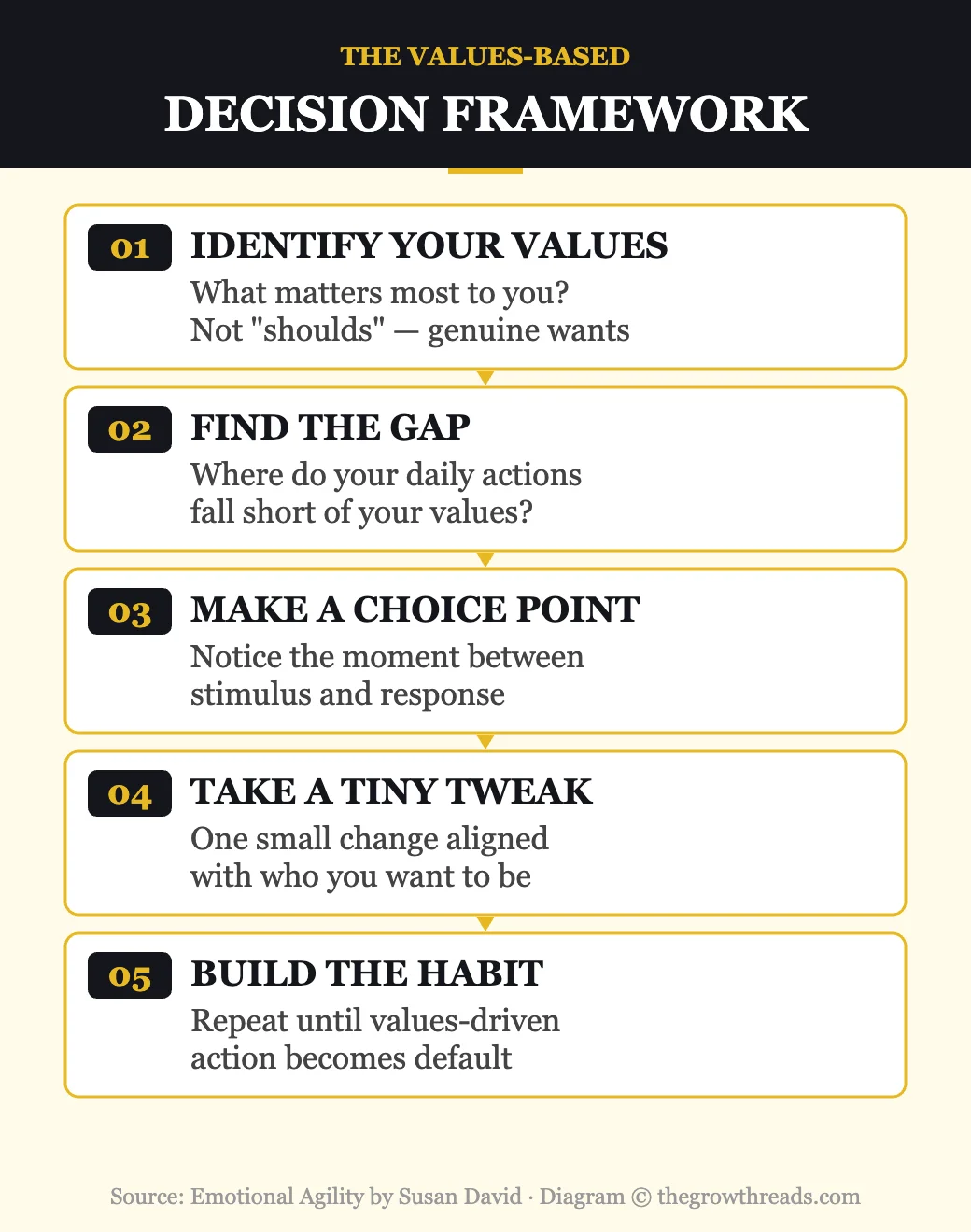
David introduces a values-sorting exercise where you identify your top values — not aspirational ones you think you should have, but the ones you actually live by when no one is watching. She then asks a powerful diagnostic question: Are my daily actions in service of these values, or in service of my fears? The gap between the two is where most human dissatisfaction lives.
Once values are clarified, they function as a decision-making compass. When you face a choice point — respond to a passive-aggressive email, take on a project that does not excite you, confront a difficult conversation — you can ask “Which response moves me toward my values?” rather than “Which response makes me feel comfortable right now?” This reframing does not make hard choices painless, but it makes them coherent.
Part 4 — Moving On: Tiny tweaks and the teeter-totter
The final stage of emotional agility is where insight becomes action. David rejects the “massive transformation” model of change. Instead, she advocates the tiny tweak — the smallest possible adjustment at a decision point that nudges behaviour toward your values. A manager who values fairness might commit to asking one quieter team member for input in every meeting. A parent who values presence might put the phone in another room during dinner. These tweaks are deliberately small because willpower is a depletable resource, and large changes provoke the identity-threat response that makes people snap back to old patterns.
David introduces the teeter-totter principle (or see-saw) to explain why some people stagnate while others burn out. On one end sits competence — the comfort of doing what you already know. On the other sits challenge — the discomfort of growth. When life tips too far toward competence, you feel bored and disengaged. When it tips too far toward challenge, you feel overwhelmed and anxious. Emotional agility is the ability to notice which end is weighted and make a deliberate correction.
She closes with a chapter on raising emotionally agile children. Rather than telling kids to “calm down” or “be brave,” David recommends helping them label emotions with specificity, normalising all feelings (while setting limits on behaviours), and modelling values-driven decision-making in front of them. Children who learn these skills early develop stronger emotion regulation, better social relationships, and higher academic performance — effects that compound across a lifetime.
Who is Emotional Agility best for — and who should read something else first?
This book is ideal for professionals and leaders who notice they react on autopilot more often than they would like, anyone who feels emotionally stuck or numbed out, and parents who want to raise emotionally intelligent children. It is especially powerful for high achievers who have “optimised everything except their inner lives.”
If you are brand new to the idea that thoughts are not facts, you may want to start with The Happiness Trap for a more gradual introduction to ACT principles. If you are primarily interested in workplace application, Emotional Intelligence by Daniel Goleman covers the organisational angle in more depth.
Questions to reflect on
- When was the last time an emotion drove a decision you later regretted — and what would “stepping out” have looked like in that moment?
- Are you more of a bottler or a brooder? How does that pattern show up in your closest relationship?
- If you listed your top three values right now, would your calendar from last week reflect them?
- Where on the competence-challenge teeter-totter are you sitting in your current role — and which tiny tweak could rebalance it?
- What is one emotion you consistently judge yourself for having — and what would it look like to show up to it with curiosity instead?
🔥 Ready to stop reacting and start choosing?
Get the frameworks to unhook from autopilot emotions and live with intention.
How to apply Emotional Agility (7-day plan)
- Day 1 — Catch your hooks: Carry a small notebook and jot down every time an emotion drives a reactive decision today. Do not judge; just notice.
- Day 2 — Label with precision: Replace vague labels (“stressed,” “upset”) with specific ones (“overwhelmed by deadlines,” “hurt by being excluded from the meeting”). Aim for at least five precise labels.
- Day 3 — Practice defusion: When you notice a recurring negative thought, preface it with “I notice I am having the thought that…” and observe how the thought’s grip loosens.
- Day 4 — Clarify three values: Write down the three things that matter most to you — not what you think should matter, but what genuinely does. Keep the list visible.
- Day 5 — Audit your calendar: Compare yesterday’s activities against your three values. Highlight one activity that served fear rather than values, and plan a tiny tweak for tomorrow.
- Day 6 — Make one tiny tweak: At one decision point today, pause and ask: “Which response moves me toward my values?” Act on that response, even if it feels uncomfortable.
- Day 7 — Teach it forward: Explain the Showing Up → Stepping Out → Walking Your Why framework to someone you trust. Teaching consolidates learning and builds accountability.
Frequently asked questions
What is emotional agility in simple terms?
Emotional agility is the ability to experience your thoughts and feelings without being controlled by them. Instead of reacting on autopilot — snapping at a colleague because you are stressed, or avoiding a conversation because you are afraid — you learn to notice the emotion, create a moment of space, and then choose a response that aligns with your values. It is not about being positive all the time; it is about being flexible and intentional with your inner experience so it does not dictate your outer behaviour.
Is Emotional Agility based on scientific research?
Yes. Susan David is a psychologist at Harvard Medical School and her framework draws heavily on acceptance and commitment therapy (ACT), a well-validated branch of cognitive-behavioural therapy with hundreds of peer-reviewed studies supporting its effectiveness. David also cites research on emotional granularity by Lisa Feldman Barrett, expressive writing studies by James Pennebaker, and her own published work on emotional flexibility and workplace performance. The book is grounded in evidence rather than anecdote.
How is Emotional Agility different from emotional intelligence?
Emotional intelligence (popularised by Daniel Goleman) is the broad capacity to recognise and manage emotions in yourself and others. Emotional agility is a more specific process — a four-step framework for unhooking from difficult emotions and taking values-aligned action. Think of emotional intelligence as the “what” (the skill set) and emotional agility as the “how” (the practical method for developing that skill set in daily life). They complement each other rather than competing.
What does “getting hooked” mean in Emotional Agility?
Getting hooked describes the moment when a thought or emotion grabs you and drives behaviour before you consciously choose a response. For example, you feel inadequate after a meeting and immediately begin over-preparing for the next one, or you feel angry at a friend and send a harsh text before thinking it through. David identifies two common hook patterns: bottling (suppressing emotions to appear fine) and brooding (ruminating obsessively on negative thoughts). Both keep you stuck.
Can emotional agility be taught to children?
Absolutely, and David devotes a full chapter to it. The key practices include helping children name their emotions with specificity (not just “sad” but “disappointed because my friend cancelled”), validating all feelings while setting limits on behaviours, and modelling values-driven decisions as a parent. Research shows that children who develop emotional granularity early have stronger emotion regulation, better friendships, and higher academic performance throughout their school years and beyond.
What is the teeter-totter principle?
The teeter-totter (or see-saw) principle describes the balance between competence and challenge that is necessary for growth and engagement. When your life tips too far toward competence — doing only what you are already good at — you feel bored and stagnant. When it tips too far toward challenge — constantly facing tasks beyond your ability — you feel overwhelmed and anxious. Emotional agility helps you notice which end is weighted and make a deliberate adjustment to stay in the productive middle.
How long does it take to become emotionally agile?
David does not prescribe a fixed timeline because emotional agility is a practice, not a destination. Most people notice meaningful shifts within a few weeks of consistently applying the four steps — particularly the defusion technique of “stepping out” from unhelpful thoughts. The 7-day plan in the book provides an accessible on-ramp. However, building deep emotional agility — the kind that holds under pressure — is an ongoing process that deepens over months and years of deliberate practice.
Related summaries
- The Happiness Trap by Russ Harris — The ACT-based companion for deeper work on defusion and acceptance.
- Emotional Intelligence by Daniel Goleman — The broader framework of emotional competence in work and life.
- The Untethered Soul by Michael Singer — A spiritual approach to the same observer-self insight David describes in Stepping Out.
- Atomic Habits by James Clear — The behavioural design companion to David’s tiny-tweak philosophy.
📚 Explore more: Best Psychology Books
Related Psychology Summaries
On the Move Summary & Review: A Neurologist’s Extraordinary Life of Curiosity and Courage
The Art of Thinking Clearly Summary & Review: 99 Biases That Sabotage Your Decisions
The Happiness Trap Summary & Review: Stop Chasing, Start Living
The Molecule of More Summary & Review: Why You Never Feel Satisfied
The Righteous Mind Summary & Review: Why Good People Disagree