

⭐⭐⭐⭐✬ 4.5/5 — The investing book Warren Buffett has sent to shareholders — twice.
Best for: Serious investors who want a framework for thinking about risk, market cycles, and contrarian positioning.
Reading time: ~7 hrs
Difficulty to apply: High — requires emotional discipline to act against the crowd during market extremes.
The Most Important Thing in one minute
Investing success requires second-level thinking — going beyond the obvious to see what others miss. Howard Marks, co-founder of Oaktree Capital Management (which manages over $170 billion), distills five decades of investment wisdom into the principles that separate great investors from average ones. His central argument is that superior returns come not from being right, but from being right when the consensus is wrong — a feat that requires deep understanding of risk, cycles, market psychology, and the limits of prediction. The book is structured around twenty “most important things,” each building on the last to create a complete framework for thoughtful, defensive, contrarian investing. Warren Buffett has said of the book: “This is that rarity, a useful book.”
Key takeaways
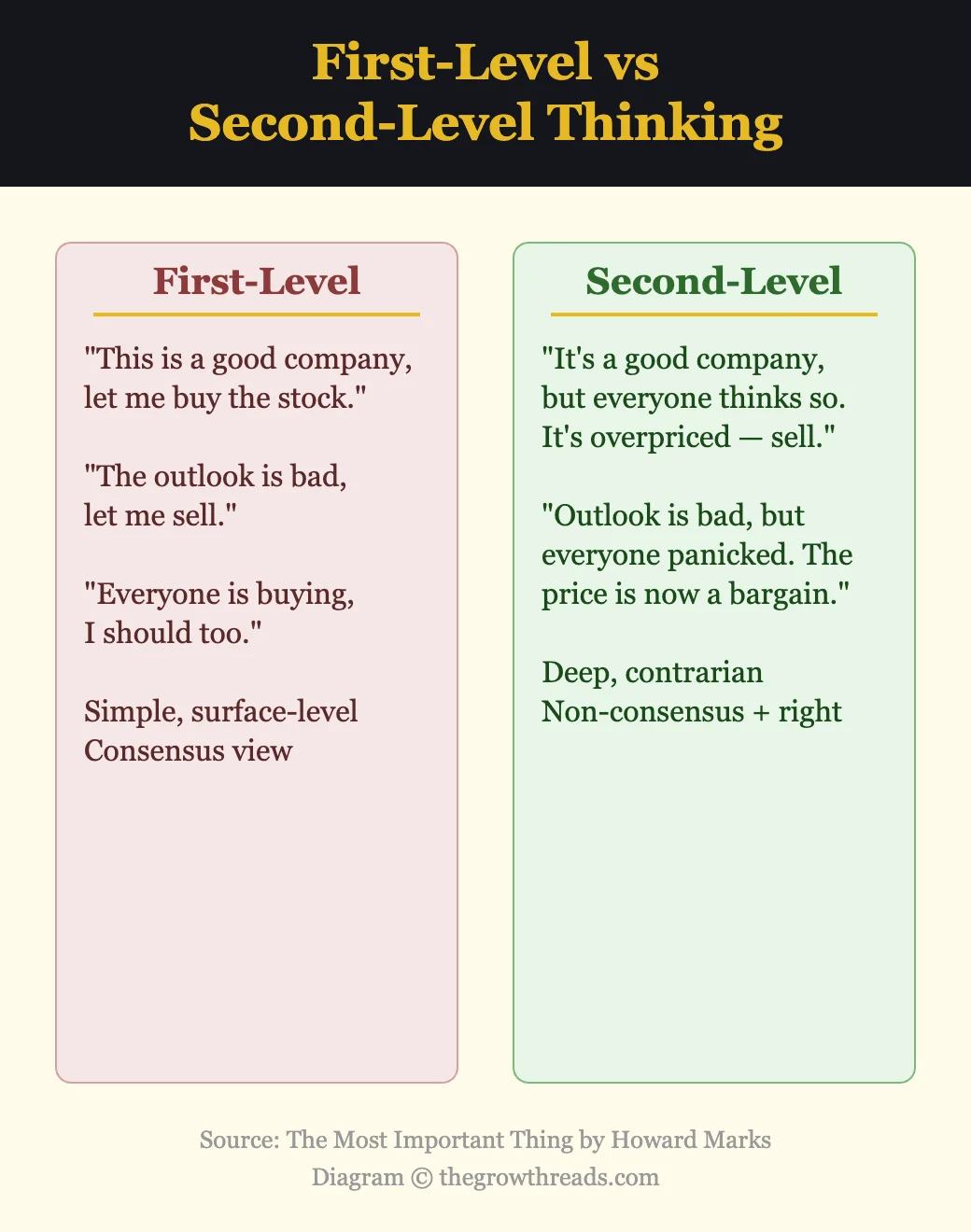
- Second-level thinking is the edge: First-level thinking says “this is a good company, buy the stock.” Second-level thinking says “this is a good company, but everyone knows it, so the stock is overpriced — sell.” The difference between average and superior returns is the depth of your thinking.
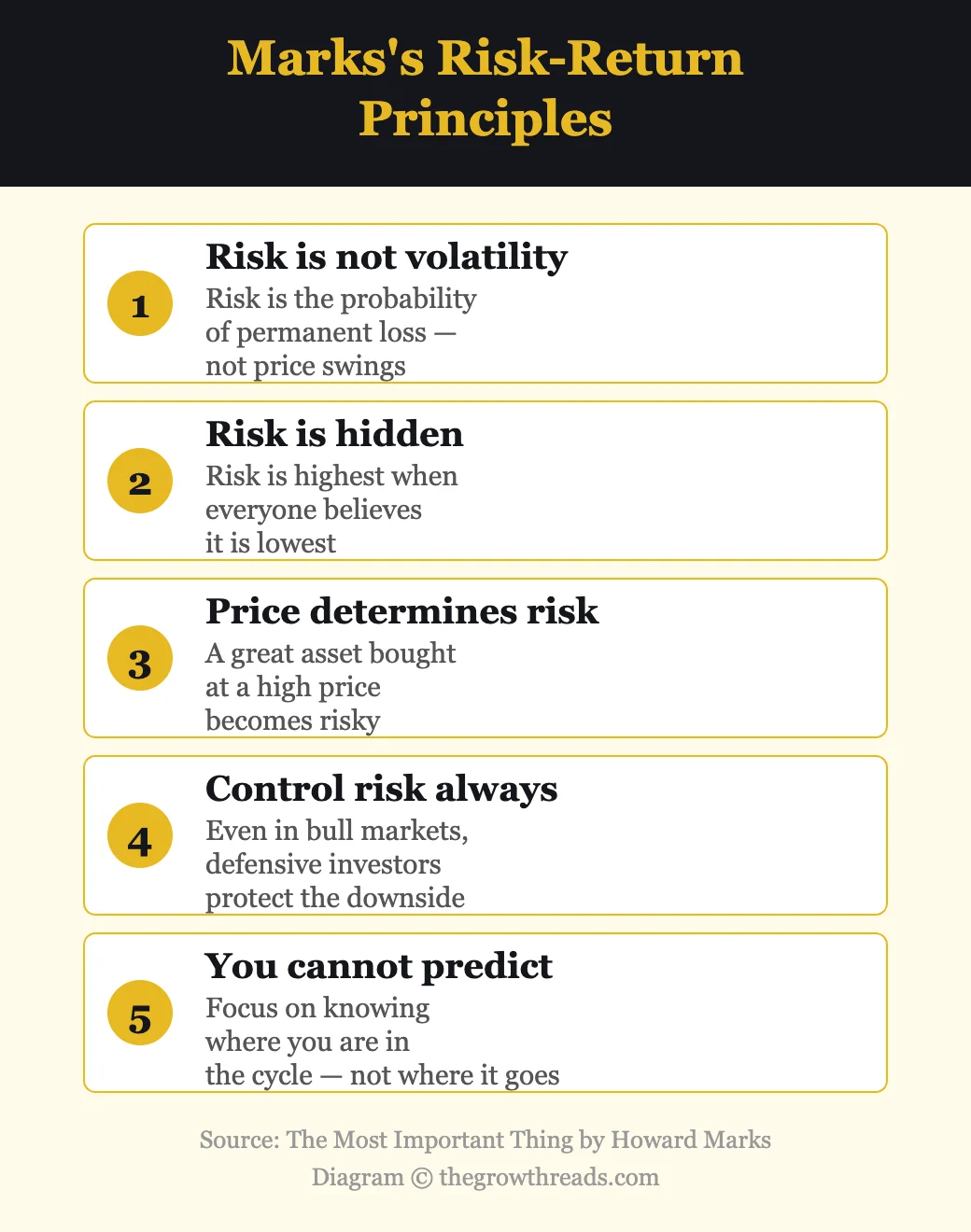
- Risk is not volatility — it is permanent loss: Academic finance defines risk as standard deviation (price swings). Marks defines it as the probability of losing money permanently. This distinction changes everything about how you construct a portfolio.
- Risk is highest when it feels lowest: When everyone believes the market is safe, prices rise until they become dangerous. The seeds of the next crash are sown in the complacency of the current boom.
- Price determines risk, not quality: A wonderful company bought at too high a price is a risky investment. A mediocre company bought at a deep enough discount can be safe. Nothing is inherently good or bad — it depends entirely on the price.
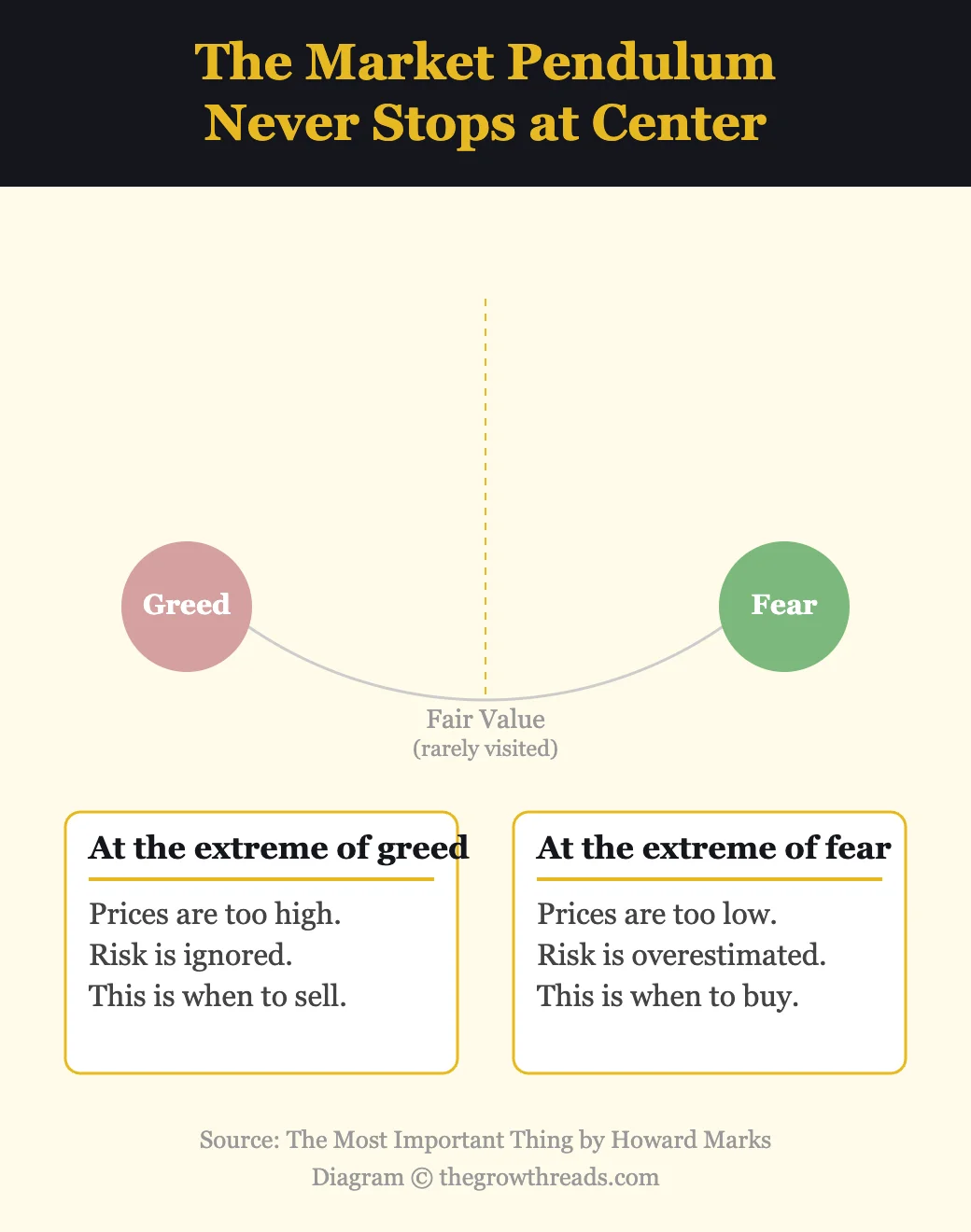
- Market cycles are inevitable: Markets swing between greed and fear like a pendulum — and they almost never stop at the center. Understanding where you are in the cycle is more useful than trying to predict where it goes next.
- Contrarian thinking is necessary but not sufficient: Going against the crowd is essential, but doing so profitably requires being right about why the crowd is wrong. Contrarianism without analysis is just stubbornness.
- Defensive investing wins: The key to long-term success is avoiding losers, not finding winners. A portfolio that avoids catastrophic losses will compound to superior returns over time, even without occasional home runs.
- You cannot predict the future: Marks divides investors into two camps: those who know they cannot predict the future and those who do not know they cannot predict the future. The honest investor focuses on understanding the present rather than forecasting the future.
- Patient opportunism beats constant action: The best investments come from waiting for moments when prices are irrationally low — then acting decisively. Most of the time, the best move is to do nothing.
- Know what you do not know: Intellectual humility is the investor’s greatest asset. The people who lose the most money are those who are certain they are right.
What is The Most Important Thing about?
The Most Important Thing distills Howard Marks’s investment philosophy into twenty interconnected principles. It covers second-level thinking, risk assessment, market cycles, contrarian positioning, and the psychology of investing — forming a complete framework for achieving superior returns through disciplined, defensive, and deeply thoughtful investing.
About the author
Howard Marks co-founded Oaktree Capital Management in 1995, which has grown to manage over $170 billion in assets, primarily in distressed debt and credit strategies. Before Oaktree, he spent 16 years at TCW Group and Citibank. Marks is best known for his investor memos, which he has written since 1990 and which have become required reading on Wall Street — Warren Buffett has said he reads every one as soon as it arrives. His investment track record spans five decades and multiple financial crises, and his approach to risk management is studied at business schools worldwide. Explore all Howard Marks book summaries →
Key concepts at a glance
| Concept | What it means | Use it when |
|---|---|---|
| Second-level thinking | Thinking beyond the obvious to find what the consensus is missing | You are evaluating any investment and want an edge over the market |
| The market pendulum | Markets swing between greed and fear, rarely pausing at fair value | You need to assess where we are in the current cycle |
| Risk as permanent loss | Risk is the probability of losing capital permanently, not price volatility | You are building or evaluating a portfolio’s risk exposure |
| Price-value relationship | An asset’s risk depends on the price you pay, not its intrinsic quality | You are tempted to buy a popular company at any price |
| Patient opportunism | Wait for irrationally low prices, then act decisively | Markets are euphoric and nothing looks cheap |
| Defensive investing | Prioritize avoiding losers over finding winners | You want consistent long-term compounding with limited downside |
| Contrarian positioning | Go against the crowd — but only when you understand why they are wrong | Everyone agrees on an investment thesis and you feel the urge to follow |
| The limits of forecasting | No one can predict the future consistently — focus on the present | You are relying on macro predictions to make investment decisions |
Part 1: Second-level thinking and market efficiency
Marks opens with what he considers the single most important concept in investing: second-level thinking. First-level thinking is simple and shallow — “this is a good company, let me buy the stock.” Second-level thinking is complex and contrarian — “this is a good company, but everyone thinks it’s great, so it’s overpriced. The expectations baked into the stock are too high. I should sell.” The difference is not intelligence but depth: second-level thinkers ask not just “what will happen?” but “what do other people think will happen, and how does that affect the price?”
This leads directly into Marks’s nuanced view of market efficiency. He acknowledges that markets are generally efficient — most of the time, prices roughly reflect available information. But he argues they are not always efficient, and it is in those moments of inefficiency that superior returns are made. The efficient market hypothesis is “a useful approximation of the way the world works most of the time,” but treating it as absolute truth causes investors to miss the best opportunities, which come when emotions — greed or fear — push prices away from intrinsic value.
Marks uses this framework to explain why most active investors underperform: they engage in first-level thinking, buying what looks good and selling what looks bad, which is exactly what the consensus is already doing. To outperform, you must develop opinions that are both non-consensus and correct — a combination that is rare precisely because it requires the discipline to disagree with the crowd and the analytical rigor to be right about it.
Part 2: Risk, cycles, and market psychology
The middle section of the book is devoted to what Marks considers the least understood concept in investing: risk. He begins by rejecting the academic definition of risk as volatility (standard deviation of returns). A stock that drops 40% and recovers to new highs was volatile but not risky. A stock that drops 40% and the company goes bankrupt was both volatile and risky. The distinction matters because volatility-based risk models give investors false comfort — they measure what is easy to measure, not what actually matters.
Marks argues that risk is perversely cyclical. When everyone perceives risk as low — during booms, when prices are rising and defaults are rare — risk is actually at its highest, because complacency leads to excessive leverage, poor lending standards, and overpriced assets. Conversely, when everyone perceives risk as high — during crashes, when panic selling creates bargains — risk is actually at its lowest, because the bad news is already reflected in prices. This is the paradox of risk: it is most dangerous when it feels safest.
He then introduces the market pendulum metaphor: investor psychology swings between greed (“I might miss out”) and fear (“I might lose money”), almost never stopping at the rational midpoint. Understanding where the pendulum is at any given moment is the most practically useful skill an investor can develop. Marks provides specific indicators: when people are euphoric, when new paradigm theories emerge, when leverage is easy, and when the riskiest securities become the most popular — the pendulum has swung too far toward greed.
Part 3: Defensive investing and the limits of knowledge
The final section builds Marks’s investment philosophy into a complete strategy — one that prioritizes defense over offense. His argument is simple: in investing, the long-term winners are not the people who hit the most home runs but the people who avoid the most strikeouts. A portfolio that earns 8% per year for 20 years will outperform one that earns 15% for 15 years and then loses 50% in a crash. Consistency and avoidance of permanent loss are the keys to compounding.
Marks distinguishes between two types of investing skill: alpha (the ability to generate returns above the market) and risk control (the ability to limit losses during downturns). He argues that risk control is both more important and more achievable than alpha. Most investors cannot consistently pick winners, but any investor can learn to avoid catastrophic losses by refusing to overpay, maintaining adequate diversification, and being honest about what they do not know.
The book closes with a powerful argument for intellectual humility. Marks divides the investment world into “I know” investors (who make confident predictions about the future) and “I don’t know” investors (who accept uncertainty and position accordingly). The “I don’t know” school does not mean paralysis — it means focusing on what is knowable (current valuations, the state of the cycle, the margin of safety in your portfolio) rather than what is unknowable (next quarter’s earnings, next year’s interest rates, the timing of the next recession).
Who is The Most Important Thing best for — and who should read something else first?
Best for: Serious investors — whether amateur or professional — who want to develop a deeper, more disciplined framework for thinking about markets. Anyone managing their own portfolio who wants to understand risk beyond what a brokerage app tells them. Business school students and finance professionals who want the practitioner perspective that textbooks lack.
Read something else first if: You are completely new to investing and need the basics — start with The Psychology of Money or The Intelligent Investor. If you want a step-by-step personal finance system, I Will Teach You to Be Rich is more practical. And if you prefer narrative over framework, The Big Short tells the story of the 2008 crisis that validates many of Marks’s principles.
Questions to reflect on
- When I make an investment decision, am I engaging in first-level thinking (reacting to headlines) or second-level thinking (considering what the consensus already expects)?
- Where is the market pendulum right now — closer to greed or fear? What evidence supports my assessment?
- Am I defining risk as volatility (price swings) or as permanent loss of capital? How would my portfolio change if I adopted Marks’s definition?
- Do I have the emotional discipline to buy when everyone else is panicking and sell when everyone else is euphoric — or do I follow the herd?
- What am I most certain about in my portfolio, and could that certainty itself be a source of hidden risk?
🔥 Ready to invest with uncommon sense?
Learn the framework that Warren Buffett calls “that rarity, a useful book.”
How to apply The Most Important Thing (7-day plan)
- Day 1 — Practice second-level thinking: Pick one stock or asset you own. Write down the consensus view. Then write down why the consensus might be wrong — and what that would mean for the price. Do you still want to hold it?
- Day 2 — Audit your risk: Review your portfolio and ask: where am I exposed to permanent loss of capital? Ignore the day-to-day price swings and focus on what could go to zero or never recover.
- Day 3 — Read the pendulum: List five indicators of market sentiment: asset prices, leverage levels, new issuance, investor confidence surveys, and media tone. Where does the evidence point — greed or fear?
- Day 4 — Check your price-value gap: For your three largest holdings, estimate intrinsic value (using earnings, cash flow, or asset value). Compare it to the current market price. Is your margin of safety adequate?
- Day 5 — Identify your biggest conviction: Find the position you feel most confident about. Now deliberately argue the other side. What would have to be true for you to be wrong? This is the discipline of intellectual humility.
- Day 6 — Build a watch list: Create a list of high-quality assets you would buy at the right price — with specific target prices written down. When the next sell-off comes, you will be ready to act instead of panicking.
- Day 7 — Write your investment philosophy: In 200 words or fewer, write down your personal investment principles. Include your definition of risk, your approach to market cycles, and the one mistake you most want to avoid. Keep it visible.
Frequently asked questions
Is The Most Important Thing worth reading for beginners?
It depends on your starting point. If you already understand basic investing concepts — stocks, bonds, valuations — this book will transform how you think about risk and markets. If you are brand new, start with The Psychology of Money or The Intelligent Investor to build the foundation, then come to Marks for the advanced framework. The ideas are not technically complex, but they require some investment context to fully appreciate.
Why does Warren Buffett recommend this book?
Buffett has sent copies of The Most Important Thing to Berkshire Hathaway shareholders on multiple occasions. The reason is alignment: Marks’s philosophy mirrors Buffett’s own approach — buy when others are fearful, focus on intrinsic value, maintain a margin of safety, and think long-term. Buffett has called it “that rarity, a useful book,” which is high praise from someone who has read thousands of investment books.
What is the difference between this book and The Intelligent Investor?
Benjamin Graham’s The Intelligent Investor is the foundational text on value investing — it teaches the mechanics. Marks’s book assumes you know the mechanics and focuses on the psychology and philosophy of investing: how to think about risk, cycles, and crowd behavior. Think of Graham as the textbook and Marks as the masterclass. Reading both gives you the complete picture.
What does “second-level thinking” mean in practice?
Second-level thinking means going beyond the obvious conclusion. Example: first-level thinking says “inflation is rising, buy gold.” Second-level thinking says “inflation is rising, everyone expects it, gold is already expensive. But if inflation peaks sooner than expected, gold will drop. I should look for assets that benefit from the inflation peak instead.” It requires asking what the consensus already expects and positioning differently.
Is Howard Marks against index investing?
Not exactly. Marks acknowledges that index investing is the right choice for most people — it provides market returns at low cost and beats most active managers over time. His argument is that for investors who are willing to put in the work to develop genuine edge — second-level thinking, deep understanding of risk and cycles — active investing can add value. But he is clear-eyed about how rare that edge is and how dangerous overconfidence can be.
How is risk different from volatility?
Marks argues that volatility — the standard deviation of returns — is an academic abstraction that misses the point. Real risk is the probability of permanent capital loss. A stock that swings wildly but ultimately recovers is volatile, not risky. A stock that drops gradually and the company goes bankrupt is risky. This distinction matters because volatility-based risk models can give investors false confidence during the exact moments when real risk is highest.
What should I read after The Most Important Thing?
For the companion volume with annotations from other great investors, read The Most Important Thing Illuminated. For market cycles specifically, Marks’s second book Mastering the Market Cycle goes deeper. For the behavioral psychology behind the cycles he describes, read Thinking, Fast and Slow by Daniel Kahneman. And for the practical mechanics of value investing, The Intelligent Investor by Benjamin Graham is the essential foundation.
Related summaries
If The Most Important Thing resonated with you, explore these related summaries:
- The Psychology of Money — Morgan Housel on how behavior drives financial outcomes
- The Intelligent Investor — Benjamin Graham’s foundational value investing framework
- Thinking, Fast and Slow — The cognitive biases behind market irrationality
- A Random Walk Down Wall Street — The case for efficient markets and index investing
Note: This summary covers investing concepts for educational purposes. It is not financial advice. Consult a qualified financial advisor before making investment decisions.