

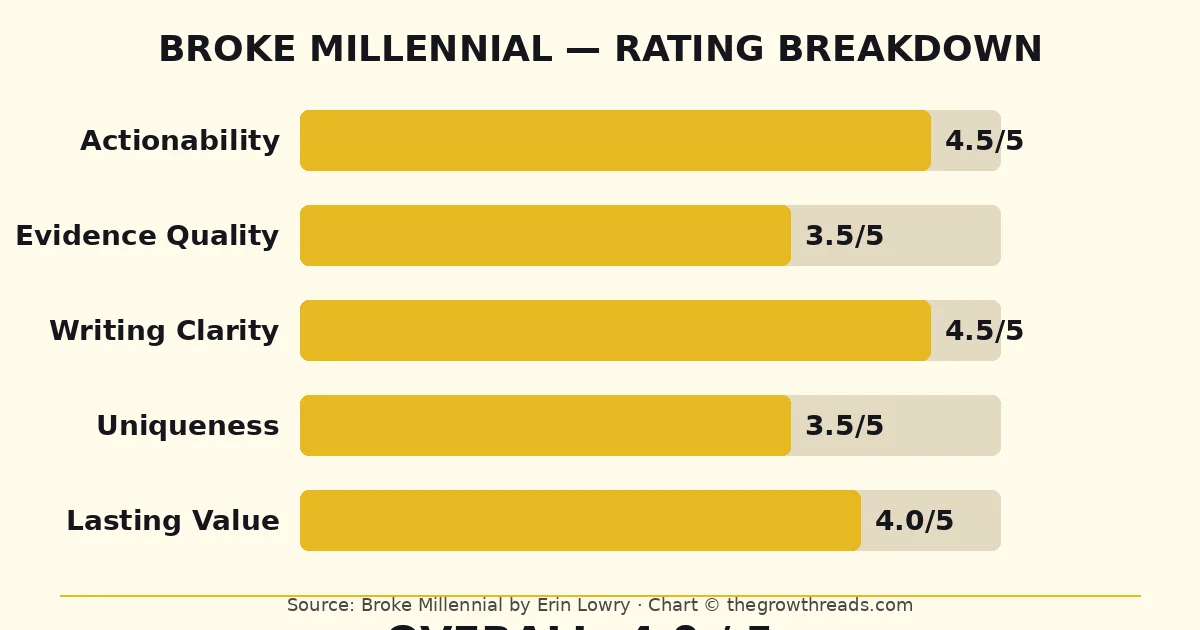
⭐⭐⭐⭐ 4.0 / 5
A relatable, jargon-free guide that turns intimidating money topics into approachable conversations for twenty- and thirty-somethings.
Best for: Young adults who know they should get their finances together but feel overwhelmed by where to start.
Reading time: ~5 hours (272 pages)
Difficulty to apply: Low — each chapter ends with concrete action steps you can implement immediately.
Broke Millennial in one minute
You do not need to earn more money to get your financial life together — you need to stop avoiding it. Erin Lowry wrote Broke Millennial after realizing that most personal finance advice was either too complicated, too condescending, or clearly written by people who had never lived paycheck to paycheck. The book walks readers through every foundational money skill — budgeting, debt payoff, negotiating salary, splitting bills with a partner, understanding investing basics — in a tone that feels like getting advice from a financially savvy friend rather than a lecture from a textbook. Lowry shares her own money story alongside practical frameworks, making the case that financial literacy is not about deprivation or spreadsheets but about understanding your own relationship with money and building systems that match your actual life.
Key takeaways
- Your money story shapes everything: The financial habits and beliefs you absorbed from your parents — whether spoken or unspoken — drive your current behavior. Identifying your money narrative is the first step to changing it.
- Budgeting is not punishment: A budget is a spending plan that reflects your values. Lowry reframes budgets as tools for freedom rather than restriction, and offers multiple frameworks to find one that fits your personality.
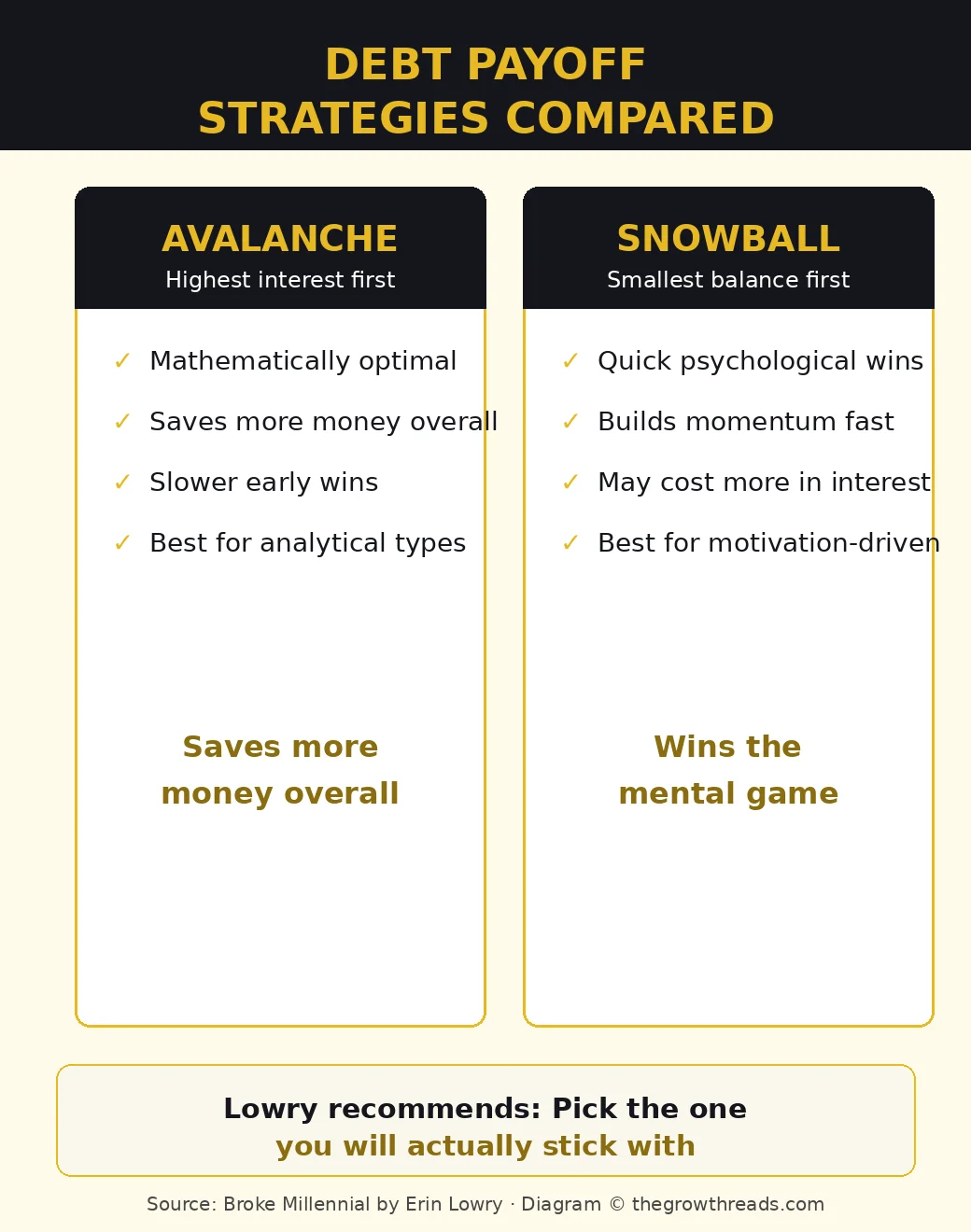
- Debt payoff needs a strategy, not shame: Whether you choose the avalanche method (highest interest first) or the snowball method (smallest balance first), having a deliberate plan matters more than which method you pick.
- Negotiate everything: Your salary, your rent, your bills, your credit card interest rate. Most people leave significant money on the table simply because they never ask.
- Automate your financial life: Set up automatic transfers to savings and investment accounts on payday. Automation removes willpower from the equation and makes good financial behavior the default.
- Talk about money with your partner early: Financial incompatibility is one of the top causes of relationship conflict. Lowry provides scripts and frameworks for having money conversations without triggering defensiveness.
- Investing is not optional: Waiting to invest until you feel ready costs you the most powerful wealth-building tool available — compound interest over time.
- Emergency funds come before everything: Three to six months of essential expenses in a savings account is the foundation that prevents every other financial plan from collapsing when life surprises you.
- Lifestyle creep is the silent budget killer: As your income grows, your expenses should not automatically grow with it. The gap between earning and spending is where wealth is built.
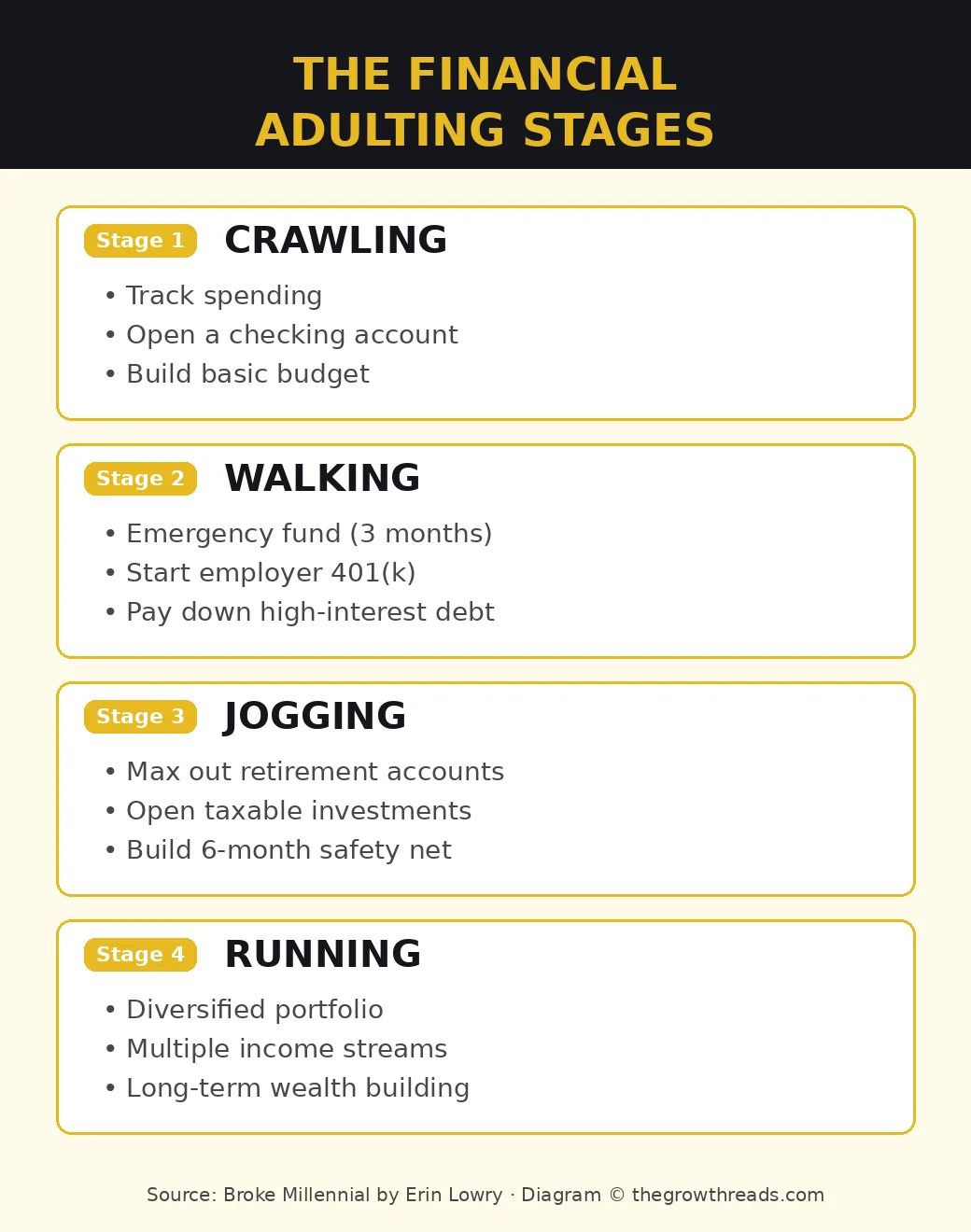
- Financial adulting is a process, not a destination: Lowry outlines stages from crawling to running — you do not need to have everything figured out at once.
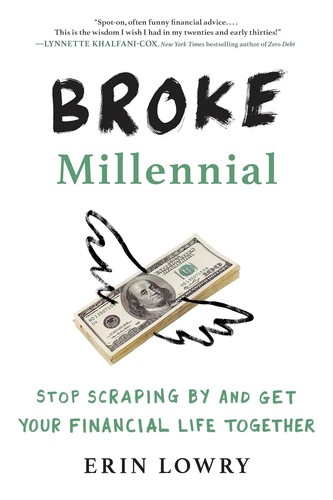
What is Broke Millennial about?
Broke Millennial is a step-by-step personal finance guide for young adults covering budgeting, debt payoff, salary negotiation, investing basics, and navigating money in relationships. Erin Lowry strips away the jargon and shame to make financial literacy accessible and actionable for readers in their twenties and thirties.
About the author
Erin Lowry started writing about personal finance in her early twenties after realizing she was one of the few people in her friend group who felt comfortable talking about money — a comfort she credits to parents who discussed finances openly at the dinner table. She launched the Broke Millennial blog in 2013, which grew into a leading personal finance platform for millennials. The blog led to her first book in 2017, followed by two sequels: Broke Millennial Takes On Investing and Broke Millennial Talks Money. Lowry has been featured in The New York Times, Forbes, and on CBS, and speaks regularly at financial literacy events. She brings a combination of personal transparency and practical research that makes complex topics approachable without being simplistic. Explore all Erin Lowry book summaries →
Key concepts at a glance
| Concept | What it means | Use it when |
|---|---|---|
| Money narrative | The story you tell yourself about money, shaped by childhood and culture | You notice emotional reactions to spending, saving, or earning |
| Cash diet | Spending only cash for a set period to build awareness of where money goes | You have no idea where your paycheck disappears to each month |
| Debt avalanche | Pay minimums on everything, throw extra at the highest-interest balance | You want to minimize total interest paid over time |
| Debt snowball | Pay minimums on everything, throw extra at the smallest balance first | You need quick wins to stay motivated through a long payoff |
| Financial adulting stages | A four-stage progression from crawling (basic budgeting) to running (investing and wealth building) | You feel overwhelmed and need to know which step comes next |
| The money talk | Structured conversations about finances with a romantic partner | You are getting serious with someone and need to align on money values |
| Automation system | Auto-transferring money to savings, investments, and bills on payday | You want good financial behavior without relying on willpower |
| Lifestyle creep guard | Deliberately directing raises toward savings and investments rather than spending | You just got a raise and want to avoid inflating your lifestyle |
Part 1 — Your money story: where it all begins
Lowry opens by asking readers a question most personal finance books skip: what did you learn about money growing up? She argues that your financial behavior is less about math and more about psychology — the beliefs, habits, and anxieties you absorbed from watching your parents handle (or avoid handling) money. Some readers grew up in homes where money was discussed openly and treated as a neutral tool. Others grew up in homes where money was a source of shame, secrecy, or conflict. These early experiences create what Lowry calls your money narrative — the unconscious story that drives every financial decision you make as an adult.
She shares her own background: her parents talked about money at the kitchen table, gave her an allowance tied to chores, and explained concepts like compound interest when she was still in elementary school. That transparency gave her a comfort with money that she later realized was rare among her peers. The chapter is not about blaming your parents — it is about becoming aware of the patterns you inherited so you can consciously choose which ones to keep and which ones to rewrite.
Lowry introduces the idea of a cash diet as the first practical step: for one month, pay for everything in cash to build visceral awareness of how you spend. Credit cards and apps create a psychological distance from spending that makes it easy to ignore. Cash forces you to feel every transaction. The exercise is not about permanent lifestyle change — it is diagnostic. Once you can see where your money actually goes, you can start making intentional choices about where you want it to go.
Part 2 — Budgeting, saving, and getting out of debt
The practical core of Broke Millennial starts with budgeting — but Lowry immediately acknowledges that the word itself causes allergic reactions in most people her age. Her reframe is simple: a budget is a spending plan that reflects your values. If travel matters to you, your budget should show that. If eating out with friends is how you maintain your social life, that is a legitimate line item. The goal is not to eliminate all spending that brings joy — it is to eliminate spending that does not bring joy so you have more money for what actually matters.
She walks through several budgeting approaches — the classic percentage-based system (50/30/20), zero-based budgeting, and envelope systems — without prescribing a single right answer. Her advice: try each for a month and stick with whichever one you actually maintain. The best budget is the one you will use, not the one that looks most impressive on paper.
The debt chapters are among the strongest in the book. Lowry explains both the avalanche and snowball methods with clear numerical examples, showing exactly how much each approach costs over time. The avalanche method — paying minimums on all debts while throwing every extra dollar at the highest-interest balance — saves more money in total interest. The snowball method — paying off the smallest balance first for quick psychological wins — keeps motivation high. Lowry’s practical recommendation: pick the one you will actually stick with. A mathematically suboptimal plan you execute beats a perfect plan you abandon after two months.
She also tackles a topic many books avoid: the emotional weight of debt. Carrying debt is not just a financial problem — it is a psychological one. Shame makes people avoid looking at their balances, which makes the problem worse, which increases the shame. Lowry breaks the cycle by normalizing the conversation and showing readers that a plan — any plan — is the antidote to financial anxiety.
Part 3 — Earning more and navigating money in relationships
Lowry devotes significant attention to the income side of the equation — something many budgeting-focused books neglect. Her chapter on salary negotiation is one of the most practical available. She provides word-for-word scripts for asking for a raise, negotiating a starting offer, and handling the common pushback lines managers use. Her core principle: never give a number first, always let the employer anchor. And if they insist, base your number on market research from sites like Glassdoor and Payscale, not on your current salary (which may be artificially low from years of small incremental raises).
She also covers freelancing and side income with a level of practical detail — invoicing, taxes, setting rates — that reflects her own experience as a freelance writer before the book deal. The chapter is not about “hustle culture” — it is about recognizing that building skills outside your day job creates both financial resilience and career optionality.
The relationship chapters are where Broke Millennial stands apart from most personal finance books. Lowry treats money conversations in relationships as a skill that can be learned, not a character trait you either have or lack. She provides frameworks for splitting bills fairly (not always 50/50 — she advocates proportional splitting based on income), deciding when to merge finances, and navigating the awkwardness of different earning levels between partners. She shares real scenarios: what happens when one partner earns three times more than the other, how to handle a partner who is a spender when you are a saver, and when to bring up debt you are carrying.
Part 4 — Investing basics and building long-term wealth
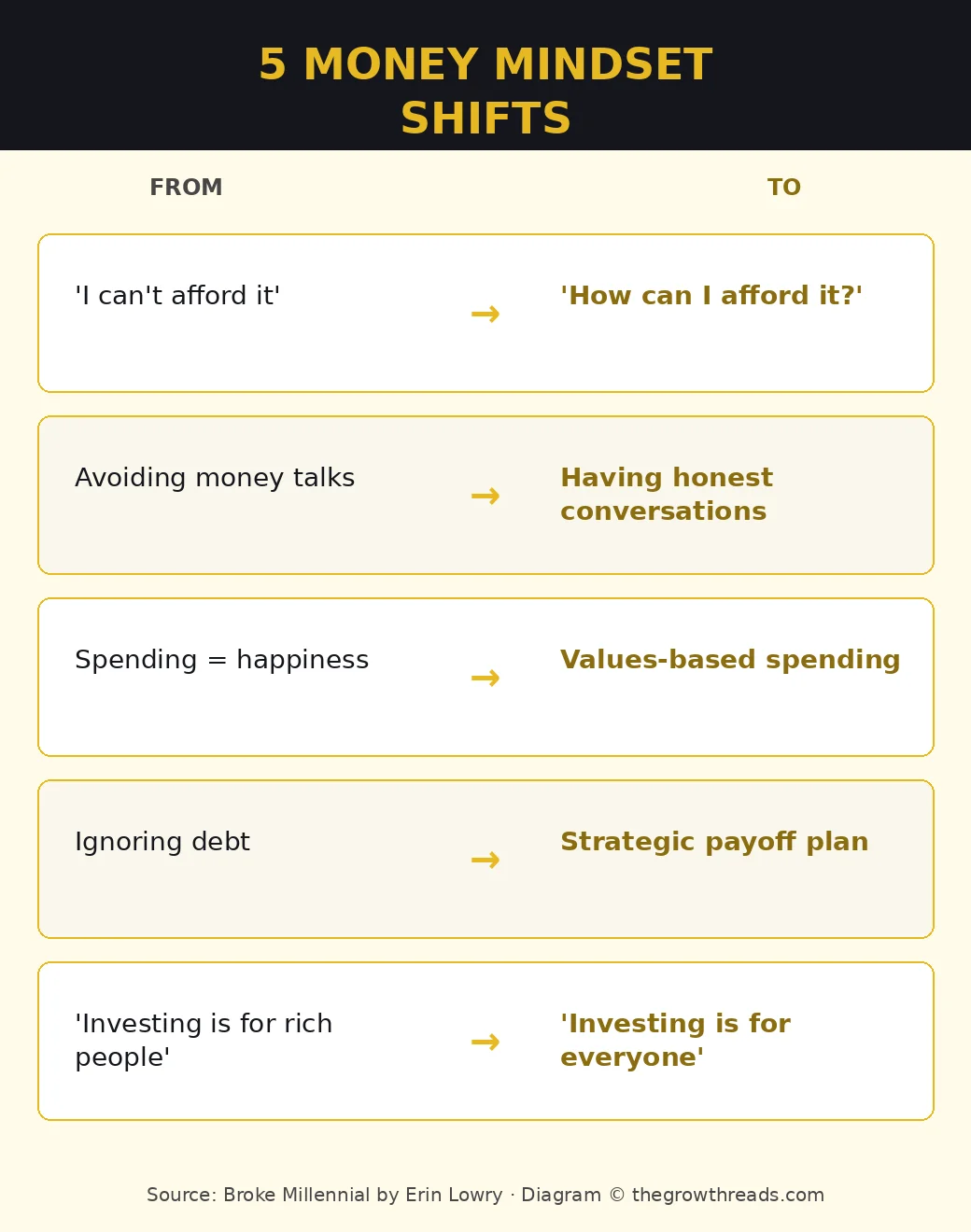
The final section tackles what Lowry calls the biggest mistake young people make with money: waiting to invest. She cites the classic compound interest comparison — someone who starts investing at 22 and stops at 30 ends up with more money at retirement than someone who starts at 30 and invests continuously until 65. The math is startling, and Lowry uses it to drive home a single point: the cost of waiting is the most expensive financial decision most young people make without realizing it.
Her investing chapters are intentionally basic — she covers the difference between stocks, bonds, and index funds, explains what a 401(k) match is and why not taking it is literally leaving free money on the table, and walks through opening a Roth IRA step by step. She does not try to make readers into stock pickers. Her recommendation is simple: low-cost index funds, consistent automatic contributions, and time in the market rather than timing the market. This aligns with the evidence-based approach championed by John Bogle and the index fund community.
Lowry closes with her financial adulting stages — a progression from crawling (basic budgeting and a checking account) through walking (emergency fund and employer retirement match) to jogging (maxing out retirement accounts) and running (diversified investments and multiple income streams). The framework is designed to reduce overwhelm: you do not need to be running before you can crawl. Figure out which stage you are in, master its tasks, and then level up.
Who is Broke Millennial best for — and who should read something else first?
Broke Millennial is ideal for anyone in their twenties or early thirties who feels financially behind and wants a judgment-free starting point. It is especially strong for readers who have avoided personal finance because the topic felt intimidating, boring, or irrelevant to their income level. If you earn a modest salary and need practical advice that respects your reality, this is your book.
If you already have a budget, are debt-free, and are looking for advanced investing strategies, Broke Millennial will feel too basic. Try The Simple Path to Wealth or The Little Book of Common Sense Investing instead. If you want a more aggressive, systems-based approach to personal finance, I Will Teach You to Be Rich covers similar ground with a bolder tone.
Questions to reflect on
- What is your earliest memory involving money — and how might that memory be shaping the financial decisions you make today?
- If you did a cash diet for one month, what category of spending do you think would surprise you the most?
- Are you currently avoiding any financial task — checking a balance, opening a bill, having a conversation with a partner — out of anxiety rather than strategy?
- Which financial adulting stage are you in right now, and what is the single most impactful action you could take to move to the next one?
- If your income increased by 20 percent tomorrow, would you have a plan for that money — or would lifestyle creep absorb it?
🔥 Ready to stop scraping by and start building wealth?
Broke Millennial gives you the practical tools and confidence to take control of your financial life — starting today.
How to apply Broke Millennial (7-day plan)
- Day 1 — Write your money story: Spend 15 minutes journaling about what you learned about money growing up. What did your parents say (or avoid saying) about finances?
- Day 2 — Start a cash diet: Withdraw enough cash for one week of discretionary spending. Put the cards away and pay cash for everything that is not a fixed bill.
- Day 3 — List every debt: Write down every balance, interest rate, and minimum payment. Choose avalanche or snowball and calculate your payoff timeline.
- Day 4 — Automate one thing: Set up one automatic transfer — savings, investment, or extra debt payment — timed for payday.
- Day 5 — Research your market salary: Look up your role on Glassdoor and Payscale. Write down the number you would ask for if you had a negotiation tomorrow.
- Day 6 — Check your employer match: If you have a 401(k) or equivalent, verify that you are contributing enough to get the full employer match. If not, increase your contribution today.
- Day 7 — Have the money talk: If you have a partner, schedule a no-pressure money conversation using Lowry’s framework. If single, tell one friend about one financial goal — accountability starts with saying it out loud.
Frequently asked questions
Is Broke Millennial only for millennials?
Despite the title, the advice applies to anyone starting their financial journey. The tone and examples skew toward twenty- and thirty-somethings, but the fundamentals — budgeting, debt payoff, investing basics, salary negotiation — are universally relevant. Gen Z readers will find it just as useful, and older readers who missed these lessons earlier will benefit from the clear, shame-free explanations.
How is Broke Millennial different from I Will Teach You to Be Rich?
Both books target young adults, but the tone and approach differ. Ramit Sethi is bolder and more prescriptive — he gives you one system and tells you to follow it. Erin Lowry is more flexible — she presents multiple options and helps you find the one that fits your personality. Sethi focuses heavily on automation and guilt-free spending on what you love. Lowry spends more time on the emotional and relational aspects of money, especially conversations with partners. If you want to be told exactly what to do, start with Sethi. If you want to understand your options and choose, start with Lowry.
Does the book cover investing in enough depth?
Broke Millennial covers investing basics — what stocks, bonds, and index funds are, how retirement accounts work, why compound interest matters. It is enough to get started, but readers who want to build a complete investment strategy will need a follow-up. Lowry herself wrote Broke Millennial Takes On Investing for this purpose. For a deeper single-volume guide, The Simple Path to Wealth by JL Collins is the natural next read.
Should I use the avalanche or snowball method for debt?
The avalanche method (paying highest-interest debt first) saves more money mathematically. The snowball method (paying smallest balances first) provides quicker psychological wins. Lowry recommends the one you will actually stick with — research from behavioral economics suggests that the motivation boost from small wins often outweighs the mathematical advantage of the avalanche for many people. If you are highly disciplined, go avalanche. If you need momentum, go snowball.
Is the salary negotiation advice practical or just theory?
Lowry provides actual scripts — word-for-word phrases to use in salary conversations, responses to common pushback lines, and email templates for following up. She also covers how to research your market value, when to negotiate (and when not to), and how to negotiate non-salary benefits when the salary number is fixed. The advice is among the most immediately actionable in any personal finance book.
How should couples handle money according to Broke Millennial?
Lowry does not prescribe one model. She presents three common approaches — fully merged finances, fully separate finances, and a hybrid (joint account for shared expenses, individual accounts for personal spending) — with the advantages and drawbacks of each. Her main advice: have the conversation early, be honest about debt and spending habits, and consider proportional splitting (each partner contributes a percentage of income rather than a flat 50/50) when there is a significant income gap.
Is Broke Millennial still relevant in 2026?
The fundamentals — budgeting, debt strategy, compound interest, salary negotiation — are timeless. Some specific product recommendations (certain apps or account types) may have changed, but the frameworks and mindset shifts are just as relevant. The relationship and money psychology chapters, in particular, address issues that do not change with market conditions or interest rates. For the most current information on specific investment accounts or tax rules, pair this book with an up-to-date online source.
Related summaries
- The Psychology of Money Summary — Morgan Housel on why personal finance is more about behavior than math.
- I Will Teach You to Be Rich Summary — Ramit Sethi on automating your finances and spending guilt-free on what you love.
- The Simple Path to Wealth Summary — JL Collins on index fund investing and financial independence.
- The Automatic Millionaire Summary — David Bach on how automating savings builds wealth without willpower.
📚 Explore the full Money collection
This summary is part of our best money books series — 39 in-depth reviews to help you earn, save, invest, and build lasting wealth.
Related Money Summaries
Skin in the Game Summary and Review
The Dhandho Investor Summary & Review: Low-Risk Value Investing That Works
The Four Pillars of Investing Summary & Review: Master Theory, History, Psychology, and Business
The One-Page Financial Plan Summary & Review: One Honest Page Beats a 40-Page Forecast
You Are a Badass at Making Money Summary & Review: Master the Mindset of Wealth