

⭐⭐⭐⭐⭐ 4.6/5
One-liner: The collected wisdom of Warren Buffett’s partner — a masterclass in mental models, rational thinking, and the art of avoiding stupidity.
Best for: Investors, decision-makers, and anyone who wants to think more clearly about money, business, and life.
Reading time: ~10 hours (352 pages)
Difficulty to apply: Moderate to high — the concepts are clear, but building a latticework of mental models requires sustained effort over years.
Poor Charlie’s Almanack in One Minute
Charlie Munger built one of the greatest investment track records in history not by being smarter than everyone else, but by being less foolish. This book collects Munger’s most important talks, essays, and ideas into a single volume. His central thesis is that real-world wisdom comes from building a “latticework of mental models” drawn from multiple disciplines — psychology, economics, physics, biology, history — and using them together to make better decisions. Rather than seeking brilliance, Munger argues you should focus on systematically avoiding stupidity. His most famous contribution, “The Psychology of Human Misjudgment,” catalogues 25 cognitive biases that reliably lead people to make terrible decisions about money and life.
Key Takeaways
- Build a latticework of mental models: No single discipline has all the answers — you need models from psychology, economics, mathematics, physics, and biology working together to see reality clearly.
- Invert, always invert: Instead of asking how to succeed, ask what would guarantee failure — then avoid those behaviors systematically.
- Stay within your circle of competence: Know the boundaries of what you truly understand, and never pretend expertise where you have none.
- Avoid cognitive biases ruthlessly: Munger identifies 25 psychological tendencies that warp human judgment — studying them is a prerequisite for rational decision-making.
- The best investment is in yourself: Reading voraciously across disciplines compounds your judgment the way interest compounds capital.
- Patience is the ultimate edge: The big money is made not in the buying and selling but in the waiting — do nothing most of the time.
- Avoid what you cannot understand: Complexity is the enemy of good returns — if you cannot explain a business simply, do not invest in it.
- Incentives drive everything: Show Munger the incentive structure and he will show you the outcome — never underestimate the power of incentives to shape behavior.
- Multidisciplinary thinking is not optional: Specialists miss the most important patterns because they only see through one lens — generalists with deep models see connections others miss.
- Avoid envy, resentment, and self-pity: Munger considers these the three most destructive emotions — eliminating them is worth more than any investment thesis.
What Is Poor Charlie’s Almanack About?
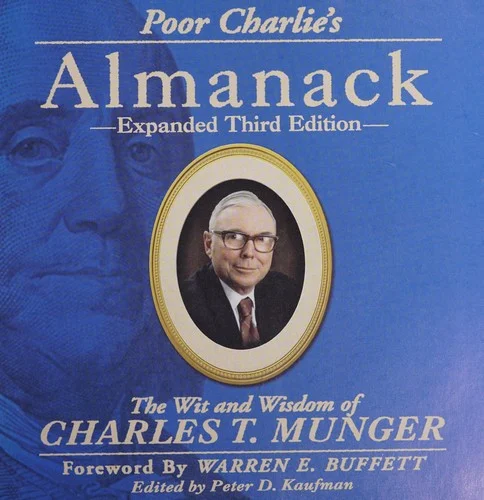
Poor Charlie’s Almanack is a collection of Charlie Munger’s speeches, essays, and wit compiled by Peter Kaufman. It presents Munger’s framework for rational thinking — built on mental models from multiple disciplines — and his famous catalogue of 25 psychological biases that cause human misjudgment. The book is part investing manual, part philosophy of life, and part intellectual autobiography of Warren Buffett’s longtime partner at Berkshire Hathaway.
About the Author
Charles Thomas Munger (1924–2023) was vice chairman of Berkshire Hathaway and Warren Buffett’s partner for over five decades. A Harvard-trained lawyer who pivoted to investing, Munger’s intellectual breadth — spanning law, meteorology, physics, psychology, and economics — became the foundation of his investing philosophy. He was famous for reading five newspapers daily and spending 80% of his waking hours reading and thinking. His influence on Buffett was profound: Munger convinced him to move beyond Benjamin Graham’s “cigar-butt” deep-value approach toward buying wonderful businesses at fair prices. Munger passed away in November 2023 at 99, just weeks before his hundredth birthday. Explore all Charlie Munger book summaries →
Key Concepts at a Glance
| Concept | What It Means | Use It When |
|---|---|---|
| Latticework of Mental Models | Interconnected models from multiple disciplines | Making complex decisions that span multiple domains |
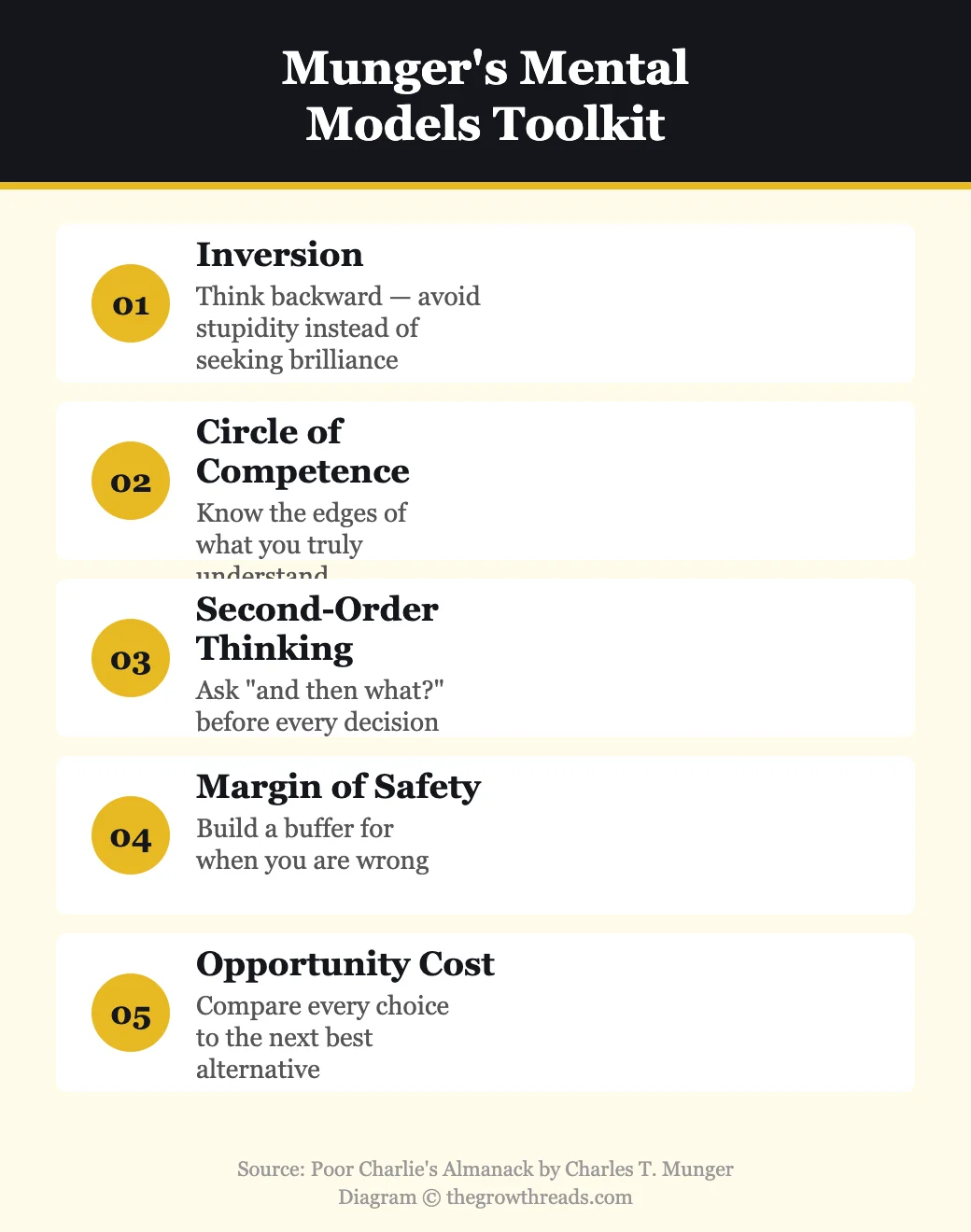
| Inversion | Solve problems backward — avoid failure first | Planning any major initiative or investment |
| Circle of Competence | Know and respect the edges of your expertise | Evaluating whether to pursue an opportunity |
| Psychology of Misjudgment | 25 cognitive biases that warp decisions | Auditing your own reasoning for hidden biases |
| Lollapalooza Effect | Multiple biases compounding in the same direction | Understanding why crowds make spectacularly bad decisions |
| Sit on Your Hands | Do nothing until a truly compelling opportunity appears | Resisting the urge to act during market volatility |
| Worldly Wisdom | Practical knowledge drawn from broad reading and experience | Building long-term judgment rather than chasing tips |
Part 1: The Munger Approach — Worldly Wisdom and Mental Models
Munger opens with his most foundational idea: the “latticework of mental models.” He argues that people who think with only one model — whether it is economics, psychology, or engineering — are like the proverbial man with a hammer to whom everything looks like a nail. The solution is to acquire roughly 80 to 100 mental models from all the major disciplines and learn to use them in combination.
He draws from mathematics (compound interest, probability), physics (critical mass, tipping points), biology (evolution, niches), psychology (cognitive biases, incentives), and economics (supply/demand, opportunity costs). The magic happens not in any single model but in the interactions between them — what Munger calls “the lollapalooza effect,” where multiple forces combine to produce an outcome far more extreme than any single factor could create.
Munger illustrates this with real investing decisions at Berkshire Hathaway. When they invested in Coca-Cola, they were not simply buying a cheap stock. They were recognizing the intersection of brand psychology (pavlovian conditioning), network effects (global distribution), and economic moats (taste preference is nearly impossible to displace). No single-discipline analyst would have seen the full picture.
Part 2: The Psychology of Human Misjudgment
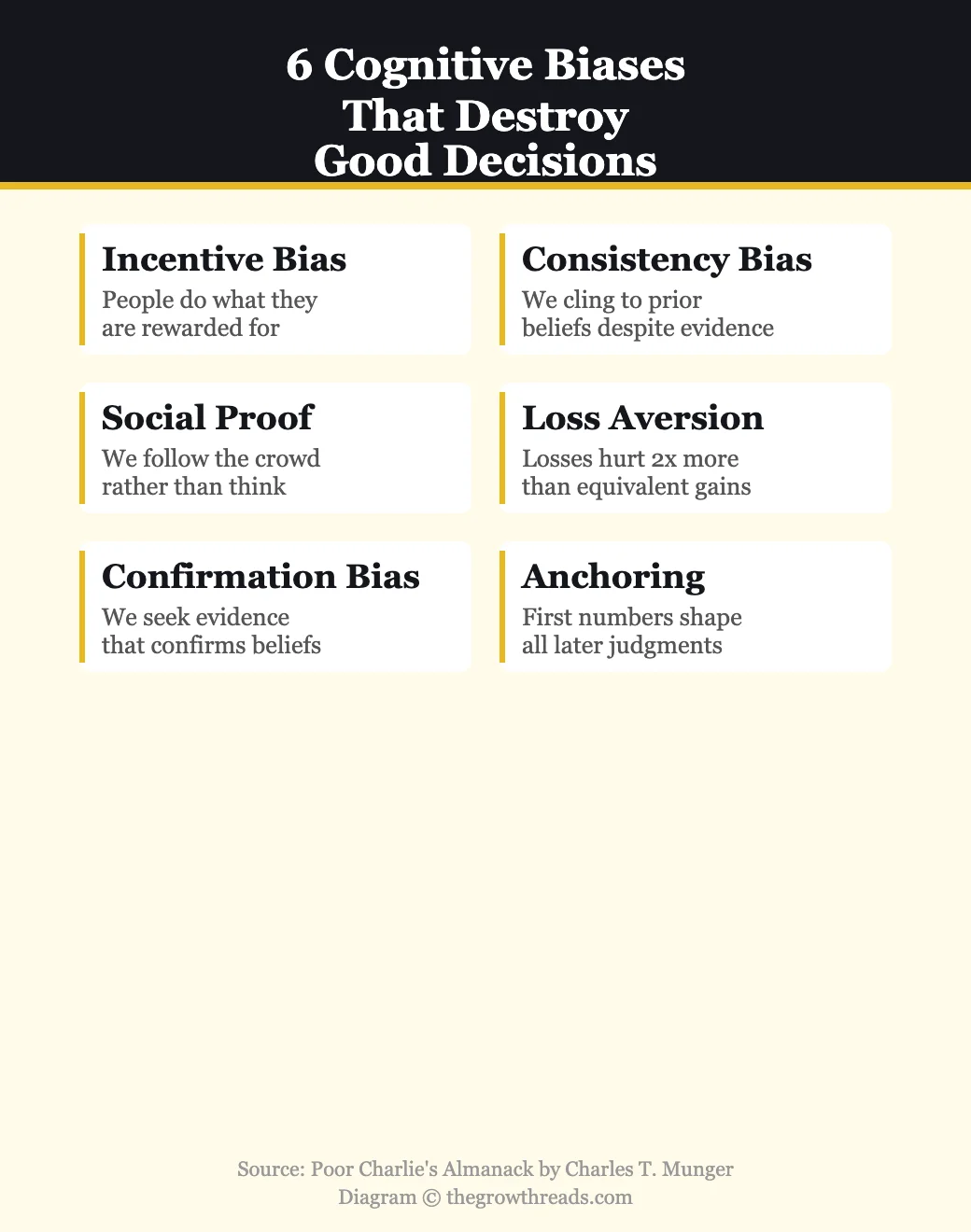
Munger’s most famous contribution is his catalogue of 25 standard causes of human misjudgment. This speech, delivered at Harvard in 1995 and refined over decades, is essentially a manual for understanding why smart people consistently make stupid decisions.
He begins with incentive-caused bias — perhaps his most emphasized principle. “Never, ever, think about something else when you should be thinking about the power of incentives,” he warns. People do not just respond to incentives; they unconsciously warp their perceptions to justify whatever the incentive structure rewards. He cites FedEx’s overnight package-sorting problem: workers paid by the hour sorted slowly, but the moment they were paid by the shift (finish early, go home), sorting speed doubled overnight.
Consistency and commitment bias, Munger argues, is equally dangerous. Once people have taken a public position or committed resources, they will defend that position long after the evidence has turned against them. This explains why investors hold losing stocks far too long and why organizations persist with failing strategies.
The “lollapalooza effect” — Munger’s term for when multiple biases combine in the same direction — produces the most catastrophic outcomes. Cults, financial bubbles, and mob behavior all result from social proof, authority bias, reciprocation tendency, and commitment bias working simultaneously. When you see these forces converging, Munger advises running in the opposite direction.
Part 3: Investing Principles and the Berkshire System
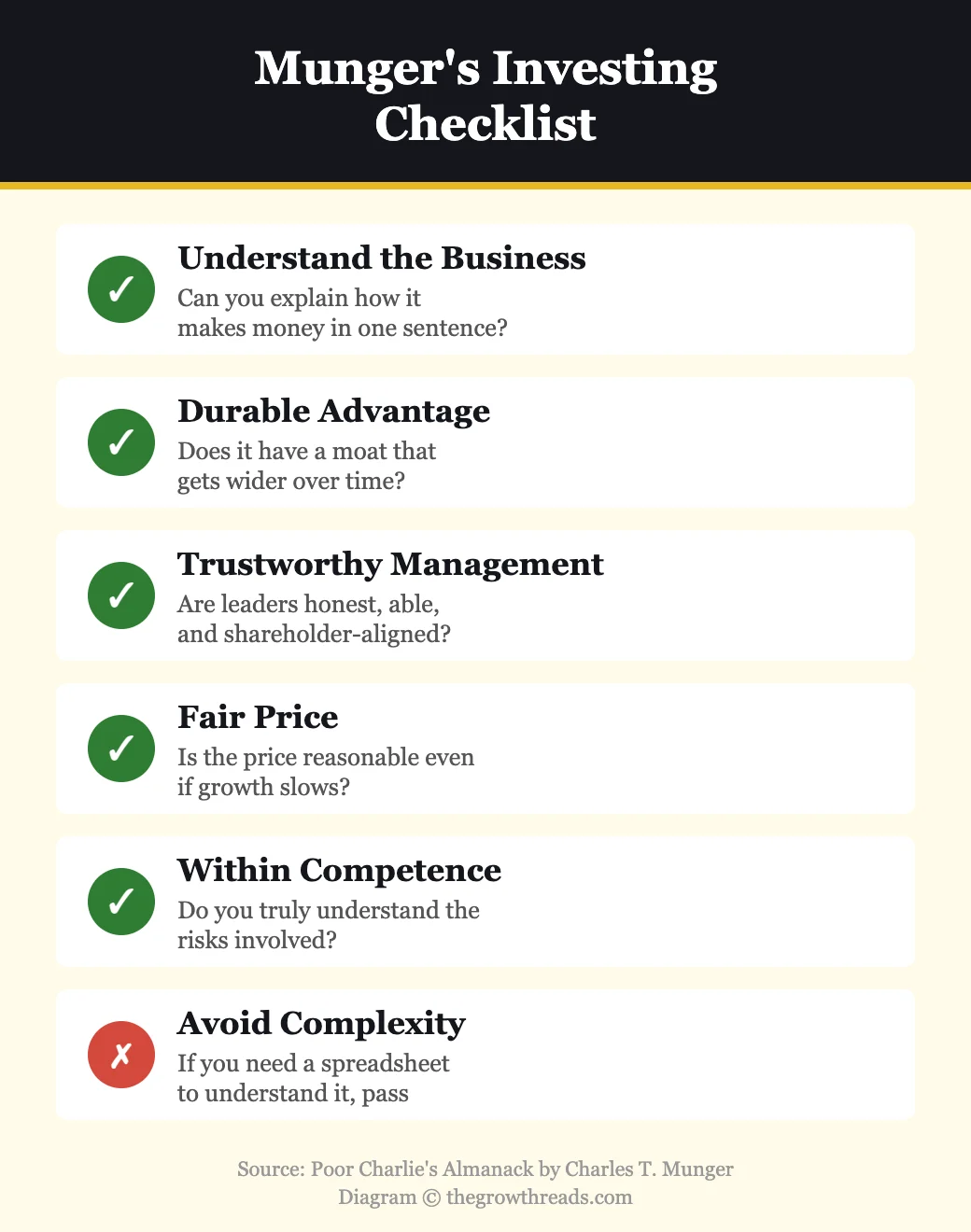
Munger’s investment philosophy is defined by what he does not do. He does not diversify broadly (he holds concentrated positions in businesses he deeply understands). He does not trade frequently (the best returns come from sitting on great businesses for decades). He does not chase complexity (if a spreadsheet is required to justify an investment, it is probably not worth making).
The “sit on your hands” philosophy is central. Munger compares great investing to baseball without called strikes — you can watch hundreds of pitches go by without swinging, and nobody penalizes you. The key is waiting for the “fat pitch” — an opportunity that is clearly within your circle of competence, offered at a price that provides a margin of safety, in a business with durable competitive advantages.
He emphasizes buying wonderful businesses at fair prices over buying fair businesses at wonderful prices — the philosophical shift he brought to Buffett’s investing approach. A wonderful business compounds value over time, meaning that even an apparently full price today looks like a bargain in retrospect if the business’s moat is genuinely widening. He points to Costco, a company he championed for decades, as the exemplar: a business model so focused on delivering value to customers that competitors cannot replicate it.
Part 4: Life Principles and Character
Beyond investing, Munger offers a philosophy of life built on the same principles of rationality. His prescription for a good life is strikingly simple: avoid envy, avoid resentment, avoid self-pity, be reliable, and spend each day trying to be a little wiser than when you woke up. He considers these emotional disciplines more important than any intellectual framework.
The principle of inversion — thinking backward — applies to life as much as investing. Instead of asking “How do I live a happy life?” Munger asks “What would guarantee a miserable life?” and then meticulously avoids those behaviors: being unreliable, being envious of others, being resentful, consuming drugs, and failing to learn from mistakes. By systematically avoiding the causes of misery, a good life becomes far more likely than it would from chasing happiness directly.
Munger also champions the idea that the best way to get what you want is to deserve it. He argues that the most reliable path to a good marriage, meaningful friendships, and professional success is to become the kind of person who merits those things — not to pursue them through manipulation or strategy. This stands in interesting contrast to more tactical approaches to success and represents Munger’s conviction that character ultimately compounds more reliably than cleverness.
Who Is Poor Charlie’s Almanack Best For — and Who Should Read Something Else First?
This book is ideal for experienced investors who want to deepen their analytical framework, business leaders who make complex decisions under uncertainty, and intellectually curious readers who enjoy connecting ideas across disciplines. Munger rewards readers who already have some investing experience and a broad reading habit.
If you are new to investing, start with The Psychology of Money by Morgan Housel for the emotional foundations, or The Intelligent Investor for the analytical ones. If you want Munger’s ideas in a more structured format, try The Warren Buffett Way by Robert Hagstrom, which organizes the Munger-Buffett approach into a clear investing methodology.
Questions to Reflect On
- What are the boundaries of your circle of competence — and are you honest about where they end?
- Which of Munger’s 25 cognitive biases do you fall prey to most often in your own decision-making?
- If you inverted your biggest current problem — asking what would make it worse rather than better — what would you stop doing immediately?
- How many disciplines do you genuinely draw on when making important decisions, and which gaps could you fill with focused reading?
- Where in your financial or professional life are you adding complexity when simplicity would serve you better?
🔥 Ready to Think Like Charlie Munger?
Build a latticework of mental models for better decisions in investing and life.
How to Apply Poor Charlie’s Almanack (7-Day Plan)
- Day 1 — Map your circle of competence. Write down the three to five areas where you have genuine expertise — then honestly list the areas where you pretend to know more than you do. Commit to staying inside the circle for the next month.
- Day 2 — Practice inversion. Take your most important current goal and invert it: list everything that would guarantee failure. Review your current behavior against that list and eliminate any overlaps.
- Day 3 — Audit your biases. Review Munger’s 25 biases and identify your top three. For each, write down a recent decision where the bias may have influenced you without your awareness.
- Day 4 — Read outside your discipline. Choose a book or long article from a field you know nothing about — biology, physics, history, or philosophy. Look for one mental model you can add to your latticework.
- Day 5 — Apply the checklist to a decision. Take a current financial or business decision and run it through Munger’s investing checklist: Do you understand it? Is there a moat? Is management trustworthy? Is the price fair? Is it within your competence?
- Day 6 — Practice patience. Identify one area where you are acting out of urgency rather than conviction. Commit to doing nothing for at least one week while you gather more information.
- Day 7 — Eliminate one source of misery. Using Munger’s inversion principle, identify one behavior or habit that is reliably making your life worse — envy, complaining, overreacting — and begin deliberately reducing it.
Frequently Asked Questions
Is Poor Charlie’s Almanack worth reading if I am not an investor?
Absolutely. While the book uses investing as its primary context, Munger’s mental models and cognitive bias framework apply to every domain of decision-making. Business leaders, doctors, lawyers, and educators have all found the psychology-of-misjudgment framework invaluable. The investing sections teach you how money works, but the mental models sections teach you how thinking works — and that is universally useful regardless of your profession.
What is the difference between the original and the Stripe Press edition?
The Stripe Press edition (2023) is a redesigned, updated version with improved typography, additional materials, and a foreword by John Collison. The core content — Munger’s speeches, the psychology of misjudgment, and his investing philosophy — remains the same. The original edition was expensive and hard to find; the Stripe Press edition made it affordable and widely available, including a free digital version released after Munger’s passing in late 2023.
What are mental models and why does Munger emphasize them?
Mental models are simplified representations of how things work — frameworks you carry in your head to understand complex situations. Munger emphasizes them because real-world problems do not come neatly labeled as “economics problems” or “psychology problems.” They are multi-causal, and you need models from multiple disciplines to see all the forces at play. The person with one model is dangerous; the person with a hundred models from ten disciplines makes consistently better decisions.
How does Munger’s approach differ from Warren Buffett’s?
Buffett was originally a pure Graham-style value investor — buying dollar bills for fifty cents. Munger pushed him toward buying great businesses at fair prices rather than mediocre businesses at cheap prices. Munger’s contribution was philosophical breadth: where Buffett thinks primarily through financial statements, Munger thinks through psychology, incentives, history, and multiple mental models. Buffett has said that Munger pushed him “from ape to human” as an investor.
What is the lollapalooza effect?
Munger coined “lollapalooza effect” to describe what happens when multiple psychological tendencies or forces combine in the same direction. Individually, each bias or force might produce a modest effect. But when three, four, or five of them align — social proof, authority, incentives, commitment bias, and reciprocation all pushing the same way — the result can be extreme and seemingly irrational. Financial bubbles, cult behavior, and corporate fraud all involve lollapalooza effects.
How long does it take to read Poor Charlie’s Almanack?
The book is approximately 352 pages in the Stripe Press edition and takes most readers eight to twelve hours. However, like a reference book, many readers return to it repeatedly rather than reading it cover to cover once. The “Psychology of Human Misjudgment” chapter alone is worth rereading annually. Many Munger devotees treat it as a book you study over years rather than consume in a weekend.
What should I read after Poor Charlie’s Almanack?
For more on mental models, try The Great Mental Models series by Shane Parrish, which was directly inspired by Munger. For the academic foundation of Munger’s bias framework, read Daniel Kahneman’s Thinking, Fast and Slow. For Munger’s investing philosophy applied systematically, try The Warren Buffett Way by Robert Hagstrom. And for Morgan Housel’s modern interpretation of Munger-influenced investing wisdom, pick up The Psychology of Money. This is not financial advice — consult a qualified financial advisor for personalized investment guidance.
Related Summaries
- The Psychology of Money by Morgan Housel — A modern classic on the behavioral side of wealth-building, deeply influenced by Munger’s thinking.
- The Intelligent Investor by Benjamin Graham — The analytical foundation that Buffett and Munger both started from before evolving their approach.
- The Warren Buffett Way by Robert Hagstrom — The Munger-Buffett investing philosophy organized into a systematic methodology.
- Same as Ever by Morgan Housel — Timeless patterns in human behavior and markets, in the Munger tradition of worldly wisdom.
For more money and investing book summaries, visit our Best Money Books pillar page.
Related Money Summaries
Naked Economics Summary and Review
One Up On Wall Street Summary & Review: How Everyday Investors Beat the Pros
Quit Like a Millionaire Summary & Review: The Math Behind Making Work Optional
The Automatic Millionaire Summary & Review: Build Wealth on Autopilot
The Little Book of Common Sense Investing Summary & Review: The Only Investment Guide You Will Ever Need