

★★★★☆ 4.3/5 — A compelling case for why fewer options lead to greater happiness.
Best for: Overthinkers, anyone overwhelmed by decisions, marketers, UX designers, and readers interested in behavioral economics.
Reading time: ~6 hours (304 pages)
Difficulty to apply: Low to moderate — practical strategies you can start using immediately.
The Paradox of Choice in one minute
Having more choices does not make us freer — it makes us more miserable. In The Paradox of Choice, psychologist Barry Schwartz draws on decades of research in decision science, behavioral economics, and psychology to show that the explosion of options in modern life — from 285 varieties of cookies to 175 salad dressings — is making us anxious, regretful, and chronically dissatisfied. The antidote is not more choice but smarter choosing: learning to satisfice instead of maximize, voluntarily constraining your options, and resisting the urge to compare your decisions to everyone else’s.
Key takeaways
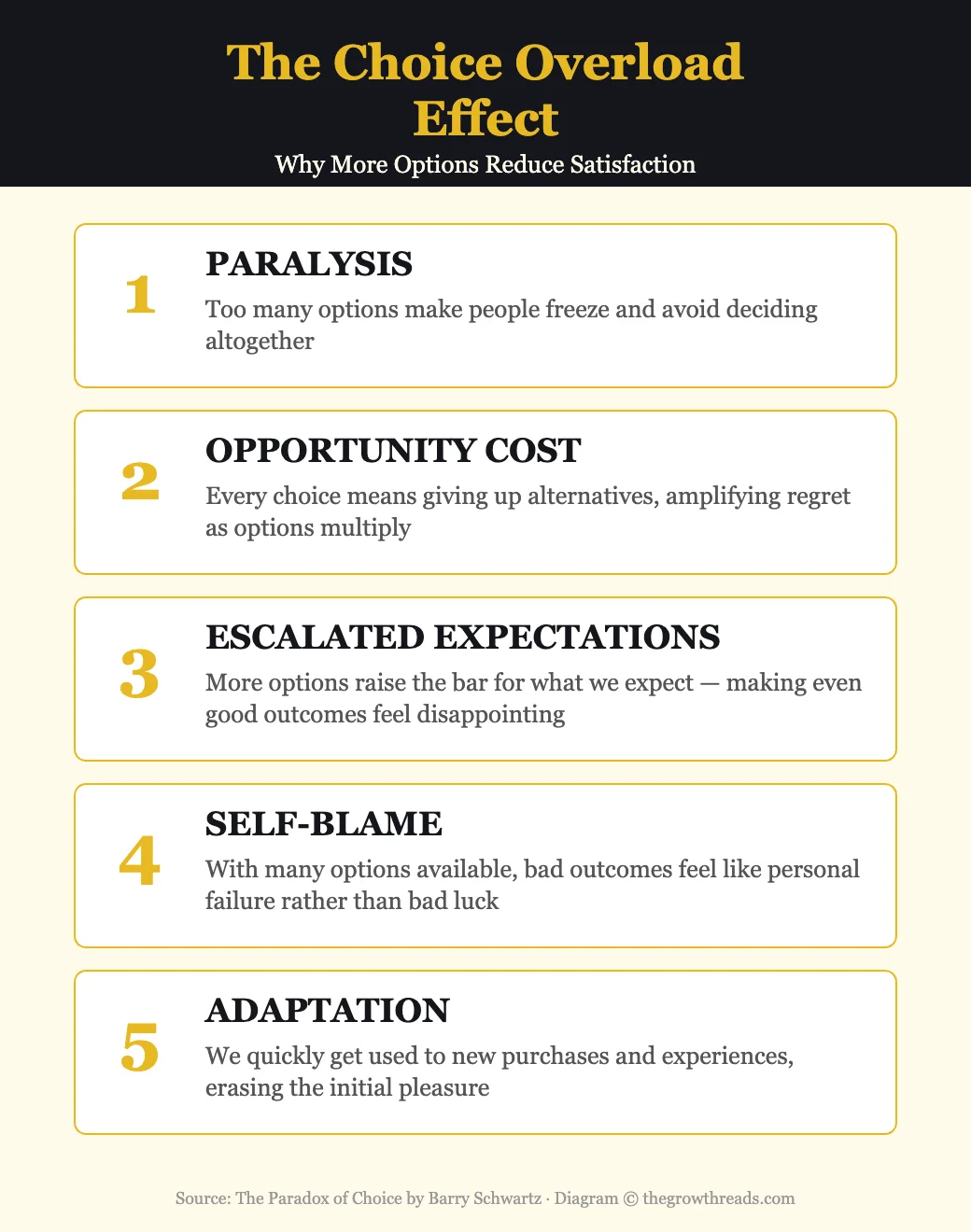
- More choice leads to less satisfaction: Beyond a certain threshold, additional options produce anxiety, paralysis, and regret rather than freedom and well-being.
- Maximizers suffer more than satisficers: People who seek the absolute best (maximizers) are more depressed, more anxious, and less satisfied with their decisions than those who seek “good enough” (satisficers).
- Opportunity costs multiply with options: Every alternative you reject becomes a phantom cost that diminishes the pleasure of whatever you chose.
- Choice overload causes decision paralysis: The famous jam study showed that shoppers presented with 24 varieties bought far less than those offered only 6 — too many options freeze people into inaction.
- Adaptation erases the thrill: We quickly adapt to new purchases and experiences, returning to our baseline happiness — a process called hedonic adaptation.
- Social comparison poisons satisfaction: Comparing your choices to what others chose (or what you imagine they chose) is one of the fastest routes to unhappiness.
- Reversible decisions are less satisfying: Counter-intuitively, knowing you can change your mind makes you less happy with what you picked. Commitment breeds contentment.
- Expectations rise with options: More choices raise the bar for what counts as an acceptable outcome, making even good results feel disappointing.
- Self-blame increases with freedom: When outcomes are bad and you had many options, you blame yourself (“I should have chosen better”) rather than external circumstances.
- Voluntary constraints are liberating: Rules, habits, and self-imposed limits (like shopping at only one store) reduce decision fatigue and increase well-being.
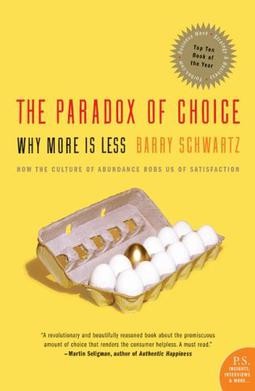
What is The Paradox of Choice about?
The Paradox of Choice argues that the abundance of options in modern consumer culture undermines well-being rather than enhancing it. Psychologist Barry Schwartz synthesizes research from decision theory, behavioral economics, and positive psychology to show that excessive choice produces paralysis, regret, and unrealistic expectations — and offers concrete strategies for making decisions that actually make you happier.
About the author
Barry Schwartz is an American psychologist who spent over 40 years as a professor at Swarthmore College before joining the Haas School of Business at UC Berkeley. His research sits at the intersection of psychology and economics, exploring how real people make decisions — as opposed to the perfectly rational agents assumed by classical economics. His TED Talk on the paradox of choice has been viewed over 15 million times, and his work has influenced fields from marketing and UX design to public policy. Schwartz is also the author of Why We Work and Practical Wisdom. Explore all Barry Schwartz book summaries →
Key concepts at a glance
| Concept | What it means | Use it when |
|---|---|---|
| Maximizing | Exhaustively comparing all options to find the objectively best one | You spend hours researching purchases and still feel dissatisfied afterward |
| Satisficing | Setting a “good enough” threshold and choosing the first option that meets it | You want faster, more satisfying decisions in low-stakes situations |
| Choice overload | The cognitive burden and paralysis caused by too many alternatives | You feel overwhelmed by menus, subscription plans, or product categories |
| Opportunity cost | The value of the next-best option you gave up by choosing what you chose | You catch yourself thinking about what you could have picked instead |
| Hedonic adaptation | The psychological process of returning to baseline happiness after any change | A new purchase thrills you for days but feels ordinary within weeks |
| Status quo bias | The tendency to stick with what you already have rather than risk a change | You keep a suboptimal subscription or job because switching feels risky |
| Counterfactual thinking | Imagining how things could have been if you had chosen differently | You replay past decisions and feel regret about roads not taken |
| Anchoring | Over-relying on the first piece of information (the anchor) when deciding | You judge a price as good or bad based on the first number you saw |
Part 1: When choice is a burden
Schwartz opens with a disarming observation: he went to buy a pair of jeans and was confronted with an overwhelming array of options — slim fit, easy fit, relaxed fit, baggy, extra baggy, stonewashed, acid-washed, distressed, button-fly, zip-fly. After an exhaustive fitting session, he left with the best-fitting jeans he had ever owned — and felt worse than ever. The experience that should have been trivial became a source of self-doubt and dissatisfaction. If this many options exist, surely the perfect pair is out there — and whatever he picked probably was not it.
This personal anecdote leads into the research that anchors the book. The famous jam study by Sheena Iyengar and Mark Lepper demonstrated the paradox in a grocery store: when shoppers encountered a display of 24 jam varieties, only 3% bought. When the display offered just 6 varieties, 30% bought — a tenfold increase. The abundance of options did not empower consumers; it paralyzed them. Schwartz argues this dynamic operates across virtually every domain of modern life: healthcare (patients now choose from dozens of treatment protocols), retirement savings (workers offered too many 401(k) fund options save less or nothing at all), education (students choosing from hundreds of courses feel less satisfied than those with a constrained curriculum), and entertainment (Netflix’s unlimited library produces more scrolling than watching).
The problem is not choice itself — Schwartz is careful to emphasize that some choice is essential for autonomy and well-being. The problem is that beyond a threshold (which varies by domain and individual), additional options produce diminishing and then negative returns. The relationship between choice and well-being is not linear; it is an inverted U-curve. We hit the peak surprisingly early.
Part 2: How we choose — and why it hurts
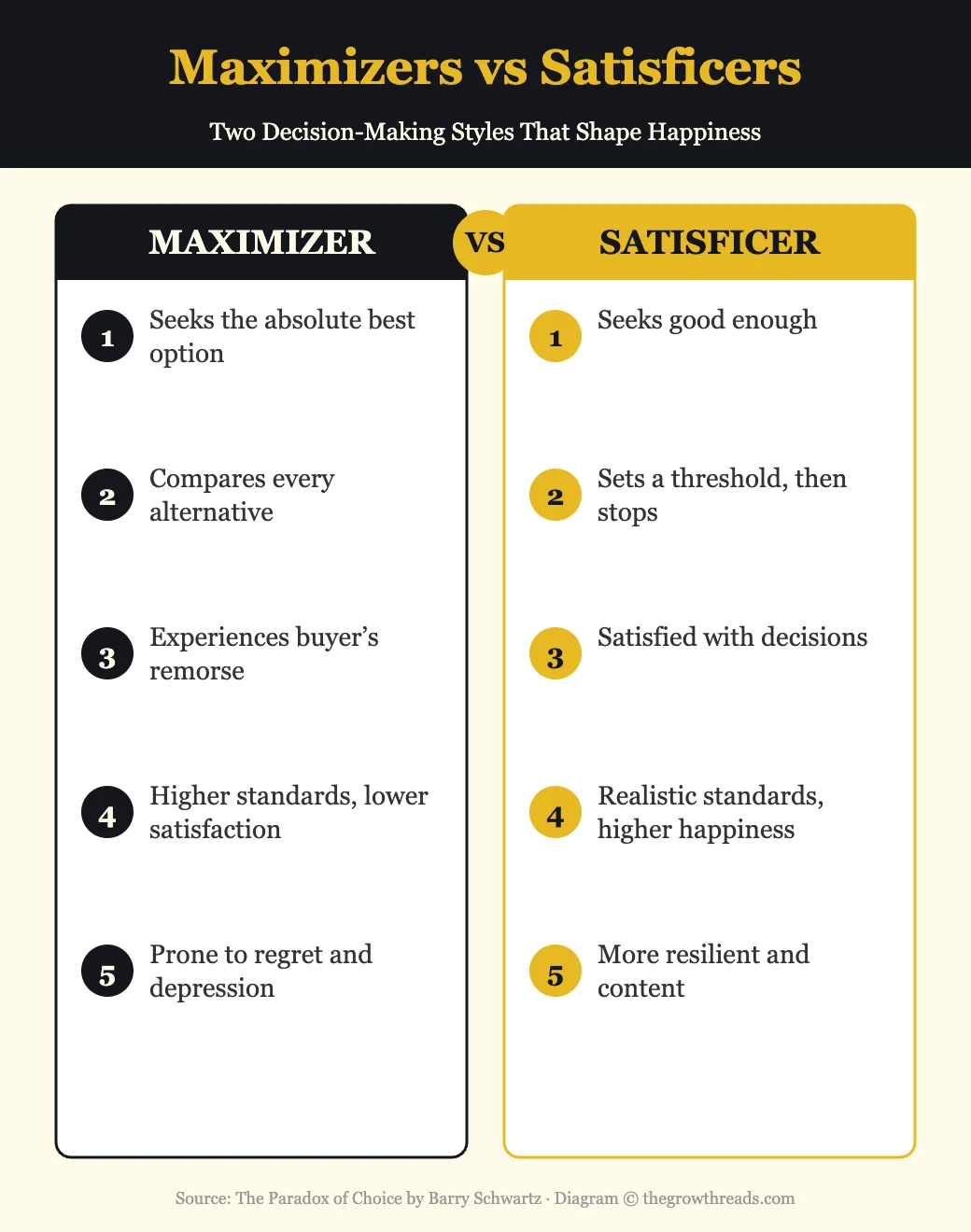
The book’s midsection dissects the psychological machinery that makes excessive choice painful. Schwartz introduces the distinction that gives the book its intellectual backbone: maximizers versus satisficers. Maximizers are people who always seek the best possible option — they compare exhaustively, research obsessively, and agonize over every decision. Satisficers set a threshold of acceptability and choose the first option that meets it. In study after study, satisficers report higher life satisfaction, less regret, less depression, and less social comparison — even though maximizers often achieve objectively better outcomes.
The paradox within the paradox: maximizers make better choices but feel worse about them. Schwartz cites research showing that maximizing job seekers land positions with 20% higher starting salaries than satisficers — but report significantly lower satisfaction with their jobs. The reason is that maximizers are haunted by opportunity costs. Every road not taken represents a phantom loss. With 6 options, you give up 5 alternatives. With 30 options, you give up 29 — and the imagined composite of all those rejected alternatives is almost certainly better than whatever you actually chose.
Schwartz then explains several psychological phenomena that amplify the pain of choosing. Hedonic adaptation means we quickly get used to new possessions and experiences, returning to our emotional baseline — so the thrill of a well-researched purchase evaporates faster than the regret of options foregone. Anchoring distorts our evaluation of options based on irrelevant reference points. Framing effects mean the same option feels different depending on whether it is presented as a gain or a loss. And loss aversion — the finding that losses hurt roughly twice as much as equivalent gains feel good — means that in a world of many options, the potential losses from choosing wrong loom larger than the potential gains from choosing right.
Part 3: The social dimension of choice
Schwartz broadens his lens from individual psychology to social forces. Social comparison — the tendency to evaluate your own choices by comparing them to what others chose — is one of the most corrosive effects of abundant choice. In a world with few options, your neighbor and you probably bought the same washing machine, and neither felt envious. In a world with 40 washing machines, your neighbor might have the one with the feature you did not know existed — and suddenly your perfectly adequate purchase feels inferior.
The rise of social media has supercharged this dynamic. Schwartz wrote the original edition before Instagram, but the revised edition acknowledges that curated highlight reels of other people’s choices create an impossibly high standard for our own. You are comparing your real decision (made under time pressure, with incomplete information) to the best-presented decisions of millions of people. The result is chronic inadequacy. Schwartz argues this is not a minor psychological quirk — it is a major driver of the rising rates of depression, anxiety, and dissatisfaction in affluent societies where material conditions are objectively excellent.
He also explores how choice intersects with identity. In traditional societies, your career, spouse, religion, and lifestyle were largely determined by your family and community. This was constraining, but it also provided a stable sense of self. In modern consumer culture, every choice becomes a statement about who you are. Choosing a coffee drink is not just functional — it is an identity performance. When every purchase carries existential weight, even trivial decisions become exhausting. Schwartz quotes Sartre: we are “condemned to be free.”
Part 4: What to do about it
The final section is the most practical. Schwartz offers concrete strategies for choosing better in a world that offers too much. His advice is counterintuitive but research-backed: the path to happiness is not finding the best option but learning to want less.
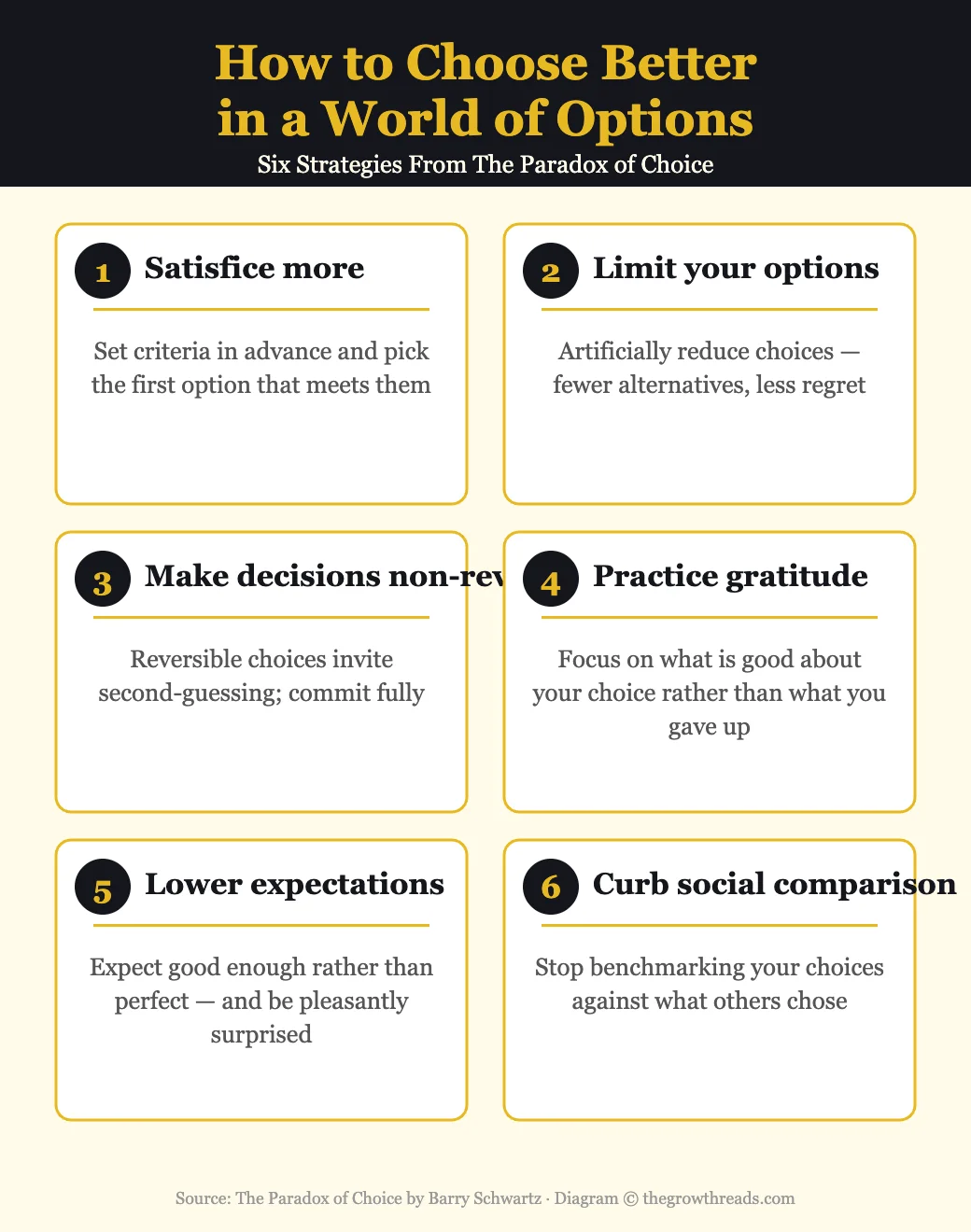
Choose when to choose. Not every decision deserves careful deliberation. Schwartz recommends identifying which decisions truly matter to you and satisficing on everything else. If you are not a wine enthusiast, buy whatever is on sale. If clothes are not central to your identity, pick a brand you trust and stop browsing. Reserve your decision-making energy for the areas that genuinely affect your well-being.
Be a satisficer, not a maximizer. This is the book’s central prescription. Develop the habit of establishing criteria in advance and accepting the first option that meets them. You will miss the theoretical best sometimes — and you will be happier. Schwartz reports that satisficers are not people with lower standards; they are people who have learned that the marginal return on further searching approaches zero (and often turns negative) far sooner than maximizers believe.
Make decisions irreversible. When possible, commit fully. Return policies, 30-day trials, and “no commitment” guarantees sound consumer-friendly, but they keep you in a perpetual state of evaluation. Research shows that people who cannot return a purchase adapt to it faster and like it more than people who can. Practice gratitude. Actively focus on what is good about your choice rather than what might be better about alternatives. Curtail social comparison. Stop checking what others chose, what they paid, or how happy they look with their decisions. And lower your expectations. When you expect merely good rather than perfect, good outcomes feel genuinely satisfying rather than vaguely disappointing.
Who is The Paradox of Choice best for — and who should read something else first?
This book is ideal for chronic overthinkers, perfectionists, and anyone who feels overwhelmed by the number of decisions modern life demands. Marketers and UX designers will find Schwartz’s research invaluable for understanding why offering fewer options can increase conversions. If you are interested in the underlying cognitive science, start with Thinking, Fast and Slow by Daniel Kahneman. If your interest is more in the emotional side — how to stop comparing yourself to others — try The Gifts of Imperfection by Brené Brown first.
Questions to reflect on
- Think of a recent purchase you agonized over. Did the extra research actually improve the outcome — or just your anxiety?
- In what areas of life are you a maximizer, and in which are you a satisficer? What would change if you flipped one of those?
- How often do you check what others chose after making a decision? What happens to your satisfaction when you do?
- Name one recurring decision you could automate or pre-commit (meal planning, clothing, subscriptions). Would that feel like freedom or restriction?
- When was the last time a “good enough” choice turned out to be genuinely good? What does that tell you about your decision thresholds?
🔥 Ready to stop overthinking and start deciding?
Get Barry Schwartz’s guide to making better choices with less stress.
How to apply The Paradox of Choice (7-day plan)
- Day 1 — Audit your decisions: Track every decision you make today — from breakfast to evening plans. Tally the total. Which ones consumed the most mental energy relative to their importance?
- Day 2 — Identify your maximizing domains: Review yesterday’s list and highlight the areas where you exhaustively research or compare. Pick one low-stakes domain (coffee, clothing, streaming) to satisfice in for the rest of the week.
- Day 3 — Set thresholds in advance: Before your next purchase or decision, write down three criteria that would make an option “good enough.” Choose the first option that meets all three — no further browsing.
- Day 4 — Go on a comparison diet: For 24 hours, do not check reviews, ratings, or what others chose after making a decision. Notice how your satisfaction differs when you skip the comparison step.
- Day 5 — Practice gratitude for choices made: Write down three things you appreciate about a recent decision — a meal, a purchase, a plan. Actively dwell on what is good about your choice rather than what might be missing.
- Day 6 — Make one irreversible commitment: Choose something today (a dinner order, a weekend activity, a small purchase) and commit to it without a backup plan. Notice how fully committing changes your experience.
- Day 7 — Design default rules: Create one permanent rule that eliminates a recurring decision — a go-to lunch order, a standard brand for household items, a fixed evening routine. Feel the freedom of not deciding.
Frequently asked questions
Is The Paradox of Choice worth reading?
Yes. Schwartz makes a research-backed case that reshapes how you think about decisions, shopping, and satisfaction. The book is accessible, well-structured, and filled with studies you will reference for years. At just 304 pages, it is a quick read with lasting impact. The revised edition adds relevant updates for the social media age. If you have ever felt exhausted by decisions or haunted by roads not taken, this book explains why and shows you what to do about it.
What is the main message of The Paradox of Choice?
The central argument is that more choice does not equal more happiness. Beyond a modest number of options, additional alternatives create anxiety, paralysis, and regret. The solution is to become a satisficer (someone who seeks “good enough” rather than the theoretical best), voluntarily limit your options, make irreversible commitments, and stop comparing your choices to those of others. Freedom comes not from infinite options but from the wisdom to choose less.
What is the difference between a maximizer and a satisficer?
A maximizer seeks the absolute best option — they exhaustively compare alternatives, research extensively, and struggle to commit. A satisficer sets criteria for what would be acceptable and picks the first option that meets those criteria. Research shows that maximizers often achieve objectively better outcomes (like higher salaries) but report lower satisfaction, more regret, and higher rates of depression. Satisficers make faster decisions and feel better about them.
What is the jam study in The Paradox of Choice?
The jam study, conducted by Sheena Iyengar and Mark Lepper, is one of the most cited experiments in behavioral economics. Shoppers at a grocery store encountered either 24 or 6 varieties of jam on a tasting display. While the large display attracted more browsers, only 3% bought jam — compared to 30% at the small display. The study demonstrated that excessive choice can paralyze consumers and reduce actual purchasing, a phenomenon now called “choice overload.”
How does The Paradox of Choice apply to business and marketing?
The book has profound implications for product design, pricing, and user experience. Companies that reduce their product lines often see increased sales — Procter and Gamble found that cutting Head and Shoulders varieties from 26 to 15 boosted revenue by 10%. For marketers, the lesson is that curating options for customers (through recommendations, defaults, and limited menus) increases conversions and satisfaction. The book has become required reading in MBA and UX design programs.
Is The Paradox of Choice still relevant today?
More relevant than ever. Since the book’s original publication in 2004, the number of choices in daily life has exploded — streaming services, food delivery apps, dating platforms, subscription boxes, and social media have all multiplied our options dramatically. The revised edition addresses these developments. Schwartz’s framework for understanding decision fatigue, choice overload, and the tyranny of comparison has only become more useful as the choice landscape has expanded.
How long does it take to read The Paradox of Choice?
The revised edition is 304 pages and takes most readers about 6 hours to finish. The writing is clear and accessible, with plenty of real-world examples that keep the pace lively. The audiobook, narrated by Ken Kliban, runs approximately 8 hours. Because the content is organized around distinct psychological concepts, the book works well read in short sessions — you can absorb one concept per sitting and apply it before moving to the next.
Related summaries
- Thinking, Fast and Slow by Daniel Kahneman — The cognitive biases that distort all human decision-making.
- Predictably Irrational by Dan Ariely — Why we consistently make irrational choices in predictable ways.
- The Obstacle Is the Way by Ryan Holiday — Stoic strategies for finding contentment within constraints.
- The Gifts of Imperfection by Brené Brown — How to stop performing for others and embrace good enough.
Explore all our psychology book summaries on the Best Psychology Books pillar page.