

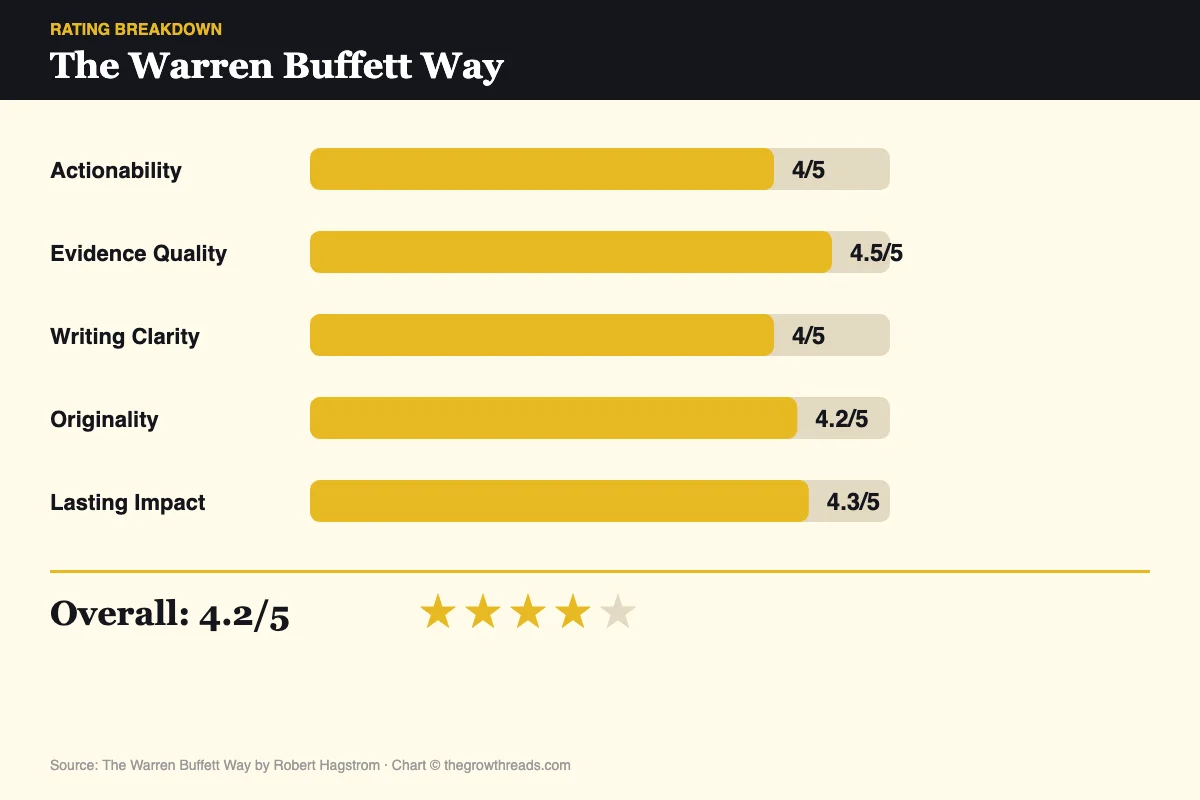
⭐⭐⭐⭐ 4.2/5 — The definitive guide to understanding how Warren Buffett thinks about investing — 12 tenets that turn a stock pick into a business partnership.
Actionability: 4.0/5 · Evidence Quality: 4.5/5 · Writing Clarity: 4.0/5 · Originality: 4.2/5 · Lasting Impact: 4.3/5
Best for: Individual investors ready to move beyond index funds and learn how to evaluate individual businesses like Buffett does.
Reading time: ~8 hours (320 pages, 3rd edition)
Difficulty to apply: High — the principles are clear, but applying them requires financial literacy, patience, and the emotional discipline to ignore market noise.
The Warren Buffett Way in one minute
Warren Buffett does not buy stocks — he buys businesses, and the 12 tenets in this book are the exact checklist he uses to decide which ones. Robert Hagstrom distills fifty years of Buffett’s investment decisions into a systematic framework organized around four categories: business tenets (is it simple, consistent, and durable?), management tenets (is leadership rational, honest, and independent?), financial tenets (does it generate strong owner earnings and returns on equity?), and market tenets (is the price significantly below intrinsic value?). The central insight is that Buffett’s genius is not stock-picking in the Wall Street sense — it is business analysis applied to publicly traded companies, combined with the patience to wait for the right price and the conviction to act big when it arrives.
Key takeaways
- You are buying a business, not a stock ticker: Buffett treats every share purchase as partial ownership of a real business. If you would not want to own the entire company, you should not own a single share.
- Stay inside your circle of competence: Only invest in businesses you can genuinely understand. Buffett famously avoided technology stocks for decades because he could not predict their economics — and was right to do so.
- Look for economic moats: The best businesses have durable competitive advantages — brand power, switching costs, network effects, or cost advantages — that protect profits for decades, not quarters.
- Management must be rational capital allocators: The single most important management quality is how they deploy excess cash. Buffett wants managers who reinvest only when returns exceed cost of capital and return the rest to shareholders.
- Owner earnings matter more than reported earnings: Buffett adjusts for depreciation, amortization, and capital expenditure to calculate what a business actually produces for its owners — a figure often very different from GAAP net income.
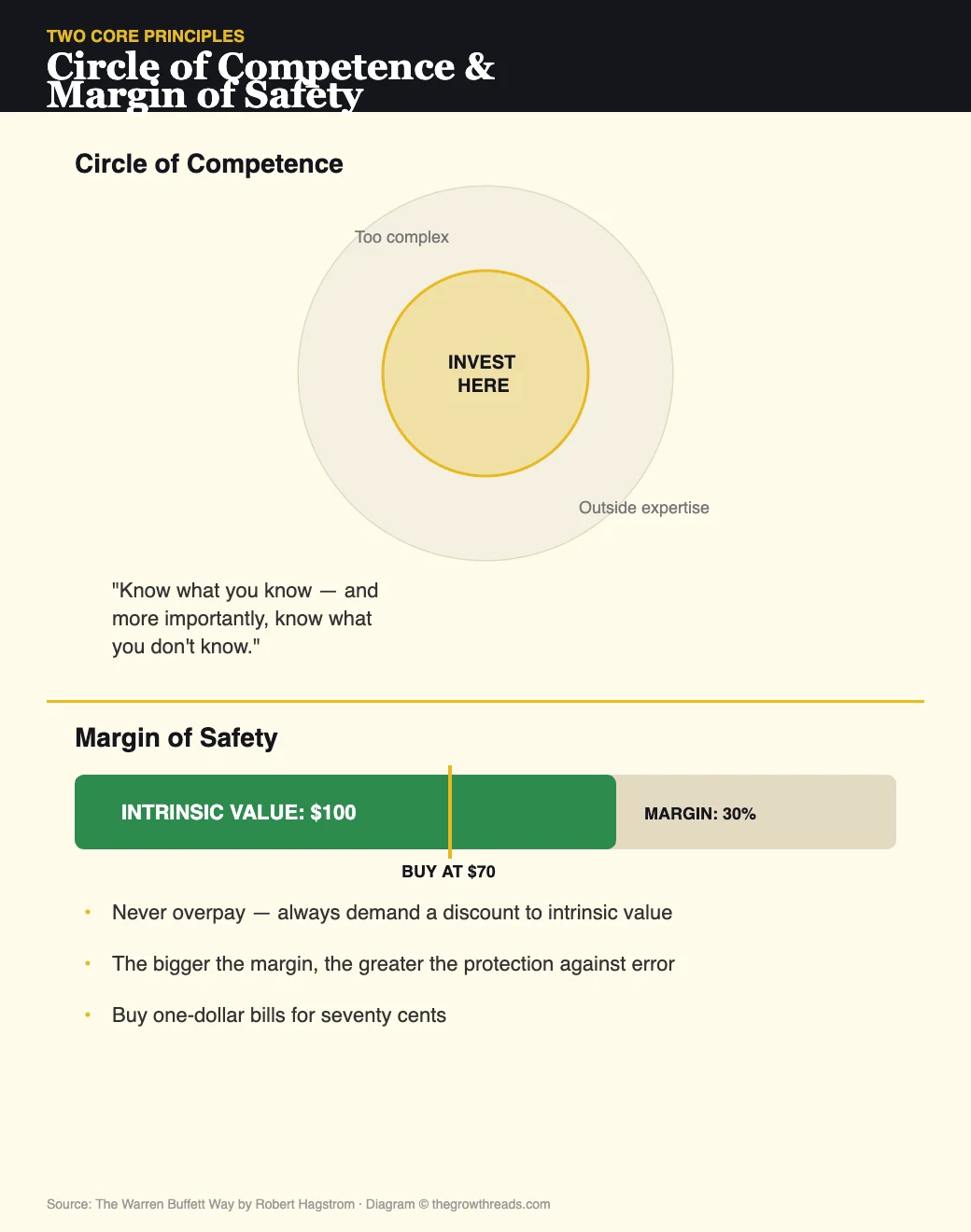
- The margin of safety is non-negotiable: Never pay full price. Buffett demands a significant gap between what a business is worth (intrinsic value) and what the market charges — buying dollar bills for seventy cents.
- Mr. Market is your servant, not your master: Market prices reflect crowd psychology, not business value. Buffett uses market volatility as an opportunity to buy quality cheaply, not as a signal to panic.
- Concentration beats diversification for the informed investor: Buffett holds a concentrated portfolio of high-conviction positions. Over-diversification is a hedge against ignorance — if you know what you own, you do not need 50 positions.
- The best holding period is forever: When you own an excellent business bought at a fair price, the optimal strategy is to do nothing. Compound interest works best without interruption.
- Temperament trumps intellect: The most important quality in investing is emotional discipline — the ability to be greedy when others are fearful and fearful when others are greedy. IQ above 125 adds little; emotional stability adds everything.
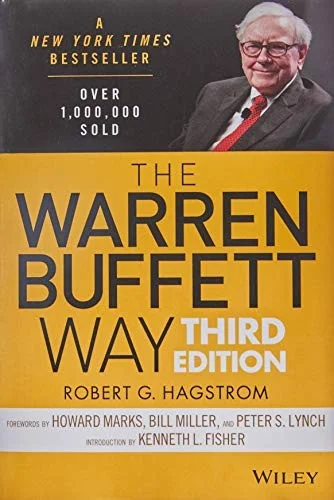
What is The Warren Buffett Way about?
The Warren Buffett Way systematically deconstructs the investment philosophy of the world’s most successful investor into 12 actionable tenets across four categories — business, management, financial, and market — then illustrates each through detailed case studies of Buffett’s actual purchases, from Coca-Cola to Washington Post, showing how the framework works in practice.
About the author
Robert G. Hagstrom is a portfolio manager, investment strategist, and the author of multiple books on investing philosophy. He has spent over three decades studying Buffett’s methods, attending Berkshire Hathaway annual meetings, and analyzing Buffett’s shareholder letters line by line. The Warren Buffett Way, first published in 1994, was the first book to systematically codify Buffett’s approach and has sold over 1.2 million copies worldwide. The third edition (2013) adds significant new material on Buffett’s evolution, including his shift toward buying entire companies and his investments in sectors he previously avoided. Forewords by Peter Lynch, Bill Miller, and Howard Marks — three of the most respected investors in history — testify to the book’s authority. Explore all Robert G. Hagstrom book summaries →
Key concepts at a glance
| Concept | What it means | Use it when |
|---|---|---|
| Circle of Competence | Only invest in businesses you truly understand | Evaluating whether you should analyze a company at all |
| Economic Moat | A durable competitive advantage that protects profits | Assessing whether a business can maintain returns for decades |
| Owner Earnings | Cash a business generates for owners after maintenance capex | Calculating what a business is actually worth to you |
| Margin of Safety | The gap between intrinsic value and purchase price | Deciding whether the current price offers enough protection |
| Mr. Market | The stock market as an emotional counterparty, not an oracle | Prices drop sharply and you feel pressure to sell |
| Institutional Imperative | The tendency of managers to imitate peers regardless of logic | Assessing whether management thinks independently |
| The Keeper Test (Buffett’s version) | Would you buy this business at today’s price if you did not already own it? | Reviewing your existing holdings |
| Focused Investing | Concentrate capital in your highest-conviction ideas | Building a portfolio that reflects genuine knowledge, not false diversification |
Part 1: Business and management tenets
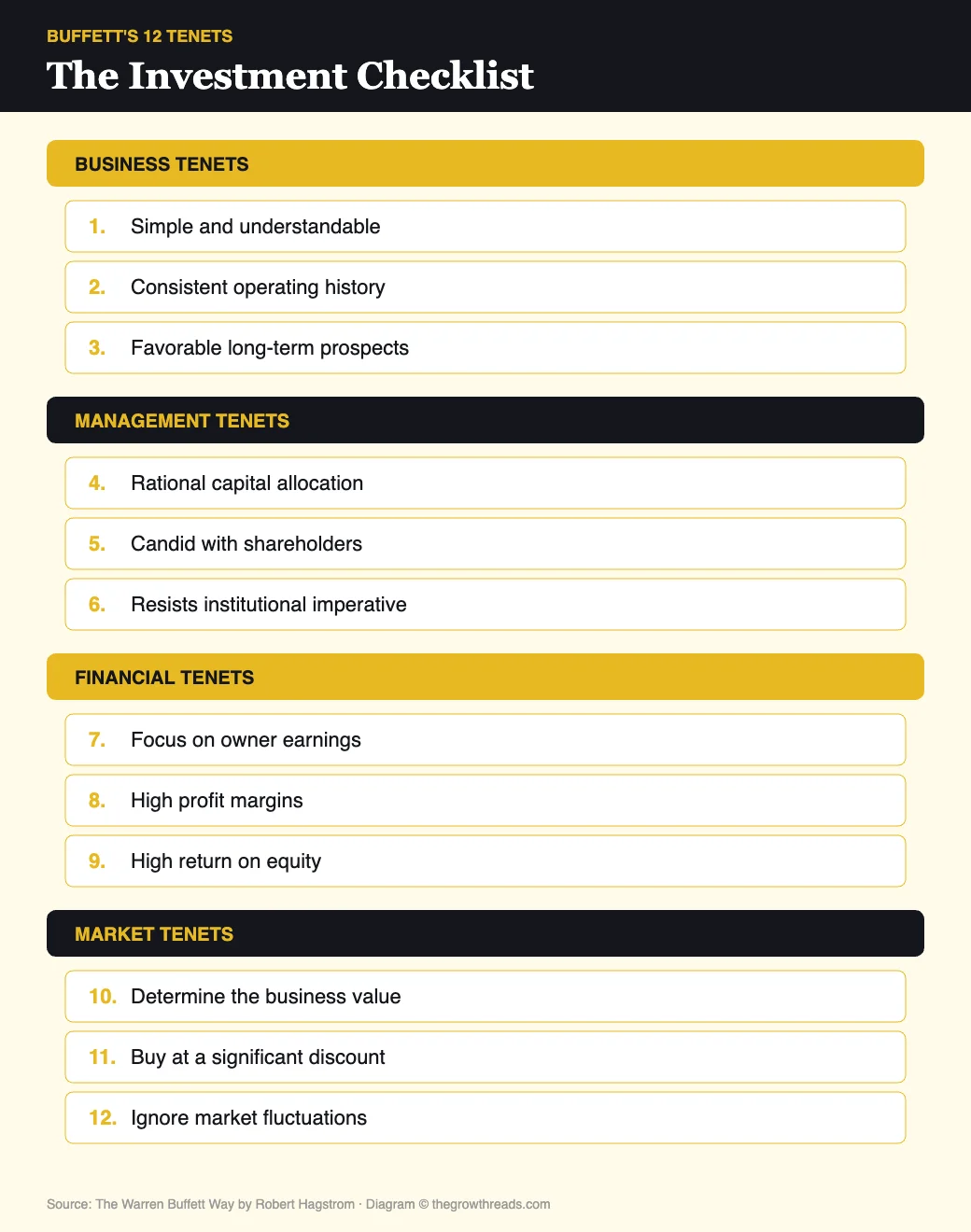
Hagstrom organizes Buffett’s investment framework into twelve tenets, beginning with three business tenets. The first is simplicity: Buffett invests only in businesses he can understand at an operational level — how they make money, who their customers are, and what could disrupt them. He famously avoided technology stocks during the dot-com bubble not because he thought tech was bad, but because he could not predict which companies would have durable economics in ten years. The second tenet is consistency: Buffett wants businesses with a long, stable operating history, not turnarounds or speculative ventures. A business that has performed well for twenty years under different economic conditions is far more predictable than one with three years of explosive growth. The third is favorable long-term prospects — a genuine economic moat that will protect the business from competition for decades.
The management tenets are equally rigorous. Buffett demands rational capital allocation: when a business generates excess cash, does management reinvest it at returns above the cost of capital, or do they waste it on empire-building acquisitions and vanity projects? He insists on candor — managers who admit mistakes in shareholder letters, not just celebrate wins. And he watches for the institutional imperative, a term Buffett coined for the tendency of corporate managers to mindlessly imitate what other companies are doing, regardless of whether it makes strategic sense. Hagstrom illustrates this with Buffett’s refusal to participate in the conglomerate craze of the 1960s and the tech bubble of the 1990s — both times when the institutional imperative was screaming “follow the crowd.”
Part 2: Financial tenets and owner earnings
The financial tenets are where Hagstrom delivers the most technical value. Buffett’s primary metric is owner earnings — not the GAAP net income that Wall Street obsesses over, but a custom calculation: reported earnings plus depreciation and amortization, minus the average annual capital expenditure required to maintain the business’s competitive position. This number represents what a business actually produces for its owners after keeping the machine running. It often differs dramatically from reported earnings, particularly in capital-intensive industries where depreciation schedules may not reflect actual asset deterioration.
Buffett also demands consistently high profit margins (indicating pricing power and efficient operations) and strong returns on equity generated without excessive leverage. Hagstrom walks through Buffett’s actual calculations for Coca-Cola, showing how the owner earnings method revealed that Coke was generating far more economic value than its reported P/E ratio suggested — a gap that the market eventually recognized, rewarding Buffett with one of the most successful investments in history.
The final financial tenet is the most counterintuitive: Buffett does not diversify in the conventional sense. He concentrates his portfolio in a small number of high-conviction positions — typically 5 to 10 stocks representing the majority of Berkshire’s equity portfolio. His logic is that diversification is protection against ignorance; if you truly understand a business, you should bet heavily on it. This focused approach amplifies both gains and losses, but Buffett argues that the amplified gains of correct concentrated bets — combined with the margin of safety on each position — produce superior long-term returns.
Part 3: Market tenets and the case studies
The market tenets are where Buffett’s philosophy diverges most sharply from Wall Street orthodoxy. Where modern finance theory says the market is efficient and prices always reflect fair value, Buffett treats the market as an emotional counterparty — Benjamin Graham’s famous “Mr. Market” metaphor. Mr. Market shows up every day offering to buy or sell shares at a price that reflects his mood, not the business’s value. On good days he offers too much; on bad days he asks too little. The intelligent investor’s job is to take advantage of Mr. Market’s mood swings, not be controlled by them.
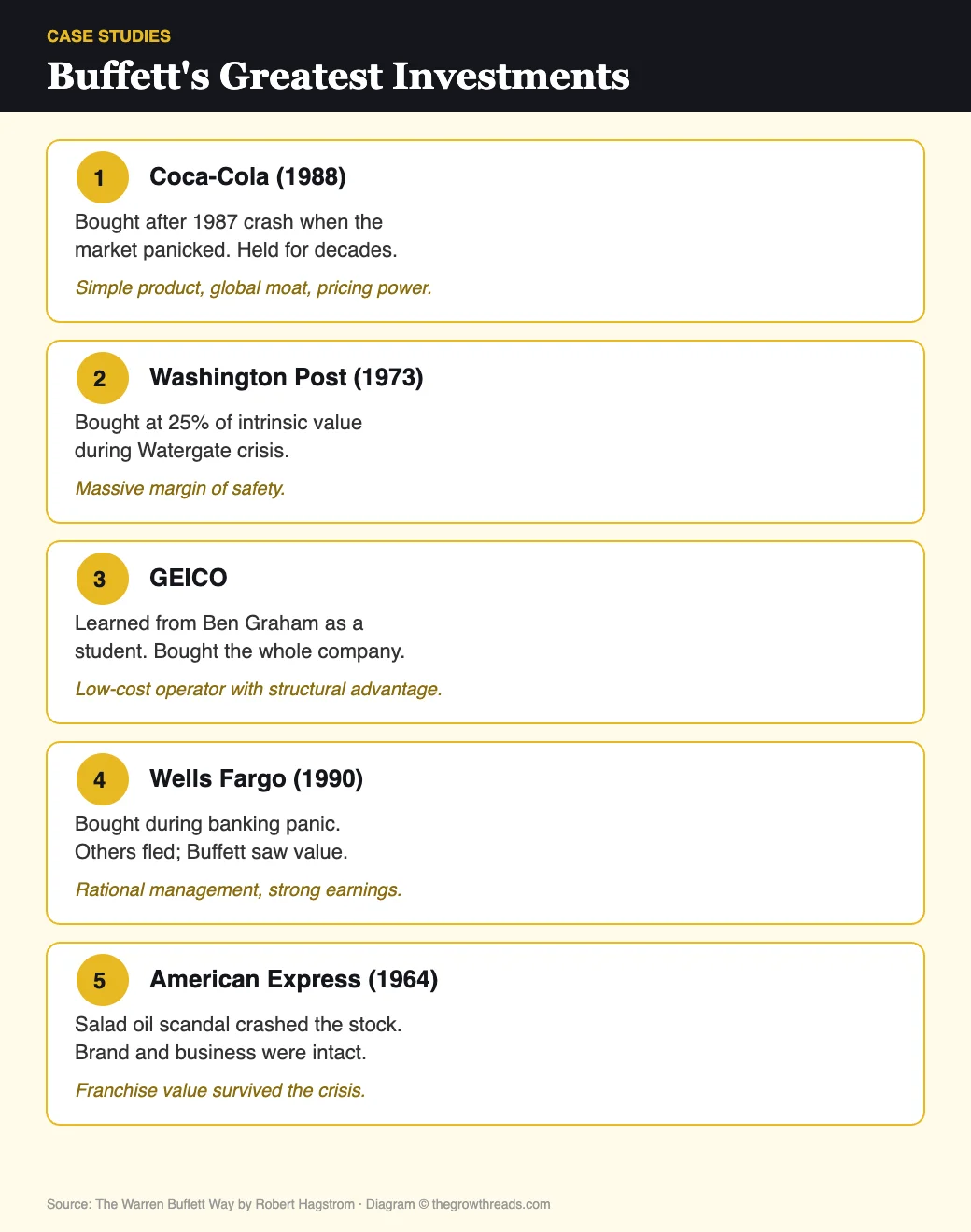
Hagstrom illustrates this through detailed case studies of Buffett’s actual investments. The Coca-Cola purchase in 1988 — made after the 1987 crash when most investors were terrified — shows all twelve tenets in action: a simple, understandable business (everyone knows Coke), with a century-long operating history, massive economic moat (the brand is worth more than the physical assets), rational management under Roberto Goizueta, exceptional owner earnings, and a stock price that, after the crash, offered a meaningful margin of safety. Buffett invested over $1 billion — a concentrated bet that would grow to represent a substantial portion of Berkshire’s portfolio and generate billions in returns over three decades.
The Washington Post purchase in 1973 demonstrates the margin of safety at its most dramatic. During the Watergate crisis, the Post’s stock dropped to roughly one-quarter of the value that any private buyer would have paid for the business. Buffett saw that the journalism scandal was a temporary event that did not affect the underlying economics of a dominant newspaper franchise. He bought aggressively, and the investment generated returns of more than 100x over the following decades.
Part 4: The psychology of investing and focus investing
The final section of the book addresses what Hagstrom calls the psychology of money — the emotional and cognitive challenges that prevent most investors from applying Buffett’s principles even when they understand them intellectually. Buffett himself has said that investing is simple but not easy: the twelve tenets are straightforward, but the discipline to follow them when markets crash, when friends are getting rich on speculative stocks, and when CNBC is screaming about the next crisis requires a temperament that most people do not naturally possess.
Hagstrom draws on behavioral finance research to explain why. Loss aversion makes investors feel losses roughly twice as intensely as equivalent gains, which leads to selling winners too early and holding losers too long. Recency bias causes investors to extrapolate recent trends indefinitely — buying at the top because “this time is different” and selling at the bottom because “it will never recover.” And the social proof bias means that watching others make money on speculative investments creates almost irresistible pressure to follow, even when the fundamentals are absent.
Buffett’s antidote is what Hagstrom calls focus investing: a small number of positions, held for a long time, selected with rigorous analysis and purchased with a margin of safety. This approach requires doing less than most investors think is necessary — fewer trades, fewer positions, less monitoring — and redirecting that energy toward deeper understanding of the businesses you own. The paradox is that by doing less, you achieve more.
Who is The Warren Buffett Way best for — and who should read something else first?
This book is ideal for investors who already have basic financial literacy and want to graduate from passive index investing to understanding how individual business analysis works. It assumes you know what a P/E ratio is and can read a balance sheet, though Hagstrom explains the more advanced concepts (like owner earnings) in detail. If you are brand new to investing, start with The Simple Path to Wealth by JL Collins or The Intelligent Investor by Benjamin Graham before tackling this book.
If you prefer a more narrative approach to Buffett’s thinking, The Psychology of Money by Morgan Housel covers complementary ground with lighter prose. And if you want Buffett’s own words, his annual shareholder letters (available free at berkshirehathaway.com) remain the single best primary source — Hagstrom’s book is the best secondary source for organizing those letters into a coherent system.
Questions to reflect on
- How many of the businesses in your current portfolio could you describe to a friend in two sentences — including how they make money and what their competitive advantage is?
- If the stock market closed for five years and you could not sell, which of your current holdings would you be completely comfortable keeping — and which would make you nervous?
- When was the last time you bought a stock because someone else was excited about it rather than because you had done your own analysis — and how did that investment perform?
- What is your honest circle of competence — which industries and business models do you genuinely understand at an operational level?
- If you had to put 50% of your portfolio into a single stock today, which would it be — and does your actual portfolio reflect that conviction?
🔥 Ready to invest the way Buffett actually does — not the way most people think he does?
Hagstrom’s 12-tenet framework could permanently change how you evaluate businesses and build a portfolio.
How to apply The Warren Buffett Way (7-day plan)
- Day 1 — Define your circle of competence: Write down the industries and business models you genuinely understand — not from reading headlines, but from experience, education, or deep study. Be brutally honest. This is your investable universe.
- Day 2 — Run the 12 tenets on one company you own: Pick one stock in your portfolio. Score it against each of Buffett’s twelve tenets. Is the business simple? Is management rational? What are the owner earnings? What is the margin of safety at today’s price? Be honest about gaps in your knowledge.
- Day 3 — Calculate owner earnings: For the same company, pull the most recent annual report. Calculate owner earnings: net income + depreciation/amortization – average annual maintenance capital expenditure. Compare this to reported EPS. The difference reveals how much real cash the business generates.
- Day 4 — Estimate intrinsic value: Using the owner earnings from Day 3, apply a simple discounted cash flow: owner earnings × (1 + growth rate) ÷ (discount rate – growth rate). Use conservative assumptions. Compare the result to the current stock price. Is there a margin of safety?
- Day 5 — Identify economic moats: For your top three holdings, list each company’s competitive advantage: brand power, switching costs, network effects, cost advantage, regulatory barriers. If you cannot articulate a specific moat, that is information — it means the business may not have one.
- Day 6 — Apply Mr. Market thinking: Review any recent buy or sell decisions you made during a market drop or surge. Were you reacting to Mr. Market’s mood (price movement) or to changes in business fundamentals? Write down one rule for how you will handle the next market panic differently.
- Day 7 — Build your focus portfolio plan: If you were starting from scratch with Buffett’s principles, which 5 to 10 businesses would you want to own for the next decade? Research them this week. Compare this ideal portfolio to your actual one. Begin closing the gap.
Frequently asked questions
What is the main idea of The Warren Buffett Way?
The central argument is that Buffett’s success comes not from stock-picking genius or market timing but from a systematic framework for analyzing businesses. Hagstrom distills this into 12 tenets across four categories — business (simple, consistent, favorable prospects), management (rational, candid, independent), financial (strong owner earnings, margins, and returns), and market (buy below intrinsic value, ignore Mr. Market’s moods). Applied consistently with emotional discipline, these tenets produce superior long-term returns.
What are Buffett’s 12 tenets of investing?
Business tenets: (1) the business is simple and understandable, (2) it has a consistent operating history, (3) it has favorable long-term prospects. Management tenets: (4) management is rational with capital, (5) candid with shareholders, (6) resists the institutional imperative. Financial tenets: (7) focus on owner earnings not EPS, (8) look for high profit margins, (9) high return on equity. Market tenets: (10) determine the intrinsic value of the business, (11) buy at a significant discount, (12) ignore market fluctuations.
What is the circle of competence?
The circle of competence is Buffett’s principle that you should only invest in businesses you genuinely understand at an operational level — how they make money, who their customers are, what threatens them, and what their economics will look like in ten years. The key insight is that the size of your circle does not matter; what matters is knowing its boundaries. Buffett avoided technology stocks for decades not because he thought tech was bad, but because he honestly assessed that he could not predict which tech companies would have durable advantages.
What are owner earnings and why do they matter?
Owner earnings is Buffett’s preferred measure of a business’s true economic output. The formula is: reported net income + depreciation and amortization – the average annual capital expenditure needed to maintain competitive position. This matters because GAAP earnings can be misleading — a company might report strong net income while actually requiring massive reinvestment just to stay in place. Owner earnings reveal what the business truly generates for its owners after keeping the engine running. This is the number Buffett uses to calculate intrinsic value.
What is the margin of safety in investing?
The margin of safety is the difference between a business’s intrinsic value (what it is actually worth based on future cash flows) and the price you pay. Buffett demands a significant gap — historically around 25 to 30 percent — to protect against errors in analysis, unforeseen problems, and general uncertainty. The concept comes from Benjamin Graham’s The Intelligent Investor and remains the single most important risk-management tool in value investing. If intrinsic value is $100, Buffett wants to buy at $70 or less.
Is The Warren Buffett Way good for beginner investors?
It depends on the type of beginner. If you understand basic financial concepts — P/E ratios, balance sheets, cash flow — the book is an excellent next step into value investing. If you are completely new to investing, start with The Simple Path to Wealth by JL Collins (for index investing) or The Psychology of Money by Morgan Housel (for the behavioral side) before tackling Hagstrom. The Warren Buffett Way assumes a baseline financial literacy and builds sophisticated analysis on top of it.
How does Buffett’s approach differ from index fund investing?
Index fund investing (as championed in The Little Book of Common Sense Investing) assumes markets are efficient and that most investors cannot beat them — so you should own everything at low cost. Buffett’s approach assumes markets are often inefficient, especially during panics and bubbles, and that informed investors can exploit those mispricings. Buffett himself recommends index funds for most people — he views active value investing as appropriate only for those willing to invest the time and emotional energy to analyze businesses deeply. Both approaches are valid; the question is whether you have the competence and temperament for the active path.
Related summaries
If The Warren Buffett Way sharpened your investing framework, these related summaries explore complementary perspectives:
- The Intelligent Investor Summary — Benjamin Graham’s foundational text on value investing — the source of Buffett’s margin of safety, Mr. Market, and many of the tenets in this book.
- One Up on Wall Street Summary — Peter Lynch’s approach to finding great investments in everyday life — more accessible, equally effective.
- The Psychology of Money Summary — Morgan Housel’s exploration of the behavioral side of investing — the emotional discipline Buffett practices instinctively.
- Common Stocks and Uncommon Profits Summary — Philip Fisher’s growth-investing framework, the other major influence on Buffett’s thinking alongside Graham.
📚 Explore more Money book summaries
This review is part of our Best Money Books collection — a curated library of the most impactful books on personal finance, investing, and building wealth, with full summaries, key takeaways, and action plans for each.
Related Money Summaries
The Big Short Summary & Review: The Outsiders Who Saw the Crash Coming
The Intelligent Investor Summary & Review: Timeless Wisdom for Building Wealth
The Little Book of Common Sense Investing Summary & Review: The Only Investment Guide You Will Ever Need
The Millionaire Next Door Summary & Review: How Wealth Is Actually Built
Think and Grow Rich Summary & Review: Napoleon Hill’s Timeless Success Formula