

★★★★½ 4.4/5 — a landmark psychology book whose single distinction — fixed versus growth mindset — has reshaped how we think about talent, effort, and success.
Best for: parents, teachers, leaders, and anyone whose beliefs about their own abilities may be holding them back · Reading time: ~6 hours (this guide: 15 min) · Difficulty to apply: Easy to grasp — noticing and shifting your mindset is ongoing work
Mindset in one minute
What you believe about the nature of ability — whether it is fixed or can grow — shapes almost everything about how you learn, achieve, and handle setbacks. Stanford psychologist Carol Dweck distills decades of research into a single, powerful distinction. People with a “fixed mindset” believe their intelligence and talents are set traits they either have or don’t; because their abilities feel like something to prove, they avoid challenges, give up when things get hard, see effort as a sign of inadequacy, and feel threatened by others’ success. People with a “growth mindset” believe abilities can be developed through effort, strategy, and learning; they embrace challenges, persist through failure, treat effort as the path to mastery, learn from criticism, and are inspired by others. The good news is that mindsets are not permanent — you can learn to recognize your fixed-mindset triggers and cultivate a growth mindset, unlocking far greater potential in yourself and the people you lead, teach, or parent.
Key takeaways
- Two mindsets shape success: the fixed mindset sees ability as static; the growth mindset sees it as developable.
- Fixed mindset avoids challenges: when ability feels fixed, difficulty threatens your self-image, so you play it safe.
- Growth mindset embraces challenges: when ability can grow, challenges become opportunities to improve.
- Effort means opposite things: the fixed mindset sees effort as a sign you lack talent; the growth mindset sees it as the road to mastery.
- Failure is interpreted differently: a fixed mindset takes failure as a verdict; a growth mindset takes it as information.
- The power of “yet”: “I can’t do it” becomes “I can’t do it yet” — reframing failure as a stage in learning.
- Praise process, not intelligence: praising effort and strategy builds a growth mindset; praising talent breeds a fixed one.
- Mindsets are learnable: the brain is malleable, and you can shift toward a growth mindset with awareness and practice.
- Mindset shapes relationships and leadership: it affects how we handle conflict, feedback, and other people’s growth.
- Beware the false growth mindset: claiming a growth mindset while still avoiding effort or challenge misses the point.

What is Mindset about?
Mindset is a psychology book by Carol Dweck about how our beliefs about ability shape our lives. It contrasts the “fixed mindset,” which sees intelligence and talent as unchangeable, with the “growth mindset,” which sees them as developable through effort. Dweck shows how a growth mindset fuels learning, resilience, and achievement across school, work, sport, and relationships.
About the author
Carol S. Dweck is a professor of psychology at Stanford University and one of the world’s leading researchers on motivation and achievement. Over several decades of studies — many with children facing setbacks — she developed the concept of mindsets, discovering that people’s beliefs about whether abilities are fixed or malleable powerfully predict how they respond to difficulty. Published in 2006 and updated in 2016, Mindset: The New Psychology of Success brought this research to a wide audience and became enormously influential in education, business, sports, and parenting, popularizing the now-ubiquitous terms “fixed mindset” and “growth mindset.” Dweck writes as a scientist translating rigorous research into practical insight, illustrating her ideas with examples from famous athletes, business leaders, and everyday parents and students. In the updated edition she also addresses misunderstandings of her work, cautioning against a “false growth mindset” that adopts the language without the substance. Explore all Carol S. Dweck book summaries →
Key concepts at a glance
| Concept | What it means | Use it when |
|---|---|---|
| Fixed mindset | Ability is a static trait | You avoid a challenge |
| Growth mindset | Ability can be developed | You face a setback |
| The power of “yet” | Not failing, just not there yet | You feel like a failure |
| Process praise | Praise effort and strategy | Encouraging others |
| Effort as the path | Work builds ability | Something feels hard |
| False growth mindset | The label without the substance | Checking your own honesty |
Part 1: Two mindsets — fixed versus growth
Dweck’s foundational discovery is that people hold one of two core beliefs about the nature of their basic qualities. Those with a fixed mindset believe that intelligence, talent, and character are carved in stone — you have a certain amount and that’s that. Those with a growth mindset believe these qualities can be cultivated through effort, good strategies, and help from others. This single belief, she shows, has enormous consequences, because it shapes how you interpret and respond to every experience of difficulty, effort, and failure.
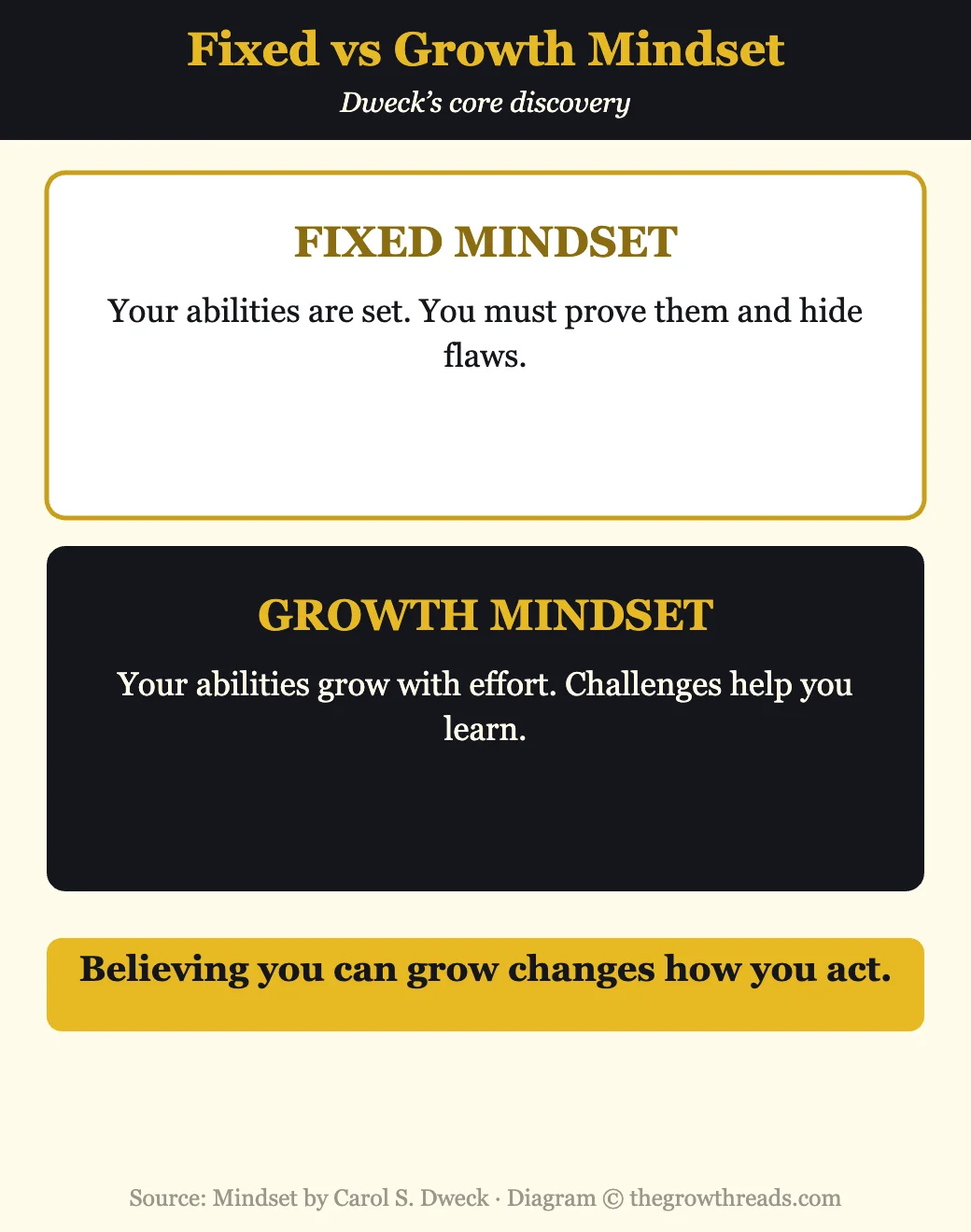
The reason the fixed mindset is so limiting is that it turns every situation into a test of your fixed ability. If your intelligence is a permanent trait, then each challenge, mistake, or effort risks revealing that you don’t have enough of it — so you become preoccupied with looking smart rather than getting smarter, and you avoid anything that might expose a deficiency. The growth mindset, by contrast, frees you from this need to constantly prove yourself. If abilities can grow, then a challenge is just a chance to stretch, a mistake is useful data, and effort is how ability is built. Dweck stresses that most people are a mix, holding a growth mindset in some areas and a fixed one in others, and that recognizing which mindset you bring to a given situation is the first step to change. The book’s project is to show how pervasively these two mindsets shape our lives and how to move toward growth.
Part 2: How the mindsets play out
The heart of the book maps the concrete ways the two mindsets diverge across the experiences that determine success.
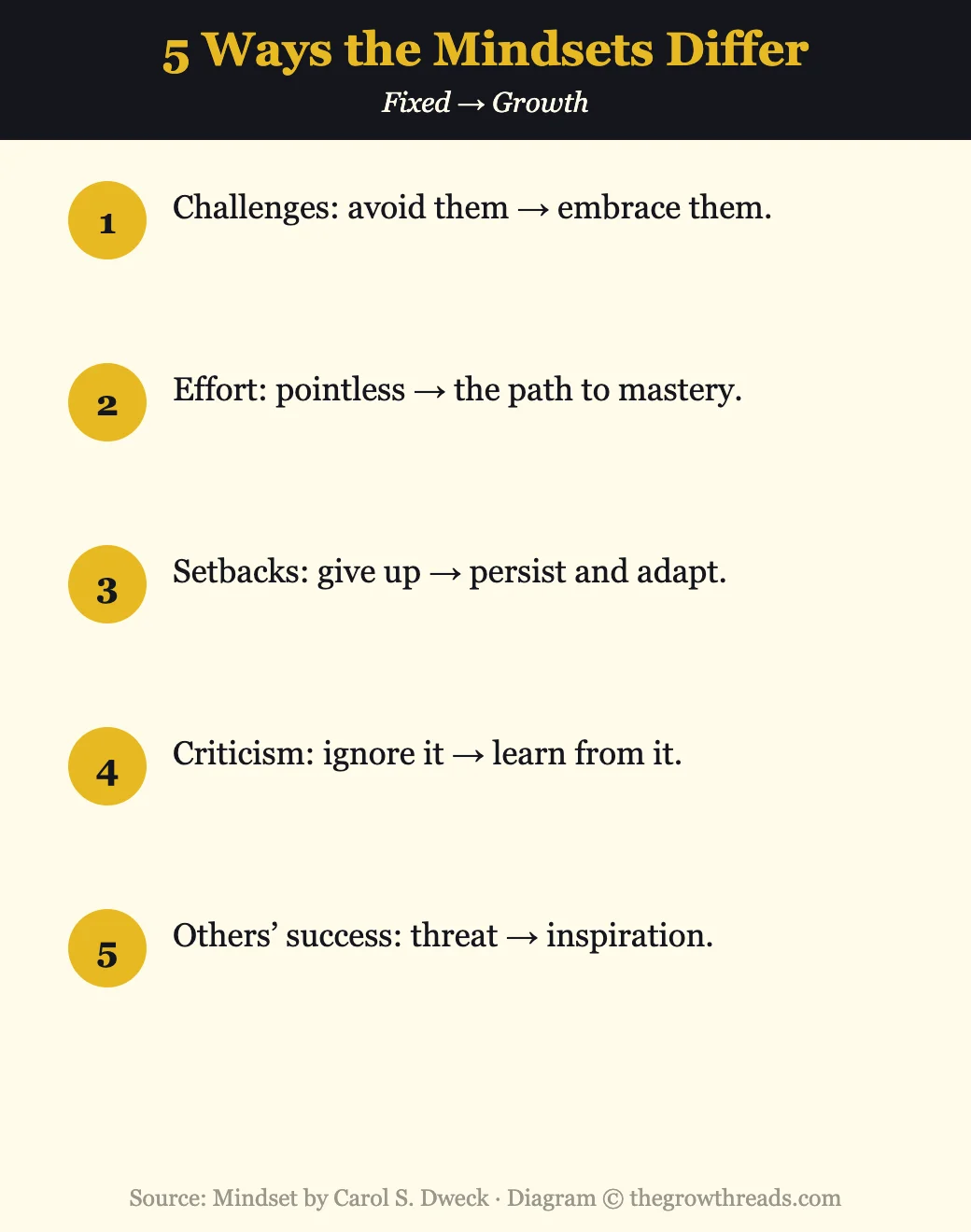
Consider challenges: the fixed mindset avoids them to protect its self-image, while the growth mindset seeks them out as fuel for development. Consider effort: for the fixed mindset, having to try hard is evidence you lack natural talent (if you were really smart, it would come easily), so effort is faintly shameful; for the growth mindset, effort is precisely what turns potential into achievement, the honorable path to mastery. Consider setbacks and failure: the fixed mindset experiences failure as a devastating verdict on its worth and tends to give up or make excuses, whereas the growth mindset treats failure as informative feedback and a normal part of learning, and so persists and adjusts. Consider criticism: the fixed mindset ignores or resents useful negative feedback because it feels like an attack, while the growth mindset welcomes it as a chance to improve. And consider the success of others: the fixed mindset feels threatened by talented peers, while the growth mindset finds them inspiring and instructive. In each case, the same event is experienced in almost opposite ways, and it is easy to see how, over time, these divergent responses compound into very different lives.
TGR Note: Dweck supplies the belief that makes perseverance possible, and Angela Duckworth’s Grit supplies the perseverance itself — the two are natural partners, since you only push through years of effort if you believe effort works. And David Goggins’s Can’t Hurt Me is the growth mindset taken to its brutal extreme: proof of how far “I can grow through discomfort” can go.
Part 3: The power of “yet” and how mindsets form
One of the book’s most memorable and practical ideas is the power of the word “yet.” When a person with a fixed mindset fails at something, they conclude “I can’t do this.” When a person with a growth mindset fails, they can reframe it as “I can’t do this yet.”
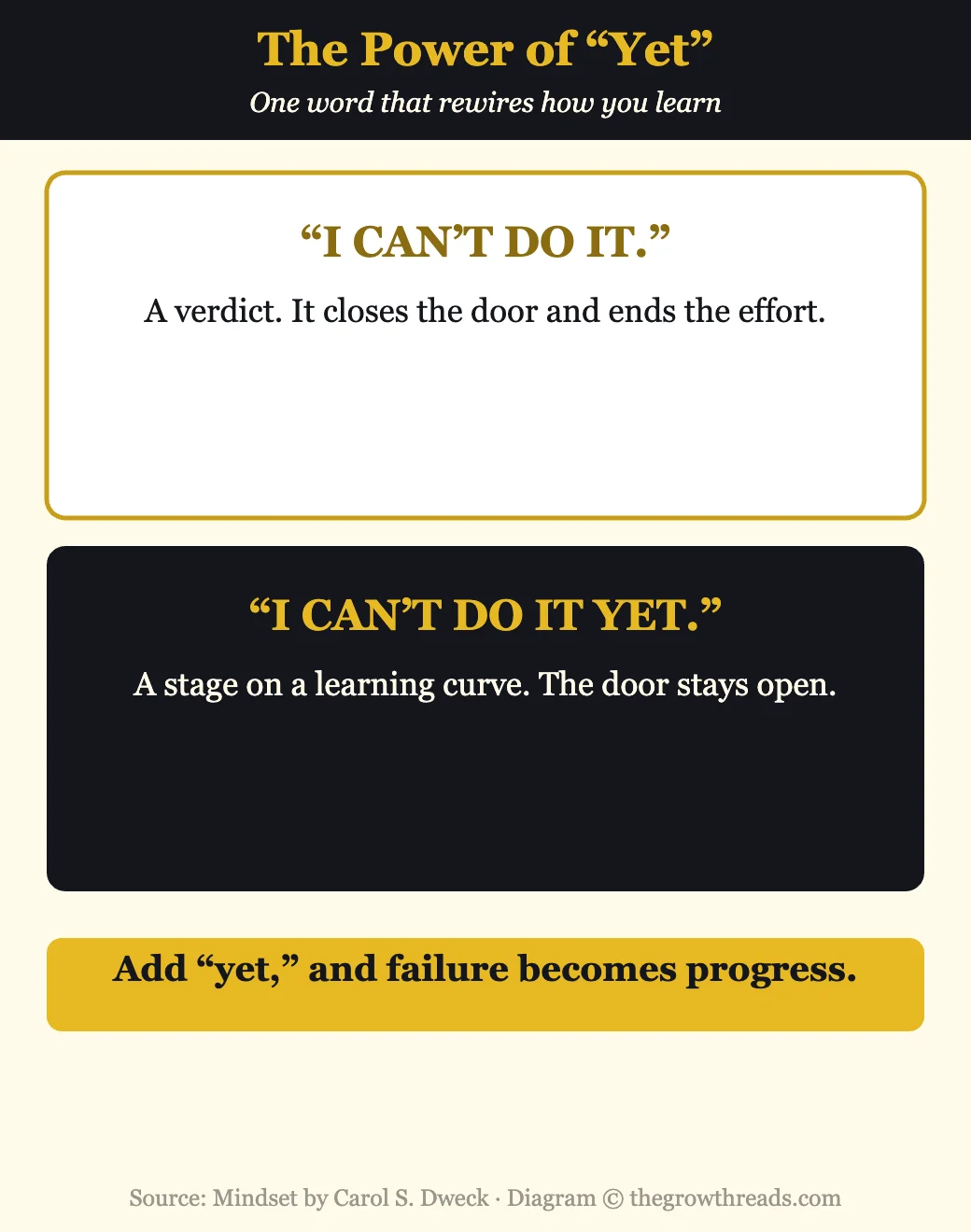
That small addition transforms failure from a permanent verdict into a temporary position on a learning curve, keeping the door to improvement open. Dweck grounds this in the science of neuroplasticity — the brain’s genuine ability to grow and rewire itself with practice — which gives the growth mindset a real biological basis: abilities truly can develop. She then turns to a crucial question: where do mindsets come from, and how are they passed on? Her research on praise is especially important here. Praising children (or adults) for their intelligence or talent — “You’re so smart!” — inadvertently instills a fixed mindset, because it teaches them that ability is a fixed trait to be judged, making them risk-averse and fragile in the face of difficulty. Praising the process instead — the effort, the strategies, the persistence — “You worked really hard on that” or “That was a smart approach” — instills a growth mindset, teaching that development comes from what you do. This finding has profound implications for how we encourage anyone we want to help grow.
Part 4: Mindsets in the real world
The final part of the book shows how mindset operates across domains. In business and leadership, Dweck contrasts fixed-mindset leaders — who need to be the smartest in the room, surround themselves with yes-men, and stifle growth — with growth-mindset leaders who develop their people and see the company as a learning organization; she uses the collapse of fixed-mindset-driven firms as cautionary tales. In sports, she argues that the greatest athletes are marked not by raw talent but by a growth-oriented dedication to practice and improvement, citing champions who out-worked more naturally gifted rivals. In relationships, a fixed mindset assumes that a good relationship should be effortless and that problems reveal fundamental incompatibility, while a growth mindset understands that relationships require ongoing work and that conflict can be navigated and learned from. In parenting and teaching, she shows how the messages adults send — through their praise, their responses to failure, and their own modeled attitudes — shape whether children develop a fixed or growth orientation.
Crucially, Dweck insists that mindsets can change: by learning to recognize your fixed-mindset “voice” in moments of challenge and setback, and deliberately choosing a growth-mindset response, you can gradually rewire how you approach ability. In the updated edition she adds an important caution about the “false growth mindset” — the trap of claiming a growth mindset (because it sounds good) while continuing to avoid challenges, dismiss criticism, or praise talent. A real growth mindset, she stresses, is not a slogan but a genuine embrace of effort, learning, and the belief that everyone can develop. It is worth noting that some specific classroom interventions based on this work have shown smaller or more variable effects in later large-scale studies, prompting healthy scientific debate; but the core distinction between fixed and growth mindsets remains one of the most useful and widely applied ideas in modern psychology. The book can feel repetitive, hammering its central point with many examples, yet that point is genuinely important and, for many readers, quietly life-changing.
Who is Mindset best for — and who should read something else first?
This book is ideal for parents, teachers, coaches, and leaders who shape others’ development, and for anyone who suspects their own beliefs about talent are limiting them. Its central idea is simple, memorable, and applicable everywhere. It is not for you if you dislike a single concept illustrated at length, since Dweck returns to the fixed-versus-growth distinction repeatedly across domains. If you want the perseverance side of the story backed by more research, read Grit; for turning a growth mindset into concrete daily behavior, pair it with Atomic Habits.
Questions to reflect on
- In which areas of your life do you hold a fixed mindset, and where a growth one?
- When you last faced a real challenge, did you lean in or protect your self-image?
- Do you treat effort as evidence of inadequacy — or as the path to getting better?
- How do you praise the people you want to help grow: for talent, or for process?
- Where could adding the word “yet” change how you see a current failure?
🔥 Ready to grow your mindset?
This guide is the map — Dweck’s research and stories are what make the shift real.
How to apply Mindset (7-day plan)
- Day 1 — Spot your mindset. Notice one area where you believe your ability is fixed, and one where you believe it can grow.
- Day 2 — Catch the fixed voice. When something feels hard, notice the “I’m just not good at this” thought and question it.
- Day 3 — Add “yet”. Take one “I can’t do this” and rephrase it as “I can’t do this yet.”
- Day 4 — Reframe effort. Choose one hard task and treat the effort as the path, not a sign of weakness.
- Day 5 — Welcome criticism. Ask for feedback on something and receive it as information to improve.
- Day 6 — Praise the process. Compliment someone (or yourself) for effort and strategy, not talent.
- Day 7 — Be inspired, not threatened. Find someone more skilled than you and study what you can learn from them.
Frequently asked questions
Is Mindset worth reading?
Yes. It introduced one of the most influential ideas in modern psychology — the distinction between fixed and growth mindsets — and its core insight can genuinely change how you approach challenges, effort, and failure in every area of life. It is especially valuable for parents, teachers, coaches, and leaders, since it clarifies how the messages we send shape others’ development. The main criticism is that the single idea is repeated across many examples and can feel padded. But the concept is important enough that the repetition helps it stick, and for many readers it is quietly transformative.
What is the difference between a fixed and growth mindset?
A fixed mindset is the belief that intelligence, talent, and abilities are static traits you either have or don’t. A growth mindset is the belief that these qualities can be developed through effort, good strategies, and learning. The difference shows up in behavior: the fixed mindset avoids challenges, sees effort as a sign of inadequacy, gives up after failure, and feels threatened by others’ success, while the growth mindset embraces challenges, values effort, persists through setbacks, and is inspired by others. The belief itself shapes the outcomes.
What is the main message of Mindset?
That your beliefs about the nature of ability profoundly shape your success and wellbeing, and that adopting a growth mindset — the belief that you can develop your abilities — leads to greater achievement, resilience, and fulfillment than a fixed mindset. Dweck argues that mindsets are learnable, so you can shift toward growth by recognizing your fixed-mindset reactions and deliberately choosing to embrace challenge, effort, and learning. The message is ultimately hopeful: potential is not predetermined.
What is the “power of yet”?
It is Dweck’s simple but powerful reframing tool. When you fail at something, a fixed mindset concludes “I can’t do this,” treating the failure as a permanent verdict. Adding the word “yet” — “I can’t do this yet” — transforms that failure into a temporary stage on a learning curve, keeping the path to improvement open. Grounded in the brain’s real ability to grow and change, the power of “yet” is a small linguistic shift that can meaningfully change how you and others respond to difficulty and setbacks.
How do you develop a growth mindset?
Dweck says it starts with awareness: learning to recognize your fixed-mindset “voice” — the thoughts that tell you to avoid a challenge, that effort is pointless, or that a setback means you lack ability — and deliberately choosing a growth-mindset response instead. Practically, that means embracing challenges, viewing effort as the path to mastery, treating failure and criticism as information, praising process rather than talent in yourself and others, and adding “yet” to statements of inability. It is an ongoing practice rather than a one-time switch, but the brain’s malleability makes real change possible.
How long does it take to read Mindset?
The book is around 300 pages and most readers finish it in about six hours. Because it repeats its central idea across many domains — school, work, sport, relationships, parenting — some readers move through the later chapters quickly. Our summary above captures the core framework and its applications in roughly 15 minutes, which is enough to understand and begin applying the fixed-versus-growth distinction.
Is the growth mindset scientifically proven?
The core distinction between fixed and growth mindsets is well established and highly influential, backed by decades of Dweck’s research. However, it is worth noting that some large-scale attempts to replicate specific classroom mindset interventions have found smaller or more variable effects than early studies suggested, which has prompted healthy scientific debate about how much and under what conditions mindset interventions boost achievement. The sensible takeaway is that the framework is a genuinely useful lens on motivation and learning, while claims about dramatic, guaranteed results from brief interventions should be treated with some caution.
Related summaries
- Grit Summary — the perseverance a growth mindset makes possible.
- Atomic Habits Summary — turning a growth mindset into daily behavior.
- Can’t Hurt Me Summary — growth through voluntary discomfort.
- The Courage to Be Disliked Summary — you are not determined by your past.
- Browse all our best psychology books.
How we analyze books: We work from the full book — reconstructing its core arguments in our own words, adding commentary that connects it to related research and other books in our library, and pressure-testing the advice against how it plays out in real life. We never reproduce the text; we synthesize it. Read our full methodology.
Disclosure: The Growth Reads is reader-supported. When you buy through links on our site we may earn an affiliate commission at no extra cost to you. We only recommend books we believe are worth your time, and our summaries and opinions are written independently.
Related Psychology Summaries
Originals Summary & Review: How Non-Conformists Move the World
The Defining Decade Summary & Review: Why Your Twenties Matter
The Laws of Human Nature Summary & Review: Decode What Drives People
The Molecule of More Summary & Review: Why You Never Feel Satisfied
Thinking, Fast and Slow Summary & Review: Master Your Mind’s Hidden Shortcuts