

⭐⭐⭐⭐ 4.3 / 5 — A warm, research-grounded manifesto for letting go of who you think you should be and embracing who you actually are.
Best for: Anyone trapped in perfectionism, people-pleasing, or the belief that they need to earn their worthiness — especially those ready for a compassionate rather than tactical approach to self-improvement.
Reading time: ~4 hours (160 pages)
Difficulty to apply: Moderate — the concepts are simple but the emotional work of releasing perfectionism and practicing vulnerability requires sustained daily intention.
The Gifts of Imperfection in one minute
Worthiness does not have prerequisites — you are enough right now, and the people who live the most connected, joyful lives believe that. Brené Brown spent years studying vulnerability, shame, and human connection. She found that the people who experienced the deepest sense of love and belonging — whom she calls Wholehearted people — all shared one thing: they believed they were worthy of it. Not because they had earned it, but because they had decided to show up as themselves. Brown distills their practices into ten guideposts, each pairing something to cultivate with something to let go of: authenticity over approval, self-compassion over perfectionism, gratitude over scarcity, play over exhaustion, and more.
Key takeaways
- Worthiness has no prerequisites: Wholehearted people do not earn belonging through achievement — they cultivate it by believing they are enough as they are.
- Vulnerability is not weakness: It is the birthplace of love, belonging, joy, courage, and creativity — you cannot selectively numb it without also numbing positive emotions.
- Shame and guilt are different: Shame says “I am bad” and leads to withdrawal. Guilt says “I did something bad” and motivates repair. Only guilt is productive.
- Perfectionism is a shield, not a path: It is a self-destructive belief that if we do everything perfectly, we can avoid the pain of blame, judgment, and shame.
- Authenticity is a daily practice: It means choosing to let go of who you think you should be in order to be who you actually are — over and over, in every interaction.
- You cannot selectively numb: When you numb painful emotions (through food, work, alcohol, screens), you also numb joy, gratitude, and happiness.
- Resilience comes from resourcefulness: Resilient people are not immune to struggle — they are skilled at reaching out, telling the truth about their pain, and asking for help.
- Comparison kills creativity: Using someone else’s life as the benchmark for your own shuts down the originality that comes from embracing your own story.
- Play and rest are not luxuries: They are essential to wholehearted living — using exhaustion as a status symbol and productivity as a measure of self-worth is a trap.
- Connection is why we are here: Neuroscience confirms that human beings are wired for connection — it gives purpose and meaning to our lives.
What is The Gifts of Imperfection about?
The Gifts of Imperfection is Brené Brown’s guide to wholehearted living — a way of engaging with the world from a place of worthiness. Drawing on a decade of research into shame, vulnerability, and human connection, Brown identifies ten guideposts that help people cultivate courage, compassion, and connection while letting go of perfectionism, numbing, and the need for certainty.
About the author
Brené Brown is a research professor at the University of Houston, where she holds the Huffington Foundation Endowed Chair at the Graduate College of Social Work. She has spent more than two decades studying courage, vulnerability, shame, and empathy. Her 2010 TEDx Houston talk, “The Power of Vulnerability,” is one of the most viewed TED talks in history with over 60 million views. She is the author of six bestselling books, including Daring Greatly, Rising Strong, and Atlas of the Heart. Brown’s research has shifted the cultural conversation around vulnerability from weakness to strength. Explore all Brené Brown book summaries →
Key concepts at a glance
| Concept | What it means | Use it when |
|---|---|---|
| Wholehearted living | Engaging with the world from a place of worthiness rather than scarcity | You feel like you need to earn love or belonging |
| Shame resilience | Recognising shame, practicing critical awareness, reaching out, speaking shame | You feel the hot wash of “not good enough” |
| Vulnerability | Uncertainty, risk, and emotional exposure — the foundation of all meaningful experiences | You are avoiding something because it might not work |
| Perfectionism | A self-protective shield disguised as striving — driven by shame, not growth | You are delaying action until conditions are perfect |
| Numbing | Using substances, behaviours, or busyness to avoid feeling vulnerable | You notice yourself reaching for comfort when uncomfortable |
| Authenticity | Letting go of who you think you should be and showing up as who you are | You are performing a version of yourself for approval |
| Scarcity mindset | The belief that you are never enough — never safe, certain, or extraordinary enough | You wake up with “not enough” running through your head |
Part 1 — Courage, compassion, and connection: the foundation
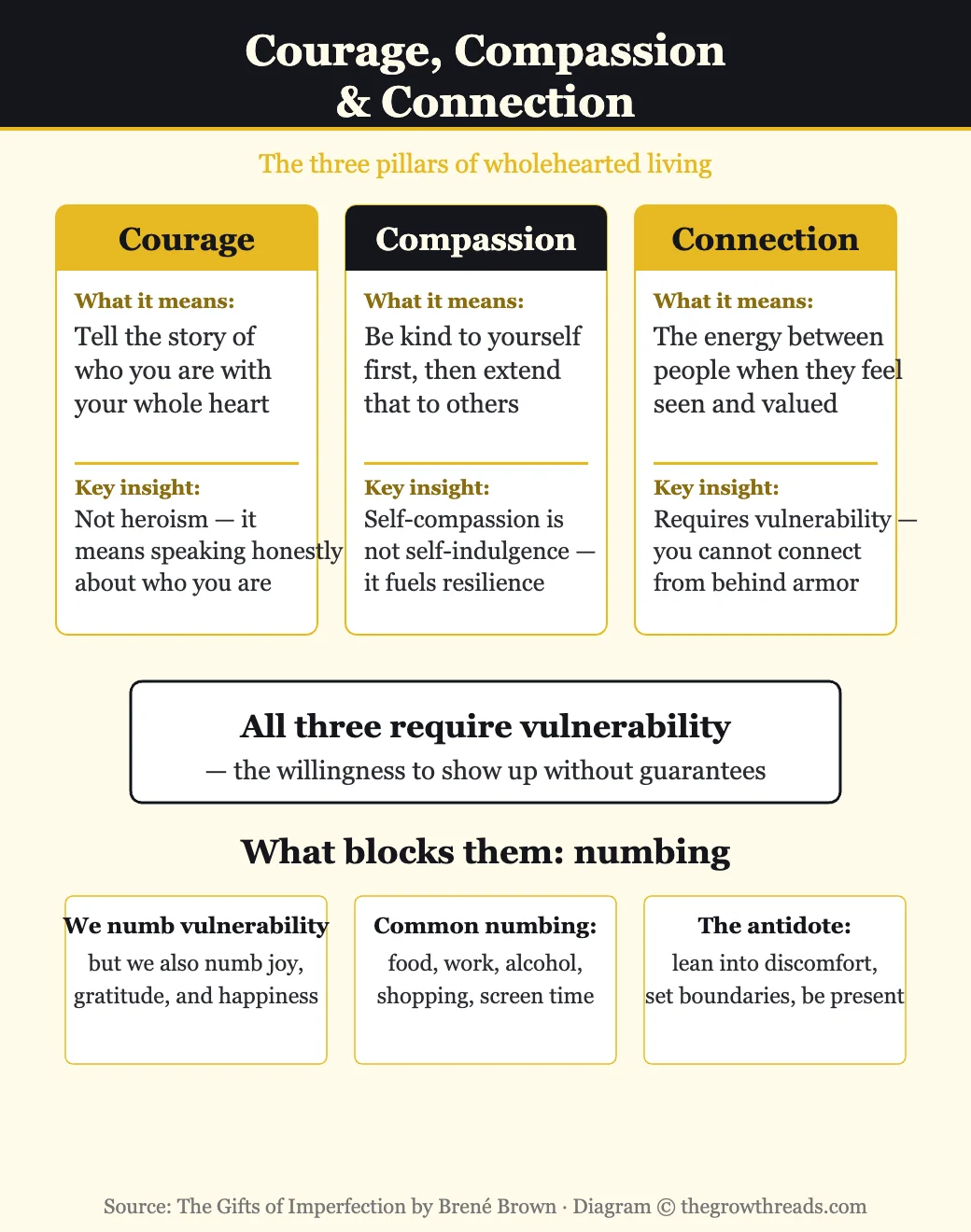
Brown opens by defining the three qualities that underpin all ten guideposts: courage, compassion, and connection. Courage, in her definition, is not heroism — it comes from the Latin word cor, meaning heart, and originally meant to tell the story of who you are with your whole heart. Compassion means being kind to ourselves first, then extending that kindness outward — Brown’s research shows that people who are compassionate toward others are invariably compassionate toward themselves first. Connection is the energy that exists between people when they feel seen, heard, and valued — and it requires vulnerability because you cannot connect authentically from behind emotional armor.
The foundation rests on a single conviction: worthiness. Wholehearted people — those who live with deep love, belonging, and joy — share the belief that they are worthy of those things. Not because they have proven it, but because they have decided it. Brown emphasizes that this is not self-esteem earned through achievement; it is an internal posture of “I am enough” that precedes action rather than following it. Everything in the book builds on this distinction.
Part 2 — Shame, perfectionism, and numbing: the barriers
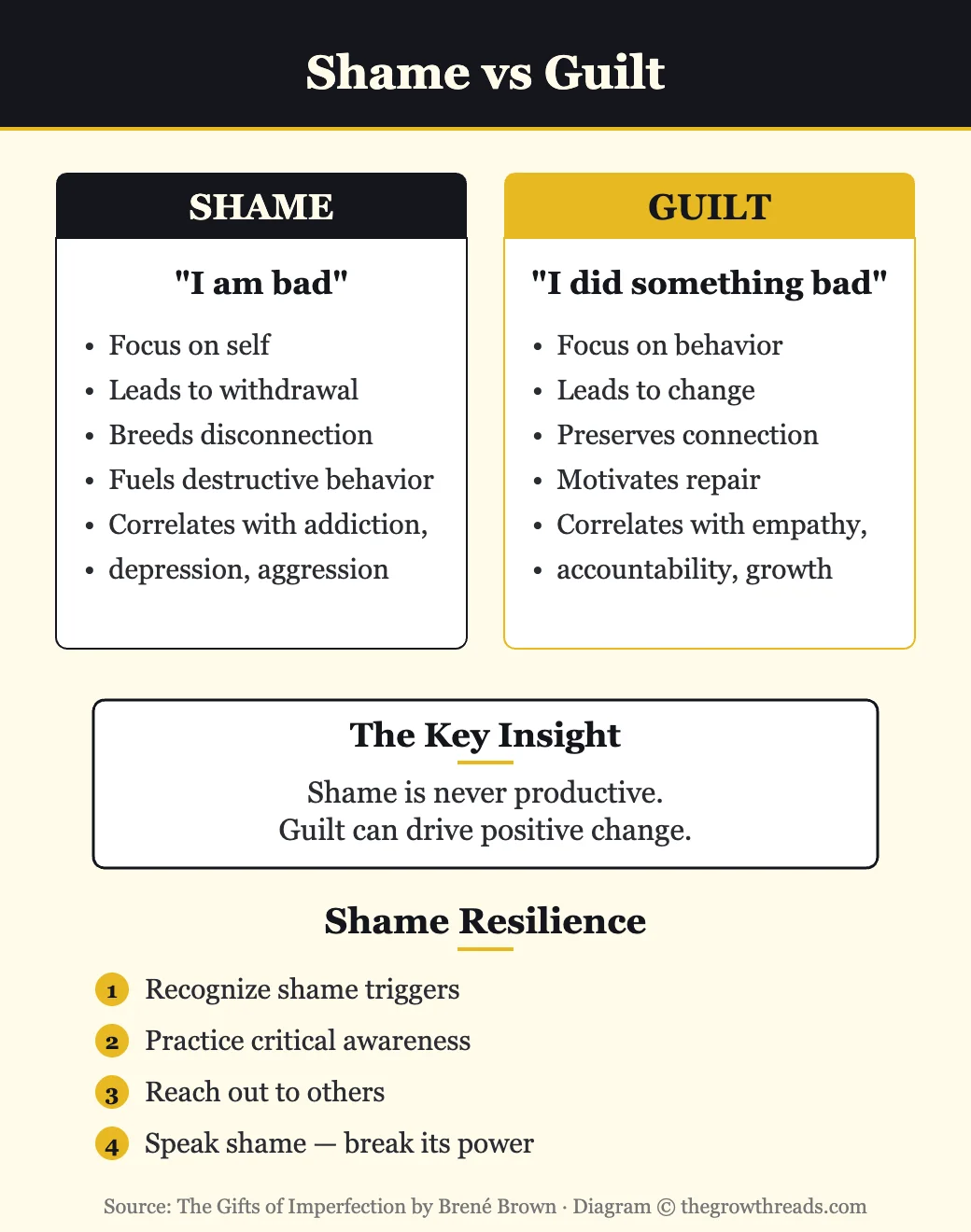
Before presenting the guideposts, Brown addresses the three biggest obstacles to wholehearted living. Shame is the intensely painful feeling that we are flawed and therefore unworthy of connection. It differs fundamentally from guilt: shame is “I am bad” while guilt is “I did something bad.” Her research shows that shame is correlated with addiction, depression, violence, and aggression, while guilt is correlated with empathy, accountability, and positive change. The antidote is shame resilience — a four-step practice of recognizing shame triggers, practicing critical awareness of social expectations, reaching out to trusted people, and speaking the shame out loud, which breaks its power.
Perfectionism, Brown argues, is not the same as striving for excellence. It is a self-destructive belief system that says: if I look perfect, live perfectly, and do everything perfectly, I can avoid or minimize blame, judgment, and shame. The problem is that perfection does not exist, so the perfectionist is locked in an unwinnable game that produces anxiety, depression, and paralysis rather than achievement. Numbing is the third barrier — when vulnerability becomes too uncomfortable, we reach for food, alcohol, work, screens, shopping, or any behaviour that dulls the feeling. Brown’s critical insight is that you cannot selectively numb: when you numb pain, you also numb joy, gratitude, and happiness.
Part 3 — The ten guideposts: cultivate and let go
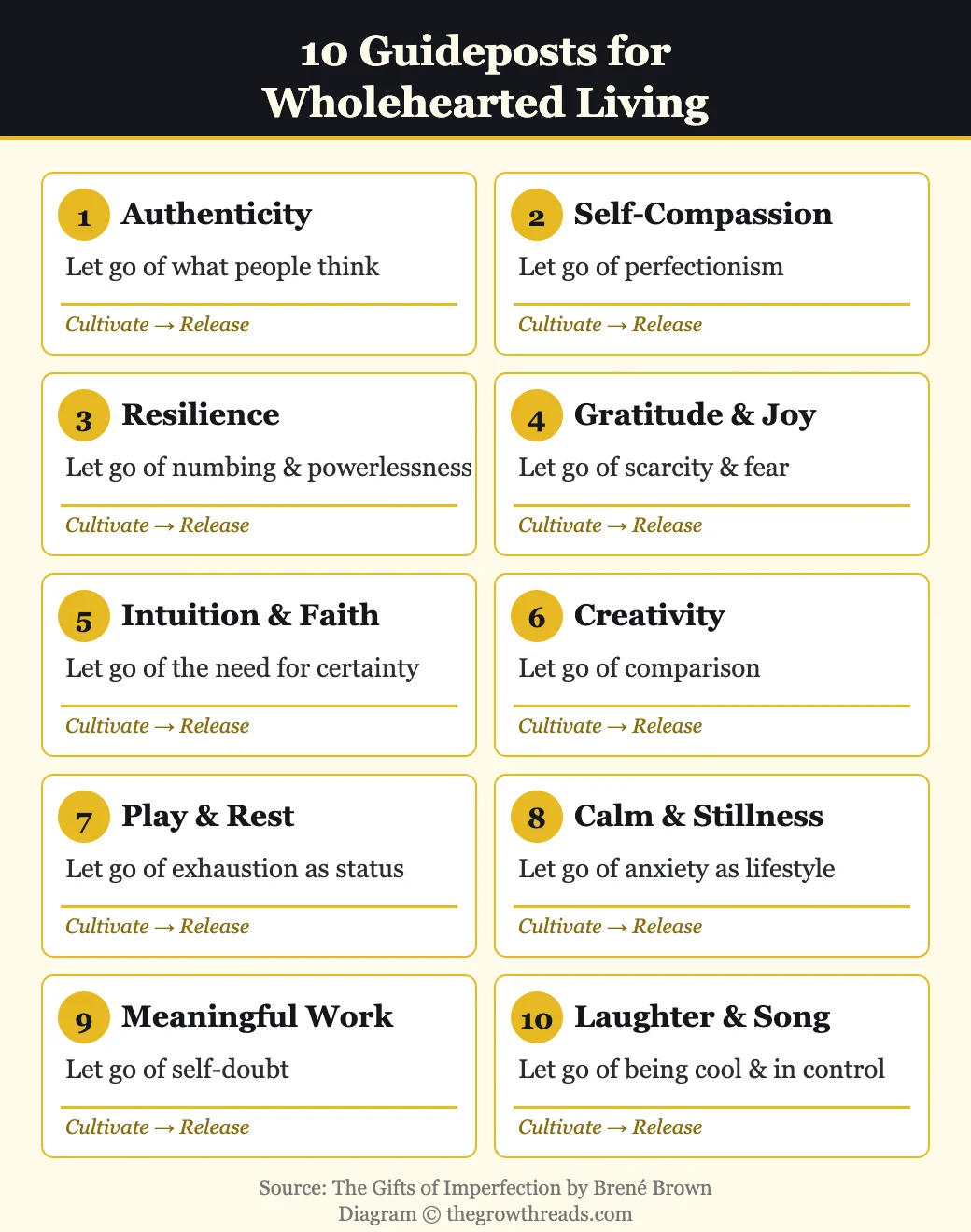
The heart of the book is the ten guideposts, each structured as a pair: something to cultivate and something to release. Cultivate authenticity by letting go of what people think. Cultivate self-compassion by letting go of perfectionism. Cultivate a resilient spirit by letting go of numbing and powerlessness. Cultivate gratitude and joy by letting go of scarcity and fear of the dark. Cultivate intuition and trusting faith by letting go of the need for certainty. Each guidepost is grounded in Brown’s research data and illustrated with personal stories from her own struggle to practice what the data revealed.
The remaining five guideposts address creativity (let go of comparison), play and rest (let go of exhaustion as a status symbol), calm and stillness (let go of anxiety as a lifestyle), meaningful work (let go of self-doubt and “supposed to”), and laughter, song, and dance (let go of being cool and always in control). Brown is transparent about how difficult she finds several of these herself — particularly play and rest, which she initially dismissed as unproductive. Her willingness to model imperfection while teaching about it gives the book an authenticity that a purely prescriptive guide would lack.
Who is The Gifts of Imperfection best for — and who should read something else first?
This book is ideal for anyone who struggles with perfectionism, people-pleasing, or the feeling that they need to be more, do more, or achieve more before they deserve belonging. It is especially powerful for high-achievers who have built their identity around performance and recognise that something still feels hollow. If you want a more research-dense and less personal treatment of vulnerability, try Brown’s later book Daring Greatly. If you are looking for a cognitive-behavioural framework rather than a shame-resilience framework, The Mountain Is You by Brianna Wiest approaches self-sabotage from a more analytical angle. For the habit-building mechanics of self-compassion, pair this with Atomic Habits.
Questions to reflect on
- When did you last hold back from doing something you cared about because you were afraid it would not be perfect?
- Do you believe you are worthy of love and belonging right now — or do you attach conditions to that worthiness?
- What is your primary numbing behaviour when vulnerability feels too uncomfortable?
- If you stopped comparing yourself to one specific person, what creative project would you start?
- When did you last allow yourself to play — with no purpose, no productivity goal, no outcome in mind?
🔥 Ready to let go of perfectionism and embrace who you are?
The Gifts of Imperfection will transform your relationship with worthiness, vulnerability, and belonging.
How to apply The Gifts of Imperfection (7-day plan)
- Day 1 — Practice a worthiness mantra: Each morning this week, look in the mirror and say: “I am enough.” Notice the resistance — that resistance is the data.
- Day 2 — Identify your perfectionism triggers: Write down three areas where you delay action until conditions are perfect. Choose one and do it imperfectly today.
- Day 3 — Practice shame resilience: The next time you feel that hot flush of “not good enough,” name it (“I’m feeling shame”), identify the trigger, and tell one person.
- Day 4 — Audit your numbing: Track every time today you reach for food, your phone, or another comfort when you feel uncomfortable. Just notice — no judgment.
- Day 5 — Practice gratitude: Before bed, write down three specific moments from today that you are grateful for. Be concrete: a sound, a conversation, a sensation.
- Day 6 — Schedule play: Block 30 minutes for purposeless play — something with no productivity goal. Drawing, dancing, building, throwing a ball. No outcome required.
- Day 7 — Choose authenticity: In one conversation today, say what you actually think instead of what you think the other person wants to hear. Notice how it feels.
Frequently asked questions
What is the main message of The Gifts of Imperfection?
The central message is that wholehearted living — a life of deep connection, joy, and belonging — begins with believing you are worthy of those things, right now, without conditions. Brown identifies ten guideposts for cultivating this posture, each pairing something to build (authenticity, self-compassion, gratitude) with something to release (people-pleasing, perfectionism, scarcity). The foundation is courage, compassion, and connection.
What is the difference between shame and guilt?
Shame is the belief “I am bad” — it focuses on the self and leads to withdrawal, disconnection, and destructive behaviour. Guilt is the feeling “I did something bad” — it focuses on behaviour and motivates repair and positive change. Brown’s research shows shame correlates with addiction and aggression, while guilt correlates with empathy and accountability. The goal is to build shame resilience, not to eliminate all uncomfortable feelings.
What does Brené Brown mean by wholehearted living?
Wholehearted living is Brown’s term for engaging with the world from a place of worthiness. Wholehearted people share the courage to be imperfect, the compassion to be kind to themselves first, and the willingness to let go of who they think they should be in order to be who they are. It is not a destination but a daily practice across ten specific guideposts that Brown identified through her qualitative research.
Is The Gifts of Imperfection a self-help book?
It is grounded in academic research — Brown is a research professor who studied shame, vulnerability, and connection for over a decade — but it is written in an accessible, personal style with practical application. Unlike many self-help books, it does not promise quick fixes. It asks readers to sit with uncomfortable truths about perfectionism, numbing, and worthiness. The 10th anniversary edition includes additional tools and reflection exercises.
How is this different from Daring Greatly?
The Gifts of Imperfection provides the foundational framework — the ten guideposts for wholehearted living. Daring Greatly goes deeper into one specific guidepost: vulnerability. It explores how vulnerability operates in relationships, parenting, leadership, and organisational culture. If Gifts is the overview, Daring Greatly is the deep dive on the single most important concept. Most readers benefit from reading Gifts first.
How long does it take to read The Gifts of Imperfection?
At 160 pages, it is one of Brown’s shortest books and reads in about 4 hours. The writing is warm and conversational, mixing research findings with personal stories. The 10th anniversary edition adds a new foreword and practical tools. For a quick grasp of the framework, the introduction and the chapter on courage, compassion, and connection cover the essentials in about 40 pages.
What does Brown mean by “you cannot selectively numb”?
When we use food, alcohol, work, or screens to avoid feeling vulnerable or uncomfortable, we do not just numb the negative emotions — we also numb joy, gratitude, happiness, and connection. The brain does not have a selective switch. Brown found this pattern consistently in her research: people who numbed pain also reported feeling less joy. The antidote is not to stop feeling but to lean into discomfort, set boundaries, and practice being present with difficult emotions.
Related summaries
- The Courage to Be Disliked — Adlerian psychology’s parallel argument for the courage to live authentically
- Mindset by Carol Dweck — how fixed vs growth mindset connects to Brown’s perfectionism trap
- The Mountain Is You by Brianna Wiest — a more analytical approach to self-sabotage patterns
- The Untethered Soul by Michael Singer — a spiritual lens on releasing the inner critic Brown describes
Related Psychology Summaries
Incognito Summary & Review: The Secret Lives of Your Brain
Stumbling on Happiness Summary & Review: Why Your Brain Lies About the Future
The Anxious Generation Summary & Review: How Phones Rewired Childhood
The Laws of Human Nature Summary & Review: Decode What Drives People
The Obstacle Is the Way Summary & Review: The Stoic Art of Turning Trials into Triumph