

⭐⭐⭐⭐ 4.0/5 — A practical, no-gatekeeping guide to financial independence that prioritizes offense (earning more) as much as defense (spending less).
Best for: Millennials and Gen Z professionals who want a step-by-step roadmap to financial independence, especially those interested in the FIRE movement but put off by extreme frugality.
Reading time: ~7 hours (336 pages) | Difficulty to apply: Moderate — the math is simple but the behavioral changes require sustained discipline over years.
Financial Freedom in one minute
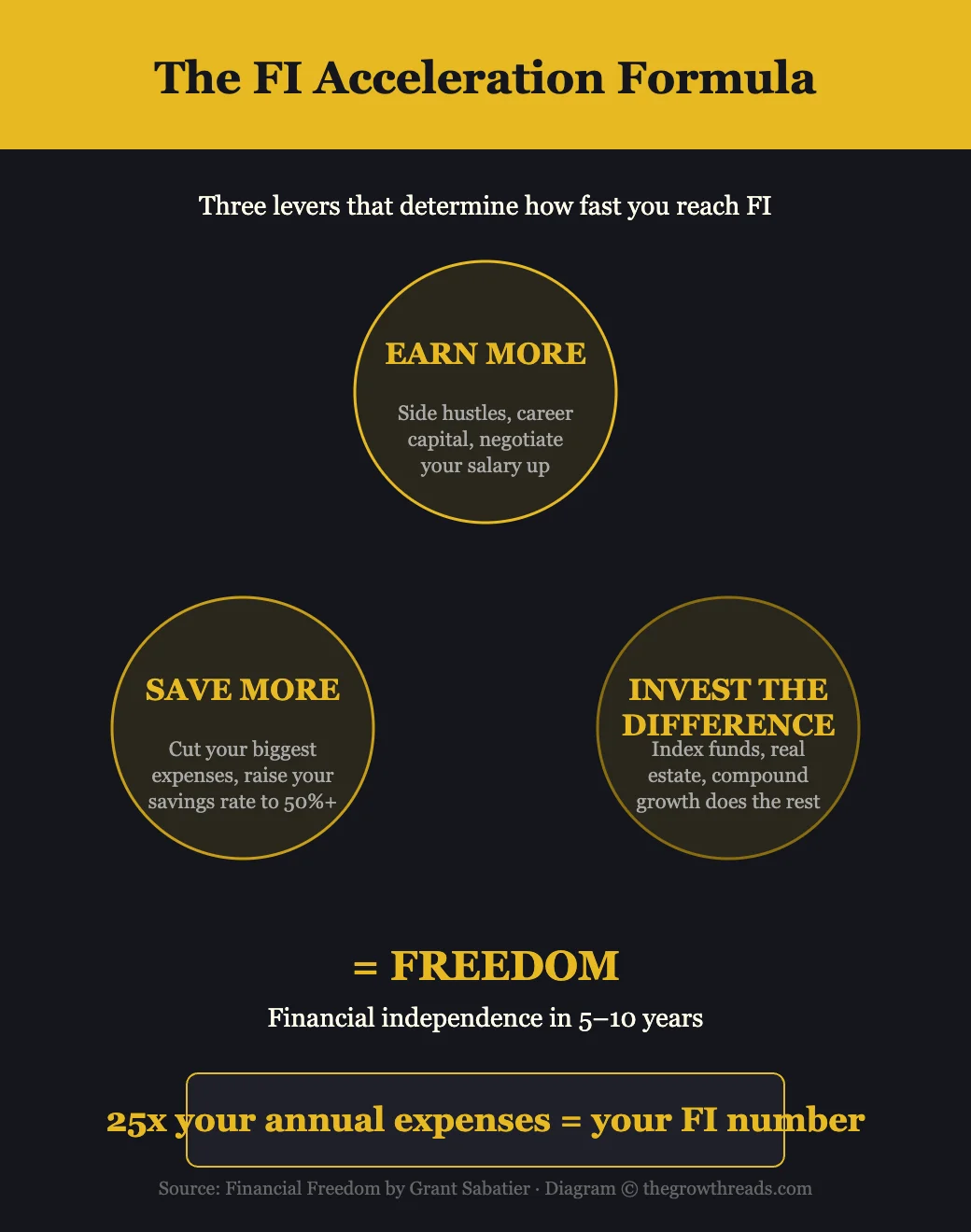
Grant Sabatier went from $2.26 in his bank account to over $1.25 million in five years — and he wrote this book to show you exactly how. Financial Freedom is the most comprehensive modern guide to reaching financial independence (FI) — the point where your investment income covers all your living expenses. Unlike many FIRE books that focus primarily on cutting expenses, Sabatier argues that earning more is at least as important as spending less. He walks you through calculating your “FI number” (roughly 25 times your annual expenses), then gives you a three-lever framework: earn more through side hustles and career optimization, save more by attacking your biggest expenses, and invest the difference in low-cost index funds. The book also tackles the psychological side — what money actually means to you, how to avoid lifestyle inflation, and how to design a life worth living before you reach the finish line.
Key takeaways
- Your FI number is 25x your annual expenses: this is the amount you need invested so that a 4% annual withdrawal covers your life — and it’s probably lower than you think.
- Time is worth more than money: Sabatier’s core philosophy is that money is a tool for buying back your time — every dollar saved and invested is a small piece of future freedom.
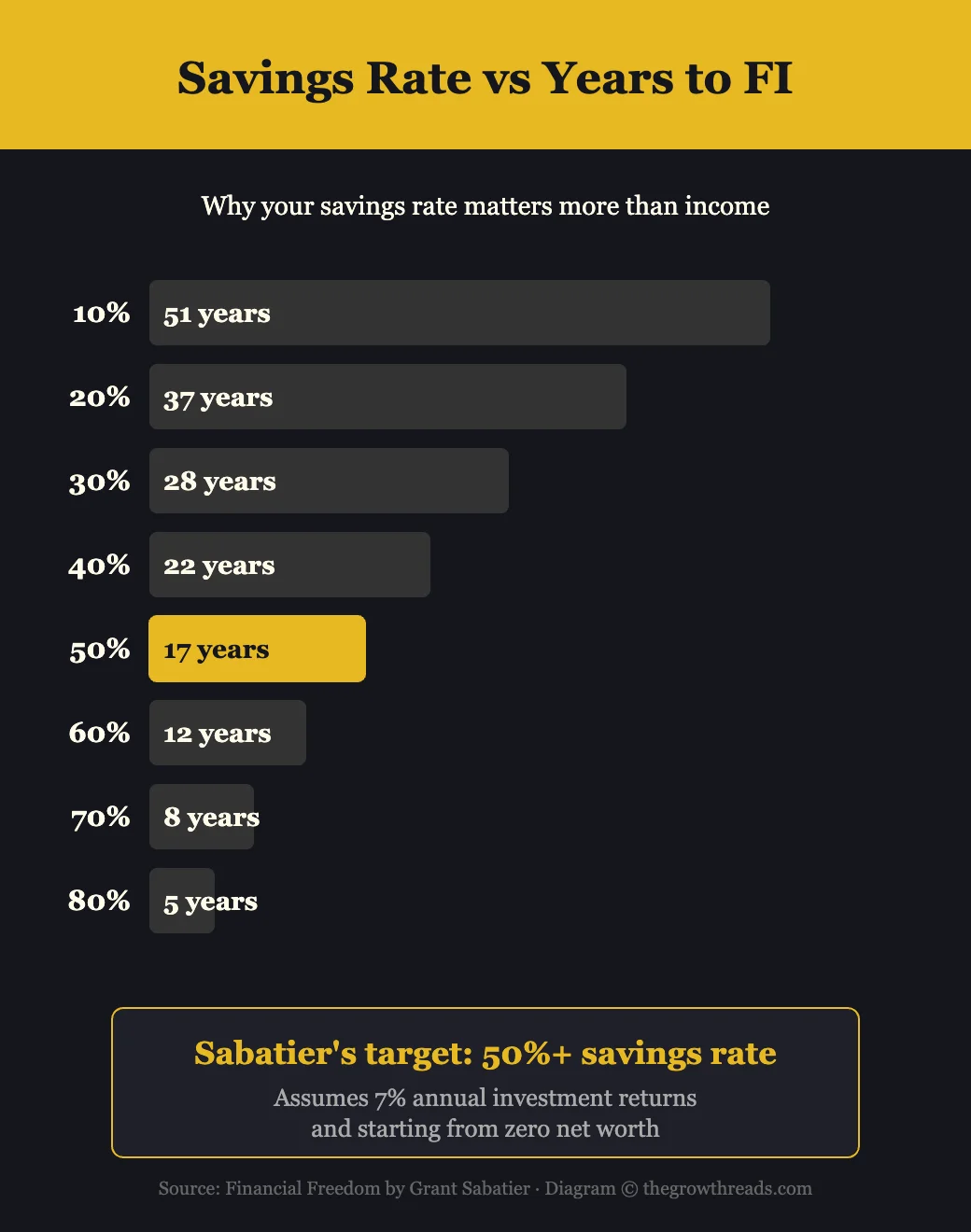
- Your savings rate is the single most important variable: someone saving 50% of their income reaches FI in roughly 17 years regardless of what they earn, while someone saving 10% needs over 50 years.
- Earning more has no ceiling; cutting has a floor: you can only cut expenses to zero, but your earning potential is theoretically unlimited — which is why side hustles and income growth deserve equal attention.
- Compound interest is the eighth wonder of the world: the earlier you start investing, the more time does the heavy lifting — Sabatier shows how $1 invested at 25 can be worth $10+ at retirement.
- Automate everything: willpower fades but systems persist — set up automatic transfers to savings and investment accounts so the decision is made once.
- Real estate and side hustles accelerate the timeline: Sabatier advocates house hacking (living in one unit while renting others) and building income streams beyond your day job.
- Track your net worth, not your income: income is vanity; net worth is freedom — what matters is what you keep and grow, not what flows through your account.
- Lifestyle inflation is the silent killer: every raise you spend instead of invest pushes your FI date further out — the key is widening the gap between earnings and spending.
- Design the life you want before you retire from the one you don’t: financial independence isn’t about quitting work — it’s about having the freedom to choose meaningful work on your terms.
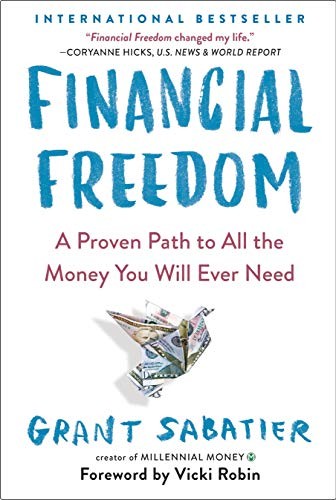
What is Financial Freedom about?
Financial Freedom is a step-by-step guide to reaching financial independence — the point where your investment income covers your living expenses — in five to ten years. Sabatier provides a three-lever framework (earn more, save more, invest the difference), tools for calculating your personal FI number, strategies for building multiple income streams, and a philosophy for designing a meaningful life both during and after the pursuit of financial independence.
About the author
Grant Sabatier is an entrepreneur, investor, and the creator of Millennial Money, one of the most-read personal finance blogs in the world. His personal story is the book’s hook: in August 2010, at age 24, he was living with his parents with $2.26 to his name. Over the next five years, he grew his net worth to over $1.25 million through a combination of side hustles, salary negotiation, aggressive saving, and index fund investing. His writing has appeared in The New York Times, The Washington Post, and NPR, and he’s been named one of the top personal finance experts by Business Insider. Sabatier is transparent about the privilege that gave him a head start (college education, family safety net) while arguing that the underlying math works regardless of starting point. Explore all Grant Sabatier book summaries →
Key concepts at a glance
| Concept | What it means | Use it when |
|---|---|---|
| FI Number | 25× your annual expenses — the investment portfolio that funds your life forever at a 4% withdrawal rate | Setting your long-term financial target |
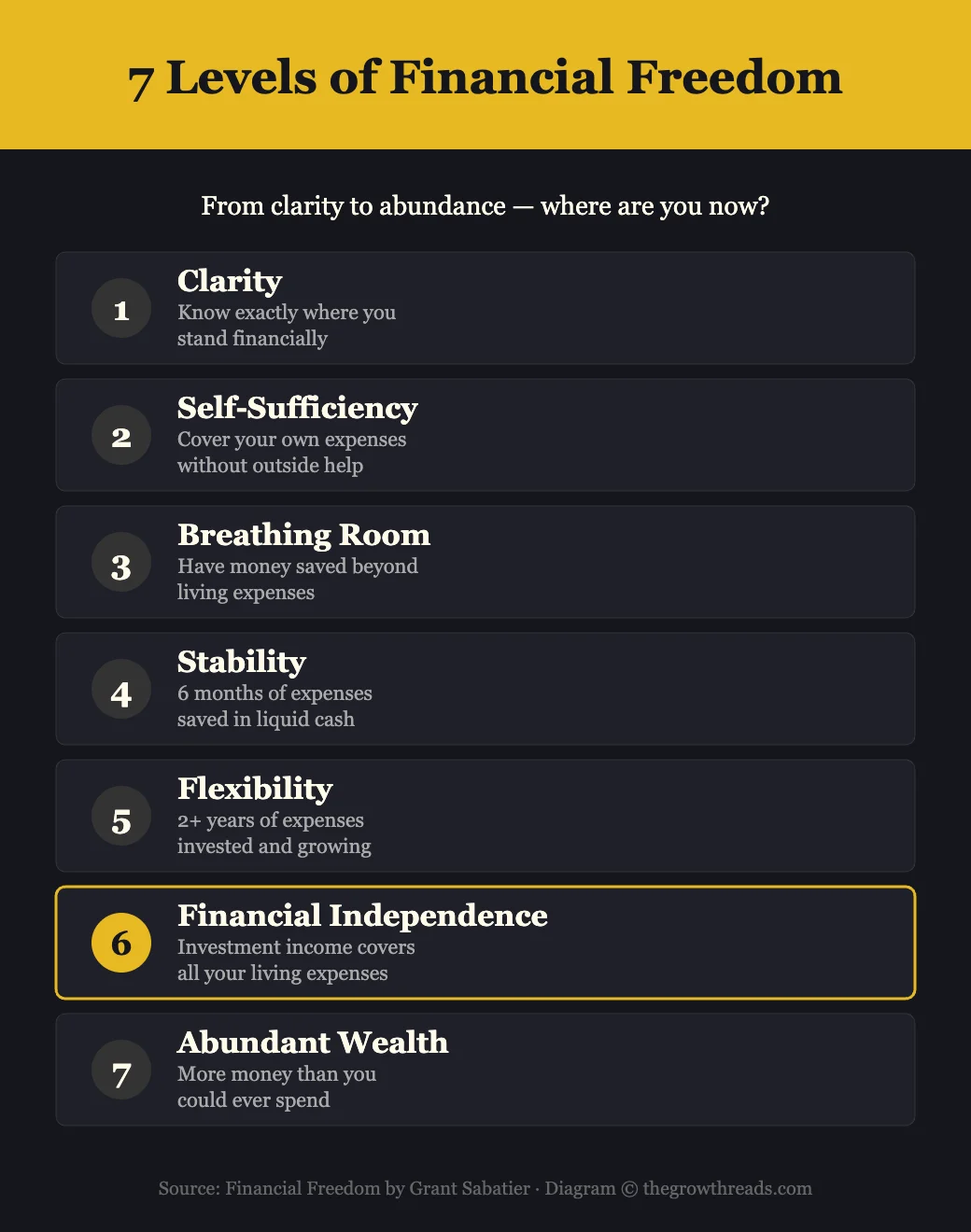
| 7 Levels of Financial Freedom | A progression from Clarity through Self-Sufficiency, Stability, Flexibility, and up to Financial Independence and Abundant Wealth | Tracking your progress and celebrating milestones |
| Savings Rate | The percentage of your after-tax income you save and invest — the single biggest determinant of how fast you reach FI | Deciding where to focus: earning more vs. spending less |
| Side Hustle Stack | Building multiple income streams beyond your day job to accelerate savings and reduce dependence on a single employer | You’ve optimized expenses and need the earning lever |
| House Hacking | Living in one unit of a multi-unit property while renting the others to eliminate or reduce your housing costs | Your housing expense is your biggest budget item |
| The Happiness of Pursuit | Finding meaning in the journey to FI, not just the destination — designing a life you don’t need to escape from | You catch yourself deferring all happiness to “after FI” |
| Automation | Setting up automatic transfers so saving and investing happen without ongoing decisions or willpower | You have the right accounts but keep forgetting to contribute |
Part 1: Redefining money and calculating your number
Sabatier opens with a provocation: most people have never thought about what money actually means to them. They’ve absorbed their parents’ money stories, their culture’s spending norms, and a vague sense that “more is better” without ever defining what “enough” looks like. He argues that this lack of clarity is the root cause of financial stress — people chase dollars without knowing what they’re chasing them for.
He introduces the concept of money as stored time. Every dollar you earn represents a certain number of minutes of your life. When you spend it, you’re trading those minutes for whatever you bought. When you save and invest it, you’re converting present work into future freedom. This reframe changes every purchasing decision: it’s not “can I afford this?” but “is this worth X hours of my life?”
The practical heart of this section is calculating your FI number using the 4% rule (originally from the Trinity Study): if you can live on 4% of your portfolio annually, you need 25 times your annual expenses to be financially independent. If you spend $40,000 a year, your FI number is $1 million. If you spend $60,000, it’s $1.5 million. Sabatier walks through how to calculate your actual annual spending (most people underestimate by 20–30%), how to project investment growth using the Rule of 72, and how to model different scenarios based on varying savings rates.
Part 2: The earning lever — income, side hustles, and career capital
This is where Financial Freedom diverges from most FIRE literature. While many books in the space focus almost exclusively on cutting expenses, Sabatier devotes roughly a third of the book to earning more. His argument is mathematical: if you earn $50,000 and save 20% ($10,000), increasing your income to $70,000 while keeping expenses flat gives you a 43% savings rate ($30,000) — a much larger impact than cutting expenses by the same $10,000 would have been psychologically feasible.
He breaks income growth into three categories. First, optimize your current job: negotiate your salary (he provides scripts), seek promotions strategically, and build career capital — skills that make you increasingly valuable in the market. Second, build side hustles: Sabatier tested over a dozen himself (freelance writing, digital marketing consulting, web development, real estate) and shares which had the best return on time invested. Third, create scalable income: products, content, or businesses that can earn while you sleep.
The side hustle section is one of the book’s strongest. Sabatier is specific about the economics: how much you can realistically earn, how long it takes to ramp up, and which hustles have the best ratio of effort to income. He’s also honest about the tradeoffs — side hustles consume time and energy that might be better spent on rest, relationships, or your primary career if you’re early in your trajectory.
Part 3: Saving strategically and attacking the big three
While Sabatier is pro-earning, he doesn’t dismiss the saving lever. He simply argues for strategic saving — attacking the three biggest expense categories (housing, transportation, and food) rather than obsessing over small daily purchases. These three categories typically consume 60–70% of household spending, so even moderate improvements here dwarf the impact of canceling subscriptions or switching to store-brand cereal.
On housing, he introduces house hacking as his top recommendation: buy a duplex, triplex, or fourplex, live in one unit, and rent the others. The rental income offsets or eliminates your mortgage, effectively giving you free housing — which alone can add 25–30% to your savings rate. He walks through the math, the financing options (FHA loans require as little as 3.5% down on owner-occupied properties up to four units), and the practical realities of being a landlord.
On transportation, his advice is straightforward: buy reliable used cars, avoid car payments, and live close to work if possible. On food, he recommends meal planning and batch cooking — not as deprivation but as a system that saves both money and time. Throughout, his tone is practical rather than moralistic: he’s not telling you to stop enjoying life, he’s showing you where the biggest levers are.
The savings rate table is one of the book’s most powerful illustrations. At a 10% savings rate, reaching FI takes about 51 years. At 25%, it drops to 32 years. At 50%, it’s roughly 17 years. At 75%, you can reach FI in about 7 years. The relationship is non-linear because saving more simultaneously reduces the expenses your portfolio needs to cover AND increases the money flowing into investments.
Part 4: Investing, automation, and designing your life
Sabatier’s investing philosophy is deliberately simple: low-cost, broad-market index funds (primarily Vanguard’s VTSAX or its equivalents). He argues against stock picking, timing the market, or complex strategies — not because they can’t work, but because the evidence shows that most active approaches underperform passive indexing over long periods, and the cognitive load diverts attention from the higher-leverage activities of earning and saving.
He covers the practical mechanics: maximizing tax-advantaged accounts (401(k), IRA, HSA) before taxable accounts, understanding the difference between traditional and Roth contributions, and the “mega backdoor Roth” for high earners. He also discusses real estate investing as a complement to index funds, covering both rental properties and REITs for those who prefer a hands-off approach.
The automation chapter is the operational backbone of the system. Sabatier prescribes a specific order: set up automatic paycheck splits (a percentage goes directly to savings and investment accounts before hitting your checking account), automate bill payments, and automate investment contributions. The goal is a system where the right financial behavior happens without any ongoing decisions — because decision fatigue is the enemy of consistency over decades.
The book closes with what Sabatier calls “the happiness of pursuit.” He pushes back against the FIRE community’s tendency to defer all happiness to a future retirement date. Financial independence isn’t an end — it’s a transition to work you choose rather than work you need. He urges readers to build a life they enjoy during the journey, not just after. This includes spending generously on the things that genuinely bring you joy while cutting ruthlessly on everything else — a version of the “values-based spending” philosophy that runs through modern personal finance thinking.
Who is Financial Freedom best for — and who should read something else first?
This book is ideal for professionals in their 20s and 30s earning a reasonable income who want a comprehensive, actionable plan for reaching financial independence. It’s especially valuable for people who’ve been turned off by extreme frugality advice and want a framework that emphasizes growing income alongside cutting expenses. Entrepreneurs and side hustlers will find the income chapters particularly practical.
If you’re new to personal finance and need the absolute basics first, start with I Will Teach You to Be Rich by Ramit Sethi — it covers automation, credit cards, and banking in more beginner-friendly detail. If you want a simpler, more philosophical take on index investing, The Simple Path to Wealth by JL Collins is more concise. And if you’re already financially independent and wondering what comes next, Die With Zero by Bill Perkins is the natural sequel.
Questions to reflect on
- What is your current savings rate? If you don’t know within 5%, that’s the first number to calculate this week.
- What does financial freedom actually mean to you — is it quitting your job, reducing hours, switching careers, or something else entirely?
- Which of the three levers (earn more, save more, invest better) has the most untapped potential in your specific situation right now?
- Are you deferring happiness to “after FI” in ways that make the journey unsustainable?
- What is the one biggest expense in your budget that you could meaningfully reduce without a quality-of-life hit — and what would that do to your savings rate?
🔥 Ready to build your path to financial independence?
Get the blueprint that took Grant Sabatier from $2.26 to $1.25 million in five years.
How to apply Financial Freedom (7-day plan)
- Day 1 — Calculate your FI number: Track every expense for the past three months (use your bank and credit card statements). Multiply your average monthly spending by 12, then by 25. That’s your target portfolio size.
- Day 2 — Determine your current savings rate: Divide your monthly savings (everything you save and invest) by your after-tax income. If it’s below 20%, identify the biggest single expense you can reduce this month.
- Day 3 — Automate your finances: Set up automatic transfers from your paycheck: first to your 401(k), then to an IRA or brokerage account, then to a high-yield savings account for emergencies. Make the right behavior the default.
- Day 4 — Audit your big three: Review your housing, transportation, and food expenses specifically. For each, write down one concrete change that would reduce costs by 10% without making you miserable.
- Day 5 — Brainstorm three side hustle ideas: List skills you have that others would pay for. Research one of them today: what would you charge, who would hire you, and how would you find your first client?
- Day 6 — Open an investment account: If you don’t already have one, open a brokerage account with Vanguard, Fidelity, or Schwab. Set up a recurring monthly investment into a total stock market index fund.
- Day 7 — Set your first milestone: Based on your current savings rate and the savings-rate-to-years table, calculate when you’ll reach your next Financial Freedom level. Write the date on a card you’ll see every day.
Frequently asked questions
What is the 4% rule and how does it determine your FI number?
The 4% rule comes from the Trinity Study, which analyzed historical stock and bond returns and found that a retiree who withdraws 4% of their portfolio in the first year (adjusting for inflation each subsequent year) has a very high probability of their money lasting 30+ years. Sabatier uses this to calculate your FI number: divide your annual expenses by 0.04, or equivalently multiply by 25. If you spend $50,000 per year, you need $1.25 million invested. The rule has its critics — some argue for 3.5% to be safer, others note that a flexible withdrawal strategy performs better — but 25x remains the standard planning benchmark in the FIRE community.
How did Grant Sabatier go from $2.26 to $1.25 million in five years?
Sabatier combined aggressive earning with aggressive saving. He started by freelancing in digital marketing while working a full-time job, often earning an additional $3,000–$5,000 per month. He negotiated his full-time salary upward multiple times. He kept his expenses extremely low by living with roommates and driving a used car. He invested everything above his basic expenses into index funds. He also built a personal finance blog (Millennial Money) that eventually became an income stream itself. He’s transparent that his starting advantages (a college degree, no student debt, family housing as a safety net) helped, but argues the system works at any income level — the timeline just stretches.
What savings rate do you need to reach financial independence?
The timeline depends entirely on your savings rate, not your income. At a 10% savings rate (assuming 7% investment returns), it takes about 51 years. At 25%, roughly 32 years. At 50%, about 17 years. At 75%, approximately 7 years. Sabatier recommends targeting at least 50% as the sweet spot between aggressive progress and sustainable living. The relationship is non-linear because increasing your savings rate simultaneously reduces the expenses your portfolio must cover AND accelerates how fast the portfolio grows — a double benefit that most people underestimate.
What does Sabatier recommend investing in?
Sabatier recommends a simple, low-cost index fund strategy centered on total stock market funds like Vanguard’s VTSAX (or its ETF equivalent VTI). He advocates maximizing tax-advantaged accounts first — 401(k) up to the employer match at minimum, then a Roth IRA, then back to max out the 401(k), then a taxable brokerage account. He’s against stock picking and market timing for most people, citing decades of evidence that passive investing outperforms active management. For diversification, he suggests adding international index funds and bonds as you approach FI, but keeping it simple during the accumulation phase.
What is house hacking?
House hacking is buying a multi-unit property (duplex, triplex, or fourplex), living in one unit, and renting out the others. The rental income offsets or completely covers your mortgage payment, effectively eliminating your biggest expense. Sabatier considers it one of the highest-impact financial moves a person in their 20s or 30s can make because it simultaneously provides housing, builds equity, generates income, and offers tax benefits. FHA loans allow you to purchase owner-occupied properties up to four units with as little as 3.5% down, making it accessible even without a large down payment.
Is Financial Freedom only for high earners?
No — Sabatier explicitly addresses this concern. The math of savings rates works at any income level: someone earning $40,000 and saving 50% ($20,000) will reach FI in the same number of years as someone earning $200,000 and saving 50% ($100,000), assuming proportional expenses. The lower earner’s FI number is simply smaller because their expenses are lower. That said, Sabatier acknowledges that higher earners have an easier time reaching high savings rates, and he devotes significant attention to increasing income through side hustles and career moves precisely because the earning lever helps most at lower income levels.
How is Financial Freedom different from other FIRE books?
Three differences stand out. First, Sabatier puts equal emphasis on earning more, not just cutting expenses — he devotes entire chapters to side hustles, salary negotiation, and building income streams, which many FIRE books skip. Second, the tone is younger and more entrepreneurial; this isn’t a book written for someone 20 years into a corporate career, it’s written for someone in their 20s or 30s with decades of compounding ahead. Third, Sabatier is more honest about the psychological dimension — he addresses lifestyle inflation, hedonic adaptation, and the importance of enjoying the journey, not just the destination.
Related summaries
- The Simple Path to Wealth Summary — JL Collins’s elegant case for index investing and financial independence.
- I Will Teach You to Be Rich Summary — Ramit Sethi’s system for automating your finances and spending on what you love.
- Die With Zero Summary — Bill Perkins on optimizing life experiences, not just net worth.
- Best Money Books — Our full ranked list of the most impactful personal finance reads.
Related Money Summaries
I Will Teach You to Be Rich Summary & Review: The 6-Week Money Automation System
Millionaire Teacher Summary & Review: Nine Rules of Wealth
Quit Like a Millionaire Summary & Review: The Math Behind Making Work Optional
The Algebra of Wealth Summary & Review: A Simple Formula for Financial Security
The Dhandho Investor Summary & Review: Low-Risk Value Investing That Works