

⭐⭐⭐⭐✨ 4.5/5 — A deeply personal guide to understanding why you hold yourself back and how to finally stop.
Best for: Anyone stuck in cycles of procrastination, self-doubt, or emotional avoidance who senses the real obstacle is internal.
Reading time: ~4 hrs (248 pages)
Difficulty to apply: Moderate — the concepts are accessible, but the emotional honesty required is demanding.
The Mountain Is You in one minute
Your biggest obstacle is not your circumstances — it is the version of yourself that is afraid to change. Brianna Wiest argues that self-sabotage is not a sign of weakness but a misguided form of self-protection. Every behaviour that holds you back once kept you safe, and the work of personal growth is building a new self that no longer needs those old defence mechanisms. The book walks you through identifying your sabotage patterns, understanding their emotional origins, and replacing them with aligned daily practices that move you toward the life you actually want.
Key takeaways
- Self-sabotage is self-protection: The behaviours that hold you back were once survival strategies — understanding their origin is the first step to releasing them.
- Your comfort zone is the real ceiling: Most people do not fail because they lack talent; they fail because success requires becoming someone unfamiliar.
- Feelings are not facts: Emotional intelligence means observing your emotions without letting them dictate your actions.
- You must build a new identity: Lasting change requires envisioning your future self and making daily decisions as that person would.
- Triggers reveal unmet needs: What bothers you most about others often points to unresolved issues within yourself.
- Releasing requires grieving: Letting go of old patterns means mourning the identity that kept you safe, even when that identity limited you.
- Micro-shifts beat dramatic overhauls: Small, consistent actions aligned with your values create more durable change than sudden transformations.
- Overthinking is a form of avoidance: Endlessly analysing a problem can be another way of avoiding the discomfort of actually solving it.
- Your mountain is your masterpiece: The challenges you face are not random punishments — they are precisely the material you need to grow.
- Purpose is built, not found: Meaning comes from consistent effort toward something that matters to you, not from a single moment of revelation.
What is The Mountain Is You about?
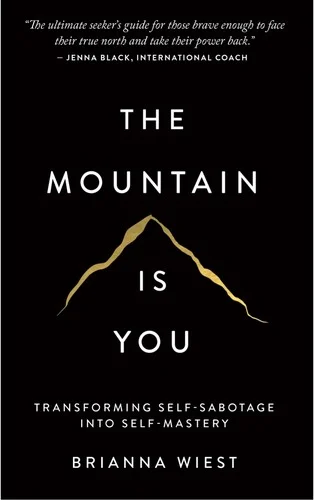
The Mountain Is You is a self-help book that explores the psychology of self-sabotage. Brianna Wiest explains that the habits and fears blocking your progress are not random character flaws but protective mechanisms your mind created in response to past experiences. The book provides a framework for identifying these patterns, understanding their emotional roots, and systematically replacing them with behaviours aligned to the person you want to become.
About the author
Brianna Wiest is an American writer and poet who built her audience through deeply personal essays on emotional intelligence and self-awareness. Her work on Thought Catalog reached hundreds of millions of readers before she published her first book. Wiest draws on her own experience of overcoming anxiety and emotional avoidance, blending personal narrative with practical psychology. She has written several books including 101 Essays That Will Change the Way You Think and When You’re Ready, This Is How You Heal, but The Mountain Is You became her breakout bestseller, spending over two years on bestseller lists and resonating particularly with readers in their twenties and thirties navigating identity transitions. Explore all Brianna Wiest book summaries →
Key concepts at a glance
| Concept | What it means | Use it when |
|---|---|---|
| Self-sabotage as self-protection | Destructive habits once served a survival purpose | You keep repeating a pattern despite knowing better |
| The comfort zone ceiling | You unconsciously pull back when success exceeds your identity | You achieve a goal then mysteriously lose motivation |
| Emotional intelligence over IQ | Recognising and processing feelings rather than reacting | Strong emotions drive impulsive decisions |
| Future-self visualisation | Making choices as the person you are becoming | You are unsure which direction to take |
| Releasing and grieving | Letting go of old identities requires mourning them | Change feels like loss even when it is positive |
| Micro-shifts | Tiny daily actions that compound into a new identity | Grand plans keep failing |
| Triggers as teachers | Emotional reactions point to unresolved inner work | You overreact to something objectively small |
| Purpose as practice | Meaning is built through consistent effort, not discovered | You feel lost waiting for your “calling” |
Part 1: Understanding self-sabotage
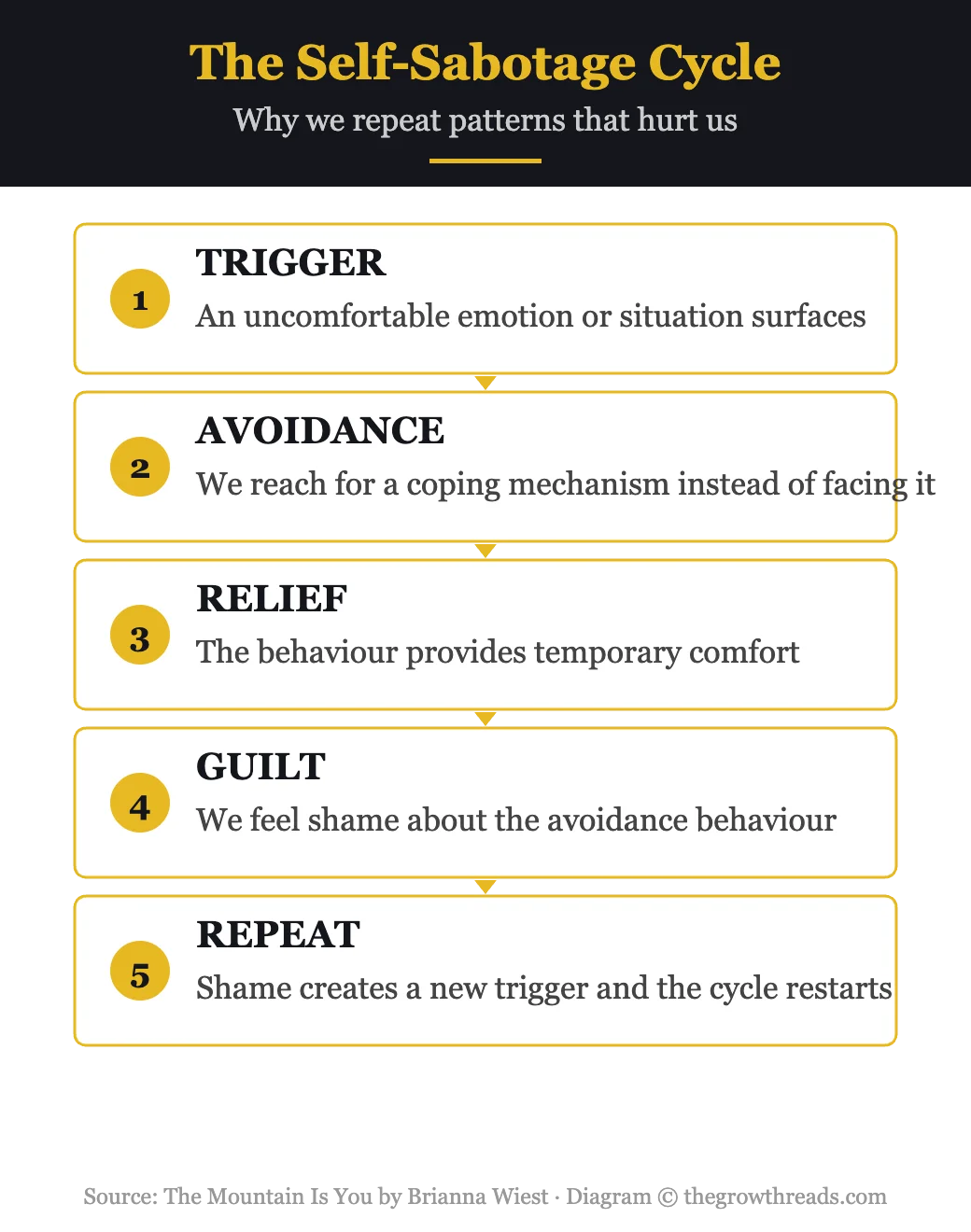
Wiest opens with a reframe that changes the entire trajectory of the book: self-sabotage is not evidence that something is wrong with you. It is evidence that something once went wrong for you, and your mind built a defence system around it. A child who learned that expressing needs led to punishment may grow into an adult who chronically people-pleases. A teenager who was mocked for ambition may become an adult who procrastinates on meaningful goals. The sabotage is the scar tissue of old emotional injuries.
The key mechanism Wiest identifies is the gap between your conscious goals and your subconscious identity. You may want a promotion, but if your deepest self-concept says “people like me do not succeed,” your behaviour will quietly work to close that gap — not by raising your identity, but by lowering your outcomes. This is why people who win the lottery often return to their previous financial state, and why individuals who escape toxic relationships frequently enter new ones with similar dynamics.
Wiest distinguishes between productive discomfort (the kind that accompanies genuine growth) and unproductive suffering (the kind that keeps you spinning in place). Growth feels like controlled burning — intentional, directional, and purposeful. Self-sabotage feels like a wildfire — chaotic, repetitive, and exhausting.
Part 2: Identifying your patterns
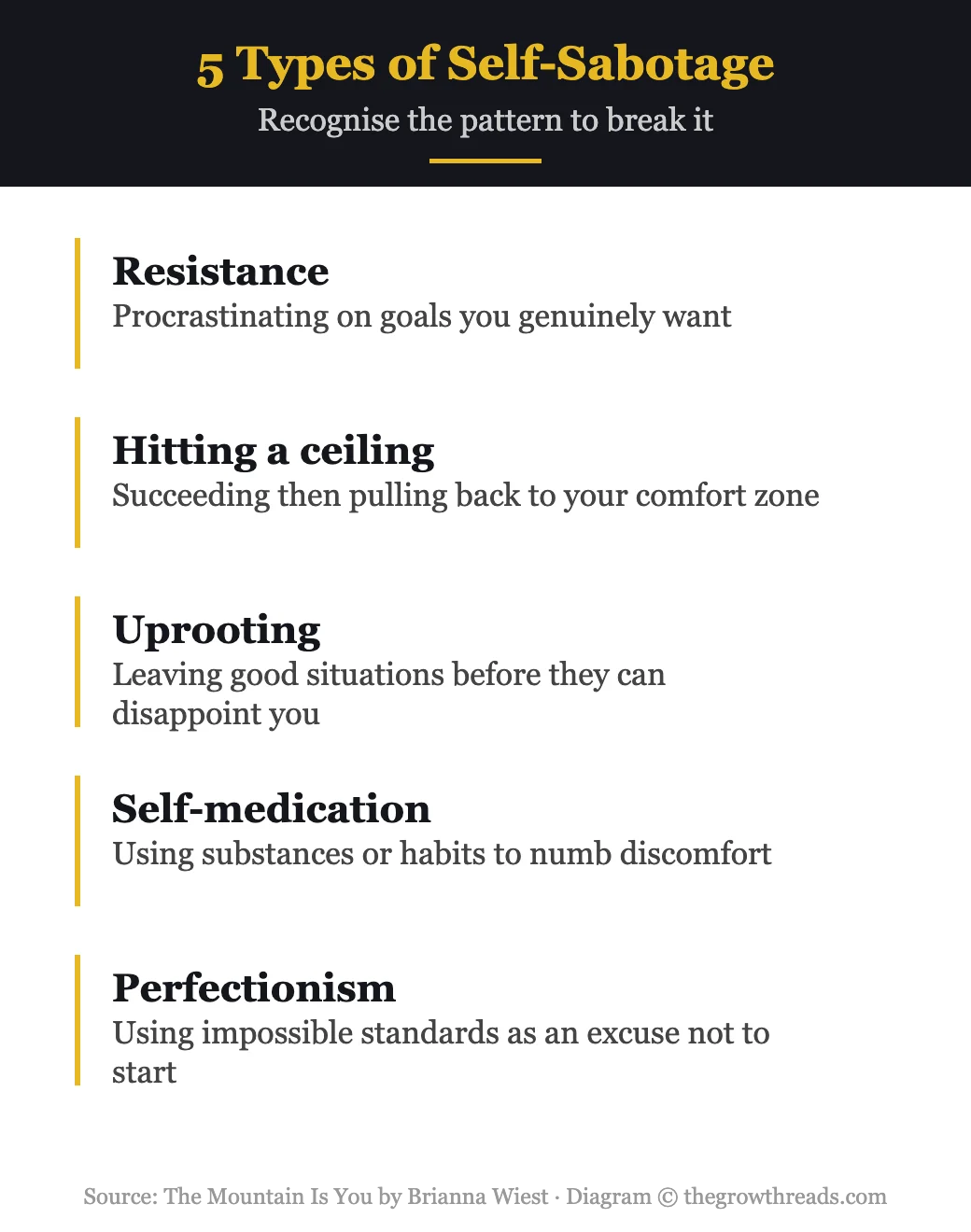
The second part of the book is diagnostic. Wiest catalogues the most common forms of self-sabotage and walks the reader through identifying which ones apply to their life. She identifies several core patterns: resistance (procrastinating on goals you genuinely want), hitting a ceiling (succeeding then unconsciously pulling back), uprooting (leaving good situations before they can disappoint you), self-medication (using substances or habits to numb discomfort), and perfectionism (using impossible standards as a reason not to begin).
What makes this section powerful is Wiest’s insistence that each pattern has an emotional logic. Perfectionism, for example, is not about high standards — it is about control. If you never finish anything, nothing can be judged. If nothing is judged, you cannot be rejected. The perfectionist’s real fear is not imperfection; it is vulnerability.
Wiest introduces the idea that your triggers are your curriculum. Whatever provokes the strongest emotional reaction in you — the colleague’s success that makes you bitter, the friend’s boundary that makes you angry — is pointing directly at the work you have not done. This is uncomfortable but practical: instead of avoiding triggers, you can use them as a diagnostic tool to identify exactly where your growth edge is.
Part 3: Releasing and letting go
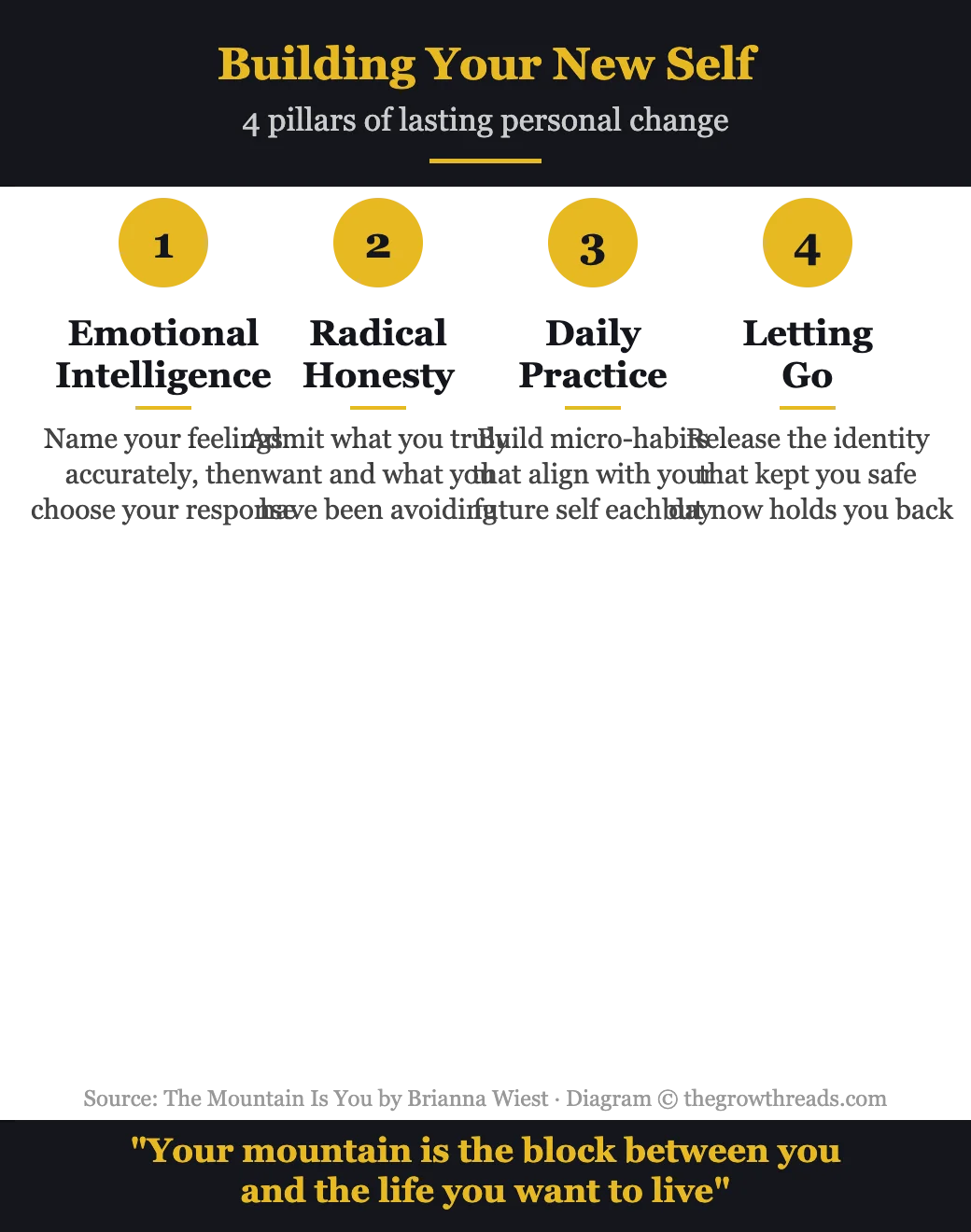
Wiest argues that the hardest part of personal growth is not building new habits — it is releasing old identities. Most self-help books focus on addition: add this morning routine, add this mindset, add this practice. Wiest focuses on subtraction: what must you let go of before the new version of yourself has room to exist?
Letting go, she writes, is a form of grieving. When you outgrow a friendship, a career path, or a version of yourself, there is genuine loss involved — even when the change is positive. The person who decides to stop drinking must grieve the social identity that came with it. The person who leaves a comfortable but unfulfilling job must grieve the security it provided. Skipping this grief does not speed up the process; it creates unresolved emotional debt that surfaces later as anxiety, nostalgia, or second-guessing.
The practical technique Wiest offers is what she calls “emotional processing” — sitting with a feeling without trying to fix it, explain it, or make it go away. She suggests a practice of asking yourself what you are feeling, where you feel it in your body, and what it needs from you — then simply allowing the answer to exist without acting on it. Over time, this builds the capacity to tolerate discomfort without reaching for old coping mechanisms.
Part 4: Building your future self
The final section shifts from diagnosis and release to construction. Wiest introduces the concept of the “future self” — not as a vague aspiration but as a concrete decision-making filter. She asks the reader to define in detail who they are becoming: what does that person’s morning look like? How do they respond to conflict? What do they prioritise when they are tired? Every daily choice becomes a vote for or against that future identity.
This is where Wiest’s framework becomes distinctly practical. She advocates for what she calls “micro-shifts” — small, almost trivially easy changes that compound over time. Instead of overhauling your entire life on a Monday morning, you make one choice differently today. You respond to one email with honesty instead of people-pleasing. You sit with one moment of boredom instead of reaching for your phone. You do one rep of the behaviour your future self would do.
Wiest also addresses the role of environment and relationships. She argues that you cannot build a new self in an environment designed for the old one. This does not always mean dramatic changes — sometimes it means rearranging a room, adjusting a daily route, or having one honest conversation. The point is that your surroundings should support the identity you are growing into, not constantly remind you of the one you are leaving behind.
Who is The Mountain Is You best for — and who should read something else first?
This book is ideal for readers who sense that their biggest obstacle is internal — people who have the talent, resources, and opportunities but consistently get in their own way. It is particularly powerful for anyone in their twenties or thirties navigating identity transitions: career changes, relationship shifts, or the gap between who they thought they would be and who they actually are.
If you are looking for a more structured, habit-focused approach to change, start with Atomic Habits first. If you want a deeper dive into the neuroscience of emotional patterns, Thinking, Fast and Slow provides more scientific rigour. If spiritual self-inquiry appeals to you more than psychological frameworks, The Power of Now may resonate more deeply.
Questions to reflect on
- What is one area of your life where you consistently get in your own way — and what might that pattern be protecting you from?
- If your future self could send you one piece of advice about the decision you are avoiding right now, what would it be?
- Which emotional triggers keep recurring in your life, and what unfinished inner work might they be pointing to?
- What identity or version of yourself do you need to grieve before you can move forward?
- What is the smallest action you could take today that your future self would thank you for?
🔥 Ready to stop being your own obstacle?
Discover why your self-sabotage patterns exist and how to finally move past them.
How to apply The Mountain Is You (7-day plan)
- Day 1 — Name your mountain: Write down the one area of your life where you most consistently self-sabotage. Describe the pattern without judgement — just observe it as data.
- Day 2 — Trace the origin: Ask yourself when this pattern first appeared. What was it protecting you from at that time? Write a short letter to your younger self acknowledging why the pattern made sense then.
- Day 3 — Map your triggers: Throughout the day, note every moment you feel a disproportionate emotional reaction. Write down the trigger, the feeling, and the unmet need beneath it.
- Day 4 — Meet your future self: Spend 15 minutes writing a detailed description of the person you are becoming. What do they do first thing in the morning? How do they handle conflict? What do they prioritise?
- Day 5 — One micro-shift: Choose one small action your future self would take and do it today. It should be easy enough that resistance feels manageable — respond to one message honestly, take one walk, write one paragraph.
- Day 6 — Practise emotional processing: When a difficult feeling arises, sit with it for five minutes without acting on it. Ask: what am I feeling? Where do I feel it? What does it need? Then let the answer exist without fixing it.
- Day 7 — Adjust your environment: Make one change to your physical space or daily routine that supports your future self — move your phone charger out of the bedroom, rearrange your desk, set one new boundary in a conversation.
Frequently asked questions
What is the main message of The Mountain Is You?
The core message is that self-sabotage is not a character flaw but a form of self-protection that has outlived its usefulness. The “mountain” in the title represents the internal obstacles — fear, old identities, unprocessed emotions — standing between you and the life you want. Wiest argues that climbing this mountain requires emotional honesty, releasing outdated survival strategies, and consistently making choices aligned with the person you are becoming rather than the person you have been.
Is The Mountain Is You based on scientific research?
The book draws on psychological concepts like cognitive behavioural patterns, emotional intelligence, and identity theory, but it is not an academic text. Wiest writes from personal experience and practical observation rather than citing peer-reviewed studies. The core ideas align with established psychology — particularly the work of Carl Jung on the shadow self and BJ Fogg on tiny habits — but readers who want rigorous evidence should treat this as a reflective companion piece rather than a clinical resource.
How long does it take to read The Mountain Is You?
The book is 248 pages and takes approximately four hours to read at an average pace. However, many readers find it more effective to read one chapter at a time and spend a few days reflecting on each section before moving on. The concepts are emotionally demanding — you are essentially diagnosing your own protective patterns — so giving yourself space between chapters allows the ideas to settle and the self-awareness to develop naturally.
What are the 5 types of self-sabotage in The Mountain Is You?
Wiest identifies five primary patterns: resistance (procrastinating on goals you genuinely want), hitting a ceiling (succeeding then unconsciously reverting to your comfort zone), uprooting (abandoning good situations before they can disappoint you), self-medication (numbing discomfort with substances or compulsive habits), and perfectionism (setting impossible standards as a reason not to begin). Each pattern has a protective logic — understanding what it once protected you from is the first step toward replacing it.
How is The Mountain Is You different from other self-help books?
Most self-help books focus on adding new behaviours — morning routines, productivity systems, affirmations. Wiest focuses on subtraction: understanding and releasing the old patterns that block growth. Her approach is more emotionally oriented than tactical. Rather than giving you a checklist, she helps you understand why you have been unable to follow the checklists you already know about. This makes the book a strong complement to more action-oriented titles like Atomic Habits or The 7 Habits of Highly Effective People.
Can The Mountain Is You help with anxiety?
While the book is not a substitute for professional mental health treatment, many readers report that its framework for understanding emotional patterns reduces the confusion and shame that often accompany anxiety. Wiest’s approach of treating anxiety as information — a signal that something in your life is misaligned rather than evidence that you are broken — can be profoundly reframing. The emotional processing techniques she describes complement therapeutic approaches like CBT and mindfulness-based interventions.
What should I read after The Mountain Is You?
If you want to build on the self-awareness with a practical habit system, read Atomic Habits by James Clear. For a deeper exploration of emotional patterns and the subconscious mind, try Thinking, Fast and Slow by Daniel Kahneman. If the spiritual dimension of self-discovery resonated, The Untethered Soul by Michael Singer goes further into the practice of observing your thoughts without attachment. For resilience and mental toughness, Can’t Hurt Me by David Goggins offers a complementary action-oriented approach.
Related summaries
- Atomic Habits Summary & Review — Build identity-based habits that compound into lasting change.
- The Untethered Soul Summary & Review — Learn to observe your thoughts and emotions without attachment.
- Mindset Summary & Review — Understand how your beliefs about ability shape your willingness to grow.
- Best Psychology Books — Our full ranked guide to the most impactful books on understanding yourself and others.
Related Psychology Summaries
Originals Summary & Review: How Non-Conformists Move the World
Self-Compassion Summary and Review
Stumbling on Happiness Summary & Review: Why Your Brain Lies About the Future
The Paradox of Choice Summary & Review: Why Less Is More for Happiness
The Tipping Point Summary & Review: How Little Things Make a Big Difference